
人教版英语八年级上册第10单元sectionB知识点+写作
人教版英语八年级上册第10单元

Common Progress Please Criticize
金戈铁骑制作
上学期第10单元同步验收练习题听力部分(共20分)
I. 听单词,判断每组单词是否含有相同的元音音素。相同的写"S", 不同的写"D"。(5分)
1. ________ 2. ________ 3. ________
4. ________ 5. ________
II. 听句子, 补全句中所缺的单词。(5分)
1. You find your bike ________.
2. Wang Lei is very ________. He is going to buy a car for his son.
3. We must ________our classroom clean.
4. Does she want to be a ________?
5. Mrs Li hasn't come here ________.
III. 听对话,选出与其内容相符的图画。(5分)
1. ________ 2. ________ 3. ________
4. ________ 5. ________
IV. 听短文, 根据其内容判断下列句子正(T)、误 (F)。 (5分)
1. Betty is Helen's sister.
2. Betty and Helen don't want to buy anything.
3. Betty wants to buy some things for school.
4. The shops aren't open when they get there.
5. Betty and Helen can't buy anything because the shops are closed.
笔试部分(共80分)
I. 语音与词汇。(20分)
人教版八年级上册英语教案 Unit 10 If you go to the party
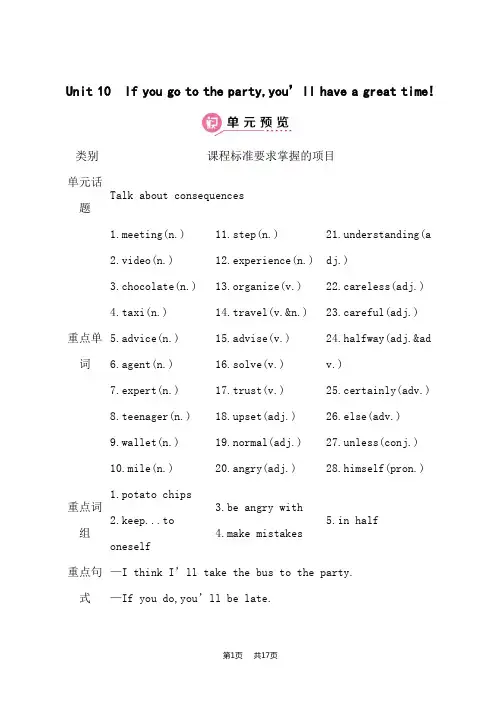
第1页 共17页 Unit 10 If you go to the party,you’ll have a great time!
类别 课程标准要求掌握的项目
单元话题 Talk about consequences
重点单词 1.meeting(n.)
2.video(n.)
3.chocolate(n.)
4.taxi(n.)
5.advice(n.)
6.agent(n.)
7.expert(n.)
8.teenager(n.)
9.wallet(n.)
e(n.) 11.step(n.)
12.experience(n.)
anize(v.)
14.travel(v.&n.)
15.advise(v.)
16.solve(v.)
17.trust(v.)
18.upset(adj.)
19.normal(adj.)
20.angry(adj.) 21.understanding(adj.)
22.careless(adj.)
23.careful(adj.)
24.halfway(adj.&adv.)
25.certainly(adv.)
26.else(adv.)
27.unless(conj.)
28.himself(pron.)
重点词组 1.potato chips
2.keep...to
oneself 3.be angry with
4.make mistakes 5.in half
重点句式 —I think I’ll take the bus to the party.
—If you do,you’ll be late. 第2页 共17页 —What will happen if they have the party today?
—If they have it today,half the class won’t come.
—Should we ask people to bring food?
人教版英语八年级上册第一单元至第十单元知识点、重点笔记

Unit 1 where did you go on vacation
Important phrases: (重点短语)1.去夏令营2.买一些特别的东西3.为考试准备4.跟某人外出5.去纽约市6.好久不见7.度假8.去某个有趣的地方9.大多数时间10.给母鸡喂食11.除—一无所有12.当然,自然13.似乎有点无聊14记日记15.令人愉快地活动16.到达17.决定去海边18.尝试滑翔伞运动19.感觉像一只小鸟20.想要骑车21.中国商人的房子22.在过去23许多古老的建筑24步行到山顶25.开始下雨26.等了一个多小时的火车27.下大雨28.忘记带一把雨伞29.又湿又冷30.因为恶劣的天气31.带着足够的钱32.足够大33.好像有点饿34.与—一样好35 不如----好36.照了相当多的相片37.停下来喝水38.继续前进39.激动地跳跃40.二十分钟后41.如此---以至于42.升起43.发现-- 44.尝起来很好吃45.尽力去做某事46.停止做某事47.不喜欢做某事48.继续做某事49.一碗米饭50为某人买某物
重点句子where did you go on vacation? go on vacation 去度假2.Visited my uncle 重点:visit为及物动词,“拜访,探望,参观,游览”后接人或地点改错Did you visit in china? 3. Did you buy anything special? 1)buy 的过去式为bought buy sth.for sb.=buy sb sth. 我为Tom买了一个礼物
2)anything 不定代词“某物,某事”主要用于疑问句和否定句中一旦anything用于可定句中,则意为“任何事,任何东西”Eg You can ask me anything you want to know 3)★形容词修饰不定代词要后置4.Oh,did you go anything interesting?这是一般过去时中不含was/were的句子在变一般疑问句时,需用助动词did。Anywhere 用作副词,“任何地方”
人教版八年级英语上册第11单元知识点
人教版八年级英语上册第11单元知识点
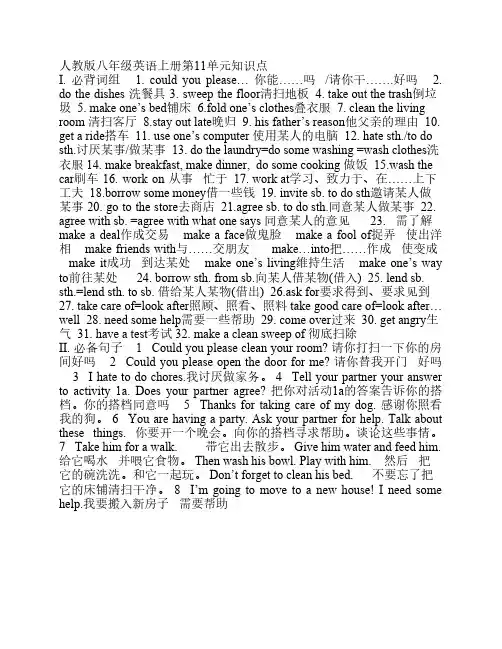
I. 必背词组 1. could you please… 你能……吗/请你干…….好吗 2.
do the dishes 洗餐具 3. sweep the floor清扫地板 4. take out the trash倒垃
圾 5. make one’s bed铺床 6.fold one’s clothes叠衣服 7. clean the living
room 清扫客厅 8.stay out late晚归 9. his father’s reason他父亲的理由 10.
get a ride搭车 11. use one’s computer 使用某人的电脑 12. hate sth./to do
sth.讨厌某事/做某事 13. do the laundry=do some washing =wash clothes洗
衣服 14. make breakfast, make dinner, do some cooking 做饭 15.wash the
car刷车 16. work on 从事忙于 17. work at学习、致力于、在……上下
工夫 18.borrow some money借一些钱 19. invite sb. to do sth邀请某人做
某事 20. go to the store去商店 21.agree sb. to do sth.同意某人做某事 22.
agree with sb. =agree with what one says 同意某人的意见 23.需了解
make a deal作成交易 make a face做鬼脸 make a fool of捉弄使出洋
相 make friends with与……交朋友 make…into把……作成使变成
make it成功到达某处 make one’s living维持生活 make one’s way
to前往某处 24. borrow sth. from sb.向某人借某物(借入) 25. lend sb.
Unit1 sectionB 知识点讲解 人教版英语八年级上册
八年级上册
unit1
Section B
1. I arrived in Penang in Malaysia this morning with my family. 今天早上,我和我的家人到达了马来西亚的槟城。
➢ arrive到达;抵达
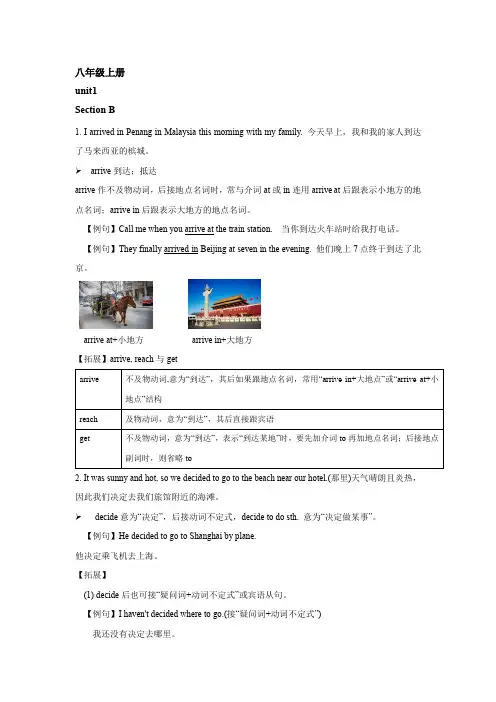
arrive作不及物动词,后接地点名词时,常与介词at或in连用arrive at后跟表示小地方的地点名词;arrive in后跟表示大地方的地点名词。
【例句】Call me when you arrive at the train station. 当你到达火车站时给我打电话。
【例句】They finally arrived in Beijing at seven in the evening. 他们晚上7点终于到达了北京。
arrive at+小地方 arrive in+大地方
【拓展】arrive, reach与get
arrive 不及物动词,意为“到达”,其后如果跟地点名词,常用“arrive in+大地点”或“arrive at+小地点”结构
reach 及物动词,意为“到达”,其后直接跟宾语
get 不及物动词,意为“到达”,表示“到达某地”时,要先加介词to再加地点名词;后接地点副词时,则省略to
2. It was sunny and hot, so we decided to go to the beach near our hotel.(那里)天气晴朗且炎热,因此我们决定去我们旅馆附近的海滩。
➢ decide意为“决定”,后接动词不定式,decide to do sth. 意为“决定做某事”。
【例句】He decided to go to Shanghai by plane.
他决定乘飞机去上海。
【拓展】
(1) decide后也可接“疑问词+动词不定式”或宾语从句。
【例句】I haven't decided where to go.(接“疑问词+动词不定式”)
八年级上册英语第十单元教案(人教版) (1)
八年级上册英语第十单元教案
年级 八年级 学科 英语 主备教师 复备教师
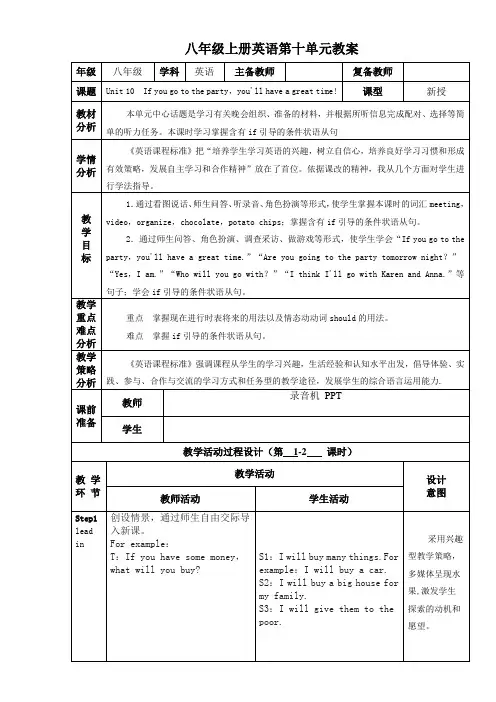
课题 Unit 10 If you go to the party,you'll have a great time! 课型 新授
教材分析 本单元中心话题是学习有关晚会组织、准备的材料,并根据所听信息完成配对、选择等简单的听力任务。本课时学习掌握含有if引导的条件状语从句
学情分析 《英语课程标准》把“培养学生学习英语的兴趣,树立自信心,培养良好学习习惯和形成有效策略,发展自主学习和合作精神”放在了首位。依据课改的精神,我从几个方面对学生进行学法指导。
教
学
目
标
1.通过看图说话、师生问答、听录音、角色扮演等形式,使学生掌握本课时的词汇meeting,video,organize,chocolate,potato chips;掌握含有if引导的条件状语从句。
2.通过师生问答、角色扮演、调查采访、做游戏等形式,使学生学会“If you go to the
party,you'll have a great time.”“Are you going to the party tomorrow night?”“Yes,I am.”“Who will you go with?”“I think I'll go with Karen and Anna.”等句子;学会if引导的条件状语从句。
教学重点难点分析 重点 掌握现在进行时表将来的用法以及情态动动词should的用法。
难点 掌握if引导的条件状语从句。
教学策略分析 《英语课程标准》强调课程从学生的学习兴趣,生活经验和认知水平出发,倡导体验、实践、参与、合作与交流的学习方式和任务型的教学途径,发展学生的综合语言运用能力.
课前准备 教师 录音机 PPT
学生
教学活动过程设计(第 1-2 课时)
教 学
环 节 教学活动 设计
意图 教师活动 学生活动
人教版英语八年级上册基础测试题:第10单元
八年级上第十单元基础测试题
一. 单项选择
( )1. She’s still worried ________ her son though he’s a big boy.
A. on B. of C. about D. with
( )2. Can you give me _____________, Mr. Li?
A. an advice B. some advice C. any advice D. two piece of
advice
( )3. Please _________ away this cup of milk . And ________ me some coffee.
A. take; bring B. bring; bring C. bring; take D. take; take
( )4. If you _________ have ID card, they _________ let you in.
A. do; won’t B. will; will C. don’t; won’t D. do; will
( )5. , Julia found her lost wallet at the street corner.
A. By the end B. At the end C. To the end D. In the
end
( )6. I don’t know if she ___________. If she __________, let me know.
A. comes; comes B. will come; comes C. comes; will come
人教版英语八年级上册unit10_sectionb_2b_课文知识训练
敬请批评指正
金戈铁骑制作 Unit10 SectionB 2b 课文知识训练
1. You can’t pass the exam ______ you study hard.
A. if B. when C. unless D. because
2. After trying many times, we were successful ______.
A. at the end B. to the end
C. in the end D. end of
3.—Who ______ went to the park?
—Tom and Linda.
A. else B. other C. another D. the other
4. Teenagers should learn to protect _______ from all kinds of danger.
A. them B. they C. their D. themselves
5. The doctor advised my father ______ smoking.
A. stop B. to stop C. stopping D. stops
6. I have some problems with my English writing. Can you give me some ______?
A. advice B. decisions C. information D. messages
7. Doing morning exercise__________ good for our health.
A. is B. was C. are D. were
8. —Mrs. Wang was sent to teach English in a poor mountain village last year.
人教版英语八年级上册第一单元至第十单元知识点、重点笔记教学文案
⼈教版英语⼋年级上册第⼀单元⾄第⼗单元知识点、重点
笔记教学⽂案
Unit 1 where did you go on vacation
Important phrases: (重点短语)
1.去夏令营
2.买⼀些特别的东西
3.为考试准备
4.跟某⼈外出
5.去纽约市
6.好久不见
7.度假8.去某个有趣的地⽅9.⼤多数时间
10.给母鸡喂⾷11.除—⼀⽆所有12.当然,⾃然13.似乎有点⽆聊14记⽇记15.令⼈愉快地活动16.到达17.决定去海边18.尝试滑翔伞运动19.感觉像⼀只⼩鸟20.想要骑车21.中国商⼈的房⼦22.在过去23许多古⽼的建筑24步⾏到⼭顶25.开始下⾬26.等了⼀个多⼩时的⽕车27.下⼤⾬
28.忘记带⼀把⾬伞29.⼜湿⼜冷30.因为恶劣的天⽓31.带着⾜够的钱32.⾜够⼤33.好像有点饿
34.与—⼀样好35 不如----好36.照了相当多的相⽚37.停下来喝⽔38.继续前进39.激动地跳跃
40.⼆⼗分钟后41.如此---以⾄于42.升起
43.发现-- 44.尝起来很好吃45.尽⼒去做某事46.停⽌做某事47.不喜欢做某事48.继续做某事49.⼀碗⽶饭50为某⼈买某物
重点句⼦where did you go on vacation?
go on vacation 去度假
2.Visited my uncle
重点:visit为及物动词,“拜访,探望,参观,游览”后接⼈或地点
改错Did you visit in china?
3. Did you buy anything special?
1)buy 的过去式为bought
buy sth.for sb.=buy sb sth.
我为Tom买了⼀个礼物2)anything 不定代词“某物,某事”主要⽤于疑问句和否定句中
⼀旦anything⽤于可定句中,则意为“任何事,任何东西”Eg You can ask me anything you want to know
Unit10.2第十单元专题10.2SectionB-八年级英语人教版(下册)
Unit10.2第十单元专题10.2SectionB-八年级英语人教版(下册)
Unit 10 I’ve had this bike for three years.
课时2
Section B 1a-3b
1. It’s been around for at least 20 years. 它在这附近至少20年了。
around 此处用作副词,意为“在附近;在周围”。
Is there anyone around? 这附近有人吗?
I’ll wait around for a while. 我会在这附近等一会儿。
【知识拓展】
2.Nowadays,millions of Chinese leave the countryside to
search for work in the cities. 如今数以百万计的中国人离开农村到城市去寻找工作。
(1)nowadays副词,意为“现今,现在;目前”,通常用于一般现在时态的句子中,且多用于句首或句末作状语。
Nowadays, children have more pocket money.
如今,孩子们有更多的零花钱。
It’s very difficult for many people to buy a house nowadays.
现今对许多人来说买房子很难。
(2)search作动词,意为“搜索,搜查”。search for意为“寻找,搜寻,探索”。后面的宾语是寻找的目标。
They are searching for a better way to solve the problem.他们正在找一个好方法解决这个问题。
【易混辨析】
①around用作副词,意为“大约”。
I usually go to bed at around ten o’ clock. 我通常在大约10点钟上床睡觉。
②around用作介词,意为“在……周围”。