
初中英语_九年级Unit6 When was it invented SectionA(3a教学设计学情分析教材分析课后反思
Teaching PlanSchool:Teacher: Textbook: Go for it! (Grade 9)Unit 6 When was it invented?Content: Section A (3a—3c)Teaching tasks:A: New words and phrases: by accident, take place, remain, boil,produce, nationalB: Grammar focus: The passive voice.C: Be able to narrate the passive voice.Teaching tools: MultimediaTeaching procedures:Step One: Free talkTalk about some inventions(what / who / when / what ed for../.. )Step Two: Warm upAccording to a picture, tell students what we will learn today.Step Three: Fast readingMatch each paragraph with its main idea.Step Four: Careful readingRead the article and finish three tasks.Task 1: Read part one and answer the questions.Task 2: Read part 2 carefully and finish the mind map. Task 3: Read part 3 and fill the chart.Step Five: Questions timeHelp students to solve the questions that they can’t understand.Step Six: Translate three sentencesStep Seven: ListeningTask 1: Read after the tape.Task 2: PK Time.Step Seven: RetellingRetell the textStep Eight: Know more about tea cultureStep Nine: Homework①Find out another invention --- coffee(who/ when/ how / where / what .used for …)②Recite the important points of this lesson .学情分析在前面的Unit 5学生已经学习了一般现在时的被动语态,学生对被动语态的概念、结构、运用已经有所掌握,但学生往往很难真正把握什么时候用被动语态,什么时候不用被动语态.此外,不规则动词过去分词的变化也往往是学生的学习难点。
这些需要教师指导学生多加练习,以达到熟能生巧的水平。
初三学生的抽象能力较低,形象思维能力强。
但注意力容易分散。
本单元通过多媒体课件和教师亲和力的语言,通过以阅读的形式讲解茶的发明和起源,学生的兴趣和注意力在不知不觉中得以集中。
初三的学生有一定的英语基础,大部分有较为明确的学习目标和认真的学习态度。
我所带的班级有一部分学生能听懂老师的话题,并参与讨论,与他人进行相关的信息交换,并表达自己的意见。
本单元是要了解有关发明的知识,而这些发明大部分都是学生生活中常见的,因此这会降低课堂学习的难度,激发学生的学习兴趣。
本课时也是通过茶的发明为载体,茶正好贴近学生的日常生活,更能调动起学生学习的积极性。
效果分析在本节课的任务型阅读教学中,我依据课程的总体目标并结合教学内容,创造性地设计贴近学生生活实际的任务活动,吸引和组织他们积极参与,使学生通过观察、思考、讨论、交流和合作等方式,步步深入了解了茶的起源和传播,在一种自然、真实或模拟真实的情境中体会语言、掌握语言的应用。
并能够掌握被动语态,并运用到一定的语言环境。
通过多媒体和任务的完成学生会突破难点,产生一定创造精神. 能完成教学目标,调动学生学习热情。
并通过连贯的听说读等方法,培养学生的交际能力,发展他们的思维能力。
并把“培养学生学习英语的兴趣,培养良好学习习惯和形成有效策略,发展自主学习和合作精神”放在了首位。
整堂课以老师提问题为主,学生回答为线条,加强和训练了学生的英语表达能力,在整节课中,学习能力好的同学不看书也能回答问题,他们的短期记忆力得到了训练和提高。
学习能力稍微弱的学生,也能用简短的句子表达出对文章的理解。
从学生的反馈来看,整堂课达到了预想的效果.教材分析本课是九年级《go for it》第六单元“When was it invented?”,本单元涉及内容是本书当中比较重要的一部分。
本单元主要讲解被动,被动语态结构及运用是教学中一个难点和重点,也是学生比较不容易理解的部分,因为它是建立在各种时态之上的。
另外通过对我们熟悉经常使用的发明物茶的历史来开阔眼界,丰富学生的阅历,使学生养成勤于思考,善于总结的好习惯。
本单元的中心话题是通过谈论常见物品的发明史,来学习被动语态的基本构成和用法。
语言技能和语言知识基本上都是围绕这个中心话题展开的: Section A 的活动设计侧重本单元的基本目标语言的学习;3a-3c是阅读板块的活动。
阅读语篇讲述了我国有记载的饮茶起源的故事:它是如何被神农无意中发明的;茶叶的发展和传播历史。
3a训练学生的快速阅读技巧,需要学生在快速阅读之后为各段匹配段落大意。
3b需要学生细读文章回答与茶叶有关的细节问题。
3c则是一个读后综合了词汇和语言结构的巩固性活动。
因此本课主要要求学生运用被动语态的过去时描述茶的发展史;运用一定的阅读策略阅读此篇文章,让学生了解中国茶文化源远流长,博大精深。
在读、说、听的基础上,以提高写的能力,从而全面提高学生的综合语言运用能力。
Unit6 When was it invented ?评测练习本节课主要借助于课本上的相关练习,有如下练习:一: Before reading1.talk about some inventions that you know( what/ who / when /Where/what …used for/.. )二:While reading1.Read the passage quickly and match each paragraph with itsmain idea.Para. 1 Lu Yu and his book Cha Jing Para. 2 How tea spread to other countriesPara. 3 How tea was invented by accident 2.Read Part 1 carefully and answer question1).What kind of drink is mentioned in Part 1?_____________________________2).When was tea first drunk? ____________________________3). How was tea invented?___________________________4). Who was tea invented by ?____________________________5). Why did Shen Nong taste the brown water?____________________________3.Read part 2 carefully and finish the mind map.4.Read part 3 carefully and fill the chart5. Translate these sentences into Chinese①The book describes how tea plants were grown and used to make tea.②It is believed that tea was brought to Korea and Japan during the 6th and 7th centuries.③It also discusses where the finest tea leaves were produced and what kinds of water were used .6. Retell the article:A few thousand years later, Lu Yu, “the saint of tea”,______Shen Nong in his book Cha Jing. The book ________how tea plants ____ ____and used to make tea. It also _______where the finest tea leaves_____ ____ and what kinds of water were used.it ____ ____ ___tea was brought to Korea and Japan during the 6th and 7the centuries. In England tea ____appear____ around 1660, but in ____ ___100 years, it had become the national drink .The tea trades from China to Western Countries _____ ______in the 19th century. This helped to______ the popularity of tea and the tea plant ___more places around the world. _____ _____many people now know about tea culture, the Chinese are _____ _____the ones who best understand the nature of tea .三: After reading:1.( writing)Find out drink in different countries and introduce this drink to your friends .(who/ when/ how / where / what ed for /…)__________________________________________________________ __________________________________________________________ __________________________________________________________ ____________________________________________________________________________________________________________________ __________________________________________________________ __________________________________________________________ _____________________2.Finish 3C on the book :课后反思本节课采取英语阅读教学中所提倡究的PWP模式: 教学设计以茶文化为主线,首先,Pre-reading部分,通过提问,以有关茶文化的句子导入,进行情景刺激,让学生在感受茶文化,从而为接下来的阅读设下铺垫。
初中英语_Unit6 When was it invented SectionA 阅读课教学设计学情分析教材分析课后反思

教学设计一、教学目标:1. 语言知识目标:1) 学习掌握下列词汇:by accident, ruler, boil, remain, smell, saint, national ,take place, doubt, without doubt2)阅读短文,能按要求找到相应的信息。
3)通过阅读提高学生们的阅读能力。
4) 了解茶叶被发明的历史及生产制作的简要过程。
2. 情感态度价值观目标:培养想象力,善于观察事物。
面对难题,用积极的态度去解决,发挥想象力,认识世界,改造世界。
二、教学重难点1. 教学重点:1) 掌握本部分出现的生词和词组,达到熟练运用的目标。
2) 阅读短文,获得相关的信息。
通过阅读练习,来提高阅读能力。
2. 教学难点:1) 阅读短文,获得相关的信息的能力。
2) 理解并运用所学的词汇及表达方式。
三、教学过程Step1. Lead-inEnjoy a video and answer two questions.(播放视频《茶叶的起源》,让学生们了解中国的茶文化,及茶叶被发明的渊源,并了解其发展过程。
)1. What is the video about?2. Who is the writer of Cha Jing?Ss try to answer the questions: 1.It’s about the tea. 2. Lu Yu.Step2:Fast- Reading1.Tell Ss to read the article quickly and match each paragraph with its main idea.Para. 1 Lu Yu and his book Cha Jing.Para.2 How tea spread to other countries. Para. 3 How tea was invented by accident.Ss read the article quickly and match each paragraph with its main idea.2. 方法指导:先阅读所给的三句话,然后快速阅读短文,抓住每一段的主题句,找到答案。
九年级英语Unit6 When was it invented知识点及练习
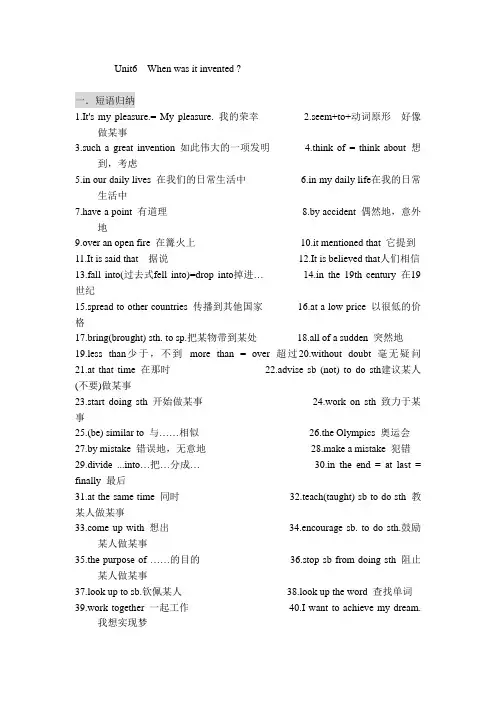
Unit6 When was it invented ?一.短语归纳1.It's my pleasure.= My pleasure. 我的荣幸2.seem+to+动词原形好像做某事3.such a great invention 如此伟大的一项发明4.think of = think about 想到,考虑5.in our daily lives 在我们的日常生活中6.in my daily life在我的日常生活中7.have a point 有道理8.by accident 偶然地,意外地9.over an open fire 在篝火上10.it mentioned that 它提到11.It is said that 据说12.It is believed that人们相信13.fall into(过去式fell into)=drop into掉进… 14.in the 19th century 在19世纪15.spread to other countries 传播到其他国家16.at a low price 以很低的价格17.bring(brought) sth. to sp.把某物带到某处18.all of a sudden 突然地19.less than少于,不到more than = over 超过20.without doubt 毫无疑问21.at that time 在那时22.advise sb (not) to do sth建议某人(不要)做某事23.start doing sth 开始做某事24.work on sth 致力于某事25.(be) similar to 与……相似26.the Olympics 奥运会27.by mistake 错误地,无意地28.make a mistake 犯错29.divide ...into…把…分成… 30.in the end = at last = finally 最后31.at the same time 同时32.teach(taught) sb to do sth 教某人做某事e up with 想出34.encourage sb. to do sth.鼓励某人做某事35.the purpose of ……的目的36.stop sb from doing sth 阻止某人做某事37.look up to sb.钦佩某人38.look up the word 查找单词39.work together 一起工作40.I want to achieve my dream.我想实现梦41.My dream will come true.我的梦想会实现42.work hard 努力工作43.on a hard floor 在坚硬的地板上44.lead to导致leader 领导,引路人45.Don't mention it.不客气,不用谢46.translate...into....把…翻译成…47.be used for doing sth=be used to do sth 48.dream of doing sth 梦想做某事二.用法集萃1. be used to do 被用来做某事be used as 被用作…be used by sb. 被某人使用2.help sb do sth.=help sb. to do sth. 帮助某人做某事3.make a decision to do sth.=decide to do sth.决定做某事4.make sb. + adj. 使某人怎么样make sb do sth使某人做某事be made to do sth 被使唤去做某5..in this way这样,用这种方式三语法全解1.some time 一段时间sometimes 有时some times几次sometime 某个时候2.one of the world's favorite drinks世界最受欢迎的饮料之一.one of …之一,后面的名词用复数(一般要加S),动词用单数(一般要加S);favorite,最喜欢的,前面要用“谁的”.3.thousand千hundred百million百万,当它们前面有数字的时候,它们本身不能加S,当它们后面有of的时候它们要加S,但前面的数字和后面的of不能同时存在4.not…until直到…才,I don…t go to sleep until 11 every day.我每天直到11点才睡觉。
九年级英语全册 Unit 6 When was it invented核心必备句型详解素材 (新版)人教新目标版
Unit6核心必备句型详解1. When was it invented? 它是何时发明的?本句用于询问某个物品的发明时间,结构为“When + was+某项物品+invented?”,其中was invented是一般过去时的被动语态,其基本结构是“was/were + 过去分词”【备课例句】This book was bought yesterday. 这本书是昨天买的。
【横向辐射】几种基本时态的被动语态1.一般现在时:am/is/are +过去分词Football is played all over the world. 足球运动遍及全世界。
2.一般过去时:was/were + 过去分词This book was bought yesterday. 这本书是昨天买的。
3.一般将来时:will be +过去分词The class meeting will be held tomorrow. 班会将在明天开。
4.现在进行时:am/is/are +being +过去分词Our teaching building is being built now. 我们的教学楼正在兴建中。
5.过去进行时:was/were + being +过去分词The bus wasn’t being repaired by me then. 那时这辆车不是由我修的。
6.现在完成时:have/has + been +过去分词The work has been finished by them. 这项工作已经被他们做完了。
【课堂变式】1.We ____not to play computer games.A. are toldB. have toldC. toldD. tell【解析】tell sb. not to do sth.意为“告诉某人不要做某事”,这里的主语we是tell 这个动作的承受者,故应用被动语态,应选A。
九年级新目标英语Unit6-When-was-it-invented-Section-A-1解读
2d Role-play the conversation.
Paul: Hey Roy, the subject for my school project is “Small inventions that changed the world.” Can you help me think of an invention?
► He takes no pleasure in his work.
► —Thanks for helping me.
—My pleasure. / It s a pleasure. 别客气。
pleasur 名词,“高兴;愉快”。常用短语 My
e
pleasure. / With pleasure. / It’s a
pleasure.
形容词,“高兴的”,短语 be
pleased
pleased to do sth.“乐于做某事”;be pleased with “对……满意”,句子的
主语通常为人
pleasan 形容词,“令人愉快的”,可作定 语
►It am pleas、ed表w语ith,t修he饰pa物inting.我对这幅画很满意。
The car was invented before the TV set.
A: I think … was invented before … B: Well, I think … was invented after ….
The telephone was invented before the TV set.
九年级新目标英语Unit6_When_was_it_invented_Section_A(3a-3c)

• Saint n.(名词) 圣徒, 圣人,圣者 ,
• Only a saint can put up with her children. 只有圣人才能容忍她的孩子们。
national形容词,意为“国家的;全国的”。 其名
词形式为nation“国家; nationality “ 国
籍”。
►The British national flag is red, white and
3b Read the passage again and answer the questions.
1.When was tea first drunk?
It was first drunk nearly 5,000 years ago.
2.How was tea invented?
While Shen Nong boiling drinking water
他几乎没说什么值得听的东西。
• ruler名词,意为“统治者;支配者” • ► A king is a ruler. 国王是统治者
boil v.
boil
[bɔɪl] ( boils; boiled; boiling ) v.沸腾;煮沸 Out in the sun all day, the blood starts to boil. 整天在太阳底下,血液都开始沸腾了。;
九年级英语全册 Unit 6 When was it invented核心常考词汇详解素材 (新版)人教新目标版

Unit6核心常考词汇详解1.invent (v.)发明;创造invent指发明创造出自然界本来不存在的东西,如工具、方法、手段、汽车、电器、合成材料等。
【备课例句】Bell invented the telephone. 贝尔发明了电话。
Smith invented a new teaching method. 史密斯发明了一种新的教学方法。
【横向辐射】discover, find, create1.discover是“发现”的意思,是指发现原来就有而一直没被发现,如发现电、煤、石油等矿藏及新星、星系或科学真理等。
Columbus discovered America in 1492.1492年哥伦布发现了新大陆。
Recently they have discovered a comet. 最近他们发现了一颗彗星。
2.find的意思是“寻找”,强调找的结果,并不指发现。
I've tried to find another copy but couldn't find one. 我试图再找一本,但没能弄到。
3.create指有目的地把原材料制成新产品,也指创造出原来不存在的或与众不同的事物。
Man creates himself. 人类创造了自己。
A novelist creates characters and a plot. 小说家塑造人物并设计情节。
【课堂变式】根据语境提示,用invent, discover,find或create的形式填空,完成句子。
1.When _____ the stream engine(蒸汽机) ___?2. I can’t ____ my bike, I’m looking for it.3. Scientists are now trying to ___ if this is possible.4. Do you know who______ the plane?5. He ____quite a number of wonderful characters in his play.【解析】I.1.was, invented 2.find 3.discover 4.invented 5. created2. be used for 用来做……此短语中的for是介词,表示用途,后接名词或动词-ing形式。
九年级英语全册Unit6Whenwasitinvented知识点归纳总结(精华版)(带答案)
九年级英语全册Unit6Whenwasitinvented知识点归纳总结(精华版)单选题1、The fish you bought yesterday smells ________. You’d better throw it away. A.goodB.badC.wellD.badly答案:B句意:你昨天买的鱼闻起来坏了,你最好把它扔掉。
good意为“好”,是形容词, bad 意为“坏的”,是形容词,well意为“好”,是副词,badly意为“坏地”,是副词。
smells意为“闻起来”,是系动词,后接形容词作表语。
根据You’d better throw it away.可知,故选B项。
2、Another bridge over the Jialing River________last year.A.buildsB.builtC.is builtD.was built答案:D句意:去年在嘉陵江上又建了一座桥。
考查动词的时态和被动语态。
builds动词第三人称单数形式,修建;built是build的过去式或过去分词形式;is built是一般现在时的被动语态;was built是一般过去时的被动语态。
根据句意可知,该句的主语Another bridge与动词构成被动关系,应用被动语态,排除A和B;再由句中的时间last year可知,应用一般过去时。
故选D。
3、Last year Huai'an Flyover(高架) _________. Now it brings much convenience to people. A.finishedB.finishesC.is finishingD.was finished答案:D句意:去年淮安高架建成。
现在它给人们带来了很多便利。
考查动词的时态。
finished完成,动词的过去式;finishes动词的一般现在时的第三人称单数;is finishing动词的现在进行时;was finished动词的一般过去时态的被动。
英语九年级Unit6Whenwasitinvented[Unit6SecA1a-2d]
Which one do you think was invented lastly?
1b Listen and match the inventions with the years.
b
c
a
1. Who are they?
d
2. What are they talking about? 3. When was... invented?
➢ To learn the new words:
heel, scoop, electricity, style, project, pleasure, zipper, daily, website, pioneer, list, mention ➢ Passive voice (past tense)
2. With pleasure.
pleasure n. 高兴;愉快 They often read books for pleasure.
固定搭配
1) my pleasure (对别人表示感谢的一种礼貌回答)不客气,很乐意效劳 。 --Thank you for your help. -- My pleasure. 2) with pleasure 高兴地;愉快地;非常乐意。
九年级英语第六单元教案Unit-6--When-was-it-invented
九年级英语第六单元教案Unit-6--When-was-it-invented Unit 6 When was it invented?Unit 6 Section A 1 (1a-2d)⼀、教学⽬标:1. 语⾔知识⽬标:1) 能掌握以下单词:heel, scoop, electricity, style, project, pleasure, zipper, daily, website,pioneer, list, mention能掌握以下句型:①—When was the telephone invented? —I think it was invented in 1876.②—What are they used for? —They are used for seeing at night.2) 能谈论物品被发明的时间、发明者,表达某发明的⽤途。
2. 情感态度价值观⽬标:了解⼀些近现代发明的时间及⽤途,激发⾃⼰热爱发明的情感。
培养想象⼒,善于观察事物。
⾯对难题,⽤积极的态度去解决,发挥想象⼒,认识世界,改造世界。
⼆、教学重难点1. 教学重点:1) 本课时的单词、词组和句型,学习运⽤⼀般过去时态的被动语态。
2) 学会询问发明时间及⽤途的基本句型:—When was the telephone invented? —I think it was invented in 1876.—What are they used for? —They are used for seeing at night.2. 教学难点:运⽤⼀般过去时态的被动语态来讨论发明的发明时间及⽤途。
三、教学过程I. Warming up1. 展⽰⼀些近代发明的图⽚与近代发明的发明者,让学⽣们将图⽚与发明者相连。
T: Do you know what these inventions are? S1: It’s a car.S2: It’s a telephone. S3: It’s a television.T: Do you know who these inventors are? S1: Karl BenzS2: Alexander Bell S3: J. L. BairdLet Ss match the inventions and the inventors.Ⅱ. Presentation引导学⽣们学习⼀般过去时态的被动语态结构。
人教版九年级英语《Unit 6 When was it invented?》说课稿
人教版九年级英语《Unit 6 When was it invented?》说课稿一. 教材分析人教版九年级英语《Unit 6 When was it invented?》是本单元的第一课时,主要讲述过去时态的疑问句以及一般过去时的被动语态。
本节课主要通过介绍一些发明的起源时间,让学生掌握过去时疑问句的构成以及一般过去时的被动语态的运用。
教材内容丰富,插图生动有趣,激发了学生学习的兴趣。
二. 学情分析九年级的学生已经掌握了基本的英语语法知识,具备一定的阅读和写作能力。
但是,对于过去时疑问句和一般过去时的被动语态的运用还存在一定的困难。
因此,在教学过程中,需要注重引导学生掌握这些语法知识,并通过大量的练习来提高他们的语言运用能力。
三. 说教学目标1.知识目标:让学生掌握过去时疑问句的构成以及一般过去时的被动语态的运用。
2.能力目标:通过听力、口语、阅读和写作的练习,提高学生运用过去时疑问句和一般过去时的被动语态进行交流的能力。
3.情感目标:激发学生学习英语的兴趣,培养他们积极向上的学习态度。
四. 说教学重难点1.教学重点:过去时疑问句的构成以及一般过去时的被动语态的运用。
2.教学难点:一般过去时的被动语态的运用。
五. 说教学方法与手段1.教学方法:采用任务型教学法,通过听力、口语、阅读和写作的练习,让学生在实际语境中掌握过去时疑问句和一般过去时的被动语态的运用。
2.教学手段:利用多媒体课件、图片、卡片等教学辅助工具,激发学生的学习兴趣,提高课堂活力。
六. 说教学过程1.导入:通过展示一些常见的发明图片,引导学生谈论这些发明的起源时间,从而引入本节课的主题。
2.新课呈现:通过多媒体课件,展示本节课的主要内容,引导学生观察并发现过去时疑问句的构成以及一般过去时的被动语态的运用。
3.语法讲解:通过示例和讲解,让学生明确过去时疑问句的构成和一般过去时的被动语态的运用规则。
4.小组讨论:学生分组进行讨论,运用过去时疑问句和一般过去时的被动语态进行交流,巩固所学知识。