
(完整版)外研版高中英语选修七Module5
单词1.minority n.少数;少数民族归纳拓展(1)be in a/the minority是少数派(尤指在投票的两部分人中);占少数a minority of少数(2)minor adj.(常作定语)较小的;次要的(3)(反)majority用作可数名词时,意思为“多数,大多数;过半数”。
常与定冠词the和介词of连用,构成词组the majority of...。
the majority of...作主语时,其后的谓语动词单复数取决于of之后的名词。
(4)the majority/minority单独作主语时,谓语动词既可用单数,也可用复数。
例句:A small minority of British households do not have a car.英国的一小部分家庭没有汽车。
People from ethnic minorities often face prejudice and discrimination.来自少数民族的人们常常面临偏见和歧视。
Boys are very much in the minority at the dance class.在舞蹈班上男孩子占极少数。
【链接训练】Most nurses are women,but in the higher ranks of the medical profession women are in a ________. A.scarcity B.minority C.minimum D.shortage【解析】句意为:大多数护士是妇女,但在高层医务工作者中,妇女只占少数。
be in a minority “是少数派,占少数”。
【答案】 B2.run v.(run—ran—run)控制,管理,经营;(公共汽车、火车等)(沿规定路线)往来行驶;伸展,延伸;融化;(指衣服上的染料或颜色)褪色,扩散归纳拓展(1)well/badly run 经营良好/不好run a hotel/school经营一家旅馆/学校(2)run after追赶某人,追逐某物run across偶然遇见某人或发现某物run into偶遇run out花光,用完例句:He has no idea how to run a business.他不知道如何管理一个公司。
There are frequent trains running between London and Brighton.伦敦与布莱顿之间的火车班次很多。
I'm afraid the colour ran when I washed your new skirt.很遗憾,你那条新裙子我洗的时候掉色了。
【链接训练】My money has ________.Would you like to give me some?A.run out B.been run outC.been running out D.being run out【解析】run out“花光,用完”,不可用于被动语态。
【答案】 A3.fasten v.固定某物;系牢,扎牢;盯住;集中注意力于……归纳拓展(1)fasten...on/to...把……固定到……上fasten A and B together把A与B联结在一起fasten on/upon抓住;缠牢;盯住fasten up系住,使连结在一起,把拉链拉好(2)fasten your attention on集中注意力于;认真地考虑fasten your eyes on注视着,盯着例句:As the plane was getting ready to take off,we all fastened (up) our seat belts.飞机就要起飞了,我们都系好安全带。
After the farmer fastened his ox to the tree,he sat down and had a rest.农夫把牛拴到树上后,就坐下休息。
The children's eyes fastened on the stranger.那些小孩子的眼睛紧盯住那个陌生人。
【链接训练】The little boy tried to ________ his two small boxes together with a piece of rope.A.fold B.attachC.fix D.fasten【解析】句意为:这个小男孩试图用一段绳子将他的两个小盒子紧紧地捆在一起。
fold“折叠”;attach“将某物系在另一物上”;fix“固定,修理”。
而fasten A andB together with sth.“用……把A和B牢牢固定在一起”,符合题意。
【答案】 D4.adjust v.适应,使适应;调整,调节;安排;校准归纳拓展(1)adjust to...适应……adjust sth./oneself to sth.使某物或某人适应(新环境等),适应……(2)adjustment n.调整,校正,适应make adjustments to对……进行调整,调节,校正例句:It took a few seconds for her eyes to adjust to the darkness.几秒钟之后她的眼睛才适应了黑暗。
She soon adjusted herself to his way of life.她很快地使自己适应了他的生活方式。
1We’ve had to make some adjustments to our original calculations.我们不得不对我们最初的预测进行一些调整。
【链接训练】Classrooms of some schools are now equipped with seats that can be ________ to the height of a person. A.adopted B.adaptedC.adjusted D.treated【解析】句意为:现在有些学校的教室装了可根据人体身高进行调节的座位。
adjust to“适应”,符合题意。
【答案】 C5.furnish v.为(房屋或房间)配备家具;供应;装备归纳拓展(1)furnish...with...用……装备……furnish...to/for为……提供……be furnished with备有,安装有,陈设有(2)furniture n.家具(集合用法,为不可数名词)a piece/an article of furniture一件家具a suite of furniture一套家具例句:Can you tell me how to furnish a house?你能告诉我如何布置房子吗?The room was furnished with antiques.房间里摆着古董。
They were kind enough to furnish food and shelter for the refugees.他们非常好心地为难民提供食宿。
They had little furniture.他们几乎没有什么家具。
【链接训练】Reading ________ the mind only with materials of knowledge;it is thinking that makes what we read ours. A.furnishes B.instructsC.admits D.quits【解析】furnish...with...意为“用……装备……”。
句意为:阅读只是用知识材料装备头脑,而思考才能够将我们所读的内容变为自己的。
【答案】 A短语1.in use在使用,在应用中归纳拓展come into use开始被使用make use of sb./sth.利用或使用某人/某物bring...into use启用put...to use使用of use=useful有用的It’s no use doing...做……没用例句:It is the dictionary that is most in use among Chinese students of English.词典在学习英语的中国学生中应用最广泛。
Take this-it’s of no use to me any more.把这个拿走吧,它对我没有用了。
It’s an opportunity to put her medical training to good use.这是将她所受的医学培训很好地付诸实践的机会。
It’s no use complaining.抱怨是没有用的。
【链接训练】①Seriously damaged,the bike is no longer ________.A.for use B.on useC.in use D.out of use【解析】句意为:由于严重受损,这辆自行车不能用了。
考查in use在使用,在应用中,是固定短语。
【答案】 C②Such good use had been__________his sparetime________his English has improved a lot.A.made of;that B.made of;asC.made in;that D.found in;as【解析】空一考查短语make good use of充分利用;空二考查句型such...that“如此……以至于……”的用法。
句意为:他如此充分利用他的业余时间以至于他的英语有了很大的进步。
【答案】 A2.set off归纳拓展(1)动身,出发(2)燃放(烟火、鞭炮等)(3)使爆炸(4)把……衬托得美丽(5)使某人开始做……例句:They set off in search of the missing child.他们出发去寻找那个丢失了的孩子。
It’s a custom for Chinese to set off firecrackers in the Spring Festival.对于中国人来说,春节燃放鞭炮是一种风俗习惯。
The slightest movement will set off the device.最轻微的动作就会使这个装置爆炸。
The red belt sets off her black dress.那条红色皮带把她的黑色裙装衬托得很美。
Whatever you say will set her off crying now.现在不管你说什么都会使她哭泣。
外研版英语 选修7 module5云南旅游介绍

◆The average of water depth:45 meters ◆the deepest point is more than 90 meters
◆Mosuo people(摩梭人) ◆ Matriarchal marriage system (母系氏族婚姻制度)
昆明石林 Shilin/Stone Forest
• 阿黑哥最终取得了胜利,但地主家却放出了猛虎来嘶咬阿 黑哥,勇敢的阿黑哥在射死地主家放出的猛虎后救出了阿 诗玛。 地主一家乘阿诗玛和阿黑过河时,买通河神放洪水冲走了 两人,洪水退后,阿诗玛变成了头包包头衫、背背竹篓的 石人像,而阿黑哥却变成了围在阿诗玛周围的石峰,永远 爱护着、保护着他深爱的阿诗玛。 现在,在阿诗玛石像周围,开满着鲜花和长满了绿草,我 站的位置,距阿诗玛石像是一个不太远不太深的水池,试 着呐喊了一声,真的可以听到久久不息的回声。如果你有 机会去石林,你也可以在那里大喊一声,看是否听到回声 。
Shangri-la, Xishuangbanna
Main scenic sports of Yunnan
• Kunming(昆明)
• Lijiang(丽江) • Dali(大理) • Xishuangbanna(西双版纳) • Shangri-La(香格里拉)
◆Beautiful scenery and brilliant culture ◆Lijiang has become one of t in China.
46
• 在一个贫苦家庭里,爸妈给自己的女儿取名叫阿诗玛。阿 诗玛长大后不仅能歌善舞而且长得非常的漂亮,许多小伙 子都喜欢上了她。但她爱上的是青梅竹马、两小无猜、家 境贫穷的阿黑哥。在一年一度的火把节里,她和聪明勇敢 的阿黑哥订了亲。当地一个财主的儿子在一次偶然的机会 碰上阿诗玛并喜欢上了她,当知道阿诗玛订亲后,便利用 阿黑哥在外放牧的机会抢走了阿诗玛,在阿诗玛拼死不愿 成婚的情况下,被关进了又冷又黑的水牢。 阿黑哥知道阿诗玛被关后,翻越布满荆棘的高山和汹涌澎 湃的河流赶回来救阿诗玛,他和地主的儿子用彝族的方式 来解决爱情争议:对歌比赛、砍树等,
外研版高中英语选修七综合测评(五)(Module5)

高中英语学习材料(灿若寒星*制作整理)综合测评(五)(Module 5)本试卷分第Ⅰ卷(选择题)和第Ⅱ卷(非选择题)两部分。
共150分,考试时间120分钟。
第Ⅰ卷第一部分听力(共两节,满分30分)第一节(共5小题;每小题1.5分,满分7.5分)听下面5段对话。
每段对话后有一个小题,从题中所给的A、B、C三个选项中选出最佳选项,并标在试卷的相应位置。
听完每段对话后,你都有10秒钟的时间来回答有关小题和阅读下一小题。
每段对话仅读一遍。
1. What does the woman mean?A. She won't lend the book to the man.B. She will finish the book very soon.C. The man needs to wait a longer time.2. Where does the conversation probably take place?A. In a restaurant.B. In a hospital.C. In a company.3. Who dislikes living in big cities?A. The woman's husband.B. The woman's children.C. The woman's parents.4. What can we learn from the conversation?A. There are too many cars in the nearby parking lot.B. The man lives three blocks away.C. He parked his car in a wrong place.5. What does the man tell the woman to do?A. To eat more food.B. To lose her weight.C. To take more exercise.第二节(共15小题;每小题1.5分,满分22.5分)听下面5段对话或独白。
外研版高中英语选修七 外研版选修7Module5 Period1教案-新版
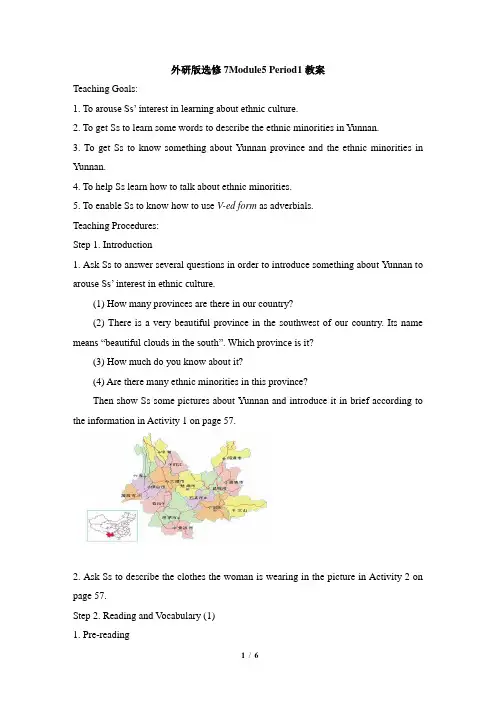
外研版选修7Module5 Period1教案Teaching Goals:1. To arouse Ss’ interest in learning about ethnic culture.2. To get Ss to learn some words to describe the ethnic minorities in Yunnan.3. To get Ss to know something about Yunnan province and the ethnic minorities in Yunnan.4. To help Ss learn how to talk about ethnic minorities.5. To enable Ss to know how to use V-ed form as adverbials.Teaching Procedures:Step 1. Introduction1. Ask Ss to answer several questions in order to introduce something about Yunnan to arouse Ss’ interest in ethnic culture.(1) How many provinces are there in our country?(2) There is a very beautiful province in the southwest of our country. Its name means “beautiful clouds in the south”. Which province is it?(3) How much do you know about it?(4) Are there many ethnic minorities in this province?Then show Ss some pictures about Yunnan and introduce it in brief according to the information in Activity 1 on page 57.2. Ask Ss to describe the clothes the woman is wearing in the picture in Activity 2 on page 57.Step 2. Reading and V ocabulary (1)1. Pre-readingLet Ss have a discussion about the ethnic minorities in Yunnan.2. Fast readingAsk Ss to read the text quickly to get the main subjects of each paragraph. Suggested Answers:Para 1: Yunnan LijiangPara 2: the old townPara 3: Naxi ethnic groupPara 4: Naxi languagePara 5: Naxi musicPara 6: Simon’s feeling3. Intensive reading(1) Ask Ss to read the passage carefully and find the words given in Activity 2 in the passage.(2) Ask Ss to read the text one paragraph after another and answer the following questions:Para 1: ① In what way is the Yunnan landscape varied?Para 2: ② Why do tourists get lost in Lijiang?Para 3: ③ In what way are Naxi women unusual?Para 4: ④ What is unusual about the Naxi language?⑤ How do the Naxi believe their people started?Para 5: ⑥ Why is Naxi music famous?Para 6: ⑦What’s the feeling of Simon?(3) Ask Ss to choose the correct answers to Activity 4 on Page 60.(4) Ask Ss to answer the questions in Activity 5.Step 3. Speaking1. Ask Ss to talk about what they have learnt about Lijiang and the Naxi people.2. Ask Ss to role-play in pairs: Student A acts Simon and Student B acts his friend at home. Now, Student B is asking Simon about Yunnan.For your reference:Student B: Hi, haven’t seen you for a long time. Where have you been?Student A: I have visited Yunnan recently.Student B: Have you been to Lijiang?Student A: Yes. It is a very beautiful city.Student B: …3. Ask Ss to read through the instructions and examples in Activity 2 on Page 61 and then ask some Ss to give their opinions.Step 4. Language Points1. ListeningAsk Ss to listen to or read the passage alongside the tape to correct their pronunciation.2. Word studyAsk Ss to fill in the blanks according to the text to learn the important words.It is the (1) that impress Simon most, though he has been in Yunnan for two months. Down in the south, in Xishuangbanna, it’s very(2) . Lijiang is half new and half old town. The old town is on the side of a mountain and (3) it is the 5,500 meter Yulong Xueshang Mountain, its peak (4) with snow. Looking from the (5) of the mountains, Simon thinks that the old town is a (6) of canals, little bridges and tiny cobbled streets that tourists get (7) in.Simon has spent several afternoons (8) in a café in the old town square, just (9) people. The culture of Naxi is (10) . It is the (11) who run Naxi society, and until recently, Naxi women inherited all (12) . The Naxi still wear (13) costume. Naxi culture is particularly famous for its (14) which has not changed for eight centuries, (15) from father to son. Among the richer Naxi people, (16) of this music showed that you were a real gentleman.Simon has learned a lot about the Naxi culture during his tour, and he understands that however (17) we may appear to be at first, we are all the same, all (18) . Suggested Answers:(1) varied landscape (2) tropical (3) opposite (4) covered (5) slopes (6) maze(7) lost (8) sitting (9) watching (10) fascinating (11) women (12) property(13) traditional (14)music(15) passed (16) knowledge (17) however (18) equal3. ExplanantionAsk Ss to work in groups and discuss the important and difficult language points.(1) The old town is on the side of a mountain and opposite it is the 5,500metre Yulong Xueshan Mountain, its peak covered with snow. (line 8, para 1)古城依山而建,对面是海拔5,500米的玉龙雪山,山顶覆盖白雪皑皑。
外研版高中英语选修七Module5Ethnic CultureLanguage Points课件ppt
Please point out the colourful words. Keys:
Reading Practice---6. Sample
Short Newspaper Report Two Englishmen got a flat tyre in the middle of the jungle last week. They didn’t know what to do, as they were a long way from habitation. A local woman found them and took them to her home for tea. Some time later a young man arrived. He had a mobile phone and they called the garage. They took twenty minutes to come.
Period 5
Module 5 Ethnic Culture
Reading Practice Culture Corner
Reading Practice---1. Prediction
Look at the title of the passage. What kind of passage do you expect it to be?
1. Where and when did Native Americans come from?
外研版高中英语选修7 Module5Introduction精品课件

5. apparently _________ adv. clearly seen or understood 6. ______ adjust v. set right; put in order; regulate 7. property ________ n. things owned; possessions 8. ______ ethnic adj. of race or the races of mankind
Work in pairs and do the quiz. 1. ______ native adj. associated with the place of one’s birth 2. ______ inherit v. heir; receive property, a title, etc. 3. _______ diverse adj. of different kinds 4. ____ run v. manage; cBause to be in operation
most diverse region of China
Capital City Kunming
Natural Stone forest, Tiger Leaping
wonders
Gorge, first bend of Yangtze
River
How much do you know about Yunnan?
border
province
capital
region
ethnic minority
share Tibet
Name Location
Yunnan most south –western province
外研版高中英语选修7module5精品PPT课件
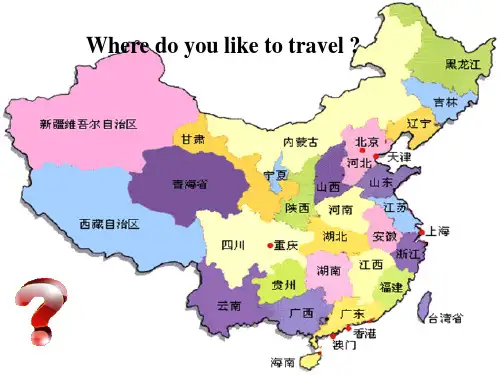
orchestra ___A_.
(a) played music that had not changed for centuries
(b) were all very old
(c) played instruments that sounded sad
1
3
4
5
6
2
2. skimming
1.Follow the listening of the text and read the whole diary, pay attention to the pronunciation .
2.During your reading ,please think about the main idea of each part.
2.What is unusual about the Naxi language? The language is the only language still used which is written in hieroglyphics. 3. How do the Naxi believe their people started?
They believe that they hatched from magic eggs helped by a creature called Tabu.
4. The Naxi language __C__.
(a). is almost 1,000 years old
(b). is not spoken any more
(c). Because there is a big lake in it
高中英语外研版选修7课件:Module5SectionⅢ IntegratingSkills
①apparent adj. 显而易见的;明白的
Obviously... ②It is apparent/obvious
显而易见……;很显然……
to sb. that...
①It was apparent(apparently)that the two women knew each other. 显然这两位妇女相互认识。 ②It is apparent to everyone that he is seriously ill. 大家都明白他病得很厉害。
15.fold 16.adjust 17.furnish 18.bare
19.waist 20.nephew 21.garage
22.rainbow 23.awkward 24.gatherer
根据提示补全下列短语 1.make up 组成;构成 2.come across (偶尔)遇见 3.hear of 听说 4.think over 仔细考虑 5.put up 举起;投宿 6.have a population of 有……人口
阅读P67课文,并从四个选项中选择最佳答案 1.They saw the woman who was carrying something long and thin,
and
.
A.they were relieved to see her
B.they were scared because they thought it was a spear
理
基
础 · 自 主 初 探
巧 突 破 · 核 心
提 素 能
Section Ⅲ Integrating Skills
句 型
·
语
篇
外研版高中英语选修第七册Module5 introduction(共19张PPT)
Evaluation Sheet- Travel Plan
Places of interest (introduction & illustrations) Travel Itinerary (Day1 … Day2… Day3…) Price List of the trip (e.g. admission tickets…insurance…) Booking & Payment (Contacts…) Notification (local customs) Duty list of group membkilometers
Population About 42 million in 2003
Rare animals golden monkey, Asian elephant
Plants
home to half of all China’s plant species
the Forbidden City and Peking Opera
Confucian Culture and Taishan Mountain
Qiao's Grand Courtyard, Shanxi Merchants and Copper Culture
Sanxingdui Civilization, Bronze Tripod & the Shu Culture
People home to 25 ethnic minorities, most diverse region
Capital City Kunming
Natural wonders
Stone forest, Tiger Leaping Gorge, first bend of Yangtze River
外研版高中英语选修七Module 5 Ethnic Culture 课件
(4) They sit in small circles in the square, with their babies on their backs, completely uninterested in the tourists.
她们围成小圈坐在广场上,身__背_孩__子_,_对_游__客__丝__毫__不_感__兴__趣_______。
(3) For example, it is the women who run Naxi society, and until recently, Naxi women inherited all property.
(4) They sit in small circles in the square, with their babies on their backs, completely uninterested in the tourists.
drive your car into the old town. ( F) 2. The Naxi women with their babies on their backs always have interest in the tourists. ( F )
3. The old man the author met could speak not only the Naxi language, but also some English. ( T )
Capital city Kunming Natural wonders Stone Forest, Tiger Leaping Gorge, first bend of Yangtze River
高中英语外研版高中选修7Module5EthnicCultu
B7M5 Ethnic Culturelntroduction& Reading and vocabularyStep I. Warming upWatch a video about Yunnan.Step II. Lead in (Introduction)Group work: role-play( one student is the guide, and the others are the guide introduces Yunnan with the information of Activitiesl&2 on P57 and answers the questions raised by the tourists)Step III. Reading1.Fast-readingRead the passage quickly. Match the photos with the paragraphs.2.Careful-readingthe paragraphs carefully and answer the following questions.1.In what way is the Yunnan landscape varied?2.Where is Yulong Xueshan Mountain? And what's its height?3.Why do tourists get lost in Lijiang?4.In what way are Naxi women unusual?5.What is unusual about the Naxi language?6.How do the Naxi believe their people started?7.Why is Naxi music famous?8.What's Simon's feeling about his travelling?Task2. True or False.1.Simon is studying in a university in Yunnan.2.The landscape of Lijiang is similar to that of Xishuangbanna — it is very tropical.3.The Naxi poems and the story of Tabu have been translated into several languages.4.There are many painters and writers in Lijiang.5.The Naxi music is so fascinating that the audience are totally lost in it.6.Naxi music is passed from generation to generation.7.Dai people played the songs with the names such as The Water Dragon Is Singing.Step IV. Post-readingTask 1. Summary:What's your feeling after reading this passage?Task2. Pair-workRole - play: work in pairs:(Simon has come back from Yunnan)Student A: Act as Simon's friend (ask Simon some questions about Yunnan)Students B: Act as Simon( answer the questions)For example:city in Yunnan did you visit?is Lijiang?is the old town like?do you know about the Naxi people?do you think of Naxi old music?Step V. HomeworkWrite a diary about your visit to a place. (when,who,where,what...)。