
仁爱版英语七年级上Unit3Topic2SectionB
He drives a Taxi. What does he do?
a driver
a driver He is ________.
a teacher/ in a school
What does she do?
She is_________. a teacher
Where does she work? in a school She works________________ .
1. She teaches English in a school. She is a _____. teacher
actor 2. The boy acts in Harry Potter. He is an________. driver 3. He drives a bus. He is a _________. 4. Her mother works in an office. She is an worker office__________.
1. Recite the dialogue in 1a.
2. Make a survey about what your
friend’s parents do and where
they work, then make a report. 3. Preview Section C.
farmer
用do/does填空。
does 1. What ________your brother do?
does 2. Where ________Maria study?
do 3. What ________Kangkang and Michael do?
4. Where________ they work? do
What do they do?
They are _____________. office workers
Where do they work?
They work __________. in an office
(影片)
doctor
office
nursepital
…
Person
Student A Student B Student C
What does he/she do?
Where does he/she work?
In our group, A’s father is a doctor. He works in a hospital in Beijing. His mother is a teacher. She teaches Chinese in a high school. B’s father/ mother is…
1. What does she do? She is a nurse. 2. What do they do? They are office workers. 3. Where does he work? He works in a school. 4. Where do they work? They work in a hospital.
a nurse/in a hospital
farmers/ on a farm
What do they do?
They are _______ farmers .
Where do they work?
They work_________. on a farm
office workers/
in an office
Listen and fill.
(录音)
David is a _____ cook in Beijing. Lisa works in Fuzhou. She is a doctor _____. Paul _____ drives a bus in Shenzhen. Danny teaches English at Nanjing No.1 High School. He is a very good ______. teacher
________ a doctor
Nanjing
Beijing
________ a driver
a teacher ________
What does your father/mother do?
He/She is _____________.
Where does he/she work?
He/She works _______________.
5. What _______Jane ’s classmate do? does
6. What _______Jane ’s classmates do? do
v.+-er/-or
n.
If you understand word
formation, you will be able to
learn words more easily.
Where does he work?
in a restaurant He works_____________.
a cook/in a restaurant
What does she do? a nurse She is _____________. Where does she work? She works in __________. a hospital
Review
Can you list the jobs you know?
How to ask people’s occupation and the place they work?
My father works on a farm. What does he do? farmer . He is a _______ a farmer
Listen and match the people’s names with the cities. Then listen again and write down their jobs.
(录音)
Fuzhou
Shenzhen
David Lisa Paul Danny
________ a cook
What does she do? She is _____________. an office worker Where does she work? She works __________. in an office an office worker/ in an office
What does your father do? a cook He is _____________.
仁爱版英语七年级unit3topic2
1.Mom,I'm home. 妈妈,我到家了。
be home在这里意为"在家",常用在口语中。
at home意为"在家"。
如:I have a pet at home. 我家里有一只宠物。
拓展:由home构成的常用短语有:go home 回家get home 到家be back home 返回家里at home 在家in one's home 在某人家里2.Kangkang, what does your mother do? 康康,你妈妈是干什么的?这一特殊疑问句是用来询问对方职业或身份的常用句型。
其结构为:what + 助动词(do/does)+ 主语+ do?回答方式是:人称代词主格+ be(am/is/are)+ 职业如:—What do you do? 你是干什么的?—I am a teacher. 我是教师。
—What does your father do? 你爸爸是干什么的?—He is a doctor. 他是医生。
—What do they do? 他们是干什么的?—They are policemen. 他们是警察。
拓展:询问职业和身份还可以用下面的结构1、What + be的适当形式+ 主语?如:—What is your mother? 你妈妈是干什么的?—She is a teacher. 她是教师。
—What are you? 你是干什么的?—I am a doctor. 我是医生。
2、What's one's job?也是用来询问对方职业的句型。
job是名词,意思是“工作”,one's要使用形容词性物主代词或名词所有格的适当形式。
如:—What's your sister's job? 你妹妹是做什么的?—She is a student. 她是学生。
—What's his job? 他是干什么的?—He is a driver. 他是司机。
七年级英语仁爱版上册Unit3_Topic2_SectionD_教学设计

Unit3 Topic2 SectionD 教学设计I. Material analysis本课是话题二的最后一个课时,主要活动是Grammar和Functions。
引导学生复习构词法、实义动词一般现在时的特殊疑问句及其回答,以及通过对话、听力训练、阅读训练、综合探究等活动复习和巩固Sections A~C学习的打招呼、询问职业、家庭成员、工作场所等信息的表达方式。
另外,学生将在学完本话题后,学会自行总结和归纳构词法的规律以及实义动词一般现在时的特殊疑问句及其回答,学会在实际的句子中发现语法错误并改正错误,同时还将锻炼他们听并判断、听再填空、读前猜测、读后总结的能力,提高他们用所学的词汇、句型、功能、话题进行综合探究活动的能力。
此外,在project的综合探究活动中,借助全家福,让学生以实践体验等方式来综合运用本话题所学知识,学会用英语做事情。
II. Teaching aims1. Knowledge aims能根据已学语音、音标及发音规则,正确朗读下列词汇并在实际的对话操练中加以应用:cute, play, its, love能根据本话题已学知识,自行总结和归纳构词法、实义动词一般现在时的特殊疑问句及其回答:teach—teach er, act—act or在教师的帮助与指引下,通过对话操练、听力训练、阅读训练、综合探究等活动复习和巩固有关打招呼、询问职业、家庭成员、工作场所等信息的表达方式,如:(1)—Glad to meet you.—Glad to meet you, too.(2)—What does your father do?—He is a doctor.(3)—Where does he work?—He works in a hospital.(4)—Who is the man in yellow?—He is my uncle.2. Skill aims能听懂有关询问职业、家庭成员等简单对话或叙述并完成相应的任务;能根据图文就职业、工作场所、家庭成员等基本情况的话题进行交流;能够在图片的帮助下进行阅读,理解大意、细节等,并按要求进行语言活动;能根据提示书面介绍自己或同伴的家庭成员的工作情况。
仁爱英语七年级上册Unit3_topic2知识点讲解及随堂练习
知识点梳理(一)单词1.职业名称teach (教) → teacher (教师) work (工作)→worker (工人) drive (驾驶)→driver (司机)farm (农场)→ farmer (农民) act(表演) →actor演员2. 对应词:teacher老师—student学生nurse护士—doctor医生waiter男服务员—waitress女服务员salesman 男售货员— salesgirl女售货员3. 家庭成员grandfather -- grandmother grandpa -- grandma father -- motherdad -- mum uncle --- aunt son--- daughter brother --- sister cousinin a school 在学校in a hospital 在医院in an office 在办公室in a shop / store 在商店on a farm 在农场at home 在家2.be home到家3. a photo of my family 一张我家的相片4.the young woman in yellow 穿黄衣服的年轻女士5. on the sofa 在沙发上6. a happy family 幸福的家7. a student in Grade Seven 一名七年级的学生8. live in…居住在9. live with…和……住在一起10. look after…照顾……;保管……(三)句型:1. I'm home. 我回来了.2. What a nice place! 多漂亮的一个地方!3. There are five people in my family.我家有五口人。
There be …“有……”,表示“某处有某人/物”,be动词的单复数形式根据所跟名词的单复数一致;people单复数同形。
仁爱英语七年级上册Unit2-topic3知识点讲解及随堂练习

知识点梳理(一)核心词汇minewhosebikecatourbananatheirbabybagshirtjacketthinknewclassmateclothesfindhelpushim 常用词组helpsbdosth(二)重点句子Guess!’s1.-第一个his是形容词性物主代词,相当于形容词。
置于名称之前,用来修饰,限定名词;第二个his等于hisbike,是名词性物主代词,其后不加名词。
如:Ourbooksarenew.=Thenewbooksareours.Hisbagisgreen.=Thegreenbagishis.Theirdesksareallhere.=Thedeskherearealltheirs2.–Whosecatisthat?那只猫是谁的?-Itishercat./It’shers.是她的(猫)。
(1)whose疑问代词,意为“谁的”,其后加名词,再加一般疑问句,或whose加一般疑问句。
如:Whosecomputeristhat?=Whoseisthatcomputer?那是谁的电脑?(2)hers为名词性物主代词,意为“她的(猫)”,其后不在加名词。
3.Ithinkit’sLiMing’s.我认为(想)是李明的。
(1)如:-(2如:(3【拓展】23)有。
如:约翰和缩写形式必须根据具体的语境来判断。
如:That’sabook.那是一本书。
(that’s是thatis的缩写形式,意为“那是”。
)翻译短语。
1.玛利亚的书___________________2.两位女教师______________________________3.男式服装_____________________4.吉姆和汤姆共有的房间_____________________________________5.我妈妈的房间__________________________________________4.Welookthesame,butweareindifferentclothes.我们看起来很像,但我们穿着不同的衣服。
仁爱版七年级上册英语笔记 Unit3 Topic3-Unit4 Topic1知识点总结
U 3 T3—U4 T11.1)would like = wantwould like没有人称和数的变化I would like an egg.=I want an egg.He would like an egg.= He wants an egg.(would like不能加s)2)would like to do = want to doa. He would like to drink some water.(drink)=He wants to drink some water.b. She would like (visit) the Great Wall.=She the Great Wall.3)I would like=I’d like He would like=He’d like4)a. I’d like an egg.(一般疑问句) Would you like an egg?Yes,please./ No,thanks.b. He’d like a hamburger.he a hamburger?. / .5)Would you like some chicken?(用some 加强语气,表示强调)6)I’d like an egg.What would you like?He’d like some fish.he ?2.1)you—yourself(反身代词)2)yoursel f---yoursel ves(pl.)3.help yourself/yourselves to +n.:随便吃……a. Help yourself (you) to some chicken, Tom.b. Help yourselves (you) to some chicken, kids.4.1)可数名词[C]:有单数和复数的形式.2)不可数名词[UC]:一般没有复数的形式.3)常见的不可数名词有:milk,rice,fish(鱼肉),chicken(鸡肉),(apple/orange) juice,water,bread5.fish:1)作为“鱼” , 是可数名词.fish—fish(pl.)2)作为“鱼肉”, 是不可数名词.some fish6.chicken:1)作为“鸡” , 是可数名词.a chicken2)作为“鸡肉”, 是不可数名词.some chicken7.some + n.(pl.),some+ [UC]some eggssome fish/chicken/milk/apple juice/rice8.---Help yourselves.---Thank you.9.---Would you like…? ---Yes, please. /No, thanks.10.What/How about +sb(宾格)/sth?What about him/her/some milk?11.All right.行,好吧(表示对别人的建议表示赞同)---I’d like some rice and chicken.---All right.k for me.13.Me,too.14.表示建议:---What about …? ---Good idea.15.an ideaa good ideaHomework:1.I’d like a hamburger.(一般疑问句) a hamburger?(肯否回答) ./ .2.She’d like some orange juice.she ?3. , boys and girls.(随便吃些鸡肉吧)4.She likes it very much.(否)She it .5..(我想喝些牛奶).6.他们怎么样??Unit 3 T 3 Section B—D1.1)usually:70-80%,often:50-60%2)usually,often放在be之后,行为动词之前.I usually have breakfast at home.2.have…for breakfast/lunch/supper/dinner1)He usually has an egg and some milk for breakfast.2)We usually have some rice and chicken for supper.3.一日三餐前不加a/an/the,后不加s.What do you usually have for/ breakfast?4.1)He usually has some bread for lunch.What does he usually have for lunch?2)We usually have some juice and fish for dinner.usuallyfor dinner?5.have:1)有2)吃,喝:have milk/bread6.[UC]前面不加a/an/the,后不加s.He has / milk and/ bread for breakfast.7.What/How about +sb(宾格)/sth?8.with带着/有,(表示伴随关系)have chicken/fish with vegetables9.some rice10.three meals(餐):breakfast,lunch,supper/dinner11.food:[UC],食物的总称,作主语,谓语用单数.My favorite food is (be) chicken and fish.12.Chinese /English food13.wait(v.)—waiter(指人)(男服务员)---waitress(女服务员)14.take one’s orderMay I take your order?15.something to drink/eat1)修饰词如不定式(to do) ,形容词修饰something时,放在something之后.2)something:某事(肯定句)anything:任何事(否/疑问)nothing:没有什么事(表否定意思的陈述句)3)Would you like +something?Would you likesomething to eat ?16.[UC]表示数量的表达法:1)a glass of apple juice/watera bag of rice /milk2)a glass of apple juice---two/some glasses of apple juice3) a bag of milk---five bags of milk17.wait/just a moment18.Let me see.让我想一想.I see. 我明白了.19.1)Would you like some vegetables?2)some vegetables/rice20.something to drink21.banana juice----Section C1.eat out2.eat---eating(现在分词)3.would like to doWould you like to have (have) dinner with me?4.have / breakfast/lunch/supper/dinner5.with sb(宾格)6.Would you like to have lunch with him?7.Yes, I’d like/love to.(to不能省略)8.1)May/can I help you?=What can I do for you?2)情态动词may/can/could+动原May I help (help) you?9.sir—madam(对应词)10.What would you liketo eat (eat)?11.Why not+动原? =Why don’t you +动原?Why not study (study) with me? = Why don’t you study with me?12.表示建议:1)What about…? 2)Why not…?肯定回答:Good idea.13.Here you are.14.---Would you like sth to drink?---Yes,please./No,thanks.Section D1.in+地点: in China2.many+n(pl.)many friends3.1)all,bothall指三者或三者以上“都”both指两者“都”2)all,both放在be之后,行为动词之前They are all students.We all like school.4.be kind to sbThe teacher is kind to us.5.have dinner with them6.such as +若干例子7.Sichuan food8.be glad to do sthObama is glad to visit (visit) the Great Wall.9.1)here,there是介词,前不加介词.2)be here/thereI’m glad to be (be) here.10.let sb do sthLet me (I) see (see).Homework:1.他晚饭通常吃什么?he usually?2.你可以点菜了吗??3.Tom,为什么不随便吃些汉堡包呢,?,Tom?4.你想喝些什么东西吗?来两杯香蕉汁.Would you like?.5.She’s glad (be) there.6.I’d like (work) with you.7.Would you like something(say)?8.Why not (tell) him about it.= him about it.9.他对我很友善.He .10.I usually have some rice for lunch.usually for lunch?1.---Do you like…?---Yes, I like …very much/a lot/a little.(No, I don’t like …at all.)Section D1.at / homeHe has a dog at home.2.it’s, its(它是)(它的)a cat. name’s Mimi.3.Tommy =Tom4.Zhou Lan likes it a lot.= Zhou Lan likes it very much.(否)Zhou Lan doesn’t like it at all.5.some,anyShe has some pets.(否)She doesn’t have any pets.(疑问)Does she have any pets?6.1)人称代词:主格---宾格I—me,you-you,he-him,she-her,it-itwe-us,they-them2)形物代—名物代my-mine,your-yours,his-his,her-hers,its-its,our-ours,their-theirsThis is a girl. name is Lily. is twelve. We like .(Her,She,her)Unit 4 T1 Section A1.What can I do for you?=Can/May I help you?2.madam---sir(对应词)3.want to do = would like to do1)She wants to have milk and bread.=She would like to have milk and bread.2)Would you like a glass of apple juice?=Do you want a glass of apple juice?3)Would she like some vegetables?=Does she want any vegetables?4.clothes:衣服的总称,复数名词,作主语时,谓语用复数形式。
仁爱英语七年级上册Unit3Topic2SectionB课件
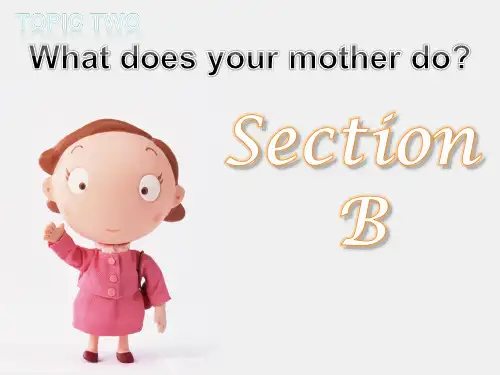
Where do they work?
They work in a school.
Tom
Linda
What do Tom and Linda do? They are office workers . Where do they work?
They work in an office.
work (v.) worker (n.)
I am an English teacher.
I work in Zhangzhou Experimental School.
[ti:tʃ] I _t_e_a_c_h_E__n_g_l_is_h__in Zhangzhou
Experimental School.
shows
cook
restaurant
nurse hospital
=her family photo
(Maria shows a photo of her family to Kangkang.) • K: Maria, what does your mother do? • M: She is a nurse. • K: Where does she work? • M: She works in a hospital. • K: And what does your father do? • M: He is a cook. • K: Where does he work? • M: He works in a restaurant.
1.show v. 给…看 ; 向…出示…
show sth. to sb. = show sb. sth. • Maria shows a photo of her family to Kangkang. = Maria shows Kangkang a photo of her family. • 给我看看你的新衣服。
仁爱版英语 七年级上册 Unit 3 Topic 2 课文及翻译-学习文档
Unit 3 Getting Together一起去Topic 2 What does your mother do? 你的妈妈从事什么工作?Section A1a1Mom. I’m home. These are my classmates.妈妈,我回来了。
这些是我的同学。
Hi, kids! Glad to meet you.你们好,孩子们!很高兴见到你们。
Welcome to my home.欢迎来我家。
Glad to meet you, too.我也很高兴见到你。
Thank you.谢谢。
2.Kangkang, what does your mother do?康康,你的妈妈从事什么工作呢?She is a teacher.她是一名教师。
And your father?那你的爸爸呢?He is a doctor. Michelle, what does your parents do?他是一名医生。
迈克,你的父母是从事什么工作呢?They are office workers.他们是办公室职员。
Section B1aMaria, what does your mother do? 玛丽娜,你的妈妈从事什么工作?She is a nurse.她是一名护士。
Where does she work?她在哪里工作?She works in a hospital.她在一家医院工作。
And what does your father do?那你的爸爸是从事什么工作呢?He is a cook.他是一名厨师。
Where does he work?他在哪里工作呢?He works in a restaurant.他在一家酒楼工作。
Section C1a1Look! This is a photo of my family. 看!这是一张我的家庭照。
Who’s the young woman in yellow?穿黄色衣服的年轻女士是谁?She’s my aunt.她是我婶婶。
仁爱版七年级上册英语-Unit3:Topic2单词汇总+知识梳理
仁爱七上-Unit3 Topic2知识梳理【重点短语和句型】1. Could you please + 动词原形……?用来表示委婉的请求---Could you please tell me your name?--- Sure/ No problem. My name is Sally.--- Sorry.2. tell sb. sth. = tell sth. to sb. 告诉某人某事tell sb. about sth. 告诉某人关于某事Please tell me your name. = Please tell your name to me.Please tell Maria about it. 请把这件事告诉玛丽亚吧。
3. help sb. do sth.= help sb. with sth. 在某方面帮助某人,帮助某人做某事Please help us find him.Could you please help me with English?= Could you please help me study English?4. want to do sth.= would like to do sth. 想要做某事want sth. = would like sth. 想要某物want sb. to do sth. 想要某人做……He wants to visit Beijing. = He would like to visit Beijing.I want/would like an orange.Jane wants Kangkang to sing some songs with her.5. show sth. to sb.= show sb. sth. 把某物展示给某人看Maria shows a photo of her family to Kangkang.6. My English is very good. =I can speak English very well.7. live in+ 地点居住在某地live with + sb. 和某人住He live in China with his parents.8. know a lot about…… 知道许多关于……的事He knows a lot about China.9. say表示说话的内容,speak表示说某种语言的能力What does he say in the letter?He can speak some English.10. 对事物的喜欢程度like……very much/a lot 非常喜欢like……a little 有点喜欢don’t like……at all 一点都不喜欢Many students in our class like English a lot, but I like it a little.He doesn’t like chocolate at all.11. a lot of+可数名词复数/不可数名词I have a lot of English books.12. every day 每天each other 相互some of them 他们中的一些eat out 下馆子,到外面吃饭13. play with sb. 和某人一块玩耍like to do/doing sth. 喜欢(做)某事She likes to play with Kitty.14.Help yourself/yourselves to sth. 随便吃(喝)……15.be kind to sb. 对某人很友好They are all kind to me. 他们对我很友好。
仁爱版英语七年级上册Unit3Topic2SectionB教学设计
2.加强对一般现在时的讲解与练习,帮助学生熟练掌握语法规则。
3.丰富课堂活动,提高学生的词汇量和口语表达能力。
4.针对学生听力理解的困难,设计适当的听力训练,提高他们的听力水平。
5.培养学生的自主学习能力,引导他们学会总结、归纳所学知识,养成良好的学习习惯。
3.学生互相批改练习,教师进行点评,指出共性问题并进行讲解。
(五)总结归纳
1.教师引导学生回顾本节课所学的新词汇、句型和语法知识,总结一般现在时的用法。
2.学生分享自己在课堂上的学习心得,交流学习方法和技巧。
3.教师对本节课进行总结,强调家庭的重要性,鼓励学生在日常生活中用英语与家人进行交流,将所学知识应用于实际生活。
三、教学重难点和教学设想
(一)教学重难点
1.重点:本节课的核心词汇和句型,如:family, mother, father, brother, sister等与家庭相关的词汇;一般现在时的用法,尤其是主语为第三人称单数的动词变化规则;以及自我介绍和询问他人的句型。
2.难点:一般现在时的正确运用,尤其是在实际对话中的灵活运用;听力训练中,对细节信息的准确捕捉和理解。
8.注重情感教育,结合家庭话题,引导学生关爱家人,培养他们的家庭责任感。在教学过程中,关注学生的情感需求,营造温馨、和谐的学习氛围。
四、教学内容与过程
(一)导入新课
1.教师通过展示一幅全家人在一起的幸福照片,引导学生关注家庭这一主题,激发他们对本节课的学习兴趣。
2.教师提问:“Do you have a happy family? Can you introduce your family members to us?”让学生尝试用英语介绍自己的家庭成员,为新课的学习做好铺垫。
仁爱英语七年级上册unit3 topic2 教案
☆Teaching DesignUnit 3 Getting TogetherTopic 2 What does your mother do?Section AI. Teaching books Project English--- Unit3 Topic1 Section A.II. Teaching tools tape recorder, small blackboardIII. Teaching methodsTeaching as a whole, visual and situational method, and team cooperation.IV. Teaching aims and demands1. Learn words and sentence patterns about occupations.2. T alk about inviting and welcoming guests.3. Learn expressions about family members.V. Teaching ProceduresStep 1: Organization and review:1. Ask and answer, review Topic 1.1) Do you often speak English after class?2) Do you like English?3) Do you have a pet?4) Could you please tell me something about your pets?2. Creat a situation and lead to the new lesson.It's Kangkang's birthday today. He will invite some friends to his home. Would you like to go with me?3. T ask presentation.Step 2: Presentation:1. Check the preparation.1) My _____(父母) are both teachers.2) Tom's father is in the teachers' ______(办公室).3) I'm very g______ to see you here.4) The man is a d______ and the woman is a n______. Theyboth work(工作) in the hospital(医院).5) A f_____ works on a farm(农场).6) - _____ _____ _____, please.(请坐) - Thank you.7) - Tom is a nice k____. - Are you kidding? (你在开玩笑?)2. Listen to 1a and answer the following questions:1) Where are the kids?2) Who is talking with the kids?3. Listen to 1a again and follow. Imitating the pronunciation and intonation.4. Practice themselves. Make similar conversations in groups and act them out .5. Ask and answer. Lead to the new sentence pattern " What do/does ... do?" and the corresponding answers.What do I do? I am a teacher. What do you do?Write down the sentence pattern " What do/does ... do?" on the blackboard and explain its usage. Ask students to master it.Step 3: Consolidation and Practice1. Listen to 2a and answer the following questions:1) What does Kangkang's mother do?2) What do Michael's parents do?2. Follow the tape. Read 2a. And then fill in the blanks in 2b.3. Wok in groups. Make similar conversations and act them out.4. Look at the pictures in 3a. Try to make a conversation like the example in pairs. Some pairs have a show. Then listen to 3a and follow.5. Work in pairs. Let students use the example in 3b to practice conversations in pairs.Step 4: ProjectMake a survey. Complete the following table about the occupations of the group members' parents. Then let students pick a table and ask students of other groups to guess like this:A:They are ...'s parents. Guess! What do they do?B:Is his father a ... ? A:No, he isn't.B:What does he do? A:He is a ...Step5: Homework:1. Workbook, Section A.2. Review Section A and Preview Section B.VI. Teaching Introspection:Section BI. Teaching books Project English--- Unit3 Topic2 Section B.II. Teaching tools tape recorder, small blackboardIII. Teaching aims and demands1. Learn the sentence patterns about inquiring workplaces.2. Go on learning the expressions about occupations.IV. Teaching ProceduresStep 1: Organization and review:1. T ask presentation.2. Play a guessing game. Review the words and sentencepatterns about occupations in Sections A.Step 2: Presentation:1. Ask and answer according to the real situations. Master thenew word "work".I'm a teacher. What do you do? I work in a shool. Where do you study?2. Write down "Where do you study?" . Help them answer "Istudy in a school." and write down it, too.3. Read and master the new sentence patterns.4. Check the preparation. Match the occupations with the workplaces.A: farmer office worker student driverteacher doctor nurse cookB: hospital office school kitchen(厨房) farm bus Step 3: Consolidation and Practice1. Listen to 1a and answer the following questions:1) What does the man do?2) Where does he work?2. Listen to 1a again and follow it by imitating the pronunciation and intonation.3. Act 1a out in pairs.4. Read the example in 1b, then work in pairs to practice after the example. Choose several pairs to act it out according to the pictures.5. Listen to 3. Check the answer.6. Describe the four persons in the table using the information in 3. David works in Beijing. He is a doctor.7. Discuss in pairs and finish 2.8. Learn the word formation. Write down several pairs of words and let students find out the rules.work -- worker teach -- teacher drive -- driver ...9. Help students summarize the expressions about jobs and workplaces.10. Exercise:Lucy is a student. She studies _____ _____ _____. Her father is a doctor. He works _____ _____ ______. Her mother isa _______. She teaches in a high school. Lucy's grandfather(祖父) is a farmer. He works ____ _____ ____. What ____ Lucy's aunt ______? She is a nurse. She works with Lucy's father. Lucy has a uncle. He is an office worker. _____ does he work? He works in Beijing.Step 4: ProjectMake a survey. Let students survey the jobs and workplaces ofother students' parents. Finish the following table and make a report to the class.1. Workbook, Section B.2. Review Section B and Preview Section C.V. Teaching Introspection:Section CI. Teaching books Project English--- Unit3 Topic2 Section C. II. Teaching tools tape recorder, small blackboardIII. Teaching aims and demands1. Learn how to draw a family tree and describe it in English.2. Learn how to talk about family members.IV. Teaching ProceduresStep 1: Organization and review:1. Listen and learn to sing the chant in 3. Lead to family members.3. T ask presentation.Step 2: Presentation:1. Look at the photo in 1a and fill in the blanks in the following passage. Check the preparation.Look! This is a photo ____ Kangkang's _____. The youngman ____ a green T-shirt is his _____, his father's _______. The young woman in yellow is his ______. They have a _____. The young woman in red and the man in black are his ______.Kangkang, his ______ and his _______ are on the _____.Kangkang has a _____ family.2. According to the photo, ask and answer.1) Who is the young woman in yellow?2) Who is the little girl?3) Who are they on the sofa?4) Which one is Kangkang's mother?Step 3: Consolidation and Practice1. Listen to 1a and follow. Pay attention to the pronunciation and mark the intonation.2. Read and Check their pronunciation and intonation.3. Act 1a out in pairs.4. Finish 1b as quickly as they can. Then read it.5.Teach how to draw the family tree in English. Draw a family tree on the blackboard while talking to the students.6. Help Kangkang finish hi family tree according to the example written on the blackboard. Then make up dialogs in pairs after the example in 1c.7. Introduce Kangkang's family members to others in their groups according to the family tree.Step 4: ProjectDraw their own family trees, then write a passage to introduce their family members.Step5: Homework:1. Workbook, Section C.2. Review Section A, B and C. Preview Section D.V. Teaching Introspection:Section DI. Teaching books Project English--- Unit3 Topic2 Section D. II. Teaching tools tape recorder, small blackboardIII. Teaching aims and demands1. Learn the pronunciation rules of the consonants: /m/, /n/, / /, /l/.2. Enable students to read the short article about family, grasp the main idea, and write similar articles by themselves.3. Review how to inquire about others' occupations and workplaces, and how to respond to such inquiries.IV. Teaching ProceduresStep 1: Organization and review:1. Look at the family tree in 1c, Section C. Ask and answer to review the sentence patterns about family members, occupations and workplaces.T2. ask presentation.Step 2: Presentation:1. Listen to 2a and answer the following questions:1) How old is Peter?2) What does his mother do?3) Where does his father work?4) Is his little sister a student?5) Do his parents live with him?Step 3: Consolidation and Practice1. Practice in pairs. Finish the questions in 2b.2. Listen 2a again and follow, imitating the pronunciation and intonation.3. Mark the key words in 2a together, then retell the text according to them.4. Listen to 3 and mark True or False.5. Sum up the language points in this topic. Listen 4a and 4bafter the tape.6. Go over the consonants in the last topic. Write down somewords with the phonetic symbol /m/ on the blackboard, and write "m" with colored chalks. Let students read and conclude "m - /m/".Then teach /n/, / / and /l/ in the same way. Then Listen and read after the tape.Step 4: Project1. Give a passage about Tom's family. Let students draw a familytree for him.I have a friend, his name is Tom. He is 13 years old. He is tall.He is in a black coat and blue pants. He is a student in our school.Tom's father is 35 years old. He is strong. He is in a white T-shirt.He is an officer in Beijing. Tom's mother is beautiful. She is 35years old, too. She teaches English in our school. Their family isnot big, but they are happy.2. Finish the table in 5 according to the last passage. Then writea passage to introduce Tom's family members.Step5: Homework:1. Workbook, Section D.2. Review the whole section, prepare form the test.V. Teaching Introspection:。