
仁爱英语七年级下Unit 6 Topic 2 Section B
Could you help me? Of course. Oh, it's very nice of you. = It's very kind of you.
3b. Suppose your neighbor comes to borrow your bike. What would you say? Make up a conversation with your partner.
( ) post office √ ( ) railway station √ ( ) hospital ( ) park
( ) supermarket
2b B. Listen again and write the places in the correct positions.
hospital bank apartment
no 在此作形容词,相当于 not a/an 或 not any “没有, 无”。
e.g. There is no book on the desk. = There isn’t a book on the desk. I have no money in my wallet. = I don’t have any money in my wallet.
keep money park buses take trains see a doctor
parking lot hospital railway station
2a. Match the pictures with the phrases.
buy things post letters buy books borrow books
偃师市府店三中 BY ANDIE
revision
• • • • • • 公寓 乡村 出租 给某人打电话 和某人居住在一起 和某人玩
apartment country (countryside) for rent call sb. at + 号码 live with sb. Play with sb.
We can: 1. talk about the facilities e.g. post office, bookstore, library, hospital 2. talk about how to ask for / offer help e.g. Would you like me to help you?
Brown. He also lives next to Mr. W Nhomakorabeatson.
4. Read and write the name of each neighbor.
Five Neighbors
Mr. Jones
Mr. Jackson
Mr. Watson
Mr. Brown
Mr. Smart
There are no houses on the right, ...
We learn: 1. some words: neighbor, store, bank, street
2. some phrases: at the end of on the street corner 3. some sentences: Could you help me?
It’s very kind of you.
You can use the sentences in 3a.
Excuse me, ... Could you help me? Of course. Oh, it's very nice of you. = It's very kind of you. Thank you. You're welcome.
2a. Look at the pictures and learn the new words.
2a. Look at the pictures and learn the new words.
2a. Look at the pictures and learn the new words.
store
bank
There is a store on the street corner.
on the street corner
2a. Look at the pictures and learn the new words.
2a. Look at the pictures and learn the new words.
1. Review the names of facilities. 2. Review how to ask for / offer
help.
3. Preview Section C.
post office
library
supermarket
bookstore
2b A. Listen to the passage and check (√) the places your hear.
( ) bookstore √ ( ) parking lot √ ( √ ) bank
( ) restaurant √
2a. Look at the pictures and learn the new words.
2a. Look at the pictures and learn the new words.
2a. Match the pictures with the phrases.
bank
parking lot post office
bookstore
restaurant
1b. Listen to 1a and fill in the blanks.
neighbor • Michael is Mary's new __________. He is store bank looking for a __________ and a ________. The in front of store is ____________ the building and the bank on ___________ is _________ the street corner.
Mr. Smart lives at the end of Park Road. There are no houses on the right, but there is a tall tree. Mr. Jackson lives between Mr. Smart and Mr. Brown. Mr. Jones lives next to Mr.
• 你住在哪种类型的房子里? • What kind of home do u live in ? • 他们住在乡村的一个大的农场住宅里。 • They live in a big farmhouse in the country. • Michael 想以低于600元每月的价格租一个房子。 • Michael wants to rent a room under $600 a month.
1a. Look, listen and say.
Are there any near here?
any 在句中用作代词,指代stores, 以避免与前文重复。
on the street corner
在街道的拐角
3a. Look at the picture and put the following sentences in the correct order. ( ) Ms. Li: Oh, it's very nice of you. Thank you. ( ) Ms. Li: Excuse me, my bag is very heavy. Could you help me? ( ) Michael: You're welcome. ( ) Michael: Of course. I live here.
Read and learn
• Mr. Smart, Mr. Jackson, Mr. Brown, Mr. Jones and Mr. Watson are neighbors. They live on Park Road. They live in townhouses.
n. 邻居,邻人
在……的结尾/末端
仁爱版七年级英语下册Unit5 Topic2 Section B案例和教学反思

仁爱版七年级英语下册Unit5 Topic2 Section B案例和教学反思一 教学设计思路由于学生对于新学单词不能很快掌握住,因此,上节课利用半节课学习本节课的单词(本节课词汇多阅读量大),目的是让学生课前预习本节课的内容。
这节课的设计环节为:1知识回眸(一) 复习Section A的知识点:现在进行时。
学生小组对话:What are you /is she/he doing? Are you /Is she/he doing?........(二)复习本课单词1).学生齐读;2).问,学生举手问不会读的单词;3).3分钟读记;4).师检查提问;2.新课1)实际演练引出本节课的知识点,.完成1a,该掌握的句子,让学生当堂背诵;2)用实物小组操练,完成1b ,学会借物的表达方式,3).读记本节课的知识点;4)学会写寻物启事,完成2a 2b.5).师简单检查提问掌握结果.4.作业:复习笔记 ,完成练习册。
二.教学反思:1.本节课是一节比较平实的课,很朴素,不象我们平时的观摩课那么富有新意,但是还是有一些大家可以借鉴的地方:1)知识点落实课堂最重要的是讲究有效性,上学期一直在学生的兴趣上挖掘,学生的成绩也不理想,该掌握的学生掌握得并不好,这学期下决心在实效上下工夫。
本节课除了让学剩多说之外,也让学生尽可能做到当堂背诵,把主要的句型背会,把知识点记住。
2)不足:课堂只顾着重实效,而忽视了学生兴趣的激发,没有什么出彩的地方,而且每次我复习单词的方式太单调,换一种方式,也会让学生感觉新鲜。
方法总是有的,比如,让学生比赛看谁能说出关于动物的单词多,比如让学生表演一种动物,学生说出它的名字……激发学生积极性的方法是很多的,只要用心去想,用心去做,总会有意想不到的收获。
仁爱版七年级下册英语u6t2知识点
仁爱版七年级下册英语u6t2知识点仁爱版七年级下册英语U6 T2知识点Unit 6是七年级下学期的英语课程,本文主要介绍Unit 6下的第二个教学任务(T2)的知识点。
该教学任务的主题是“Where's the post office?”,主要内容涉及询问位置和给出位置的表达,建筑物的名称,学习使用就近一些地点表达门牌号等。
一、位置询问和回答在日常生活中,询问位置和回答位置是很常见的对话情景。
在英语中,学习如何询问位置和回答位置是很有必要的,常用的表达方式如下:1. Where's the post office?2. How can I get to the library?3. Excuse me, do you know where the nearest bank is?4. I'm looking for the supermarket. Can you help me?5. Could you tell me how to get to the park, please?回答上述问题的方式有很多,其中一些表达如下:1. It's next to the bank.2. Go straight ahead, and turn left at the second intersection.3. The library is on your right.4. You can find the supermarket on the corner of the street.5. The park is opposite the cinema.二、建筑物和地点名称当我们询问和回答位置时,建筑物和地点的名称是非常重要的。
以下是Unit 6 T2所涉及的一些建筑物和地点名称:1. Post office2. Library3. Bank4. Supermarket5. Cinema6. Park7. Hospital8. School学生需要尽可能多地记住这些名称,并且学会使用它们来描述位置和方向。
仁爱初一Unit6Topic2详案(仁爱版七年级英语下册教案教学设计)
仁爱初一 Unit6 Topic 2 详案(仁爱版七年级英语下册教案教学设计)Section AMain activities: 1a, 2a and 2bTeaching periods: .1~2Teaching aims and demands:1. Talking about names and surroundings of the houses.2. Understanding the ads of renting.3. Further-studying the structure of “there be”.Teaching procedure:Step 1 Review1. The teacher shows photos/pictures to say something about his/her rooms/hours and surroundings.2. Students show their own pictures or their ideal/dreaming houses to the others. Also tell others the surroundings and rooms. Each student should say five to eight sentences for his/her picture.3. Ask students which one they prefer, apartment building, townhouse or farmhouse.Step 2 Presentation1. Give an introduction of the dialog: Wang Wei and Kangkang are talking bout their houses and their grandparents’ houses. Listen carefully and try to find out where they and their grandparents are living now, in an apartment house, in a townhouse or in a farmhouse.2. Raise questions and assign the listening tasks.Where are Wang Wei’s grandparents living?Where are Kangkang’s grandparents licing?Could Wang Wei go to play soccer with Kangkang?3. Complete the chare in 1b.4. Answer the following questions, and complete 1c.Who lives in apartment building?Who lives in townhouses?Who lives in farmhouses?Who lives in dormitories?Step 3 Consolidation1. Read the ads in 2a and make sure which ones are looking for or which ones are being let.2. Look at the ads and learn the new words: rent, furniture, quiet, single, per3. Finish 2b according to the ads.Step 4 PracticeStudents’ activities: Talk about how to write out “WANTED” or “TO LET”. The content of “WANTED” or “TO LET” includes: requirements, introduction and telephone numbers, etc.Step 5 Project1. The teacher reads out his/her own ads for renting and try to find out the suitable apartment or house among the students ads. And then write it out.2. First speak out the ads, and then write them down. Show them out on the wall. Ask each of them to find out his/her own dreaming house.Section BMain activities: 1a and 2aTeaching periods: 1~2Teaching aims and demands:1. Learning the names of facilities in the local area, such as a shop.2. Descr ibing one’s living environment.3. Making telephones for help.Teaching procedure:Step 1 Review1. Show a map of a community. Describe the facilities of the community and their functions.2. Get the students to talk about their own areas or villages.There is a small garden in front of my house.There are a lot of tall buildings in our area.Step 2 Presentation1. Hang the pictures in 1a on the wall. Introduce the pictures first in order to make the listening material easy.For example:Mike is Mary’s new neighbor. He is looking for a store. There is a store in front of their building. Also there is a bank on the street corner.2. Listen and imitate.3. Read the dialog and do pair work.4. Finish 1b and 1c.Step 3 Consolidation1. Listen to the dialog first, then read it out.2. Practice in pairs for some time.Step 4 Practice1. Finish 2b. Practice the conversation with partners, focusing on fluency.2. Students practice from mechanical exercise to meaningful exercise. Change the people, places, and things into the other ones.Step 5 ProjectMake a survey.Section CMain activities: 1 and 3aTeaching periods: 1Teaching aims and demands:1. Talking about neighbors and surroundings.2. Further-studying the structure of “there be”.3. Talk about how to get on well with neighbors.Teaching procedure:Step 1 Review1. Discuss your own area and try to answer the following questions:Is there a bank around you?Where can you buy fruits?Is there a community service centre in your area?2. Discussion:If something is broken or doesn’t work in your house, who can help you?3. Finish 1.Show posters (teaching pictures) to the students, using “there be” structure to retell the story as many as possible.Step 2 Presentation1. Present the dialog 3a with the picture. The teacher retells the story and raises questions according to the text. For example: Look! Dave is playing the piano. He is beautifully, but it is too loud. Mr. Smith is knocking at the door. Mr. Smith is talking about it to Dave. Dave is really sorry. He will try to play quietly.2. Listen and answer.Questions: what is Dave doing?Who is Dave’s neighbor?What is happening to them?3. Read the text. Ask and answer question with each other.Step 3 ConsolidationPractice 3b in pairs and then act it out.Step 4 Practice1. Discuss with your partner “How do you get on well with your neighbors? Are you a good neighbor?”2. Finish 4.First practice in pairs and then group work. At last arrange all the answers into an article.3. Song time: finish 5.Step 5 ProjectSay something about your neighbor’s family, their daily activities, then write it out. Subject: My Neighbor. Use the words in Section B as many as possible.Section DMain activities: 1and 4Teaching periods: 1Teaching aims and demands:Review the structure of “there be”.Teaching procedure:Step 1 Review1. Beginning songs Home on the Range.2. Say something about your house or building, then answer the following questions:Which type of home do you live?Where do you want to live?Do you have a good neighbor?3. Finish 1. Try to find out more words pronounced with.Step 2 Presentation1. Show the pictures and say something about them.2. Read the text and fill in the form with “suburbs” or“cities”.3. Answer the questions:Why do so many people dislike living in the cities?Why do they like living in the suburbs?Which one do you prefer, living in the cities or living in the suburbs?What’s the opinion of your classmates?4. Finish 4b.Step 3 Consolidation1. Further study 3a, 3b. Summarize the uses of the “there be” structure and useful expressions.2. Listen to the tape. Finish 4b.Step 4 Practice1. Answer the question in 5.2. Write out an article according to the answers.Step 5 Project1. Write a passage with about 50 words. The title is “I like living in the cities/suburbs”.2. Finish 6. Class activities: Let’s chant.Teaching assessment:Dictation。
仁爱英语七年级下册Unit6导学案
Unit 6 Our local areaTopic 1 Is there a computer in your study?Section A一、学习目标:1.学习There is/are 句型。
2.学习表示方位的短语介词。
3.能够简单谈论自己的家。
二、学习内容:1.词汇: beautiful, garden, bedroom, second, floor, and so on, upstairs, kitchen, dining room, living room, bathroom, first2.句型: 1)—Where is your bedroom?—It’s on the second floor. There is a study next to my bedroom.2)—What’s in your study?—There is a sofa, a desk, some books and so on.3)—There is/are… on the first/second floor…三、自主学习:1. 写出并熟记下列名词:花园卧室第二地板近旁到楼上进来厨房餐厅起居室浴室前面房子在后面门2.写出下列短语:在二楼在花园如此多在什么的前面(内部、外部)四、学习小结:1.There be 句型表示: ____________________________a. There be 的结构_____________________________b. Be 如何使用_________________________________c. 变一般疑问句________________________________2.为什么不…? 都有哪些表达?_________________________________________________________________________五、达标检测:(一)用be动词填空:1. There a pen in my hand.2. There some juice in the glass.3. there a study on the second floor?4. There some books on the shelf.5. There 61 students in our class.6. there any apples in the kitchen?(二)单选:1.Why not home and watch TV?A. goB. to goC. going2. Is there a clock next to the photo? .A. Yes, it is.B. Yes, there is.C. Yes, there isn’t.3.There is a bedroom the second floor.A. onB. atC. in4. May I have a look your pen?A. forB. afterC. at(三)句型转换:1. There is a book on the desk.(改为否定句)a book on the desk.2. There is a cat behind the door.( 改为复数形式)There two behind the door.3. Tom has some books. (改为一般疑问句)Tom books?4. Jane does her homework at home. (改为一般疑问句)?5. I sit in front of her. (同义句转换)She me.6. There is a cat behind the door. (改为一般疑问句)a cat behind the door?Unit6 Our Local AreaTopic 1 Is there a computer in your study?Section B一、学习目标:1.熟记单词和短语。
仁爱版英语七年级下册Unit 6 Topic 2 Section A课件
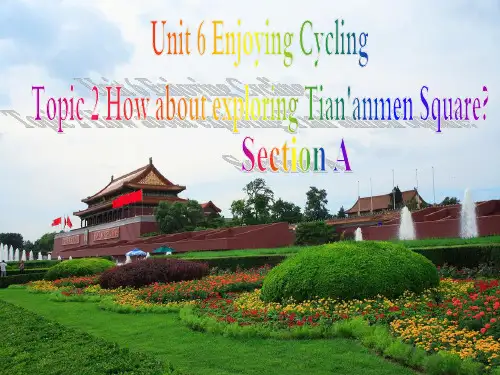
Key points
4. But now I’m on vacation. 但我现在在度假。 on 指“处于……情况或状态” 这种用法常见的短语有:
在度假 on holiday在线 on line 热销中 on sale 在出差 on business
•Steps(步骤) for the spring field trip
1. decide on the place to go 你计划去哪里? Where do you plan to go? 你为什么去那里? Why do you want to visit it? 去某地参观/旅游 go on a visit/trip to sp. 2. choose proper vehicles 哪一种是我们郊游的最佳方式?
I’d like to book some train tickets to Mount Tai. 去泰山的火车票价格多少?
How much does it cost to get to Mount Tai by train? What’s the price of the train tickets to Mount Tain? 4. book some rooms 5. buy enough food and drinks prepare some money…
Key points
• 1. Glad to receive your postcard.
• =I’m glad to receive your postcard.
• receive v. 收到,接到,表示客观上收到 • receive sth. from sb.从某人那获得某物 • send sth to sb. 把某物送/寄给某人 • 【链接】accept v. 接受,表示主观上接受 • I r_e_c_e_iv_e_d_ his invitation but I didn’t__a_c_ce_p_tit.
仁爱版英语七年级下Unit6 Topic2教学设计

七年级Unit 6 Topic 2Section AI. Material analysis(教材分析)本话题在第一个话题的基础上继续学习和房屋有关的表达法,巩固和拓展there be句型,学习关于房屋类型以及谈论房屋周边环境,如各种设施和服务场所的表达法。
本课是第六单元话题二的第一课时。
本课的主要活动是1a, 3a和4a。
通过人物对话呈现主要教学内容,学习住房类型的词汇和表达方式。
通过听有关租房的对话,让学生了解关于出租、求租等应用广告。
此外,语音板块将呈现并操练元音字母o、字母组合o+st/ld, oa和辅音字母h的读音及语音辨认。
II. Teaching aims(教学目标)1.Knowledge aims(知识目标)能根据已学语音、音标及发音规则,正确朗读下列词汇并在实际的对话操练中加以应用:“townhouse, farmhouse, country, apartment, rent, quiet, month, rent ”;能够正确使用there be句型以及表示房屋类型的表达方式等;能够运用“谈论房屋类型、居住环境和邻里关系、出租和求租”等话题进行交流与对话操练,如:(1)—What kind of home do you live in?—It’s a townhouse with two floors.(2)—How many floors are there in your building?—There are seven.(3)—Do you like living there?—Yes.(4)Michael is looking for an apartment near our school.2.Skill aims(能力目标)能听懂简单的课堂用语并做出适当的反应;能根据图文就居住环境等基本话题进行交流;能根据已学音标拼读单词;能看懂简单的求租、出租房屋的广告。
3.Emotional aims(情感目标)能够在相互对话和表演等活动中,培养对学习英语的兴趣和积极主动的学习精神;能够与同伴积极合作,参与课堂活动,大胆实践。
2016年春仁爱英语七年级下Unit 6 Topic 2 My home is in an apartment building
Unit 6 Topic 2 My home is in an apartment building重点单词1、建筑名称:townhouse farmhouse apartment store bank bookstore parkinglot supermarket2、道路名词:street railway station road traffic area3、地区名词:Country city countryside community4、动词:rent post close sleep miss move5、名词:month end sport service cost air6、形容词:quiet close colorful noisy freshSection AI 重点短语1 What kind of 什么种类2 A townhouse with two floors一套两层的排房3.Live with 和…住在一起4.Live in 居住在…5.In the country在农村6.Like doing sth.7.Look for 寻找8.For rent 出租9.room wanted 求租房屋10. A quiet room. 一个安静的房间11. Call sb. At+电话号码打某人的电话。
II 重点知识点1.Wang Wei, what kind of home do you live in?It’s a townhouse with two floors.Kind名词“种类,类型”what kind of…?“哪种…?What kind of sports do you like?拓展:a kind of一种many kinds of许多种,all kinds of 各种各样的。
With two floors两层的。
这儿的介词with意为“带有,有,伴有”This is a table with three legs.这是一张三条腿的桌子。
仁爱英语七年级下册Unit6 topic2 Section C.D练习
Section C一. 单词和短语社区____________儿童____________ 靠近____________远的____________ 服务____________地区____________许多____________靠近____________做运动____________五彩缤纷的____________二. 翻译1、有许多老人住在这里。
2、许多有小孩的家庭也住在这里。
3、他们都对彼此很友好。
4、我们可以打电话向他们求助。
三. 按要求完成下列各句1. Some ________ (child) are playing soccer over there.2. There’re a lot of books on the desk. (改为同义句)There’re ______ books on the de sk.3. There’s a hospital near the bank.(改为同义句)A hospital is ______ ______ the bank.4. There’re many students on the playground. They’re playing football. (改为同义句)There’re ____ _________ ________ _________ on the playground.四. 选择适当的介词填空。
1. Tom sits ______ (on/at) the playground.2. There is a bridge(冰箱) _______(in front of/in the front of) the living room.3. My house is _______ (on/ next to) Jim’s house.4. There is a tall building _______ (behind/under) the restaurant.5. The girl is sitting ______ (on/in) the tree.6. I will go shopping _______ (and/with) my sister this afternoon.7. He has a glass of milk and some bread _______ (to/for) breakfast in the morning.8. There is a garage(车库) ________(near/to) the house.9. I put my sports shoes _______ (under/behind) the desk.10. _______ (At/In) the end of the street, you can see the cinema _____(on/in) the right.五. 用所给词的正确形式填空。
仁爱版七年级英语下册第六单元Topic2SectionC教案
Unit6 Topic2 SectionC 精品教案I. Material analysisSection C是一节阅读、写作课,主要活动是1a,2和3a。
通过图片所创设的情景,将学生带入阅读材料的语境中,呈现一篇关于自己居住社区的周边设施的介绍,给学生提供写作的范文;还将要求学生根据1a所学内容,结合自己的实际情况写一篇介绍自己社区的短文,是一个信息输出的过程,旨在培养学生的写作能力;语音板块通过听录音完成不同的任务,来复习所学语音,培养学生的辨音能力、单词的连读、句子的升降调以及正确的朗读习惯。
本课涉及邻里关系,因此教师在教学英语知识与技能的同时,应引导学生学会和他人和谐相处,共创美好的生活氛围。
本课也是一堂阅读课,教师应该摒弃传统的满堂灌,转换为对学生阅读能力的培养,包括略读、扫读、寻找细节信息、信息转换能力等,为学生的终身英语阅读打下良好的基础。
II. Teaching aims1.Knowledge aims能根据已学语音、音标及发音规则,正确朗读并能拼写下列词汇:such as, community, child, children, a lot of, lots of, sport, close, close to, far, far from, service, area, colorful能够在篇章叙述中,熟练运用there be句型来介绍自己居住的社区、社区环境和周边设施;能够就“谈论社区环境、周边设施”等话题进行交流与陈述,如:(1)There are a lot of tall buildings and small gardens in ourcommunity.(2)There is a community service center in our area....2.Skill aims能听懂简单的课堂用语并做出适当的反应;能根据图文就居住环境和邻里关系等基本话题进行交流;能根据图文理解相关话题,并根据要求进行学习活动;能写出介绍自己居住的社区环境的短文。
Unit 6 Topic 2 Section D-七年级英语下册课后培优分级练(仁爱版)(解析版)
GFI Unit 6 Our Local AreaTopic 2 Section DMy home is in an apartment building.单词检测1. ____ sleep2. ____ move3. ____ countryside4. ____ city5. ____ noisy6. ____ traffic7. ____ cost8. ____ miss9. ____ air10. ___ fresh短语自测11. ___ move ...from...12. ___ The cost of living13. ___ living room14. ___ countryside life重点句子Many people are moving from the countryside to cities for work. The traffic is heavy and the cost of living is high.课下注释小练单词: v.&n.睡觉v .搬(家);移动 n .乡村,农村n .城市 adj .吵闹的 n.交通n.费用,花费v .需付费v.思念;错过 n.空气;空中 adj .新鲜的短语:从·搬迁来 生活成本 起居室 乡村生活句子:很多人为了工作,正从农村迁往城市。
城市的交通非常拥堵生活开销非常高。
培优第一阶——基础过关练一、根据首字母填空1.That coat c_____ me 200 yuan. I think it is too expensive. 2.The farmhouse has a big y_____.3.Don’t make so much n______, the children are sleeping. 4.The t_____ is very heavy in Guangzhou. 5.Please m_____ the big box into the room.二、根据汉语提示填空6.I like eating ________ (新鲜的) fruits very much. 7.Be quiet, the children are ________ (睡觉). 8.They want to ________ (搬家) to New York.9.I ________ (想念) my grandmother in the countryside. 10.London and New York are big ________ (城市).三、单项选择11.Many people are______ the cities______ the suburbs. A .come from; toB .move from; toC .moving from; toD .coming from; to答案自查课后培优练级练12.The cost of living in the cities is very______A.large B.small C.high D.big 13.—Where’s the picture?—It’s the wall.A.on B.in C.at D.of 14.My study is ____ the second floor. Please go___.A.in, upstairs B.on, upstairsC.in, to upstairs D.on, to upstairs15.The supermarket is over there ___ the right.A.on B.at C.in D.of 16.--____ any milk in the cup? --Yes, ____some.A.Are there, there are B.Is there, there areC.Are there, there is D.Is there, there is17.I see John ____ with the computer in his study.A.to play B.plays C.playing D.is playing 18.Near our school, there ____ a shop.A.have B.has C.are D.is 19.The people in the shop ____ very friendly.A.is B.has C.are D.have 20.The tree is ____ the car.A.in front of B.in the front of C.next D.near of 四、改写句子21.You can’t catch that bird.(改为否定祈使句)______ _____ that bird.22.There is some bread for her.(改为一般疑问句)____ ____ ____bread for her?23.She is a Chinese baby.(改为复数形式)____ are Chinese ____.24.We can see six bags of rice in the car.(就划线部分提问)________ _______ bags of rice______ you see in the car?25.The boys are playing games near the house.(对划线部分提问)_____ ______ the boys playing games?参考答案:【详解】句意:这个外套花了我200元,我认为它太贵了。