
七年级英语上册-Module6Unit1优质课课件-外研版
Oceania
Does …come…? tiger ---Asia Kangaroo---Europe Wolf---the Arctic
The tiger comes from Asia. Does the tiger come from Asia? Yes, it does.\No, it doesn’t.
I am long and thin.
I am very big and have a very long nose.
I can walk a long way without(没有) water.
I wear black and white coat, I like eating bamboo.
the Arctic Asia Europe
China
North America
Africa South America
Australia
Does the kangaroo come from Australia? Does the tiger come from Asia? Does the panda come from China? Does the polar bear the Arctic? Does the wolf come from Europe? Yes, it does. It comes from Australia. Yes, it does. It comes from Asia. Yes, it does. It comes from China. Yes , the Arctic. Yes, it does. It comes from Europe.
Group work: Language points
Group work: Language points
• 1.Welcome to +place.欢迎到某地 • 2.基数词+thousand(注意,不是复数) (hundred, million,etc)
e from=be from 来自
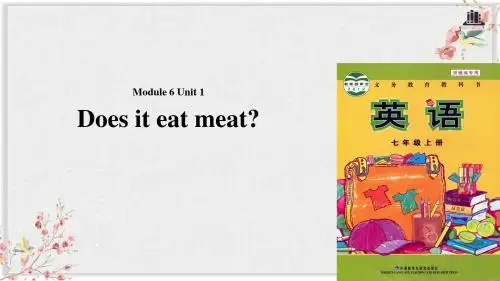
Unit1 Does the tiger eat meat?
Would you like to visit tguide(导游).
panda
lion
monkey
elephant
giraffe
neck
tiger
snake
camel
Ask and answer questions about animals in Activity 3. A: Does the bear eat meat?
B: Yes, it does.
A: Does the tiger eat bamboo?
B: No, it doesn’t. It eats meat.
bear
elephant
giraffe
lion
panda
monkey
zebra
tiger
plants
animals
leaf—leaves
bamboo
Look at the picture. What can you see? bear elephant giraffe lion monkey panda tiger zebra zoo
情景剧表演
You are a teacher in Beijing International School. A new student Sally comes to your class. Please make a conversation
T: Welcome to… S: T: S:
Please remember: To love animals is to love ourselves.
lion
zebra
wolf
kangaroo
polar bear
What am I?
bear
camel
elephant
lion
snake
tiger
A guessing game
I am orange and black, I am the king(国王) in the forest.
I am the tiger’s cousin (同类), I like eating small animals.
Sure. Shall we go and…? That’s very funny.
Listen and repeat.
dangerous favourite here there sure
Listen and choose
1. lives
3. loves
or
.
2. comes
4. likes
Retell the text
Welcome to Beijing Zoo. Sixteen thousand___________________. It has __________animals ---kangaroos, polar bears, zebras, pandas and ______. The tiger comes from Asia and it eats meat. The kangaroo ____________________. The polar bear ___________________. My favourite animal is the panda. It lives___________________________.
行为动词一般现在时的一般疑问句, 当第三人称单数作主语时: 1、在句首加助动词does。 2、谓语动词要变成动词原形。 3、回答时用,Yes, it does.
Let’s have a try eat (eat) fish? 1. Does ____ the tiger ___ doesn’t No, it ________(do not). 2. _____ ___ (like) to Does the polar bear like swim? Yes , it _______(do ). does
A.首字母填空: 1. Beijing Zoo has many kinds of a______. nimals 2. The lions are d_________ angerous because they eat meat. 3. Pandas are black and white and eat b______. amboo 4. The b____ ears eat meat and plants. 5. An e_______ lephant is tall and eats plants.
Hope you know more
1.Love me, love my dog.
2.A wolf in a sheep’s clothing.
3.Go to the sea, if you would fish well.
Good bye!
Look at the pictures. What can you see?
What we have learned today?
Does the tiger come from China? Yes, it does. /No, it doesn’t. Does it eat meat? Yes, it does.
一般现在时 第三人称单数 一般疑问句
Homework : What's your favourite animal?
The bears eat meat too, but also (5) plants / leaves. Elephants are (6) different / cute. They’re (7) tall / white and eat (8) plants/ meat. Pandas are black and white and eat (9) bamboo / other animals. The (10) panda’s/ guide’s name is Lingling.
Ask and answer. A: What’s your favourite animal? Does it eat plants? B: Yes, it does. A: Does it come from China? B: Yes, it does. A: Is it the panda? …
bear elephants giraffe √ lion monkey panda tiger zebra zoo √ √
Now complete the table.
Animals Lions
Bears Elephants Pandas
Things they eat
meat (other animals) meat, plants plants bamboo, plants and leaves
Listen and check ( √) the words you hear in Activity 1. Now work in pairs and say what you can see. — There are three giraffes. — Yes, and there are some zebras.
elephant
giraffe
snake zebra panda
monkey lion camel
elephant
giraffe
snake zebra panda
monkey lion
tiger
camel
wolf
polar bear panda
tiger
kangaroo
合集下载
Module6Unit1You'vegotaletterfromNewYork.第1课时(课件)英语
Homework
1. 抄写课后单词。听Listen and read.部分录 音,并朗读课文。 2. 请你用本课所学句型“I have got...” 说 说你拥有的物品。
Thank you!
Presentation
Act out the dialogue.
Look,listen and say
Presentation
Listen, read and answer.
课文教学
1. Has Daming got a Chinese dragon kite? Yes, he has.
2. Can Laura fly kites? No, she can’t.
课文教学
get a letter from often difficult has got have got
Presentation
Read the passage.
课文教学
Consolidation and extension
活动一
请用句型“I have got…”来描述手中的物品吧,还可以将句型进行扩展哦!
Presentation
课文教学
1. often 意为“经常”,是频度副词。 He often goes out for a walk after supper. 晚饭后他经常去散步。 2. difficult意为“困难的”,是形容词。 She finds it very difficult to get up early. 她觉得很难早起。
S1: I have got a model plane. It can fly. S2: I have got a goose. It can sing and
外研版七年级英语上册ModuleUnit教学课件

外研版七年级英语上册课件ModuleUni t
外研版七年级英语上册课件ModuleUni t
some的用法:some意为“一些”,可作形
容词和代词。它常修饰可数名词复数。
如:some books 一些书 some boys 一些男孩
some 常用 在肯定句中。
也可修饰不可数名词:
some water 一些水 some tea 一些茶叶
外研版七年级英语上册课件ModuleUni t
外研版七年级英语上册课件ModuleUni t
A Western breakfast
In the West, for breakfast, people usually eat bread and eggs and drink coffee or tea, milk and fruit juice.
➢ 以s, x, ch,sh结尾的名词后加-es box boxes 盒子 watch watches 手表
外研版七年级英语上册课件ModuleUni t
➢ 以f 或fe 结尾的名词,多数变f 或fe 为v 再加-es leaf leaves 树叶 knife knives 小刀
➢ 以“辅音字母+-y”结尾的名词,变 y为 i再加-es party parties 聚会 story stories 故事
外研版七年级英语上册课件ModuleUni t
外研版七年级英语上册课件ModuleUni t
但在表示建议,反问,请求的疑问句中,或 期望得到肯定回答时,多用some而不用any。 如:Would you like some coffee?
你要不要来点咖啡? How about some fruit juice? 来点水果汁如何?
外研版七年级英语上册课件ModuleUni t
some的用法:some意为“一些”,可作形
容词和代词。它常修饰可数名词复数。
如:some books 一些书 some boys 一些男孩
some 常用 在肯定句中。
也可修饰不可数名词:
some water 一些水 some tea 一些茶叶
外研版七年级英语上册课件ModuleUni t
外研版七年级英语上册课件ModuleUni t
A Western breakfast
In the West, for breakfast, people usually eat bread and eggs and drink coffee or tea, milk and fruit juice.
➢ 以s, x, ch,sh结尾的名词后加-es box boxes 盒子 watch watches 手表
外研版七年级英语上册课件ModuleUni t
➢ 以f 或fe 结尾的名词,多数变f 或fe 为v 再加-es leaf leaves 树叶 knife knives 小刀
➢ 以“辅音字母+-y”结尾的名词,变 y为 i再加-es party parties 聚会 story stories 故事
外研版七年级英语上册课件ModuleUni t
外研版七年级英语上册课件ModuleUni t
但在表示建议,反问,请求的疑问句中,或 期望得到肯定回答时,多用some而不用any。 如:Would you like some coffee?
你要不要来点咖啡? How about some fruit juice? 来点水果汁如何?
外研版七年级英语上册M10-U2课件

and parents usually give their children a hongbao. It _m__e_a_n_s_ lucky monkey.
P63
Task 6
根据关键词提示复述课文。 Spring Festival / important in China / happens every year/ comes in February/ January
C: visit uncles and aunts (wear … and get a hongbao)
Language points
1. Like Christmas, it happens every year, but not on the same day. like意为“像,跟……一样”,后接名 词或代词。如:
Module 10 Spring Festival
Unit 2 My mother’s cleaning our house
and sweeping away bad luck.
Words and expressions
Christmas n. 圣诞节 February n. 二月 January n. 一月
Task 1
2 Match the paragraphs with the P62 pictures.
①
②
③
A
B
C
ห้องสมุดไป่ตู้
Task 2
Answer the following questions.
1. When is Spring Festival?
It usually comes in February, but sometimes it comes in January.
外研(新标准)版九年级上Module6 Unit1课件(共14张PPT)
?
If you work harder, you will do well in your exam.
110
Peter I spend too much time playing computer games, so I fail the exam. That’s a shame!
PeterБайду номын сангаас
fail v. /eɪ/ shame n. I have a /eɪ / problem!
1、If you want to be a success, That’s a shame! No deal keep healthy, or___________ . (That’s such a pity!) 2、--- He is really a kind man. No deal. You mean --- ___________ you know You mean… the man well? That’s not the point. 3 、He said he was lack of money, That was not the point , maybe he wanted but I think_________________
Module 6 Problems
Unit 1 If I start after dinner, I will finish it before I go to bed.
Free talk
What will you do if you have problems in English? I will… if I have problems in English.
What is Tony’s problem ?
英语上册Module6Unit1You'vegotaletterfromNewYork第1课时教学设

difficult.
Please write to me__
we can be pen friends.
听录音,回答问题。
Who sent the postcard to Sam and Amy?
Where is the postcard from ?
Whathas Daming got ?
What has Laura got ?
Maybe everyone has eaten it. Sometimes it’s
red.Sometimes it’s
green.
主要通过chant和问候将学生的心快速拉回课堂,同时将所要复习的句型和本册所学的知识利用猜谜的形式融合在一起,激发学生的学习兴趣。
二、互动探究。
(20)分钟
二)、新知呈现:
__I have got a cold.
2、给Laura写封回信。
五、家庭作业
1、听读课文20分钟。
2、背诵课后单词。
1、选词填空。
have got has got
(1)Amy ____a toy car.
(2)They __some books
about Americanfestivals.
and but
using “but”、“and”.
学生观察明信片。
2)、听录音,填空。
I live in New York,__I
am not America.
Daming has got a
Chinese kite,___we fly
it in the park.
I’vegotsome
chopsticks,__they are
What has Daming got ?
Please write to me__
we can be pen friends.
听录音,回答问题。
Who sent the postcard to Sam and Amy?
Where is the postcard from ?
Whathas Daming got ?
What has Laura got ?
Maybe everyone has eaten it. Sometimes it’s
red.Sometimes it’s
green.
主要通过chant和问候将学生的心快速拉回课堂,同时将所要复习的句型和本册所学的知识利用猜谜的形式融合在一起,激发学生的学习兴趣。
二、互动探究。
(20)分钟
二)、新知呈现:
__I have got a cold.
2、给Laura写封回信。
五、家庭作业
1、听读课文20分钟。
2、背诵课后单词。
1、选词填空。
have got has got
(1)Amy ____a toy car.
(2)They __some books
about Americanfestivals.
and but
using “but”、“and”.
学生观察明信片。
2)、听录音,填空。
I live in New York,__I
am not America.
Daming has got a
Chinese kite,___we fly
it in the park.
I’vegotsome
chopsticks,__they are
What has Daming got ?
外研版七年级英语上册课件Module 6 Unit 1
Beijing Zoo
animal
New words
elephant
wolf
giraffe
tiger
zebra
lion
polar bear monkey
snake
camel
kangaroo
panda
Pair work Work in pairs and say what you can see.
6. Does the panda eat meat? No, it doesn't.
Post-listening
Complete the table.
Animals
Things they eat
Lions Bears Elephants
meat, other animals meat and plants plants
Animal
bear
Come the USA
from… China Australia Asia the Arctic Europe England Australia Australia America
meat Eat… bamboo
gmreaasts
grass bamboo grass
meat meat
这儿的许多人,例如约翰先生,宁愿喝咖 啡。
2. Here are the lions. Here are ... 属于倒装句型,主语用复数。 here位于句首,主语若为名词,应引起倒装;
主语若为人称代词,则“主谓”要用正常语序。 这种提前主要是为了强调。如:
— Where’s my watch?
— Is it in your bag?
It has a long nose.
新目标英语七年级上册unit6Period1公开课课件
02
实施
03
04
安排5-10分钟时间,让学生 提问。
教师解答学生的疑问,并引导 其他学生参与讨论。
Teacher's Q&A session
目的: 教师解答学生疑惑,提供个性化指导。 教师收集学生的问题,挑选有代表性的进行解答。
实施
对于共性问题,教师可组织小组讨论或邀请学生分享经 验。
Classroom interactive games
Try to understand the cultural background and context of the text.
Practice listening, speaking, writing and translation to
improve English proficiency.
深入解析语法规则
通过讲解、演示和练习,使学生深入理解Unit6涉及的语法知识点,如现在进行时、一般将来时等,并能在实际语境中运用。
Text Analysis
培养阅读理解能力
通过对Unit6的课文进行深入分析,引导学生理解文章的主题、结构和语言特点,同时提高学生的阅 读速度和理解能力。
03 teaching method
培养批判性思维
学生在讨论中学会倾听、思考、表 达自己的观点,培养批判性思维能 力。
增强沟通技巧
小组讨论让学生学会与人沟通、协 商、达成共识,提高沟通技巧。
04 Teaching interaction
Student questioning session
01
目的: 鼓励学生主动提问,促 进知识内化。
Reading and Understanding: A Trip to New York City
外研版八年级英语上册Module6 Unit1 课件
D.careless enough
解析 enough修饰形容词时要后置,先排除选项A和选项C;
根据题干中的“Amy的报告做得很好”可知,她足够“认
真”,注意到了每个细节,careful enough符合题意。故答案为
B。
25.(人与自我·乐于实践)(2024黑龙江哈尔滨南岗区期末)
—How can we know the answer? —We need to do some research to A the answer.
Ⅲ.用所给词的适当形式填空 11.(新素材·神舟十八号)A lot of young teenagers are interested (interest) in our country’s Shenzhou ⅩⅧ mission. 12.It’s very dangerous(danger) for a young child to
the poor children in Guizhou.
9.(国防教育) My brother joined the Chinese army because he wanted to protectour country.
10.(人与社会·畅想未来) I’m going to be an astronaut when I grow up.
swim alone. He or she must go with an adult. 13.(探教材·P42) That means we can give money to help (help)
protect the animals.
14.(思维品质·评价思维)(2023重庆西南大学附中期末)It’s impossible(possible) for them to travel around the world if they don’t have much money. 15.I think it’s necessary to take (take) measures to protect the wild animals living there.
Module6Unit1第一课时教学设计外研版英语七年级上册
(1)点读笔领读,注意语音语调,意群停顿;
(2)自读:有感情地朗读课文。
分角色朗读对话。
学生能较为流畅地表达自己的想法。
学生能准确、大声跟读课文。
Step4.Grammar points
1.Read the following sentences and find out the grammar rules.
fly-flies /z/;carry-carries /z/
study-studies /z/; worry-worries
(3)以“s, x, ch, sh”结尾的,在词尾加“es”,发音为/iz/如:
teach-teaches /iz/; watch-watches /iz/
(4)以“o”结尾的动词,加“es”,读/z/如:
学情
分析
学生对很多动物所熟知,学生们非常熟悉,有大量的生活经验。学生之前已经学习过一些动物的名词以及一些形容动物的形容词,对于一般现在时的一般疑问句。否定句等有所了解,但掌握的不够扎实。
对英语国家的标志性动物及文化,和一些不熟悉动物的生活习性不熟悉。
学习
目标
通过本课时学习,学生能够:
1.借助图片和语境理解单词的含义;
---Yes, _____________
③老虎吃肉,不吃蔬菜。
A tiger ___________ , but it _______________________.
④---熊猫来自日本吗?----不,不是。
---Does the panda ________________________?
----No, ____________
基于标准的“教学评一体化”设计
课题
M6U1A trip to the zoo Unit1 Does it eat meat?
(2)自读:有感情地朗读课文。
分角色朗读对话。
学生能较为流畅地表达自己的想法。
学生能准确、大声跟读课文。
Step4.Grammar points
1.Read the following sentences and find out the grammar rules.
fly-flies /z/;carry-carries /z/
study-studies /z/; worry-worries
(3)以“s, x, ch, sh”结尾的,在词尾加“es”,发音为/iz/如:
teach-teaches /iz/; watch-watches /iz/
(4)以“o”结尾的动词,加“es”,读/z/如:
学情
分析
学生对很多动物所熟知,学生们非常熟悉,有大量的生活经验。学生之前已经学习过一些动物的名词以及一些形容动物的形容词,对于一般现在时的一般疑问句。否定句等有所了解,但掌握的不够扎实。
对英语国家的标志性动物及文化,和一些不熟悉动物的生活习性不熟悉。
学习
目标
通过本课时学习,学生能够:
1.借助图片和语境理解单词的含义;
---Yes, _____________
③老虎吃肉,不吃蔬菜。
A tiger ___________ , but it _______________________.
④---熊猫来自日本吗?----不,不是。
---Does the panda ________________________?
----No, ____________
基于标准的“教学评一体化”设计
课题
M6U1A trip to the zoo Unit1 Does it eat meat?
2024年外研版英语六年级上册Module 6 Unit 1 -课件
A. on
B. for
C. in
4. This book is mine ______ that one is yours.
A. but
B. or
C. and
都二
能分
运浇
用灌
好,
“八
二分
八等
定待
律;
”二
,分
我管
们教
一,
起八
,分
静放
待手
花;
开二
。分
成
➢ Pure of heart, life is full of sweet and joy!
Ⅱ.单项选择。
1.We often _______ a kite in te park.A. fly
B. flying
C. is flying
2. Please write ______ me.
A. for
B. to
C. at
3. Do you like to live _____ Shanghai?
2. I live in New York, but I am not a American. 我住在纽约,但我不是美国人。 (1)but是转折连词,表示语意的转折,其前后的
单词、短语或句子在意义上形成鲜明的对比。其中, but连接两个句子时只用加逗号。
其他的转折连词: however副词,也表示(较强的)转折,但连
绩 ,
八
分
方
法
。
愿
全
Dear Sam and Amy, I am Daming’s friend and I want to be your friend too. I live in New York, but I am not American. I am from London in the UK. So we are all British! Do you like China? I want to visit China next year. Daming has got a Chinese dragon kite and we often fly it in the park. It’s difficult for me. Have you got a book about the US? I can send you one. Please write to me and we can be pen friends. Daming says he will write to you soon. Best, Luara