
译林版五年级下英语知识点(20200521104502)
ask…for help 向……求助
full 满的,饱的
get to 到达
on your right 在你的右侧
next to 在……旁边 turn left 向左转
See you later. 一会儿见。
traffic light 交通灯
turn right 向右转
bookshop 书店
get off 下车
用法。如:Could ?\ Can? you ?help? me? ----?Yes, of? cou\rCsee.rtainly .\? Sure.? Could ?\ Can ?you? tell?
me?t he ?way ?to? the? Zoo ??
情态动词的基本用法 :
1)情态动词没有人称和数的变化;如:?Li?ming ?can? speak? English.?
二、词组:
very big 很大
by bus 乘公共汽车
your new home 你的新家
on foot 步行
by metro 乘地铁
far from school 离学校远
by taxi 乘出租车
come to school 来学校
a taxi driver 一位出租车司机
in the park 在公园里
二、词组:
Saturday morning 周六早上
clean the car 擦车
help him 帮他
cook breakfast 做早饭
in the kitchen 在厨房
sweep the floor 扫地
make the bed 整理床铺
cook dinner 做晚饭
wash the dishes洗碗
B.变一般疑问句,变化规则是将情态动词直接提到句首,后面保持不变。
例如: He? can? play? the ?pian(o. 改成一般疑问句) Can ?he? play ?the? piano??
C.变特殊疑问,变化规则是词加情态动词开头的一般疑问句。
例如: He ?can? play ?the? pian(o. 对划线部分提问) ?What? can ?he? play ??
一、单词 :
game 游戏,比赛
angry 生气的,愤怒的
drive... away 赶走
I can't wait!我等不及了! meat猪、牛、羊等的肉
potato 马铃薯,土豆
spot 斑,点
tomato 西红柿
walk to 走到
get off 下车
see a new film 看一部新电影 a
next to 在……旁边
on the street 在街上
ask a policeman for help向一位警察求助
be over 结束
want to visit 想要参观 on your right 在你的右侧
brush?one's ?teeth刷?牙
drink ?water?喝水 point ?at?指着,指向 take? medicine ?吃药
二、词组:
see? the ?doctor?看医生
have ?a? headache?头痛 drink ?some ?warm? water?喝些温水
let? me? check? 让我检查
parent? 父或母
clean ?擦,洗
cook? 烧,煮
busy? 忙的
go? away? 走了,离开 ladybird? 瓢虫
pest? 害虫
grow? 种植
garden? 花园
sweet 甜的
sweep? the ?floor?扫地
wash ?the? dishes? 洗碗 make? the? bed? 整理床铺
have ?a? fever? 发烧
eat? a ?lot? of ?sweets ?吃?许多糖
at? home? 在家
feel? cold? 感觉冷
before ?bed time?在就寝时间以前
have ?a ?rest??休息
see ?the ?dentist?看牙医
too ?many ?sweets? 太多糖
2. Go ?along ?this ?stree沿t. 着这条街走。
3. Turn? left ?/ right ?at ?the ?traffic ?lights.在? 交通灯向左 /右转。
? on / ?off?…at?…在……上 /下车。
5. You ?can? see? the ?bookshop? on? your? rig你ht可. 以看见书店在你的右手侧。
4. What ?should ?… do????……应该怎么做?
5. … should ?have ?a ?rest.?…?应该休息。
?四、语法:
have?→?has?三( 单 )
??shouldn't?=?should ?not ???tooth→? ?teeth
Unit?5 知识点
一、单词 :?
Unit 2 知识点
一、单词 :
far from 离……远 near 在……附近 by …乘……
bus 公共汽车,大巴士
on foot 步行
metro 地铁
taxi 出租车,的士 bike 自行车
plane 飞机
ship 轮船
train 火车
ride 骑车
show 给……看
basket 篮子
city 城市
2. I am/They are watching TV. 我/他们在看电视。
3. What is he /she doing ?他 /她在做什么?
4. He/She is sleeping.他 /她在睡觉。
四、语法:
现在进行时结构: Be + 动词的 ing 形式。 do→ doing
Unit 6 知识点
Unit?4 知识点
一、单词 :?
feel? 感觉
toothache? 牙疼 anything? 任何东西 See ?the ?doctor看? 医生
check? 检查 dentist? 牙医
bedtime? 就寝时间
giraffe?长颈鹿
neck? 脖子
have? a? rest休? 息
sh o ul d ??应该
译林新版小学五年级下册知识点整理
Unit 1 知识点
一、单词 :
because 因为
fairy 仙女
fit 合适,合身
have to 不得不,必须
mushroom 蘑菇
prince 王子
pick 摘,拾
take off 脱下
clothes 衣服
let 让
put on 穿上
understand 明白,理解
brush? your? teeth?刷牙
take? some ?medicine?吃些药
三、句型:
1. What's? wrong ?with?… ??……怎么了?
? / They ?have ?a ?fever / headac…he我 /他们发烧 /头痛……
3. He ?/? She ?has? a ?cold /?toothac…he他 /她感冒 /牙痛……
2) 表示许可,意思是“可 以”。如: You? can? watch? TV? after?晚s饭up后pe你r.可? 以看电视。 如: You ?can ?stay ?here ?for ?another ?six? weeks你.?可以再待在这儿六个月。
3)?和 can相关的常用句型
a) Can ?I ?help? you??—?Yes,? please. ?/?No ,?thanks. ?
2)情态动词的后面必须跟动词原形 ;?如:He ?should ?go ?to? school ?on ?time.?
3)情态动词的句式变化 A. 变否定句,变化规则是在情态动词后面
"not"。 ?
例如: He? can? play ?the ?pian(o. 改成否定句) He? ca’n t? play? the? piano.
clean the table 擦桌子
eat fruit 吃水果
watch TV 看电视
wash clothes 洗衣服
grow grapes 种葡萄
big and sweet 又大又甜
go away 走了,离开
so sweet 真甜
in the garden 在花园里
三、句型:
1. What are you/they doing?你 /他们在做什么?
2. I live …我住在……
3. I live near/ far from…我住在附近 /离远
4. How do you come to school?你怎样来学校的?
5. I come to schoo…l 我来学校……
Unit 3 知识点
一、单词 :
along 沿着,顺着
ask the way 问路
知识点 2: Would 表示建议“你愿意…吗”
Would ?you? like ?to? go ?shopping? with? me??-----Yes’,?dI?love? to.’?/dI ?love? to.?
But? ’I m ?busy? now. Would? you ?like ?something ?to? eat / drink??----’Yeds,??lIik…e
turn left 向左转
turn right 向右转
新译林版英语五年级下册语法知识汇总
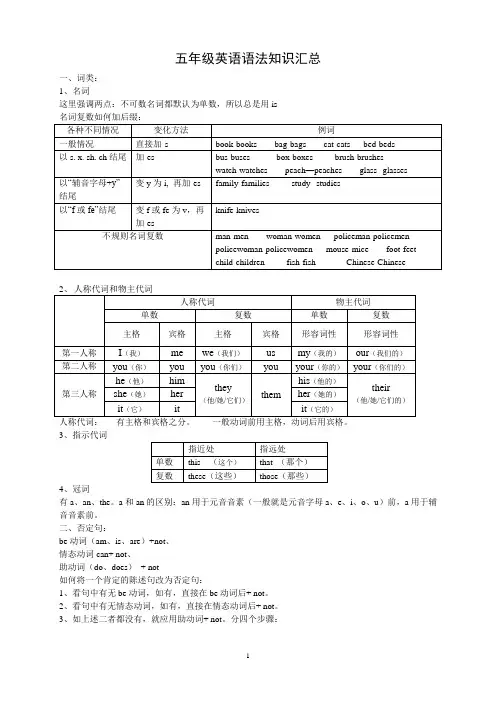
五年级英语语法知识汇总一、词类:1、名词这里强调两点:不可数名词都默认为单数,所以总是用is名词复数如何加后缀:人称代词:有主格和宾格之分。
一般动词前用主格,动词后用宾格。
3、指示代词4、冠词有a、an、the。
a和an的区别:an用于元音音素(一般就是元音字母a、e、i、o、u)前,a用于辅音音素前。
二、否定句:be动词(am、is、are)+not、情态动词can+ not、助动词(do、does)+ not如何将一个肯定的陈述句改为否定句:1、看句中有无be动词,如有,直接在be动词后+ not。
2、看句中有无情态动词,如有,直接在情态动词后+ not。
3、如上述二者都没有,就应用助动词+ not。
分四个步骤:(1)肯定陈述句中本来是没有助动词的,要加上去,位置在主语(某人或某物)后,动词前。
(2)确定助动词用do、does,根据句中动词,动词是原形的助动词就用do,动词是第三人称单数的助动词就用does,(3)在助动词后加not。
(4)原句中动词假如发生变化就要恢复成原形。
强调一点,有some的要考虑是否要用any。
三、一般疑问句。
如何将一个肯定的陈述句改为一般疑问句:1、看句中有无be动词,如有,把be动词提到句首即可。
2、看句中有无情态动词,如有,把情态动词提到句首即可。
3、如上述二者都没有,就应把助动提到句首。
分四个步骤:(1)肯定陈述句中本来是没有助动词的,要加上去,位置在主语(某人或某物)后,动词前。
(2)确定助动词用do还是does,根据句中动词,动词是原形的助动词就用do,动词是第三人称单数的助动词就用does(3)把助动词后提到句首。
(4)原句中动词假如发生变化就要恢复成原形。
强调一点,有some的要考虑是否要用any。
四、特殊疑问句。
表示疑问,有疑问词(在开头),回答有很多种可能。
1、一般现在时(1)一般现在时中的be动词:一般用原形:am is aream用于第一人称单数(I);is用于第三人称单数(he she it和其他人名或称谓,如:Ben his sister 等);are用于第二人称单数(you)和所有复数(包括第一人称复数we、第二人称复数you;第三人称复数they和其他复数,如the children 、his parents等)。
(完整版)译林版五年级下英语知识点

译林新版小学五年级下册知识点整理Unit 1知识点一、单词:because 因为 fairy 仙女 fit 合适,合身 have to 不得不,必须mushroom 蘑菇 prince 王子 pick 摘,拾 take off 脱下clothes 衣服 let 让 put on 穿上 understand 明白,理解before 在…以前 late 迟的 try on 试穿 be bad for有害的pick 摘 leave…behind 留下,丢下二、词组:be sad 伤心 go to the party 去聚会 at the party 在聚会come back 回来 take off 脱下 have a good time 过得愉快try on 试穿 have to go必须走 leave…behind 留下,丢下in the forest 在深林里 under a tree在一棵树下 look so nice 看起来很漂亮are bad for us 对我们有害的 pick a big red mushroom 摘一个大红色的蘑菇at the prince's house 在王子的房子 don't have any nice clothes or shoes 没有漂亮的衣服或鞋子三、句型:1. Why are you so sad ? 你为什么这么伤心?2. Because I can’t go to the party. 因为我不能去参加聚会。
3.Why?为什么?4. Because I don’t have any nice clothes and shoes.因为我没有漂亮的衣服或鞋子。
四、语法: can't = can not don't =do not知识点1:can 的用法1)can表示能力,意思是“能,会”。
后面直接跟动词原形,用于一切人称和数。
新版译林英语五年级下册知识点整理
新版译林英语五年级下册知识点整理一、名词1.可数名词与不可数名词2.可数名词单数和复数形式的构成规则3.不可数名词的用法及常见不可数名词4.名词所有格的构成规则5.专有名词的用法及常见专有名词二、代词1.人称代词的用法及主格和宾格的区分2.物主代词的构成及用法3.反身代词的构成及用法4.指示代词的构成及用法5.疑问代词的构成及用法三、形容词1.形容词的用法及位置2.形容词比较级和最高级的构成规则3.形容词比较级和最高级的用法4.形容词的否定形式和副词形式四、动词1.动词的基本形式、过去式和现在分词的构成规则2.动词的时态:一般现在时、一般过去时和一般将来时3.动词的否定句和一般疑问句的构成规则4.动词的现在进行时和一般过去时5.常见动词短语的用法及意义五、副词1.副词的用法及位置2.程度副词的构成及用法3.时间副词和地点副词的用法4.方式副词的构成及用法六、介词1.常见介词的用法及意义2.介词短语的构成及用法3.介词和动词之间的搭配七、冠词1.冠词的用法及区分2.定冠词和不定冠词的用法3.零冠词的用法八、连词1.并列连词的用法及意义2.选择连词和副词从句的用法3.结果连词和原因连词的用法4.时间连词和条件连词的用法九、句子1.陈述句和疑问句的构成和用法2.祈使句和感叹句的构成和用法3.陈述句的肯定句和否定句的构成和用法4.疑问句的一般疑问句和特殊疑问句的构成和用法十、阅读1.阅读理解的基本技巧和策略2.阅读时的关键词和重点定位3.根据上下文推测词义的方法4.根据文章内容回答问题的技巧以上是新版译林英语五年级下册的知识点整理。
通过对这些知识点的学习和掌握,学生们能够提高自己的英语语言能力,进一步巩固和扩展自己的词汇量和语法知识,为更高年级的英语学习打下坚实的基础。
希望同学们能够通过系统学习和不断练习,提高自己的英语水平,更好地与世界沟通交流。
译林版五年级英语下册知识点汇总

译林版小学五年级下册知识点整理Unit1知识点一、单词:because因为fairy仙女fit合适,合身have to不得不,必须leave..behind留下,丢下mushroom蘑菇prince王子understand明白,理解pick摘,拾take off脱下be bad for有害的clothes衣服let让puton穿上before在..以前try on试穿late迟的pick摘二、词组:at the prince's house在王子的房子be sad伤心go to the party去聚会don't have any nice clothes or shoes没有漂亮的衣服或鞋子come back回来have a good time过得愉快at the party在聚会take off脱下try on试穿have to go必须走leave..behind留下,丢下in the forest在深林里under a tree在一棵树下pick a big red mushroom摘一个大红色的磨菇look so nice看起来很漂亮are bad for us对我们有害的1Why are you so sad?你为什么这么伤心?Because I can't go to the party.因为我不能去参加聚会。
Why?为什么?Because I don't have any nice clothes and shoes.因为我没有漂亮的衣服或鞋子。
四、语法:can't=can not don't=do notUnit2知识点一、单词:far from离….远near在.……附近by….乘.…bus公共汽车,大巴士on foot步行metro地铁taxi出租车,的士bike自行车plane飞机ship轮船train火车ride骑车show给……看basket篮子city城市二、词组:your new home你的新家very big很大far from school离学校远live on Moon Street住在月亮街上near City Library在城市图书馆附近come to school来学校by bus乘公共汽车on foot步行by metro乘地铁by taxi乘出租车a taxi driver-位出租车司机in the park在公园里can fly会飞show his bike to sam展示他的自行车给山姆看too young太小(年龄)sit in the basket坐在篮子里2Where do you live?你住在哪里?Ilive.…我住在……I live near/far from..我住在附近/离远How do you come to school?你怎样来学校的?I come to school..我来学校.……Unit3知识点一、单词:along沿着,顺着ask the way问路ask.…for help向…….求助full满的,饱的get to到达next to在……旁边on your right在的右侧。
新译林版英语五年级下册语法知识总结
新译林版英语五年级下册语法知识总结一、英语的时态1. 一般现在时 (Simple Present Tense)- 表示经常发生的动作或惯- 表示客观真理或普遍事实- "I go to school every day."2. 现在进行时 (Present Continuous Tense)- 表示正在进行的动作- 表示现阶段的临时动作- "She is playing soccer right now."3. 一般过去时 (Simple Past Tense)- 表示过去发生的动作或存在的状态- "I visited my grandparents last week."4. 过去进行时 (Past Continuous Tense)- 表示过去某个时间段正在进行的动作- "They were watching a movie at that time."5. 将来时 (Future Tense)- 表示将来要发生的动作或存在的状态- "I will go to the beach tomorrow."二、英语的语态1. 主动语态 (Active Voice)- 谓语动词的主语是动作的执行者- "Tom ate an apple."2. 被动语态 (Passive Voice)- 谓语动词的主语是动作的承受者- "The apple was eaten by Tom."三、英语的句型1. 肯定句 (Affirmative Sentence)- 表述陈述事实或肯定情况- "She likes to sing."2. 否定句 (Negative Sentence)- 表述否定事实或否定情况- "He doesn't eat meat."3. 疑问句 (Interrogative Sentence)- 用于提问,需要以疑问词或助动词来构成- "Where is your sister?"4. 祈使句 (Imperative Sentence)- 用于发出请求、命令、建议等- "Please close the window."四、英语的词性1. 名词 (Noun)- 用来表示人、事物、动物、地方等- "cat, book, teacher"2. 动词 (Verb)- 用来表示动作或状态- "run, eat, sleep"3. 形容词 (Adjective)- 用来修饰名词或代词- "beautiful, happy, tall"4. 副词 (Adverb)- 用来修饰动词、形容词、副词等- "quickly, very, well"5. 代词 (Pronoun)- 用来代替名词作主语、宾语等- "I, you, he, she"以上是新译林版英语五年级下册的语法知识总结,希望对你有所帮助。
新译林版英语五年级下册语法知识归纳

新译林版英语五年级下册语法知识归纳一、名词1. 名词是指表示人、事、物、地点等具体或抽象概念的词语。
2. 可数名词可以和数词连用表示数量,如one cat、three apples。
3. 不可数名词不可以和数词连用,表示具体或抽象的事物,如milk、water。
二、动词1. 动词是指表示动作、状态或存在的词语。
2. 动词分为及物动词和不及物动词。
- 及物动词需要有宾语才能构成完整的谓语,如She likes apples。
- 不及物动词可以独立构成谓语,如I swim every day。
三、形容词1. 形容词是用来修饰名词或代词的词语。
2. 形容词可以表示人或物的特征、性质、状态等。
3. 形容词可以用来比较大小,常用词尾+er表示比较级,如taller、bigger。
4. 形容词可以用来最高级,常用词尾+est表示最高级,如tallest、biggest。
四、副词1. 副词是用来修饰动词、形容词或其他副词的词语。
2. 副词用来描述动作的方式、程度、时间等。
3. 副词可以用来比较程度,常用more或less表示比较级,如more beautiful、less careful。
4. 副词可以用来最高级,常用most或least表示最高级,如most beautiful、least careful。
五、代词1. 代词是用来代替名词的词语。
2. 代词可以替代人或物,在句子中充当名词的角色。
3. 代词包括人称代词、物主代词、指示代词、疑问代词等。
六、介词1. 介词是用来表达名词与其他单词(如动词、形容词等)之间的关系的词语。
2. 介词可以表示位置、方向、时间、原因等。
3. 常用的介词有in、on、at、from、to、with等。
七、连词1. 连词是用来连接词语、词组、句子等的词语。
2. 连词可以连接并列词语、并列词组或并列句子。
3. 常用的连词有and、but、or、so等。
八、语序1. 语序是指词语在句子中的顺序。
译林版五年级英语下册语法知识点总复习汇总
译林版五年级英语下册语法知识点总复习汇总五年级下册知识点⼀、名词(单数,复数,不可数)1.单数 a fairy , a toothachean art room/ English teacher / idea / umbrella ( a.e.i.o.u)2.复数 1.⼀般直接+s:trains,students,2.以s. x. sh.ch结尾,加es:bus-buses,class-classes,3. 以“辅⾳字母+y”结尾,变y为i,加es:library—librarieshobby---hobbies city——cities family——families4. 以o结尾的,加es:potatoes,tomatoes5.不规则名词复数: man-men, woman-women, policeman-policemen child-childrenfoot-feet,tooth-teeth3. 不可数bread,meat,soup, milk,juice,tea , rice …⼆、⼈称代词1.主格:I we you you he she he it they★2.宾格:me us you you him her him it themtry it/them on help me/him/herWhat’s wrong with him/her/them? eat thembe bad for us Let me/us….give it a cake come to see him3.形容词性物主代词:my our your your his her its their★三、介词1、表⽰时间的:①in +⽉份:in January ,in April②in the morning /afternoon/evening③in +季节:in winter④on +具体⽇期on the 23rd of June⑤at +具体时刻at five o’clock2、表⽰节⽇的:①at Spring Festival at Christmas / Halloween②on Mother’s Day on Children’s Day3、表⽰地点的:(far from/near/next to/beside/behind/between/under/in/on/at)①at the party / at the prince’s house / at the traffic lights / at the bus stopat Park Station / at home/school②on your left③on Moon Street / in Sunshine Town★四、季节和⽉份Spring is in March,April and May. warmSummer is in June,July and August. hotAutumn is in September,October and November. coolWinter is in December,January and February. cold★五、基数词和序数词基数词:one two three four five six seven eight nine teneleven twelve thirteen fourteen fifteen sixteen seventeeneighteen nineteen twenty twenty-one thirty ···序数词:first second third fourth fifth sixth seventh eighth ninth tenth eleventh twelfth thirteenth fourteenth fifteenth ···twentieth twenty-first thirtieth thirty-second序缩写:六、哪些情况加动词原形:1.can /should /would2. let3.助动词do/does4.to练习:1.Su Hai should ___________(take) some medcine.2.Let’s go and ____________(have)a party.3.______(do)Nancy ______ (like) _______(dance) ?4.Cinderella has to ___________(come) back before 12 o’clock.七、哪些情况加动词ing1.be2. go3.be good at4.like5.what /how about注意:动词ing形式也叫作动词的现在分词(-ing),变化规则:(1)直接加ing:draw——drawing play——playing(2)以不发⾳的e结尾的,去e加ing:dance——dancing skate——skating make——making have——having write——writing live——living come------coming ride -------riding drive------driving(3)以重读闭⾳节结尾,呈现“辅元辅”结构的,双写末字母加ing:swim——swimming run——running chat——chattingsit——sitting put ——putting shop——shoppingget-----getting练习:1.Let’s go ________(swim) this afternoon.2.You’re really good at _________(skate).3._____(be) your uncle ______(read) books now?4.How about ________(watch) a film?★⼋、现在进⾏时表⽰:正在进⾏的动作或存在的状态。
完整word版译林版五年级英语下册语法知识点总复习
五年级下册知识点一、名词(单数,复数,不可数)1.单数 a fairy , a toothachean art room/ English teacher / idea / umbrella ( a.e.i.o.u)2.复数 1.一般直接+s:trains,students,2.以s. x. sh.ch结尾,加es:bus-buses,class-classes,3. 以“辅音字母+y”结尾,变y为i,加es:library—libraries hobby---hobbies city——cities family——families4. 以o结尾的,加es:potatoes, tomatoes5.不规则名词复数: man-men, woman-women, policeman-policemen child-children foot-feet,tooth-teeth3. 不可数 bread,meat,soup, milk,juice,tea , rice …二、人称代词1.主格:I we you you he she he it they★2.宾格:me us you you him her him it themtry it/them on help me/him/her What's wrong with him/her/them? eat thembe bad for us Let me/us….give it a cake come to see him 3.形容词性物主代词:my our your your his her its their★三、介词1、表示时间的:① in +月份: in January , in April② in the morning /afternoon/evening③ in +季节: in winterrd of June on the 23+具体日期④on⑤ at +具体时刻 at five o'clock2、表示节日的:① at Spring Festival at Christmas / Halloween② on Mother's Day on Children's Day3、表示地点的:(far from/near/nextto/beside/behind/between/under/in/on/at)① at the party / at the prince's house / at the traffic lights/ at the bus stopat Park Station / at home/school② on your left③ on Moon Street / in Sunshine Town★四、季节和月份Spring is in March,April and May. warmSummer is in June,July and August. hotAutumn is in September,October and November. coolcold in December,January and February. is Winter★五、基数词和序数词基数词:one two three four five six seven eight nine teneleven twelve thirteen fourteen fifteen sixteen seventeeneighteen nineteen twenty twenty-one thirty ···序数词:first second third fourth fifth sixth seventh eighth ninthtenth eleventh twelfth thirteenth fourteenth fifteenth ···twentieth twenty-first thirtieth thirty-second序缩写:六、哪些情况加动词原形:1.can /should /would2. let3.助动词 do/does4.to练习:1.Su Hai should ______(take) some medcine.2.Let's go and ______(have)a party.3.______(do)Nancy ______ (like) _______(dance) ?4.Cinderella has to ______(come) back before 12 o'clock.七、哪些情况加动词ing1.be2. go3.be good at4.like5.what /how about 注意:动词ing形式也叫作动词的现在分词(-ing),变化规则:(1)直接加ing:draw——drawingplay——playing(2)以不发音的e结尾的,去e加ing:dance——dancing skate——skating make——making have——having write——writing live——living come------coming ride -------riding drive------driving(3)以重读闭音节结尾,呈现“辅元辅”结构的,双写末字母加ing:swim——swimming run——running chat——chattingsit——sitting put ——putting shop——shoppingget-----getting练习:1.Let's go ________(swim) this afternoon.2.You're really good at _________(skate).3._____(be) your uncle ______(read) books now?4.How about ________(watch) a film?★八、现在进行时表示:正在进行的动作或存在的状态。
江苏译林版英语五年级下册必背语法知识点
江苏译林版英语五年级下册必背语法知识点1.Be动词包括am、are、is三个。
2.“吃一日三餐”中的“吃”只能用have,不能用eat,因为eat指的是具体食物。
3.“It’s time to”后接动词词组,如“It’s time to eat the cake”,而“It’s time for”后接名词,如“It’s time for the cake”。
4.在英语句子中,时间和地点通常放在句子的开头或结尾。
5.Whose是“谁的”,后接名词,表示询问物品的主人;who’s是“谁是”,后接人,具体询问人是谁。
6.Fun表示有趣、乐趣,而XXX表示滑稽、好笑。
7.So表示“如此的、那么的”;very表示“很、非常”;too表示“太”。
这三个词语意思不同。
8.在一般现在时中,当主语是第三人称单数时,加助动词do,它会吸动词上的s。
改成疑问句时,do变成does,被它吸走后动词就变成原形了,例如“He has XXX”变成“Does he have XXX?”。
9.当单词的开头是元音发音时,an可以用在其前面。
10.打电话时常用的语言包括“May I speak to…”、“Yes。
this is…”、“Who’s that?”等。
11.有些单词本来就是复数,如trousers、glasses、noodles 等,加量词时仍保持复数形式,如“a pair of trousers”、“a bowl of noodles”。
12.不可数名词可以通过加量词变成可数,如“a pair of shoes”、“a bowl of soup”。
13.时间和日期相关的词汇都可以用“on”,包括“on Monday”、“on New Year’s Eve”等。
14.“舞蹈课”和“画画课”可以变成动词形式的“dancing lesson”和“drawing lesson”。
15.Any通常用在否定句和疑问句中。
16.在Can I have some…和Would you like some…等问句中,不需要使用any。
(完整版)译林英语五年级下册知识点整理
译林新版小学五年级下册知识点整理Unit 1 Cinderella一、单词:二、词组:1.at the prince’s house 在王子的房子2.be sad 伤心3.go to the party 去聚会4.don’t have any nice clothes or shoes没有漂亮的衣服或鞋子e back 回来6.have a good time 过得愉快7.at the party 在聚会8.take off 脱下9.try on 试穿10.have to go必须走11.leave…behind 留下,丢下12.in the forest 在深林里13.under a tree在一棵树下14.pick a big red mushroom摘一个大红色的蘑菇15.look so nice 看起来很漂亮16.are bad for us 对我们有害的三、句型:1.Why are you so sad ? 你为什么这么伤心?2.Because I can’t go to the party. 因为我不能去参加聚会。
3.Why?为什么?4.Because I don’t have any nice clothes and shoes.因为我没有漂亮的衣服或鞋子。
四、语法:c an’t = can not don’t =do notUnit 2 How do you come to school?一、单词:二、词组:1.your new home 你的新家2.very big 很大3.far from school 离学校远4.live on Moon Street 住在月亮街上5.near City Library在城市图书馆附近e to school 来学校7.by bus 乘公共汽车8.on foot 步行9.by metro 乘地铁10.by taxi 乘出租车11.a taxi driver 一位出租车司机12.in the park 在公园里13.can fly 会飞14.show his bike to sam 展示他的自行车给山姆看15.too young 太小(年龄)16.sit in the basket 坐在篮子里三、句型:1.Where do you live?你住在哪里?2.I live …我住在……I live near/ far from…我住在附近/离远3.How do you come to school? 你怎样来学校的?4.I come to school…我来学校……Unit 3 Asking the way二、词组:1.want to visit 想要参观2.get to 到达3.get on上车4.get off 下车5.at Park Station在公园站6.walk to 走到7.next to 在……旁边8.on the street 在街上e out from从……出来11.ask a policeman for help 向一位警察求助12.go along this street 沿着这条街走13.on your right 在你的右侧14.see a new film 看一部新电影15.wait for the bus 等公交车16.take the metro 乘地铁17.be over 结束18.at the traffic lights 在交通灯19.turn left向左转20.turn right 向右转三、句型:1.How do I get to …?我怎样到达……?2.Go along this street.沿着这条街走。