
外研版英语九年级上册 Module2 Unit3
外 研 版 英 语 九年级 上册 M odule 2 Unit 3
think about 考虑;思考
其后跟名词、代词或动名词作宾语
I’ll think about it. 我会考虑这件事的。 Did you think about going to Hainan for a holiday? 你考虑过到海南度假吗? make a wish 许个愿望 Throw some money in the fountain and make a wish. 往喷泉里扔些钱,学个愿望。
1. __A_f_t_er____ our friends arrived, we all went to the square.
2. __W__h_il_e__ they were watching TV, we listened to music and sang traditional songs.
5. We have celebrated the festival _s_i_n_c_e_ the first pioneers from England arrived in America.
6. _A_f_t_e_r they landed, their first winter was worse than any English winter.
2. _B_e_f_o_r_e_ we begin dinner, my father gives thanks for the food.
3. _W__h_e_n_ it is all over, everyone helps wash the dishes.
4. And my family always go somewhere interesting __a_s_s_o_o_n_a_s__ the holiday begins.
Daming: Yes, we don’t want to get there (3)___a___.
Betty: Oh, Daming! You always think about eating.
Daming: Well, it’s something to do (4)___f____.
Betty: Байду номын сангаасon’t you want to make a wish for the New Year (5)___d_____.
Betty: When are we going to the party?
Daming: We’re waiting for you. We can go (1)__b___.
Betty: OK, let’s go. It’s better to be early and get there (2)__c____.
__si_n_c_e__ he started to learn English last month.
make progress 取得进步
Study well and make progress every day.
好好学习,天天向上。
make a lot of progress 取得许多进步
We all decided to make a lot of progress in the new term. 我们都决定要在新学期取得进步。
3. _A_s__so_o_n__a_s_ it was twelve o’clock, we all shouted “Happy New Year”.
4. We stayed there _u__n_ti_l she arrived. 5. He has made a lot of progress
外 研 版 英 语 九年级 上册 M odule 2 Unit 3 外 研 版 英 语 九年级 上册 M odule 2 Unit 3
1. _W__h_i_le__ we’re staying with our friends, we’re going to spend one day in Qingdao.
外 研 版 英 语 九年级 上册 M odule 2 Unit 3
外 研 版 英 语 九年级 上册 M odule 2 Unit 3
外 研 版 英 语 九年级 上册 M odule 2 Unit 3
Children think that Father Christmas waits (2)__u_n_ti_l_ they are asleep and then comes in and leaves presents for them. They would like him to come (3)_b_e_f_o_r_e_ they fall asleep, so they can see him. They do not know that it is their parents who put the presents at the end of their beds
(4)_w__h_il_e_ they are sleeping.
外 研 版 英 语 九年级 上册 M odule 2 Unit 3
外 研 版 英 语 九年级 上册 M odule 2 Unit 3
We have several weeks off school and we can (2)_s_p_e_n_d__so_m__e__ti_m_e__ doing our favourite things. For example, we can (3)__g_e_t_t_o_g_et_h_e_r___ with friends. When the weather is good, we can (4)_h_a_v_e__a_p_i_c_n_ic___ in the park and play games (5)_a_s_w__e_ll__.
外研版九上英语Module 3 Unit 2
He developed training courses for local
doctors and nurses; and wrote books so that
they could learn about how he treat 目的状语
the sick.
从句
Dr Bethune often worked very hard w设ith法ou完t r成esting or taking care of himself. Once, he even worked for
3. What did Norman Bethune do during his stay in China? He helped treat the wounded, developed training courses for local doctors and nurses and wrote books.
sixty-nine hours without stopping and managed to
save over a hundred lives. One day in 1939, he cut
his finger during an operation, but he continued his
on one’s own
意为“独自的;独立的;主动的”。
例:我能独立把工作完成。 I am able to finish the work on my own.
continue
(1) continue 作动词,“继续”。 常用短语:continue to do/doing sth. 继续从事某事 相当于go on doing sth
Canadian doctor hospital sick soldier treat war wound
外研版英语九年级上册模块1--Unit-3复习课教案
Module 1Unit3Language in useⅠ、Teaching model:Revision and applicationⅡ、Teaching method:Formal and interactive practiceⅢ、Teaching ObjectivesKnowledge objective1.To review the key words, phrases, and sentences of M1.2.To learn to use different tensesAbility objective1. To understand and use different tenses2. To learn to describe places and experiences.Moralobjective.To learn about the wonders of China and the world. Love our country, be proud of our country.Ⅳ、Teaching importance and difficulty1.To summarise and consolidate the use of articles2. To practise the new vocabulary and expressions.V、Teaching methodPWP method, task-based methodVI、Teaching aidsA tape recorder, multimedia and some picturesⅦ、Teaching ProceduresLearning Aims(学习目标)1.To review the key words, phrases, and sentences of M92.To use articles3. To learn to read large numbersStep 1:Review the knowledge(知识回顾)1.师友互查1)Review the phrasesgo through, fall away, on top of, look over, look across, look down,get out of , join in, agree with, man-made, more than, millions of,in one’s opinion2)课文原句在现1. I got out of the car, went through a gate and walked along a dark path.2. I looked over them, but it was silentand there was no sign of it.3. I looked down to the Colorado River4. Finally, I looked to my left and to my right.5. The sun rose behind me and shone ontherocks.Farbelowme,thegroundfell away and down to a river.6. I remained by the canyon for a bout half an hour…7.Let’s callWonder of the Worldand join in the discussion.8.I think the Giant’s Causeway is the most fantastic natural wonder.9. I think Victoria Falls in Africa is even more fantastic.10. But in my opinion, man-made wonders are more exciting than natural ones.(友情提示:师友朗读,理解记忆。
外研-九年级上册-学生版-Module2

Module 2 Public holidays【新手目标】通过本关,你能够听懂节假日方面的话题并能进行相关对话。
关卡1 Unit1 My family always go somewhere interesting as soon as the holiday begins.【过关笔记】Tony: The First of October is China's National Day, isn 't it, Lingling?Lingling: Yes. The People's Republic of China was founded on 1st October 1949. People have celebrated the National Day since then. There are flowers and national flags everywhere, and we have a threeday holiday.Tony: Do you have any plans for the holiday this year?Lingling: Yes. My parents and I are going to visit some friends in Shandong Province and will stay there until the end of the holiday. While we're staying with our friends, we're going to spend one day in Qingdao. When is your national day, Betty'?Betty : Our national day is called Independence Day. It's on 4th July. We've celebrated it since 1777. It's a public holiday, but we only have one day off. On that day, there are all kinds of holiday activities. It's the start of the vacation season and most people take a vacation sometime in July or August.Lingling: And is there anything special on that day?Betty: Well, you can see American flags everywhere. We usually have a picnic somewhere nice. Kids have great fun. We also watch bands play music in public parks.Daming: Do you have a national day in the UK, Tony?Tony: No, we don't we celebrate Christmas with a twoday holiday. And my family always go somewhere interesting as soon as the holiday begins.【成长例题】一、单项选择例题1. Look! Some people are having fun ________ in the river.A. swimB. to swimC. swimmingD. swims例题2. If you want to get on well with your classmates, you’d better not think too much aboutyourself, because a selfless(无私的)child is popular ________.A. somewhereB. everywhereC. where例题3. I hope to see you again ________ next year.A. every timeB. sometimeC. some timesD. sometimes例题4. I saw some boy students ________ basketball when I passed the playground.A. playedB. playsC. playingD. to play例题5. —Rose, have you taken a visit ________?—Yes, I visited the Giant's Causeway last month.A. anywhere fantasticB. somewhere fantasticC. fantastic somewhereD. fantastic anywhere二、用所给词的适当形式填空例题1. There are all________(kind) of flowers in the park.例题2. I live on the________(twelve) floor of the building.例题3. The mother won’t go until her son ________(e) back.例题4. As soon as they________(arrive) there, they will go to the hospital.例题5. The young man __________(live) alone since he graduated from college. 【过关练习】一、用下面方框内的词或短语的适当形式填空1. That was years ago. I’ve changed jobs __________.2. At the Spring Festival, we often __________ and eat dumplings.3. There are _________ holiday activities on Independence Day.4. —Yifan, what’s your _________ language?—Chinese. I’m proud of it.5. The new movie began _________ we arrived.二、用所给词或短语翻译句子1. 下周我将请两天假。
九年级英语外研版上册Module3_Unit2_课时训练(三)
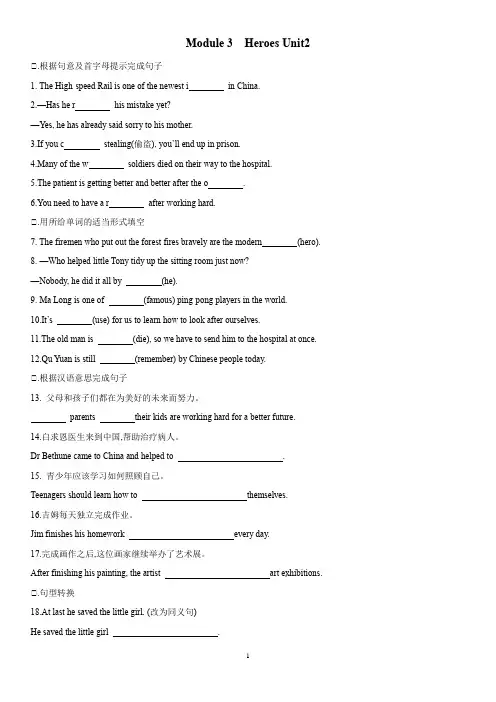
Module 3Heroes Unit2Ⅰ.根据句意及首字母提示完成句子1. The High-speed Rail is one of the newest i in China.2.—Has he r his mistake yet?—Yes, he has already said sorry to his mother.3.If you c stealing(偷盗), you’ll end up in prison.4.Many of the w soldiers died on their way to the hospital.5.The patient is getting better and better after the o.6.You need to have a r after working hard.Ⅰ.用所给单词的适当形式填空7. The firemen who put out the forest fires bravely are the modern(hero).8. —Who helped little Tony tidy up the sitting room just now?—Nobody, he did it all by (he).9. Ma Long is one of (famous) ping-pong players in the world.10.It’s (use) for us to learn how to look after ourselves.11.The old man is (die), so we have to send him to the hospital at once.12.Qu Yuan is still (remember) by Chinese people today.Ⅰ.根据汉语意思完成句子13. 父母和孩子们都在为美好的未来而努力。
外研版九年级英语上册教案Module 3 Unit 2

Module 3 HeroesUnit 2 There were few doctors, so hehad to work very hard on his own.教材分析This is the second lesson in this module. The reading material is information about heroes. It’s a good text to help the students improve their reading strategies, such as getting information from the reading material.教学目标【知识目标】1. Key words:Canadian,sick,soldier,treat,war,wound,realise,dying,care,tool,invention,useful,rest,himself,manage,operation,continue,Canada2. Key phrases:die for, take care of, so that, in the end, close to, both...and...,at that time, die of3. Key sentences:(1)He invented special medical tools to use outside hospitals and close to the fighting areas so that doctors could treat the wounded more quickly.(2)There were few doctors, so he had to work very hard on his own.(3)He developed training courses for local doctors and nurses,and wrote books so that they could learn about how he treated the sick.【能力目标】To know about the life story of heroes and put important things in the right order according to the timeline.To write a passage to introduce Ss’ own heroes.【情感目标】To know about the life story of heroes and learn from them.教学重难点【教学重点】1. Key words:Canadian, sick, oldier, reat, war, wound, realise, dying, care, tool, invention, useful, rest, himself, manage,operation, continue, Canada2. Key phrases:die for, take care of, so that, in the end, close to, both...and...,at that time, die of3.Key sentences:(1)He invented special medical tools to use outside hospitals and close to the fighting areas so that doctors could treat the wounded more quickly.(2)There were few doctors, so he had to work very hard on his own.(3)He developed training courses for local doctors and nurses, and wrote books so that they could learn about how he treated the sick.【教学难点】To improve reading skills课前准备Multimedia教学过程Step I.Warming up and leading inT: Work in pairs and look at the picture and discuss who the person is and what he or she did. Use the words in Activity 1 to help you.Ss: Take turns talking about Norman Bethune.S1:....S2:....T:Do you want to know more about Norman Bethune?Today let’s know about him.【设计意图】通过讨论英雄人物——白求恩,激发学生学习兴趣,从而为导入新课打下基础。
外研版九年级英语上册教案 Module3 Unit2

Unit 2 There were few doctors, so he had to work very hard on his own.【教学目标】1.通过阅读My hero-Dr Norman Bethune,让学生掌握并运用略、精读的技巧,即略读找大意,精读搜索相关信息。
2通过精读,学生能在语境中感知so, so that和because引导的状语从句的用法。
.3. 通过了解英雄人物,学生做到爱英雄、学英雄、争做英雄,以此发奋学习,热爱生活,做国家有用人才。
【教学方法】本课主要采用任务型教学方法,通过自主学习、合作学习的方式,借助教学评价手段督促学生,通过网络课件提高课堂教学密度,加大信息量的输入,其模式是教师创设自主学习情境——学生进入情境进行意义建构——学生走出情境实现知识迁移运用——自我评价与反馈。
【教学过程】I. Warming-up通过图片和视频对白求恩做简单介绍。
II. New wordsFinish Activity 1 on page 20.Learn some new words in this unit.III. Reading1. Read the passage and check your answers to Activit y 1.2. Listen to the passage and fill in the blanks.Name: Norman BethuneNationality:_______Be born in :_______Became a doctor in :_______Came to China in:_______3. Read and number the events about Norman Bethune in the order they happened.a came to Chinab wrote books about ways of treating the sick in Chinac was born in 1890d invented medical tools to use outside hospitalse diedf went to treat the wounded soldiers in Spain4. Read the passage again and answer the questions. (so that用法)1) Why did he go to China during the Anti-Japanese War?2) Why did he invent special medical tools to use outside hospitals?3) Why did he develop training courses for local doctors and nurses, and wrote books?5. Finish Activity 4 on page 21.IV. Language points1. He came to China to help the Chinese people and died for them.die for 意为“为……而死”。
外研版九年级英语Module 2 Unit 3
4. My favourite sport is _f_o_o_t_b_a_l_l_ because _it__is__v_e_r_y__in__te_r_e_s_t_i_n_g____.
5. I usually play sports on__S_a__tu__r_d_a_y_s____. 6. After-school activities, such as_d__a_n_c_i_n_g_
Anna: Hi, Bob. How did your exams go last term? Bob: Great! I got good marks in (1) both / each maths and geography. What about you?
Anna: I did really well in English. That’s (2) anything / something I’ve always enjoyed. My marks in history and art weren’t so good, because (3) none / neither is my favourite subject. What will you study this term?
holiday in Germany
language
win all
Pete Year 10 GeographyClub, football my chess
chess club
matches
8 Read the passage and say where you think it comes from.
Wednesday afternoons.
7 Listen again and complete the table.
外研版英语九年级上册Module 2单元知识点归纳总结(详细版)
Module2 Public holidaysUnit1 My family always go somewhere interesting as soon as the holiday begins.1.The People’s Republic of China (简写为PRC) was founded (一般过去式的被动语态) on 1st October, 1949.find–found--found找到found—founded--founded建立, 创立类似的:lie- lay- lain 躺(现在分词l y ing)lie- lied- lied 撒谎lay- laid- laid 下蛋;铺设,摆设(三单lays 现在分词laying)1)I lay on the floor with my legs in the air.我躺在地上,双腿抬起。
2)Don’t believe him. He’s lying.3)My hen lays an egg a day.4)They laid him on the floor. 他们把他放在地上。
lay the table 摆放餐具2.People have celebrated the National Day since then. (since then从那以后, 是现在完成时的标志)eg: He went to Beijing in 1999. He has lived there since then.celebrate vt.eg:We held a party to celebrate our success.我们举行宴会庆祝我们的成功。
celebrate… with…用…来庆祝have a celebrat ion n.3. have…off休息多少时间eg:I’m going to have some time off.I was off duty yesterday. 昨天我不值班。
外研版九年级英语上册教案Module 3 Unit 2(外研)
Module 3Unit 2 There were few doctors, so hehad to work very hard on his own.◆教材分析本模块围绕英雄这一话题,开展听,说,读,写活动。
语法重点是操练由so, so that 和because 引导的状语从句。
语言技能和语言知识主要都是围绕英雄人物这一中心话题展开。
通过了解英雄人物,培养学生爱英雄,学英雄,争做英雄的好品质,并以此发奋学习,做国家有用人才。
本单元是阅读课,通过了解白求恩这位英雄,学习一些相关词汇,更重要的是通过阅读这个语篇,学习如何描述一位英雄,为写作打基础。
◆教学目标【知识目标】1、让学生学会使用本课的单词,重点是一些动词的用法。
2、学生能在情景对话中熟练运用所学知识。
【能力目标】能够正确掌握并运用并列连词so和从属连词because,so that,能够对袁隆平进行全面的描述或独到的评价。
【情感目标】通过大量阅读名人传 记,从中懂得做人的道理,勇于担当, 甘于奉献, 体验人生价值的真谛。
【教学重点】 1.词汇operation, treat, wounded, dying, continue, realize, useful, manage,2.短语die for, save one’s life, at that time, on one’s own, the sick, die of, in the end.3.句型 He came to China to help the Chinese people and died for them.He had to work very hard on his own.【教学难点】掌握并运用并列连词so 和从属连词because, so that.多媒体课件、单词卡片Step 1 VocabularyOrganize the students to read the new words together.Step 2 PresentationLook and say用所给的连接词和提示完成状语从句。
外研九年级英语上册Module3 Unit2 课件(共30张PPT)
order: a c d e b f
Pass Challenges (闯关)
Boys VS Girls
Read Paragraph One and Paragraph Two,then do true or false !
1.Norman Bethune is one of China’s most
4 他继续工作直到深夜。
He _c_o_n_ti_n_u_e_d_w__o_rk__in_guntil __l_a_te_ at night.
5尽管下着大雨,他们还是决定去帮助危险中的
群众。
I_n__ _sp__it_e_ _o__f_ the heavy rain, they decide t_o__h_e_lp___ the people __in__ _d_a_n__g_e_r.
famous heroes. T
2.Norman Bethune is Chinese. F
3. He gave his life to helping the Japanese
people. F
4.He was born in 1890 and became a doctor in
1926. F
5.Norman Bethune went to the front to look after
injured soldires in the Second World War.F
Read Paragraph There and choose the right answer to each question.
1.When did Norman Bethune come to China ?