
陕旅版四年级英语上册 unit 4 第三课时
She gets up at six.
When does she get up?
She goes to bed at twelve.
When does she go to bed?
Oh! She goes to bed late.
Look and talk
A: When does he ... B: He ... A: When do you ... Then? B: I ... at ...
五、阅读短文,判断句子正(√)误(×)。 I get up at six. I have breakfast at seven. Then I have a class at eight. I have lunch at twelve. I play games at four in the afternoon. School is over at five. I have dinner at six. I don’t watch TV.I go to bed early. ( (×)2.I have a class at 7:30. √)1.I get up at 6:00. ( √)3.I have lunch at 12:00. (×)4.I watch TV at 6:30. (×)5.I go to bed late.
He goes to school at eight.
When does he have classes?
He has classes at nine.
When does he go to bed?
He goes to bed at ten.
Read a sபைடு நூலகம்ory
OK, Mom.
It’s too late, Kitty. Go to bed.
同学们,这一课学习的单词你们都掌握了吗?现在大 家来检验一下,点击下面的视频开始听写吧 !
2.She goes to bed late. 她睡得晚。 在一般现在时中,当人称是第三人称单 数时,动词要用它对应的第三人称单数形式。 动词第三人称单数形式变化规则: ①一般情况下,直接在动词后加s。 stop— stops read—reads
②以“辅音字母+y”结尾的,改y为i,再加es。 fly— flies
太热了。 It's too hot. too作为“也”的意思时放在句尾, 并且前面要用“,”隔开。 我也是七点起床。 I get up at seven, too.
Exercise
一、单项选择。 ( B )1.—What do you do at 8:00 in the morning? —I ____ . A. have lunch B. have a class C. go to bed ( A )2. We have lunch ____ 12:00. A. at B. in C. on ( B )3. I go to bed early ____ the evening. A. at B. in C. on
Breakfast is ready. Get up, Kitty!
When do you go to bed?
I go to bed late at night.
Early to bed and early to rise!
Language points
It’s too late, Kitty. 凯蒂,太晚了。 too意为“太……”,用来表示程度。
Listen and choose
听力原文
1. —Does she play games in the afternoon?
—Yes, she does. 2. I watch TV in the evening.
3. —When does Mary go to bed?
—She goes to bed at nine.
Unit 4
When do you have classes?
陕旅版四年级上册
New words
早 的 I get up early today.
晚的;迟的 Don’t be late.
Let’s learn more
No. But my mother gets up very early. Do you get up early in the morning?
Play roles
I say, you do, then you say, I do.
Look and talk
A: When does he ... B: He ... A: When do you ... Then? B: I ... at ...
Play roles
When does he go to school?
Play roles
When does he go to school?
He goes to school at eight.
When does he have classes?
He has classes at nine.
When does he go to bed?
He goes to bed at ten.
③以s,x,ch,sh结尾的,在词尾加es发音为/Iz/。
teach— teaches
④以o结尾的动词,加es go— goes
⑤特殊变化。 have — has
go to bed意为“上床睡觉”。
Let’s play
Go to bed, go to bed. Please go to bed.
Check answer
Language points
1. Do you get up early in the morning? 你早晨起床起得早吗? 由助动词do构成的一般疑问句的句型结构为: Do+主语+动词(短语)原形+其他?。
肯定回答为:Yes, I / we do.“是的”; 否定回答为:No, I / We don't. “不,不是”。
陕旅版四年级英语上册课件Unit 4 Part A(陕旅)

陕西旅游出版社 四年级 | 上册
When do you get up
When do you have breakfast in the When do you go to school morning?
When do you have a class
陕西旅游出版社 四年级 | 上册
When do you play games in the When do you go home afternoon?
陕西旅游出版社 四年级 | 上册
陕西旅游出版社 四年级 | 上册
Unit 4
When do you have classes? Part A
Leading in.
陕西旅游出版社 四年级 | 上册
The answer is clock.
What time is it?
It's 7 o'clock.
陕西旅游出版社 四年级 | 上册
听录音,回答问题: When does Shanshan have classes?
陕西旅游出版社 四年级 | 上册
When do you have classes, Shanahan?
陕西旅游出版社 四年级 | 上册
I have classes at eight in the morning.
听录音,回答问题: When does Shanshan play games at school?
When do you play games?
I play games at four in the afternoon.
陕西旅游出版社 四年级 | 上册
两人一组,用句型: —When do you + 动词短语? —I…轮流问答。
陕旅版四年级英语上册全套课件 unit3

Unit 3 What’s for breakfast?
陕旅版四年级上册
New words
Draw your likes , or dislike
milk ice-cream cake candy
egg fish grape vegetable
I have rice and fish for dinner.
Let’s learn
breakfast
lunch
rice noodles soup dumplings meat chicken
Let’s talk
Good morning, Mom and Dad! What’s for breakfast?
apple bread orange pear
banana cookie tea juice
Play roles
apple
Do you like apples?
Do you like bananas?
banana
Yes, I do. No, I don’t.
Do you like ice-cream?
We have eggs, bread and milk.
Great! Thank you, Mom
Hi, Mom! What’s for lunch?
Look! We have rice, chicken, Very good! vegetables and soup.
Play roles with your partner
第一人称用am, 第二人称和复数用 are,第三人称单数用is。
我准备好了。 I am ready.
陕旅版小学英语四年级上册全册教案

陕西旅游版四年级英语上册教案学校:教师:日期:陕旅版小学四年级《英语》上册教材分析1. 陕旅版小学四年级《英语》上册教育理念教材是实施课标的手段之一,是对课标的具体细化,在实际教学中是主要的教学资料,科学地对教材定位就是用教材教,而不是教教材。
修订后的陕旅版小学四年级《英语》上册教材依据国家教育部颁布的2011版英语课程标准,严格遵循新课标的教育理念和教学目标,以“话题—功能—结构—任务”为基本思路编写设计而成的。
该书以Alice、Su Nan、Kitty、Wu Chen、Colin、Kevin、Li Shan、Liu Zhaoyang 以及活泼可爱、滑稽有趣的Toby和Aggie为主线形象;由他们带领同学们,在真实自然的情景中,通过参与各种内容丰富、形式多样的语言活动,来感知和体验语言,并逐渐学会运用语言进行简单交流,从而达到新课标提出的小学英语教学的各项目标。
同时,该书以学生为本,注重小学四年级学生的年龄特点和心理特征,从调动和激发其对英语的学习兴趣入手,通过大量贴近生活实际、富有时代气息的形式灵活多样的主题和内容和朗朗上口、富有韵律感的英语歌曲和歌谣以及生动有趣的卡通图片画面,让学生在听、说、唱、演、玩中主动汲取新知,为以后的英语学习奠定扎实的基础。
2. 陕旅版小学四年级《英语》上册内容特色a. 生动性:教材版式设计图文相间,比例适度,疏密有致;插图新颖活泼,符合儿童审美情趣,努力营造轻松、活泼的教材面貌,从直觉和感知层面激发学生学习兴趣。
如部分单元中Part B的Read astory部分,教材中的图画与磁带中的故事紧密结合,构成立体的视听结构,以更形象化的语言和场景相结合让学生巩固所学知识内容,以培养学生学英语的兴趣、信心、策略和习惯为根本出发点,为学生英语能力的持续发展打下坚实的基础。
b. 趣味性:教材中安排了节奏明快的chant、具有较强感染力的英文歌曲、走迷宫、涂颜色等教学内容,听、说、做、玩、唱、演的内容安排,使表现形式丰富多样,既富于情趣,又能开发学生智力。
2017-2018学年陕旅版小学四年级英语上册全册教案
Unit 1 What is your father?单元总目标本单元教学共分为4课时。
第一课时以词汇教学为主,主要是对家庭成员的名称进行复习并学习有关职业的词汇,“词不离句”是本课时教学要遵循的原则。
第二课时为会话教学,要求学生在学习重点词汇的基础上能够理解和运用对话What is your father? He is a...Is your mother a worker? No,she is not.She is a nurse.学习怎样对某人的职业进行回答。
第三课时以PartB中的Let`s learn more为主,让学生拓展学习更多有关职业职业的表达,理解和运用句型I want to be a...表达个人理想。
第四课时在综合复习本单元重难点的基础上,通过练习检测学生的学习效果。
单元知识目标:一、复习单词:Grangpa,grandma,father,mother,brother,sister,teacher,student.二、能听、说、读、写有关职业的单词:Cook,doctor,driver,policeman,nurse,worker,famer.三、能听懂、会说、会读、会用与家庭成员和职业有关的交际用语:1.-What is your...?-He/She is a...-What about...?-He/She is a...2.-Is your mother a...?-No,shen`t.She is a...3.-What is he/she?-She/He is a...4.I want to be a...情感目标:1、通过复习谈论家庭成员,培养学生热爱家庭的情感。
2、在学习和讨论职业话题中帮助学生树立正确的职业观。
第一课时教学内容:Part A Let’s talk(主)Think and matchLet’s learnComplete your family tree教学目标:1、复习有关家庭成员的单词:grandpa,grangma,father,mother,brother,sister.2、学习有关职业的单词:cook,doctor,driver,policeman,nurse,worker,famer.教学重点:能听懂、会说“What is your father/mother?He/She is a...”日常用语。
最新陕旅版四年级上册英语教案Unit4
Unit 4 When do you have classes?第一课时教学目标:1.能听懂、会说、会读、会写词汇: get up, have class, have lunch, play games, watch TV, go to bed.教学重点:能灵活运用上述词汇。
教学难点:能听懂、会说、会读、会写下列句型:1.—When do you + 动词短语?---I…2.—Do you + 动词短语?--Yes, we do.3. When does your father/mother + 动词短语?--He/She does…教学环节:一.学习目标(2分钟)(一)出示学习目标:学习“四会”单词:get up, have class, have lunch, play games, watch TV, go to bed.(二)学生齐读学习目标,明确本节课任务。
二.自主学习(15分钟)(一)温故知新1.通过简短的会话,复习巩固前面学过的一些内容。
1.Hello, boys and girls. How are you?2.What’s for breakfast?3.Do you like eggs for breakfast?4.Do you like English songs? Let’s sing a song, ok?2.做Look and write.(二)阅读方法对照课本,边看图边连线。
(三)互助释疑1.学生集体听磁带跟读单词,要求指读。
2.个别学生展示,教师及时评价。
3.教师逐一对学生容易出错的单词进行有针对性的训练。
(四)探究出招通过教师的描述,先用铅笔在书上画出答案。
三.展示交流(10分钟)(一)小组展示通过课本第26页Let’s learn 部分的主图或课件展示词汇。
(二)班级展示1.指名小组上讲台做动作,用英语描述词汇,你来表演我来猜。
2.教师借助卡通时钟拨动时间,学生按照时间顺序来学习活动。
陕旅版英语(新版)四年级上册第四课when_do_you_have_classes
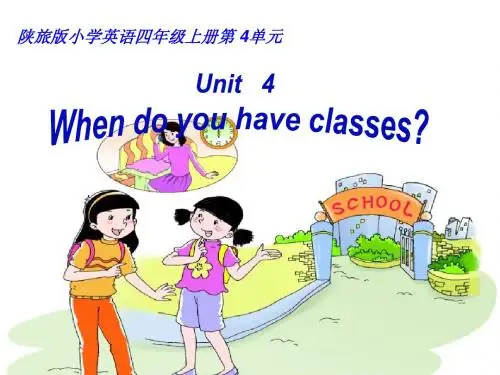
/play games / have lunch /go to bed
.Look and complete!
up get _____
have a_____ class
bed go to_____
have lunch _____
games watch______ TV play______
Homework
说教学过程
I have a big face. I have two hands. One is long.The other is short. I don’t have a leg,but I can go.
clock
Learning Aims: 1.能听懂、会说、会读、会写词汇: get up、have a class、have lunch
用几句简单的话向家人或 朋友介绍一下你一天的生活吧!
Thank you !
说教法Biblioteka 3.教学手段 根据本课教材提供了大量生活情景的特点,我采用了让 学生们在听、做、说、唱、玩、演中学习单词,再将 所学语言积极地应用到生活中去,使学生的多种感官 共同参与到整个学习过程中,激发学生的学习兴趣,提高 课堂教学效率。
4.学情分析 优秀学生和学困生(不爱学和反应慢)
教学目标
新课程强调知识与技能、过程与方法、情感态度与价值观三个 角度的有机结合,为此我制定如下学习目标。
play games 、 watch TV、 go to bed
2.能听懂会说会用下列句型: —When do you+ 动词短语? — I…at…
get up
have classes
have lunch
go to bed
最新陕旅版英语(三起)四年级上册Unit4 第三课时课件
(名词)早上;上午
【例句】 We have PE in the morning. 我们上午有 体育课。
【短语】 in the morning在上午
重点词汇2
early
(形容词)早的
【例句】 He gets up early.他起床早。
【短语】 the early morning 清晨
重点句型
She gets up at six.
A:When does he … B:He gets up …
When does he go home?
He goes home at five in the afternoon.
A:When does he … B:He gets up … When does he go to bed?
He goes to bed at ten at night.
本课我们学习了以下知识,请同学们一定加强巩固,以便能和 同学们进行灵活交流哦! (1)— Do you get up early in the morning? 你早上起床早吗? — No. But my mother gets up very early. 不。但是我的妈妈起床早。
(2)She gets up at six. 她六点起床。
她六点起床。 详解
这是一般现在时的肯定句句型。
肯定句句型结构:主语 + 行为动词 + 其他.
如: We study Chinese. 我们学习语文。
Let’s learn more 听第二段录音,回答问题: When does Shanshan’s mother go to bed?
点击“课文朗读”,跟 我一起听对话吧!
根据你每天的行动做一个时间表。
四年级英语上册教案Unit 4 Part B-陕旅版
Unit 4 Part B第三课时以Part B 中的Let' s learn more 为主,拓展学习第三人称单数的特殊疑问句及回答When does she/ he...? She/ He gets up at...第四课时在有效拓展练习本单元的重点内容的基础上,完成检测并通过故事学习达到一定的情感教育目标。
【知识与能力目标】1. 能听、说、读、写单词:early, late.2. 复习和巩固词汇:get up, have a class, have lunch, play games, watch TV, go to bed.【过程与方法目标】1. 能听懂、会说句型:—When does your father/ mother+动词短语?—He/ She...并且能在日常生活中加以运用,要求模仿正确,语音语调自然。
2. 能听懂、理解Read a story 中情节简单的小故事,并且能流利地跟读录音,要求模仿正确,语音语调自然。
【情感态度价值观目标】1. 引导学生养成合理安排时间、规律生活的好习惯。
2. 鼓励学生和他人进行小组合作,培养学生的合作能力。
【教学重点】能听、说、读、写单词:early, late.复习和巩固词汇:get up, have a class, have lunch, play games, watch TV , go to bed.【教学难点】能听懂、会说句型:—When does your father/ mother+动词短语?—He/ She...1. 任意两个可爱的小动物卡片、单词卡片、本节课教学PPT 、人物头饰、卡通时钟。
2. Read a story 中的人物头饰,磁带、录音机。
Step 1. Leading in.1. The teacher plays chant video and performs "It' s time to get up" with the students. The chant reads as follows:Time, time, time, time, time, it' s time to get up, get up.I brush my teeth, get dressed, eat breakfast and go to school.2. Simon saysThe teacher instructed the students to repeat the action:go to bed/ get up/ play games/ have lunch, Do the exercises at the same time and make a sound practice. When the students are fully involved, they will not make any noise when they are doing the action, and they will not do any action to increase the difficulty of the activity.Step 2. Let' s learn.1. With the pictures of Let' s learn, the corresponding letters and words are shown in this section. The teacher will introduce the new words in this lesson.Teachers' questions:—When do you watch TV?—I watch TV at...2.The teacher introduced the words early and late according to the students' answers.Teachers show prepared by the two small animals CARDS, each small animals right alongside them a week' s time to get up, lets the student observe two small animals wake time, teachers guide students were compared.The cat/ ...gets up early.The bear/ ...gets up late.Step 3. Let' s learn more.1. The teacher shows the picture of the dialogue so that the students can speak freely about the content they observe.such as:I can see.../ There is/ are...2. Listen to the tape then listen to the tape again. Then answer the question.The following questions are available for reference:Does Li Shan get up early?Li Shan' s mother gets up very early.Yes or no?When does Li Shan' s mother go to bed?3.The teacher should pay special attention to the correct expression of the third person singular in the answer, and the teacher will play the recording again, and ask the students to imitate the pronunciation and intonation of the characters in the recording.Key sentence patterns:When does your father/ mother...?He/ She...Step 4. Look and talkThe teacher USES the cartoon clock to constantly change the time, lets the student say accurate time, when asks the student question time, the teacher can appropriately add the question.The teacher sets the clock to six o' clock, and asks:When do you have dinner?Turn the clock to four.and asks:When do you play games at school?After the student answers, the teacher shows the picture of the Look and talk part. The teacher can let the student observe and encourage the student to describe to the class.Step 5. Read a story.The teacher presents a picture of the Read a story section, guides the students to observe the picture carefully and answers questions, and helps the students to understand what Angle calls "rise" at the end of the story.Teachers can do actions or in the sun, for example, let students understand rise here have said is get up get up. The teacher play the tape, guides the student to combine images to Read a story part of the content, understand the story to the effect, for every class.In this case, the teacher should encourage the students to imitate the pronunciation and intonation of the tape, to see who imitates the most image, the student plays Kitty, the teacher plays several other characters, and the students make corresponding actions.Or sub-group play.略。
四年级英语上册unit4第三课时教案陕旅版
陕旅版四年级上册unit_4课件
thir-teen
four-teen
fif-teen
我发现:
Ee [i:]
[i:] [e]
[i:]
we she tree three These
me knee sheep he Chinese
[e]
leg egg bed desk pen elephant pencil seven yes eleven
pig
cow
dog chick sheep grass tree
dogs chicks sheep grass trees
请同学们完成书本22页练习
What can you see?
Look! A nice farm!
Let us My grandma has a small have a look! farm in the village.
Really? What does she have on the farm?
Wow! how nice! What can you see on my grandma’s farm?
Oh, no! Go away! Go away!
How many apples are there?
How many rats are there?
THANK YOU FOR YOUR ATTENDENCE!
How many pears are there?
How many trees are there?
horses How many ____
are _____ there _____?
How many rabbits are there?
How many ducks are there?