
英语人教版八年级下册why don't you
Unit 4 Why don’t you talk to your parents?
Section A 1 (1a-2d)
一、Teaching aims:
1、Master some key words and sentences:
allow, wrong
(1) What’s wrong?
(2) I’m reall y tried because I studied until midnight last night.
(3) Why don’t you talk to him about it?
(4)You could give him a ticket to a ball game.
2、Learn how to ask for other’s opinions, how to give suggestions and how to respond to other’s advice.
3、Cultivate students’ listening and speaking skill.
4、Be able to realize other people’s feeling in commun ication.
二、Teaching key points and difficulties
1.Master the key words and expressions.
2.L earn how to ask for other’s opinions, and how to give advice.
3.Learn some ways of expressing advice.
三、Teaching methods
Communicative approach, Audio-lingual method,Activity teaching method
四、Teaching procedures
Step 1 Lead-in
Greet the class as usual.
Step 2 Warm-up
Today, we are going to learn unit 4. In this unit,we are going to talk about problems and learn to give other’s advice. Look! The boy is Dave. He looks unhappy. Do you know what’s wrong with him?/What’s the matter with him? Try to guess, please. Maybe he has too much homework to do. This is Dave’s problem. In our life, we may have some problems, too. Now, let’s look at more pictures to learn more students’ problems. Step 3 Presentation
1..Listening
(1)Learn some phrases and sentences and read them.
(2)Listen and circle
(3)Check the answer
(4)Read the listening material and find the advice
(5)Explain the use of why don’t you... /why not ...and give examples 2.Pair-work1
(1) Give them a pattern
(2) Ask them to make a short conversation.
(3) Invite some students to present their conversations.
3.Listening (2a)
There is a boy. His name is Peter. He is unhappy today, because he had a fight with his good friend and he don’t know how to do. Listen to the recording and fill in the blanks with could or should.
(1)Students listen and fill in the blanks
(2)Check the answers
(3)Read the sentences together
4. Listening (2b)
1. Let Ss read the sentences below. Explain some main sentences for the Ss. Make sure they know the meaning of each sentence.
2. Play the recording for the Ss to write the letters (a-e) next to the advice in 2a.
3. Play the recording again to check the answers.
Step 4 Pair work
1. Tell Ss to make a conversation using the information in 2a and 2b.
2. Let one pair to read out their conversation first.
3. e.g. A: What’s the matter, Peter?
B: I had a fight with my best friend. What should I do?
A: Well, you should call him so that you can say you’re sorry.
B: But I don’t want to talk about it on the phone.
4. Ss act the conversation in pairs. Ask some pairs to act out their conversations.
Step 5 Role-play
1. Ss read the conversations and try to understand the meaning.
2. Read the conversation after the teacher.
3. Answer the questions.
1) How does Kim feel about her sister after her sister gave back the things?
2) Does Dave think it is all right for Kim’s sister to take away Kim’s
things? How do you know?
3) Does Dave think the two sisters have a serious problem? How do you know?
4) What does Dave mean by saying “Hope things work out”?
4. Practice the conversation with their partner. Then let some pairs to act
out the conversation.
5. Explain some new words and main points in the conversation.
Step 6 Summary
In this class, we learned how to talk about problems and how to give others advice.
Step 7 Exercise
Ⅰ. 根据语境及所给首字母提示,补全所缺单词。
1. —Can you go to a movie with us tonight?
—Sorry, my parents don’t a me to go out at night.
2. —My mobile phone do esn’t work.
—There must be something w with it.
3. —Who’s that young woman?
—I don’t know. I g she is Kate’s aunt.
4. —Mom, Jill made my room dirty.
—Oh, it’s not a big d . After all she’s a 3-year-old girl. Ⅱ. 根据语境及所给汉语提示,用恰当的短语填空。
1. —What are you ____________(浏览), Jack?
—Yesterday’s newspapers.
2. Everyone hopes all the things will ____________(解决).
3. Just now Ms. Jackson ____________(生……的气) Lisa, wasn’t she?
4. At home, Linda always ____________(和……打架) her younger brother.
5. Ten minutes ago, Helen ____________(把它们归还) to your sister.。
2020年人教版新目标 英语 八年级下册 Unit 4 Why don’t you talk
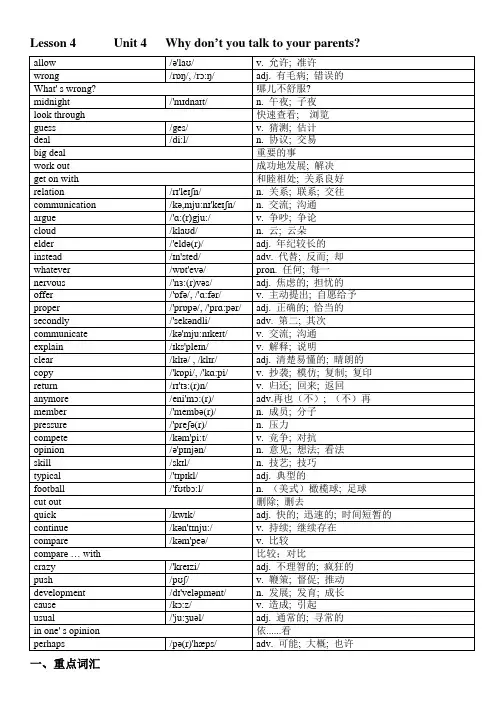
Lesson 4 Unit 4 Why don’t you talk to your parents?一、重点词汇1. allow v.允许;准许allow sb to do sth ; allow doing sth;be (not) allowed to do妈妈允许我周末看电视。
My mother allows me to watch TV on weekends.不允许在教室吃饭。
We don’t allow eating in the classroom.2.deal n.a great deal of time许多He was trying to make a deal with them.交易v. 处理,多与with连用相关词组:a good/great deal很多It' s a deal.就这么定了 a big deal大事deal with常与how连用do with常与what连用3.Look through浏览,快速查看含look的常用短语:look up;look at; look out; look for; look after; look like; look around; look down on/ upon; look over 4.argue v.争论argument n.Argue with sb = have an argument with sb 与某人争辩Argue on / about sth 辩论某事Argue with sb about sth为某事与某人争论我和她争论哪个队伍会赢。
I’m arguing with her about which team will win.5.Offer v.&n.提供Offer to do sth主动提出做某事;offer sb sth = offer sth to sb 提供某人某物他主动提出借我几本书。
人教八年级英语下册《Unit 4 Why don't you talk to your parent
4. Kids shouldn’t play computer games until late at night. They should rest early.
◆You could do … : “你(可以) 做……” ◆ Let’s do … : “让我们做……吧!” ◆ “主语+had better (not)+动词原形” :
“……最好(不要)做某事” You’d better go to school on time. ◆ It’s best to do ... : “做……再好不过 了。”
• 3. You could save more money __s_o_t_h_a_t_ you can buy a gift for your friend’s birthday.
4. Kids shouldn’t play computer games ___u_n_t_i_l __ late at night. They should rest early.
Guess
1. H__o_w__a_b_o_u_t going out for a walk? 2. W__h__a_t _a_b_o_u_t_ another cake? 3. W__h__y_d_o_n_’_t_ you _t_u_r_n__to__ the
reference book? 4.Why _d_id_n_’_t you s_e_e_ the football match? 5.W__h_y__d_o_n_’_t _y_o_u_ go there with us? 6. W__h__y_n_o_t_ go fishing today?
人教版八年级英语下册:Uni4 Why don’t you talk to your parents

பைடு நூலகம்
如: Why don’t you come with me? = Why not come with me? 肯定回答:Good idea / OK / All right / Sounds good等。 否定回答:I’m afraid not / That’s too … /Sorry, I can’t等。
should还可以表示一种义务或责任,意为
“应该”。例如:
You should finish your homework before you
play games on the computer.
你应该先完成你的家庭作业,然后再玩电脑。
◆You should / could do … 意为“你应该 (可以) 做……” ◆ Let’s do … 意为“让我们做……吧!” ◆ You’d better (not) do … 意为“你最好 (不)做……” ◆ It’s best to do ... 意为“做……再好不过 了。” ◆ Shall we do … ? 意为“我们做……好 吗?”
3. My sister spends all evening on the phone. Advice:You _____________________________ could advise her to help with _____________________________ housework or go for a walk. 4. My cousin borrows my things without returning them. could make him know it’s wrong Advice:You _____________________________ ______________________________ to do that. 5. My parents won’t let me have a pet. You should promise them that you Advice:______________________________ _______________________________ will never let it affect your study.
新人教版八年级下册英语unit-4
Unit 4 Why don't you talk to your parents?一.基本知识点1。
Why don’t you talk to your parents? 你为什么不和你打父母谈谈呢?Why don’t you do sth ?= Why not do sth?为什么不..。
.。
.呢?2。
My parents don’t allow me to hang out with my friends. 我的父母不允许我和我的朋友们出去闲逛。
allow sb。
to do sth 允许某人做某事【拓展】allow v 允许allow doing sth 允许做某事They don’t allow smoking。
allow sb. to do sth 允许某人做某事My mother allows me to watch TV.be allowed to do sth 被允许做某事3。
What’s wrong? 怎么啦?【解析】What’s wrong( with sb。
/ sth) (某人/物) 怎么了?4。
look through 浏览5.work out 解决;成功地发展,后跟fine,well,badly等词,表明产生的结果如何.The teachers encourage their students to ____ the problems by themselves, and in this way students can enjoy success。
A。
give up B。
work out C. look through5。
get on with sb. 和某人和睦相处;和某人关系良好=get along withget on well/ badly with 相处的好/坏My problem is I can’t get on with my favorite. 我的问题是我不能喝我的家人和睦相处。
人教版英语八年级下册Unit 4 Why don’t you talk to your parent

2019-2020学年人教版英语八年级下册Unit 4 Why don’t you talk to your parents?课文知识点总结Section A1.Why don’t you talk to your parents? 你为什么不和你打父母谈谈呢?【解析】Why don't you do sth ?= Why not do sth? 为什么不......呢?【拓展】用于提建议的句型有:(1)What about doing sth ?=How about doing sth? ….怎么样?(2)Why don’t you do sth?= Why not do sth? 为什么不呢?(3)Let’s do sth.让我们一起做某事吧。
(4)Shall we/I do sth?我们做…好吗?(5)had better do/not do sth 最好做/不做某事(6) Will/Would you please do sth 请你做…好吗?(7) Would you like to do sth? 你想去做某事吗?(8)Would you mind doing sth?你介意做某事吗?【回答】(1). 同意对方的建议时,一般用:◆Good idea./ That’s good idea. 好主意◆OK/ All right./ Great 好/ 行/太好了◆Yes, please ./ I’d love to 是的/ 我愿意◆I agree with you 我同意你的看法◆No problem 没问题◆Sure/ Of course/ Certainly 当然可以◆Yes, I think so 对,我也这样想(2).对对方的帮助或要求表示委婉谢绝时,一般用:◆I don’t think so 我认为不是这样◆Sorry, I can’t 对不起,我不能◆I’d love to, but…◆I’m afraid…我愿意,但恐怕……2.I have to study too much so I don’t get enough sleep.我要学的太多,因此我睡眠不足。
人教版八年级英语下册Unit 4 Why don’t you talk to your parent
1. Why don’t you talk to your parents? 为什么不跟你的父母谈谈呢?
【自主领悟】(1)Why don’t you do sth. ? 这是一个否定疑问 句, “为什么不……? ”常用来征求意见和提出建议, 相当于 Why not do sth. ? 句式。例如: Why don’t you go with us? = Why not go with us? 为什么不同我们一起去呢? (2)talk to sb. 意为“同某人谈话”。例如: He talked to me about my study. 他跟我谈了关于我的学习的事情。
Unit 4 Why don’t you talk to your parents?
Section A (1a-2d)
Ⅰ. 短语互译 1. get enough sleep 2. have a fight with sb. 3. look through 4. hang out 5. 把……归还给…… 6. 允许某人干某事 7. 成功地发展; 解决 答案: 1. 有足够的睡眠 2. 跟某人打架 3. 浏览 4. 闲逛 5. give. . . back to. . . 6. allow sb. to do sth. 7. work out
【归纳拓展】allow的不同搭配 (1)allow sth. /doing sth. 允许(做)某事 例如: We don’t allow eating in the classroom. 我们不允许在教室里吃饭。 (2)allow sb. sth. (双宾语)给予某人某物 例如: He allows his son too much money. 他给他儿子太多的钱。
speak to sb. “跟某人讲话”
人教版八年级英语下册《Unit4 Why don’t you talk to your parent
人教版八年级英语下册《Unit4 Why don’t you talk to your parents》教学设计(第5课时)一. 教材分析人教版八年级英语下册《Unit4 Why don’t you talk to your parents》是本单元的第五课时,主要围绕着如何向父母提出建议展开。
本课时包含两个部分:part A 和part B。
part A包含一个听力活动,一个读写任务和一个口语练习;part B包含一个读写任务和一个口语练习。
本课时旨在帮助学生掌握向父母提出建议的策略,提高他们的听说读写能力。
二. 学情分析学生在之前的学习中已经掌握了如何提出建议的基本句型“Why don’t you…?”和“You should….”,但还需要在实际情境中进行运用和提高。
此外,学生在听力、口语、阅读和写作方面需要进一步的加强和巩固。
三. 教学目标1.知识目标:(1)能够听懂、会说、会读、会写本课时所学的单词和短语。
(2)能够运用所学句型提出建议,并进行简单的交流。
2.能力目标:(1)提高学生的听力能力。
(2)提高学生的口语表达能力。
(3)提高学生的阅读和写作能力。
3.情感目标:(1)培养学生积极主动与父母沟通的习惯。
(2)培养学生珍惜友谊,关心他人的品质。
四. 教学重难点(1)掌握本课时所学的单词和短语。
(2)运用所学句型提出建议,并进行简单的交流。
(1)如何准确地运用听力技巧获取信息。
(2)如何准确地运用阅读技巧获取信息。
五. 教学方法1.任务型教学法:通过完成各种任务,激发学生的学习兴趣,提高学生的学习积极性。
2.情境教学法:通过设定真实的情境,让学生在实际情境中学习和运用英语。
3.交际型教学法:通过小组讨论、角色扮演等方式,培养学生的交际能力。
六. 教学准备1.教材:人教版八年级英语下册《Unit4 Why don’t you talk to your parents》。
2.课件:根据教学内容制作的课件。
人教版八年级英语下册Unit 4 Why don't you talk to your parent
Unit 4 Why don't you talk to your parents?Period1 section A(1a-2d)导学案一自主学习I 基础单词1 guess_____2 deal_____3 允许;准许_____4 错误的;不对的________II 核心单词1 hang out_______2 have a fight with .____________3 give back to .________4 允许某人做某事_________5 浏览___________6 成功地发展;解决___________二合作探究重要句型1 My parents don't_____me ____ ____ ______with my friends.我父母不允许我和朋友闲逛。
2 What's ________? 怎么啦?I'm really tired because I studied______midnight last night. 我十分累因为做外我学习到很晚。
3 ______ ______ you go to sleep earlier this evening?今晚你为什么不早早睡觉呢?4 Hope things ____ ____ . 但愿情况会好起来。
三达试标测单选 1 _____help your good friend? I can't understand you.A Why not youB Why don'tC Why don't youD Why don't2 If you will know the news quickly, you may____the website quickly first.A look upB look throughC look overD look at3 You talked____at the meeting.____people might not be happy.A too much;Too muchB too much; Too manyC too many Too muchD much too ;Too many4 _______?I'm always late for school and I don't know why.A Why do you say soB Why are you doingC What's wrongD Why aren't you in school early. 四课后作业1 He didn't allow the children_______(play) in his garden.2 Did you find the little boy____(lie) on the ground when you passed by?3 I have no time_____(relax) because I have too much homework every day.4 I'm always go to bed late these days.I feel sleepy.。
人教新目标八年级英语下册Unit4Whydon'tyoutalktoyourparents说课稿
人教新目标八年级英语下册Unit 4 Why don’t you talk to your parents说课稿一. 教材分析人教新目标八年级英语下册Unit 4 Why don’t you talk to your parents是一篇关于日常交流和沟通的文章。
本篇文章主要讲述了在遇到问题时,如何与父母沟通,寻求解决方案。
通过本节课的学习,学生能够掌握情态动词why not的用法,以及如何运用交际策略进行日常交流。
教材内容贴近学生生活,有利于激发学生的学习兴趣和积极性。
二. 学情分析八年级的学生已经掌握了基本的英语语法和词汇,具备一定的听说读写能力。
但在实际交流中,学生往往因为害羞、紧张等原因不敢开口说英语,本题正好可以引导学生学会如何与父母沟通,提高他们的交际能力。
同时,学生在这个年龄段开始关注家庭和社交问题,对本节课的内容会产生浓厚兴趣。
三. 说教学目标1.知识目标:学生能够掌握情态动词why not的用法,了解日常交际中的沟通策略。
2.能力目标:学生能够运用所学知识进行日常交流,提高口语表达能力。
3.情感目标:学生学会与父母沟通,增进家庭关系,培养良好的交际习惯。
四. 说教学重难点1.重点:情态动词why not的用法和日常交际策略。
2.难点:如何运用所学知识进行实际交流,克服羞涩、紧张等心理障碍。
五. 说教学方法与手段1.情景教学法:通过设定情景,让学生在实际语境中学习英语,提高交际能力。
2.任务型教学法:学生分组完成任务,激发学习兴趣,培养合作精神。
3.互动式教学法:教师与学生互动,引导学生积极参与课堂讨论,提高口语表达能力。
六. 说教学过程1.导入:用一段关于家庭沟通的短片引出本节课的主题,激发学生的学习兴趣。
2.新课呈现:教师展示文章,引导学生关注文章标题和关键词,预测文章内容。
3.课堂讲解:教师讲解情态动词why not的用法和日常交际策略,让学生通过例句理解并掌握。
4.实践环节:学生分组进行角色扮演,运用所学知识进行实际交流,教师巡回指导。
初中英语人教版八年级下册《Unit 4 Why don't you talk to your par
6.nervous adj. 焦虑的;担忧的 I 'm nervous about your English .
presentation Learn new words
7.offer v. 主动提出; 自愿给与 offer sth to sb.=offer sb sth 给某人提供某物 He offered help to us. 8.explain v.说明;说明 He explained clearly.
time for proper communication. Secondly, why don’t you sit down and communicate
with your brother? You should explain that you don’t mind him watching TV all the
1. What’s Sad and Thirteen’s main problem?
He can’t get on with his family.
R2.eHaodwidnoges shekfielell:aYt ohoumec?an guess the mHeeaanlwianysgfeoelfs laonwelyoarndd nyeorvuousd. on’t know
make sth. clear — explain Can you explain to me how to do this math problem? talk — ___c_o_m_m_ u_n__ic_a_t_e__T_h_e__tw__o_f_r_ie_n_d__s _h_a_s_n_’t__c_o_m_m__u_n_i_c_a_te_d__w__it_h_each other