
外研版高中英语必修5 Module 4《Carnival》Period Three Grammar课件
本 讲 栏 目 开 关
知识储备
The room was being painted when I left.(过去进行时的被 动语态) 在我离开时,房间正在粉刷。 So far my thesis has been completed.(现在完成时的被动语 态) 到目前为止我的论文已经写好。 The room had been broken into before we came.(过去完成 时的被动语态) 我们来之前已经有人强行闯入这个屋子了。 The design will have been done by the end of this week.( 将 来完成时的被动语态) 这个设计在本周末会做完。
讲 栏 目 开 关
located (locate).
8.If animals who live in groups such as elephants,foxes and wolves don’t follow rules and each does its own thing,the group might be torn apart (tear apart).
课堂讲练互动
本 讲 栏 目 开 关
知识储备
二、被动语态各时态的构成 时态 一般现在时 does 主动语态 be (am,is,are)do/ 被动语态 am/is/are+done will/shall be+done am/is/are+being+ done was/were+done have/has+been+ done
is
6.The woman was walking about outside the operation room,because her son was being operated (operate) on. 本 7.The church was built where a Roman temple had once been
课堂讲练互动
本 讲 栏 目 开 关
(已经被尝试) by
知识储备
复习被动语态 一、被动语态概述 语态是动词的一种形式,用以说明主语与谓语动词之间 的关系。英语的语态共有两种:主动语态和被动语态。主动 语态表示主语是动作的执行者,被动语态表示主语是动作的 承受者。被动语态是动词的一种特殊形式,一般说来,只有 需要动作对象的及物动词才有被动语态。汉语往往用 “被”、“受”、“给”等词来表示被动意义。
had+been+ done will/shall have been done was/were+ being+done
本 讲 栏 目 开 关
课堂讲练互动
知识储备
Paper is made from wood.(一般现在时的被动语态) 纸是木头制成的。 The letter was typed on the computer.(一般过去时的被动 语态) 这封信是用电脑打出来的。 A lecture will be held in the meeting room by Professor John.(一般将来时的被动语态) 约翰教授将在会议室举行一个讲座。 The road is being repaired by construction workers.(现在 进行时的被动语态) 建筑工人正在修路。
课堂讲练互动
本 讲 栏 目 开 关
一般将来时 will+do 现在进行时 am/is/are+doing 一般过去时 was/were did 现在完成时 have/has+done
知识储备
过去完成时 had+done 将来完成时 过去进行时 will/shall have do was/were+ doing
课堂讲练互动
语法感知
Ⅱ.完成句子 1.A new teaching building will be set up (将被建造) in our school next year. 2.Before you leave the classroom,the door and windows should be closed (应该关上) in case of rain. 3.Every possible means has been tried the company to improve its production. 4.As we know,all the regulations in school must be kept/ obeyed (必须被遵守). 5.There’s a crowd of people over there.Go and see what is being sold (在卖).
课堂讲练互动
本 讲 栏 目 开 关
was followed was
is celebrated
(celebrate) for
the former slaቤተ መጻሕፍቲ ባይዱes took over the carnival.
语法感知
5.Stop talking at once;the latest news about the world being broadcast (broadcast).
语法感知
Period Three
Grammar
Ⅰ.用所给词的适当形式填空 1.In Europe,where it began,carnival (follow)by forty days without meat. 2.As time passed,however,the carnival period extended (extend). 3.Today,carnival in Venice five days in February. 4.When the slave trade was abolished (abolish) in 1838
课堂讲练互动
本 讲 栏 目 开 关
知识储备
注意 过去分词。
1.情态动词的被动结构。其形式为:情态动词+be+
本 讲 栏 目 开 关
The baby should be taken good care of by the babysitter. 这个孩子应该受到保姆的精心照顾。 2.“get+过去分词”也可表示被动语态。 He was knocked down by a car and got killed. 他被一辆车撞死了。
外研版高中英语必修五课件:Module 4 Carnival Period 1 .

约公元前2070年,禹建立夏朝,这是我国历史上第一个王 朝。启继承父位,从此王位世袭制代替禅让制。
约公元前1600年,成汤打败夏桀,建立商朝。约公元前 1300年,盘庚迁都到殷。商朝曾疆域辽阔,经济有很大的发展, 但由于商纣王的残暴统治而走向灭亡。
探究主题1 夏朝的建立 1.阅读下列材料: 材料一
编后语
老师上课都有一定的思路,抓住老师的思路就能取得良好的学习效果。在上一小节中已经提及听课中要跟随老师的思路,这里再进一步论述听课时如何 抓住老师的思路。
① 根据课堂提问抓住老师的思路。老师在讲课过程中往往会提出一些问题,有的要求回答,有的则是自问自答。一般来说,老师在课堂上提出的问 题都是学习中的关键,若能抓住老师提出的问题深入思考,就可以抓住老师的思路。
探究主题2 商朝的建立和迁都 2.阅读下列材料: 材料一 夏桀是历史上有名的暴君。他经常与大批贵族整日整 夜的饮酒作乐,还把人当坐骑,甚至把老虎放在人口集中的地 方,目睹人们逃命取乐。夏桀把自己比作太阳。
材料二
【探究思考】
(1)桀悔恨自己没有杀了汤,以至于落得个天下不保的下场,
结合材料一和所学知识你认为他的想法对吗?
3.“汤遂率兵伐夏桀……乃践天子位,代夏朝天下。”这件事 发生于公元前1600年。( √ ) 提示:材料指的是公元前1600年,成汤伐桀、建立商朝的情景。 4.商都殷位于长江中下游地区。( × ) 提示:据《商朝略图》可知,商都殷位于黄河中下游地区。 5.在殷墟的一处窖穴中曾发现400多把使用过的石镰刀。这说 明,那时农业生产的规模已相当大。( √ ) 提示:从考古发掘出的石镰刀的数量上,可以看出当时劳动生 产的规模已相当大。
(2)材料二中,从“天下为公”到“天下为家”反映了怎样的 历史变化?这一变化开始的标志是什么?发生这种历史变化的 根本原因是什么? 参考答案:王位世袭制取代禅让制。启继承了禹最高统治者的 位置。这是生产力和私有制发展的结果,是历史发展的必然趋 势。
外研版高二英语必修5第四模块carnival好说课稿

高二英语必修5第四模块carnival说课稿李桂杰我今天说课的内容是高二英语必修5第四模块carnival——狂欢节首先介绍一下这节课的地位和作用:本节课是第四模块的第二课时,是一节阅读课,在本模块的教学过程中起着重要的作用。
本课主要向大家介绍一个很著名的外国节日——狂欢节,这个话题与我们的日常生活和学生们感兴趣的外国文化有着很大的联系,对此话题的学习与讨论有益于提高学生学习英语的兴趣,通过日常教学使学生们掌握有关节日的新词汇并使他们了解其它国家的文化背景和社会风貌,为学生以后的阅读和学习做好知识储备。
其次要对学生现有情况进行分析:课前已经让学生们通过各种渠道搜集有关狂欢节的信息,所以他们对本节课要讨论的话题已有一定的了解;但他们缺乏有关这一话题的英语词汇量,也不太善于用英语进行交流。
所以根据以上分析我确定了本节课的教学目标,教学重点和难点教学目标:1.知识目标:准确理解文章内容,并掌握文章中出现的新词汇New words: memory hide pretend revive bookPhrases: dress up, come to an end, date back to , think of, last for2.能力目标:能够回答与课文有关的问题,通过阅读练习提高学生们的阅读能力和提取信息、处理信息的能力,并能够用自己的语言复述课文重要内容3.情感目标:语言是文化的载体,当人们开始学习另一种语言时,他们从某种意义上说就加入到另一种文化中了,所以要培养学生的跨文化交际意识,重视中外文化的差异。
教学重点:准确理解课文内容,并掌握其中的重要词汇教学难点:用学过的词汇和句型复述课文重要内容在整个过程中我将使用多媒体课件来帮助我完成教学任务,它能够很快地抓住学生的注意力并导入正课。
我采用任务教学法和自由讨论教学法,组织学生有目的的进行阅读,在自由的氛围中交流和学习。
教学过程共分以下5个环节第一个环节:复习及导入1.复习:设置若干个问题,要求学生用前一节课的知识作出回答,以便得以巩固2.导入:利用大屏幕给出一些著名节日的欢乐景象,让大家来猜是什么节日,由此导出本节课要学习的话题狂欢节。
外研社必修五module4carnival全单元教案资料

精品文档Module 4 CarnivalI. 教学内容分析本模块的主题是狂欢节。
以西方的几种主要传统节日作为导入,接着通过各种活动详细介绍了狂欢节的历史、发展、种类及人们的活动、饮食、服饰和习俗。
其中有关食物和节日的词汇,和表达喜好和厌恶的句型又可以引申到中国传统节日和习俗,有益于培养学生的跨文化意识。
本模块从五幅西方节日图片的探讨开始,导入本模块的话题——Carnival。
Introduction 部分设计以西方的五种主要传统节日(Carnival, Holi, Halloween, Christmas, Thanksgiving Day)作为导入,让学生通过图片做配对练习了解西方的节日习俗,激发学生对西方节日的好奇心,达到导入整个模块的效果。
Reading and Vocabulary介绍有关狂欢节的一些知识,主要介绍了狂欢节的面具。
课文前后的四个相关练习帮助同学们学习和了解了相关词汇和文章主旨。
Grammar部分主要是通过练习复习被动语态在各种时态中的运用的语法项目。
Vocabulary and Listening分为词汇部分和听力两大部分。
词汇部分学习和巩固一些关于食物的单词;听力部分是关于西方节日的,对于同学们来说,听力材料偏生疏,因此听力要做一定的处理。
Learning to learn是关于通过听听力提高语音面貌的英语学习方法,对于提高学习策略水平有很大的帮助。
Everyday English通过学习复习Vocabulary and Listening中的句子学会一些非常有用的日常生活用语:give up, go wild about, more or less, high spot, funnily enough, in your blood, wash down 和walk off a meal。
Function介绍表达“喜欢、不喜欢和偏爱”的功能用语。
Reading and Writing集说话和写作于一体,培养的是学生语言综合运用的能力。
高中英语外研版必修五教师用书Module 4 Carnival
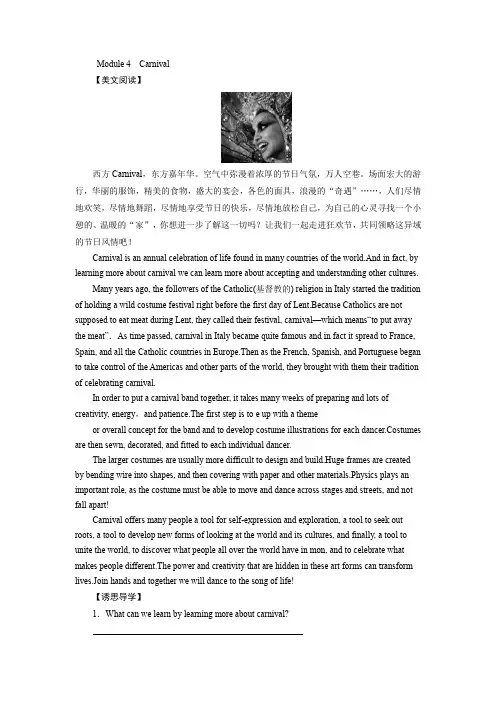
Module 4Carnival【美文阅读】西方Carnival,东方嘉年华。
空气中弥漫着浓厚的节日气氛,万人空巷。
场面宏大的游行,华丽的服饰,精美的食物,盛大的宴会,各色的面具,浪漫的“奇遇”……,人们尽情地欢笑,尽情地舞蹈,尽情地享受节日的快乐,尽情地放松自己,为自己的心灵寻找一个小憩的、温暖的“家”,你想进一步了解这一切吗?让我们一起走进狂欢节,共同领略这异域的节日风情吧!Carnival is an annual celebration of life found in many countries of the world.And in fact, by learning more about carnival we can learn more about accepting and understanding other cultures.Many years ago, the followers of the Catholic(基督教的) religion in Italy started the tradition of holding a wild costume festival right before the first day of Lent.Because Catholics are not supposed to eat meat during Lent, they called their festival, carnival—which means“to put away the meat”.As time passed, carnival in Italy became quite famous and in fact it spread to France, Spain, and all the Catholic countries in Europe.Then as the French, Spanish, and Portuguese began to take control of the Americas and other parts of the world, they brought with them their tradition of celebrating carnival.In order to put a carnival band together, it takes many weeks of preparing and lots of creativity, energy,and patience.The first step is to e up with a themeor overall concept for the band and to develop costume illustrations for each dancer.Costumes are then sewn, decorated, and fitted to each individual dancer.The larger costumes are usually more difficult to design and build.Huge frames are created by bending wire into shapes, and then covering with paper and other materials.Physics plays an important role, as the costume must be able to move and dance across stages and streets, and not fall apart!Carnival offers many people a tool for self-expression and exploration, a tool to seek out roots, a tool to develop new forms of looking at the world and its cultures, and finally, a tool to unite the world, to discover what people all over the world have in mon, and to celebrate what makes people different.The power and creativity that are hidden in these art forms can transform lives.Join hands and together we will dance to the song of life!【诱思导学】1.What can we learn by learning more about carnival?【答案】We can learn more about accepting and understanding other cultures.2.Which countries played an important rale in spreading carnival?【答案】Frence,Spain, and Portugal3.What does carnival offer people?【答案】Carnival offers many people a tool to develop new forms of looking at the world and its cultures.Period ⅠPreviewing(教师用书独具)●课标技能要求初步掌握本课文中的词汇,浅层次理解课文,了解相关的背景知识。
高中英语 Module4 Carnival课件 外研版必修5 外研版必

√
3. Special food
4. Carnival in Venice √
Reading and Vocabulary 3—Scanning (5m)
Activity 2
1. c 5. b
2. b 3. c 4. a
6. b
7. b 8. b
Paragraph 1 What’s your general impression
) Introduction-2. western festivals(4m
• How much do you know about the
following western festivals? Christmas
This is a Christian festival which comes in the middle of winter.
Paragraph 3 Where does the writer say we can see the most famous carnival? What was it like at first?
The most famous carnival in Europe was in _V_e_n_ic_e_. People ate, drank and wore m__a_s_k_s. At the beginning, it lasted for just one day. As time passed, the carnival period was __ex_t_e_n_d_e_d_and people walked round the streets for weeks _o_n_e_n_d_doing what they wanted without _b_e_in_g__r_ec_o_g_n_i_z_ed__. Many crimes went _u_n_p_u_n_is_h_e_d_.
外研必修五Module-4-课文及翻译
Module 4 CarnivalThe Magic of the MaskThink of carnival, and you think of crowds, costumes, and confusion想到狂欢节你就会想到群众、服装和混乱。
The sounds and sights change from one country to another but the excitement is the same everywhere随着国家的变化听到的和看到的都是不同的,但是任何地方人们都是兴奋的。
“Carnival” comes from two Latin words, meaning “no more meat”“狂欢节”是由俩个拉丁词演变而来的,它的意思是“不要吃肉”。
In Europe, where it began, carnival was followed by forty days without meat, as people prepared for the Christian festival of Easter欧洲是狂欢节的发源地,在接近狂欢节的四十天里是不能吃肉的,人们准备迎接基督教的“复活节’。
People saw Carnival as a last chance to have fun at the end of the winter season Having fun meant eating, drinking, and dressing up人们把狂欢节做为冬天结束前最后的一个玩乐机会,尽情的吃喝玩了、打扮。
The most famous carnival in Europe was in Venice欧洲最著名的狂欢节是在威尼斯。
At the beginning, it lasted for just one day People ate, drank, and wore masks刚开始的时候,狂欢节只持续了一天。
英语必修5外研版M4Carnival阅读及写作教案
Teaching plan
外研版Book 5 Module 4 CarnivalReading and writing
Teaching Aims
1.Help the students know some festivals in English.
Christmas, Spring festival, Dragon boat festival, Mid-autumn festival, Halloween, Holi, Valentine’s day, Easter, Carnival, Thanksgiving day
No.3 Nice Carnival (France)
1.Introduce the three carnivals above through pictures and videos, and let the students find out their specialists.
(Reference answers: Rio Carnival—Samba dance competition, everybody can join in the party to dance, sing happily. Venice Carnival—mask, great costume, special make-up, parade with mask, and everybody can show their creative skills. Nice Carnival--- long history, cartoon elements, and super parade)
Learning Strategies
高中英语 Module 4《Carnival》教案-Vocabulary 外研版必修5
Module 4 Carnival(Period 3)Teaching aim: Deal with language points1. Carnival originates from ______./ the origins of carnival 狂欢节的起源originate vt.使产生; 创始; 创办; 发明;发起; 引起origin用作名词,表示“起源,开端,来源”。
The origin of the custom are unknown.该风俗的起源不详。
There are several sayings about the origins of life on earth。
They originated the plan. 他们首先提出这一计划。
联想拓展original adj. (无比较级)最初的;原始的;创新的originate in/ from sth. 起源/发生于… originate with 由某人发起”首创”All theories originate from / in practice and in turn serve practice.任何理论都来源于实践,反过来又为实践服务。
The film originated in / from a short story. 这部电影取材于一篇短篇小说。
The use of steam originated many other reforms. 蒸汽的使用引起了许多其他改革。
The optic theory originated with Einstein. 光学理论是爱因斯坦首创的。
【巩固运用】The quarrel ___________ (源于)in rivalry between two tribes; they were quarrelling about which was the ________(起源)for ancient art.2.Think of carnival, and you think of crowds, costumes and confusions. 想起狂欢节,你就想起拥挤的人群,节日的服饰和混乱的场景。
外研版高二英语必修5Module4Carnival教案
外研版高二英语必修5Module 4 Carnival教案一、教学内容本节课选自外研版高二英语必修5 Module 4 Carnival,具体内容包括第1单元Reading and Vocabulary、第2单元Grammar和第3单元Reading and Writing。
详细内容如下:1. Reading and Vocabulary:介绍巴西里约热内卢狂欢节的历史、活动安排以及节日意义。
2. Grammar:讲解一般现在时、一般过去时和一般将来时的被动语态。
3. Reading and Writing:探讨狂欢节对当地经济和文化的影响。
二、教学目标1. 知识目标:学生能够掌握课文中的重点词汇、短语和语法结构,了解狂欢节的相关知识。
2. 技能目标:培养学生阅读、写作、听说等多方面的技能,提高学生的英语实际运用能力。
3. 情感目标:激发学生对世界各国文化的兴趣,培养学生的跨文化交际意识。
三、教学难点与重点1. 教学难点:一般现在时、一般过去时和一般将来时的被动语态。
2. 教学重点:课文中的重点词汇、短语以及狂欢节的相关知识。
四、教具与学具准备1. 教具:多媒体课件、黑板、粉笔。
2. 学具:教材、笔记本、字典。
五、教学过程1. 导入:通过展示巴西里约热内卢狂欢节的图片和视频,引发学生对狂欢节的兴趣,为新课的学习做好铺垫。
2. 阅读理解:学生自主阅读课文,完成相关练习,了解狂欢节的历史、活动安排和意义。
3. 语法讲解:教师讲解一般现在时、一般过去时和一般将来时的被动语态,并举例说明。
4. 例题讲解:分析教材中的例题,引导学生运用所学的语法知识进行改写句子。
5. 随堂练习:学生完成课堂练习,巩固所学知识。
6. 小组讨论:学生分组讨论狂欢节对当地经济和文化的影响,并进行汇报。
六、板书设计1. 课文Carnival2. 重点词汇:history、schedule、economy、culture3. 语法结构:被动语态(一般现在时、一般过去时、一般将来时)七、作业设计1. 作业题目:(1)用被动语态改写下列句子。
Module4Carnival教案外研版必修5(精)
Module 4 CarnivalPeriod OneTeaching aims:1. To revise Chinese and western festivals.2. To develop the students reading ability.3. To understand what is about Carnival.Important and difficult points:1 Get the students to understand the history of carnival.2 Get the students to describe the festivals in groups.Teaching procedures:Step 1. Revision.Read the new words of this passage.Step 2. Introduction1. We have learned many festivals both Chinese and the Western. What festivals do you know? Divide the class into 2 groups. One group is for Chinese Festivals, the other group is for Western festivals.Make a list of them on the blackboard..2. Turn to Page 31— Match the festivals with the description.Step 3. Lead-inToday we will learn another festival ---- Carnival. It originates from Europe, and during thesedays, people often love wearing special clothes and masks for it.Step 4. Fast-readingMatch the main idea with every paragraph.Paragraph 1 A meaning of carnival and how it was celebratedParagraph 2 B the law about wearing masksParagraph 3 C general impression of carnivalParagraph 4 D how it is celebrate today in Venice and the feature of it Paragraph 5 E carnival in Venice and the problem it causedParagraph 6 F the revival of the tradition of celebrating it.(Answers: 1— 6 CAEBFDStep 5. Further-readingRead the passage and answer the questions.1. Where does Carnival come from? What does it mean?2. When was it celebrated?3. Where was the most famous Carnival in Europe?4. How long did the first Carnival in Venice last? What about now?5. Did the government of Venice encourage the wearing of masks?6. Who started the Carnival again, tourists or students?(Answers: 1. “Carnival” comes from two Latin words, meaning “no more meat”. 2. It began just after Christmas. 3. The most famous carnival in Europe was in Venice. 4. At the beginning, it lasted for just one day. 5. No. 6. The students started the Carnival. Step 6. VocabularyActivity 1: Read through the words in the box and have the students repeat them individually. Ask the students to complete the task individually, then check with a partner. Check the answers together:(Answers: 1. confusion 2. excitement 3. mask 4. mystery 5. magic 6. costume 7. crowd 8. tradition 9. atmosphereActivity 2: Choose the correct meanings of the words and phrases.Check the answers one by one.(Answers: 1— 4 babb 5— 8 abbbStep 7. DiscussionDiscuss in groups of four.1. What is the feature of carnival in Venice?2. Which is your favourite festival?Step 8. Homework1. Workbook— on Page 87.Read the passage and match the headings with the text.2. Write a short passage about your favorite festival.Period TwoTeaching aims:1. To listen to the description about western customs.2. To express likes, dislikes and preferences:(1 I love doing…;(2 I don’t like…; I hate…; I dislike…; I don’t care much for(3 I prefer…to…; I prefer doing …(4 I’d rather…than…(5 I an interested in…3. To learn several phrases.Difficult and important points:1. Get the students to express likes and dislikes2. Learn to use the phrases: give up; go wild ;more or less; high spot; funnily enough; in your blood; wash down; walk offTeaching procedures:Step 1. RevisionCheck the homework.— Ask several students to read the short passage with the name of My Favorite Festival.Step 2. Vocabulary1. Read the words about food.2. Now say which things you eat at a festival.3. Practice.Activity 2: Find these things in the box in Activity 1.(1 Two type of meat ((2 a food that consists of a tube of skin containing meat mixed with herbs. ((3 five vegetables ((4 two ingredients for making a cake ((Answers: (1 pork and chicken (2 sausages (3 beans, cabbages, garlic, onion, peas (4 flour, eggsStep 3. ListeningBefore listening— Look at the photos in Activity 4 and tell them every picture meaning a special festival..While listening— Listen to the tape twice and match the names of the festivals with the photos.After Listening:Complete the tableStep 4. Everyday English1. Read the sentences and choose the correct meaning of the words and phrases.2. Check the answers one by one. (1-b (2 a (3 b (4a (5 b (6 a (7a (8b3. Explain the words and phrases.(1give up sth. =don’t have it any more(2 go/wild with joy 欣喜若狂(3 more or less =approximately (oppositeexactly.Eg: That is approximately correct.(4 high spot= the best part(5 be/run in sb.`s blood = be /run in the blood. 生来就有的(因遗传或环境影响eg; Most of my family are teachers, it runs in the blood.(6 wash down a meal = have a drinkwalk off a meal = help the food go down by walking.Step 5. Function1. Match the sentences with the speakers. Say what they are speaking about.(1Caitlin: King Cake(2Maria: Feijoada(3 Stefan: saugages(4 Cameron: traditional Jamaican food – chicken with rice and peas.2. Number the phrases from the most negative to the most positive(1 Ask the students to do this individually.(2 Call the answers back from the whole class, one at a time, from 1--6(3 Write down them on the blackboard:3. Work in pairs. Discuss your preferences for food to eat at festival. Use the phrases in Activity2.(1 Read the example with the class.(2 Pair the students to discuss their preferences.(3 Circulate and monitor their production.Step 6. HomeworkFinish off the workbook.Period ThreeTeaching aims:1. To learn more about carnival.2. To teach them how to write an e-mail.3. To develop the students’ reading skills.Difficult and important points:1. Get the students to learn to write an e-mail.2. Get the students to understand some important sentences.Teaching procedures:Step 1. RevisionRead the words and have a dictation.Step 2. Lead-inWhat do you remember about carnival?Where did it start first?Step 3. Fast-reading:Read and underline the topic sentences ( use your own words about every paragraph. Paragraph1: We can understand what carnival is all about by reading the history of America and the meeting of two cultures.Paragraph2: The slave trade brought millions of black people to the new world. Paragraph3: The slaves were forced to watch their European masters to celebrate carnival and then they began to hold carnival with their own features.Paragraph4: Carnival became a celebration of freedom.Paragraph5: As time went on, carnival became a way of uniting different communities and now it has become a celebration of life itself.Step 4. Further reading1. What did marked the beginning of the slave trade?2. How were millions of people taken to work as slaves?3. How did the slaves begin to hold their own carnival in Trinidad?4. When was the slave trade abolished?5. How was carnival changed when the slave trade was abolished?6. When did carnival become a way to unite different communities?(Answers: 1 That the arrival of European in America, and the opening of huge farms and plantations to grow cotton, fruit and vegetables, meant there was an immediate need to people to work on them marked the beginning of the slave trades. 2 Millions of people were taken by force from their homes in America and transported to the New World to work as slaves? 3. They painted their faces white, imitating their masters and making fun of them. 4. The slave trade was abolished in 1838. 5. It became more colourful and more exciting than it had been before. 6. As people forgot their everyday problems and enjoyed themselves eating, drinking, and dancing.Step 5. Several phrases(1 by force (2 be forced to do (3make fun of sb. (4 bring good luck (5 take over (6 take part in (7 become a celebration of freedom (8 with the time passing Step 6. Discussion1. What is the meaning of carnival?2. Which Chinese festival is most like carnival?Step 7. Reading and writingActivity1. Read the email and number the things in the order you read them1. Read through the things with the whole class and make sure that they understand them all.2. Ask them to read the email and order the things individually, then check with a partner.3. Call back the answers from the whole class, in order.(Answers: 1. the atmosphere at the festival 2. the music 3. the food 4. what the writer’s doing5. what the writer’s going to doActivity2. Underline the adjectives used to describe.1. the atmosphere: noisy/ colourful2. the music: great/ exciting/ relaxing3. the food: good/ tastyActivity3 Write an email from a Chinese festival. Make sure of the details about:1. the atmosphere2. the music3. the foodStep 8. HomeworkWrite a description of the festival for visitors to China.( For example: Spring Festival Period FourTeaching aims:1. To learn new words and expressions and learn how to use them.2. To review of the passive voices.Difficult and important points:1. Get the students to know how to use passive voices:一般现在时和一般过去时的被动语态2. The usage of: hide, pretend, memory, wander, come to an end, dress up; consist of be good for ,date from.Teaching procedures:Step 1. RevisionRead the sentences and find out what grammar are they?1. Is the room cleaned every day?2. We were woken up by a loud noise during the night.3. Something must be done before it is too late.4. Have you heard the news? The President has been shot?5. The car was three years old but hadn’t been used very much.6. There’s somebody walking behind us. I think we are being followed.Step 2. Presentation—被动语态被动语态的基本形式是 : be +过去分词根据时态的不同 , be的形式有所变化 .(1 一般现在时的被动语态 : am/is /are+过去分词 (口语可用 get/become或 got /became(2 一般过去时的被动语态 :was /were+过去分词被动语态的基本用法 :不知道或没有必要提到动作的执行者是谁时用被动语态 . 强调或突出动作的承受者常用被动语态 .(有时可省略 .使用被动语态应注意的几个问题 .(1 主动变被动时双宾语的变化 . 看下列例句eg: 我朋友在我生日时送我一本有趣的书 .My friend gave me an interesting book on my birthday.— An interesting book was given to me (by my friend on my birthday.— I was given an interesting book (by my friend on my birthday.(2 主动变被动时 , 宾补成主补 (位置不变 ; 作宾补的省略 to 的不定时在被动语态中应加 to. eg: 老板让他整天工作 .The boss made him work all day long.— He was made to work all day long (by the boss.(3 短语动词变被动语态时 , 勿要掉”尾巴”.eg: 孩子们被他照顾的很好 .— The children were taken good care of ( by her.eg: 要注意一下你的发音和拼写 .— Your pronunciation and spelling should be paid attention to.(4 情态动词和 be going to, be to, be sure to ,used to, have to, had better等结构变被动语态 , 只需将它们后面的动词原形变为 be +过去分词。