
八年级英语上册第一单元Section A 1
Listen to conversation 2 and complete the blanks. Kevin went to beach for his vacation. volleyball but he went He didn’t play __________, swimming The food there tasted ___________. really good. And he met some __________________. interesting people
1a Match the activities with the pictures [a-g].
1b
Listen and number the people in the picture (1-5).
1. Tina
2. Xiang Hua 3. Sally 4. Bob 5. Tom
4 2 5 3
adj. 精彩的;绝妙的
Helen: Yes, I did. It was wonderful! We took quite a few photos there. What about you? Did you do anything special last month? adj. & pron.
2c
Role-play conversations between Grace, Kevin and Julie.
A: Grace, where did you go on vacation? B: I went to New York City. A: Oh, really? Did you go with anyone? B: Yes, I went with my mother.
little / a little用来修饰不可数名词, little表示否定意思,没有,几乎没有。 a little 表示肯定意思,有一点儿。 例如: There is ________ little ink in my bottle. Can you give me _________ a little ink? 我的瓶子里没有墨水了, 你能给我点儿墨水吗?
【牛刀小试】 —Is your friend Michael still in Australia? —I don’t know. I have ________ information about him because we haven’t seen each other for ________ years. A. a little; a few B. little; a few C. a few; that D. few; a little
3. We took quite a few photos there. a few意为“一些,若干(= some)”, 后跟可数名词复数形式。 quite a few意为“相当多;不少 (=many)”后跟可数名词复数形式。 e.g. __________ A few girls are playing volleyball. 几个女孩正在打排球。 There are ______________ quite a few birds in the forest. 在那片森林里有很多鸟。
Yes, I ...
2d Read the conversation and
match the people with the right place.
Rick
Helen
Role-play the conversation. Rick: Hi, Helen. Long time no see. Helen: Hi, Rick. Yes, I was on vacation last month. adv. 在任何地方 Rick: Oh, did you go anywhere interesting? Helen: Yes, I went to Guizhou with my family. Rick: Wow! Did you see Huangguoshu Waterfall?
People Grace Kevin Julie
Places
Look at the picture. Where was this girl?
2a
People Grace Kevin Julie
Listen. Where did the people go on vacation? Complete the chart. Places New York City
most+名词 泛指多数,无范围; most+ of + the (this/that/those/these等)名 词 ,指某一范围内的多数。 e.g. __________________ Most of the students go to school by bike. 这些学生们中的多数骑自行车去上 学。
someone new in your e.g. I can see ____________ group. 我在你团队里看到一个新人。 There’s __________________ nothing interesting in the news today. 今天没什么有趣的新闻。
2. Did you go _____________________? anywhere interesting 你去任何有趣的地方了吗? anywhere adv. 意为“在任何地方”, 常用于一般疑问句或否定句中,代替 somewhere。 e.g. I can’t find my keys anywhere. (翻译) 我到处找也找不到我的钥匙。
Watch the video.
What did you do during summer vacation?
I went to Beijing for vacation.
I went to summer camp.
I went to the mountains.
I stayed at home.
Listen to conversation 3 and complete the blanks. Julie stayed at home. She didn’t do anything interesting. She studied for ______. tests Because everyone was on vacation, she _______ didn’t go out with anyone.
相当多;不少
不多;很少
Rick: Not really. I just stayed at home most of the time to read and relax.
1. Did you buy anything special? 在英语中,anything, something, nothing 和everything是用于指代事物的复合不定 代词,与之相对应的复合不定代词anyone, someone, no one和everyone (anybody, somebody, nobody和everybody) 用于指人。 与形容词连用时,形容词必须置于复合不 定词之后,语法上称作“后置”。
Listen to conversation 1 and complete the blanks. New York City for her Grace went to _______________ her mother vacation. She went with _____________. She went to Central Park, and she bought _______ a hat for her father.
the beach stayed at home
Listen again. Check (√) Yes, I did 2b or No, I didn’t for each question.
Did you… go with anyone? go to Central Grace Park? buy anything special? Yes, I did. No, I didn’t
I ...
Kevin, where did you go on vacation?
Yes, I ...
Oh, really? Did you go with anyone?
Julie, where did you go on vacation?
I ...
Oh, really? Did you go with anyone?
I went to the beach.
I visited museums.
f 1. stayed at home __ 2. went to New York b City __ g 3. visited my uncle __ 4. went to summer camp __ d 5. went to the mountains c __ 6. went to the beach a __ e 7. visited museums ___
few、a few、little、a little的区别和联系: few / a few用来修饰可数名词, few表示否定意义,没有,几乎没有; a few表示有肯定意思,有几个。 例如: He has ___________ few friends here. He feels lonely. 他这里没朋友。他感觉寂寞。 There are ___________ a few eggs in the basket. 篮子里有几个鸡蛋.
4. I just stayed at home most of the time to read and relax.
人教版英语八年级上册Unit 1 Section A 1a—2d课件(共17张PPT)

Section A 1 1a-2d
Who is on duty today ?
July 2016
I cooked.
I watered the flowers.
I took a walk with my dog . I watched TV
Yourself S1 S2 S3 Where did you go? Xiamen
What did you do? took photos
Did you buyYes Nhomakorabeaanything special?
How was your vacation?
Great
Report like this:
In my group, S1 went to ……. He ……
• 14、Thank you very much for taking me with you on that splendid outing to London. It was the first time that I had seen the Tower or any of the other famous sights. If I'd gone alone, I couldn't have seen nearly as much, because I wouldn't have known my way about.
1a Match the activities with the pictures [a-g].
1. stayed at home _f_ 2. went to New York
City _b_ 3. visited my uncle _g_
人教版八年级上册英语 Unit 1 Section A 背记手册及答案

UNIT 1 Where did you go on vacation?Section A (1a-3c)重点单词1. anyone pron.任何人2.anywhere adv.在任何地方3. wonderful adj.精彩的;绝妙的4.fewadj.&pron.不多;很少5. most adj., adv.&pron. 最多;大多数6. something pron. 某事;某物7. nothing pron. 没有什么;没有一件东西8. everyone pron. 每人;人人;所有人9. myself pron. 我自己;我本人10. yourself pron. (pl. yourselves)你自己;您自己11. seemv. 好像;似乎;看来12. bored adj. 厌倦的;烦闷的13. someonepron. 某人14. diary n. 日记;记事簿15. hen n. 母鸡16. pign. 猪词形变换1. wonderful—wonder (名词/动词)2. myself—ourselves (复数)3. yourself—yourselves(复数)重点短语1. go on vacation去度假2. quite a few相当多;不少3. most of the time大部分时间4. stay at home待在家里5. go to the beach去海滩6. take photos照相7. have a good time玩得开心8. keep a diary记日记重点句型1. Did you go anywhere interesting?你去什么有趣的地方了吗?2. How did you like it?你觉得它怎么样?3. Why didn't you buy anything for yourself?你为什么不为自己买点东西呢?4. The only problem was that there was nothing much to do in the evening but read.唯一的问题是在晚上除了读书没什么事情可做。
仁爱版新版八年级(上册)英语Unit1topic1SectionA课件

Me, too.常用于自己的做法或想法与别人的一致时。 e.g. —I like drinking milk in the morning.我喜欢早晨喝牛 奶。
—Me, too. 我也是。
also , as well
also, 也 I also like drinking milk in the morning
Join参加,加入
• join+ 团体 • join in通常指参加某种活动,尤其指和其他人一起参加某
项活动。 ①May I join in the game?我可以参加这个比赛吗? take part in指参加群众性活动、会议、劳动、游行等,往 往指参加者持有积极的态度,起一份作用,有时与join in 可互换。例句: • We should take part in school activities.我们应该积极参 加学校的活动。 = join in
He is going to write a letter tonight.
He will write a book one day.
see sb. do sth.看见某人做了某事;强调看见动作的全过 程,现在动作已结束。 see sb. doing sth. 看见某人正在做某事,强调动作正在进行。
—I’m going to play soccer. 我要去踢足球。
另外它还可以表示预测。 e.g. Look at the sky. It’s going to rainoing to与will两者都可表示将要发生的事、 将要去做某事,但它们有如下几点区别:
be going to表示近期、眼下就要发生的事情, will 表示的将来时间则较远一些,如:
• prefer 更喜欢+ 名词/动名词/不定式 • P 109 • I prefer apples. • I prefer playing basketball. • I prefer to play basketball.
人教版八年级英语上册U1 Section A (1a—2d)基础练习(含答案)
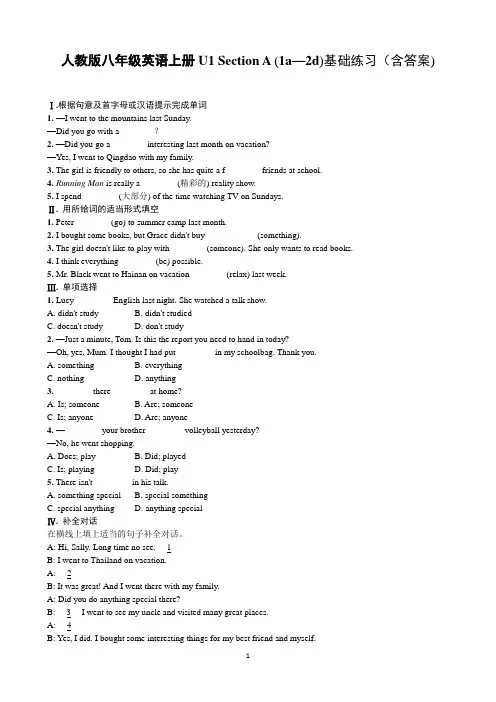
人教版八年级英语上册U1 Section A (1a—2d)基础练习(含答案)Ⅰ.根据句意及首字母或汉语提示完成单词1.—I went to the mountains last Sunday.—Did you go with a________?2.—Did you go a________ interesting last month on vacation?—Yes, I went to Qingdao with my family.3. The girl is friendly to others, so she has quite a f________ friends at school.4.Running Man is really a ________(精彩的) reality show.5. I spend ________(大部分) of the time watching TV on Sundays.Ⅱ. 用所给词的适当形式填空1. Peter ________(go) to summer camp last month.2. I bought some books, but Grace didn't buy ________ (something).3. The girl doesn't like to play with ________(someone). She only wants to read books.4. I think everything ________(be) possible.5. Mr. Black went to Hainan on vacation ________(relax) last week.Ⅲ. 单项选择1. Lucy ________ English last night. She watched a talk show.A. didn't studyB. didn't studiedC. doesn't studyD. don't study2.—Just a minute, Tom. Is this the report you need to hand in today?—Oh, yes, Mum. I thought I had put ________ in my schoolbag. Thank you.A. somethingB. everythingC. nothingD. anything3. ________ there ________ at home?A. Is; someoneB. Are; someoneC. Is; anyoneD. Are; anyone4.—________ your brother ________ volleyball yesterday?—No, he went shopping.A. Does; playB. Did; playedC. Is; playingD. Did; play5. There isn't ________ in his talk.A. something specialB. special somethingC. special anythingD. anything specialⅣ. 补全对话在横线上填上适当的句子补全对话。
仁爱版新版八年级上册英语 Unit1 topic1 Section A课件

—I’m going to play soccer. 我要去踢足球。
另外它还可以表示预测。 e.g. Look at the sky. It’s going to rain. 看这天,快要下雨了。
• be going to与will两者都可表示将要发生的事、 将要去做某事,但它们有如下几点区别:
be going to表示近期、眼下就要发生的事情, will 表示的将来时间则较远一些,如:
Topic 1 I am going to play basketball.
Section A
1a. Look and say.
1. What is Michael going to do?
2. What is the meaning of “cheer…on”?
be going to结构, 是一般将来时的一种表达法。 表示主语将要进行某一行动的打算、意图,且这种打算会付诸实践。 e.g.—What are you going to do tomorrow?你明天打算干什么?
as well I like drinking milk in the morning as well.
• cheer v.加油,欢呼,喝彩, • cheer sb. on意为“为某人喝彩”。 • 为他加油
cheer him on
•1、我们的市场行为主要的导向因素,第一个是市场需求的导向,第二个是技术进步的导向,第三大导向是竞争对手的行为导向。 •2、市场销售中最重要的字就是“问”。 •3、现今,每个人都在谈论着创意,坦白讲,我害怕我们会假创意之名犯下一切过失。 •4、在购买时,你可以用任何语言;但在销售时,你必须使用购买者的语言。 •5、市场营销观念:目标市场,顾客需求,协调市场营销,通过满足消费者需求来创造利润。2021年10月27日星期三 2021/10/272021/10/272021/10/27 •6、我就像一个厨师,喜欢品尝食物。如果不好吃,我就不要它。2021年10月2021/10/272021/10/272021/10/2710/27/2021 •7、我总是站在顾客的角度看待即将推出的产品或服务,因为我就是顾客。2021/10/272021/10/27October 27, 2021 •8、利人为利已的根基,市场营销上老是为自己着想,而不顾及到他人,他人也不会顾及你。2021/10/272021/10/272021/10/272021/10/27
八年级英语上册第一单元SectionA
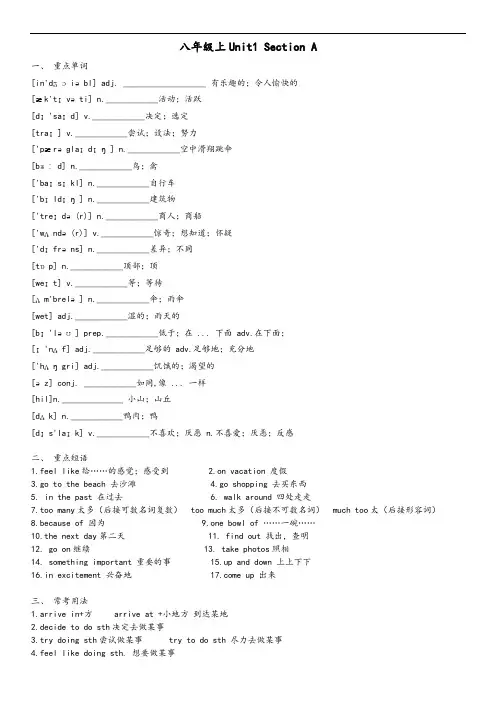
八年级上Unit1 Section A一、重点单词[in'dʒɔiəbl] adj. ___________________ 有乐趣的;令人愉快的[æk'tɪvəti] n.____________活动;活跃[dɪ'saɪd] v.____________决定;选定[traɪ] v.____________尝试;设法;努力['pærəɡlaɪdɪŋ] n.____________空中滑翔跳伞[bɜːd] n.____________鸟;禽['baɪsɪkl] n.____________自行车['bɪldɪŋ] n.____________建筑物['treɪdə(r)] n.____________商人;商船['wʌndə(r)] v.____________惊奇;想知道;怀疑['dɪfrəns] n.____________差异;不同[tɒp] n.____________顶部;顶[weɪt] v.____________等;等待[ʌm'brelə] n.____________伞;雨伞[wet] adj.____________湿的;雨天的[bɪ'ləʊ] prep.____________低于;在 ... 下面 adv.在下面;[ɪ'nʌf] adj.____________足够的 adv.足够地;充分地['hʌŋgri] adj.____________饥饿的;渴望的[əz] conj. ____________如同,像 ... 一样[hil]n.______________ 小山;山丘[dʌk] n.____________鸭肉;鸭[dɪs'laɪk] v.____________不喜欢;厌恶 n.不喜爱;厌恶;反感二、重点短语1.feel like给……的感觉;感受到2.on vacation 度假3.go to the beach 去沙滩4.go shopping 去买东西5. in the past 在过去6. walk around 四处走走7.too many太多(后接可数名词复数) too much太多(后接不可数名词) much too太(后接形容词)8.because of 因为 9.one bowl of ……一碗……10.the next day第二天 11. find out 找出,查明12. go on继续 13. take photos照相14. something important 重要的事 15.up and down 上上下下16.in excitement 兴奋地 e up 出来三、常考用法1.arrive in+方 arrive at +小地方到达某地2.decide to do sth决定去做某事3.try doing sth尝试做某事 try to do sth 尽力去做某事4.feel like doing sth. 想要做某事5.enjoy doing sth 喜欢做某事6.want to do sth 想去做某事7.start doing sth 开始做某事8.stop doing sth停止做某事9.look +形容词看起来……10.dislike doing sth 不喜欢做某事11.why not do sth? = Why don’t you do sth? 为什么不做……呢?12.so+形容词+that+从句如此……以至于……13.tell sb (not)to do sth告诉某人(不要)做某事14.keep doing sth 继续做某事15.forget to do sth忘记去做某事 forget doing sth 忘记做过某事四、重点语法——一般过去时1.一般过去时的基本用法表示过去发生的动作或存在的状态We went to the beach and swam in the sea yesterday.表示过去的习惯动作或过去经常发生、反复发生的动作或存在的状态。
人教 八年级上册第一单元Section A 1a—2d(共49张PPT)
1. — Where did you go on vacation? — I went to the mountains. / …
2. Did you…? Yes, I did. / No, I didn’t.
Talk about past events.
my summer vacation
visited museums
visited my uncle
went to the mountains went to summer camp
Read aloud and remember them: went to New York City
went to the beach
visited museums stayed at home onversations
1、4 or 6 students in one group 2、Play the conversations in real situation 3、Practice for 4-6 mins 4、Show us in the front of the class
conversation1
A: Where did you go on vacation,Grace? B: I went to New York City. A: Oh, really? Did you go with anyone? B: Yes, I w__e_n_t_with my mother. A: Did you go to Central Park? B: Yes, I did . It was really nice. A: Did you buy an__y_th_in_g_s_p_e_c?ial B: Yes, I bought something for my father. A: Oh, really? What? B: _I_bo_u_gh_t_h_im a__hat.
八年级英语上册Unit1Period1SectionA1a_2d习题课件鲁教版五四制
C. get back
D. worry about
【点拨】根据文中“... our kids began to help us with the
housework.”可知,我们的孩子开始帮忙做家务。由此可
见后面表示孩子们照顾宠物,故选A。
返回
Now my daughter Cindy can do many 23 of housework. ( B )23. A. differences B. kinds C. ways D. boxes 【点拨】根据前文“At the age of six, our kids began to help us with the housework.”可知在孩子们六岁时就开始帮忙做家务, 可见现在作者的女儿会做许多种家务。故选B。
鲁教五四版 八年级上
Unit 1 Could you please clean your room?
Period 1 Section A(1a-2d)
一、 根据句意及所给汉语提示填空 1. The kids made a terrible ___m__e_ss___ (杂乱) of the living room.
few 25 . First, it is fun for kids to help.
( B )25. A. words B. reasons C. lessons D. ideas 【点拨】根据文中“First, it is fun for kids to help ... Second, it’s never too ... for them to learn some things.”可知,首先对 孩子们来说,帮忙做家务很有乐趣,其次他们可以学些东 西。可见这是在说让孩子早做家务的原因。故选B。
人教英语八年级上册 UNIT1Section A1a2d(共19张PPT)
1.Where did you go on vacation? 你去哪儿度假? go on vacation 意为“去度假”。
2. I went to summer camp. 我去了夏令营。 go to summer camp 意为“去夏令营”。 类似的短语还有: 1.go to the mountains 去爬山 2.go to the beach 去海滩 3.go to the movies 去看电影 4.go to the party 去参加聚会 5.go to work 去上班
( B ) 2.They helped me ___ my books.
A. finds B. to find C. found D. finding
( A ) 3. What ___ you ___yesterday?
A. did, do B. do, do C. did, doing D. are, do
( C ) 4. ---Where did she go on vacation?
---She ___ to the beach.
A. go
B. goes
C. went D. going
( C ) 5.Everyone____a good time!
A.had B. have
C.has
D.having
anyone 表示“某人”时,常用于否定句和疑问句中,意为 “什么人,谁”;表示 “任何人”,可用于肯定句。被形容词 修饰时,形容词应该置于其后。
2. anywhere 的用法
1) 我在什么地方都不能找到它。I can't find it anywhere. 2) 昨晚你去什么地方了吗? Did you go anywhere last night? 3) 你去过又去的地方吗? Did you go to anywhere interesting? 4) 随便坐。 Sit anywhere.
人教版英语八年级上册Unit1SectionA1a1c说课稿
一、教材分析
(一)内容概述
本节课为人教版英语八年级上册Unit 1 "How often do you exercise?" Section A 1a-1c的内容。这部分内容在整个课程体系中位于单元的开始部分,起着引入单元主题的作用。通过本节课的学习,学生能够掌握频率副词及其短语,学会用英语询问和表达日常活动的频率。主要知识点包括:频率副词(always, usually, often, sometimes, rarely, never)及其短语的用法;一般现在时态的运用;日常活动类词汇(exercise, watch TV, play computer games等)。
(3)通过任务型教学法,激发学生的学习兴趣,提高课堂参与度。
3.情感态度与价值观目标:
(1)培养学生养成积极健康的生活习惯,关注自己的身体健康;
(2)鼓励学生用英语交流,增强他们的自信心;
(3)培养学生的团队合作精神,尊重他人。
(三)教学重难点
根据对学生的了解和教学内容的分析,本节课的教学重点和难点如下:
3.对话展示:播放教材中的对话,让学生跟读、模仿,并在实际语境中感知频率副词和一般现在时态的运用。
(三)巩固练习
为了帮助学生巩固所学知识并提升应用能力,我将设计以下巩固练习或实践活动:
1.小组活动:学生分组,根据给出的频率副词和日常活动词汇,编写对话进行角色扮演。
2.听力练习:播放一段含有频率副词的对话,让学生回答相关问题,提高听力理解能力。
1.多媒体课件:展示课程内容、示例对话、练习题等,丰富课堂表现形式,提高学生的学习兴趣。
2.网络资源:提供丰富的听力、口语练习材料,拓展学生的学习资源。