
初中英语语法之一般过去时
3. The weather was great yesterday.
How was the weather yesterday?
用be动词的适当形式填空
4. Mike was eleven years old last year.
How old was Mike last year?
将下列句子改为一般疑问句
4. Was there any milk in the fridge the day before yesterday?
Yes, there was. / No, there wasn't. 5. Were all the students very happy?
Yes, they were. / No, they weren't. 6.Was your school trip excellent?
加-_e_d___
worry
过去式 worked played hoped
lived
stopped shopped
studied worried
下列动词的过去式是什么?
answer answered look looked play played show showed brush brushed start started listen listened help helped
asked
washed
cook dance learn save rain snow skate
cooked danced learned saved rained snowed skated
一般过去时态
1.表示过去某个时间发生的动作 (实义动词)如:
We played soccer yesterday afternoon.
5. Our school trip was excellent.
How was your school trip?
6. It was Monday yesterday.
What day was ( it ) yesterday?
Miss Ma
Yes, they were. / No, they weren't. 2.Was the weather great yesterday?
Yes, it was. / No, it wasn't. 3.Were the strawberries good? Yes, they were. / No, they weren't.
5.They are good friends .
Theyw__e_r_e good friends in 2001.
用be动词的适当形式填空 1. I __w_a_s___ at school just now(刚才). 2. He ___w_a__s__ in Shanghai last week. 3. We ___w_e_r_e__ students two years ago. 4. They __w_e_r_e___ on the farm last
或存在的状态。(be动词) 如: He was very short when he was ten.
be动词的过去式
am is
was
不 规
则
变
are were 化
I am
he
she is
it
we
you are
they
was were
1.I am a student .
I _w__a_s a student 10 years ago .
Was there any milk in the fridge the day before yesterday?
5. All the students was very happy.
Were all the students very happy?
6. Our school trip was excellent.
day before yesterday.
There wasn't any milk in the fridge the day before yesterday.
5. She was late for class this morning .
She wasn't late for class this morning.
2. He was in Shanghai last week.
He wasn't in Shanghai last week.
3. The strawberries were good .
The strawberries weren't good.
将下列句子改为否定句。 4. There was some milk in the fridge the
含was / were的否定句 在was/ were后加上not.
was were
not
was not = wasn't were not = weren't
将下列句子改为否定句。 1. I was at school just now(刚才).
I wasn't at school just now.
Yes, it was. / No, it wasn't.
含was / were的特殊疑问句句 对划线部分提问
疑问词+was/were + ...?
对划线部分提问 1. I was at school just now.
Where were you just now?
2. They were on the farm last weekend.
过去式
规则动词过去式的构成
构成规则
原形
一般在动词原形末尾加_e_d_ work
play
结尾是e的动词加_d__
hope live
末尾只有一个辅音字母的
重读闭音节词,先_双__写__这
stop
个辅音字母,再加__e_d___ shop
结尾是“辅音字母+y”的动
词,先变“y”为“__i_”再
study
want wanted clean cleaned taste tasted walk walked work worked stop stopped live lived
注意读音
下列动词的过去式是什么?
like visit pick climb enjoy arrive love worry watch remember
last year.
8. There __w__a_s___ some milk in the
fridge the day before yesterday.
9. All the students _w_e_r_e__ very happy. 10. She _w_a_s_ late for class this morning . 11. Our school trip __w__a_s_ excellent.
Was the weather great yesterday?
3. The strawberries were good .
Were the strawberries good?
将下列句子改为一般疑问句
4. There was some milk in the fridge the day before yesterday.
含was / were的一般疑问句 将was/ were置于句首。
Was ...?
Were...?
将下列句子改为一般疑问句
1. They were on the farm last weekend.
Were they on the farm last weekend?
2. The weather was great yesterday.
构成规则
原形
一般在动词原形末尾加_e_d_ work
play
结尾是e的动词加_d__
hope live
末尾只有一个辅音字母的
重读闭音节词,先_双__写__这
stop
个辅音字母,再加__e_d___ shop
结尾是“辅音字母+y”的动
词,先变“y”为“__i _”再
study
加-_e_d___
worry
2.She is a student
例
She _w_a_s_ a student 10 years ago .
3.You are a student.
Youw__e_r_e a student 10 years ago . 如
4.It is a small village.
It_w__a_s a small village in 1997 .
一般过去时态
一
构成
般
过
用法
去
时
态
常用时间
动词的过去式
1.表示过去某个时间发 生的动作或存在的状态。
2.表示过去经常或 反复发生的动作。
yesterday (morning / ...) last night /week/ ... 时间段+ ago in +过去时间(如:in2015)
规则动词过去式的构成
liked
visited
picked
注
climbed enjoyed
意
arrived
读
loved
音
worried
watched
remembered
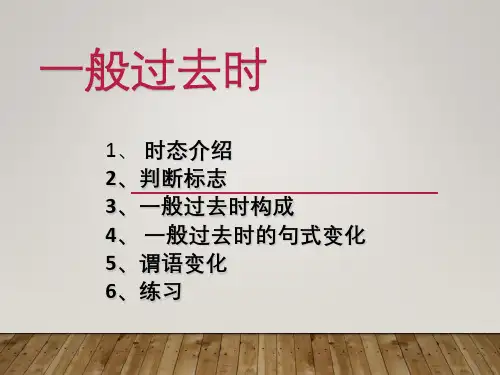
初中英语语法专项:一般过去时
• 6S. Mhey misonth’tergliokeins ghertostugdoenstsh.o(变pp一in般g疑to问m句o)rrow.
写出下列动词的过去式:
go
went
use
think thought live
be
was/ were wake
happen happened keep
give gave
say
become became clean
get got
buy
rain rained play
stay stayed learn
pass passed see
answer answered read
used lived woke kept said cleaned bought played learnt/ed saw read
run ran borrow borrowed grow grew watch watched write wrote smile smiled open opened begin began swim swam carry carried study studied
4、一般过去时句式变换
一般过去时态句式的构成
陈述句式
动词
肯定式
否定式
I was ….
I was not(wasn’t)….
He /She/it was…. He/She/It was not(wasn’t)…. be We/You/They were …. We/You/They were not
•元浊 /d/ ,即 ed 在元音,浊 辅音后面念 /d/ ,
初中英语语法 八大时态之一般过去时课件

I study in Beijing. I studied in Beijing .
she stops. she stopped.
I go to school by bike every day. I went to school by bike yesterday.
以e结尾的,直接在词尾加d dance - danced 辅音加y结尾,变y为i加ed study - studied 重读闭音节结尾,双写词尾字母加 ed stop - stopped 3.不规则变化: 没有变化 cut -cut put-put come-come hit-hit let-let 特殊情况 have/has—had, go---went, eat---ate, say—said
1
last year
时间
last week
标志 2 last weekend
The day before
3 。。。。。。
一般过去时
动词的变化
一般过去时-含有be动词的
• She is in Beijing.
She was in Beijing .
• I am a student.
I was a student.
read — read
write — wrote say — said
play — played
learn — learned buy — bought cry — cried
study — studied swim — swam walk — walked
一般过去时主要动词的变化:
初中英语语法八大时态总结(完整版)
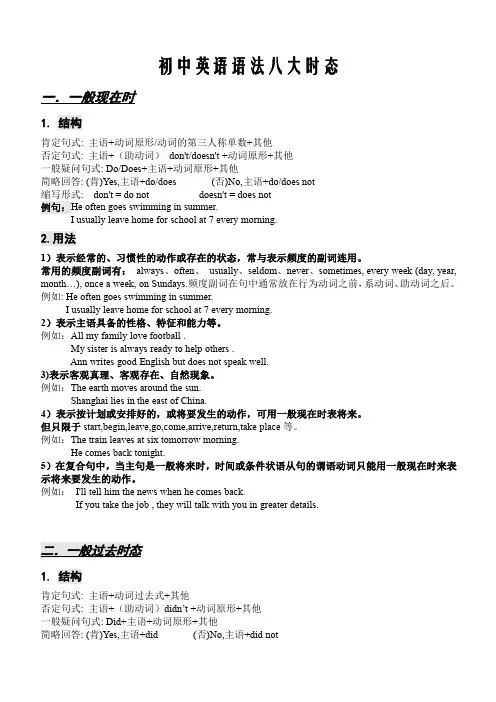
初中英语语法八大时态一.一般现在时1. 结构肯定句式: 主语+动词原形/动词的第三人称单数+其他 否定句式: 主语+(助动词) don't/doesn't +动词原形+其他 一般疑问句式: Do/Does+主语+动词原形+其他 简略回答: (肯)Yes,主语+do/does (否)No,主语+do/does not 缩写形式: don't = do not doesn't = does not 例句:He often goes swimming in summer. I usually leave home for school at 7 every morning.2.用法1)表示经常的、习惯性的动作或存在的状态,常与表示频度的副词连用。
常用的频度副词有: always、often、 usually、seldom、never、sometimes, every week (day, year, month…), once a week, on Sundays.频度副词在句中通常放在行为动词之前, 系动词、 助动词之后。
例如: He often goes swimming in summer. I usually leave home for school at 7 every morning. 2)表示主语具备的性格、特征和能力等。
例如:All my family love football . My sister is always ready to help others . Ann writes good English but does not speak well. 3)表示客观真理、客观存在、自然现象。
例如:The earth moves around the sun. Shanghai lies in the east of China. 4)表示按计划或安排好的,或将要发生的动作,可用一般现在时表将来。
初中英语语法——一般过去时知识点总结归纳

初中英语语法——一般过去时知识点总结归纳一般过去时——表示过去发生的动作或事件。
概念: 1) 表示过去某个时间发生的动作或存在的状态。
常和表示过去的时间状语连用. 如: yesterday , last week , in 1998 , two days ago 等。
如: I went to a movie yesterday. 我昨天去看了一场电影。
2) 也可表示过去经常或反复发生的动作。
如: He always went to work by bike last week。
构成: (1) 主语+ be (was / were ) +……(2) 主语+ 实义动词过去式+【解析】常和表示过去的时间状语连用,如yesterday, last night, the day before yesterday, 3 days ago...含有be动词的句子,将be动词变为过去式。
am, is的过去式为was, are的过去式为were:I was at the butcher's.You were a student a year ago.The teacher was very beautiful ten years ago.★变否定句在be动词后面加notI was not at the butcher's.You were not a student a year ago.The teacher was not very beautiful ten years ago.★变疑问句将be动词移动到句首Were you at the butcher's?Were you a student a year ago?Was the teacher very beautiful ten years ago?★肯定回答否定回答Yes, I was. / No, I was not.Yes, you were. / No, you were not.Yes, he/she was. / No, he/she was not.★特殊疑问句What did you do?(必背)不含有be动词的句子,将动词变为过去式:I finished my homework yesterday.The boy went to a restaurant.The Sawyers lived at King Street a year ago.★变疑问句在句首加did,动词变为原型Did you finish your homework yesterday?Did the boy go to a restaurant?Did the Sawyers live at King Street a year ago?★变否定句在主语和动词之间加did notI did not finish my homework yesterday.The boy did not go to a restaurant.The Sawyers did not live at King Street a year ago.★肯定回答及否定回答Yes, I did. / No, I didn't.Yes, he did. / No, he didn't.Yes, they did. / No, they did not.。
初中英语语法一般过去时
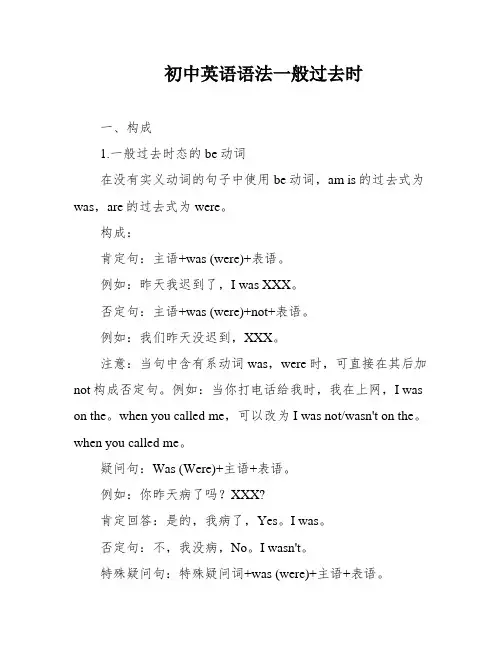
初中英语语法一般过去时一、构成1.一般过去时态的be动词在没有实义动词的句子中使用be动词,am is的过去式为was,are的过去式为were。
构成:肯定句:主语+was (were)+表语。
例如:昨天我迟到了,I was XXX。
否定句:主语+was (were)+not+表语。
例如:我们昨天没迟到,XXX。
注意:当句中含有系动词was,were时,可直接在其后加not构成否定句。
例如:当你打电话给我时,我在上网,I was on the。
when you called me,可以改为I was not/wasn't on the。
when you called me。
疑问句:Was (Were)+主语+表语。
例如:你昨天病了吗?XXX?肯定回答:是的,我病了,Yes。
I was。
否定句:不,我没病,No。
I wasn't。
特殊疑问句:特殊疑问词+was (were)+主语+表语。
例如:你是什么时候出生的?When were you born?2.实义动词的一般过去时态肯定句要使用动词的过去式,否定句和疑问句要使用助动词do和does的过去式did。
构成:肯定句:主语+动词过去式+宾语。
例如:我昨天九点钟回的家,I went home at nine o'clock XXX。
否定句:主语+didn't+动词原形+宾语。
例如:我昨天没回家,I XXX't go home XXX。
疑问句:Did+主语+动词原形+宾语。
例如:你昨天回家了吗?Did you go home yesterday?肯定回答:是的,我回了,Yes。
I did。
否定回答:不,我没回家,No。
I XXX't。
3.助动词和情态动词过去式shall―should(将要)用于第一人称单数;will―would(将要)用于所有人称;can—could(能,会);may―might (可以);must―must(必须);have to―had to(不得不)。
一般过去时用法的说明-初中英语语法
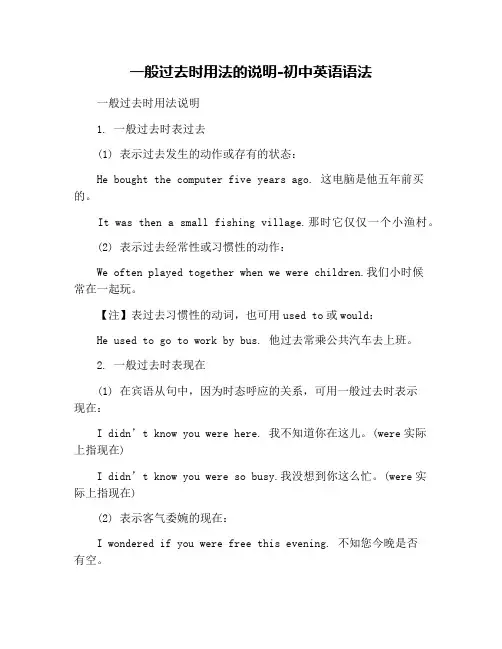
一般过去时用法的说明-初中英语语法一般过去时用法说明1. 一般过去时表过去(1) 表示过去发生的动作或存有的状态:He bought the computer five years ago. 这电脑是他五年前买的。
It was then a small fishing village.那时它仅仅一个小渔村。
(2) 表示过去经常性或习惯性的动作:We often played together when we were children.我们小时候常在一起玩。
【注】表过去习惯性的动词,也可用used to或would:He used to go to work by bus. 他过去常乘公共汽车去上班。
2. 一般过去时表现在(1) 在宾语从句中,因为时态呼应的关系,可用一般过去时表示现在:I didn’t know you were here. 我不知道你在这儿。
(were实际上指现在)I didn’t know you were so busy.我没想到你这么忙。
(were实际上指现在)(2) 表示客气委婉的现在:I wondered if you were free this evening. 不知您今晚是否有空。
I thought you might like some flowers. 我想您也许想要些花。
【注】能这样有的动词主要限于want, wonder, think, hope, intend等少数动词。
(3) 用于某些特殊结构中表示现在It’s time we started. 我们该动身了。
I wish I knew his name. 要是我知道他的名字就好了。
I’d rather you lived closer to us. 我希望你能住得离我们近点。
【注】该用法主要用于it’s time, I wish, I’d rather, if only, as if, as though 等少数结构后接从句的情形,其中有些结构后面的句子还可用一般过去时表示将来:I’d rather you came next Monday. 我宁愿你下周星期一来。
初中英语语法八大时态总结完整版
初中英语语法八大时态总结完整版一、一般现在时1.定义:表示经常性或习惯性的动作、状态或真理。
2.结构:主语+动词原形(+其他成分)。
3.例句:(1) I go to school every day.(2) He often plays basketball after school.(3) Water boils at 100 degrees Celsius.二、一般过去时1.定义:表示过去一些时间发生的动作或存在的状态。
2.结构:主语+动词的过去式(+其他成分)。
3.例句:(1) They visited their grandparents last weekend.(2) She lived in Beijing when she was young.(3) We studied English in middle school.三、一般将来时1.定义:表示将来一些时间将要发生的动作或存在的状态。
2. 结构:主语 + will + 动词原形(+ 其他成分)。
3.例句:(1) I will go to the park tomorrow.(3) We will have a party next week.四、现在进行时1.定义:表示现在正在进行的动作。
2. 结构:主语 + am/is/are + 动词-ing(+ 其他成分)。
3.例句:(1) She is reading a book right now.(2) They are playing soccer in the park.(3) We are having dinner at the moment.五、过去进行时1.定义:表示过去一些时间正在进行的动作。
2. 结构:主语 + was/were + 动词-ing(+ 其他成分)。
3.例句:(1) He was watching TV at 8 o'clock last night.(2) They were traveling in Europe during summer vacation.(3) We were studying when the phone rang.六、将来进行时1.定义:表示将来一些时间正在进行的动作。
初中英语语法八大时态之一般过去时
初中英语语法八大时态之一般过去时
一般过去时
1.概念:过去某个时间里发生的动作或状态;过去习惯性、经常性的动作、行为。
2.基本结构:
①was/were;②行为动词过去式
否定形式:①was/were + not;②在行为动词前加didnt,同时还原行为动词。
一般疑问句:①was或were放于句首;②用助动词do的过去式did 提问,同时还原行为动词。
3.用法
1) 在确定的过去时间里所发生的动作或存在的状态。
时间状语有:yesterday,last week,an hour ago,the other day,in 1982等。
例如:Where did you go just now? 刚才你上哪儿去了?
2) 表示在过去一段时间内,经常性或习惯性的动作。
例如:When I was a child,I often played football in the street。
我是个孩子的时候,常在马路上踢足球。
Whenever the Browns went during their visit,they were given a warm welcome。
那时,布朗一家无论什么时候去,都受到热烈欢迎。
注意:used to + do:过去常常表示过去习惯性的动作或状态,但如今已不存在。
例如:Mother used not to be so forgetful。
老妈过去没那么健忘。
Scarf used to take a walk。
斯卡夫过去常常散步。
初中英语语法六大时态
初中英语语法六大时态初中英语通常涵盖的六大时态是:一般现在时、一般过去时、一般将来时、现在进行时、过去进行时和现在完成时。
以下是这些时态的基本结构和用法:1.一般现在时 (Present Simple)1.结构:主语+ 动词原形(第三人称单数使用动词第三人称单数形式)2.用途:描述经常发生的动作或状态;表达客观事实、普遍真理或习惯性动作;表示主语的特征或状态。
3.例子:She always gets up early. (她总是早起。
)2.一般过去时 (Past Simple)1.结构:主语+ 动词过去式2.用途:描述过去某个时间发生的动作或状态;叙述过去的事实或经历。
3.例子:I watched TV last night. (我昨晚看了电视。
)3.一般将来时 (Future Simple)1.结构:主语+ will + 动词原形2.用途:表示将来某个时间要发生的动作或状态;表示计划、意愿或预测。
3.例子:She will go to the party tomorrow. (她明天要去参加聚会。
)4.现在进行时 (Present Continuous)1.结构:主语+ be 动词(am/is/are)+ 动词-ing2.用途:描述当前正在进行的动作或正在发生的情况。
3.例子:They are playing football now. (他们现在正在踢足球。
)5.过去进行时 (Past Continuous)1.结构:主语+ be 动词的过去式(was/were)+ 动词-ing2.用途:描述过去某个时间正在进行的动作或状态。
3.例子:When I was a child, I was always playing outside. (当我还是个孩子的时候,我总是在外面玩。
)6.现在完成时 (Present Perfect)1.结构:主语+ have/has + 过去分词2.用途:描述过去发生的动作对现在造成的影响或结果;表示从过去某个时间开始一直持续到现在的动作或状态。
初中英语语法:一般现在时、一般过去时和一般将来时
初中英语语法:一般现在时、一般过去时和一般将来时一、一般现在时(一)一般现在时的三种形式1、谓语是be(am/is/are)的一般现在时。
①肯定形式:主语+be+表语(形容词、名词充当表语)。
I am hungry.You are beautiful.He is a doctor.①否定形式:主语+be+not+表语(形容词、名词充当表语)。
I am not hungry.You aren't beautiful.He isn't a doctor.①一般疑问句形式:Be+主语+表语(形容词、名词充当表语)?肯定回答:Yes,主语+be. 否定回答:No, 主语+ be+not.—Are you hungry?—Yes,I am./No,I'm not.—Is he a doctor?—Yes, he is./No, he isn,t.①特殊疑问句形式:特殊疑问词+Be开头的一般疑问句?—What is he?—He is a doctor.注意:be要随着主语变。
2.谓语动词是实义动词(及物动词或不及物动词)的一般现在时。
①肯定形式:“主语+及物动词+宾语”或“主语+不及物动词”。
She has a little brother.她有一个弟弟。
The sun rises in the east.太阳从东方升起。
①否定形式:“主语+don't/doesn't+及物动词+宾语”或“主语+don't/doesn't+不及物动词”。
She doesn't have a little brother.她没有弟弟。
I don't eat every morning.我每天早晨都不吃饭。
①一般疑问句形式:“Do/Does+主语+及物动词原形+宾语”或“Do/Does+主语+不及物动词原形”。
肯定回答:Yes,主语+do/does. 否定回答是:No, 主语+ don't/doesn't.—Do you eat every morning?—Yes, I do./No, I don't.—Does she have a little brother?—Yes, she does./No, she doesn't.①特殊疑问句:特殊疑问词+do/does开头的一般疑问句?What do you like?When do you go to school?注意:根据主语确定用do还是does。