
英文写作名词解释
What is a summary?A summary is a short piece of writing that gives the main facts or ideas of a story or article,etc. The qualities of a good summary?It should be objective,that is,the writer does not include any ideas of his/her own. It should be complete ,that is,the writer does not leave out important facts or ideas.It should be balanced,in other words,the writer gives equal attention to each main idea.The goal of a summary?It is to give readers an objective,complete,accurate and balanced view ofsomething(an article,a story ,a novel,a play,etc)Paragraph unityA unified paragraph contains only sentences that explain or support the general statement made in the topic sentence.Any sentence that does not relate to (=is not connected in some way)the main idea will not develop it.How to achieve paragraph unity?Begin with a discussable point and express it in a topic sentence.Stick to this single point throughout,that is,all other sentence should be aboutthis point.Prove or develop the point;don 't merely repeat it.Link your sentence to make your ideas easy to follow.How to outline (=to give the main facts about something) a story?Divide the story into smaller parts. Summarize each part in one sentence.Number your sentence summaries to make them an outline of the story.What is a narrative paragraph?A narrative paragraph is one that briefly describes an incident or a personal experience. Requirements that a good narrative paragraph should meet?Though its length is limited,it is complete,that is,it has a beginning,middle and end.It includes as little conversation as possible.Its sentences are connected by suitable linking words or expressions.Here are some common time linking words/expressions.Afterward later when shortly afterward soon while the next day/night then Paragraph coherence(Coherence is connection )A coherent paragraph is one in which every sentence after the first is connected to the one before it,to the topic sentence ,or to both ,and readers can readily follow the writer 's train of thought(= a related series of thoughts)An incoherence paragraph is one in which the sentences are badly connected or not connected at all,and the readers are likely to lose their way.How to achieve paragraph coherence?Arrange sentence in a clear order.Use correct pronounsUse correct linking words and expressions.What is exposition?Exposition is explanatory writing.Its purpose is to explain or clarify a point. Patterns of expositionExemplificationProcess analysis Cause-Effect analysis Comparison and contrast Classification Definition Analogy What is exemplification?Exemplification is a method of supporting a thesis statement with a series of specific examples or sometimes,with a single extended example.It is one of the most common and most useful means of developing a paragraph or an essay.What is an essay?An essay is a related group of paragraphs written for some purpose.Types of essaysEssays can be classified into types,or modes,according to their purposes. Narrative essays relate a sequence of events,whether factual or not.Descriptive essays create a word picture of a scene,a person,or an object.Expositive essays explain--to inform,instruct,clarify,illustrate,or define. Argumentative essays state an opinion and defend it logically.Basic structure of an expositive essayAn expositive essay has three parts: A beginning called the introduction. A middle called the body.An end called the conclusion.Elements of the expositive essay OutliningThesis statementTitleTransitionWhat is an outline?An outline is a method of organizing materials in logical order.It is a list that shows the main ideas and the structure of something you are planning to write.In other words,it is a plan for a piece of writing.Constructing an outline makes the writing of your essay easier.Types of outline1.Topic outline,which uses only key words and phrases.2.Sentence outline,which uses complete sentence.Format(the arrangement ,design,or organization of something)A topic outline looks like this:Thesis:In my first year at college,I learned to spend my money wisely.What is process analysis?A process analysis is a step-by-step explanation of how to do something,or how something works/done or made,or something happened.What is process analysis used for?1.To give directions to people who want or need to perform the process.(giving instructions )2.To give information to those who want to understand the process but may not actually performit.(giving information)3.To explain how something happened.(giving the history) What are the major typesof process analysis?1.Directive process analysis which is aimed at explaining how to do or make something.rmative process analysis which is aimed at explaining how something is done/works or how something took place/happened.What is comparison/contrast?Comparison/contrast is a method of developing a paragraph or an parison shows similarity while contrast shows difference.The word comparison is sometimes used to mean both comparison and contrast.What is comparison/contrast used for?1.To clarify something unknown or not well understood.2.To lead a new way of viewing something familiar.3.To bring one or both of the subjects into sharper focus.4.To show that one subject is better than the other. What is classification? Classification is the method of grouping objects,people,or ideas systematically.Itis one of the most useful organizational strategies in writing.What is classification used for?1.To organize and perceive the world around us.2.To present a mass of material by means of some orderly system.3.To deal with complex or abstract topics by breaking a broad subject intosmaller,neatly sorted categories.What is definition?1.Definition is the explanation of the meaning of a word or concept.2.Definition is also a method of developing an essay.What is analogy?Analogy is an extended comparison based on the similar features of two things of different classes,one familiar one easily understood,the otherunfamiliar ,abstract,or complicated.It is an important method of exposition.What are transition?Transition,also called ”transitional devices ”,are words,phrases,and even whole sentences that link sentence to one another.What is a journal?A journal is a record of experiences,ideas,or reflections kept regularly for private use.It is something “for you eye only ”.So you can write from your heart and letideas and feelings flow freely.Journal writing is a form of free-writing,which involves writing whatever comes to your mind about what happens around you and what you observe and think about. Argumentation and persuasion defined.Argumentation-persuasion is the type of writing in which writers try to encourage readers to accept their point of view on a controversial issue.In argumentation ,writers use objectives,logical reasoning,facts,and hard evidence to demonstrate the soundness of a position.Their purpose is to encourage readers to accept their point of view.In persuasion,writers use emotional language and dramatic appeals to readers' concerns,beliefs and values,often in the hope of encouraging then to take a specific action,besides,encouraging acceptance of an opinion.Argumentation and persuasion are frequently used together in an essay.Also,the two terms are often used interchangeably.The claim definedClaims,or propositions,represent answers to what you are trying to prove in an argumentative essay.Although they are the conclusions of your arguments,they often appear as these statements. Abstract&concrete wordsConcrete words identify persons and things that can be perceived by the senses--seen,heard,tasted,felt,smelled,e.g.table,boy,rose,etc.Abstract words denote qualities,concepts,relationships,acts,conditions,ideas that we can 't perceive directly through our five senses,e.g.honesty,friendship,life,etc. Most words are neither wholly abstract nor concrete.They are between the two extremes,e.g.exercise,rest,answer,etc.General&specific wordsSpecific words identify individual items in a group,e.g.BuickGeneral words relate to categories,an overall group,e.g.carMost words are neither wholly general nor specific.They are between the two extremes,e.g.child,student,flower,etc.The support definedThe ideas and information intended to convince readers that the claim is sound or believable. What is conciseness?Conciseness means being direct and to the point.Redundant words or wordy writing is not concise.Do not over-use words to deliver the message in your writing.Refutation definedRefutation is attempts to prove views against the writer 's position wrong or false.It is often an indispensable part of an argumentative essay,for it shows that the writer is aware of opposing viewpoints and has thought about both sides.Essays that mainly refute opposing views are known as rebuttal arguments.Fallacies definedFallacies are statements that may sound reasonable or true but are not logically defensible and may actually be deceptive.The emotional appeal definedEmotional appeal is a strategy writers and public speakers use to persuade,which is to arouse the reader's/audience's feelings to reinforce an argument.真题:What is the research paper?What is the process of writing it?A research paper is usually a formal,fairly long and well-documented composition. Process: 1.choosing a topic2.Collecting information3.Analyzing the information,organizing ideas and working out an outline4.Writing the first draft5.Revising the draft and finalizing the paper.What is the sentence?What is the effective sentence?A sentence contains at least a subject and a predicate verb:if the verb is transitive,there must be an object,if the verb is a link verb,there must be a predicative or complement.They are unity,coherence,conciseness,emphasis and variety.How many types of sentences according to the use?What are they?There are four.They are declarative,interrogative,imperative and exclamatory sentence.How many types of sentences according to the structure?What are they?There are four.They are simple,compound,complex and compound-complex sentence.。
narrative essay名词解释
narrative essay名词解释
Narrative Essay,中文称为“记叙文”,是一种常见的写作形式,主要通过叙述一件事情或一系列事件来表达作者的观点或情感。
这种类型的文章通常包括事件的起因、经过和结果,以及一个或多个角色的发展。
记叙文的目的是让读者身临其境,体验故事中的情感和事件,从而引发读者的共鸣和思考。
在撰写记叙文时,需要注意以下几点:
1. 明确主题:在开始写作之前,要明确文章的主题和目的,确保文章内容紧扣主题。
2. 叙述生动:记叙文需要将事件和角色生动地呈现出来,让读者感受到故事的情感和意义。
3. 结构清晰:文章的结构要清晰,包括开头、主体和结尾,使读者能够轻松地理解故事的发展。
4. 语言简洁:记叙文的语言要简洁明了,避免过多的修饰和冗长的句子,使文章更加易于阅读和理解。
5. 符合逻辑:在叙述事件和角色时,要注意符合逻辑,避免出现矛盾和不合理的地方。
总之,记叙文是一种富有情感和情节的写作形式,能够引起读者的共鸣和思考,对于培养语言能力和表达能力有很大的帮助。
英美文学名词解释整理版
英美文学名词解释1. Allegory: A tale in verse or prose in which characters, actions, or settings represent abstract ideas or moral qualities. An allegory is a story with two meanings, a literal meaning and a symbolic meaning.寓言:用诗歌或散文讲的故事,在这个故事中人物、事件或背景往往代表抽象的概念或道德品质。
所有的寓言都是一个具有双重意义、文学内涵或象征意义的故事。
2.Alliteration: The repetition of the initial consonant sounds in poetry.头韵:诗歌中单词开头读音的重复。
3.Allusion:A reference to a person, a place, an event, or a literary work that a writer expects the reader to recognize and respond to. An allusion may be drawn from history, geography, literature, or religion.典故:文学作品中作家希望读者能够认识或做出反应的一个人物、地点、事件或文学作品。
典故或来自历史、地理、文学或宗教。
4. American Naturalism: American naturalism was a new and harsher realism. American naturalism had been shaped by the war; by the social upheavals that undermined the comforting faith of an earlier age. America’s literary naturalists dismissed the validity of comforting moral truths. They attempted to achieve extreme objectivity and frankness, presenting characters of low social and economic classes who were determined by their environment and heredity. In presenting the extremes of life, the naturalists sometimes displayed an affinity to the sensationalism of early romanticism, but unlike their romantic predecessors, the naturalists emphasized that the world was amoral, that men and women had no free will, that lives were controlled by heredity and environment, that the destiny of humanity was misery in life and oblivion in death. Although naturalist literature described the world with sometimes brutal realism, it sometimes also aimed at bettering the world through social reform.美国自然主义:美国自然主义是一种新的、更具批判性的现实主义。
用于名词解释的英文

用于名词解释的英文在我们学习和使用英语的过程中,名词是必不可少的一部分。
而为了准确地理解和运用这些名词,我们需要掌握一些用于名词解释的英文表达方式。
本文将介绍一些常用的用于名词解释的英文短语和表达方法。
第一,最常见的用于解释名词的方式是使用定冠词“a”或“an”加上名词本身。
例如,我们可以说:“A dog is a domesticated carnivorous mammal.”(狗是一种被驯化的食肉哺乳动物。
)或者说:“An apple is a fruit.”(苹果是一种水果。
)这种方法非常简洁明了,适用于初级英语学习者。
第二,我们可以使用“a kind of”或“a type of”来解释名词。
例如:“A cat is a kind of domesticated carnivorous mammal.”(猫是一种被驯化的食肉哺乳动物。
)或者说:“An orange is a type of citrus fruit.”(橙子是柑橘类水果的一种。
)这种方式更加具体明确,可以进一步将名词划分为更细致的类别。
第三,我们可以使用“is a”短语来进一步解释名词的定义。
例如:“A scientist isa person who conducts scientific research.”(科学家是进行科学研究的人。
)或者说:“A bicycle is a vehicle with two wheels.”(自行车是一种有两个轮子的交通工具。
)这种方式更加详细地描述了名词的特征和属性。
第四,我们可以使用“refers to”来解释名词的含义。
例如:“The term 'global warming' refers to the long-term increase in Earth's average temperature due to human activities.”(“全球变暖”这个术语指的是由于人类活动而导致的地球平均温度长期增加。
(完整版)英美文学名词解释最全版
01. Humanism(人文主义)1>Humanism is the essence of the Renaissance.2> it emphasizes the dignity of human beings and the importance of the present life. Humanists voiced their beliefs that man was the center of the universe and man did not only have the right to enjoy the beauty of the present life, but had the ability to perfect himself and to perform wonders.02. Renaissance(文艺复兴)1>The word “Renaissance”means “rebirth”, it meant the reintroduction into western Europe of the full cultural heritage of Greece and Rome.2>the essence of the Renaissance is Humanism. Attitudes and feelings which had been characteristic of the 14th and 15th centuries persisted well down into the era of Humanism and reformation.3> the real mainstream of the English Renaissance is the Elizabethan drama with William Shakespeare being the leading dramatist.03. Metaphysical poetry(玄学派诗歌)1>Metaphysical poetry is commonly used to name the work of the 17th century writers who wrote under the influence of John Donne.2>with a rebellious spirit, the Metaphysical poets tried to break away from the conventional fashion of the Elizabethan love poetry.3>the diction is simple as compared with that of the Elizabethan or the Neoclassical periods, and echoes the words and cadences of common speech.4>the imagery is drawn from actual life.04. Classicism(古典主义)Classicism refers to a movement or tendency in art, literature, or music that reflects the principles manifested in the art of ancient Greece and Rome. Classicism emphasizes the traditional and the universal, and places value on reason, clarity, balance, and order. Classicism, with its concern for reason and universal themes, is traditionally opposed to Romanticism, which is concerned with emotions and personal themes.05. Enlightenment(启蒙运动)1>Enlightenment movement was a progressive philosophical and artistic movement which flourished in France and swept through western Europe in the 18th century.2> the movement was a furtherance of the Renaissance from 14th century to the mid-17th century.3>its purpose was to enlighten the whole world with the light of modern philosophical and artistic ideas.4>it celebrated reason or rationality, equality and science. It advocated universal education.5>famous among the great enlighteners in England were those great writers like Alexander pope. Jonathan Swift. etc.06.Neoclassicism(新古典主义)1>In the field of literature, the enlightenment movement brought about a revival of interest in the old classical works.2>this tendency is known as neoclassicism. The Neoclassicists held that forms of literature were to be modeled after the classical works of the ancient Greek and Roman writers such as Homer and Virgil and those of the contemporary French ones.3> they believed that the artistic ideals should be order, logic, restrained emotion and accuracy, and that literature should be judged in terms of its service to humanity.07. The Graveyard School(墓地派诗歌)1>The Graveyard School refers to a school of poets of the 18th century whose poems are mostly devoted to a sentimental lamentation or meditation on life. Past and present ,with death and graveyard as themes.2>Thomas Gray is considered to be the leading figure of this school and his Elegy written in a country churchyard is its most representative work.08. Romanticism(浪漫主义)1>In the mid-18th century, a new literary movement called romanticism came to Europe and then to England.2>It was characterized by a strong protest against the bondage of neoclassicism, which emphasized reason, order and elegant wit. Instead, romanticism gave primary concern to passion, emotion, and natural beauty.3>In the history of literature. Romanticism is generally regarded as the thought that designates a literary and philosophical theory which tends to see the individual as the very center of all life and experience. 4> The English romantic period is an age of poetry which prevailed in England from 1798 to 1837. The major romantic poets include Wordsworth, Byron and Shelley.09. Byronic Hero(拜伦式英雄)1>Byronic hero refers to a proud, mysterious rebel figure of noble origin.2> with immense superiority in his passions and powers, this Byronic Hero would carry on his shoulders the burden of righting all the wrongs in a corrupt society. And would rise single-handedly against any kind of tyrannical rules either in government, in religion, or in moral principles with unconquerable wills and inexhaustible energies.3> Byron’s chief contribution to English literature is his creation of the “Byronic Hero”10. Critical Realism(批判现实主义)1>Critical Realism is a term applied to the realistic fiction in the late 19th and early 20th centuries.2> It means the tendency of writers and intellectuals in the period between 1875 and 1920 to apply the methods of realistic fiction to the criticism of society and the examination of social issues.3> Realist writers were all concerned about the fate of the common people and described what was faithful to reality.4> Charles Dickens is the most important critical realist.11. Aestheticism(美学主义)1>The basic theory of the Aesthetic movement--- “art for art’s sake” was set forth by a French poet, Theophile Gautier, the first Englishman who wrote about the theory of aestheticism was Walter Pater.2> aestheticism places art above life, and holds that life should imitate art, not art imitate life.3> According to the aesthetes, all artistic creation is absolutely subjective as opposed to objective. Art should be free from any influence of egoism. Only when art is for art’s sake, can it be immortal. They believed that art should be unconcerned with controversial issues, such as politics and morality, and that it should be restricted to contributing beauty in a highly polished style.4> This is one of the reactions against the materialism and commercialism of the Victorian industrial era, as well as a reaction against the Victorian convention of art for morality’s sake, or art for money’s sake.美学运动的基本原则”为艺术而艺术”最初由法国诗人西奥费尔.高缔尔提出,英国运用该美学理论的第一人是沃尔特.佩特.美学主义崇尚艺术高于生活,认为生活应模仿艺术,而不是艺术模仿生活.在美学主义看来,所有的艺术创作都是绝对主观而非客观的产物.艺术不应受任何功利的影响,只有当艺术为艺术而创作时,艺术才能成为不朽之作.他们还认为艺术不应只关注一些热点话题如政治和道德问题,艺术应着力于以华丽的风格张扬美.这是对维多利亚工业发展时期物质崇拜的一种回应,也是向艺术为道德或为金钱而服务的维多利亚传统的挑战.12.The Victorian period(维多利亚时期)1>In this period, the novel became the most widely read and the most vital and challenging expression of progressive thought. While sticking to the principle of faithful representation of the 18th century realist novel, novelists in this period carried their duty forward to criticism of the society and the defense of the mass.2> although writing from different points of view and with different techniques, they shared one thing in common, that is, they were all concerned about the fate of the common people. They were angry with the inhuman social institutions, the decaying social morality as represented by the money-worship and Utilitarianism, and the widespread misery, poverty and injustice.3>their truthful picture of people’s life and bitter and strong criticism of the society had done much in awakening the public consciousness to the social problems and in the actual improvement of the society.4> Charles Dickens is the leading figure of the Victorian period.13. Modernism(现代主义)1>Modernism is comprehensive but vague term for a movement , which begin in the late 19th century and which has had a wide influence internationally during much of the 20th century.2> modernism takes the irrational philosophy and the theory of psycho-analysis as its theoretical case.3> the term pertains to all the creative arts. Especially poetry, fiction, drama, painting, music and architecture.4> in England from early in the 20th century and during the 1920s and 1930s, in America from shortly before the first world war and on during the inter-war period, modernist tendencies were at their most active and fruitful.5>as far as literature is concerned, Modernism reveals a breaking away from established rules, traditions and conventions. fresh ways of looki ng at man’s position and function in the universe and many experiments in form and style. It is particularly concerned with language and how to use it and with writing itself.14. Stream of consciousness(意识流)(or interior monologue)In literary criticism, Stream of consciousness denotes a literary technique which seeks to describe an individual’s point of view by giving the written equivalent of the character’s thought processes. Stream of consciousness writing is strongly associated with the modernist movement. Its introduction in the literary context, transferred from psychology, is attributed to May Sinclair. Stream of consciousness writing is usually regarded as a special form of interior monologue and is characterized by associative leaps in syntax and punctuation that can make the prose difficult to follow, tracing as they do a character’s fragmentary thoughts and sensory feelings. Famous writers to employ this technique in the English language include James Joyce and William Faulkner.学术界认为意识流是一种通过直接描述人物思维过程来寻求个人视角的文学写作技巧。
写作基础的名词解释
写作基础的名词解释写作是人类交流的一种基本方式,通过文字表达思想、传递信息、引发思考。
在写作的过程中,我们会遇到各种各样的名词,这些名词有时候可能会让人感到困惑。
本文将为你解释一些常见的写作基础名词,帮助你更好地理解和运用它们。
1. 主题(Theme)主题是写作的核心思想或中心议题,是全文内容的主线和纽带。
它贯穿于整篇作品,是作者想要传达的主要观点或情感。
一个好的主题应该对读者有启发与感染力,同时也能为作品带来内在的一致性。
2. 观点(Point of View)观点是作者对问题或事物的看法、立场或态度。
不同的观点可以迎合不同读者的需求,同时也能增加作品的多样性和思考层面。
通过明确自己的观点,作者可以更好地引导读者思考和参与进来。
3. 文体(Genre)文体指的是作品所属的文学类型或形式。
常见的文体有小说、散文、诗歌、戏剧等。
不同的文体有其独特的写作规范和特征,熟悉并灵活运用各种文体可以使作品更有表现力和吸引力。
4. 结构(Structure)结构是指作品按照一定的顺序和组织方式进行构建的框架。
良好的结构能够使作品更加整体、有序,有助于读者理解和接受作者的观点。
常见的结构有线性结构、平行结构、对比结构等。
5. 描述(Description)描述是通过文字描绘事物的外表、细节、特征等,以便读者能够形象地感知、理解和体验。
描述能够增强作品的真实感和可视化能力,使读者更容易产生共鸣。
6. 对比(Comparison)对比是通过比较事物的相似性和差异性来凸显观点的一种修辞手法。
通过对比,作者能够更清晰地表达自己的观点,使读者更好地理解和思考。
7. 修辞(Rhetoric)修辞是指运用一种特定的语言风格和技巧来表达观点、加强语言的说服力和表现力。
常见的修辞手法包括比喻、夸张、反问、排比等,它们能够使作品更生动、有趣,增加读者的阅读体验。
8. 内容(Content)内容是指作品中所呈现的具体信息、思想、情感等。
英文写作名词解释
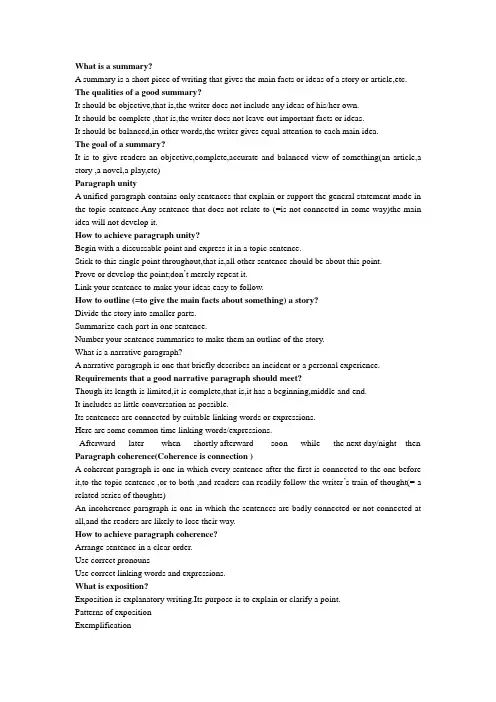
What is a summary?A summary is a short piece of writing that gives the main facts or ideas of a story or article,etc. The qualities of a good summary?It should be objective,that is,the writer does not include any ideas of his/her own.It should be complete ,that is,the writer does not leave out important facts or ideas.It should be balanced,in other words,the writer gives equal attention to each main idea.The goal of a summary?It is to give readers an objective,complete,accurate and balanced view of something(an article,a story ,a novel,a play,etc)Paragraph unityA unified paragraph contains only sentences that explain or support the general statement made in the topic sentence.Any sentence that does not relate to (=is not connected in some way)the main idea will not develop it.How to achieve paragraph unity?Begin with a discussable point and express it in a topic sentence.Stick to this single point throughout,that is,all other sentence should be about this point.Prove or develop the point;don’t merely repeat it.Link your sentence to make your ideas easy to follow.How to outline (=to give the main facts about something) a story?Divide the story into smaller parts.Summarize each part in one sentence.Number your sentence summaries to make them an outline of the story.What is a narrative paragraph?A narrative paragraph is one that briefly describes an incident or a personal experience. Requirements that a good narrative paragraph should meet?Though its length is limited,it is complete,that is,it has a beginning,middle and end.It includes as little conversation as possible.Its sentences are connected by suitable linking words or expressions.Here are some common time linking words/expressions.Afterward later when shortly afterward soon while the next day/night then Paragraph coherence(Coherence is connection )A coherent paragraph is one in which every sentence after the first is connected to the one before it,to the topic sentence ,or to both ,and readers can readily follow the writer’s train of thought(= a related series of thoughts)An incoherence paragraph is one in which the sentences are badly connected or not connected at all,and the readers are likely to lose their way.How to achieve paragraph coherence?Arrange sentence in a clear order.Use correct pronounsUse correct linking words and expressions.What is exposition?Exposition is explanatory writing.Its purpose is to explain or clarify a point.Patterns of expositionExemplificationProcess analysisCause-Effect analysisComparison and contrastClassificationDefinitionAnalogyWhat is exemplification?Exemplification is a method of supporting a thesis statement with a series of specific examples or sometimes,with a single extended example.It is one of the most common and most useful means of developing a paragraph or an essay.What is an essay?An essay is a related group of paragraphs written for some purpose.Types of essaysEssays can be classified into types,or modes,according to their purposes.Narrative essays relate a sequence of events,whether factual or not.Descriptive essays create a word picture of a scene,a person,or an object.Expositive essays explain--to inform,instruct,clarify,illustrate,or define.Argumentative essays state an opinion and defend it logically.Basic structure of an expositive essayAn expositive essay has three parts:A beginning called the introduction.A middle called the body.An end called the conclusion.Elements of the expositive essayOutliningThesis statementTitleTransitionWhat is an outline?An outline is a method of organizing materials in logical order.It is a list that shows the main ideas and the structure of something you are planning to write.In other words,it is a plan for a piece of writing.Constructing an outline makes the writing of your essay easier.Types of outline1.Topic outline,which uses only key words and phrases.2.Sentence outline,which uses complete sentence.Format(the arrangement ,design,or organization of something)A topic outline looks like this:Thesis:In my first year at college,I learned to spend my money wisely.What is process analysis?A process analysis is a step-by-step explanation of how to do something,or how something works/done or made,or something happened.What is process analysis used for?1.To give directions to people who want or need to perform the process.(giving instructions )2.To give information to those who want to understand the process but may not actually performit.(giving information)3.To explain how something happened.(giving the history)What are the major types of process analysis?1.Directive process analysis which is aimed at explaining how to do or make something.rmative process analysis which is aimed at explaining how something is done/works or how something took place/happened.What is comparison/contrast?Comparison/contrast is a method of developing a paragraph or an parison shows similarity while contrast shows difference.The word comparison is sometimes used to mean both comparison and contrast.What is comparison/contrast used for?1.To clarify something unknown or not well understood.2.To lead a new way of viewing something familiar.3.To bring one or both of the subjects into sharper focus.4.To show that one subject is better than the other.What is classification?Classification is the method of grouping objects,people,or ideas systematically.It is one of the most useful organizational strategies in writing.What is classification used for?1.To organize and perceive the world around us.2.To present a mass of material by means of some orderly system.3.To deal with complex or abstract topics by breaking a broad subject into smaller,neatly sorted categories.What is definition?1.Definition is the explanation of the meaning of a word or concept.2.Definition is also a method of developing an essay.What is analogy?Analogy is an extended comparison based on the similar features of two things of different classes,one familiar one easily understood,the other unfamiliar ,abstract,or complicated.It is an important method of exposition.What are transition?Transition,also called”transitional devices”,are words,phrases,and even whole sentences that link sentence to one another.What is a journal?A journal is a record of experiences,ideas,or reflections kept regularly for private use.It is something “for you eye only ”.So you can write from your heart and let ideas and feelings flow freely.Journal writing is a form of free-writing,which involves writing whatever comes to your mind about what happens around you and what you observe and think about.Argumentation and persuasion defined.Argumentation-persuasion is the type of writing in which writers try to encourage readers to accept their point of view on a controversial issue.In argumentation ,writers use objectives,logical reasoning,facts,and hard evidence to demonstrate the soundness of a position.Their purpose is to encourage readers to accept their point of view.In persuasion,writers use emotional language and dramatic appeals to readers' concerns,beliefs and values,often in the hope of encouraging then to take a specific action,besides,encouraging acceptance of an opinion.Argumentation and persuasion are frequently used together in an essay.Also,the two terms are often used interchangeably.The claim definedClaims,or propositions,represent answers to what you are trying to prove in an argumentative essay.Although they are the conclusions of your arguments,they often appear as these statements. Abstract&concrete wordsConcrete words identify persons and things that can be perceived by the senses--seen,heard,tasted,felt,smelled,e.g.table,boy,rose,etc.Abstract words denote qualities,concepts,relationships,acts,conditions,ideas that we can’t perceive directly through our five senses,e.g.honesty,friendship,life,etc.Most words are neither wholly abstract nor concrete.They are between the two extremes,e.g.exercise,rest,answer,etc.General&specific wordsSpecific words identify individual items in a group,e.g.BuickGeneral words relate to categories,an overall group,e.g.carMost words are neither wholly general nor specific.They are between the two extremes,e.g.child,student,flower,etc.The support definedThe ideas and information intended to convince readers that the claim is sound or believable. What is conciseness?Conciseness means being direct and to the point.Redundant words or wordy writing is not concise.Do not over-use words to deliver the message in your writing.Refutation definedRefutation is attempts to prove views against the writer’s position wrong or false.It is often an indispensable part of an argumentative essay,for it shows that the writer is aware of opposing viewpoints and has thought about both sides.Essays that mainly refute opposing views are known as rebuttal arguments.Fallacies definedFallacies are statements that may sound reasonable or true but are not logically defensible and may actually be deceptive.The emotional appeal definedEmotional appeal is a strategy writers and public speakers use to persuade,which is to arouse the reader’s/audience’s feelings to reinforce an argument.真题:What is the research paper?What is the process of writing it?A research paper is usually a formal,fairly long and well-documented composition.Process:1.choosing a topic2.Collecting information3.Analyzing the information,organizing ideas and working out an outline4.Writing the first draft5.Revising the draft and finalizing the paper.What is the sentence?What is the effective sentence?A sentence contains at least a subject and a predicate verb:if the verb is transitive,there must be an object,if the verb is a link verb,there must be a predicative or complement.They are unity,coherence,conciseness,emphasis and variety.How many types of sentences according to the use?What are they?There are four.They are declarative,interrogative,imperative and exclamatory sentence.How many types of sentences according to the structure?What are they?There are four.They are simple,compound,complex and compound-complex sentence.。
外国文学名词解释
外国文学名词解释
以下是一些常见的外国文学名词解释:
1. 小说(Novel):一种长篇故事性的文学形式,通常以虚构的情节和人物为基础。
2. 诗歌(Poetry):一种以韵律、节奏和表达深层意义为特点的文学形式。
3. 戏剧(Drama):一种以对话和行动为主要表现手段的文学形式,通常在舞台上演出。
4. 散文(Prose):一种不受特定韵律和节奏限制的文学形式,通常以故事、评论或描述为主。
5. 自传(Autobiography):一种以作者自己的生活经历为基础的文学作品。
6. 传记(Biography):一种以某个人的生平事迹为基础的文学作品。
7. 文学批评(Literary Criticism):对文学作品进行分析和评价的学术研究领域。
8. 现实主义(Realism):一种文学流派,强调对现实生活的客观描写和真实性。
9. 浪漫主义(Romanticism):一种文学流派,强调个人情感、幻想和想象力。
10. 象征主义(Symbolism):一种文学流派,强调使用象征和隐喻来传达深层意义。
英语四级作文专有名词
Argumentation是英语四级作文中常见的一种文体,通常要求考生根据所给的观点或现象,进行分析、辩证,提出自己的看法。在写这种作文时,考生需要有较强的逻辑思维能力,能清晰地陈述自己的观点,并能用恰当的论据和例子加以支持。
二、Narration(记叙文)
Narration是另一种常见的英语四级作文文体。这种文体要求考生根据所给的事件或故事情节,进行叙述。在叙述过程中,考生需要注意时间和事件的先后顺序,逻辑要清晰,并且要尽量生动详实地描绘事件的发展过程,让读者有身临其境的感觉。
五、Thesis statement(论文声明)
在英语四级作文中,论文声明是一个非常重要的概念。它要求考生在写作的最开始部分,对自己的立场或观点进行简要的表述。论文声明通常体现了考生在整篇文章中要表达的核心思想,因此要求考生在明确自己立场的同时,要简洁明了地表达出来。
六、Supporting evidence(论据)
在议论文中,论据是支持观点的重要依据。考生需要通过丰富的知识储备和逻辑思维,能够提供有力的论据来支持自己的观点,使文章更加有说服力。
七、Conclusion(结论)
在英语四级作文中,结论部分是整篇文章的收尾部分,也是表明作者观点的最终归宿。结论需要简洁明了地总结全文的核心内容,对全文进行概括,让读者对文章的主题有一个清晰的印象。
三、Description(描写文)
Description文体要求考生根据所给的人、物、地点等信息,进行描写。这种文体要求考生通过形象、生动的语言描绘出所给对象的形象和特征,让读者对所描写的对象有清晰而生动的印象。
四、Exposition(说明文)
Exposition文体要求考生对所给的问题或现象进行说明,通常需要考生能够分析问题或现象的原因、影响等内容,并能够用简练、明了的语言进行阐述。
大学英语语法考试名词解释
大学英语语法考试名词解释一、名词的分类(一)、根据其意义1、专有名词主要指人名、地名及某类人和事物专有的名词(1)人名Mrs.SmithHemingway(2)地名Beijingthe Yellow River(3)某类人的名称AmericansRussians(4)某些抽象事物的名称BuddhismEnglish(5)月份、星期名及节日名称MaySaturdayNew Year’s Day(6)书名、电影及诗歌的名称Gone with the WindVenomOde to the West Wind2、普通名词指一类人、事物、物质或抽象概念的名称,这些名词一般不用来指某一具体事物(1)个体名词①指作为个体而存在的人或东西可以指具体的人或物He has two sisters. 他有两个姐姐。
Pandas live in the forest. 熊猫生活在森林里。
也可指抽象的东西A new century has just begun. 一个新的世纪刚刚开始。
I had a dream last night. 我昨天晚上做了一个梦。
②个体名词有复数的形式weeksproblems③个体名词单数形式可以和a/an连用a weeka problem(2)集体名词指一群人或一些事物总称,表示由个体组成的集体familyteamaudience(3)物质名称指无法分为个体的东西teaclothrain(4)抽象名词表示一些抽象概念,用来指人或事物的品质、情感、状态等honestylovesilence(二)、根据其语法特征1、可数名词2、不可数名词二、名词的数(一)、可数名词1、定义(1)可用数目计算的名词是可数名词。
(2)个体名词、集体名词大多为可数名词。
2、可数名词单数变复数的规则(1)规则变化①一般情况下,在词尾直接加-sbook→bookstree→treescap→caps 帽子②以-s,-x,-ch,-sh结尾的名词, 在词尾加-esglass→ glasses 眼镜box→boxeswatch→watchesbrush→ brushes刷子③以辅音字母加-y结尾的名词,把y改为i,再加-esstory→storiescountry→countries④以-o结尾的名词变为复数时,常在词尾加-s;但中学英语中下列名词要加-es,它们是:黑人英雄爱吃土豆西红柿radio→radios 收音机photo→photoshero→heroesNegro→Negroespotato→potatoestomato→tomatoes⑤以-f或-fe结尾的名词变复数需把-f或-fe去掉,加-vesself→selves(本身),life→lives(生命)wife→wives(妻子),half→halves(一半)loaf→loaves(面包),shelf→shelves(架子)thief→thieves(小偷),knife→ knives(刀子)leaf→leaves(叶子),wolf→wolves(狼)有些只加-sroofs屋顶cliffs悬崖proofs证据beliefs信仰chiefs主管人,领袖(2)不规则变化①单复数不同行的名词foot→feet(脚),man→men(男人)woman→women(女人), mouse→mice (老鼠)tooth→teeth(牙齿),goose→geese(鹅)gentleman→gentlemen(绅士),child→children(孩子)ox→oxen 公牛②单复数同行的名词Chinese中国人,Japanese日本人means 方法,crossroads 十字路口species种类,sheep绵羊③外来名词的复数形式criterion→criteria 标准curriculum→curricula/ curriculums 全部课phenomenon- -phenomena 现象analysis→analyses 分析basis→bases 基础crisis→crises 危机thesis→theses论文diagnosis→diagnoses 诊断bacterium→bacteria 细菌medium→media 媒体datum→data 数据(二)不可数名词1、定义(1)不可用数目计算的名词。
篇章的名词解释英文
篇章的名词解释英文篇章是指在语言使用中,由若干个句子或段落组成的完整文本。
它是一种组织有序的表达形式,用于传递信息、表达思想和交流观点。
在英文中,有几个术语可以用来描述篇章的特征和结构,下面将对这些术语进行解释。
1. Text(文本)Text是指一个完整的书面或口头表达形式。
它可以是一篇文章、一段对话、一封信件或一本书。
在篇章中,text代表了一个有机整体,包括了引言、论述和结论等不同部分。
2. Paragraph(段落)Paragraph是指在篇章中组织思想和表达论点的基本单位。
一个段落通常包括一个主题句和相关的支持句,用于阐述一个独立的思想或论点。
通过合理地使用段落,篇章的内容能够更加清晰和有条理。
3. Introduction(引言)Introduction是篇章的开头部分,用于引入读者并概述后续内容。
在引言中,作者可以提出主题或问题,并阐明写作目的和重要性。
通过引言,读者可以更好地了解篇章的背景和主旨。
4. Body(正文)Body是篇章中承载主要内容的部分。
它通常包含了作者的论点、观点和证据,并通过逻辑和连贯的结构展开讨论。
在正文中,作者可以使用事实、案例、统计数据等来支持自己的观点,同时采用合适的过渡词和连接词来确保篇章的连贯性。
5. Conclusion(结论)Conclusion是篇章的结尾部分,用于总结和归纳正文中的主要论点。
在结论中,作者可以再次强调自己的立场,并提供进一步思考的方向。
结论的目标是给读者一个整体性的印象,并使他们在阅读后对篇章的主题和观点有所思考。
6. Transition(过渡)Transition是用于在篇章中创建逻辑和连贯性的工具。
它可以是一个过渡词、过渡短语或句子,用于帮助读者理解不同部分之间的关系。
通过使用适当的过渡词,作者可以将不同的观点和段落连接起来,使整个篇章更具有条理性。
7. Cohesion(连贯性)Cohesion是指篇章中不同部分之间的密切联系和一致性。