
苏教版牛津英语七年级上册第四单元知识点与课文讲解
苏教版牛津英语七年级上册第四单元知识点与课文讲解
Unit4
一、 日常用语
We need an egg and a tomato for the soup. 我们需要一只鸡蛋和一个西红柿做汤。
Would you like a glass of water? 你想要杯水吗?
Let’s make a pancake. 我们做个薄煎饼吧。
How to keep fit? 怎样保持身体健康?
二.词组
take more exercise 多锻炼
walk to school 步行上学
three time a week 每周三次
keep healthy 保持健康
join the army 参军
the love of one’s country 爱国心
want to be 想成为。
play cards 玩牌
play games 做游戏 get 。from。 从。获得(得到)。 would like(sb.)to do sth
想要(某人)干某事 less than 不到 how much/many 多少 keep
fit 保持健康 not at all 根本不;一点也不 feel worried 感到忧虑
Good luck with sth/to sb 祝好运 be busy doing sth 忙于干。
give sb sth.=give sth to sb 给某人某东西
二、 日常用语
We need an egg and a tomato for the soup. 我们需要一只鸡蛋和一个西红柿做汤。 Would you like a glass of water? 你想要杯水吗?
Let’s make a pancake. 我们做个薄煎饼吧。
How to keep fit? 怎样保持身体健康?
三、知识讲解
1. Let’s have a hamburger.我们吃个汉堡包。
① let's=let us, let后面用动词原形即Let’s do sth.“让我们干。吧。”
例如:
Let’s have a rest.让我们休息一下吧。
Let’s play games.让我们做游戏吧。
〖注意〗
let’s开头的祈使句,其反意疑问句在句末加shall we?表示包括听话人在内的一种建议。 如果不表示建议,而是提出一种请求,表示允许,不包括听话人在内时,则let us不缩写成let’s,其反意疑问句为will you?
我们踢篮球,好吗?(表示建议)
让我们看看你的图画,可以吗?(表示请求允许)
2.have动词,“吃、喝;有”。例如:( 注意第三人称单数
has )
你要喝杯茶吗?
你早饭吃些什么?
3. You are always hungry, Eddie. 你总是饿,埃迪。
always副词,“一直,总是”,是一个频率副词,常用于一般现在时。
She always has lunch at home.
The sun always rises in the east.
① hungry形容词,“饥饿的”,其反义词是full,在句中作表语。
Are you hungry?你饿了吗?
I always feel hungry after school. 放学后我总是觉得饿。
3. You never exercise.你从不锻炼。
①never副词,“从不,永不”,本身具有否定意义,语气比not重,用never表示否定时,不需要加助动词“not”。
I never go to school late. 我上学从不迟到。 She never writes to her father.她从不给她的父亲写信。
②exercise动词,“锻炼,训练”,在句中作谓语。例如:
Mike’s sister often exercises her voice in the morning.
麦克的姐姐经常在早晨嗓子。
He is exercising the boys in swimming.
名词,“训练、锻炼(单数);做操;练习、习题(复数)等”。例如:
You’d better take more exercise.
Eat less and take more exercise, you will be thin.
Have you finished your Chinese exercises?
do morning exercises do eye exercises
4. I want to be a dancer.我想当一名舞蹈演员。
want to be“想成为。”,want动词,“想,想要”其后可接名词或动词不定式作宾语,也可宾语接动词不定式,即want sth想某物,want to do sth.想做某事;want to to do sth.“想让某人做某事”。例如:
I want some black tea. 我想要些红茶。
What do you want me to do? 你想要我做什么?
be动词原形,“做,成为”。例如:
I want to be a doctor. 我想成为一名医生。
Don’t be late! 别迟到! 5. It’s important for a dancer to be healthy.对一个舞蹈演员来说健康是很重要的。 常见的句型是:It is+ adj.+ for/of sb to
do sth。例如:
1. 孩子在这条河里游泳很危险。
2.能帮助我,真是太好了。
3.你这么做真粗心。
6. Before, I seldom ate fruit and vegetables.以前,我不常吃水果和蔬菜。
seldom副词,“很少,不常、难得”,其反义词是often。通常置于行为动词之前;助动词和be动词之后。是一个表示否定意义的副词。例如:
1.布朗夫人很少外出。
2.米莉上学很少迟到。
7. I ate a lot of sweet snacks between meals.在两餐之间我吃了许多甜食。
between介词,“在(两者之间)”,后面可以跟名词或代词,跟代词时要用宾格。 Put the desk between us.
把课桌放在我们俩中间。
between。and。“在。和。之间”,它限于两者之间;如果是三者之间或三者以上,要用介词among。between和and之间可以是两个人,也可以是两个不同的物或两个点(时间、数字、场所)。例如:
Peter sat between Mary and Jane. 彼得坐在玛丽和简之间。
The shop opens between 9 a.m. and 5 p.m. 商店在上午九点和下午五点间开门。 Mary is sitting among the children. 玛丽坐在孩子们之中。
8. I know that sweet snacks are not good for me. 我知道甜零食对我没有好处。 be good for。“对。有益(有用)”,后接人或事物的名词。例如:
Sunshine is good for your plants. 你的花草要多晒太阳。
Is this kind of food good for me? 这种食物对我身体有益吗?
This cream is good for bums. 这种油膏治烧伤和烫伤很管事儿。
Milk is good for children.
类似的固定词组还有:
be good at “擅长,善于”, 后接名词,代词或动名词。例如:
Kate is good at English. 凯特擅长英语。
Mike is good at playing football. 麦克擅长绘画。
be good to“对。好(和善、慈爱)”,后接表示人的或要格化的名词。例如: She is good to me. 她对我好。
9. Now, I always eat an apple for breakfast. 现在,我总是早饭吃一个苹果。 eat sth. for breakfast/lunch/supper=have sth. for breakfast/lunch/supper
“早饭/午饭/晚饭吃。”。例如:
I ate some bread for breakfast.=I had some bread for
breakfast.
早饭我吃的面包。
What did you eat for supper?=What did you have for supper?
晚饭你吃得什么?
10. After class, I also like playing computer games and
chatting with my friends on the Internet.
课后,我也喜欢玩电子游戏和朋友们在网上聊天。
like doing sth.“喜欢干某事”,后面跟动名词表示习惯性的动作。playing和chatting属于
名词短语,在句中作谓语动词的宾语。
play动词,
①“玩,做(游戏),踢(球)”,可以构成以下的固定词组:
play cards 玩牌
play games 做游戏
play football 踢足球
②“演奏,吹奏”,可以构成的固定词组有:
play the piano 弹钢琴 play the violin 拉小提琴
② play with。 玩。 play with water 玩水
七年级上册Unit4重点单词词组句子
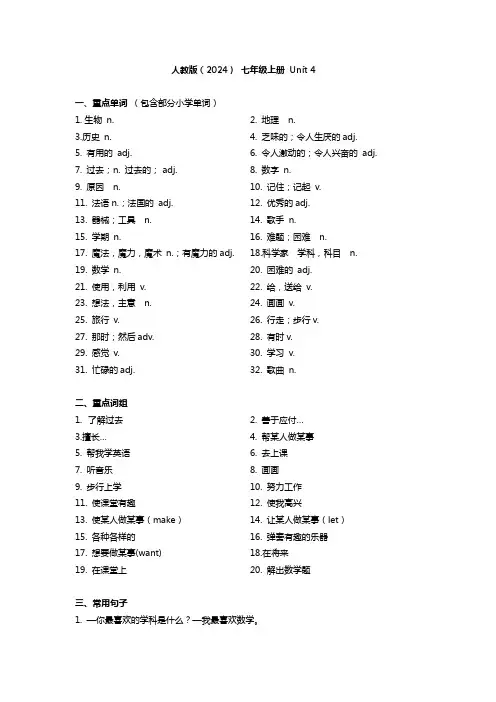
人教版(2024) 七年级上册 Unit 4
一、重点单词 (包含部分小学单词)
1. 生物 n. 2. 地理 n.
3.历史 n. 4. 乏味的;令人生厌的adj.
5. 有用的 adj. 6. 令人激动的;令人兴奋的 adj.
7. 过去;n. 过去的; adj. 8. 数字 n.
9. 原因 n. 10. 记住;记起 v.
11. 法语n.;法国的 adj. 12. 优秀的adj.
13. 器械;工具 n. 14. 歌手 n.
15. 学期 n. 16. 难题;困难 n.
17. 魔法,魔力,魔术 n.;有魔力的adj. 18.科学家 学科,科目 n.
19. 数学 n. 20. 困难的 adj.
21. 使用,利用 v. 22. 给,送给 v.
23. 想法,主意 n. 24. 画画 v.
25. 旅行 v. 26. 行走;步行v.
27. 那时;然后adv. 28. 有时v.
29. 感觉 v. 30. 学习 v.
31. 忙碌的adj. 32. 歌曲 n.
二、重点词组
1. 了解过去 2. 善于应付…
3.擅长… 4. 帮某人做某事
5. 帮我学英语 6. 去上课
7. 听音乐 8. 画画
9. 步行上学 10. 努力工作
11. 使课堂有趣 12. 使我高兴
13. 使某人做某事(make) 14. 让某人做某事(let)
15. 各种各样的 16. 弹奏有趣的乐器
初中英语新人教版七年级上册Unit4Section B课文讲解(2024秋)
七年级英语上册
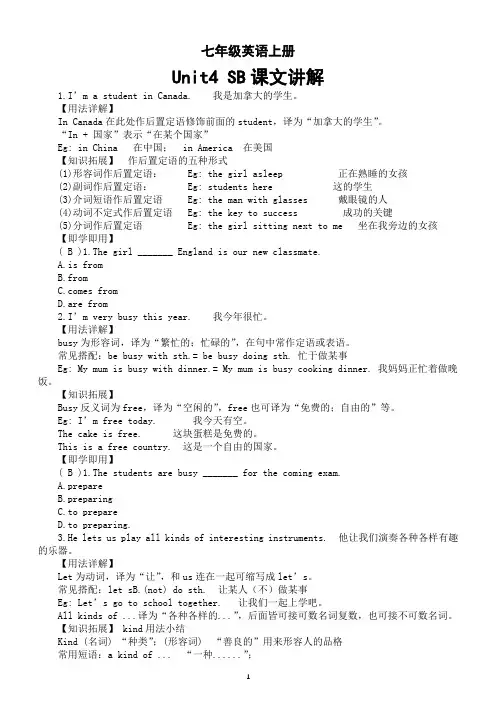
Unit4 SB课文讲解
1.I’m a student in Canada. 我是加拿大的学生。
【用法详解】
In Canada在此处作后置定语修饰前面的student,译为“加拿大的学生”。
“In + 国家”表示“在某个国家”
Eg: in China 在中国; in America 在美国
【知识拓展】 作后置定语的五种形式
(1)形容词作后置定语: Eg: the girl asleep 正在熟睡的女孩
(2)副词作后置定语: Eg: students here 这的学生
(3)介词短语作后置定语 Eg: the man with glasses 戴眼镜的人
(4)动词不定式作后置定语 Eg: the key to success 成功的关键
(5)分词作后置定语 Eg: the girl sitting next to me 坐在我旁边的女孩
【即学即用】
( B )1.The girl _______ England is our new classmate.
A.is from
B.from
es from
D.are from
2.I’m very busy this year. 我今年很忙。
【用法详解】
busy为形容词,译为“繁忙的;忙碌的”,在句中常作定语或表语。
常见搭配:be busy with sth.= be busy doing sth. 忙于做某事
Eg: My mum is busy with dinner.= My mum is busy cooking dinner. 我妈妈正忙着做晚饭。
【知识拓展】
Busy反义词为free,译为“空闲的”,free也可译为“免费的;自由的”等。
24秋最新人教版七年级上册英语第四单元Unit4《My Favourite Subject》课文翻译
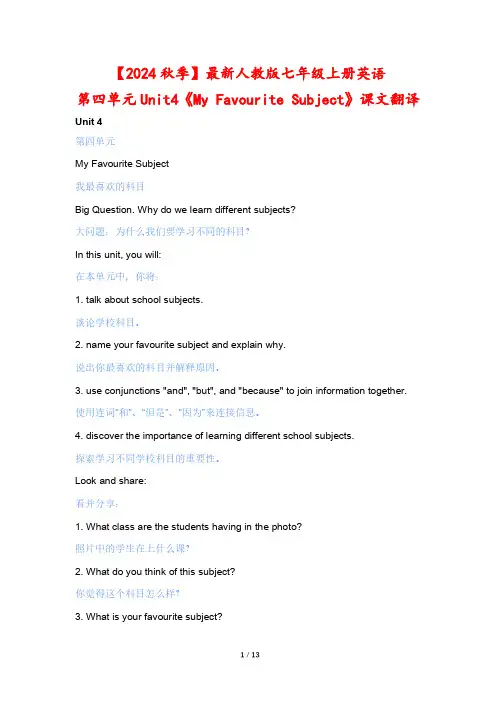
1 / 13 【2024秋季】最新人教版七年级上册英语 第四单元Unit4《My Favourite Subject》课文翻译 Unit 4 第四单元 My Favourite Subject 我最喜欢的科目 Big Question. Why do we learn different subjects? 大问题:为什么我们要学习不同的科目? In this unit, you will: 在本单元中,你将: 1. talk about school subjects. 谈论学校科目。 2. name your favourite subject and explain why. 说出你最喜欢的科目并解释原因。 3. use conjunctions "and", "but", and "because" to join information together. 使用连词“和”、“但是”、“因为”来连接信息。 4. discover the importance of learning different school subjects. 探索学习不同学校科目的重要性。 Look and share: 看并分享: 1. What class are the students having in the photo? 照片中的学生在上什么课? 2. What do you think of this subject? 你觉得这个科目怎么样? 3. What is your favourite subject? 2 / 13 你最喜欢的科目是什么? 1a. Match the school subjects in the box with the pictures. Some subjects are extra. 1a. 将方框中的学校科目与图片匹配。一些科目是多余的。 1a. Match the school subjects in the box with the pictures. Some subjects are extra. 1a. 将方框中的学校科目与图片匹配。一些科目是多余的。 art 艺术 biology 生物 Chinese 中文 IT 信息技术 English 英语 geography 地理 history 历史 maths 数学 music 音乐 PE
【2024秋】最新版译林版七年级上册英语第四单元Unit4《单词+短语+句子》默写专项练习(含答案)
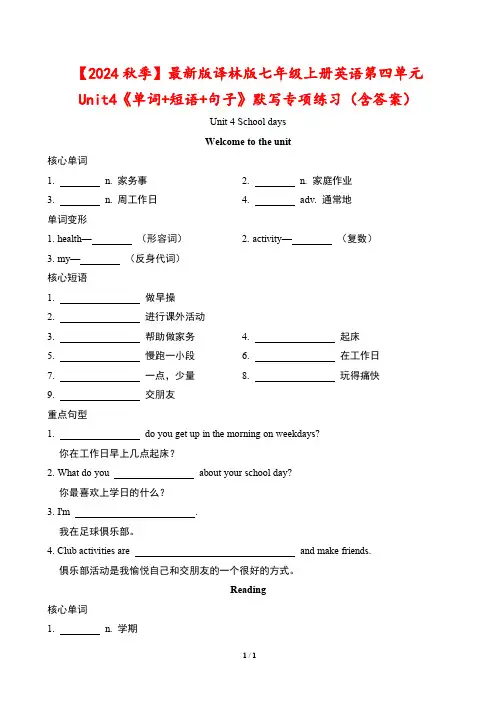
1 / 1 【2024秋季】最新版译林版七年级上册英语第四单元 Unit4《单词+短语+句子》默写专项练习(含答案) Unit 4 School days Welcome to the unit 核心单词 1. n. 家务事 2. n. 家庭作业 3. n. 周工作日 4. adv. 通常地 单词变形 1. health— (形容词) 2. activity— (复数) 3. my— (反身代词) 核心短语 1. 做早操 2. 进行课外活动 3. 帮助做家务 4. 起床 5. 慢跑一小段 6. 在工作日 7. 一点,少量 8. 玩得痛快 9. 交朋友 重点句型 1. do you get up in the morning on weekdays? 你在工作日早上几点起床? 2. What do you about your school day? 你最喜欢上学日的什么? 3. I'm . 我在足球俱乐部。 4. Club activities are and make friends. 俱乐部活动是我愉悦自己和交朋友的一个很好的方式。 Reading 核心单词 1. n. 学期 2 / 2 2. vi. (从……)开始vt. & vt. 开始,着手n. 开头,开端 3. n. 语言 4. adj. 令人大为惊奇的 5. n. 生物学 6. n. 大自然;天性 7. vi. & vt. 训练;练习 8. n. 田,地;领域 9. n. 旅行 10. vi. & vt. 离开;vt. 使保留 11. vt. 采,摘;挑选 12. adj. 活着的,活的 单词变形 1. one— (序数词) 2. write— (名词,作家) 3. well— (最高级) 4. class— (复数) 5. work— (复数,著作) 核心短语 1. 野外考察,实地考察 2. 动身去,到……地方去 3. 学校足球队 4. 说一点儿汉语 重点句型 1. The Chinese language . 汉语言真的令人惊叹。 2. are great fun too! 课后活动也很有趣! 3. Tomorrow morning we will to pick apples there. 明天上午我们将动身前往一个农场,在那里采摘苹果。 4. your school life ? 你的学校生活是什么样的? 5. Hope to you soon. 希望很快收到你的来信。 6. Your new school . 3 / 3 你的新学校听起来很棒。 7. I my school life. 我想告诉你我的学校生活。 8. It is interesting . 参观有趣的地方很有趣。 Grammar 核心单词 1. adv. 很少 2. n. 网球运动 单词变形 swim— (名词) 核心短语 1. 告诉某人关于某事 2. ……中的一员 3. 当然 4. 去滑旱冰 重点句型 1. I do not play tennis. 我没有太多时间打网球。 2. She always dances . 她总是跳舞半个小时。 Pronunciation ~ Further study 核心单词 1. vt. & vi. (使)生长,发育 2. n. 参观;旅行 3. n. 网站 4. n. 视频 5. adv. 在外面prep. 向……外面 6. n. 平静;和平 7. n. 宁静,平静 8. n. 团队合作 9. adj. 更好的 10. adj. 累人的 11. n. 职责,任务;责任,义务 12. n. 区域;面积;领域 13. prep. 以,凭借;通过;穿过 14. n. 组,群,批 4 / 4 15. n. (依次轮到的)机会 16. vt. 倒空,腾空adj. 空的 17. n. 垃圾桶 18. pron. 某事;某物 单词变形 well— (比较级) 核心短语 1. 参加 2. 轮流 3. 照顾,照料 重点句型 1. do you about school field trips? 关于学校的实地考察你觉得怎么样? 2. It's nice nature. 亲近大自然是件好事。 3. Everybody make things better. 每个人都尽全力使事情变得更好。 4. It keep our school area clean. 保持我们学校区域的清洁感觉很好。 5. This helps me learn take care of plants. 这有助于我学会如何照料植物。 5 / 5 Unit 4 School days Welcome to the unit 核心单词 1. housework 2. homework 3. weekday 4. usually 单词变形 1. healthy 2. activities 3. myself 核心短语 1. do morning exercises 2. do after-school activities 3. help with housework 4. get up 5. go for a short jog 6. on weekdays 7. a little 8. have lots of fun/enjoy oneself 9. make friends 重点句型 1. What time 2. like best 3. in the Football Club 4. a good way for me to enjoy myself Reading 核心单词 1. term 2. start 3. language 4. amazing 5. Biology 6. nature 7. practise 8. field 9. trip 10. leave 11. pick 12. living 单词变形 1. first 2. writer 3. best 4. classes 5. works 核心短语 1. field trip 2. leave for 3. the school football team 4. speak a little Chinese 重点句型 1. is really amazing 2. After-school activities 6 / 6 3. leave for a farm 4. What is; like 5. hear from 6. sounds great 7. would like to tell you about 8. to visit fun places Grammar 核心单词 1. seldom 2. tennis 单词变形 swimming 核心短语 1. tell sb.about sth. 2. a member of 3. of course 4. go roller skating 重点句型 1. have much time to 2. for half an hour Pronunciation ~ Further study 核心单词 1. grow 2. tour 3. website 4. video 5. outside 6. peace 7. quiet 8. teamwork 9. better 10. tiring 11. duty 12. area 13. through 14. group 15. turn 16. empty 17. bin 18. something 单词变形 better 核心短语 1. take part in 2. take turns 3. take care of 重点句型 1. What; like 2. to get close to 3. tries their best to 4. feels good to 5. how to
2021-2022学年牛津译林版英语七年级上册unit4 quarter词汇讲义

Unit4词汇讲义拓展
1 2021-2022学年
牛津译林版七年级英语上册
quarter英 [ˈkwɔ:tə(r)] 美 [ˈkwɔ:rtə(r)]
第三人称单数:quarters第三人称复数:quarters现在分词:quartering过去分词:quartered过去式:quartered
quarter 基本解释
名词四分之一; 一刻钟; 地区; (美式足球的)一节
及物动词把…四等分; 供…住宿; 使(士兵)驻扎
quarter 相关词组
1. at close quarters : 接近地;
2. ask for quarter : 请求饶命;
quarter 相关例句
及物动词
1. The soldiers were quartered in the village.
士兵们驻扎在村子里。
名词
1. The marchers came from all quarters.
游行者来自四面八方。
2. From which quarter is the wind blowing?
风从哪个方向吹来?
3. He was waiting for a quarter of an hour.
他等了一刻钟了。
4. He traveled in all quarters of the earth when he was young.
他年轻时曾周游世界。
quarter 情景对话
夜生活
A:Smith Steakhouse. Can I help you?
史密斯牛排店。能为您效劳吗?
B:Yes, I’d like to make a reservation for (two at eight o’clock/ six at seven
thirty/ three at a quarter to nine).
好的。我想预订一张(八点钟的两人台/ 7点30的六人台/ 8点45的三人台)。
江苏牛津英语七年级上册课文中文Reading&Task

Unit 1 P8 Reading 欢迎来到七年级一班
嗨!我是米莉,阳光中学的一名新生。我12岁。我有一头短发。我喜爱阅读。现在让我们来见见我的新同班同学吧。
你好!我的名字是西蒙。我很高。我喜欢运动。我经常放学后踢足球。
这是桑迪。她又高又苗条。她头发很长。她喜欢音乐。
这是丹尼尔。他来自南京。他很矮。他擅长数学。
P16 Task 丹尼尔
嗨,大家好!我叫丹尼尔。我12岁。我来自南京,但现在我和我家人住在北京。
我不高,我头发非常短,并且我戴眼镜。
在阳光中学我喜欢所有的功课,且我擅长数学。
在学校我有许多新朋友,他们都非常好。
Unit 2 P20 Reading 我最喜爱的足球运动员
我喜爱运动,并且我很喜欢足球。李华是我最喜爱的足球明星。
李华22岁。他是黄河足球俱乐部的一名新成员。他来自广东,但是现在住在北京。他看起来强壮并且足球踢得很好。很多人喜欢他。
李华每天踢足球。在他的空余时间,他学习英语。他也喜欢听音乐。这使他很快乐。
李华想要在下届世界杯踢球。我希望他梦想成真。
P28 Task我热爱体育
我的名字叫戴维David。我热爱体育,并且我非常喜欢篮球。
我是我们学校篮球队的一名成员。我常和我的朋友放学后打篮球。我们常谈论篮球并在电视上观看篮球比赛。
姚明是我最喜欢的篮球运动员。他篮球打得非常好。他是我的偶像。
Unit 3 P32 Reading 欢迎来到我们学校
嗨!妈妈。
嗨,宝贝。你们学校看起来很漂亮。操场是如此地大。
是的,它是。让我带你四处看看吧。我们现在在教学楼的前面。它里面有18个教室。我的教室在一楼。
教室干净又明亮。
是的,它们是。妈妈,这边请。我们也有一个美术室、一个音乐室和两个电脑室。
那真实棒极了。你们也有一个图书馆,对吗?
是的。那幢新的建筑物是我们的图书馆。
它看起来很现代化。在那边的建筑物是什么?
它是学校礼堂。我们在那儿开会。
我明白了。那个穿白衬衫的男人是谁?
初一英语七上沪教牛津UNIT 4知识点清单
1 结合校内 高效学习
七上沪教牛津英语校内知识点清单
Unit 4
◼ Vocabulary:
单词/词组 词性/释义 考点拓展
Australia n. 澳大利亚 Australian n. 澳大利亚人; adj. 澳大利亚的
footprint n. 脚印
wet adj. 湿的 = not dry
puddle n. 水坑
kick v. 踢 英英释义中有foot
town n. 城镇
blow n. 打击;v. 吹 blow-blew-blown
blow away吹跑
blow out吹灭
blow up爆炸
everything pron. 每件事 = all the things
trip n. 旅途 = travel
shine v. 照耀 = give/send out light
brightly adv. 明亮地 bright adj. 明亮的
picnic n. 野餐
dry adj. 干的 = not wet
snowy adj. 下雪的 类似的词:sunny; windy; foggy; rainy
spend v. 花费 spend用法:
sb. spend time/money on sth.
sb. spend time/money (in) doing sth.
cost用法:
sth. cost sb. some money
take用法:
it takes sb. some time to do sth.
pay用法:
sb. pay money for sth.
relative n. 亲戚 = members of family
during prep. 在…的时候 注意是介词,后加名词或短语 放在季节前等于知识点清单
\
2 七上沪教牛津英语校内知识点清单
结合校内 高效学习 in
grandparent n. 爷爷奶奶
packet n. 包装袋;小盒子
2021-2022学年牛津译林版英语七年级上册unit4 activity词汇讲义
Unit4词汇讲义拓展
1 2021-2022学年
牛津译林版七年级英语上册
activity英 [ækˈtɪvəti] 美 [ækˈtɪvɪti]
第三人称复数:activities
activity 基本解释
名词活动; 活跃,敏捷; 活动力; 教育活动
activity 相关例句
名词
1. Stamp collecting is my favorite activity.
集邮是我最喜爱的消遣。
2. The store was a scene of great activity.
这家商店顾客盈门。
3. The school offers many recreational activities for the students.
该校为学生提供了很多娱乐活动。
4. Too many extracurricular activities take up too much of our precious time for
study.
课外活动太多,占去了我们很多宝贵的学习时间。
5. He once engaged in anti-government activity.
他一度从事反政府的活动。
activity 网络解释
1. 动作:可记录的数据可以是动作(Activity) 、标签( tag) 、报警(alarm) 等. 动作包括命令、宏的执行,系统信息采集等. 记录的标签数据可以用来生成趋势图,而报警记录则可以用于故障分析和事故追踪, 它们分类存储在不同的记录文件里.
activity 词典解释
1. 热闹状况;活跃
Activity is a situation in which a lot of things are happening or being done.
e.g. ...an extraordinary level of activity in the government bonds market.
江苏省淮北中学七年级英语上册 Unit 4Food教案 牛津译林版
word
- 1 - / 25 某某省某某中学英语学科教案
总 课 题 7A Unit 4 Food 总课时 10 第 1 课时
课 题 Wele to the unit 课型 New
教学目标 1. To learn the vocabulary about the food.
2. To talk about likes and dislikes of food.
3. To act out the ic strips.
教学重点 To master the vocabulary about the food.
教学难点 To master the vocabulary about the food.
课前预习 1. Preview the new words and phrases.
2. To talk about the favourite food.
教学过程
教学环节 教 师 活 动 学 生 活 动 备课札记
Step 1
Create
plots and
scenes to
guide the
new lesson
Step2
Learning
and
practice
Step3 Wele
to the unit
A
Show the students some pictures
of food (rice, hamburgers,
vegetables, chicken, fish,
apples, oranges and cakes) with
the puter
Say: What can you see? Do you
like them?
(1) Show some pictures of food
and help Ss learn the English
names of food.
Say:Look at the pictures. What
新人教版七年级(上册)Unit 4 知识点总结
1 新人教版七年级(上册)Unit 4 知识点总结
nit 4 My Favourite Subject
一、短语归纳
1. the importance of ……..的重要性
2. favourite subject 最喜欢的学科
3. wake up 醒来
4. be late for 迟到
5. come on 快点
6. next class 下一节课
7. learn about 了解;学习;知道
8. be good with 灵巧的;善于应付…的
9. help sb with 帮助某人做(某事)
10. look at sth 看某物
11. let sb do sth 让:果人做某事
12. listen to 听;倾听
13. be good at 擅长
14. walk to school 步行去卜:学
15. work hard 努力工作
16. make sb /sth+adj. 计果人 /物
17. make sb do sth 让某人做果事
18. on that day 在那天
19. the same as 与……一样 2 20. all kinds of 各种各样的
21. want to be 想要成为
22. in the future 将来;未来
23. work out 计算出;解决
24. in class 课堂上
25. feel like 感觉像
26. in one's life 在某人的生活中
二、必背重点句型
1. 谈论最喜欢的学科:
——What's your favourite subject?你最喜欢的学科是什么?
——My favourite subject is English.我最喜欢的学科是英语。
2. 询问原因并给出理由:
-——Why do you like it?你为什么喜欢它?
——It's interesting to learn about the past. 了解过去是有趣的。