
Chapter 6 Risk and Risk Aversion
Multiple Choice Questions注:除用黄色标出的题目外,其它题目都做1. A T-bill pays 6 percent rate of return. Would risk-averse investors invest in a riskyportfolio that pays 12 percent with a probability of 40 percent or 2 percent with aprobability of 60 percent?A) Yes, because they are rewarded with a risk premium.B) No, because they are not rewarded with a risk premium.C) No, because the risk premium is small.D) Cannot be determined.E) None of the above.Answer: B Difficulty: ModerateRationale: The risk averse investor will assume risk if the additional risk is rewarded by increased returns. Risky portfolio returns = 12%(0.4) + 2%(0.6) = 6% (no riskpremium).2. Which of the following statements regarding risk-averse investors is true?A) They only care about the rate of return.B) They accept investments that are fair games.C) They only accept risky investments that offer risk premiums over the risk-free rate.D) They are willing to accept lower returns and high risk.E) A and B.Answer: C Difficulty: ModerateRationale: See rationale for question 6.1.3. Which of the following statements is (are) true?I)Risk-averse investors reject investments that are fair games.II)Risk-neutral investors judge risky investments only by the expected returns.III)Risk-averse investors judge investments only by their riskiness.IV)Risk-loving investors will not engage in fair games.A) I onlyB) II onlyC) I and II onlyD) II and III onlyE) II, III, and IV onlyAnswer: C Difficulty: ModerateRationale: Risk-averse investors consider a risky investment only if the investment offers a risk premium. Risk-neutral investors look only at expected returns whenmaking an investment decision.4. In the mean-standard deviation graph an indifference curve has a ________ slope.A) negativeB) zeroC) positiveD) northeastE) cannot be determinedAnswer: C Difficulty: EasyRationale: The risk-return trade-off is one in which greater risk is taken if greater returns can be expected, resulting in a positive slope.5. In the mean-standard deviation graph, which one of the following statements is trueregarding the indifference curve of a risk-averse investor?A) It is the locus of portfolios that have the same expected rates of return and differentstandard deviations.B) It is the locus of portfolios that have the same standard deviations and different ratesof return.C) It is the locus of portfolios that offer the same utility according to returns andstandard deviations.D) It connects portfolios that offer increasing utilities according to returns and standarddeviations.E) none of the above.Answer: C Difficulty: ModerateRationale: Indifference curves plot trade-off alternatives that provide equal utility to the individual (in this case, the trade-offs are the risk-return characteristics of theportfolios).6. In a return-standard deviation space, which of the following statements is (are) true forrisk-averse investors? (The vertical and horizontal lines are referred to as the expected return-axis and the standard deviation-axis, respectively.)I)An investor's own indifference curves might intersect.II)Indifference curves have negative slopes.III)In a set of indifference curves, the highest offers the greatest utility.IV)Indifference curves of two investors might intersect.A) I and II onlyB) II and III onlyC) I and IV onlyD) III and IV onlyE) none of the aboveAnswer: D Difficulty: ModerateRationale: An investor's indifference curves are parallel, and thus cannot intersect and have positive slopes. The highest indifference curve (the one in the most northwestern position) offers the greatest utility. Indifference curves of investors with similarrisk-return trade-offs might intersect.7. Elias is a risk-averse investor. David is a less risk-averse investor than Elias.Therefore,A) for the same risk, David requires a higher rate of return than Elias.B) for the same return, Elias tolerates higher risk than David.C) for the same risk, Elias requires a lower rate of return than David.D) for the same return, David tolerates higher risk than Elias.E) cannot be determined.Answer: D Difficulty: ModerateRationale: The more risk averse the investor, the less risk that is tolerated, given a rate of return.8. When an investment advisor attempts to determine an investor's risk tolerance, whic hfactor would they be least likely to assess?A) the investor's prior investing experienceB) the investor's degree of financial securityC) the investor's tendency to make risky or conservative choicesD) the level of return the investor prefersE) the investor's feeling about lossAnswer: D Difficulty: ModerateRationale: See text box page 170.Use the following to answer questions 9-10:Consider the following two investment alternatives. First, a risky portfolio that pays a 15 percent rate of return with a probability of 60% or a 5 percent return with a probability of 40%, and second, a T-bill that pays 6 percent.9. The risk premium on the risky investment isA) 11 percent.B) 1 percent.C) 9 percent.D) 5 percent.E) none of the above.Answer: D Difficulty: ModerateRationale: 15%(0.6) + 5%(0.4) = 11%; 11% - 6% = 5%.10. If you invest $50,000 in the risky portfolio, your expected profit would be__________.A) $5,500B) $7,500C) $25,000D) $3,000E) none of the aboveAnswer: A Difficulty: ModerateRationale: $50,000(0.11) = $5,500.11. If a T-bill pays 5 percent, which of the following investments would not be chosen by arisk-averse investor?A) An asset that pays 10 percent with a probability of 0.60 or 2 percent with aprobability of 0.40.B) An asset that pays 10 percent with a probability of 0.40 or 2 percent with aprobability of 0.60.C) An asset that pays 10 percent with a probability of 0.20 or 3.75 percent with aprobability of 0.80.D) An asset that pays 10 percent with a probability of 0.30 or 3.75 percent with aprobability of 0.70.E) neither a nor b would be chosen.Answer: C Difficulty: ModerateRationale: 10%(0.2) + 3.75%(0.8) = 5% (no risk premium). Other alternatives pay arisk premium. (Note that all alternatives must be calculated to answer this question.) Use the following to answer questions 12-13:Assume an investor with the following utility function: U = E(r) - 3/2(s2).12.To maximize her expected utility, she would choose the asset with an expected rate of returnof _______ and a standard deviation of ________, respectively.A) 12%; 20%B) 10%; 15%C) 10%; 10%D) 8%; 10%E) none of the aboveAnswer: C Difficulty: ModerateRationale: U = 0.10 - 3/2(0.10)2 = 8.5%; highest utility of choices.13. To maximize her expected utility, which one of the following investment alternativeswould she choose?A) A portfolio that pays 10 percent with a 60 percent probability or 5 percent with 40percent probability.B) A portfolio that pays 10 percent with 40 percent probability or 5 percent with a 60percent probability.C) A portfolio that pays 12 percent with 60 percent probability or 5 percent with 40percent probability.D) A portfolio that pays 12 percent with 40 percent probability or 5 percent with 60percent probability.E) none of the above.Answer: C Difficulty: DifficultRationale: U(c) = 9.02%; highest utility of possibilities.14. A portfolio has an expected rate of return of 0.15 and a standard deviation of 0.15. Therisk-free rate is 6 percent. An investor has the following utility function: U = E(r) - (A/2)s2. Which value of A makes this investor indifferent between the risky portfolio and the risk-free asset?A) 5B) 6C) 7D) 8E) none of the aboveAnswer: D Difficulty: DifficultRationale: 0.06 = 0.15 - A/2(0.15)2; 0.06 - 0.15 = -A/2(0.0225); -0.09 = -0.01125A; A = 8; U = 0.15 - 8/2(0.15)2 = 6%; U(R f) = 6%.15. According to the mean-variance criterion, which one of the following investmentsdominates all others?A) E(r) = 0.15; Variance = 0.20B) E(r) = 0.10; Variance = 0.20C) E(r) = 0.10; Variance = 0.25D) E(r) = 0.15; Variance = 0.25E) none of these is dominates the other alternatives.Answer: A Difficulty: DifficultRationale: A gives the highest return with the least risk; return per unit of risk is .75, which dominates the reward-risk ratio for the other choices.16. Consider a risky portfolio, A, with an expected rate of return of 0.15 and a standarddeviation of 0.15, that lies on a given indifference curve. Which one of the following portfolios might lie on the same indifference curve?A) E(r) = 0.15; Standard deviation = 0.20B) E(r) = 0.15; Standard deviation = 0.10C) E(r) = 0.10; Standard deviation = 0.10D) E(r) = 0.20; Standard deviation = 0.15E) E(r) = 0.10; Standard deviation = 0.20Answer: C Difficulty: DifficultRationale: Portfolio A has a reward to risk ratio of 1.0; portfolio C is the only choice with the same risk-return tradeoff.Use the following to answer questions 17-19:Investment Expected Return E(r) Standard Deviation1 0.12 0.32 0.15 0.53 0.21 0.164 0.24 0.21U = E(r) - (A/2)s2, where A = 4.0.17. Based on the utility function above, which investment would you select?A) 1B) 2C) 3D) 4E) cannot tell from the information givenAnswer: C Difficulty: DifficultRationale: U(c) = 0.21 - 4/2(0.16)2 = 15.88 (highest utility of choices).18. Which investment would you select if you were risk neutral?A) 1B) 2C) 3D) 4E) cannot tell from the information givenAnswer: D Difficulty: DifficultRationale: If you are risk neutral, your only concern is with return, not risk.19. The variable (A) in the utility function represents the:A) investor's return requirement.B) investor's aversion to risk.C) certainty-equivalent rate of the portfolio.D) minimum required utility of the portfolio.E) none of the above.Answer: B Difficulty: ModerateRationale: A is an arbitrary scale factor used to measure investor risk tolerance. The higher the value of A, the more risk averse the investor.20. The exact indifference curves of different investorsA) cannot be known with perfect certainty.B) can be calculated precisely with the use of advanced calculus.C) although not known with perfect certainty, do allow the advisor to create moresuitable portfolios for the client.D) A and C.E) none of the above.Answer: D Difficulty: EasyRationale: Indifference curves cannot be calculated precisely, but the theory does allow for the creation of more suitable portfolios for investors of differing levels of risktolerance.21. The riskiness of individual assetsA) should be considered for the asset in isolation.B) should be considered in the context of the effect on overall portfolio volatility.C) combined with the riskiness of other individual assets (in the proportions theseassets constitute of the entire portfolio) should be the relevant risk measure.D) B and C.E) none of the above.Answer: D Difficulty: EasyRationale: The relevant risk is portfolio risk; thus, the riskiness of an individual security should be considered in the context of the portfolio as a whole.22. Which one of the following statements regarding hedging is true?A) Hedging is adding securities to an existing portfolio to increase the overall return.B) Hedging is a strategy used by investors to increase both the risk and return of aportfolio.C) Hedging is a strategy used by investors to reduce the risk of a portfolio.D) Hedging is a strategy used to increase portfolio volatility.E) None of the above is true.Answer: C Difficulty: ModerateRationale: Hedging reduces risk, and involves investing in an asset with a payoff pattern that offsets the return volatility of other assets in the portfolio.23. A fair gameA) will not be undertaken by a risk-averse investor.B) is a risky investment with a zero risk premium.C) is a riskless investment.D) Both A and B are true.E) Both A and C are true.Answer: D Difficulty: ModerateRationale: A fair game is a risky investment with a payoff exactly equal to its expected value. Since it offers no risk premium, it will not be acceptable to a risk-averse investor.24. You are a risk-averse investor. Portfolio A has E(r) = 12% and s = 18%. Portfolio B hass = 21%, and has end-of-year cash flows of either $84,000 or $144,000 with equalprobability. At what price for portfolio B would you be indifferent between A and B?A) $100,000B) $101,786C) $84,000D) $121,000E) None of the aboveAnswer: A Difficulty: DifficultRationale: Portfolio A has CV= .12/.18 = .6667, and so must B; CVB = .6667 = E(r)/.21;E(r)=.14, so B must earn 14%. The expected terminal value for B is .5(84,000)+ .5(144,000) = $114,000; 14% = (114,000-P)/P; P=$100,00025. An investor can choose to invest in T-bills paying 5% or a risky portfolio withend-of-year cash flow of $132,000. If the investor requires a risk premium of 5%, what would she be willing to pay for the risky portfolio?A) $100,000B) $108,000C) $120,000D) $145,000E) $147,000Answer: C Difficulty: ModerateRationale: (5% + 5%) = (132,000 - P) / P; 10% (P) = 132,000 - P; 1.10 (P) = 132,000; P = 120,000.26. The presence of risk means thatA) investors will lose money.B) more than one outcome is possible.C) the standard deviation of the payoff is larger than its expected value.D) final wealth will be greater than initial wealth.E) terminal wealth will be less than initial wealth.Answer: B Difficulty: EasyRationale: The presence of risk means that more than one outcome is possible.27. The utility score an investor assigns to a particular portfolio, other things equal,A) will decrease as the rate of return increases.B) will decrease as the standard deviation increases.C) will decrease as the variance increases.D) will increase as the variance increases.E) will increase as the rate of return increases.Answer: E Difficulty: EasyRationale: Utility is enhanced by higher expected returns and diminished by higher risk.28. The certainty equivalent rate of a portfolio isA) the rate that a risk-free investment would need to offer with certainty to beconsidered equally attractive as the risky portfolio.B) the rate that the investor must earn for certain to give up the use of his money.C) the minimum rate guaranteed by institutions such as banks.D) the rate that equates “A” in the utility function with the average risk ave rsioncoefficient for all risk-averse investors.E) represented by the scaling factor “-.005” in the utility function.Answer: A Difficulty: Moderate29. According to the mean-variance criterion, which of the statements below is correct?Investm ent E(r) Standard D eviationA 10%5%B 21%11%C 18%23%D24%16%A) Investment B dominates Investment A.B) Investment B dominates Investment C.C) Investment D dominates all of the other investments.D) Investment D dominates only Investment B.E) Investment C dominates investment A.Answer: B Difficulty: ModerateRationale: This question tests the student's understanding of how to apply themean-variance criterion.30. Adding a home insurance policy to your portfolio of assets is an example of ______.A) speculatingB) asset dominanceC) hedgingD) neurosisE) risk neutralityAnswer: C Difficulty: Easy31. Which of the following sayings illustrates the concept of diversification?A) Don't throw the baby out with the bathwater.B) A stitch in time saves nine.C) Neither a borrower nor a lender be.D) Don't put all your eggs in one basket.E) Out of sight, out of mind.Answer: D Difficulty: Easy32. The standard deviation of a portfolio of assetsA) increases as the number of assets in the portfolio increases.B) increases as the weight in any particular asset increases.C) increases as the standard deviations of the assets change through time.D) increases as the assets' expected returns increase.E) increases as the assets' covariances increase.Answer: E Difficulty: DifficultRationale: To answer this question the student must understand the variables that are included in the equation for a portfolio's standard deviation and evaluate the potential impact of a change in each of the variables.33. Steve is more risk-averse than Edie. On a graph that shows Steve and Edie'sindifference curves, which of the following is true? Assume that the graph showsexpected return on the vertical axis and standard deviation on the horizontal axis.I)Steve and Edie's indifference curves might intersect.II)Steve's indifference curves will have flatter slopes than Edie's.III)Steve's indifference curves will have steeper slopes than Edie's.IV)Steve and Edie's indifference curves will not intersect.V)Steve's indifference curves will be downward sloping and Edie's will be upward sloping.A) I and VB) I and IIIC) III and IVD) I and IIE) II and IVAnswer: B Difficulty: ModerateRationale: This question tests whether the student understands the graphical properties of indifference curves and how they relate to the degree of risk tolerance.Use the following to answer questions 34-38:State ofthe Market ProbabilityReturn on IndigoEngines Inc.Return on TaupeTables Inc.Low 0.3 6% 3%34. What are the expected returns of Indigo Engines and Taupe Tables, respectively?A) 9.7% and 15.2%B) 10.1% and 17.4%C) 11.6% and 16.3%D) 8.4% and 6.8%E) 12.5% and 13.9%Answer: C Difficulty: Easy35. What are the standard deviations of Indigo Engines and Taupe Tables, respectively?A) 2.98% and 6.45%B) 3.67% and 8.71%C) 4.59% and 11.92%D) 3.84% and 9.12%E) 5.91% and 10.47%Answer: B Difficulty: Moderate36. What is the covariance between Indigo Engines and Taupe Tables?A) .003192B) .067541C) .002498D) .055437E) .011479Answer: A Difficulty: Difficult37. What is the expected return on a portfolio that has 60% in Indigo Engines and 40% inTaupe Tables?A) 11.96%B) 8.41%C) 10.62%D) 14.73%E) 13.48%Answer: E Difficulty: Moderate38. What is the standard deviation of a portfolio that has 60% in Indigo Engines and 40% inTaupe Tables?A) 12.93%B) 7.94%C) 5.68%D) 3.97%E) 13.42%Answer: C Difficulty: DifficultUse the following to answer questions 39-40:Consider the following two investment alternatives. First, a risky portfolio that pays a 12 percent rate of return with a probability of 50% or a 4 percent return with a probability of 50%, and second, a T-bill that pays 3 percent.39. The risk premium on the risky investment isA) 11 percent.B) 1 percent.C) 9 percent.D) 5 percent.E) none of the above.Answer: D Difficulty: ModerateRationale: 12%(.5) + 4%(.5) = 8%; 8% - 3% = 5%.40. If you invest $20,000 in the risky portfolio, your expected profit would be__________.A) $5,500B) $7,500C) $25,000D) $1,600E) none of the aboveAnswer: D Difficulty: ModerateRationale: $20,000(0.08) = $1,600.41. If a T-bill pays 2.5 percent, which of the following investments would not be chosen bya risk-averse investor?A) An asset that pays 10 percent with a probability of 0.60 or 2 percent with aprobability of 0.40.B) An asset that pays 10 percent with a probability of 0.40 or 2 percent with aprobability of 0.60.C) An asset that pays 10 percent with a probability of 0.20 or 0 percent with aprobability of 0.80.D) An asset that pays 10 percent with a probability of 0.30 or 3.75 percent with aprobability of 0.70.E) Neither A nor B would be chosen.Answer: C Difficulty: ModerateRationale: 10%(0.2) + 0%(0.8) = 2% (no risk premium). Other alternatives pay a risk premium. (Note that all alternatives must be calculated to answer this question.)Use the following to answer questions 42-43:Consider the following two investment alternatives. First, a risky portfolio that pays a 15 percent rate of return with a probability of 75% or a 4 percent return with a probability of 25%, and second, a T-bill that pays 2.5 percent.42. The risk premium on the risky investment isA) 11 percent.B) 1 percent.C) 9.75 percent.D) 5 percent.E) none of the above.Answer: C Difficulty: ModerateRationale: 15%(.75) + 4%(.25) = 12.25%; 12.25% - 2.5% = 9.75%.43. If you invest $120,000 in the risky portfolio, your expected profit would be__________.A) $15,500B) $17,500C) $14,700D) $13,000E) none of the aboveAnswer: C Difficulty: ModerateRationale: $120,000(0.1225) = $14,700.Use the following to answer questions 44-45:Consider the following two investment alternatives. First, a risky portfolio that pays a 20 percent rate of return with a probability of 65% or a 7 percent return with a probability of 35%, and second, a T-bill that pays 3 percent.44. The risk premium on the risky investment isA) 12.45 percent.B) 13.1 percent.C) 9.75 percent.D) 15.6 percent.E) none of the above.Answer: A Difficulty: ModerateRationale: 20%(.65) + 7%(.35) = 15.45%; 15.45% - 3% = 12.45%.45. If you invest $100,000 in the risky portfolio, your expected profit would be__________.A) $15,450B) $17,500C) $14,700D) $13,000E) none of the aboveAnswer: A Difficulty: ModerateRationale: $100,000(0.1545) = $15,450.46. An investor can choose to invest in T-bills paying 3% or a risky portfolio withend-of-year cash flow of $18,000. If the investor requires a risk premium of 7%, what would she be willing to pay for the risky portfolio?A) $18,000.00B) $16,363.64C) $17,264.81D) $15,956.12E) $14,700.96Answer: B Difficulty: ModerateRationale: (3% + 7%) = (18,000 - P) / P; 10% (P) = 18,000 - P; 1.10 (P) = 18,000; P = 16,363.64.47. An investor can choose to invest in T-bills paying 4% or a risky portfolio withend-of-year cash flow of $12,000. If the investor requires a risk premium of 3%, what would she be willing to pay for the risky portfolio?A) $10,000.00B) $11,111.11C) $12,222.22D) $14,555.55E) $11,214.95Answer: E Difficulty: ModerateRationale: (4% + 3%) = (12,000 - P) / P; 7% (P) = 12,000 - P; 1.07 (P) = 12,000; P = 11,214.95.48. An investor can choose to invest in T-bills paying 2% or a risky portfolio withend-of-year cash flow of $4,000. If the investor requires a risk premium of 6%, what would she be willing to pay for the risky portfolio?A) $3,669.13B) $3,703.70C) $3,567.89D) $4,212.88E) $2,753.46Answer: B Difficulty: ModerateRationale: (2% + 6%) = (4,000 - P) / P; 8% (P) = 4,000 - P; 1.08 (P) = 4,000; P =3,703.70.49. The standard deviation of a portfolio that has 20% of its value invested in a risk-freeasset and 80% of its value invested in a risky asset with a standard deviation of 20% is ____%.A) 18B) 14C) 12D) 20E) 16Answer: E Difficulty: ModerateRationale: (.8)*(20%) = 1650. The standard deviation of a portfolio that has 40% of its value invested in a risk-freeasset and 60% of its value invested in a risky asset with a standard deviation of 40% is ____%.A) 18B) 14C) 19D) 24E) 20Answer: D Difficulty: ModerateRationale: (.6)*(40%) = 2451. The standard deviation of a portfolio that has 30% of its value invested in a risk-freeasset and 70% of its value invested in a risky asset with a standard deviation of 30% is ____%.A) 18B) 14C) 21D) 24E) 20Answer: C Difficulty: ModerateRationale: (.7)*(30%) = 2152. If the standard deviation of stock 'A' is 30, the standard deviation of stock 'B' is 30, andthe correlation between stocks 'A' and 'B' is 0.8, the covariance between stocks 'A' and 'B' is ___.A) 900B) 24C) 720D) 30E) 642Answer: C Difficulty: ModerateRationale: (.8)(30)(30) = 72053. If the standard deviation of stock 'A' is 40, the standard deviation of stock 'B' is 32, andthe correlation between stocks 'A' and 'B' is 0.75, the covariance between stocks 'A' and 'B' is ___.A) 1,280B) 40C) 32D) 0.75E) 960Answer: E Difficulty: ModerateRationale: (.75)(40)(32) = 96054. If the standard deviation of stock 'A' is 38, the standard deviation of stock 'B' is 27, andthe correlation between stocks 'A' and 'B' is -0.6, the covariance between stocks 'A' and 'B' is ___.A) 615.6B) -615.6C) 27D) -27E) 417.23Answer: B Difficulty: ModerateRationale: (-0.6)(38)(27) = -615.655. If the standard deviation of stock 'A' is 29, the standard deviation of stock 'B' is 31, andthe covariance between stocks 'A' and 'B' is 486.25, the correlation between stocks 'A' and 'B' is ___.A) 0.54B) 0.45C) 0.27D) -0.27E) 417.23Answer: A Difficulty: ModerateRationale: (486.25)/(29)(31) = 0.5456. If the standard deviation of stock 'A' is 28, the standard deviation of stock 'B' is 24, andthe covariance between stocks 'A' and 'B' is 556, the correlation between stocks 'A' and 'B' is ___.A) 0.54B) 0.83C) -0.83D) -0.54E) 4.23Answer: B Difficulty: ModerateRationale: (556)/(28)(24) = 0.82757. If the standard deviation of stock 'A' is 25, the standard deviation of stock 'B' is 22, andthe covariance between stocks 'A' and 'B' is -402, the correlation between stocks 'A' and 'B' is ___.A) 0.54B) 0.45C) 0.73D) -0.73E) 417.23Answer: D Difficulty: ModerateRationale: (-402)/(25)(22) = -0.7358. Assume that a portfolio is invested in three securities. Security 'A' has an expectedreturn of 8%, security 'B' has an expected return of 10%, and security 'C' has anexpected return of 14%. If the portfolio weights are 20%, 40%, and 40% respectively, the expected return on the portfolio should be ___%.A) 11.2B) 12.4C) 10.7D) 9.8E) none of the aboveAnswer: A Difficulty: ModerateRationale: (.2)(8%)+(.4)(10%)+(.4)(14%) = 11.2%59. Assume that a portfolio is invested in three securities. Security 'A' has an expectedreturn of 10%, security 'B' has an expected return of 16%, and security 'C' has anexpected return of 7%. If the portfolio weights are 30%, 50%, and 20% respectively, the expected return on the portfolio should be ___%.A) 11.2B) 12.4C) 10.7D) 9.8E) none of the aboveAnswer: B Difficulty: ModerateRationale: (.3)(10%)+(.5)(16%)+(.2)(7%) = 12.4%60. Assume that a portfolio is invested in three securities. Security 'A' has an expectedreturn of 12%, security 'B' has an expected return of 14%, and security 'C' has anexpected return of 18%. If the portfolio weights are 25%, 60%, and 15% respectively, the expected return on the portfolio should be ___%.A) 11.2B) 12.4C) 10.7D) 9.8E) none of the aboveAnswer: E Difficulty: ModerateRationale: (.25)(12%)+(.6)(14%)+(.15)(18%) = 14.1%。
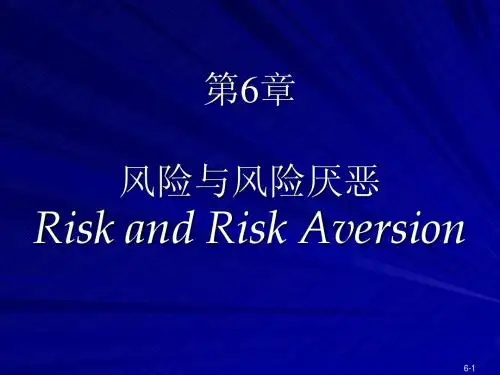
风险厌恶与风险资产的最优组合(ppt 46页)

• 多元化:同时持有多种资产可以减少总体 风险而不降 低期望收益率
收益率的概率分布
• 投资的收益率是不确定的(有风险) • 我们用如下指标来刻划不确定性
– 期望收益率:你预期将获得的平均收益率 – 波动率(标准差):未来收益率的分散程度 – 股票的波动率越大,可能的收益率区间越宽,
方差与相关系数
协方差:衡量两种证券的收益率如何共同变化以及共
同变化的幅度
co R ~ A ,R ~ v B niR A i E R ~ A R B iE R ~ B i 1
经济的状态 概率
• 对损失比收益更加敏感,也即满足厌恶损 失(loss aversion)的特征
• 权重函数:非线性的概率变换
前景理论(Prospect Theory)
Kahneman和Tversky(1979)
前景理论(Prospect Theory)
Kahneman和Tversky(1979)
风险管理
• 套期保值:减少不利的风险暴露,同时也 丧失了获利的机会
i 1
ER~ :投资的期望收益率
i:第i种状态发生的概率 R i:第i种状态发生时的收益率估计值 n:可能的状态的数量
计算期望收益率的例子
经济的状态
概率
Risco的收益率 Genco的收益率
强
0.20
50%
30%
正常
0.60
10%
10%
弱
0.20
30%
10%
E R ~ Ri s 0 .c 2 o 0 0 .5 0 0 .6 0 0 .1 0 0 .2 0 0 .3 0
收益率出现极端情况的可能性越大
6investment Finance
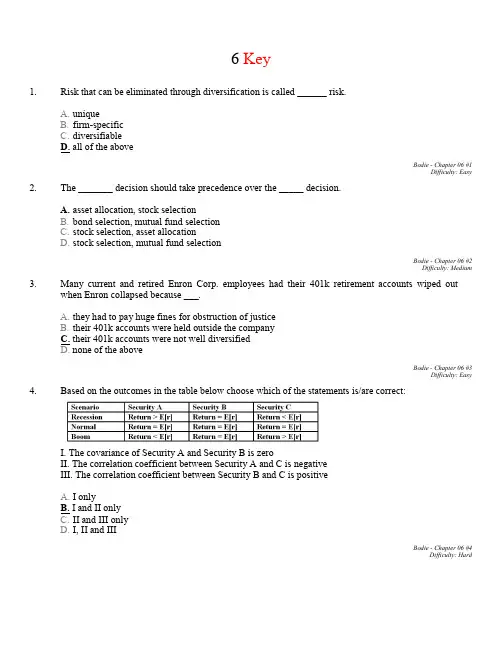
6Key1.Risk that can be eliminated through diversification is called ______ risk.A.uniqueB.firm-specificC.diversifiableD. all of the aboveBodie - Chapter 06 #1Difficulty: Easy2.The _______ decision should take precedence over the _____ decision.A.asset allocation, stock selectionB.bond selection, mutual fund selectionC.stock selection, asset allocationD.stock selection, mutual fund selectionBodie - Chapter 06 #2Difficulty: Medium 3.Many current and retired Enron Corp. employees had their 401k retirement accounts wiped outwhen Enron collapsed because ___.A.they had to pay huge fines for obstruction of justiceB.their 401k accounts were held outside the companyC. their 401k accounts were not well diversifiedD. none of the aboveBodie - Chapter 06 #3Difficulty: Easy 4.Based on the outcomes in the table below choose which of the statements is/are correct:I. The covariance of Security A and Security B is zeroII. The correlation coefficient between Security A and C is negativeIII. The correlation coefficient between Security B and C is positiveA. I onlyB. I and II onlyC.II and III onlyD.I, II and IIIBodie - Chapter 06 #4Difficulty: Hard5.Asset A has an expected return of 15% and a reward-to-variability ratio of .4. Asset B has anexpected return of 20% and a reward-to-variability ratio of .3. A risk-averse investor would prefer aportfolio using the risk-free asset and ______.A.asset AB.asset BC.no risky assetD.can't tell from the data givenBodie - Chapter 06 #5Difficulty: Medium 6.Adding additional risky assets to the investment opportunity set will generally move theefficient frontier _____ and to the ______.A. up, rightB. up, leftC.down, rightD.down, leftBodie - Chapter 06 #6Difficulty: Medium7.An investor's degree of risk aversion will determine his or her ______.A.optimal risky portfolioB.risk-free rateC. optimal mix of the risk-free asset and risky assetD. capital allocation lineBodie - Chapter 06 #7Difficulty: Medium8.The ________ is equal to the square root of the systematic variance divided by the total variance.A. covarianceB. correlation coefficientC.standard deviationD.reward-to-variability ratioBodie - Chapter 06 #8Difficulty: Medium9.Which of the following statistics cannot be negative?A. CovarianceB. VarianceC.E[r]D.Correlation coefficientBodie - Chapter 06 #9Difficulty: Easy10.Asset A has an expected return of 20% and a standard deviation of 25%. The risk free rate is 10%.What is the reward-to-variability ratio?A. .40B. .50C. .75D. .80Bodie - Chapter 06 #10Difficulty: Medium11.The correlation coefficient between two assets equals to _________.A.their covariance divided by the product of their variancesB.the product of their variances divided by their covarianceC.the sum of their expected returns divided by their covarianceD. their covariance divided by the product of their standard deviationsBodie - Chapter 06 #11Difficulty: Medium12.Diversification is most effective when security returns are _________.A. highB. negatively correlatedC.positively correlatedD.uncorrelatedBodie - Chapter 06 #12Difficulty: Easy13.The expected rate of return of a portfolio of risky securities is _________.A.the sum of the securities' covariancesB.the sum of the securities' variancesC. the weighted sum of the securities' expected returnsD. the weighted sum of the securities' variancesBodie - Chapter 06 #13Difficulty: Easy14.Beta is a measure of security responsiveness to _________.A.firm specific riskB.diversifiable riskC. market riskD. unique riskBodie - Chapter 06 #14Difficulty: Easy15.The risk that can be diversified away is __________.A. betaB. firm specific riskC.market riskD.systematic riskBodie - Chapter 06 #15Difficulty: Easy 16.To eliminate the bias in calculating the variance and covariance of returns from historical datathe average squared deviation must be multiplied by _________.A.n/(n - 1)B.n * (n - 1)C.(n - 1)/nD.(n - 1) * nBodie - Chapter 06 #16Difficulty: Medium 17.Consider an investment opportunity set formed with two securities that are perfectly negativelycorrelated. The global minimum variance portfolio has a standard deviation that is always _________.A.equal to the sum of the securities standard deviationsB.equal to -1C. equal to 0D. greater than 0Bodie - Chapter 06 #17Difficulty: Medium18.Market risk is also called __________ and _________.A. systematic risk, diversifiable riskB. systematic risk, nondiversifiable riskC.unique risk, nondiversifiable riskD.unique risk, diversifiable riskBodie - Chapter 06 #18Difficulty: Easy19.Firm specific risk is also called __________ and __________.A.systematic risk, diversifiable riskB.systematic risk, non-diversifiable riskC.unique risk, non-diversifiable riskD. unique risk, diversifiable riskBodie - Chapter 06 #19Difficulty: Easy20.Which one of the following stock return statistics fluctuates the most over time?A.Covariance of returnsB.Variance of returnsC. Average returnD. Correlation coefficientBodie - Chapter 06 #20Difficulty: Medium21.Harry Markowitz is best known for his Nobel prize winning work on _____________.A. strategies for active securities tradingB. techniques used to identify efficient portfolios of risky assetsC.techniques used to measure the systematic risk of securitiesD.techniques used in valuing securities optionsBodie - Chapter 06 #21Difficulty: Easy22.Suppose that a stock portfolio and a bond portfolio have a zero correlation. This means that ______.A. the returns on the stock and bond portfolio tend to move inverselyB. the returns on the stock and bond portfolio tend to vary independently of each otherC.the returns on the stock and bond portfolio tend to move togetherD.the covariance of the stock and bond portfolio will be positiveBodie - Chapter 06 #22Difficulty: Easy 23.You put half of your money in a stock portfolio that has an expected return of 14% and a standarddeviation of 24%. You put the rest of you money in a risky bond portfolio that has an expected return of 6% and a standard deviation of 12%. The stock and bond portfolio have a correlation 0.55. Thestandard deviation of the resulting portfolio will be ________________.A.more than 18% but less than 24%B.equal to 18%C. more than 12% but less than 18%D. equal to 12%σ2p = 0.02592 = (.52)(.242) + (.52)(.122) + 2(.5)(.5)(.24)(.12)0.55; σ = 16.1%Bodie - Chapter 06 #23Difficulty: Hard24.On a standard expected return vs. standard deviation graph investors will prefer portfolios that lie to the_____________ of the current investment opportunity set.A.left and aboveB.left and belowC.right and aboveD.right and belowBodie - Chapter 06 #24Difficulty: Easy25.The term "complete portfolio" refers to a portfolio consisting of _________________.A.the risk-free asset combined with at least one risky assetB.the market portfolio combined with the minimum variance portfolioC.securities from domestic markets combined with securities from foreign marketsmon stocks combined with bondsBodie - Chapter 06 #25Difficulty: Easy26.Rational risk-averse investors will always prefer portfolios _____________.A. located on the efficient frontier to those located on the capital market lineB. located on the capital market line to those located on the efficient frontierC. at or near the minimum variance point on the efficient frontierD. that are risk-free to all other asset choicesBodie - Chapter 06 #26Difficulty: Easy27.The optimal risky portfolio can be identified by finding ____________.I. the minimum variance point on the efficient frontierII. the maximum return point on the efficient frontier the minimum variance point on theefficient frontierIII. the tangency point of the capital market line and the efficient frontierIV. the line with the steepest slope that connects the risk free rate to the efficient frontierA.I and II onlyB.II and III onlyC.III and IV onlyD.I and IV onlyBodie - Chapter 06 #27Difficulty: Medium28.Reward-to-variability ratios are ________ on the ________ capital market line.A.lower; steeperB.higher; flatterC.higher; steeperD.the same; flatterBodie - Chapter 06 #28Difficulty: Medium29.A portfolio is composed of two stocks, A and B. Stock A has a standard deviation of return of 24% while stockB has a standard deviation of return of 18%. Stock A comprises 60% of the portfolio while stock B comprises 40% of the portfolio. If the variance of return on the portfolio is .0380, the correlation coefficient between the returns on A and B is _________. A. 0.583 B. 0.225 C. 0.327 D. 0.1280.0380 = (.62)(.242) + (.42)(.182) + 2(.6)(.4)(.24)(.18) ρ; ρ = 0.583Bodie - Chapter 06 #29Difficulty: Hard30. The standard deviation of return on investment A is .10 while the standard deviation of return on investment B is .05. If the covariance of returns on A and B is .0030, the correlation coefficient between the returns on A and B is _________.A. .12B. .36C. .60D. .77Correlation =Bodie - Chapter 06 #30 Difficulty: Medium31.A portfolio is composed of two stocks, A and B. Stock A has a standard deviation of return of 35% while stockB has a standard deviation of return of 15%. The correlation coefficient between the returns on A and B is 0.45. Stock A comprises 40% of the portfolio while stock B comprises 60% of the portfolio. The standard deviation of the return on this portfolio is _________.A. 23.00%B. 19.76%C. 18.45%D. 17.67%σ2p = (.402)(.352) + (.602)(.15)2 +(2)(.4)(.6)(.35)(.15)(.45) σ2p = .039046 σp = 19.76%Bodie - Chapter 06 #31 Difficulty: Medium32.The standard deviation of return on investment A is .10 while the standard deviation of return oninvestment B is .04. If the correlation coefficient between the returns on A and B is -.50, thecovariance of returns on A and B is _________.A. -.0447B. -.0020C. .0020D. .0447Bodie - Chapter 06 #32Difficulty: Medium 33.Consider two perfectly negatively correlated risky securities, A and B. Security A has an expected rate ofreturn of 16% and a standard deviation of return of 20%. B has an expected rate of return of 10% and astandard deviation of return of 30%. The weight of security B in the minimum variance portfolio is_________.A.10%B.20%C. 40%D. 60%Bodie - Chapter 06 #33Difficulty: Hard An investor can design a risky portfolio based on two stocks, A and B. Stock A has an expectedreturn of 18% and a standard deviation of return of 20%. Stock B has an expected return of 14% and a standard deviation of return of 5%. The correlation coefficient between the returns of A and B is 0.50.The risk-free rate of return is 10%.Bodie - Chapter 0634.The proportion of the optimal risky portfolio that should be invested in stock A is _________.A.0%B.40%C.60%D.100%Bodie - Chapter 06 #34Difficulty: HardA.14.0%B.15.6%C.16.4%D.18.0%Bodie - Chapter 06 #35Difficulty: Hard36.The standard deviation of return on the optimal risky portfolio is _________.A. 0%B. 5%C.7%D.20%Bodie - Chapter 06 #36Difficulty: Hard An investor can design a risky portfolio based on two stocks, A and B. Stock A has an expectedreturn of 21% and a standard deviation of return of 39%. Stock B has an expected return of 14% and a standard deviation of return of 20%. The correlation coefficient between the returns of A and B is 0.4.The risk-free rate of return is 5%.Bodie - Chapter 06 37.The proportion of the optimal risky portfolio that should be invested in stock B is approximately_________.A.29%B.44%C.56%D. 71%WB = 71%Bodie - Chapter 06 #37Difficulty: HardA. 14%B. 16%C.18%D.19%E[r p] = (.29)(.21) + (.71)(.14) = 16%Bodie - Chapter 06 #38Difficulty: Hard39.The standard deviation of the returns on the optimal risky portfolio is _________.A.25.5%B.22.3%C. 21.4%D. 20.7%σ2rp = (.292)(.392) + (.712)(.202) +2(.29)(.71)(.39)(.20).4 σ2rp = .045804σrp = 21.4%Bodie - Chapter 06 #39Difficulty: Hard C.An investor can design a risky portfolio based on two stocks, A and B. The standard deviation of return onstock A is 24% while the standard deviation on stock B is 14%. The correlation coefficient between thereturn on A and B is 0.35. The expected return on stock A is 25% while on stock B it is 11%. Theproportion of the minimum variance portfolio that would be invested in stock B is approximately_________.45%67%C. 85%D. 92%WB = ; COVAB = ρABσAσB = (.35)(.24)(.14) = .01176WB =Bodie - Chapter 06 #40Difficulty: Hard41.An investor can design a risky portfolio based on two stocks, A and B. The standard deviation ofreturn on stock A is 20% while the standard deviation on stock B is 15%. The expected return on stockA is 20% while on stockB it is 10%. The correlation coefficient between the return on A and B is 0%.The expected return on the minimum variance portfolio is approximately _________.A. 10.00%B. 13.60%C.15.00%D.19.41%Bodie - Chapter 06 #41Difficulty: Hard 42.An investor can design a risky portfolio based on two stocks, A and B. The standard deviation of return onstock A is 20% while the standard deviation on stock B is 15%. The correlation coefficient between the return on A and B is 0%. The standard deviation of return on the minimum variance portfolio is_________.A.0%B.6%C. 12%D. 17%Bodie - Chapter 06 #42Difficulty: Hard43. A measure of the riskiness of an asset held in isolation is ____________.A. betaB. standard deviationC.covarianceD.semi-varianceBodie - Chapter 06 #43Difficulty: Easy44.Semitool Corp has an expected excess return of 6% for next year. However for every unexpected 1%change in the market, Semitool's return responds by a factor of 1.2. Suppose it turns out the economy and the stock market do better than expected by 1.5% and Semitool's products experience more rapid growth than anticipated, pushing up the stock price by another 1%. Based on this information whatwas Semitool's actual excess return?A.7.00%B.8.50%C. 8.80%D. 9.25%6% + (1.5%)(1.2) + 1% = 8.8%Bodie - Chapter 06 #44Difficulty: Medium45.The part of a stock's return that is systematic is a function of which of the following variables?I. Volatility in excess returns of the stock marketII. The sensitivity of the stock's returns to changes in the stock marketIII. The variance in the stock's returns that is unrelated to the overall stock marketA. I onlyB. I and II onlyC.II and III onlyD.I, II and IIIBodie - Chapter 06 #45Difficulty: Easy 46.Stock A has a beta of 1.2 and Stock B has a beta of 1. The returns of Stock A are ______ sensitiveto changes in the market as the returns of Stock B.A.20% moreB.slightly moreC.20% lessD.slightly lessBodie - Chapter 06 #46Difficulty: Easy 47.Which risk can be diversified away as additional securities are added to aportfolio? I. Total riskII. Systematic riskIII. Firm specific riskA.I onlyB.I and II onlyC.I, II, and IIID.I and IIIBodie - Chapter 06 #47Difficulty: Easy48.According to Tobin's separation property, portfolio choice can be separated into two independenttasks consisting of __________ and __________.A identifying all investor imposed constraints; identifying the set of securities that conform to the. investor's constraints and offer the best risk-return tradeoffsB. identifying the investor's degree of risk aversion; choosing securities from industry groups thatare consistent with the investor's risk profileC identifying the optimal risky portfolio; constructing a complete portfolio from T-bills and the optimal. risky portfolio based on the investor's degree of risk aversionD choosing which risky assets an investor prefers according to their risk aversion level; minimizing the. CAL by lending at the risk-free rateBodie - Chapter 06 #48Difficulty: Medium 49.You are constructing a scatter plot of excess returns for Stock A versus the market index. If thecorrelation coefficient between Stock A and the index is -1 you will find that the points of the scatter diagram ______________________ and the line of best fit has a ______________.A. all fall on the line of best fit; positive slopeB. all fall on the line of best fit; negative slopeC.are widely scattered around the line; positive slopeD.are widely scattered around the line; negative slopeBodie - Chapter 06 #49Difficulty: Medium50.The term excess-return refers to ______________.A. returns earned illegally by means of insider tradingB. the difference between the rate of return earned and the risk-free rateD.the difference between the rate of return earned on a particular security and the rate of returnearned on other securities of equivalent riskE.the portion of the return on a security which represents tax liability and therefore cannot bereinvestedBodie - Chapter 06 #50Difficulty: Easy 51.You are recalculating the risk of ACE stock in relation to the market index and you find the ratio ofthe systematic variance to the total variance has risen. You must also find that the ____________.A.covariance between ACE and the market has fallenB.correlation coefficient between ACE and the market has fallenC. correlation coefficient between ACE and the market has risenD. unsystematic risk of ACE has risenBodie - Chapter 06 #51Difficulty: Medium52. A stock has a correlation with the market of 0.45. The standard deviation of the market is 21% andthe standard deviation of the stock is 35%. What is the stock's beta?A. 1.00B. 0.75C.0.60D.0.55β =Bodie - Chapter 06 #52Difficulty: Medium53.The values of beta coefficients of securities are __________.A.always positiveB.always negativeC.always between positive 1 and negative 1D. usually positive, but are not restricted in any particular wayBodie - Chapter 06 #53Difficulty: Easy54. A security's beta coefficient will be negative if ____________.A.its returns are negatively correlated with market index returnsB.its returns are positively correlated with market index returnsC.its stock price has historically been very stableD.market demand for the firm's shares is very lowBodie - Chapter 06 #54Difficulty: Easy 55.The market value weighted average beta of firms included in the market index will always be_____________.A.0B.between 0 and 1C. 1D. There is no particular rule concerning the average beta of firms included in the market indexBodie - Chapter 06 #55Difficulty: Easy56.Diversification can reduce or eliminate __________ risk.A.allB.systematicC. non-systematicD. only an insignificantBodie - Chapter 06 #56Difficulty: Easy57.In order to construct a riskless portfolio using two risky stocks, one would need to find two stocks witha correlation coefficient of ________.A.1.0B.0.5C.0D. -1.0Bodie - Chapter 06 #57Difficulty: Easy 58.Some diversification benefits can be achieved by combining securities in a portfolio as long asthe correlation between the securities is _____________.A. 1B. less than 1C.between 0 and 1D.less than or equal to 0Bodie - Chapter 06 #58Difficulty: Easy 59.If an investor does not diversify their portfolio and instead puts all of their money in one stock,the appropriate measure of security risk for that investor is the ________.A.stock's standard deviationB.variance of the marketC.stock's betaD.covariance with the market indexBodie - Chapter 06 #59Difficulty: Medium60.Which of the following provides the best example of a systematic risk event?A.A strike by union workers hurts a firm's quarterly earnings.B.Mad Cow disease in Montana hurts local ranchers and buyers of beef.C. The Federal Reserve increases interest rates 50 basis points.D. A senior executive at a firm embezzles $10 million and escapes to South America.Bodie - Chapter 06 #60Difficulty: Easy61.Which of the following statements is true regarding time diversification?I. The standard deviation of the average annual rate of return over severalyears will be smaller than the one-year standard deviation.II. For a longer time horizon, uncertainty compounds over a greaternumber of years.III. Time diversification does not reduce risk.A.I onlyB.II onlyC.II and III onlyD.I, II and IIIE.None of the statements are correctBodie - Chapter 06 #61Difficulty: Medium62.You find that the annual standard deviation of a stock's returns is equal to 25%. For a 3 yearholding period the standard deviation of your total return would equal _______.A.75%B.25%C. 43%D. 55%Bodie - Chapter 06 #62Difficulty: EasyBodie - Chapter 0663.The beta of this stock is ____.A.0.12B.0.35C. 1.32D. 4.05Beta equals slope coefficient = 1.32Bodie - Chapter 06 #63Difficulty: Easy64.This stock has greater systematic risk than a stock with a beta of ___.A.0.50B.1.50C.2.00D.3.000.50 < 1.32Bodie - Chapter 06 #64Difficulty: Easy65.The characteristic line for this stock is Rstock = ___ + ___ Rmarket.A. 0.35, 0.12B. 4.05, 1.32C.15.44, 0.97D.0.26, 1.36Intercept equals 4.05 and slope equals 1.32.Bodie - Chapter 06 #65Difficulty: Medium66.____ percent of the variance is explained by this regression.A.12B.35C.4.05D.80R 2= 12 means 12% of the variance is explained by the regression.Bodie - Chapter 06 #66Difficulty: Medium67.The stock is ______ riskier than the typical stock.A.32%B.15.44%C.12%D.38%Beta of 1.32 means that this stock is 32% riskier than the market.Bodie - Chapter 06 #67Difficulty: Medium 68.Decreasing the number of stocks in a portfolio from 50 to 10 would likely_________________________.A. increase the systematic risk of the portfolioB. increase the unsystematic risk of the portfolioC.increase the return of the portfolioD.decrease the variation in returns the investor faces in any one yearBodie - Chapter 06 #68Difficulty: Medium69.If you want to know the portfolio standard deviation for a three stock portfolio you will have toA.calculate two covariances and one trivarianceB.calculate only two covariancesC. calculate three covariancesD. average the variances of the individual stocksBodie - Chapter 06 #69Difficulty: Medium70.Which of the following correlations coefficients will produce the least diversification benefit?A.-0.6B.-0.3C.0.0D. 0.8Bodie - Chapter 06 #70Difficulty: Easy71.Which of the following correlation coefficients will produce the most diversification benefits?A. -0.6B. -0.9C.0.0D.0.4Bodie - Chapter 06 #71Difficulty: Easy72.What is the most likely correlation coefficient between a stock index mutual fund and the S&P 500?A.-1.0B.0.0C. 1.0D. 0.5Bodie - Chapter 06 #72Difficulty: Easy73.Investing in two assets with a correlation coefficient of -0.5 will reduce what kind of risk?A.Market riskB.Non-diversifiable riskC.Systematic riskD. Unique riskBodie - Chapter 06 #73Difficulty: Easy74.Investing in two assets with a correlation coefficient of 1.0 will reduce which kind of risk?A.Market riskB.Unique riskC.Unsystematic riskD. With a correlation of 1.0, no risk will be reducedBodie - Chapter 06 #74Difficulty: Easy75. A portfolio of stocks fluctuates when the treasury yields change. Since this risk can not be eliminated through diversification, it is called __________.A. firm specific riskB. systematic riskC. unique riskD. none of the aboveBodie - Chapter 06 #75Difficulty: Easy76. As you lengthen the time horizon of your investment period and decide to invest for multiple years you will find that ________.I. the average risk per year may be smaller over longer investmenthorizons II. the overall risk of your investment will compound over time III. your overall risk on the investment will fallA. I onlyB. I and II onlyC. III onlyD. I, II and IIIBodie - Chapter 06 #76 Difficulty: Medium77.You are considering adding a new security to your portfolio. In order to decide whether you should add the security you need to know the security's _______. I. expected return II. standard deviationIII. correlation with your portfolio A. I onlyB. I and II onlyC. I and III onlyD. I, II and IIIBodie - Chapter 06 #77 Difficulty: Medium78. Which of the following is a correct expression concerning the formula for the standard deviation of returns of a two asset portfolio where the correlation coefficient is positive?A.σ2rp < (W 12σ12 + W 22σ22)B. σ2rp = (W 12σ12 + W 22σ22)C. σ2rp = (W 12σ12 - W 22σ22)D.σ2rp > (W 12σ12 + W 22σ22)Bodie - Chapter 06 #78 Difficulty: Medium79.What is the standard deviation of a portfolio of two stocks given the following data? Stock A has astandard deviation of 18%. Stock B has a standard deviation of 14%. The portfolio contains 40% ofstock A and the correlation coefficient between the two stocks is -.23.A.9.7%B.12.2%C.14.0%D.15.6%Bodie - Chapter 06 #79Difficulty: Medium 80.What is the standard deviation of a portfolio of two stocks given the following data? Stock A has astandard deviation of 30%. Stock B has a standard deviation of 18%. The portfolio contains 60% ofstock A and the correlation coefficient between the two stocks is -1.0.A. 0.0%B. 10.8%C.18.0%D.24.0%Bodie - Chapter 06 #80Difficulty: Medium 81.The expected return of portfolio is 8.9% and the risk free rate is 3.5%. If the portfolio standarddeviation is 12.0%, what is the reward to variability ratio of the portfolio?A. 0.0B. 0.45C.0.74D.1.35Reward to variability ratio = (.089 - .035)/.12 = 0.45Bodie - Chapter 06 #81Difficulty: Medium82. A project has a 60% chance of doubling your investment in one year and a 40% chance of losing half your money. What is the standard deviation of this investment? A. 25% B. 50% C. 62% D. 73%E[r p ] = (.60)(1) + (.40)(-.5) = .40σ2rp = (.60)(1 - .40)2 + (.40)(-.5 - .40)2 = .54 σrp = .73Bodie - Chapter 06 #82 Difficulty: Medium83. A project has a 50% chance of doubling your investment in one year and a 50% chance of losing half your money. What is the expected return on this investment project?A. 0%B. 25%C. 50%D. 75%E[rp] = (.5)(100) + (.5)(-50) = 25%Bodie - Chapter 06 #83Difficulty: EasyThe figures below show plots of monthly excess returns for two stocks plotted against excess returns for a market index.Bodie - Chapter 0684. Which stock is likely to further reduce risk for an investor currently holding his portfolio in a well diversified portfolio of common stock?A. Stock AB. Stock BC. There is no difference between A or BD. You cannot tell from the information given.Bodie - Chapter 06 #84 Difficulty: Medium。
博迪投资学第10版英文教材课后答案(6)

博迪投资学第10版英⽂教材课后答案(6)CAPITAL ALLOCATION TO RISKY ASSETSCHAPTER 6: RISK AVERSION ANDCAPITAL ALLOCATION TO RISKY ASSETS PROBLEM SETS1. (e)2. (b) A higher borrowing rate is a consequence of the risk of the borrowers’ default.In perfect markets with no additional cost of default, this increment would equal the value of the borrower’s option to default, and the Sharpe measure, with appropriate treatment of the default option, would be the same. However, in reality there are costs to default so that this part of the increment lowers the Sharpe ratio. Also,notice that answer (c) is not correct because doubling the expected return with afixed risk-free rate will more than double the risk premium and the Sharpe ratio. 3. Assuming no change in risk tolerance, that is, an unchanged risk aversioncoefficient (A), then higher perceived volatility increases the denominator of theequation for the optimal investment in the risky portfolio (Equation 6.7). Theproportion invested in the risky portfolio will therefore decrease.4. a. The expected cash flow is: (0.5 × $70,000) + (0.5 × 200,000) = $135,000With a risk premium of 8% over the risk-free rate of 6%, the required rate ofreturn is 14%. Therefore, the present value of the portfolio is:$135,000/1.14 = $118,421b. If the portfolio is purchased for $118,421, and provides an expected cashinflow of $135,000, then the expected rate of return [E(r)] is as follows:$118,421 × [1 + E(r)] = $135,000Therefore, E(r) =14%. The portfolio price is set to equate the expected rate ofreturn with the required rate of return.c. If the risk premium over T-bills is now 12%, then the required return is:6% + 12% = 18%The present value of the portfolio is now:$135,000/1.18 = $114,4076-1CAPITAL ALLOCATION TO RISKY ASSETSd. For a given expected cash flow, portfolios that command greater riskpremia must sell at lower prices. The extra discount from expected valueis a penalty for risk.5.When we specify utility by U =E(r) – 0.5A σ2, the utility level for T-bills is: 0.07The utility level for the risky portfolio is:U = 0.12 – 0.5 × A × (0.18)2 = 0.12 – 0.0162 × AIn order for the risky portfolio to be preferred to bills, the following must hold:0.12 – 0.0162A > 0.07 ? A < 0.05/0.0162 = 3.09A must be less than 3.09 for the risky portfolio to be preferred to bills.6. Points on the curve are derived by solving for E(r) in the following equation:U = 0.05 = E(r) – 0.5A σ2 = E(r) – 1.5σ2The values of E(r), given the values of σ2, are therefore:σσ 2E(r)0.00 0.0000 0.050000.05 0.0025 0.053750.10 0.0100 0.065000.15 0.0225 0.083750.20 0.0400 0.110000.25 0.0625 0.14375The bold line in the graph on the next page (labeled Q6, for Question 6) depicts the indifference curve.7. Repeating the analysis in Problem 6, utility is now:U = E(r) – 0.5Aσ2 = E(r) – 2.0σ2 = 0.05The equal-utility combinations of expected return and standard deviation arepresented in the table below. The indifference curve is the upward sloping line in the graph on the next page, labeled Q7 (for Question 7).σσ 2E(r)0.00 0.0000 0.05000.05 0.0025 0.05500.10 0.0100 0.07000.15 0.0225 0.09506-2CAPITAL ALLOCATION TO RISKY ASSETS0.20 0.0400 0.13000.25 0.0625 0.1750The indifference curve in Problem 7 differs from that in Problem 6 in slope.When A increases from 3 to 4, the increased risk aversion results in a greaterslope for the indifference curve since more expected return is needed in order to8. The coefficient of risk aversion for a risk neutral investor is zero. Therefore, thecorresponding utility is equal to the portfolio’s expected return. The corresponding indifference curve in the expected return-standard deviation plane is a horizontal line, labeled Q8 in the graph above (see Problem 6).9. A risk lover, rather than penalizing portfolio utility to account for risk, derivesgreater utility as variance increases. This amounts to a negative coefficient of risk aversion. The corresponding indifference curve is downward sloping in the graph above (see Problem 6), and is labeled Q9.6-3CAPITAL ALLOCATION TO RISKY ASSETS6-410. The portfolio expected return and variance are computed as follows:(1) W Bills (2) r Bills (3) W Index (4) r Index r Portfolio (1)×(2)+(3)×(4) σPortfolio(3) × 20% σ 2 Portfolio0.0 5% 1.0 13.0% 13.0% = 0.130 20% = 0.20 0.0400 0.2 5% 0.8 13.0% 11.4% = 0.114 16% = 0.16 0.0256 0.4 5% 0.6 13.0% 9.8% = 0.098 12% = 0.12 0.0144 0.6 5% 0.4 13.0% 8.2% = 0.082 8% = 0.08 0.0064 0.8 5% 0.2 13.0% 6.6% = 0.066 4% = 0.04 0.0016 1.05%0.013.0%5.0% = 0.0500% = 0.00 0.000011. Computing utility from U = E(r) – 0.5 × A σ2 = E(r) – σ2, we arrive at the valuesin the column labeled U(A = 2) in the following table:W Bills W Index r Portfolio σPortfolio σ2Portfolio U(A = 2)U(A = 3) 0.0 1.0 0.130 0.20 0.0400 0.0900 .0700 0.2 0.8 0.114 0.16 0.0256 0.0884 .0756 0.4 0.6 0.098 0.12 0.0144 0.0836 .0764 0.6 0.4 0.082 0.08 0.0064 0.0756 .0724 0.8 0.2 0.066 0.04 0.0016 0.0644 .0636 1.00.00.0500.00 0.00000.0500 .0500The column labeled U(A = 2) implies that investors with A = 2 prefer a portfolio that is invested 100% in the market index to any of the other portfolios in the table.12. The column labeled U(A = 3) in the table above is computed from:U = E(r) – 0.5A σ2 = E(r) – 1.5σ2The more risk averse investors prefer the portfolio that is invested 40% in the market, rather than the 100% market weight preferred by investors with A = 2.13. Expected return = (0.7 × 18%) + (0.3 × 8%) = 15%Standard deviation = 0.7 × 28% = 19.6%14. Investment proportions: 30.0% in T-bills 0.7 × 25% = 17.5% in Stock A 0.7 × 32% = 22.4% in Stock B 0.7 × 43% = 30.1% in Stock CCAPITAL ALLOCATION TO RISKY ASSETS6-515. Your reward-to-volatility ratio: .18.080.3571.28S -== Client's reward-to-volatility ratio: .15.080.3571.196S -== 16.17. a.E(r C ) = r f + y × [E(r P ) – r f ] = 8 + y × (18 - 8) If the expected return for the portfolio is 16%, then:16% = 8% + 10% × y ?.16.080.8.10y -== Therefore, in order to have a portfolio with expected rate of return equal to 16%, the client must invest 80% of total funds in the risky portfolio and 20% in T-bills.CAPITAL ALLOCATION TO RISKY ASSETS6-6b.Client’s investment proportions: 20.0% in T-bills0.8 × 25% = 20.0% in Stock A 0.8 × 32% = 25.6% in Stock B 0.8 × 43% = 34.4% in Stock Cc.σC = 0.8 × σP = 0.8 × 28% = 22.4%18. a.σC = y × 28%If your client prefers a standard deviation of at most 18%, then:y = 18/28 = 0.6429 = 64.29% invested in the risky portfoliob. ().08.1.08(0.6429.1)14.429%C E r y =+?=+?=19. a.y*0.36440.27440.100.283.50.080.18A σr )E(r 22Pf P ==?-=-=Therefor e, the client’s optimal proportions are: 36.44% invested in the risky portfolio and 63.56% invested in T-bills.b. E(r C ) = 8 + 10 × y* = 8 + (0.3644 × 10) = 11.644% σC = 0.3644 × 28 = 10.203%20. a.If the period 1926 - 2009 is assumed to be representative of future expected performance, then we use the following data to compute the fraction allocated to equity: A = 4, E(r M ) ? r f = 7.93%, σM = 20.81% (we use the standard deviation of the risk premium from Table 6.7). Then y * is given by:M f 22ME(r )r 0.0793y*0.4578A σ40.2081-===? That is, 45.78% of the portfolio should be allocated to equity and 54.22%should be allocated to T-bills.b.If the period 1968 - 1988 is assumed to be representative of future expected performance, then we use the following data tocompute the fraction allocated to equity: A = 4, E(r M ) ? r f = 3.44%, σM = 16.71% and y* is given by:CAPITAL ALLOCATION TO RISKY ASSETS6-7M f 22M E(r )r 0.0344y*0.3080A σ40.1671-===? Therefore, 30.80% of the complete portfolio should be allocated to equity and69.20% should be allocated to T-bills.c.In part (b), the market risk premium is expected to be lower than in part (a) and market risk is higher. Therefore, the reward-to-volatility ratio is expected to be lower in part (b), which explains the greater proportion invested in T-bills.21. a. E(r C ) = 8% = 5% + y × (11% – 5%) ? .08.050.5.11.05y -==-b. σC = y × σP = 0.50 × 15% = 7.5%c.The first client is more risk averse, allowing a smaller standard deviation.22. Johnson requests the portfolio standard deviation to equal one half the marketportfolio standard deviation. The market portfolio 20%M σ=which implies 10%P σ=. The intercept of the CML equals 0.05f r =and the slope of the CML equals the Sharpe ratio for the market portfolio (35%). Therefore using the CML:()()0.050.350.100.0858.5%M fP f P ME r r E r r σσ-=+=+?==23. Data: r f = 5%, E(r M ) = 13%, σM = 25%, and B f r = 9%The CML and indifference curves are as follows:CAPITAL ALLOCATION TO RISKY ASSETS6-824. For y to be less than 1.0 (that the investor is a lender), risk aversion (A) must be large enough such that:1A σr )E(r y 2M f M <-=1.280.250.050.13A 2=-> For y to be greater than 1 (the investor is a borrower), A must be small enough: 1A σr )E(r y 2M f M >-=0.640.250.090.13A 2=-< For values of risk aversion within this range, the client will neither borrow nor lend, but will hold a portfolio comprised only of the optimal risky portfolio:y = 1 for 0.64 ≤ A ≤ 1.2825. a.The graph for Problem 23 has to be redrawn here, with: E(r P ) = 11% and σP = 15% CAPITAL ALLOCATION TO RISKY ASSETS6-9E(r)σ913251115b.For a lending position: 2.670.150.050.11A 2=->For a borrowing position: 0.890.150.090.11A 2=-<Therefore, y = 1 for 0.89 ≤ A ≤ 2.6726. The maximum feasible fee, denoted f, depends on the reward-to-variability ratio.For y < 1, the lending rate, 5%, is viewed as the relevant risk-free rate, and we solve for f as follows: .11.05.13.05.15.25f ---= ? .15.08.06.012 1.2%.25f ?=-== For y > 1, the borrowing rate, 9%, is the relevant risk-free rate. Then we notice that,even without a fee, the active fund is inferior to the passive fund because:`More risk tolerant investors (who are more inclined to borrow) will not be clients ofCAPITAL ALLOCATION TO RISKY ASSETS6-10the fund. We find that f is negative: that is, you would need to pay investors to choose your active fund. These investors desire higher risk-higher return complete portfolios and thus are in the borrowing range of the relevant CAL. In this range, the reward-to-variability ratio of the index (the passive fund) is better than that of the managed fund..13.08-28. a.With 70% of his money invested in my fund’s portfolio, the client’s expected return is 15% per year and standard deviation is 19.6% per year. If he shifts that money to the passive portfolio (which has an expected return of 13% and standard deviation of 25%), his overall expected return becomes: E(r C ) = r f + 0.7 × [E(r M ) ? r f ] = .08 + [0.7 × (.13 – .08)] = .115 = 11.5% The standard deviation of the complete portfolio using the passive portfolio would be:σC = 0.7 × σM = 0.7 × 25% = 17.5%Therefore, the shift entails a decrease in mean from 15% to 11.5% and adecrease in standard deviation from 19.6% to 17.5%. Since both mean return and standard deviation decrease, it is not yet clear whether the move isCAPITAL ALLOCATION TO RISKY ASSETS6-11beneficial. The disadvantage of the shift is that, if the client is willing to accept a mean return on his total portfolio of 11.5%, he can achieve it with a lower standard deviation using my fund rather than the passive portfolio. To achieve a target mean of 11.5%, we first write the mean of the complete portfolio as a function of the proportion invested in my fund (y ):E(r C ) = .08 + y × (.18 ? .08) = .08 + .10 × yOur target is: E(r C ) = 11.5%. Therefore, the proportion that must be invested in my fund is determined as follows:.115 = .08 + .10 × y ? .115.080.35.10y -== The standard deviation of this portfolio would be:σC = y × 28% = 0.35 × 28% = 9.8%Thus, by using my portfolio, the same 11.5% expected return can be achieved with a standard deviation of only 9.8% as opposed to the standard deviation of 17.5% using the passive portfolio.b.The fee would reduce the reward-to-volatility ratio, i.e., the slope of the CAL. The client will be indifferent between my fund and the passive portfolio if the slope of the after-fee CAL and the CML are equal. Let f denote the fee:Slope of CAL with fee .18.08.10.28.28f f---==Slope of CML (which requires no fee).13.080.20.25-== Setting these slopes equal we have:.100.200.044 4.4%.28ff -=?==per year29. a.The formula for the optimal proportion to invest in the passive portfolio is:2MfM A σr )E(r y*-=Substitute the following: E(r M ) = 13%; r f = 8%; σM = 25%; A = 3.5:20.130.08y*0.2286=22.86% in the passive portfolio 3.50.25-==?CAPITAL ALLOCATION TO RISKY ASSETS6-12b.The answer here is the same as the answer to Problem 28(b). The fee that you can charge a client is the same regardless of the asset allocation mix of the client’s portfolio. You can charge a fee that will equate the reward-to-volatility ratio of your portfolio to that of your competition.CFA PROBLEMS1. Utility for each investment = E(r) – 0.5 × 4 × σ2We choose the investment with the highest utility value, Investment 3. Investment ExpectedreturnE(r)Standarddeviationσ Utility U 1 0.12 0.30 -0.0600 2 0.15 0.50 -0.3500 3 0.21 0.16 0.1588 4 0.240.210.15182. When investors are risk neutral, then A = 0; the investment with the highest utility is Investment 4 because it has the highest expected return.3. (b)4. Indifference curve 25. Point E6. (0.6 × $50,000) + [0.4 × (-$30,000)] - $5,000 = $13,0007. (b)CAPITAL ALLOCATION TO RISKY ASSETS6-138. Expected return for equity fund = T-bill rate + risk premium = 6% + 10% = 16% Expected rate of return of the clien t’s portfolio = (0.6 × 16%) + (0.4 × 6%) = 12% Expected return of the client’s portfolio = 0.12 × $100,000 = $12,000 (which implies expected total wealth at the end of the period = $112,000) Standard deviation of client’s overall portfolio = 0.6 × 14% = 8.4% 9.Reward-to-volatility ratio =.100.71.14=CHAPTER 6: APPENDIX1. By year end, the $50,000 investment will grow to: $50,000 × 1.06 = $53,000Without insurance , the probability distribution of end-of-year wealth is:Probability Wealth No fire 0.999 $253,000 Fire0.001$ 53,000For this distribution, expected utility is computed as follows:E[U(W)] = [0.999 × ln(253,000)] + [0.001 × ln(53,000)] = 12.439582 The certainty equivalent is:W CE = e 12.439582 = $252,604.85With fire insurance , at a cost of $P, the investment in the risk-free asset is:$(50,000 – P)Year-end wealth will be certain (since you are fully insured) and equal to:[$(50,000 – P) × 1.06] + $200,000 Solve for P in the following equation:[$(50,000 – P) × 1.06] + $200,000 = $252,604.85 ? P = $372.78This is the most you are willing to pay for insurance. Note that the expected loss is “only” $200, so you are willing to pay a substantial risk premium over the expected value of losses. The primary reason is that the value of the house is a large proportion of your wealth.CAPITAL ALLOCATION TO RISKY ASSETS2. a. With insurance coverage for one-half the value of the house, the premiumis $100, and the investment in the safe asset is $49,900. By year end, theinvestment of $49,900 will grow to: $49,900 × 1.06 = $52,894If there is a fire, your insurance proceeds will be $100,000, and theprobability distribution of end-of-year wealth is:Probability WealthNo fire 0.999 $252,894Fire 0.001 $152,894For this distribution, expected utility is computed as follows:E[U(W)] = [0.999 × ln(252,894)] + [0.001 × ln(152,894)] = 12.4402225 The certainty equivalent is: W CE = e 12.4402225 = $252,766.77b.With insurance coverage for the full value of the house, costing $200, end-of-year wealth is certain, and equal to:[($50,000 – $200) × 1.06] + $200,000 = $252,788Since wealth is certain, this is also the certainty equivalent wealth of the fullyinsured position.c.With insurance coverage for 1? times the value of the house, the premiumis $300, and the insurance pays off $300,000 in the event of a fire. Theinvestment in the safe asset is $49,700. By year end, the investment of$49,700 will grow to: $49,700 × 1.06 = $52,682The probability distribution of end-of-year wealth is:Probability WealthNo fire 0.999 $252,682Fire 0.001 $352,682For this distribution, expected utility is computed as follows:E[U(W)] = [0.999 × ln(252,682)] + [0.001 × ln(352,682)] = 12.4402205 The certainty equivalent is: W CE = e 12.440222 = $252,766.27Therefore, full insurance dominates both over- and under-insurance. Over-insuring creates a gamble (you actually gain when the house burns down).Risk is minimized when you insure exactly the value of the house.6-14。
RISK APPETITE&RISK TOLERENCE&RISK PREFERENCE(WS201407)
风险偏好(Risk Appetite)指的是组织为了获取价值达到目的而愿意接受的风险总量。它是由组织 的风险管理理念所决定的,并且对企业的文化和经营产生一定的影响。一个组织的风险偏好对资源配置 的方式,人员的管理及组织构架的建立过程都有着重要的影响,并将最终对组织的有效运行和对风险给 与回应的方式产生重要的影响。建立风险偏好是企业进行风险覆盖的首要任务,以便满足风险管理对企 业特有风险识别和确认的要求。决策者在设定组织总体目标、战略时应该充分考虑到风险偏好因素对企 业价值带来的影响。
“风险忍受”、“风险容忍”等。在目前中国大陆监管机构的文件中,更多采用了“风险承受”这 个翻译;Risk Appetite 目前在香港和台湾地区,把这次专有名词译为“风险胃纳”,而在中国内地 地区这个词基本上被译为“风险偏好”,特别是银监会的监管文件采用了这个术语。由于 Risk Preference 已经被约定俗成为“风险偏好”,故在使用中若不加入注明,就容易出现混淆的情况。
风险容忍(Risk Tolerance)指的是组织为了达到目的而愿意接受的与预期结果的相背离的程度, 更具体的说这个概念是建立在组织对预期结果偏差程度的容忍之上的。
风险偏好和风险容忍这两个概念从定义上来说有着一定的联系,也存在着一些不同,这些不同表现为: 风险偏好(Risk Appetite)可以认为是从正面积极地去对风险进行管理和控制,同时也说明了 投资者对风险的承担意愿及能力;而风险容忍(Risk Tolerance)可以说是组织被动地去接受风 险,它的决定因素有主观的偏好因素和客观的资本金规模等限制因素。 风险偏好(Risk Appetite)是从组织整体的战略管理层面出发,在决定组织的风险偏好(Risk Appetite) 时, 风险容忍 (Risk Tolerance) 是需要考虑的众多方面之一, 也可以说风险容忍 (Risk Tolerance)是风险偏好(Risk Appetite)在具体层面上的应用。 风险容忍(Risk Tolerance)的目标设定有更多的灵活性;而风险偏好(Risk Appetite)则建立 了一个风险的限制范围以避免额外风险的发生。 风险容忍(Risk Tolerance)可以从质、量两方面进行设定;风险偏好(Risk Appetite)侧重从 目标上提出要求。
《博弈与信息—博弈论概论》答案odd08

ODDAnswers to Odd-Numbered Problems,4th Edition of Games and Information, RasmusenCHAPTER8:Further Topics in Moral Hazard26March2005.12November2005.Erasmuse@..This appendix contains answers to the odd-numbered problems in the fourth edition of Games and Information by Eric Rasmusen,which I am working on now and perhaps will come out in2006.The answers to the even-numbered problems are available to instructors or self-studiers on request to me at Erasmuse@.Other books which contain exercises with answers include Bierman&Fernandez (1993),Binmore(1992),Fudenberg&Tirole(1991a),J.Hirshleifer&Riley(1992),Moulin (1986),and Gintis(2000).I must ask pardon of any authors from whom I have borrowed without attribution in the problems below;these are the descendants of problems that I wrote for teaching without careful attention to my sources.PROBLEMS FOR CHAPTER 8:Further Topics in Moral Hazard8.1.Monitoring with error (easy)An agent has a utility function U =√w −αe ,where α=1and e is either 0or 5.His reservation utility level is U =9,and his output is 100with low effort and 250with high effort.Principals are risk neutral and scarce,and agents compete to work for them.The principal cannot condition the wage on effort or output,but he can,if he wishes,spend five minutes of his time,worth 10dollars,to drop in and watch the agent.If he does that,he observes the agent Daydreaming or W orking ,with probabilities that differ depending on the agent’s effort.He can condition the wage on those two things,so the contract will be {w,w }.The probabilities are given by Table 1.Table 1:Monitoring with Error Probability ofEffortDaydreaming W orking Low (e =0)0.60.4High (e =5)0.10.9(a)What are profits in the absence of monitoring,if the agent is paid enough to makehim willing to work for the principal?Answer .Without monitoring,effort is low.The participation constraint is √w −0≥9,so w =81.Output is 100,so profit is 19.(b)Show that high effort is efficient under full information.Answer .High effort yields output of 250.U ≥√w −αe or 9=√w −5is the participation constraint,so 14=√w and w =196.Profit is then 54.This is superiorto the profit of 19from low effort (and the agent is no worse off),so high effort is more efficient.(c)If α=1.2,is high effort still efficient under full information?Answer .If α=1.2,then the wage must rise to 225,for profits of 25,so high effort is still efficient.The wage must rise to 225because the participation constraint becomes √w −1.2(5)≥9.(d)Under asymmetric information,with α=1,what are the participation and incentive compatibility constraints?Answer .The incentive compatibility constraint is 0.6√w +0.4√w ≤0.1√w +0.9√w −5.The participation constraint is 9≤0.1√w +0.9√w −5.(e)Under asymmetric information,with α=1,what is the optimal contract?Answer .From the participation constraint,14=0.1√w +0.9√w ,and √w =140.9−(19)√w .The incentive compatibility constraint tells us that 0.5√w =5+0.5√w ,so √w =10+√w .Thus,10+√w =15.6−0.11√w (1)and √w =5.6/1.11=5.05.Thus,w =25.5.It follows that √w =10+5.05,sow =226.5.8.3.Bankruptcy ConstraintsA risk-neutral principal hires an agent with utility function U =w −e and reservation utility U =5.Effort is either 0or 10.There is a bankruptcy constraint:w ≥0.Output is given by Table 4.Table 4:Bankruptcy Probability of Output ofEffort0400Total Low (e =0)0.50.51High (e =10)0.20.81(a)What would be the agent’s effort choice and utility if he owned the firm?Answer .e =10,because expected output is then 360instead of the 200with low effort,and the agent’s utility is 350instead of 200.(b)If agents are scarce and principals compete for them what will be the agent’s contractunder full information?His utility?Answer .Effort is high,as found in part (a).The wage is 360for high effort and 0for low (though there are other possibilities).Agent utility is 350.(c)If principals are scarce and agents compete to work for them,what will the contractbe under full information?What will the agent’s utility be?Answer .Because principals are scarce,U =U =5.Effort is high.The wage is 15if effort is high,and 0if it is low.(d)If principals are scarce and agents compete to work for them,what will the contractbe when the principal cannot observe effort?What will the payoffs be for each player?Answer .An efficiency wage must be paid so that the incentive compatibility con-straint of part (d)is satisfied.The participation constraint is thus not binding.Thelow wage will be0,since the principal wants to make the gap as big as possible be-tween the low wage and the high wage.The high wage must equal25to get incentive compatibility.Hence,U=0.1(0)+0.9(25)−10=12.5(2)π(H)=337.5(=0.1(0−0)+0.9(400−25)).This exceedsπ(L)=195(=0.5(0−5)+0.5(400−5)).(e)Suppose there is no bankruptcy constraint.If principals are the scarce factor andagents compete to work for them,what will the contract be when the principal cannot observe effort?What will the payoffs be for principal and agent?Answer.Since agents are risk neutral,selling the store works well.The expected wage must be15for the agent so that U=U=5,and an incentive compatibility constraint must be satisfied to obtain high effort:0.5w(0)+0.5w(400)≤0.1w(0)+0.9w(400)−10,(3)which can be rewritten as w(400)−w(0)≥25.Many contracts can ensure this.One is to sell the store for360minus10for the high effort minus5for the opportunity cost, which is equivalent to letting the agent keep all the output for a lump-sum payment of 345:w(0)=0+15−360=−345and w(400)=400+15−360=55,which averages to an expected wage of15and an expected utility of5.The principal’s payoffis345.8.5.Efficiency Wages and Risk Aversion(see Rasmusen[1992c])In each of two periods of work,a worker decides whether to steal amount v,and is detected with probabilityαand suffers legal penalty p if he,in fact,did steal.A worker who is caught stealing can also befired,after which he earns the reservation wage w0.If the worker does not steal,his utility in the period is U(w);if he steals,it is U(w+v)−αp, where U(w0+v)−αp>U(w0).The worker’s marginal utility of income is diminishing: U >0,U <0,and lim x→∞U (x)=0.There is no discounting.Thefirm definitely wants to deter stealing in each period,if at all possible.(a)Show that thefirm can indeed deter theft,even in the second period,and,in fact,dothat is higher than the reservation wage w0.so with a second-period wage w∗2Answer.It is easiest to deter theft in thefirst period,since a high second-period wage increases the penalty of beingfired.If w2is increased enough,however,the marginal utility of income becomes so low that U(w2+v)and U(w2)become almost identical, and the difference is less thanαP,so theft is deterred even in the second period. (b)Show that the equilibrium second-period wage w∗is higher than thefirst-period wage2.w∗1Answer.We already determined that w2>w0.Hence,the worker looks hopefully towards being employed in period2,and in Period1he is reluctant to risk his job by stealing.This means that he can be paid less in Period1,even though he may still have to be paid more than the reservation wage.8.7.MachineryMr.Smith is thinking of buying a custom-designed machine from either Mr.Jones or Mr.Brown.This machine costs5000dollars to build,and it is useless to anyone but Smith.It is common knowledge that with90percent probability the machine will be worth10,000dollars to Smith at the time of delivery,one year from today,and with10 percent probability it will only be worth2,000dollars.Smith owns assets of1,000dollars. At the time of contracting,Jones and Brown believe there is there is a20percent chance that Smith is actually acting as an“undisclosed agent”for Anderson,who has assets of 50,000dollars.Find the price be under the following two legal regimes:(a)An undisclosed principal is not responsible for the debts of his agent;and(b)even an undisclosed principal is responsible for the debts of his agent.Also,explain(as part[c])which rule a moral hazard model like this would tend to support.Answer.(a)The zero profit condition,arising from competition between Jones and Brown, is−5000+0.9P+0.1(1000)=0,(4)because Smith will only pay for the machine with probability0.9,and otherwise will default and only pay up to his wealth,which is1.This yields P≈5,444.(b)If Anderson is responsible for Smith’s debts,then Smith will pay the5,000dollars. Hence,zero profits require−5000+0.9P+0.1(0.2)P+0.1(0.8)(1000)=0,(5) which yields P≈5,348.(c)Moral hazard tends to support rule(b).This is because it reduces bankruptcy and the agent will be more reluctant to order the machine when there is a high chance it is unprofitable.In the model as constructed,this does not arise,because there is only one type of agent,but more generally it would,because there would be a continuum of types of agents,and some who would buy the machine under rule(b)wouldfind it too expensive under rule(a).Even in the model as it stands,rule(a)leads to the inefficient outcome that a machine worth2,000to Smith is not give to Smith.Rather,he pays his wealth and lets the seller keep the machine,which is inefficient since the machine really is worth2000to Smith.This is a question about zero-profit prices.Guessing would have been a good idea here:it is very intuitive that the price would always be above$5,000,and that it would be higher if the principal never had to cover the agent’s debts.You should be able to tell that P>10,000is impossible,because Smith would never pay it.Also,the sellers compete,so it is their profits that provide a participation constraint,not the benefit to the buyer.。
ch06风险与风险厌恶
U = E ( r ) - .005 A σ 2 = .22 - .005 A (34%) 2 风险厌恶度 效用值 Risk Aversion A Value High 5 -6.90 3 4.66 Low 1 16.22
T-bill = 5%
6-7
风险厌恶,风险与收益的权衡
Equilibrium of Risk Aversion,Risk and return Aversion,
6-16
风险中性投资者的无差异曲线 Risk neutral: Indifference Curves
期望收益 Expected Return
风险中性型的 投资者对风险 无所谓,只关 心投资收益.
标准差 Standard Deviation
6-17
风险偏好投资者的无差异曲线 Risk Seeking : Indifference Curves
6-12
确定性等价收益率(Certainly 确定性等价收益率(Certainly equivalent rate) rate) 为使无风险资产与风险资产具有相同的效 用而确定的无风险资产的报酬率,称为风 险资产的确定性等价收益率. 由于无风险资产的方差为0 由于无风险资产的方差为0,因此,其效用 U就等价于无风险回报率,因此,U就是风 就等价于无风险回报率,因此,U 险资产的确定性等价收益率.
期望收益Expected Return 期望收益
风险偏好型的 投资者将风险 作为正效用的 商品看待,当 收益降低时候, 可以通过风险 增加得到效用 补偿.
标准差Standard Deviation 标准差
6-18
资产组合风险
Portfolio Risk
到现在为止,我们的讨论一直集中在个人全部资产组合的 风险与收益上.这样的资产组合是由各种类型的资产组成 的,除了在金融市场上的直接投资外,投资者还持有养老 基金,以储蓄形式进行的人寿保险计划,住宅,还有并非 最不重要的是他们自身技能带来的获利能力(人力资本). Investor portfolios are composed of diverse types of assets. In addition to direct investment in financial markets, investors have stakes in pension funds, life insurance policies with savings components, homes, and not least, the earning power of their skills (human capital).
投资学题库Chap006
Chapter 06Capital Allocation to Risky Assets Multiple Choice Questions1.Which of the following statements regarding risk-averse investors is true?A. T hey only care about the rate of return.B. T hey accept investments that are fair games.C. T hey only accept risky investments that offer risk premiums over the risk-free rate.D. T hey are willing to accept lower returns and high risk.E. T hey only care about the rate of return, and they accept investments that are fair games.2.Which of the following statements is(are) true?I) Risk-averse investors reject investments that are fair games.II) Risk-neutral investors judge risky investments only by the expected returns.III) Risk-averse investors judge investments only by their riskiness.IV) Risk-loving investors will not engage in fair games.A. I onlyB. I I onlyC. I and II onlyD. I I and III onlyE. I I, III, and IV only精选文库3.Which of the following statements is(are) false?I) Risk-averse investors reject investments that are fair games.II) Risk-neutral investors judge risky investments only by the expected returns.III) Risk-averse investors judge investments only by their riskiness.IV) Risk-loving investors will not engage in fair games.A. I onlyB. I I onlyC. I and II onlyD. I I and III onlyE. I II and IV only4.In the mean-standard deviation graph an indifference curve has a ________ slope.A. n egativeB. z eroC. p ositiveD. v erticalE. c annot be determined5.In the mean-standard deviation graph, which one of the following statements is true regardingthe indifference curve of a risk-averse investor?A. I t is the locus of portfolios that have the same expected rates of return and differentstandard deviations.B. I t is the locus of portfolios that have the same standard deviations and different rates ofreturn.C. I t is the locus of portfolios that offer the same utility according to returns and standarddeviations.D. I t connects portfolios that offer increasing utilities according to returns and standarddeviations.E. N one of the options6.In a return-standard deviation space, which of the following statements is(are) true for risk-averse investors? (The vertical and horizontal lines are referred to as the expected return-axis and the standard deviation-axis, respectively.)I) An investor's own indifference curves might intersect.II) Indifference curves have negative slopes.III) In a set of indifference curves, the highest offers the greatest utility.IV) Indifference curves of two investors might intersect.A. I and II onlyB. I I and III onlyC. I and IV onlyD. I II and IV onlyE. N one of the options7.Elias is a risk-averse investor. David is a less risk-averse investor than Elias. Therefore,A. f or the same risk, David requires a higher rate of return than Elias.B. f or the same return, Elias tolerates higher risk than David.C. f or the same risk, Elias requires a lower rate of return than David.D. f or the same return, David tolerates higher risk than Elias.E. C annot be determined8.When an investment advisor attempts to determine an investor's risk tolerance, which factorwould they be least likely to assess?A. T he investor's prior investing experienceB. T he investor's degree of financial securityC. T he investor's tendency to make risky or conservative choicesD. T he level of return the investor prefersE. T he investor's feelings about loss9.Assume an investor with the following utility function: U = E(r) - 3/2(s2).To maximize her expected utility, she would choose the asset with an expected rate of return of _______ and a standard deviation of ________, respectively.A. 12%; 20%B. 10%; 15%C. 10%; 10%D. 8%; 10%10.Assume an investor with the following utility function: U = E(r) - 3/2(s2).To maximize her expected utility, which one of the following investment alternatives would she choose?A. A portfolio that pays 10% with a 60% probability or 5% with 40% probability.B. A portfolio that pays 10% with 40% probability or 5% with a 60% probability.C. A portfolio that pays 12% with 60% probability or 5% with 40% probability.D. A portfolio that pays 12% with 40% probability or 5% with 60% probability.11.A portfolio has an expected rate of return of 0.15 and a standard deviation of 0.15. The risk-free rate is 6%. An investor has the following utility function: U = E(r) - (A/2)s2. Which value ofA makes this investor indifferent between the risky portfolio and the risk-free asset?A. 5B. 6C. 7D. 812.According to the mean-variance criterion, which one of the following investments dominatesall others?A. E(r) = 0.15; Variance = 0.20B. E(r) = 0.10; Variance = 0.20C. E(r) = 0.10; Variance = 0.25D. E(r) = 0.15; Variance = 0.25E. N one of these options dominates the other alternatives.13.Consider a risky portfolio, A, with an expected rate of return of 0.15 and a standard deviationof 0.15, that lies on a given indifference curve. Which one of the following portfolios might lie on the same indifference curve?A. E(r) = 0.15; Standard deviation = 0.20B. E(r) = 0.15; Standard deviation = 0.10C. E(r) = 0.10; Standard deviation = 0.10D. E(r) = 0.20; Standard deviation = 0.15E. E(r) = 0.10; Standard deviation = 0.2014.U = E(r) - (A/2)s2,where A = 4.0.Based on the utility function above, which investment would you select?A. 1B. 2C. 3D. 4E. C annot tell from the information given精选文库15.U = E(r) - (A/2)s2,where A = 4.0.Which investment would you select if you were risk neutral?A. 1B. 2C. 3D. 4E. C annot tell from the information given16.U = E(r) - (A/2)s2,where A = 4.0.The variable (A) in the utility function represents theA. i nvestor's return requirement.B. i nvestor's aversion to risk.C. c ertainty-equivalent rate of the portfolio.D. m inimum required utility of the portfolio.17.The exact indifference curves of different investorsA. c annot be known with perfect certainty.B. c an be calculated precisely with the use of advanced calculus.C. a lthough not known with perfect certainty, do allow the advisor to create more suitableportfolios for the client.D. c annot be known with perfect certainty and although not known with perfect certainty, doallow the advisor to create more suitable portfolios for the client.18.The riskiness of individual assetsA. s hould be considered for the asset in isolation.B. s hould be considered in the context of the effect on overall portfolio volatility.C. s hould be combined with the riskiness of other individual assets in the proportions theseassets constitute the entire portfolio.D. s hould be considered in the context of the effect on overall portfolio volatility and should becombined with the riskiness of other individual assets in the proportions these assetsconstitute the entire portfolio.19.A fair gameA. w ill not be undertaken by a risk-averse investor.B. i s a risky investment with a zero risk premium.C. i s a riskless investment.D. w ill not be undertaken by a risk-averse investor and is a risky investment with a zero riskpremium.E. w ill not be undertaken by a risk-averse investor and is a riskless investment.20.The presence of risk means thatA. i nvestors will lose money.B. m ore than one outcome is possible.C. t he standard deviation of the payoff is larger than its expected value.D. f inal wealth will be greater than initial wealth.E. t erminal wealth will be less than initial wealth.21.The utility score an investor assigns to a particular portfolio, other things equal,A. w ill decrease as the rate of return increases.B. w ill decrease as the standard deviation decreases.C. w ill decrease as the variance decreases.D. w ill increase as the variance increases.E. w ill increase as the rate of return increases.22.The certainty equivalent rate of a portfolio isA. t he rate that a risk-free investment would need to offer with certainty to be consideredequally attractive as the risky portfolio.B. t he rate that the investor must earn for certain to give up the use of his money.C. t he minimum rate guaranteed by institutions such as banks.D. t he rate that equates "A" in the utility function with the average risk aversion coefficient forall risk-averse investors.E. r epresented by the scaling factor "-.005" in the utility function.23.According to the mean-variance criterion, which of the statements below is correct?A. I nvestment B dominates investment A.B. I nvestment B dominates investmentC.C. I nvestment D dominates all of the other investments.D. I nvestment D dominates only investment B.E. I nvestment C dominates investment A.24.Steve is more risk-averse than Edie. On a graph that shows Steve and Edie's indifferencecurves, which of the following is true? Assume that the graph shows expected return on the vertical axis and standard deviation on the horizontal axis.I) Steve and Edie's indifference curves might intersect.II) Steve's indifference curves will have flatter slopes than Edie's.III) Steve's indifference curves will have steeper slopes than Edie's.IV) Steve and Edie's indifference curves will not intersect.V) Steve's indifference curves will be downward sloping and Edie's will be upward sloping.A. I and VB. I and IIIC. I II and IVD. I and IIE. I I and IV25.The capital allocation line can be described as theA. i nvestment opportunity set formed with a risky asset and a risk-free asset.B. i nvestment opportunity set formed with two risky assets.C. l ine on which lie all portfolios that offer the same utility to a particular investor.D. l ine on which lie all portfolios with the same expected rate of return and different standarddeviations.26.Which of the following statements regarding the capital allocation line (CAL) is false?A. T he CAL shows risk-return combinations.B. T he slope of the CAL equals the increase in the expected return of the complete portfolioper unit of additional standard deviation.C. T he slope of the CAL is also called the reward-to-volatility ratio.D. T he CAL is also called the efficient frontier of risky assets in the absence of a risk-freeasset.27.Given the capital allocation line, an investor's optimal portfolio is the portfolio thatA. m aximizes her expected profit.B. m aximizes her risk.C. m inimizes both her risk and return.D. m aximizes her expected utility.E. N one of the optionsand a variance of 0.04 and 70% in a T-bill that pays 6%. His portfolio's expected return and standard deviation are __________ and __________, respectively.A. 0.114; 0.12B. 0.087; 0.06C. 0.295; 0.06D. 0.087; 0.12E. N one of the options29.An investor invests 30% of his wealth in a risky asset with an expected rate of return of 0.13and a variance of 0.03 and 70% in a T-bill that pays 6%. His portfolio's expected return and standard deviation are __________ and __________, respectively.A. 0.114; 0.128B. 0.087; 0.063C. 0.295; 0.125D. 0.081; 0.05230.An investor invests 40% of his wealth in a risky asset with an expected rate of return of 0.17and a variance of 0.08 and 60% in a T-bill that pays 4.5%. His portfolio's expected return and standard deviation are __________ and __________, respectively.A. 0.114; 0.126B. 0.087; 0.068C. 0.095; 0.113D. 0.087; 0.124E. N one of the optionsand a variance of 0.04 and 30% in a T-bill that pays 5%. His portfolio's expected return and standard deviation are __________ and __________, respectively.A. 0.120; 0.14B. 0.087; 0.06C. 0.295; 0.12D. 0.087; 0.1232.You invest $100 in a risky asset with an expected rate of return of 0.12 and a standarddeviation of 0.15 and a T-bill with a rate of return of 0.05.What percentages of your money must be invested in the risky asset and the risk-free asset, respectively, to form a portfolio with an expected return of 0.09?A. 85% and 15%B. 75% and 25%C. 67% and 33%D. 57% and 43%E. C annot be determineddeviation of 0.15 and a T-bill with a rate of return of 0.05.What percentages of your money must be invested in the risk-free asset and the risky asset, respectively, to form a portfolio with a standard deviation of 0.06?A. 30% and 70%B. 50% and 50%C. 60% and 40%D. 40% and 60%E. C annot be determined34.You invest $100 in a risky asset with an expected rate of return of 0.12 and a standarddeviation of 0.15 and a T-bill with a rate of return of 0.05.A portfolio that has an expected outcome of $115 is formed byA. i nvesting $100 in the risky asset.B. i nvesting $80 in the risky asset and $20 in the risk-free asset.C. b orrowing $43 at the risk-free rate and investing the total amount ($143) in the risky asset.D. i nvesting $43 in the risky asset and $57 in the riskless asset.E. S uch a portfolio cannot be formed.deviation of 0.15 and a T-bill with a rate of return of 0.05.The slope of the capital allocation line formed with the risky asset and the risk-free asset is equal toA. 0.4667.B. 0.8000.C. 2.14.D. 0.41667.E. C annot be determined36.Consider a T-bill with a rate of return of 5% and the following risky securities:Security A: E(r) = 0.15; Variance = 0.04Security B: E(r) = 0.10; Variance = 0.0225Security C: E(r) = 0.12; Variance = 0.01Security D: E(r) = 0.13; Variance = 0.0625From which set of portfolios, formed with the T-bill and any one of the four risky securities, would a risk-averse investor always choose his portfolio?A. T he set of portfolios formed with the T-bill and security A.B. T he set of portfolios formed with the T-bill and security B.C. T he set of portfolios formed with the T-bill and security C.D. T he set of portfolios formed with the T-bill and security D.E. C annot be determinedconstructed with two risky securities, X and Y. The weights of X and Y in P are 0.60 and 0.40, respectively. X has an expected rate of return of 0.14 and variance of 0.01, and Y has an expected rate of return of 0.10 and a variance of 0.0081.If you want to form a portfolio with an expected rate of return of 0.11, what percentages of your money must you invest in the T-bill and P, respectively?A. 0.25; 0.75B. 0.19; 0.81C. 0.65; 0.35D. 0.50; 0.50E. C annot be determined38.You are considering investing $1,000 in a T-bill that pays 0.05 and a risky portfolio, P,constructed with two risky securities, X and Y. The weights of X and Y in P are 0.60 and 0.40, respectively. X has an expected rate of return of 0.14 and variance of 0.01, and Y has an expected rate of return of 0.10 and a variance of 0.0081.If you want to form a portfolio with an expected rate of return of 0.10, what percentages of your money must you invest in the T-bill, X, and Y, respectively, if you keep X and Y in the same proportions to each other as in portfolio P?A. 0.25; 0.45; 0.30B. 0.19; 0.49; 0.32C. 0.32; 0.41; 0.27D. 0.50; 0.30; 0.20E. C annot be determinedconstructed with two risky securities, X and Y. The weights of X and Y in P are 0.60 and 0.40, respectively. X has an expected rate of return of 0.14 and variance of 0.01, and Y has an expected rate of return of 0.10 and a variance of 0.0081.What would be the dollar values of your positions in X and Y, respectively, if you decide to hold 40% of your money in the risky portfolio and 60% in T-bills?A. $240; $360B. $360; $240C. $100; $240D. $240; $160E. C annot be determined40.You are considering investing $1,000 in a T-bill that pays 0.05 and a risky portfolio, P,constructed with two risky securities, X and Y. The weights of X and Y in P are 0.60 and 0.40, respectively. X has an expected rate of return of 0.14 and variance of 0.01, and Y has an expected rate of return of 0.10 and a variance of 0.0081.What would be the dollar value of your positions in X, Y, and the T-bills, respectively, if you decide to hold a portfolio that has an expected outcome of $1,120?A. C annot be determinedB. $568; $378; $54C. $568; $54; $378D. $378; $54; $568E. $108; $514; $378精选文库41.A reward-to-volatility ratio is useful inA. m easuring the standard deviation of returns.B. u nderstanding how returns increase relative to risk increases.C. a nalyzing returns on variable rate bonds.D. a ssessing the effects of inflation.E. N one of the options42.The change from a straight to a kinked capital allocation line is a result ofA. r eward-to-volatility ratio increasing.B. b orrowing rate exceeding lending rate.C. a n investor's risk tolerance decreasing.D. i ncrease in the portfolio proportion of the risk-free asset.43.The first major step in asset allocation isA. a ssessing risk tolerance.B. a nalyzing financial statements.C. e stimating security betas.D. i dentifying market anomalies.44.Based on their relative degrees of risk toleranceA. i nvestors will hold varying amounts of the risky asset in their portfolios.B. a ll investors will have the same portfolio asset allocations.C. i nvestors will hold varying amounts of the risk-free asset in their portfolios.D. i nvestors will hold varying amounts of the risky asset and varying amounts of the risk-freeasset in their portfolios.45.Asset allocation may involveA. t he decision as to the allocation between a risk-free asset and a risky asset.B. t he decision as to the allocation among different risky assets.C. c onsiderable security analysis.D. t he decision as to the allocation between a risk-free asset and a risky asset and thedecision as to the allocation among different risky assets.E. t he decision as to the allocation between a risk-free asset and a risky asset andconsiderable security analysis.46.In the mean-standard deviation graph, the line that connects the risk-free rate and the optimalrisky portfolio, P, is calledA. t he security market line.B. t he capital allocation line.C. t he indifference curve.D. t he investor's utility line.47.Treasury bills are commonly viewed as risk-free assets becauseA. t heir short-term nature makes their values insensitive to interest rate fluctuations.B. t he inflation uncertainty over their time to maturity is negligible.C. t heir term to maturity is identical to most investors' desired holding periods.D. t heir short-term nature makes their values insensitive to interest rate fluctuations and theinflation uncertainty over their time to maturity is negligible.E. t he inflation uncertainty over their time to maturity is negligible and their term to maturity isidentical to most investors' desired holding periods.48.Your client, Bo Regard, holds a complete portfolio that consists of a portfolio of risky assets(P) and T-Bills. The information below refers to these assets.What is the expected return on Bo's complete portfolio?A. 10.32%B. 5.28%C. 9.62%D. 8.44%E. 7.58%(P) and T-Bills. The information below refers to these assets.What is the standard deviation of Bo's complete portfolio?A. 7.20%B. 5.40%C. 6.92%D. 4.98%E. 5.76%(P) and T-Bills. The information below refers to these assets.What is the equation of Bo's capital allocation line?A. E(r C) = 7.2 + 3.6 × Standard De viation of CB. E(r C) = 3.6 + 1.167 × Standard Deviation of CC. E(r C) = 3.6 + 12.0 × Standard Deviation of CD. E(r C) = 0.2 + 1.167 × Standard Deviation of CE. E(r C) = 3.6 + 0.857 × Standard Deviation of C(P) and T-Bills. The information below refers to these assets.What are the proportions of stocks A, B, and C, respectively, in Bo's complete portfolio?A. 40%, 25%, 35%B. 8%, 5%, 7%C. 32%, 20%, 28%D. 16%, 10%, 14%E. 20%, 12.5%, 17.5%52.To build an indifference curve we can first find the utility of a portfolio with 100% in the risk-free asset, thenA. f ind the utility of a portfolio with 0% in the risk-free asset.B. c hange the expected return of the portfolio and equate the utility to the standard deviation.C. f ind another utility level with 0% risk.D. c hange the standard deviation of the portfolio and find the expected return the investorwould require to maintain the same utility level.E. c hange the risk-free rate and find the utility level that results in the same standarddeviation.53.The capital market lineI) is a special case of the capital allocation line.II) represents the opportunity set of a passive investment strategy.III) has the one-month T-Bill rate as its intercept.IV) uses a broad index of common stocks as its risky portfolio.A. I, III, and IVB. I I, III, and IVC. I II and IVD. I, II, and IIIE. I, II, III, and IV54.An investor invests 35% of his wealth in a risky asset with an expected rate of return of 0.18and a variance of 0.10 and 65% in a T-bill that pays 4%. His portfolio's expected return and standard deviation are __________ and __________, respectively.A. 0.089; 0.111B. 0.087; 0.063C. 0.096; 0.126D. 0.087; 0.14455.An investor invests 30% of his wealth in a risky asset with an expected rate of return of 0.11and a variance of 0.12 and 70% in a T-bill that pays 3%. His portfolio's expected return and standard deviation are __________ and __________, respectively.A. 0.086; 0.242B. 0.054; 0.104C. 0.295; 0.123D. 0.087; 0.182E. N one of the optionsdeviation of 0.20 and a T-bill with a rate of return of 0.03.What percentages of your money must be invested in the risky asset and the risk-free asset, respectively, to form a portfolio with an expected return of 0.08?A. 85% and 15%B. 75% and 25%C. 62.5% and 37.5%D. 57% and 43%E. C annot be determined57.You invest $100 in a risky asset with an expected rate of return of 0.11 and a standarddeviation of 0.20 and a T-bill with a rate of return of 0.03.What percentages of your money must be invested in the risk-free asset and the risky asset, respectively, to form a portfolio with a standard deviation of 0.08?A. 30% and 70%B. 50% and 50%C. 60% and 40%D. 40% and 60%E. C annot be determineddeviation of 0.20 and a T-bill with a rate of return of 0.03.The slope of the capital allocation line formed with the risky asset and the risk-free asset is equal toA. 0.47.B. 0.80.C. 2.14.D. 0.40.E. C annot be determined59.You invest $1,000 in a risky asset with an expected rate of return of 0.17 and a standarddeviation of 0.40 and a T-bill with a rate of return of 0.04.What percentages of your money must be invested in the risky asset and the risk-free asset, respectively, to form a portfolio with an expected return of 0.11?A. 53.8% and 46.2%B. 75% and 25%C. 62.5% and 37.5%D. 46.2% and 53.8%E. C annot be determineddeviation of 0.40 and a T-bill with a rate of return of 0.04.What percentages of your money must be invested in the risk-free asset and the risky asset, respectively, to form a portfolio with a standard deviation of 0.20?A. 30% and 70%B. 50% and 50%C. 60% and 40%D. 40% and 60%E. C annot be determined61.You invest $1,000 in a risky asset with an expected rate of return of 0.17 and a standarddeviation of 0.40 and a T-bill with a rate of return of 0.04.The slope of the capital allocation line formed with the risky asset and the risk-free asset is equal toA. 0.325.B. 0.675.C. 0.912.D. 0.407.E. C annot be determineddeviation of 0.21 and a T-bill with a rate of return of 0.045.What percentages of your money must be invested in the risky asset and the risk-free asset, respectively, to form a portfolio with an expected return of 0.13?A. 130.77% and -30.77%B. -30.77% and 130.77%C. 67.67% and 33.33%D. 57.75% and 42.25%E. C annot be determined63.You invest $100 in a risky asset with an expected rate of return of 0.11 and a standarddeviation of 0.21 and a T-bill with a rate of return of 0.045.What percentages of your money must be invested in the risk-free asset and the risky asset, respectively, to form a portfolio with a standard deviation of 0.08?A. 301% and 69.9%B. 50.5% and 49.50%C. 60.0% and 40.0%D. 61.9% and 38.1%E. C annot be determineddeviation of 0.21 and a T-bill with a rate of return of 0.045.A portfolio that has an expected outcome of $114 is formed byA. i nvesting $100 in the risky asset.B. i nvesting $80 in the risky asset and $20 in the risk-free asset.C. b orrowing $46 at the risk-free rate and investing the total amount ($146) in the risky asset.D. i nvesting $43 in the risky asset and $57 in the risk-free asset.E. S uch a portfolio cannot be formed.65.You invest $100 in a risky asset with an expected rate of return of 0.11 and a standarddeviation of 0.21 and a T-bill with a rate of return of 0.045.The slope of the capital allocation line formed with the risky asset and the risk-free asset is equal toA. 0.4667.B. 0.8000.C. 0.3095.D. 0.41667.E. C annot be determinedShort Answer Questions66.Discuss the differences between investors who are risk averse,risk neutral,and risk loving.67.In the utility function: U = E(r) - [-0.005As2], what is the significance of "A"?68.What is a fair game? Explain how the term relates to a risk-averse investor's attitude towardspeculation and risk and how the utility function reflects this attitude.69.Draw graphs that represent indifference curves for the following investors: Harry, who is arisk-averse investor; Eddie, who is a risk-neutral investor; and Ozzie, who is a risk-loving investor. Discuss the nature of each curve and the reasons for its shape.70.Toby and Hannah are two risk-averse investors. Toby is more risk-averse than Hannah. Drawone indifference curve for Toby and one indifference curve for Hannah on the same graph.Show how these curves illustrate their relative levels of risk aversion.71.Discuss the characteristics of indifference curves, and the theoretical value of these curves inthe portfolio building process.72.Describe how an investor may combine a risk-free asset and one risky asset in order toobtain the optimal portfolio for that investor.73.The optimal proportion of the risky asset in the complete portfolio is given by the equation y* =[E(r P) - r f]/(.01A times the variance of P). For each of the variables on the right side of the equation, discuss the impact of the variable's effect on y* and why the nature of therelationship makes sense intuitively. Assume the investor is risk averse.74.You are evaluating two investment alternatives. One is a passive market portfolio with anexpected return of 10% and a standard deviation of 16%. The other is a fund that is actively managed by your broker. This fund has an expected return of 15% and a standard deviation of 20%. The risk-free rate is currently 7%. Answer the questions below based on thisinformation.a. What is the slope of the capital market line?b. What is the slope of the capital allocation line offered by your broker's fund?c. Draw the CML and the CAL on one graph.d. What is the maximum fee your broker could charge and still leave you as well off as if youhad invested in the passive market fund? (Assume that the fee would be a percentage of the investment in the broker's fund and would be deducted at the end of the year.)e. How would it affect the graph if the broker were to charge the full amount of the fee?。
投资学第7版Test Bank答案06
Multiple Choice Questions1. Which of the following statements regarding risk-averse investors is true?A) They only care about the rate of return.B) They accept investments that are fair games.C) They only accept risky investments that offer risk premiums over the risk-free rate.D) They are willing to accept lower returns and high risk.E) A and B.Answer: C Difficulty: Moderate2. Which of the following statements is (are) true?I)Risk-averse investors reject investments that are fair games.II)Risk-neutral investors judge risky investments only by the expected returns.III)Risk-averse investors judge investments only by their riskiness.IV)Risk-loving investors will not engage in fair games.A) I onlyB) II onlyC) I and II onlyD) II and III onlyE) II, III, and IV onlyAnswer: C Difficulty: ModerateRationale: Risk-averse investors consider a risky investment only if the investmentoffers a risk premium. Risk-neutral investors look only at expected returns whenmaking an investment decision.3. In the mean-standard deviation graph an indifference curve has a ________ slope.A) negativeB) zeroC) positiveD) northeastE) cannot be determinedAnswer: C Difficulty: EasyRationale: The risk-return trade-off is one in which greater risk is taken if greater returns can be expected, resulting in a positive slope.4. In the mean-standard deviation graph, which one of the following statements is trueregarding the indifference curve of a risk-averse investor?A) It is the locus of portfolios that have the same expected rates of return and differentstandard deviations.B) It is the locus of portfolios that have the same standard deviations and different ratesof return.C) It is the locus of portfolios that offer the same utility according to returns andstandard deviations.D) It connects portfolios that offer increasing utilities according to returns and standarddeviations.E) none of the above.Answer: C Difficulty: ModerateRationale: Indifference curves plot trade-off alternatives that provide equal utility to the individual (in this case, the trade-offs are the risk-return characteristics of theportfolios).5. In a return-standard deviation space, which of the following statements is (are) true forrisk-averse investors? (The vertical and horizontal lines are referred to as the expected return-axis and the standard deviation-axis, respectively.)I)An investor's own indifference curves might intersect.II)Indifference curves have negative slopes.III)In a set of indifference curves, the highest offers the greatest utility.IV)Indifference curves of two investors might intersect.A) I and II onlyB) II and III onlyC) I and IV onlyD) III and IV onlyE) none of the aboveAnswer: D Difficulty: ModerateRationale: An investor's indifference curves are parallel, and thus cannot intersect and have positive slopes. The highest indifference curve (the one in the most northwestern position) offers the greatest utility. Indifference curves of investors with similarrisk-return trade-offs might intersect.6. Elias is a risk-averse investor. David is a less risk-averse investor than Elias.Therefore,A) for the same risk, David requires a higher rate of return than Elias.B) for the same return, Elias tolerates higher risk than David.C) for the same risk, Elias requires a lower rate of return than David.D) for the same return, David tolerates higher risk than Elias.E) cannot be determined.Answer: D Difficulty: ModerateRationale: The more risk averse the investor, the less risk that is tolerated, given a rate of return.7. When an investment advisor attempts to determine an investor's risk tolerance, whichfactor would they be least likely to assess?A) the investor's prior investing experienceB) the investor's degree of financial securityC) the investor's tendency to make risky or conservative choicesD) the level of return the investor prefersE) the investor's feeling about lossAnswer: D Difficulty: ModerateUse the following to answer questions 8-9:Assume an investor with the following utility function: U = E(r) - 3/2(s2).8. To maximize her expected utility, she would choose the asset with an expected rate ofreturn of _______ and a standard deviation of ________, respectively.A) 12%; 20%B) 10%; 15%C) 10%; 10%D) 8%; 10%E) none of the aboveAnswer: C Difficulty: ModerateRationale: U = 0.10 - 3/2(0.10)2 = 8.5%; highest utility of choices.9. To maximize her expected utility, which one of the following investment alternativeswould she choose?A) A portfolio that pays 10 percent with a 60 percent probability or 5 percent with 40percent probability.B) A portfolio that pays 10 percent with 40 percent probability or 5 percent with a 60percent probability.C) A portfolio that pays 12 percent with 60 percent probability or 5 percent with 40percent probability.D) A portfolio that pays 12 percent with 40 percent probability or 5 percent with 60percent probability.E) none of the above.Answer: C Difficulty: DifficultRationale: U(c) = 9.02%; highest utility of possibilities.10. A portfolio has an expected rate of return of 0.15 and a standard deviation of 0.15. Therisk-free rate is 6 percent. An investor has the following utility function: U = E(r) - (A/2)s2. Which value of A makes this investor indifferent between the risky portfolio and the risk-free asset?A) 5B) 6C) 7D) 8E) none of the aboveAnswer: D Difficulty: DifficultRationale: 0.06 = 0.15 - A/2(0.15)2; 0.06 - 0.15 = -A/2(0.0225); -0.09 = -0.01125A; A = 8; U = 0.15 - 8/2(0.15)2 = 6%; U(R f) = 6%.11. According to the mean-variance criterion, which one of the following investmentsdominates all others?A) E(r) = 0.15; Variance = 0.20B) E(r) = 0.10; Variance = 0.20C) E(r) = 0.10; Variance = 0.25D) E(r) = 0.15; Variance = 0.25E) none of these dominates the other alternatives.Answer: A Difficulty: DifficultRationale: A gives the highest return with the least risk; return per unit of risk is .75, which dominates the reward-risk ratio for the other choices.12. Consider a risky portfolio, A, with an expected rate of return of 0.15 and a standarddeviation of 0.15, that lies on a given indifference curve. Which one of the following portfolios might lie on the same indifference curve?A) E(r) = 0.15; Standard deviation = 0.20B) E(r) = 0.15; Standard deviation = 0.10C) E(r) = 0.10; Standard deviation = 0.10D) E(r) = 0.20; Standard deviation = 0.15E) E(r) = 0.10; Standard deviation = 0.20Answer: C Difficulty: DifficultRationale: Portfolio A has a reward to risk ratio of 1.0; portfolio C is the only choice with the same risk-return tradeoff.Use the following to answer questions 13-15:13. Based on the utility function above, which investment would you select?A) 1B) 2C) 3D) 4E) cannot tell from the information givenAnswer: C Difficulty: DifficultRationale: U(c) = 0.21 - 4/2(0.16)2 = 15.88 (highest utility of choices).14. Which investment would you select if you were risk neutral?A) 1B) 2C) 3D) 4E) cannot tell from the information givenAnswer: D Difficulty: DifficultRationale: If you are risk neutral, your only concern is with return, not risk.15. The variable (A) in the utility function represents the:A) investor's return requirement.B) investor's aversion to risk.C) certainty-equivalent rate of the portfolio.D) minimum required utility of the portfolio.E) none of the above.Answer: B Difficulty: ModerateRationale: A is an arbitrary scale factor used to measure investor risk tolerance. The higher the value of A, the more risk averse the investor.16. The exact indifference curves of different investorsA) cannot be known with perfect certainty.B) can be calculated precisely with the use of advanced calculus.C) although not known with perfect certainty, do allow the advisor to create moresuitable portfolios for the client.D) A and C.E) none of the above.Answer: D Difficulty: EasyRationale: Indifference curves cannot be calculated precisely, but the theory does allow for the creation of more suitable portfolios for investors of differing levels of risktolerance.17. The riskiness of individual assetsA) should be considered for the asset in isolation.B) should be considered in the context of the effect on overall portfolio volatility.C) combined with the riskiness of other individual assets (in the proportions theseassets constitute of the entire portfolio) should be the relevant risk measure.D) B and C.E) none of the above.Answer: D Difficulty: EasyRationale: The relevant risk is portfolio risk; thus, the riskiness of an individual security should be considered in the context of the portfolio as a whole.18. A fair gameA) will not be undertaken by a risk-averse investor.B) is a risky investment with a zero risk premium.C) is a riskless investment.D) Both A and B are true.E) Both A and C are true.Answer: D Difficulty: ModerateRationale: A fair game is a risky investment with a payoff exactly equal to its expected value. Since it offers no risk premium, it will not be acceptable to a risk-averse investor.19. The presence of risk means thatA) investors will lose money.B) more than one outcome is possible.C) the standard deviation of the payoff is larger than its expected value.D) final wealth will be greater than initial wealth.E) terminal wealth will be less than initial wealth.Answer: B Difficulty: EasyRationale: The presence of risk means that more than one outcome is possible.20. The utility score an investor assigns to a particular portfolio, other things equal,A) will decrease as the rate of return increases.B) will decrease as the standard deviation increases.C) will decrease as the variance increases.D) will increase as the variance increases.E) will increase as the rate of return increases.Answer: E Difficulty: EasyRationale: Utility is enhanced by higher expected returns and diminished by higher risk.21. The certainty equivalent rate of a portfolio isA) the rate that a risk-free investment would need to offer with certainty to beconsidered equally attractive as the risky portfolio.B) the rate that the investor must earn for certain to give up the use of his money.C) the minimum rate guaranteed by institutions such as banks.D) the rate that equates “A” in the utility fun ction with the average risk aversioncoefficient for all risk-averse investors.E) represented by the scaling factor “-.005” in the utility function.Answer: A Difficulty: Moderate22. According to the mean-variance criterion, which of the statements below is correct?A) Investment B dominates Investment A.B) Investment B dominates Investment C.C) Investment D dominates all of the other investments.D) Investment D dominates only Investment B.E) Investment C dominates investment A.Answer: B Difficulty: ModerateRationale: This question tests the student's understanding of how to apply themean-variance criterion.23. Steve is more risk-averse than Edie. On a graph that shows Steve and Edie'sindifference curves, which of the following is true? Assume that the graph showsexpected return on the vertical axis and standard deviation on the horizontal axis.I)Steve and Edie's indifference curves might intersect.II)Steve's indifference curves will have flatter slopes than Edie's.III)Steve's indifference curves will have steeper slopes than Edie's.IV)Steve and Edie's indifference curves will not intersect.V)Steve's indifference curves will be downward sloping and Edie's will be upward sloping.A) I and VB) I and IIIC) III and IVD) I and IIE) II and IVAnswer: B Difficulty: ModerateRationale: This question tests whether the student understands the graphical properties of indifference curves and how they relate to the degree of risk tolerance.24. The Capital Allocation Line can be described as theA) investment opportunity set formed with a risky asset and a risk-free asset.B) investment opportunity set formed with two risky assets.C) line on which lie all portfolios that offer the same utility to a particular investor.D) line on which lie all portfolios with the same expected rate of return and differentstandard deviations.E) none of the above.Answer: A Difficulty: ModerateRationale: The CAL has an intercept equal to the risk-free rate. It is a straight linethrough the point representing the risk-free asset and the risky portfolio, inexpected-return/standard deviation space.25. Which of the following statements regarding the Capital Allocation Line (CAL) isfalse?A) The CAL shows risk-return combinations.B) The slope of the CAL equals the increase in the expected return of a risky portfolioper unit of additional standard deviation.C) The slope of the CAL is also called the reward-to-variability ratio.D) The CAL is also called the efficient frontier of risky assets in the absence of arisk-free asset.E) Both A and D are true.Answer: D Difficulty: ModerateRationale: The CAL consists of combinations of a risky asset and a risk-free assetwhose slope is the reward-to-variability ratio; thus, all statements except d are true.26. Given the capital allocation line, an investor's optimal portfolio is the portfolio thatA) maximizes her expected profit.B) maximizes her risk.C) minimizes both her risk and return.D) maximizes her expected utility.E) none of the above.Answer: D Difficulty: ModerateRationale: By maximizing expected utility, the investor is obtaining the best risk-return relationships possible and acceptable for her.27. An investor invests 30 percent of his wealth in a risky asset with an expected rate ofreturn of 0.15 and a variance of 0.04 and 70 percent in a T-bill that pays 6 percent. His portfolio's expected return and standard deviation are __________ and __________,respectively.A) 0.114; 0.12B) 0.087;0.06C) 0.295; 0.12D) 0.087; 0.12E) none of the aboveAnswer: B Difficulty: ModerateRationale: E(r P) = 0.3(15%) + 0.7(6%) = 8.7%; s P = 0.3(0.04)1/2 = 6%.Use the following to answer questions 28-31:You invest $100 in a risky asset with an expected rate of return of 0.12 and a standard deviation of 0.15 and a T-bill with a rate of return of 0.05.28. What percentages of your money must be invested in the risky asset and the risk-freeasset, respectively, to form a portfolio with an expected return of 0.09?A) 85% and 15%B) 75% and 25%C) 67% and 33%D) 57% and 43%E) cannot be determinedAnswer: D Difficulty: ModerateRationale: 9% = w1(12%) + (1 - w1)(5%); 9% = 12%w1 + 5% - 5%w1; 4% = 7%w1; w1 =0.57; 1 - w1 = 0.43; 0.57(12%) + 0.43(5%) = 8.99%.29. What percentages of your money must be invested in the risk-free asset and the riskyasset, respectively, to form a portfolio with a standard deviation of 0.06?A) 30% and 70%B) 50% and 50%C) 60% and 40%D) 40% and 60%E) cannot be determinedAnswer: C Difficulty: ModerateRationale: 0.06 = x(0.15); x = 40% in risky asset.30. A portfolio that has an expected outcome of $115 is formed byA) investing $100 in the risky asset.B) investing $80 in the risky asset and $20 in the risk-free asset.C) borrowing $43 at the risk-free rate and investing the total amount ($143) in the riskyasset.D) investing $43 in the risky asset and $57 in the riskless asset.E) Such a portfolio cannot be formed.Answer: C Difficulty: DifficultRationale: For $100, (115-100)/100=15%; .15 = w1(.12) + (1 - w1)(.05); .15 = .12w1 + .05 - .05w1; 0.10 = 0.07w1; w1 = 1.43($100) = $143; (1 - w1)$100 = -$43.31. The slope of the Capital Allocation Line formed with the risky asset and the risk-freeasset is equal toA) 0.4667.B) 0.8000.C) 2.14.D) 0.41667.E) Cannot be determined.Answer: A Difficulty: ModerateRationale: (0.12 - 0.05)/0.15 = 0.4667.32. Consider a T-bill with a rate of return of 5 percent and the following risky securities:Security A: E(r) = 0.15; Variance = 0.04Security B: E(r) = 0.10; Variance = 0.0225Security C: E(r) = 0.12; Variance = 0.01Security D: E(r) = 0.13; Variance = 0.0625From which set of portfolios, formed with the T-bill and any one of the 4 risky securities, would a risk-averse investor always choose his portfolio?A) The set of portfolios formed with the T-bill and security A.B) The set of portfolios formed with the T-bill and security B.C) The set of portfolios formed with the T-bill and security C.D) The set of portfolios formed with the T-bill and security D.E) Cannot be determined.Answer: C Difficulty: DifficultRationale: Security C has the highest reward-to-volatility ratio.Use the following to answer questions 33-36:You are considering investing $1,000 in a T-bill that pays 0.05 and a risky portfolio, P, constructed with 2 risky securities, X and Y. The weights of X and Y in P are 0.60 and 0.40, respectively. X has an expected rate of return of 0.14 and variance of 0.01, and Y has an expected rate of return of 0.10 and a variance of 0.0081.33. If you want to form a portfolio with an expected rate of return of 0.11, what percentagesof your money must you invest in the T-bill and P, respectively?A) 0.25; 0.75B) 0.19; 0.81C) 0.65; 0.35D) 0.50; 0.50E) cannot be determinedAnswer: B Difficulty: ModerateRationale: E(r p) = 0.6(14%) + 0.4(10%) = 12.4%; 11% = 5x + 12.4(1 - x); x = 0.189(T-bills) (1-x) =0.811 (risky asset).34. If you want to form a portfolio with an expected rate of return of 0.10, what percentagesof your money must you invest in the T-bill, X, and Y, respectively if you keep X and Y in the same proportions to each other as in portfolio P?A) 0.25; 0.45; 0.30B) 0.19; 0.49; 0.32C) 0.32; 0.41; 0.27D) 0.50; 0.30; 0.20E) cannot be determinedAnswer: C Difficulty: DifficultRationale: E(r p) = .100.10 = 5w + 12.4(1 - w); x = 0.32 (weight of T-bills); Ascomposition of X and Y are .6 and .4 of P, respectively, then for 0.68 weight in P, the respective weights must be 0.41 and 0.27; .6(.68) = 41%; .4(.68) = 27%35. What would be the dollar values of your positions in X and Y, respectively, if youdecide to hold 40% percent of your money in the risky portfolio and 60% in T-bills?A) $240; $360B) $360; $240C) $100; $240D) $240; $160E) Cannot be determinedAnswer: D Difficulty: ModerateRationale: $400(0.6) = $240 in X; $400(0.4) = $160 in Y.36. What would be the dollar value of your positions in X, Y, and the T-bills, respectively,if you decide to hold a portfolio that has an expected outcome of $1,200?A) Cannot be determinedB) $54; $568; $378C) $568; $54; $378D) $378; $54; $568E) $108; $514; $378Answer: B Difficulty: DifficultRationale: ($1,200 - $1,000)/$1,000 = 12%; (0.6)14% + (0.4)10% = 12.4%; 12% = w5% + 12.4%(1 - w);w=.054; 1-w=.946; w = 0.054($1,000) = $54 (T-bills); 1 - w = 1 -0.054 = 0.946($1,000) = $946; $946 x 0.6 = $568 in X; $946 x 0.4 = $378 in Y.37. A reward-to-volatility ratio is useful in:A) measuring the standard deviation of returns.B) understanding how returns increase relative to risk increases.C) analyzing returns on variable rate bonds.D) assessing the effects of inflation.E) none of the above.Answer: B Difficulty: ModerateRationale: B is the only choice relevant to the reward-to-volatility ratio (risk and return).38. The change from a straight to a kinked capital allocation line is a result of:A) reward-to-volatility ratio increasing.B) borrowing rate exceeding lending rate.C) an investor's risk tolerance decreasing.D) increase in the portfolio proportion of the risk-free asset.E) none of the above.Answer: B Difficulty: DifficultRationale: The linear capital allocation line assumes that the investor may borrow and lend at the same rate (the risk-free rate), which obviously is not true. Relaxing this assumption and incorporating the higher borrowing rates into the model results in the kinked capital allocation line.39. The first major step in asset allocation is:A) assessing risk tolerance.B) analyzing financial statements.C) estimating security betas.D) identifying market anomalies.E) none of the above.Answer: A Difficulty: ModerateRationale: A should be the first consideration in asset allocation. B, C, and D refer to security selection.40. Based on their relative degrees of risk toleranceA) investors will hold varying amounts of the risky asset in their portfolios.B) all investors will have the same portfolio asset allocations.C) investors will hold varying amounts of the risk-free asset in their portfolios.D) A and C.E) none of the above.Answer: D Difficulty: EasyRationale: By determining levels of risk tolerance, investors can select the optimum portfolio for their own needs; these asset allocations will vary between amounts of risk-free and risky assets based on risk tolerance.41. Asset allocationA) may involve the decision as to the allocation between a risk-free asset and a riskyasset.B) may involve the decision as to the allocation among different risky assets.C) may involve considerable security analysis.D) A and B.E) A and C.Answer: D Difficulty: EasyRationale: A and B are possible steps in asset allocation. C is related to securityselection.42. In the mean-standard deviation graph, the line that connects the risk-free rate and theoptimal risky portfolio, P, is called ______________.A) the Security Market LineB) the Capital Allocation LineC) the Indifference CurveD) the investor's utility lineE) none of the aboveAnswer: B Difficulty: ModerateRationale: The Capital Allocation Line (CAL) illustrates the possible combinations of a risk-free asset and a risky asset available to the investor.43. Treasury bills are commonly viewed as risk-free assets becauseA) their short-term nature makes their values insensitive to interest rate fluctuations.B) the inflation uncertainty over their time to maturity is negligible.C) their term to maturity is identical to most investors' desired holding periods.D) Both A and B are true.E) Both B and C are true.Answer: D Difficulty: EasyRationale: Treasury bills do not exactly match most investor's desired holding periods, but because they mature in only a few weeks or months they are relatively free ofinterest rate sensitivity and inflation uncertainty.Use the following to answer questions 44-47:Your client, Bo Regard, holds a complete portfolio that consists of a portfolio of risky assets (P) and T-Bills. The information below refers to these assets.44. What is the expected return on Bo's complete portfolio?A) 10.32%B) 5.28%C) 9.62%D) 8.44%E) 7.58%Answer: A Difficulty: EasyRationale: E(r C) = .8*12.00% + .2*3.6% = 10.32%45. What is the standard deviation of Bo's complete portfolio?A) 7.20%B) 5.40%C) 6.92%D) 4.98%E) 5.76%Answer: E Difficulty: EasyRationale: Std. Dev. of C = .8*7.20% = 5.76%46. What is the equation of Bo's Capital Allocation Line?A) E(r C) = 7.2 + 3.6 * Standard Deviation of CB) E(r C) = 3.6 + 1.167 * Standard Deviation of CC) E(r C) = 3.6 + 12.0 * Standard Deviation of CD) E(r C) = 0.2 + 1.167 * Standard Deviation of CE) E(r C) = 3.6 + 0.857 * Standard Deviation of CAnswer: B Difficulty: ModerateRationale: The intercept is the risk-free rate (3.60%) and the slope is(12.00%-3.60%)/7.20% = 1.167.47. What are the proportions of Stocks A, B, and C, respectively in Bo's complete portfolio?A) 40%, 25%, 35%B) 8%, 5%, 7%C) 32%, 20%, 28%D) 16%, 10%, 14%E) 20%, 12.5%, 17.5%Answer: C Difficulty: ModerateRationale: Proportion in A = .8 * 40% = 32%; proportion in B = .8 * 25% = 20%;proportion in C = .8 * 35% = 28%.48. To build an indifference curve we can first find the utility of a portfolio with 100% inthe risk-free asset, thenA) find the utility of a portfolio with 0% in the risk-free asset.B) change the expected return of the portfolio and equate the utility to the standarddeviation.C) find another utility level with 0% risk.D) change the standard deviation of the portfolio and find the expected return theinvestor would require to maintain the same utility level.E) change the risk-free rate and find the utility level that results in the same standarddeviation.Answer: D Difficulty: DifficultRationale: This references the procedure described on page 207-208 of the text. The authors describe how to trace out indifference curves using a spreadsheet.49. The Capital Market LineI)is a special case of the Capital Allocation Line.II)represents the opportunity set of a passive investment strategy.III)has the one-month T-Bill rate as its intercept.IV)uses a broad index of common stocks as its risky portfolio.A) I, III, and IVB) II, III, and IVC) III and IVD) I, II, and IIIE) I, II, III, and IVAnswer: E Difficulty: ModerateRationale: 'The Capital Market Line is the Capital Allocation Line based on theone-month T-Bill rate and a broad index of common stocks. It applies to an investor pursuing a passive management strategy.50. An investor invests 40 percent of his wealth in a risky asset with an expected rate ofreturn of 0.18 and a variance of 0.10 and 60 percent in a T-bill that pays 4 percent. His portfolio's expected return and standard deviation are __________ and __________,respectively.A) 0.114; 0.112B) 0.087; 0.063C) 0.096; 0.126D) 0.087; 0.144E) none of the aboveAnswer: C Difficulty: ModerateRationale: E(r P) = 0.4(18%) + 0.6(4%) = 9.6%; s P = 0.4(0.10)1/2 = 12.6%.51. An investor invests 70 percent of his wealth in a risky asset with an expected rate ofreturn of 0.11 and a variance of 0.12 and 30 percent in a T-bill that pays 3 percent. His portfolio's expected return and standard deviation are __________ and __________,respectively.A) 0.086; 0.242B) 0.087; 0.267C) 0.295; 0.123D) 0.087; 0.182E) none of the aboveAnswer: A Difficulty: ModerateRationale: E(r P) = 0.7(11%) + 0.3(3%) = 8.6%; s P = 0.7(0.12)1/2 = 24.2%.Use the following to answer questions 52-54:You invest $100 in a risky asset with an expected rate of return of 0.11 and a standard deviation of 0.20 and a T-bill with a rate of return of 0.03.52. What percentages of your money must be invested in the risky asset and the risk-freeasset, respectively, to form a portfolio with an expected return of 0.08?A) 85% and 15%B) 75% and 25%C) 62.5% and 37.5%D) 57% and 43%E) cannot be determinedAnswer: C Difficulty: ModerateRationale: 8% = w1(11%) + (1 - w1)(3%); 8% = 11%w1 + 3% - 3%w1; 5% = 8%w1; w1 =0.625; 1 - w1 = 0.375; 0.625(11%) + 0.375(3%) = 8.0%.。
risk的用法和例句
risk的用法和例句Risk是一个常用的英语单词,它的意思是“风险”、“危险”、“冒险”等。
在日常生活中,我们经常会遇到各种各样的风险,因此掌握risk的用法和例句非常重要。
下面是一些关于risk的用法和例句,希望对大家有所帮助。
1. take a risk:冒险例句:I decided to take a risk and start my own business.我决定冒险创业。
2. run the risk of:冒着……的风险例句:If you don't wear a helmet, you run the risk of getting a head injury.如果你不戴头盔,就冒着头部受伤的风险。
3. minimize the risk:降低风险例句:We need to take steps to minimize the risk of accidents in the workplace.我们需要采取措施来降低工作场所事故的风险。
4. high risk:高风险例句:Investing in stocks is considered a high-risk activity.投资股票被认为是一项高风险的活动。
5. low risk:低风险例句:Putting your money in a savings account is a low-risk investment.把钱存入储蓄账户是一种低风险的投资。
6. risk assessment:风险评估例句:Before starting a new project, we need to conduct a risk assessment.在开始新项目之前,我们需要进行风险评估。
7. risk management:风险管理例句:Effective risk management is essential for the success of any business.有效的风险管理对于任何企业的成功都是必不可少的。
Chap 6 The Portfolio
5-9
THE HISTORICAL RECORD
Information obtained from foregoing figure
positive average excess return-> risk premium 1.54% per year on long term government bonds-> 5.36%-3.82% 9.29% on large stocks-> 13.11%-3.82%
5-17
Risk ቤተ መጻሕፍቲ ባይዱversion and Utility Values:
5-18
Risk Aversion and Utility Values:
Q: How will the indifference curve of a less risk-averse investor compare to the indifference curve drawn in foregoing Figure? Draw both indifference curves passing through point P. Solution: The less risk-averse investor has a shallower indifference curve. An increase in risk requires less increase in expected return to restore utility to the original level. Look at the figure below
The higher the standard deviation, the higher the variability of the HPR