
牛津译林版八年级英语下册Unit1复习课件1
unhappy 7.Thegirlfelt_________becauseshefailedint heexamagain.(happy)
用所给词的适当形式填空:
cleaner 8.Thewaterinthatriverismuch______thanbef ore.(clean) lonely 9.Theoldmanwas_________whenhiswifedie d.(alone) action 10.Youcantakethefollowing______tostopith appening.(act)
southern tourist
married
用所给词的适当形式填空:
well 1.Sallyknowsthatcityvery_______becauses heusedtolivedthere.(good) pleasant 2.Theyhadavery________triptoHangzhou.( please) pleased 3.Myparentswerevery________whenIgotgo odmarksintheEnglisyfather__________beahistoryteacher. (过去是) toandfromthetown 2.Peoplecantravel______________bybus,taxiortrain. (往返这个城镇) tokeepintouch 3.TheInternetmakesiteasyforpeople___________ witheachother.(保持联系) gotmarried 4.Myparents_____________17yearsago.(结婚) overtheyears 5.SunshineTownhaschangedalot____________(这些年) 6.Theoldfeellonely_______________becauseit’sdifficultt oseetheirgoodfriends.fromtimetotime (时不时地)
8BUnit1
Revision
根据要求写出下列单词的适当形式。
pollution 1.pollute(名词)2.south( 形容词) changes 3.change(复数)4.tour (名词) 5.beautiful(名词) beauty 6.please(形容词) pleased,pleasant easier形容词) 7.easy(比较级)8.marry( 9.recent(副词) recently 10.bring(过去分词) brought 11.cheap(反义词) expensive 12.nature(形容词) natural difficult,hard 13.easy(反义词) lucky 14.luck(形容词) wives 15.wife(复数)
MultipleChoice 1.Heusedto()inasmallvillage,butnowhehasbeen usedto()there. A.live;livingB.live;liveC.living;living √ 2.Rose()herchocolatewithafriend.Bothofthem werehappy. pared √
用所给词的适当形式填空:
pollution 4.Water________ismoreterriblethannoise__ pollution _______.(pollute) southern 5.GuangdongProvinceisinthe________part ofChina.(south) realized 6.Haveyou________thatyou’vemadeabigmi stake?(realize)
¡ for后面应该接“段时间”;
since后面应该接“点时间”或者“句子”。
关键点: 1、知道什么是“段时间”或者“点时间”; 2、since引导的从句通常采用“一般过去时”
Game2:火眼金睛-改错
1.Wherehaveyouevergone?TheGreatWall.
2.WehavebeentotheUSAformanyyears. shanZoo?-Twice.
----been
- 3.-HowmanytimeshaveyoubeeninHongin -to ----gone
4.-Whereisyourmother?ShehasbeentoAmerica.
1、知道have/hasbeen(to)、gone(to)、been(in)三者 之间的根本区别: have/hasbeento表示当事人曾经去过某地 have/hasbeenin强调当事人在某地待过一段时间 have/hasgoneto说话时当事人不在现场,去了某地 2、三者的常见用法 been(to)+地点+次数 been(in)+地点+段时间/句子 gone(to)+地点 3、共同点 当后跟地点是副词时,介词省略
• Hi!Iamyourbestfriend– Presentperfecttense.
Let’splaysomegames!
请选择一种颜色的 星来答题。
Game1:fororsince
1.Wehavelivedhere____1990. since For 2.Howlonghaveyoustudiedhere?___5years. 3.Theboyhashadabadcold_____lastnight. since 4.Mr.Huanghaskeptthebooks______aweekago. since 5.Ihavetaughtintheschool_____Icamehere. 6.Wehavebeenfriends__alongtime. since for
牛津译林版八年级下册英语 Unit 1-Unit 4 期中重难点语法知识点复习提纲(全面!)

牛津译林版八年级下册英语Unit 1-Unit 4 期中重难点语法知识点复习提纲Unit 11.just ①副词,意为“刚刚,刚才”,通常与现在完成时连用。
① 副词,意为“正好,恰好;仅仅,只是”,起加强语气的作用。
① just now,意为“刚才,刚刚”,相当于a moment ago,用于一般过去时态的句子中。
2.change ①不及物动词,意为“变化”。
change into 意为“变成”。
① 及物动词,意为“交换;改变;换乘”。
① 可数或不可数名词,意为“改变,变化,转变”。
① 不可数名词时,意为“零钱”。
ed to意为“曾经,过去常常”,暗含“现在不再”之意,后接动词原形。
①used to结构在变为否定形式时有两种变法:一:used not to do sth.;二:didn’t use to do sth.。
①used to结构在变为一般疑问句时也有两种形式:一:Used+主语+to do sth.?,二:Did+主语+use to do sth.?”。
①含有used to 结构的句子在变为反意疑问句时,构成肯定的疑问可用did或used,构成否定的疑问可用didn’t或usedn’t。
4.kind① 形容词,意为“友好的;亲切的”。
be kind to 意为“对……友好”。
① 可数名词,意为“种类”。
5.交通方式常用的表达方法①by+表示交通工具的名词,表示泛指乘某种交通工具,在句中作状语。
by sea/water/ship乘船/由水路by air/plane乘飞机by underground/land/train/bus乘地铁/经陆路/乘火车/乘公共汽车①in/on+冠词/形容词性物主代词+表示工具的名词,在句中作状语。
① take+a/the+表示交通工具的名词,在句中作谓语。
① on foot“步行”,是介词短语,在句中作状语。
6.too many,too much 与much tootoo many:意为“太多的”,中心词是many,其后接可数名词复数。
最新译林中学英语八年级下册精品公开课赛课课件 8B Unit1 Past and present Main Task课件1 牛津版
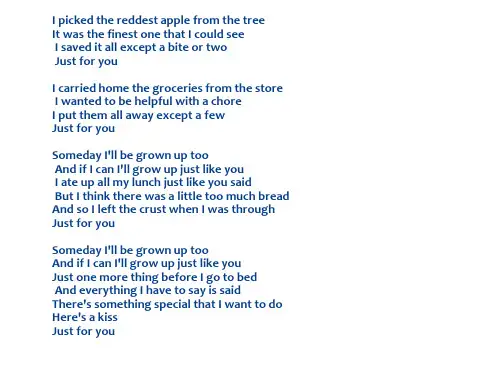
At present:
Many people have moved out to other areas A park ,a large shopping center and a theater The river is much cleaner.
Read Amy’s report, fill in the blanks.
environment is not as good as before.
However, most young people feel happy
because the changes have brought them a _______ modern life.
Moonlight Town is a place near Beijing and is not very far from Sunshine Town. It used to be a quiet ____place. There weregreen _______and hills fresh air. However, the area has changed over the years. There are now many ________, ________ and a lot more people. new roads new buildings
The changes to SunshineTown
In the past:
30,000 people lived in the town. Some small restaurants, shops, market stalls, a small post office and an old cinema. The water pollution was terrible because the shoe factory dumped waste into the river.
牛津译林版八年级英语下册Unit1知识点归纳总结

1. past and present 过去和现在past 1). n. in the past(一般过去时)2). adj. in the past few years(现在完成时) 3). prep. walk past 经过=present 1). n. 现在, 目前 at present 2). n. 礼物 receive a present 收到一件礼物 2. in the bowl 在碗里; on the plate 在盘子上 3. 1).过去常常做某事(现在不做了) usedto do sth. = often did sth. in the pastused to be…= … was/were once… = was/were… in the past 和某人分享某物 share sth. with sb.Eg. You often shared food with me in the past. = Youfood with me.You used to be so kind to me. = Youto me.2). 习惯于, 适应于(做)某事 be/get used to (doing) sth. (现在仍如此做)我习惯于上午六点起床。
Iup at 6 a.m.3). 区分:used to do sth. 过去常常做某事(现在不做)get/be used to doing sth. 习惯于做某事(to 为介词)4. just 1). adv. 刚才(现在完成时) I’v e just eaten it.2). adv. 正好, 恰好(加强语气) The shirt is just my size.这件衬衫正和我的尺码。
3). just now 刚刚, 刚才(一般过去时);5. change 1). v./n. 改变, 变化 changes in/to … ……的变化 T h etown has changed a lot over the years.(v.)= There have been great changes over the years. (n.)= Great changes have taken place over the years.2). n. [U] 零钱. Here is your change. 这是你的零钱。
牛津译林版八年级下册课件:8Bunit1 复习课 (共33张)

conclusion: already 已经, 常常用于肯定句
yet 仍,还 用于否定和疑问句 ever 表曾经 ,never 表从未。
填一填
1.They h_a_v_e__le_a_r_n_ed_ (learn) English for three years/ since three years ago/since 2011.
3. Tom and Mary _g_o_t_m__a_rr_ie_d_ in 1965. ( 结婚)
4. Tom _h_a_s__b_e_e_n_m__a_r_ri_e_d__to_ Mary for ten years . (和…结婚)
高频考点
used to do sth 过去常常做某事 1)我父亲过去是个老师.
from time to time
9.在镇的北部 in the northern part of town
10.采访某人 interview sb/have an interview with sb
11.把...变成
turn into
12.一生
all one's life
13.往返
return to and from
He is / gets used to riding a bike to school
every day.
going to school by bike
used to:
3.In the past ,I used to___B______ late,but now I am used to__________ early.
牛津译林版八年级英语下册Unit1课件(共56张PPT)

用所给词的适当形式填空:
1. Drinking _p_o_ll_u_t_e_d_ water does harm to one’s health so watepro_ll_u_t_i_o_n__ is really terrible. (pollute)
2. Guang dong Province is in the s_o__u_t_h_e_r_npart of China.
5.改进,改善 improve (名词) improvement
6.形势,情况 situation
7.尽管,即使这样 anyway
8.环境,条件 condition
9.到(在)国外 abroad
10.正是,没错 exactly
11.小学教育的,初级的 primary
12.丈夫 husband
13.妻子 wife
(n.) communication
用所给词的适当形式填空:
1. We can learn a lot about Yangzhou’s Past and
_p_r_e_s__e_n_t____(现在).
2. I can’t imagine how terrible the _s_i_t_u_a_t__io__n(形势) was
(复数) wives
14.环境 environment(形容词) environmental
Part1 Words
1. 北方 north (adj.) northern
2.南方 south (adj.) southern 3.结婚(vt.) marry (adj.) married
(n.)marriage 4.污染 (vt.) pollute (adj.)polluted(n.)pollution 5.采访(vt.) interview (n.) interview (n.)interviewer 6.进来,最近 (adv.) recently (adj.) recent 7.交流,交际(vt.) communicate
牛津译林版八年级英语下册Unit1单元知识点讲解
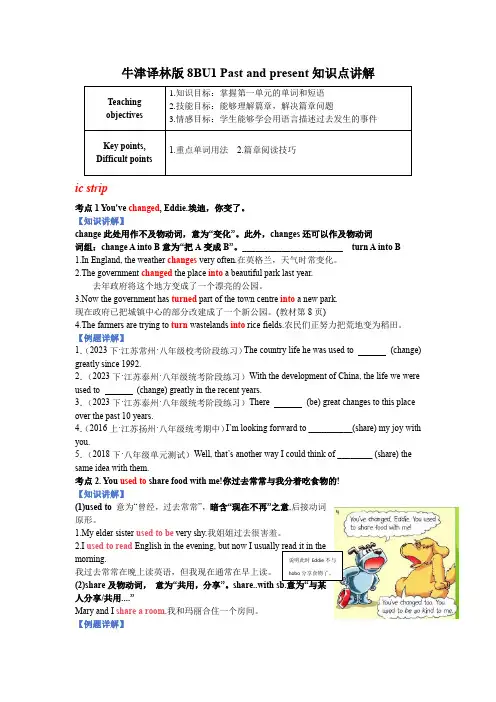
牛津译林版8BU1 Past and present 知识点讲解 Teachingobjectives1.知识目标:掌握第一单元的单词和短语2.技能目标:能够理解篇章,解决篇章问题3.情感目标:学生能够学会用语言描述过去发生的事件 Key points,Difficult points 1.重点单词用法 2.篇章阅读技巧ic strip考点1 You've changed , Eddie.埃迪,你变了。
【知识讲解】change 此处用作不及物动词,意为“变化”。
此外,changes 还可以作及物动词词组:change A into B 意为“把A 变成B”。
_______________________ turn A into B1.In England, the weather changes very often.在英格兰,天气时常变化。
2.The government changed the place into a beautiful park last year.去年政府将这个地方变成了一个漂亮的公园。
3.Now the government has turned part of the town centre into a new park.现在政府已把城镇中心的部分改建成了一个新公园。
(教材第8页)4.The farmers are trying to turn wastelands into rice fields.农民们正努力把荒地变为稻田。
【例题详解】 1.(2023下·江苏常州·八年级校考阶段练习)The country life he was used to (change) greatly since 1992.2.(2023下·江苏泰州·八年级统考阶段练习)With the development of China, the life we were used to (change) greatly in the recent years.3.(2023下·江苏泰州·八年级统考阶段练习)There (be) great changes to this place over the past 10 years.4.(2016上·江苏扬州·八年级统考期中)I’m looking forward to __________(share) my joy with you.5.(2018下·八年级单元测试)Well, that’s another way I could think of ________ (share) the same idea with them.考点2. You used to share food with me!你过去常常与我分着吃食物的!【知识讲解】(1)used to 意为“曾经,过去常常”,暗含“现在不再”之意,后接动词原形。
牛津译林版八年级英语下册Unit1-2Grammar现在完成时课件
Eddie has eaten my food.
埃迪吃了我的食物。
Eddie ate my food and now Hobo has nothing to eat.
(“居住”这个动作从4年前延续到现在,可能还会继续延续下去。)
Language points
一、现在完成时的含义
(1)现在完成时表示过去发生或已经完成的某一动作对现在造成 的影响或结果。(汉语中常用“已经”、“过”、“了”等表达) 通 常与表示包括现在在内的时间副词just(句中), already(句中,句末 ), before(句末), yet(句末), never(句中), ever(句中) ,recently(句末)等状语连用。例如:
(B) 不规则动词的过去分词 (Page122)
原形 过去式 过去分词 原形 过去式 过去分词
do did done go went gone see saw seen buy bought bought put put put build built built
eat ate eaten find found found forget forgot forgotten come came come cut cut cut write wrote written
Eddie has lived with Millie since he was born. 埃迪自从出生以来,一直和米莉住在一起。
(“居住”这个动作从出生一直延续到现在,可能还要继续延续下去。)
Eddie has lived with Millie for four years. 埃迪已经和米莉居住在一起四年了。
Unit+1+Past+and+present知识点整理 牛津译林版英语八年级下册
Unit 1 Past and present 过去和现在【重点词汇】1.pass-passed-passed 过去past(1)[n.]过去①in the past在过去(2)[adj.]从前的;刚过去的①in the past few weeks近几周(3)介词[prep.](表示时间)在...之后;经过①twenty past five 5点二十(4)[adv.]经过①walk past走过2.present现在,目前at present目前,现在(1)[n.]礼物,礼品(2)[v.]赠送;颁发,授予(3)[adj.]①出席,在场(作表语或后置定语)②现存的,现在的(做前置定语)3.just [adv.]刚才(常与现在完成时连用)(1)恰好,正好相当于exactly(2)仅仅是;只是相当于only(3)just then就在那时相当于at that moment(4)just与just now区别①just常与现在完成时连用,位于实义动词之前,助动词、情态动词或系动词之后②just now常与一般过去时连用,相当于a moment ago,通常位于句末4.change(1)[v.]改变,更换①change/turn...into... 把...变成...(2)[n.]变化,变革;零钱(不可数名词)5.since[conj.]&[prep.]自……以来6.ever[adv.]曾经7.northern北方的,北部的southern western eastern8.married已婚的,结婚的(1)get married结婚(2)be married已婚(3)be/get married to sb.与某人结婚9.wife妻子-wives[pl.](1)knife-knives(2)wolf-wolves(3)thief-thieves(4)half-halves(5)leaf-leaves10.away[adv.]离开,在(某距离)处(1)go away离开(2)right away立刻(3)take away带走(4)run away逃离(5)put away收起来(6)far away远离(7)keep...away from... 使...远离...11.block街区12.pollution污染;污染物(1)[v.]pollute(2)light pollution光污染(3)air pollution空气污染(4)water pollution水污染(5)noise pollution噪声污染13.problem[n.]问题,难题(1)question与ask/answer(2)problem难以解决问题solve/work out连用14.factory工厂15.waste(1)废料;废品(不可数名词)(2)[n.]浪费,可以和冠词a连用(3)[adj.]废弃的,无用的;荒芜的(4)[v.][新义]浪费,滥用①waste sth. on sth.浪费某物在某物/事上②waste sth. (in) doing sth.浪费某物做某事16.realize[v.]意识到;实现(1)realize实现,是及物动词,被实现(2)come true实现,成为现实,是不及物动词,不能用于被动语态17.situation形势,情况18.husband丈夫19.impossible[adj.]不可能的(1)impossibly[adv.](2)possible[adj.]-possibly[adv.](3)possibility[n.]可能性20.interview采访;会见[新义]n.对……进行面试;采访21.environment环境condition环境,条件,状况22.lonely和alone(1)lonely形容词孤独的,强调人的内心感受;偏僻的。
2020年春牛津译林版英语八年级下册— Unit1知识点梳理
Unit 1 Past and present1.1 Comic strip & Welcome to the unit1:past and present(1)pastn. 过去,以前;in the past 在过去adj. 过去的,以前的;in the past few years 在过去的几年里prep. 经过walk past the post office走过邮局In the past, there was no underground in Nanjing.Let’s not make the past mistakes.When I walk past the post office, I see a bird flying over the tree.(2)presentadj.现在的; 目前的; 出席的n.现在; 礼物; at present 现在;a present for you=a gift for you给你的礼物vt.介绍; 出现; 提出; 赠送;Everyone can be present ed a present at present.2:You’ve changed, Eddie. You used to share food with me.你变了。
你以前跟我分享食物的。
(1)change: vt./vi. 改变,变更; change into变成n.变化,改变; change(s) to ...的变化Great changes to Nanjing have taken place.(2)use n.用途; 使用能力; 运用头脑(或身体)的能力;vt.用,使用; 行使,①used to (do sth.) “过去常常(做某事)” 批注:否定形式:didn’t use to / usedn’t to②get/be used to(doing sth. )“习惯于(做某事)He used to go fishing every Saturday. But since he changed his job, he’s barely(几乎不) had a chance. He thinks he’ll never be used to this busy lifestyle.useful adj. 有用的;useless adj. 无用的3:I first lived in the northern part of the town with my parents.Beijing is in the northern part of China.批注:注意in the north与in the northern part of 的同义句转换。
【最新】牛津译林版八年级英语下册Unit 1 Reading 2优质课课件
3. Many factories used to d_um_p___their waste water into the clean river.
4. Now more and more students r_ea_li_z_e _ it is important to learn English well.
1.I miss my friends in the primary school _fr_o_m__t_im_e__t_o_t_im__e because I cannot see them _a_s_o_f_te_n__a_s before.
2.My uncle h_a_s_c_h_a_n_g_e_d_a__lo_t since he __g_o_t_m_a_r_r_ie_d_.
e.g.: The weather is usually pleasant here in May . The trip is pleasant.
pleased : 指感到愉快。通常描述人。 be pleased with-Eg: I’m pleased with your work.
The teacher is pleased with us. 同根词---pleasure. With pleasure /It’s my pleasure.
5. We are trying our best to _t_u_r_n_our
country _i_n_to__ a modern and strong one.
4. Water p_o_ll_u_ti_o_n is more terrible than noise p_o_l_lu_t_io_n_. (pollute)