
高三语法复习形容词和副词
Personally, I don't think he will interview
you.
► 考点二 形容词的位置 1.形容词作后置定语的几种情况 规则1:当形容词修饰由some,any,no,every构成 的复合不定代词,如something,anything,nothing 等时置于不定代词后。如:
解题思路分析:
1.形容词是作定语、表语、补语的典型 词类。因此,在做语法填空时,若句子缺 定语、表语或补语,要首先想到用形容词。
2.副词在句中作状语,修饰动词、形容 词、副词、介词短语或整个句子。
3.形容词和副词的比较等级的常用句型。
◇ 考点归纳 ◇ ► 考点一 形容词、副词的功能
1.形容词在句中主要作定语、表语和补 足语,但有时也作状语,表示伴随、原 因等。如: (1).We find the boy considerate.(宾语补足 语)
规则1:形容词作状语是形容主语的 性质,而副词作 状语则修饰动词。 如: He walked home slowly. 他慢慢地 步行回家了。
He arrived home, hungry and tired. 他到家时又累又饿。
规则2:有些副词像fortunately, luckily,
surally 等作评注性状语往往修饰整 个句子,对整个句子进行说明或解释, 表示说话人的态度与看法。通常位于句 首,常用逗号与句子开。 如:Surprisingly, no one in the class
[例2] (2011年)He must be 20 m__e_n_t_a_ll_y (mental) disabled.
解析:修饰分词形容词作状语,用副词,故填。
[例3] (2010年) His teacher took a deep drink, smiled 34 _w_a_r_m__ly_(warm), and thanked his student very much for the sweet water.
规则5:有些形容词既可位于所修饰的名词之前, 也可位于所修饰的名词之后,其意思可能不变,也
可能大不相同。
如:a nearby school = a school nearby 附近的学校; the present situation 目前的形势; the people present 在场的人们。
2.多个形容词排序 规则:限定描绘大长高,形状年龄与新老,颜色国 籍出材料,作用类别往后靠。即:限定词(冠词、代 词、数词等)+描绘性形容词(beautiful, interesting…) +大小、长短、高低形容词+形状、年龄、新旧形 容词+颜色、国籍、出处、材料形容词+用途、类 别形容词+中心名词。 如:a big round conference table 一张大的圆会议桌
子和连接上下句子顺序。如: (1)He spoke English fairly fluently.(修饰谓
语动词) (2)Fortunately, none of them was hurt.(修
饰整个句子,作出评论)
(3)His first response was to say no. Later, however, he changed his mind.(连接性状 语)
2.能否根据语境判断用所给形容词或副词 的比较级填空。 [例5](2012年)It might have made it a
little 21 _h_a_r_d_e_r__(hard) for everybody
because it meant they had to turn around 解析:作宾补依然是要用形容词,所以词 类不用转换,可考虑比较级;句中a little 常用来修饰比较级,表示“更难一点”, 故填harder。
解析:修饰动词smiled,作状语,用副词形式, 故填。
[例4](2009年)But Jane knew from past experience that her 36 __c_h_o_ic_e_(choose) of ties hardly ever pleased her father.
解析:在形容词性物主代词后一定是用名 词形式,故填。
规则3:else常用作疑问代词和不定代词的后置定语。 规则4:有些表语形容词作定语时后置,如afraid, alone,awake,asleep,alive,ashamed,worth等。 如:
Tom was the only boy awake at that time. 汤姆是那时唯一醒着的男孩。
Is there anything new in today's newspaper? 今天的报纸上有什么新的东西吗? 规则2:当“形容词+介词/不定式”构成的短语作 定语时置于被修饰名词后。如:
There is a bag full of rice on his table. 他的桌上有满满一袋米。
(2). He walked in the snow, cold and hungry.(伴随状语)
(3). Afraid of difficulties, they took the easy road.(原因状语)
◇ 考点归纳 ◇ ► 考点一 形容词、副词的功能
2.副词作状语主要是用作修饰动词、形容 词、副词、介词短语等,还可以修饰句
高三语法复习 ——形容词和副词
形容词副词与广东高考
形容词和副词是语法填空的必考点,每年都 有一致两道题。主要以“用括号中所给词的正确 形式填空”的形式考查考生: 1.能否根据形容词和副词的基本用法判断该用所 给词的形容词形式还是副词形式填空
[例1](2012年)Mary felt 18 _p__le_a_s_e_d_(please), because there were many empty seats in the room. 解析:在系动词felt后作表语,用形容词,表示 “高兴的”,填。
高考英语复习形容词和副词知识点讲解讲义(必考点)
高考英语必考点学案:形容词与副词一、形容词和副词基本用法(一)形容词基本用法1.作定语,修饰名词、代词。
如:I have an interesting book.我有一本有趣的书。
2.作表语。
通常与系动词be , get , grow , bee , feel , appear, prove , seem, look, keep, smell, taste, sound , turn, remain 等连用。
如:The weather is getting cooler and cooler.天气越来越凉爽。
3.作宾补。
如:The news made every one happy.这则消息令每个人都很高兴。
The wall was painted green.墙被刷成了绿色。
4.作状语,用来说明主语的特征、状态。
表示伴随、原因、结果等。
如:Tired and hot, we had to stop to have a break.又累又热,我们不得不停下来休息。
He fell down dead.他倒下死了。
(二)副词基本用法1.作状语。
通常修饰动词、形容词、副词或整个句子。
如He runs fast.他跑得很快。
The book is very interesting.这本书很有趣。
The bus came quite early.公共汽车到得很早。
She left shortly after the meeting.会议刚结束她就走了。
(修饰介词短语)Frankly, I don’t agree with you.说实话,我不同意你的意见。
(修饰句子)2.作表语。
如:Class is over.下课了。
Time is up.时间到。
3.作定语。
如:Do you know the girl upstairs? 你认识楼上的女孩吗?Soon you will be acquainted with the people around. 不久你就会熟悉这附近的人。
高考英语语法复习--形容词与副词

高中英语语法复习天津市汉沽区第五中学刘华(一) 形容词、副词的作用与位置1. 形容词是用来修饰名词的,常被放在名词前作定语或放在系动词后面作表语。
He is a young man.He is young.2.副词则用来修饰形容词、动词、其他副词或者句子,一般位于形容词之前,动词之后或句子之首。
It’s very good.He runs fast.I’m very well.He has not been to Japan recently.以下属几种特殊情况,须牢记:1.形容词短语作定语,定语后置。
a language difficult to mastera leaning tower about 180 feet high2. 表语形容词(afraid , alike , alone , asleep, awake , alive 等)作定语,定语后置如a man alive有些表身体健康状况的形容词如well , faint ,ill 只作表语。
sick既可作表语又可作定语,ill 如作定语意为“bad” 。
3. 形容词用作定语,修饰不定代词通常后置。
Something important4. else 常用作疑问代词和不定代词的后置定语。
What else, somebody else.5. enough 修饰名词前置.I have enough money to buy this book .但enough 修饰形容词、副词时必须后置。
He runs fast enough.This book is good enough.6. 几个副词并列作状语时,其顺序较灵活,一般是:方式-地点-时间。
We had a good time together outdoors last Sunday.7. 频度副词often , always , usually 等放在be 之后、行为动词前。
He is always working hard.8. 副词作定语,定语后置。
高中英语语法复习之形容词和副词

高中英语语法复习之形容词和副词一、形容词:表示人和事物的特征,对名词起修饰和描绘作用。
e.g. long, empty, cheap, hungry, etc.1、成分:在句中作定语、表语、宾语补足语等成分.He is a good student. ()I have something important to tell you. ()当形容词修饰由some-,any-,no-,every-构成的不定代词时,形容词要放在这些不定代词的之后.e.g.Is there anything interesting in today’s newspaper ?The trees turn green in spring. ()We are alone on the island. ()只能作表语,不能作定语的形容词:alone afraid awake asleep alive able形容词和宾语一起构成复合宾语.We must keep the classroom clean. ()He made us happy. ()Colour it green. ()Attention :有些单词以-ly结尾,但却是形容词而非副词:lively、lonely、lovely、deadly、friendly、ugly、silly、likely、timely 、brotherly 、sisterly 、motherly fatherly 等。
形容词的原级句型:1)as+形容词原形+asTom is as tall as Mike.Tom is three times as old as Mike.There are as many students in our school as yours.2)否定not as+形容词原形+as “和… 不一样”或not so+形容词原形+as “不及/不如…Tom is not as tall as Mike.Tom is not so tall as Mike.3)so+ 形容词原级+that丛句/such+名词+that丛句He is so big that he can’t enter the room by the door .4)… too+原级+ to do sth.He is too young to join the army.5)形容词原级+ enough to do sth.This truck is big enough to carry 5 tons.形容词比较级的句型:1)比较级+than…Our school is larger than theirs.This bridge is longer than that one.表示两者之间的选择,可使用“Which is+ 比较级,…or…?”Which is longer, this one or that?2)表示不及另一方时,使用“less+原级+than…”This park is less beautiful than that one.3)“The+比较级…,the+比较级…”The smaller the house is, the less it will cost us the heat.4)“…比较级+and+比较级…”In spring, the days are getting longer and longer.可修饰比较级的词:a bit, a little, rather, much, far, by far, many, a lot, lots, a great deal, any, still, even等典型例题:1)--- Are you feeling ____?--- Yes,I'm fine now.A. any wellB. any betterC. quite goodD. quite better2)The experiment was ____ easier than we had expected.A. moreB. much moreC. muchD. more much3)If there were no examinations, we should have ___ at school.A. the happiest timeB. a more happier timeC. much happiest timeD. a much happier time 注意:no/ not + 比较级+ than 的特殊含义• A is no more careful than B.•A和B两人都不仔细。
高中英语:形容词与副词语法知识点
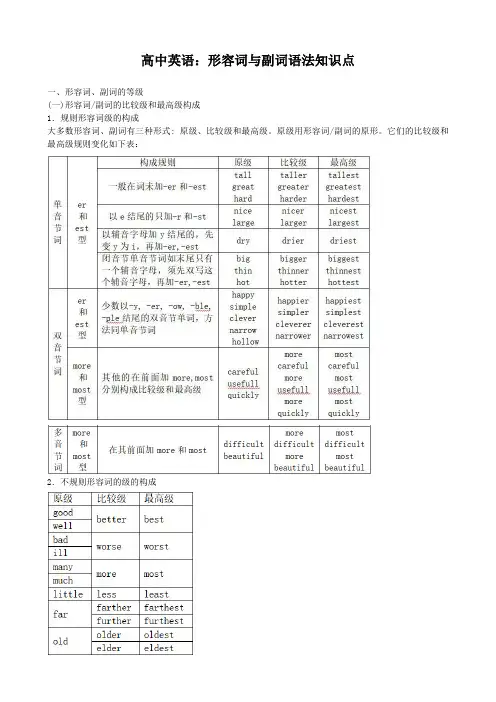
高中英语:形容词与副词语法知识点一、形容词、副词的等级(一)形容词/副词的比较级和最高级构成1.规则形容词级的构成大多数形容词、副词有三种形式: 原级、比较级和最高级。
原级用形容词/副词的原形。
它们的比较级和最高级规则变化如下表:2.不规则形容词的级的构成3.形容词、副词递减的比较等级的构成在形容词、副词前加less和least,表示“较不”和“最不”interesting有趣的 less interesting较无趣的 least interesting最无趣的important重要的 less important较不重要的 least important最不重要的有些形容詞可以加er及est或前面加上more / most來形成比較級和最高級polite –politer 或more polite –politest 或most polite ,这类词还有quiet,handsome,pleasant,common,exact.注意:下列双音节词比较级和最高级加er;est(1).无规律,死记住的词cruel,pleasant quiet civil exact stupid commom,dismal(阴沉的,忧郁的), devine(梦幻的) antique(古老的) grotesque(怪诞的)(2)-le以le为结尾的词idle,feeble, senile(衰老的), agile(灵巧的), nimble(灵活的,敏捷的). Humble(谦虚的,简陋的). Suble(阴暗的,貂皮的), able. Supple(柔顺的,灵活的).gentle.noble.. (3)-y以y为结尾的词lucky happy misty stormy,kingly, naughty, angry timely lively,healthy, heavy,busy,beastly...heavy,busy(4)重音在第二音节上chinese remote afraid alone alike apart polite severe intense obscureprofound(5)-er以ER为结尾的词tender sober clever bitter(6)-owyellow narrow shallow(浅的,表面的) hollow4.没有比较级和最高级的形容词、副词有些形容词由于其本身涵义一般不用来比较。
高中英语高考复习形容词和副词语法总结
高中英语形容词和副词语法总结形容词和副词是语法填空的必考点,主要以"用括号中所给词的正确形式填空"的形式考查考生。
1.形容词可作定语、表语、补语。
因此,在做语法填空时,若句子缺定语、表语或补语,要首先想到用形容词。
2.副词在句中作状语,修饰动词、形容词、其他副词、介词短语或整个句子。
因此当设空处作状语时,首先考虑要填副词。
3.做语篇型语法填空时,考生还需根据上下文及形容词和副词比较等级的常用句型来判断。
短文改错中,本该用形容词时却用了副词或其他词性,或本该用副词却用了形容词,要根据形容词和副词的基本用法判断。
此外平时复习时还要注意一些常见的形容词、副词辨析。
考向一形容词、副词的基本用法1.形容词作状语表示伴随或结果,并不表达动作的方式。
After the long journey, the three of them went back home, hungry and tired.经过长时间旅行后,他们三个回到家,又饿又累。
2.有些副词还可以作连词,作副词时常放在句末。
如:though, (ever)since, in case等。
He is old.He works hard, though.=Though he is old, he works hard.虽然他年事已高,但他工作还是很努力。
3.有些副词置于句首可修饰全句,作评注性状语。
如:obviously, naturally, surprisingly 等。
Fortunately, he was not drowned and was saved by the PLA.幸运的是,他没被淹死,被解放军给救了。
Happily for her, her stepmother was kind to her.高兴的是,她的继母对她很好。
4.can not/never与enough 或too连用表示:无论怎样都不过分;越……越好。
—I was riding alone in the street and all of a sudden, a car cut in and knocked me down.——我正在大街上独自一人骑自行车,突然一辆小汽车强行超车把我撞倒了。
高考英语 语法总复习 7 形容词和副词
• 13.One of the________(bad) gift choices I ever made was for my high school English teacher,Ms Chen.
<乙)用“less+原级+than”表示。 • Seeking information on the Internet is more convenient
than searching in a library.
• 在实际运用中,than从句常常省略,要通过上下文 来理解。
• Traveling from place to place is now so much cheaper and easier.
• 5.Hardly had Sabrina finished her words when Albert said________(sharp),“Don’t be so mean,” pointing a finger of warning at her.
• 6.Raymond’s parents wanted him to have the________(well)possible education.
原级”表示“越来越……”,其反义词组为“less and less+原级”。
• In many ways my disability has made me grow more and more independent.
• (2)“the+比较级,the+比较级”表示“越……, 就越……”。
• The more upset I got,the less I was able to concentrate.
高考英语语法之形容词和副词
高考英语语法之形容词和副词第一部分考点精讲精练第1讲比较级考点1.可以修饰比较级的词常用来修饰比较级的词或短语有:a bit, a little, rather, much, far, by far, many, a lot, a great deal, any, still, even等。
by far的用法:用于强调,意为“……得多” “最最……” “显然”等,可修饰形容词或副词的比较级和最高级,通常置于其后,但是若比较级或最高级前有冠词,则可置于其前或其后。
如:It’s quicke r by far to go by train. 乘火车要快得多。
She ran fastest by far. 她跑得最快(显然她跑得最快)。
He’s by far the cleverer student.他是个聪明得多的孩子。
He is by far the best teacher.=He is the best teacher by far.他是最最好的老师(或他显然是最好的老师)。
1.You are such a woman as always think ____ ofyourself than others.A. muchB. much moreC. littleD. much less2.【2004福建】The number of people present at theconcert was _____than expected. There were many ticket left.A. much smallerB. much moreC. much largerD. many more3.-The novel is, I have to say, not a bit interesting,How do you find it?-Why! It’s ____________ that I have ever read.A. a most interestingB. a more interestedC. a less interestingD. by far the most interesting4.【2007 全国II】After two years’ research, we no whave a ____ better understanding of the disease.A. veryB. farC. fairlyD. quite 5.------ The disease he suffers is not easy to cure.------ I know, but is he _____ better?A. muchB. ratherC. anyD. little6.【2000上海】You're standing too near the camera.Can you move ______ ?A. a bit farB. a little fartherC. a bit of fartherD. a little far7.【2006江苏】I wish you’d do ________ talking andsome more work. Thus things will become better.A. a bit lessB. any lessC. much moreD. a little more考点2.more 、much与比较级more 和多音节形容词和副词一起构成比较级,如more interesting, more exciting单音节词和部分双音节词在后面加-er构成比较级. 如:taller, earlier, hottermuch修饰比较级。
知识点形容词与副词总结
知识点形容词与副词总结形容词和副词是英语语法中的两个重要部分,它们用来修饰名词和动词,帮助我们准确地传达和表达信息。
在本文中,我们将总结常见的知识点形容词和副词,以便更好地理解和运用它们。
1. 形容词的用法形容词通常位于名词前面,用来描述、补充或限定名词的特性、特征或状态。
下面是对一些常见形容词的总结:1.1 基本形容词- good (好的):He is a good student.(他是个好学生。
)- bad (坏的):The weather today is bad.(今天的天气很糟糕。
)- happy (快乐的):She looks happy today.(她今天看起来很开心。
)- sad (悲伤的):He felt sad after watching the movie.(看完电影后,他感到很难过。
)1.2 比较级和最高级形容词比较级和最高级形容词用于表示不同事物之间的比较。
- tall (高的):taller (比较级)、tallest (最高级)- happy (快乐的):happier、happiest例如:- He is taller than his brother.(他比他的兄弟高。
)- She is the happiest person in the room.(她是房间里最快乐的人。
)1.3 泛指和特指形容词泛指形容词用于描述没有具体限制的事物,而特指形容词用于描述特定的事物。
- some (一些):He bought some apples.(他买了一些苹果。
)- this (这个):This book is interesting.(这本书很有趣。
)2. 副词的用法副词通常用来修饰动词、形容词或者其他副词,用来表达方式、时间、原因等。
2.1 副词修饰动词- slowly (慢慢地):He walks slowly.(他走得很慢。
)- quickly (快速地):She runs quickly.(她跑得很快。
高三英语语法总复习——形容词和副词
2)有些以-ly 结尾既为形容词,也为副词。 daily,weekly,monthly,yearly,early The Times is a daily paper. It is published daily.
1.There are some (dead )leaves on the ground. 地上有些枯叶。
2.The terrorist's attack caused more than three hundred (death).
恐怖分子的袭击造成了3百人的伤亡。
3.The roar of the explosion was followed by a (deathly) silence.
interesting because of its association with persons or events in history: 具有历史意义的首次太空旅行。而且也 用于形容那些因与历史事件或人物有联系而有名或有趣的事物:
a historic house. Historicalrefers to whatever
3. worthwhile 可作表语和定语 It is worthwhile to do或 It is worthwhile doing
dead --- deadly --- deathly
dead adj.死的, 无感觉的, 呆板的, 不流动的, (语言、习惯)废 弃了的, 熄灭的 n.死者 adv.完全地, 绝对的, 突然的 death n.死, 死亡, 致死的原因, 毁灭, 屠杀 deadly adj.致命的, 势不两立的, 死一般的, 极度的, 必定的 deathly adj.死一般的 adv.象死一样地
高三语法复习形容词和副词课件
05
练习与巩固
选择题练习
总结词
考察学生对形容词和副词用法的理解
详细描述
设计一系列选择题,包括形容词和副 词的辨析、比较级和最高级的运用等 ,让学生从四个选项中选择正确的答 案。
填空题练习
总结词
检验学生对形容词和副词的拼写和用 法的掌握程度
详细描述
提供一些句子,让学生根据句子语境 填写适当的形容词或副词,注意时态 、语态和数的变化。
04
形容词和副词的固定搭配与常见错误
常见固定搭配
形容词+名词:例如“美 丽的花朵”、“高大的建 筑”
形容词、副词+to do: 例如“很高兴认识你”、 “非常愿意帮助你”
副词+动词:例如“快速 地奔跑”、“慢慢地走来 ”
形容词、副词+enough :例如“足够聪明”、“ 足够强大”
常见错误分析
01
02
03
04
误用形容词、副词
例如将“good”误用为 “well”,“fast”误用为
“quickly”
修饰不当
例如将“very”修饰为 “extremely”,“so”修饰
为“such”
位置不当
例如将形容词放在名词前面, 将副词放在动词后面
混淆含义
例如将“hardly”误解为 “hard”,“already”误解
比较级和最高级的特殊用法
原级比较
省略形式
有时为了强调两者之间的相同之处, 可以使用原级比较,例如,"He is as fast as me."
在口语中,有时可以省略比较级和最 高级的助动词,例如,"He's taller than me."