
九年级英语unit6 when was it invented?section A 3a-3c
Fill in the blanks with the proper forms according to the third paragraph.
People believed that tea _____________ was brought (bring) to Korea and Japan during the 6th and 7th centuries. In England, tea _____________ didn’t appear (not appear) until around 1660, but in less than 100 years, it had become the national drink. The tea trade took from China to Western countries ______ (take) place in the 19th century.
偶然;意外地
Read the passage again and 3b answer the questions. 1. When was tea first drunk? It was first drunk about 5,000 years ago. ___________________________________ 2. How was tea invented? ___________________________________ It was invented by accident. 3. Who is called “the saint of tea”? n. 圣人,圣徒 Lu Yu. ___________________________________
My pleasure! Let me think… hmm… I know! The zipper!
The zipper? Is it really such a great invention?
Think about how often it’s used in our daily lives. You can see zippers on dresses, trousers, shoes, bags… almost everywhere!
Fill in the blanks with the proper forms according to the first paragraph. Tea (after water), the most popular drink in the world ___________ was invented (invent) by accident. It is believed that tea was _________ drunk (drink) 5,000 years ago. It ______ is said (say) that a Chinese ruler called (call) Shen Nong was the first ______ _________ to discover (discover) tea as a drink. One day Shen Nong __________ was boiling (boil) drinking water
3. boil v. 煮沸;烧开 e.g. Boil the potato for 20 minutes. 把土豆煮20分钟。
4. remain v. 保持不变;剩余 ① 作连系动词,后跟名词、形容词、不定 式、分词等做表语。指保持某种状态。 e.g. Peter become a manager, but Mike remained a worker. 彼得成为经理,可迈克仍是工人。 ② 作不及物动词,意为“剩余”。 e.g. Only a few leaves remained on the tree. 树上仅剩下几片叶子。
Well, you do seem to have a point…
Of course! I thought about it because I saw a website last week. The pioneers of different inventions were listed there. For example, it mentioned that the zipper was invented by Whitcomb Judson in 1893. But at that time, it wasn’t used widely.
1. One of the world’s favorite drinks was
_________ invented by accident. 2. Tea was first ________ drunk by Shen Nong 5,000 years ago.
invent, drink, bring, produce, trade produced when the 3. A nice smell was _________ tea leaves dropped into the hot water. 4. Tea was ________ brought to Korea and Japan during the 6th and 7th centuries. 5. Tea is now ______ traded between many different countries.
4. What is Cha Jing about? The book describes how tea plants were ____________________________________ grown and used to make tea. It also ____________________________________ discusses where the finest tea leaves were ____________________________________ produced and what kinds of water were ____________________________________ used. ____________________________________ 5. When was tea brought to other countries? Tea was brought to Korea and Japan ____________________________________ during the 6th and 7th centuries. It was ____________________________________ brought to England at around 1660. ____________________________________
v. 保持不变
(produce) a nice smell so he ______ tasted (taste)
n. 气味
the brown water. It was quite delicious, and so, one of the world’s favorite drinks ____________ was invented (invent).
Unit 6 When was it invented?
Check the homework. 1. When was the car invented? 2. They are used for changing the style of the shoes. 3. Think about how often it’s used in our daily lives. 4. The pioneers of different inventions were listed there. 5. It mentioned that the zipper was invented by Judson in 1893.
毫无疑问;的确
__________ understand (understand) the nature of tea.
Complete the sentences with the 3c correct forms of the verbs in the box.
invent, drink, bring, produce, trade
Let some students role-play the conversation in 2d. Hey Roy, the subject for my school project is “Small inventions that changed the world.” Can you help me think of an invention?
v. 煮沸,烧开 n. 统治者,支配者
over an open fire. Some leaves from a tea plant ____ fell (fall) into the water and remained there for some time. It produced ________
Fill in the blanks with the proper forms according to the second paragraph.
Lu Yu, “the saint of tea”, ____________ mentioned (mention) Shen Nong in his book Cha Jing a few thousand years later. The book describes how tea plants ___________ were grown and used to make tea. It also discusses where the finest tea leaves ______________ were produced (produce) and what kinds of water _________ were used (use).
人教版英语九年级全册Unit6WhenwasitinventedSectionA2a2d说课稿

3.通过提问方式,如“Can you guess who invented these things?”,引导学生进入本节课的主题。
(二)新知讲授
在新知讲授阶段,我将逐步呈现知识点,引导学生深入理解:
1.通过PPT展示与发明相关的词汇,教授新词汇的发音、拼写和含义;
(一)教学策略
在本节课中,我将采用以下主要教学方法:
1.情境教学法:通过设定与发明相关的具体情境,让学生在情境中感知、体验语言,提高语言运用能力。
理论依据:情境教学法认为,语言学习应紧密结合实际情境,让学生在情境中自然地习得语言。
2.任务型教学法:设计富有挑战性的任务,引导学生主动参与、合作探究,提高学生的实践运用能力。
1.教具:实物、图片、卡片等,用于创设情境、展示发明相关内容。
Hale Waihona Puke 作用:直观展示,激发学生兴趣,帮助学生形象地理解语言。
2.多媒体资源:PPT、视频、音频等,用于呈现教学内容、辅助听力训练。
作用:丰富教学手段,提高教学效果,增强学生的学习兴趣。
3.技术工具:投影仪、电脑、音响等,用于展示多媒体资源,辅助教学。
(2)通过听力、阅读、口语练习,培养学生自主学习的能力;
(3)运用任务型教学法,提高学生的实践运用能力。
3.情感态度与价值观:
(1)激发学生对发明创造的兴趣,培养学生的创新意识;
(2)让学生了解发明对人类生活的影响,培养学生的社会责任感;
(3)通过学习不同国家的发明,增进学生对各国文化的了解和尊重。
2.以小组合作形式,让学生讨论发明背后的故事,引导学生运用一般过去时的被动语态描述发明;
2.小组合作:组织学生进行小组讨论,让学生在互动交流中提高英语表达能力;
201X秋九年级英语unit6When was it invented SectionA-B课文知识点归纳详细讲解

Unit6 When was it invented?Unit6 When was it invented?重点短语1.think of 想出seem to do sth似乎要做2.have a point 有道理at that time在那时3.by accident 偶然;意外地fall into落入;掉入4.make tea制茶less than少于5.take place发生;出现around the world 全世界6.without doubt毫无疑问the nature of... ......的本质7.drop into掉进at a low price以低价8.advise sb.(not) to do sth劝某人(不)做all of a sudden 突然;猛然9.work on从事于be similar to与......类似10.by mistake错误地in the end 最后11.the Olympics奥林匹克运动会divide ... into... 把......分开12.at the same to同时stop... from doing... 阻止......做......13.dream of 梦想the number of ......的数量14.look up to 钦佩;仰慕encourage sb. to do sth 鼓励某人做某事15.take notes 记笔记decide on 决定e up with想出重点句型1.—When was the telephone invented?—I think it was invented in 18762.—Who was it invented by ?—It was invented by Whitcomb JubsonSection A1. I think the TV was invented before the car. 我认为电视机先于汽车被发明。
人教版九年级英语《Unit6Whenwasitinvented?》SectionB说课稿2
人教版九年级英语《Unit 6 When was it invented?》Section B说课稿2一. 教材分析人教版九年级英语《Unit 6 When was it invented?》Section B主要包括两个部分:听力练习和口语交流。
本节课的主要内容是学习过去时态,通过介绍各种发明的起源时间,让学生掌握过去时态的用法。
教材通过丰富的图片、听力材料和口语练习,激发学生的学习兴趣,提高他们的听说能力。
二. 学情分析九年级的学生已经掌握了基本的英语语法知识,对于过去时态有一定的了解。
但学生在实际运用过去时态时,常常出现时态混乱、句子结构不正确等问题。
此外,学生的听说能力参差不齐,部分学生对英语学习缺乏兴趣。
三. 说教学目标1.知识目标:让学生掌握过去时态的构成和用法,能正确运用过去时态描述发生在过去的事情。
2.能力目标:提高学生的听说能力,能流利地用英语进行过去时态的交际。
3.情感目标:激发学生对英语学习的兴趣,培养他们积极向上的学习态度。
四. 说教学重难点1.重点:过去时态的构成和用法。
2.难点:过去时态在实际交际中的运用。
五. 说教学方法与手段1.采用任务型教学法,让学生在完成任务的过程中自然地学习和运用过去时态。
2.运用多媒体教学手段,如PPT、视频等,为学生提供丰富的视觉和听觉材料,提高课堂趣味性。
3.小组合作学习,鼓励学生积极参与,提高他们的口语表达能力。
六. 说教学过程1.热身(5分钟):通过播放一首英文歌曲,让学生放松心情,激发他们对英语学习的兴趣。
2.导入(10分钟):教师展示各种发明的图片,引导学生谈论这些发明的起源时间,自然引入过去时态的学习。
3.新课呈现(15分钟):教师通过PPT展示过去时态的构成和用法,讲解过去时态的规则。
同时,为学生提供一些例子,让他们跟读并模仿。
4.听力练习(15分钟):教师播放一段关于发明起源时间的听力材料,学生听后回答相关问题。
此环节旨在提高学生的听力技能,并巩固过去时态的知识。
人教版九年级英语《Unit6Whenwasitinvented?》SectionA说课稿1

人教版九年级英语《Unit 6 When was it invented?》Section A说课稿1一. 教材分析人教版九年级英语《Unit 6 When was it invented?》Section A主要包括两部分内容:对话和阅读理解。
本节课主要讨论关于发明物的历史,通过学习让学生了解不同发明的起源和发展,同时提高他们的英语听说读写能力。
二. 学情分析九年级的学生已经具备了一定的英语基础,对于日常生活中的话题能够进行简单的交流。
但是,对于一些专业的科技领域的词汇和表达可能还比较陌生,因此,在教学过程中需要帮助学生掌握相关词汇和表达,并能够运用到实际情境中。
三. 说教学目标1.知识目标:学生能够掌握关于发明物的词汇和表达,如“inventor”,“invention”等;能够理解并运用一般过去时表达过去发生的事情。
2.能力目标:学生能够听懂、会说、会读、会写关于发明物的词汇和表达;能够通过阅读理解文章,获取信息并进行简单的推理。
3.情感目标:培养学生对科技创新的兴趣和好奇心,激发他们学习英语的兴趣。
四. 说教学重难点1.重点:学生能够掌握关于发明物的词汇和表达,能够运用一般过去时进行交流。
2.难点:学生能够理解阅读理解文章,获取信息并进行简单的推理。
五. 说教学方法与手段1.教学方法:采用任务型教学法,让学生在实际情境中学习、应用英语。
2.教学手段:利用多媒体课件、图片、视频等辅助教学,提高学生的学习兴趣和参与度。
六. 说教学过程1.导入:通过展示一些常见的发明物,如手机、电脑等,引导学生谈论关于发明物的话题,激发学生的兴趣。
2.新课呈现:讲解关于发明物的词汇和表达,如“inventor”,“invention”等,并通过例句让学生理解这些词汇的用法。
3.对话学习:通过听力练习,让学生听懂、会说关于发明物的对话,并能够运用一般过去时进行交流。
4.阅读理解:让学生阅读关于发明物的文章,理解文章内容,获取信息并进行简单的推理。
九年级新目标英语Unit6-When-was-it-invented-Section-A-1解读
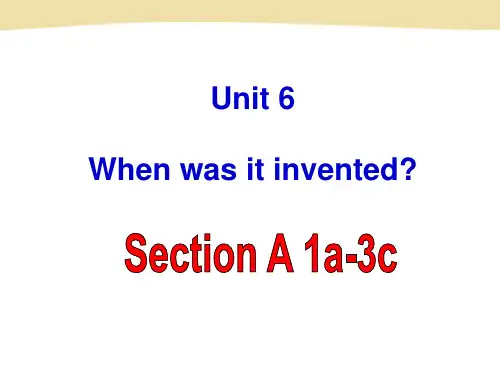
2d Role-play the conversation.
Paul: Hey Roy, the subject for my school project is “Small inventions that changed the world.” Can you help me think of an invention?
► He takes no pleasure in his work.
► —Thanks for helping me.
—My pleasure. / It s a pleasure. 别客气。
pleasur 名词,“高兴;愉快”。常用短语 My
e
pleasure. / With pleasure. / It’s a
pleasure.
形容词,“高兴的”,短语 be
pleased
pleased to do sth.“乐于做某事”;be pleased with “对……满意”,句子的
主语通常为人
pleasan 形容词,“令人愉快的”,可作定 语
►It am pleas、ed表w语ith,t修he饰pa物inting.我对这幅画很满意。
The car was invented before the TV set.
A: I think … was invented before … B: Well, I think … was invented after ….
The telephone was invented before the TV set.
人教新目标英语九年级 Unit 6 When was it invented?SectionA(Gr

Unit6 SectionA(Grammar focus-4c)学案【学习目标】1.掌握下列词汇:bell,musical,instrument,biscuit,fridge,low2.进一步复习巩固学习Section A部分所学的生词和短语。
3.进一步学习运用一般过去时态的被动语态。
4. 运用一般过去时态的被动语态完成相应练习。
5. 面对难题,用积极的态度去解决,发挥想象力,认识世界,改造世界。
【重点和难点】学习重点:1. 学习生词fridge, low, somebody, translate, lock, earthquake, sudden, all of a sudden, biscuit, cookie, instrument22. 复习巩固Section A 部分所学的生词和词组,达到熟练运用的目标。
学习难点:1. 一般过去时态的句子变为被动语态。
2. 综合运用所学的知识进行练习运用。
【课前预习】一、学出单词和短语1. 冰箱n. ________2. 低的;矮的adj. ________3. 某人n. ________4. 锁上;锁住v. 锁n. ________5. 发出铃声;打电话v. ________6. 地震n. ________7. 突然(的)adj. ________8. 钟(声);铃(声)n.________9. 饼干n. ________10. 曲奇饼n. ________11.音乐的;有音乐天赋的adj. ________12.器械;仪器;工具n. ________二、根据句意及首字母提示完成单词。
1. Food is put in the f_________ to keep fresh.2. The music was so beautiful, it went high and l_________, up and down.3. The book was t___________ into different languages.4. When I got to my classroom, I found the door was l_________. So I had to wait for half an hour until they came.5. Most of the buildings and trees fell down after the e__________.【合作探究】探究一、一般过去时被动语态的结构观察下面例句总结被动语态的结构。
2014秋九年级英语unit6When was it invented SectionA-B课文知识点归纳详细讲解简单
Unit6 When was it invented?Section A1. I think the TV was invented before the car. 我认为电视机先于汽车被发明。
【解析1】invent v 发明→inventor n 发明家→invention n 发明【辨析】invent/ discover/find/find out2.My pleasure!这是我的荣幸【解析】please v 取悦→pleasure n愉快.It’s my _____________(please) to help you.→pleased adj.(人)高兴的→pleasant adj.(物)令人愉快的They went to Qingdao and had a ___________(pleasure) trip.be pleased to do sth 愉快做某事I’m pleased _____________(meet) you.be pleased with sth 对….满意3.Think about how often it’s used in our daily lives想想看它在我们的日常生活中是多么经常被用到。
``【解析】daily adj. 日常的;每日的= everyday【拓展】day n. 天,日→daily adj. 每日的daily life 日常生活4. The pioneers of different inventions were listed there 不同发明的先驱被列在那里。
【解析】list n 列表;列清单n 名单;清单make a list of ... 制作......的目录5.For example, it mentioned that the zipper was invented by Whitcomb Judson in 1893.例如,它提到拉链是惠特科姆.贾德森于1839年发明的。
九年级Unit 6 When was it inventedSection A2
Unit 6 When was it invented?Section A2 (3a-3c)WuFeng school Tang Li【学习目标】1.掌握下列词汇:by accident,ruler,boil,remain,smell,saint,national,take place,doubt,without doubt2.了解茶叶发明的历史。
3.面对难题,用积极的态度去解决,发挥想象力,认识世界,改造世界。
【重点和难点】学习重点:1. 通过阅读了解茶叶的发明历史。
2. 短语:by accident,take place,without doubt,all of a sudden的用法。
3. 被动语态结构的变化。
学习难点:1. 阅读短文,获得相关信息的能力。
2. 理解并运用所学的词汇及表达方式。
【课前预习】一. 请根据中文意思写出下列重点单词。
1. 统治者;支配者n. _______ 2.煮沸;烧开v. _______3.保持不变;剩余v. _______ 4.气味n.发出……气味, 闻到v._______5.国家的;民族的adj. _______ 6.贸易;交易n.做买卖; v._______7.疑惑;疑问n. 怀疑v._______二. 请认真阅读课本,找出下列重点短语。
8. 偶然;意外地__________9.一位叫神农的中国统治者__________10.在火堆上__________11.落入水中__________12.泡茶_________13.发生;出现_____ 14.毫无疑问;的确__________ 15.茶圣___________ 【合作探究】探究一、Learn words and phrases in 3a on P43.(仅作阅读参考词汇)1. the most popular drink 最受欢迎的饮料2. be invented by sb. 被某人发明3. by accident 偶然,意外地4. over an open fire 在火堆上5. fall into 落入;掉入6. be used for 被用来做……7. make tea 制茶8. less than 少于9. tea trade 茶叶贸易10. take place 发生11. the popularity of ……的知名度12. around the world 全世界13. even though 即使14. know about 了解15. tea culture 茶文化16. without doubt 毫无疑问17. the nature of ……的本质18. be brought to 传到19. the saint of tea 茶圣20. during the 6th and 7th centuries 6-7世纪间探究二、浏览课本P43阅读的标题和图片对下列问题进行预测。
人教版九年级英语Unit6whenwasitinvented(SectionBReading)说课稿
Unit 6 when was it invented? (Section B Reading) 说课稿陈传玲Good morning, ladies and gentlemen. It’s my honor to be here to present my lesson.I will divide the instruction into 7 parts: the analysis of teaching material, the analysis o f the students, teaching methods, studying methods, teaching procedure,blackboard design a nd teaching reflections.Part 1 Analysis of the teaching material (说教材)First: Status and Function (本课在教材中的地位和作用)The content of my lesson is from Go for it! Book 9, Unit 6 When was it invented?(Section B Reading), This lesson is a reading passage. The text mainly talks about the history of basketball. The grammar point is the passive voice. In unit 5, students have g ot in touch with the passive voice. In this Unit, students will go on studying the passive voice. This lesson seepage of learning strategies is the mind-map, hope that after studying the lesson, students can form an infiltrated knowledge of the strategy, and in the future s tudy they can consciously use the learning strategies.Second: Teaching Aims(教学目标)According to the new standard curriculum and the syllabus, and after studying the te aching material, I think the teaching aims are the followings:1. Knowledge objects (知识目标)(1) Study the new words, phrases and important sentences.(2) Understand the main idea of the text.2. Ability objects (能力目标)(1) Learn the history of basketball by using some reading skills.(2) Can retell the text by using the learning strategy of mind-map3. Moral objects(情感目标)Equip students with the moral education of “love sports, cherish life”.Third: The Important and Difficult Points. (重难点)Based on the requirement of the syllabus. The important point is about mastering the passage, knowing the main ideas of reading, learning about the history of basketball. The difficult points are how to master reading strategies and make a mind map.Part 2 Analysis of the students (说学情)The students are from class 2, Grade 9. They have a certain ability of English. Som e students are not active and confident in class, some students have trouble in reading, an d they are poor in reading strategies, so I’ll have students study in a relaxed atmosphere.Part 3 Teaching Methods(说教法)As we know, a good teaching method requires that the teacher should help students develop good sense of the English language. For achieving these teaching aims and after t he analysis of the teaching material and teaching aims, I will use the following methods a ccording to the modern social communication teaching theories:(1) Interactive Approach(2) Task-based Language Teaching(3) Students independently inquiryPart 4 Studying Methods (说学法)According to the situation of the students and teaching aims. I’ll teach Ss how to be successful language learners by these ways:(1) Let students get the knowledge actively by skimming, scanning and detailed rea ding.(2) Let the Ss design their own mind map.Part 5 Teaching Procedure (说教学过程)Now, let’s come to the teaching procedure. I have desig ned the following steps to tr ain their reading abilityStep 1 Warm-up and lead-inAsk students some questions about doing sports:Q1. Do you often do sports?Q2. What sports do you usually do?Q3. Can you list eight sports played in China?Purpose of my design(设计意图)(1) Lead in the topic and catch Ss’ attention about the topic.(2) It is a connecting link between the preceding and the following.Step 2 Pre-reading◇Task1 Let students look at some pictures and talk about the sports in the picture.Q1: W hat’s your favorite sport?Q2: Who’s your favorite sports star?Q3: Do you know how to play basketball?Purpose of my design(设计意图)(1) It is close to students’ life, so it can make them interested in the next studying.(2) Let Ss have the desire to read further◇Task2. Look at a picture and name the basketball equipment.Purpose of my design(设计意图)(1) To stimulate students’ interest in reading.(2) To provide the necessary background knowledge.(3) To lead in the topicStep 3 While-reading◇Task 1 Skimming1. Ask the Ss to look through the passage and find out the main ideas. Let the stud ents know maybe it’s a good idea to read the first sentences in each paragraph.2. After two minutes, students got the answer: The passage mainly talks about the hi story, invention and popularity of basketball.Purpose of my design(设计意图)Lead students know skimming is useful for them to find out the main idea of a pas sage.◇Task 2 ScanningLet the students read the first and second passage and answer the questions(1) When was the sports of basketball invented?(2) How popular is basketball?(3) Why were the Berlin Olympics important for basketball?Purpose of my design(设计意图)(1) Lead students to know the strategy of scanning, let them learn to scan the usefu l information they need.(2) Let students learn about something important about the history of basketball.◇Task3 Detailed reading1. Read the following two paragraphs and answer the questions(1) When was the first basketball game in history played?(2) Who invented basketball and how is it played?(3) Where was the sport of basketball invented?2. Read the passage again and complete the mind map.Purpose of my design(设计意图)Enable students to understand the given material better by using different reading ski lls.Step 4 Post-reading◇Task 1Lead students to finish the mind map with the teacher step by step.◇Task 2 Tell students to choose one of the main ideas of basketball to introduce with the help of mind map.Purpose of my design(设计意图)(1) Train Ss’ abil ity of making a mind map(2) It’s the Output of their knowledge. I think if the Ss can finish this task well, th ey will benefit a lot in their spoken English.Step 5 HomeworkMake a mind map about basketball and introduce for us next classPurpose of my design(设计意图)I divided homework into two parts as oral homework and written homework to impr ove their oral English and writing ability.Part 6. Blackboard design(说板书)Finally, let’s focus on the last aspect, the blackboard design. First, on the left, I w ill write down the title of this unit and put down the key words to make students realize t he importance of them and have a deeper memory. The PPT will hang out in the middle. The part next to PPT will be used for free writing and scores of each group will be wriPart 7 Teaching Reflections (说教学反思)In my opinion, it is successful. My reasons are as follows: Firstly, the teaching aims were quite clear. All the activities were focused on the theme “reading strategies” and w ere developed to reach the teaching goal----Enable the students to master the ways of exte nsive reading and reading in details. Secondly, task-based teaching method and making a mind map were adopted successfully. Thirdly, in this lesson I designed different activitiesto arouse the students’ interests of learning English. Such as: skimming, scanning, detailed reading and mind map. The students were eager to speak and use English in class. In ad dition, I think, the most shinning point of this lesson ismaking a mind map and introduci ng it to others. It is a new way for students to practice their spoken English. The student s became more interested and more active in thinking and using.No class is perfect. As a teacher, we should pay more attention to the students who are not good at English. We should encourage them more. Give them more chances to s peak and use English. I think, with more encouragement, they are sure to make greater pr ogress in the future.Above is my representation of this lesson. Thank you!。
人教版九年级英语《Unit6Whenwasitinvented?》SectionA教学设计2
人教版九年级英语《Unit 6 When was it invented?》Section A教学设计2一. 教材分析人教版九年级英语《Unit 6 When was it invented?》Section A主要介绍了与发明物相关的动词短语和一般过去时的被动语态。
本节课的主要内容包括三个部分:阅读文本、听力练习以及口语交流。
通过本节课的学习,学生能够掌握与过去相关的被动语态的运用,以及学会如何运用动词短语描述事物的发明时间。
二. 学情分析九年级的学生已经掌握了英语学习的基本语法和词汇,具备一定的阅读和听力能力。
但是,对于一般过去时的被动语态和与发明物相关的动词短语的运用,部分学生可能还存在一定的困难。
因此,在教学过程中,需要针对学生的实际情况进行针对性的教学。
三. 教学目标1.知识目标:学生能够掌握一般过去时的被动语态,以及与发明物相关的动词短语。
2.能力目标:学生能够运用所学的动词短语和被动语态进行简单的口语交流和写作。
3.情感目标:通过学习,学生能够增强对科技发展的兴趣和好奇心。
四. 教学重难点1.重点:一般过去时的被动语态的运用。
2.难点:与发明物相关的动词短语的运用。
五. 教学方法1.任务型教学法:通过设计各种任务,让学生在实践中学习和运用语言。
2.情境教学法:创设各种情境,让学生在真实的语境中学习和运用语言。
3.交际法:通过小组讨论和角色扮演等方式,让学生进行真实的交际。
六. 教学准备1.教师准备:备好相关的教学材料,如PPT、教案等。
2.学生准备:预习相关的词汇和语法知识。
七. 教学过程1.导入(5分钟)通过展示一些常见的发明物,如手机、电视等,引导学生谈论这些发明的出现时间,引出本节课的主题。
2.呈现(10分钟)通过PPT展示本节课的主要内容,包括一般过去时的被动语态和与发明物相关的动词短语。
让学生边看PPT边跟读,加强记忆。
3.操练(15分钟)设计一些简单的口语练习,让学生运用所学的动词短语和被动语态进行练习。