
牛津译林版(新)八年级上册英语Unit8 Natural disasters 同步练习3
Unit8 Natural disasters 同步练习Ⅰ.用所给词的适当形式填空1. At___________ (one), they played very___________ (bad) in the football match.2. The boy was too ___________ (frighten) to move when the train is coming.3. Many people ___________ (trap) after the big earthquake.4. Would you please tell me where ___________ (find) Tommy?5. My hobby is ____________ (chat) with my friends on the Internet.6. When the girl heard the good news, she got very ____________ (excite).7. Listen! Can you hear him ________ (sing) in the next room?8. He used to __________ (enjoy) football when he ___________ (be) young.9. Our teacher asked us to write our competitions as _____________ (care) as possible.10. ---Who do you think ____________ (sing) in the next room? ---Maybe Amy is.Ⅱ.单项选择()1.. People looked at each other _______.A. fearB. fearsC. in fearD. in fears()2. What’s _______ there? Let’s go to see it.A. happenedB. happensC. happeningD. happen()3. We are too tired; we want to stop _____ a rest.A. havingB. hasC. to haveD. had()4. Finally the noise and shaking ended. I _________.A. calmed downB. was calm downC. came downD. kept quite()5. People ran __________ all directions when they heard a big noise like thunder.A. inB. onC. atD. for()6. Dalian is a great place __________ for its fine weather.A. visitedB. visitC. visitingD. to visit()7. You’d better _________ smoking.A.giving upB. give upC. gave upD. to give up()8. Parents try their best to keep their children __________.A.healthyB. healthC. healthilyD. unhealthy()9. A rabbit _____ a tree and died yesterday afternoon.A. crashB. crashedC. crashed intoD. crashed to()10. Who is the most famous ______ pop star in the world?A. aliveB. livingC. liveD. livesⅢ.完形填空There was an old man who loved money very much. He never gave __1___ to anybody. After some years he __2___rich.One day he __3__ near the river with his friends when he fell __4___ the river. His friends ran to help him. One of them held out his hand and cried, “Give me your hand, and I’ll pull you out!” The rich man’s head went ____5___ the water and then came up again, but he did not give his hand to his friend. Again ____6___ friend tried, but again the ____7__ thing happened.Then another friend, Nasreddin, said, “Take my hand and I’ll pull you out!” The rich man ___8__ his hand and Nasreddin pulled him ____9____ the water.“You don’t know your friend well,” Nasreddin said to the others. “When you say ‘give’ to him, he does nothing, but when you say ‘take’, he __10_____takes.”()1. A. nothing B. anything C. something D. everything()2. A. became B. becomes C. would be D. has been()3. A. walks B. was walking C. walked D. is walking()4. A. off B. on C. inside D. into()5. A. up B. under C. for D. out of()6. A. the other B. others C. other D. another()7. A. hard B. good C. same D. different()8. A. found B. sent C. took D. gave()9. A. out of B. from C. away D. on()10. A. usually B. sometimes C. always D. neverⅣ.阅读理解In March 1964, Alaska began to shake. There was a great earthquake. It was the biggest earthquake the country ever had.Shops and houses fell down. One street dropped 30 feet. One island rose about 11 meters into the air parts of the sea bottom became dry land. People felt the earthquake hundreds of kilometers away.Each year there are many earthquakes. Most of them are small. They happen in different parts of the world. We are not sure what makes them. But if you are near, you can see the earth move. You may see a big crack(裂缝) in the ground. Sometimes the land drops on one side of the crack. It goes up on the other side of the crack. There is a new hill. The old world has a new shape.( ) 1. The strongest earthquake in Alaska happened in __.A. April 1967B. June 1864C. March 1964D. May 1867( ) 2. The word “earthquake” in the story means __.A. a sudden dropping of the island.B. the making of a new hillC. a strong shaking or moving of the ground.D. the rising and falling of the sea bottom.( ) 3. The story wants to tell us __.A. earthquake change the landB. houses fall down and streets are brokenC. Alaska shakes a lotD. how the strongest earthquake happened( ) 4. From the story we know earthquakes happen _________.A. in shops and other buildingsB. only in big citiesC. in small countriesD. in different parts of the world( ) 5. From this story we can see __.A. earthquakes often do a lot of harmB. people are trying to stop earthquakesC. the bottom of the sea is nearly dryD. most people are afraid of earthquakes。
牛津译林版八年级上册Unit8《Naturaldisasters》(Reading2)说课稿
牛津译林版八年级上册Unit 8《Natural disasters》(Reading 2)说课稿一. 教材分析《牛津译林版八年级上册Unit 8 Natural disasters》的Reading 2部分主要介绍了龙卷风的发生原因、特点以及给人们带来的危害。
文章通过讲述一个发生在龙卷风中的真实故事,让学生了解和认识这一自然灾害。
文章语言简练,内容丰富,贴近学生生活,能够激发学生的学习兴趣,培养他们关爱生命、敬畏自然的意识。
二. 学情分析八年级的学生已经具备了一定的英语基础,能够听、说、读、写简单的英语句子。
但他们在阅读理解方面还存在一定的困难,特别是对于长篇文章的理解和分析能力。
此外,学生对于龙卷风这一自然灾害的了解并不深入,因此需要在课堂上进行引导和拓展。
三. 说教学目标1.知识目标:学生能够掌握Reading 2中出现的关键词汇和短语,如tornado、destroy、emergency等;能够理解文章的主旨大意,了解龙卷风的成因、特点和危害。
2.能力目标:学生能够运用所学知识,进行阅读理解和信息提取;能够运用英语进行简单的交流和讨论。
3.情感目标:学生能够培养关爱自然、敬畏生命的意识,提高自我保护能力。
四. 说教学重难点1.重点:学生能够掌握Reading 2中出现的关键词汇和短语,理解文章的主旨大意。
2.难点:学生能够运用所学知识,进行阅读理解和信息提取;能够运用英语进行关于龙卷风的讨论。
五. 说教学方法与手段1.教学方法:采用任务型教学法,让学生在完成任务的过程中,掌握知识、提高能力。
2.教学手段:利用多媒体课件、图片、视频等辅助教学,激发学生的学习兴趣,提高课堂效果。
六. 说教学过程1.导入:通过展示龙卷风的图片和视频,引导学生关注这一自然灾害,激发学习兴趣。
2.预习:让学生预习Reading 2,自主学习生词和短语,了解文章大意。
3.课堂讲解:教师引导学生学习Reading 2,讲解生词和短语,分析文章结构,讲解龙卷风的成因、特点和危害。
牛津译林版英语八上Unit8NaturalDisasters
•
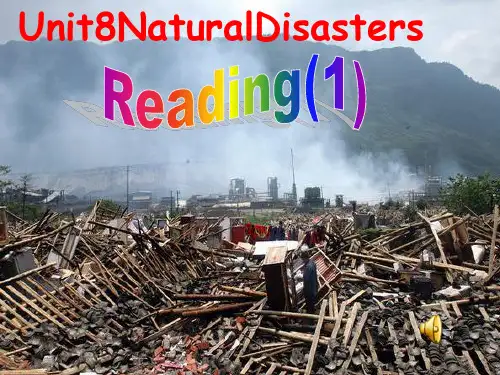
惊恐地尖叫 向四面八方逃离 感到一阵轻微的摇晃 片片玻璃和砖块 我被困了。 平静下来 大喊救命 活着 寻找出路 黑暗中拽着自己 缓慢爬行 搬走砖块
Post-reading
WhatdoyouknowaboutTimmy’sstoryinTaiwanearthq uake? WhentheearthquakehitTaiwanin1999,Timmywas___ sleeping _____.Heheardaloudnoiselike________.Thenthenoi thunder sebecamelouder,likebombsundertheground.Peoplesc reamedin________.Thenpiecesofglassand_______ bricks fear ___felldown. Whenthenoiseandshakingstopped,Timmywas______ __andcouldnotgetout.Hefelt_________andhisheart trapped was__________.Amomentoffearwentthroughhis__ nervous beating ___.Thenhetriedto____downand_________himself mind slowlythroughthedark.Finally,peoplecameandheardhi calm pulled scryforhelp.Theymovedawaythebricksand____him. Timmywas______atlast.
F 2.Hefeltnervousandhishead
wasbeatingfast.
heart
mind
牛津译林版英语八年级上 Unit 8 Natural disasters Welcome to the unit 课件(共24张PPT)
Talk
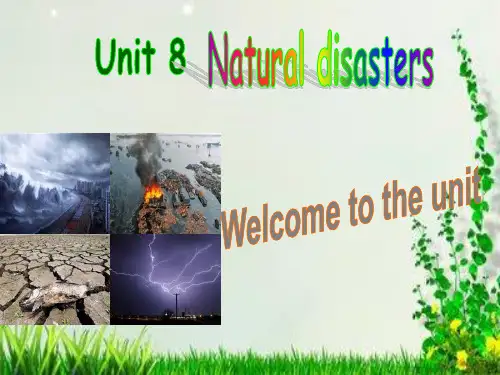
1. What was the weather like when Hobo was sleeping? It was rainy./It was raining heavily. 2. When there’s too much rain in a short time, what will it cause? It will cause flood. 3. What does flood belong to? Natural disaster or accident?
Yes, sometimes the wind is so heavy that it blows trees down. And I can’t see anything at all in the street.
......
Hobo has some trouble. What happened to him?
around his house. His furniture and all his books got wet. B: Did your friend leave his house? A: Yes. He and his family moved to his uncle’s house, as his uncle lived far away and there was no flood there.
请点击
Complete the following sCehnetceknycoesu.r answer
1. 1998年的特大洪水冲走了许多房屋和 大树。 The big flood in 1998 _w_a_s_h_e_d__a_l_o_t_o_f_ _h_o_u_s_es__a_n_d_t_r_e_e_s_a_w_a_y_.__
牛津译林版英语八年级上册:Unit 8 Natural disasters. 教案5
Unit 8 Natural disastersLesson 5【教学目标】1.To understand the process of producing an accident report form.2.To recognize the key expressions involved in an emergency call and an accident report 【教学重难点】1.To recognize the key expressions involved in an emergency call and an accident report2.To think more about what to do when there is an accident.【教学过程】Step 1 Talking about the weatherFirst, get the students to talk about the weather today.Step 2 Showing a picture of snowy daysShow a picture of snowy days and then get the students to talk about the weather conditions. Encourage the students to discuss what will happen to cars and people.Picture A: It’s snowy. The snow is heavy. The heavy snow covers the groun d.It covers everyt hing. (Teach the word ‘cover’.)Picture B: It is difficult to walk. It is easy for people to fall over.Picture C: It is dangerous to drive a car. Look at the picture there is car accident.Two people are trapped in the car. They can’t get out. They are victims. (Teach the word ‘victim’.)Step 3 Discussing about what the victims can doGet the students to discuss about what the victims can do to get someone to help them.Step 4 Looking at the two reportsExplain that Mr. and Mrs. Su had a car accident during the snowstorm. Ask students to look at the two reports and explain that the report form in Part A1 is from the hotline as the report in Part A2 is made by the policemen after they rescued Mr. and Mrs. Su.Explain the items in the report form and make sure that they can understand it.Step 5 Playing the tape twicePlay the tape for the students to find as much information as possible. And then fill in the report form. And of course, it is impossible for them to complete the table by listening.Get them to read the repot below and find more information.Step 6 Checking the answersAfter completing the report form, invite the student to check the answers in pairs.Step 7 Making up a new dialogueGet the students to work in pairs and make up a new dialogue between an interviewer and Mr. or Mrs. Su.Say, ‘An interviewer went to see Mr. Su and Mrs. Su in the hospital, he/she interviewed them about the accident.’ Invite the students to talk about the information in the report form or they can add something.Step 8 C ompleting Sandy’s e-mailStep 9 Homework1.Finish off the relative exercises.2.Recite the useful words and expressions.。
牛津译林版-英语-八上-8单元 Natural disasters pronunciation
初中英语牛津译林版八年级上册Unit 8 Natural disasters pronunciationContent:Speak up and pronunciationPeriod:10-8Teaching aims and demands:1.To describe an disaster or accident by responding to questions and interacting with others .2.To identify a natural disaster ,describe it and explain the results .3.To identify the intonat ion pattern of statements . .Key points:1.To describe a disaster or accident by responding to questions and interacting with others .2.To identify the intonation pattern of statementsDifficult points:To describe an disaster or accident by responding to questions and interacting with others . Teaching aids:A tape recorder and some picturesTeaching methods:Pair work and practicingTeaching procedures:复备栏目Step 1 RevisionRevise the words and phrases in Integrated skillsStep 2 PresentationShow pictures of different kinds of bad weather and disasters . Get thestudents to talk about the results of the m .T explains that Sandy and Amy are talking about a natural disaster . Invitethem to listen to the tape and try to answer the questions .1.What are they talking about ?2.How did it happen ?3.Was anybody hurt ? Why or Why not ?Step 3 PracticeGet students to read the dialogue aloud .Ask students to pay attention to theintonation of different sentences .We use a rising tone for generalquestions .We use falling tones for ‘wh-’questions or statements .Ask Ss to read the dialogue again . Then get Ss to practice and act in pairs .Step 4 Listening and reading1.Ss liste n to the sentences on Page 104 and pay attention to the end of thesentences . Make the voice fall at the end of the sentences .2.Get them to read the dialogue on Page 104 pay attention to the intonationpatterns. Put a following arrow in the box if they think her voice should fallhere .Ask them to focus on what Sandy said about the fire and get the mainpoints .Step5 ProductionAsk Ss to make up new dialogues. They can talk about a natural disaster theykno w . Pay special attention to the intonation .Step 6 Homework1.Read the dialogues in correct intonation .2.Finish off more exercises.3.Preview Main task: find the new phrases and try to re member them.教学反思:达标检测Unit 6 Speak up and pronunciation (30’)一、用所给的汉语或英语单词的适当形式填空(9’)1.He felt cold and ___________ (frighten ), but he couldn’t move .2.They sent the __________ (受害者) to the hospital at once .3.The snowstorm started again in the afternoon and it got ______ (bad) later .4.Mrs Su hurt her leg but it was not _________ (严重的).5.The snow was heavy and it _______ (覆盖)everything .6.This morning I read a newspaper article about a car ________ (事故).7.I was surprised to see that my pet dog was still _____ (live) after the earthquake .8.The number of the _____________ (survive) of the Titanic was less than eight hundred .9.Pe ople ran in all _______ (direct) when they heard the sudden gun .二、用正确的语音和语调朗读下列句子(8’)1. Did you hear about the flood in Wuhan last month ?2. Were you alone in the car ?3.When will they arrive in Beijing ?4.How much does the baby mouse weigh ?5.Who is the busiest in your family ?6.There was water all round her house .7.He and his family moved his uncle’s house8.The whole road was covered with snow and we couldn’t get out .三、用所给动词的适当形式填空(13’)1.Who is ________ (mop) up the f loor ? It’s so clean .2.It’s unlucky ______ (lose)the game or get ______(lose) in a new city .3.We should try our best ________ (prevent) the sand from _______ (come) to the good farmland in the south .4.Timmy ________ (trap) in a dark place when the earthquake _______ (stop) .5.The radio says that the temperature __________ (drop)a little tomorrow .6.When they _______ (hear)the big noise like thunder ,they ______ (tell) themselves _______ (keep) calm .7.The firemen________ ( put) out the fire soon .8.Bad weather ________ (cause) natural disaster .。
牛津译林版八年级英语8A Unit8 Natural disasters知识点归纳总结

8A Unit8 Natural disasters一.词汇拓展1.shake v.→shaking (n.) 摇动2.direct v. →direction(n.) 方向3.live v. →alive (adj.) 活着的4.safe adj. →safety(n.) 安全5.fear (n.) →fearful(adj.)可怕的、担心的二.重点短语1. wash away 冲走wash 代词away2. be all wet 全湿了3. start to rain 开始下雨4. wake up 醒来wake代词up wake up+名词5. mop up the water 把水拖干净6. crash into a tree 撞在树上7. start big fire 引起大火8. fall from the tree 从树上掉下来9. a heavy storm with thunder and lightening 伴有雷电的大暴雨10. catch fire 着火11.in the early morning 在清晨12.feel a slight shake 感觉到轻微的晃动13.hear a loud noise like thunder 听到像雷声的噪音14. start to shake 开始摇晃shake hands with sb.15.scream in fear 恐惧地尖叫16. run out of the building 跑出楼房17.try my best to run out 尽我所能的跑出18.begin to calm down 开始平静下来19.say to oneself 自言自语20. calm down 平静下来21. silent silence silently 安静寂静的22. not at all 一点也不23 find one’s way out 找到出路24. hear about the fire 听说火灾hear of 听说hear from收到...的来信25. Was anyone hurt? 有没有受伤?hurt v.adj.26. fear v. fearful fearless 害怕A moment of fear went through my mind. 一丝恐惧掠过我的脑海。
牛津译林版八年级英语上册专题+Unit8+Natural+disasters+课后练习及详解
Unit8 Natural disasters课后练习题一:翻译:昨晚下雨了,马路都湿了。
假如他以为可以邀我外出,他就大错特错了。
题二:翻译:由于洪水,地面全湿了。
这没有宾馆,你搞错了。
题三:翻译:她用书打他的头。
昨晚他家失火了。
题四:翻译:雪球打在他的鼻子上。
不要太靠近火炉,你的衣服可能会着火。
题五:翻译:我哥哥怕他的老师。
她为她妈妈担心。
他担心父母的评价。
题六:翻译:那个男孩怕他的爸爸。
女孩的父母为她的安全担心。
成千上万的民众为他们的生命安全担心。
题七:翻译:有些人很费粮食,然而有些人却吃不饱。
我喜欢唱歌,而她喜欢阅读。
敌兵们四处逃窜。
题八:翻译:你喜欢体育,而我更喜欢音乐。
儿子在家吃好饭而父母却在田里辛勤劳作。
放学后,孩子们向各个方向分散了。
题九:翻译:那个男孩的眼里充满了恐惧。
他与玛丽的关系经历了四个阶段。
我们将在一起审阅这些论文。
题十:翻译:他们能够毫无畏惧地表达自己的观点。
伊拉克在过去的15年里经历了太多的战争。
她自己检查她的夹克衫口袋,最终发现了丢失的钥匙。
题十一:翻译:我是五岁开始学习滑冰的。
题十二:翻译:我是在中学开始学英语的。
题十三:翻译:他喜欢每天早上听收音机。
我努力想听清楚他讲的一字一句。
听着这激动人心的故事,我非常兴奋。
题十四:翻译:有时我听一会儿音乐,发现这是一个放松自己的好方式。
我好像听到有人在敲门。
听到这个令人激动的消息,我们都非常兴奋。
题十五:翻译:我们得尽快离开这里。
我们应该尽可能多地拜访我们的朋友。
题十六:翻译:他说他会尽快给我写信。
她尽可能地节省钱。
题十七:翻译:昨天晚上六点到八点的时候,他们正在看球赛。
当我离开的时候他正在画一幅世界地图。
老师走进教室的时候,学生们正在谈论当天的新闻。
I __________ a friend when Bob came in. A. telephoned B. am telephoningC. was telephoningD. telephonesAs I __________ in the park, it __________ to rain.A. walk; was beginningB. was walking; beganC. was walking; was beginningD. walk; beganWhile we __________ for the bus, a girl __________ up to us.A. were waiting; was runningB. waited; was runningC. waited; ranD. were waiting; ran题十八:翻译:玛丽昨晚6点到7点一直在复习功课。
牛津译林版八年级上册Unit 8《Natural disasters》(Task)说课稿
牛津译林版八年级上册Unit 8《Natural disasters》(Task)说课稿一. 教材分析《牛津译林版八年级上册Unit 8 Natural disasters》是围绕自然灾害展开的一篇文章。
本节课的主要内容是让学生通过阅读文章,了解自然灾害对人类生活的影响以及如何在自然灾害面前保护自己。
教材内容丰富,插图生动,激发了学生学习兴趣。
同时,本节课还设计了丰富的口语、写作和听力活动,帮助学生全面提高英语能力。
二. 学情分析八年级的学生已经具备了一定的英语基础,对于一些简单的自然灾害词汇和表达方式有所了解。
但他们在阅读长篇文章、理解复杂信息方面还存在一定的困难。
因此,在教学过程中,我需要关注学生的个体差异,调整教学策略,确保每个学生都能参与到课堂活动中来。
三. 说教学目标1.知识目标:学生能够掌握与自然灾害相关的词汇和表达方式,如earthquake、tsunami、hurricane等。
2.能力目标:学生能够通过阅读文章,理解自然灾害对人类生活的影响,提高阅读理解能力。
3.情感目标:培养学生关爱生命、珍惜生命的意识,以及面对自然灾害时的自我保护能力。
四. 说教学重难点1.重点:学生能够掌握与自然灾害相关的词汇和表达方式,理解文章内容。
2.难点:学生能够运用所学知识,就自然灾害话题进行口语交流和写作表达。
五. 说教学方法与手段1.任务型教学法:通过完成各种任务,激发学生的学习兴趣,提高学生的参与度。
2.情境教学法:创设生动的情境,让学生在真实的环境中学习英语。
3.交际式教学法:鼓励学生积极参与课堂交流,提高口语表达能力。
4.利用多媒体教学手段:通过播放视频、图片等,丰富教学内容,提高学生的学习兴趣。
六. 说教学过程1.导入:以一段关于自然灾害的视频导入,激发学生的学习兴趣。
2.阅读理解:学生阅读文章,回答相关问题,了解自然灾害对人类生活的影响。
3.词汇学习:学生通过小组合作,归纳总结文章中出现的自然灾害词汇。
牛津译林版八年级英语上册Unit 8 Natural disasters revision课件
Past continuous tense
long action1 while long action2 longer action when shorter action shorter action while/when longer action
基本用法
过去进行时
1.表示在过去某个时间点正在发生的动作.常与
(when, while)
4.延续性动词用过去进行时,短暂性动词用一般过 去时.
while+延续性动词 when +短暂性动词 The earthquake started
while I was doing some shopping.
I was trying to find my way out
2.mop (过去式) 3. shake (名词) 4. trap (过去式) 5. dead (反义词) 6. wind(形容词) 7. fog (形容词) 8. loud (副词) 9.drop (过去式) 10.arrive(名词) 11.fireman(复数)
natural mopped
shaking trapped alive
at this time yesterday.
5.I ____w_a_s__tr_y_in_g__to__fi_n_d____my way out when I suddenly
heard some noise above me .
Past continuous tense
构成:was/were + doing
A. To close all the doors. B. To hide under a big tree. C. To stay on the top floor.
最新牛津译林版中学八年级英语上册 Unit 8 Natural disasters Revision教案
Natural disasters课题Revision总第课时备课时间上课时间课时Period 8 教具 A recorderTeachingaimsto review what they have learnt in this unit;TeachingfocusTo revise the use of past continuous tenseDifficu ltpointsTo identify the vocabulary about bad weather and natural disas tersTeachingmethodTask-based approac h,Scene pedagogy and Teach ing with humorTeaching procedur es The second p reparinglessonsSTEP 1 Giving a weather reportGet a student give a weather report. Then get them to talk about their favorite weather.STEP 2 Eliciting the use of past continuous tenseRemind the students of the topic of this unit ‘Natural Disa ster’.Elicit the use of past continuous tense. By asking some questions.What was Timmy doing wh en the earthquake happened?He was doing some shopping when the earthquake happened. While/ when he was doing some shopping the earth quake. While / he was do ing some shopping, his mother was cooking at home.Explain the way past continuous t ense is used and when to use ‘when’ or ‘while’.S TEP 3 Finishing off the exercises in Part AGet the students to finish off the exercises in Part A, Page107. Get the students to check the answers in pairs and then checkthem in class. Do this orally and write the most important words on board. When we come to some familiar topics here, we can talk more about it. For stronger classes, it is good to talk about more natural disasters.STEP 4 Do some more consolidate exercisesSTEP 5 Homeworka.Read through the whole unit and get ready for the comingtest.b.Finish off the exercises in the Evaluation Handbook andLearning English.Teachingnotes。