
2020高中英语人教版必修三unit 1 festivals and celebrations Listening and speaking 导学案
Unit 1 Festivals and Celebrations 导学案Period 1 Listening and speaking1. Students can get the detailed information from the listening.2. Students learn the listening strategy - listen for relationships.3. Students can talk about the festivals using the given words and phrases1.Students can get the detailed information from the listening.2.Students learn the listening strategy - listen for relationships.Part A Listening and Speaking --- Talk about festival activitiesStep 1 Lead in ---free talkThere are many festivals around the word? What are they? And what’s your favorite festival?Step 2 Before listeningActivity1Look at the words and phrases below, can you translate them into Chinese.Qingming FestivalSpring festivalChristmas FestivalThe Dragon Boat Festivalfestivals①wear traditional costumes②dress up in carnival costumes③visit a lantern fair④march along the streets⑤receive congratulations from⑥guess riddles⑦attend the ceremony⑧watch samba dace⑨give performanceActivity 2 Look at the photos below, try to describe the pictures with the words and phrases in the box.Step 3 While- listeningActivity 1 Listen and write the order of the conversations next to the names of the festivals above. Then match each conversation with the relationship between the speakers below.______a tour guide and members of a tour group______an interviewer and an interviewee______a reporter and a tourist______two friendsListen for relationshipsTo listen for a relationship, youneed to pay attention to howpeople talk to each other (e.g.friends usually call each otherby first names) and someparticular questions in theconversation(e.g.”Could I havethe bill, please?” tells us thatthe speaker is a customer in arestaurant).Activity 2 listen again and complete the sentences with the correct words In Conversation 1 , the woman is wearing______colour. It took her a long time to do her hair and make-up, and to get_____. She is going to meet her_____soon.In Conversation 2 , Carla advises Li Mei to change her_______. this is because the weather is _____and they will be outside for a long time.In Conversation 3 , the people are enjoying the ______show.Activity 3 listen again and make a list of each festival’s activities.Chinese Lantern Festival:Coming-of -age Day:Ria Carnival:Step 3 After- listeningIn pairs, discuss which of these festival attracts you the most and why.EXAMPLEA: I think the Ria Carnival would be the most exciting. After all, as you know, I love to dance!B: I love dancing, too. But I’m not sure I’d enjoy it in such hot weather.A: So which festival do you like best?B: I like...Step 4 Pronunciation语音同化是英语口语发音中一种非常普遍的现象。
在正常语流或快速语流中,说话者较难在极短时间内改变发音方法或部位,一个音受另一个相邻的音的影响,变成与它相同或相近的音,形成了语音同化现象。
同化现象不只发生在两个词的边缘,也发生在同一个词的内部。
音的同化有两种情况: 融合同化以及音变。
Activity 1Listen and read aloud the words or phrases to your partner. Pay attention to the change in the pronunciation of the bold letters.1 d uty, e d ucation2 u s e , u s ually3 new s, new s paper4 i s , i ss ue5 las t year6 i n bed7 tho s e shirts8 a s you seeActivity 2 work in pairsOne student in the group listen the tape and read, another listen and check if there are any difference. And then exchange.Activity 3 listen t to the following sentences, paying attention to the consonants in bold. How do their pronunciations change when they are read in the sentences?1 Di d you enjoy the holiday?2 Miss, congratulations o n becoming an adult!3 It’ll be too tiring to walk or dance for a long time in tho s e shoes.4 I was hoping to hear tha t you had a great time throughout.5 Children then take part in Easter egg hunts to find the eggs and wi n prizes.6 I n Mexico, the Day off the Dead is celebrated between October 31st and November 2nd .Listen for the first time, ask students follow the tape and read the above sentences,pay attention to the pronunciation of the bold letter.Listen for the second time, discuss with partner about the different pronunciation. Listen for the third time, students follow the tape and read the sentences loudly. 答案Activity1Look at the words and phrases below, can you translate them into Chinese.(1) wear traditional costumes(2) dress up in carnival costumes(3) visit a lantern fair(4) march along the streets(5) receive congratulations from(6) guess riddles (7) attend the ceremony (8) watch samba dace (9) give performanceActivity 2 Look at the photos below, try to describe the pictures with the words and phrases in the box.穿着传统服饰穿着狂欢服参观灯会游街收到...的祝福猜谜语参加仪式 观看桑巴舞 进行表演●did you / /dɪd ju:/ /dɪd ʒu:/ ●on becoming /ɒn bɪˈkʌmɪŋ/ /ɒm bɪˈkʌmɪŋ/ ●those shoes /ðəʊz 'ʃu:z/ /ðəʊ ʒu:z/ ●that you /ðæt ju:/ /ðætʃ u:/ ●win prizes/w ɪn 'praɪzɪz/ /w ɪm 'praɪzɪz/ ●In Mexico /ɪn ˈmeksɪkəʊ/ /ɪm ˈmeksɪkəʊ/(3.)(6). (1)(5)(7) (2)(4)(8)(9)Step 3 While - listeningActivity 1 Listen and write the order of the conversations next to the names of the festivals above. Then match each conversation with the relationship between the speakers below.Chinese Lantern Festival a tour guide and members of a tour group Coming -of -Age an interviewer and an interviewee ______ a reporter and a touristRio Carnival two friendsActivity 2 listen again and complete the sentences with the correct wordsListen for relationshipsTo listen for a relationship, you need to pay attention to how people talk to each other (e.g. friends usually call each other by first names) and some particular questions in theconversation(e.g.”Could I have the bill, please?” tells us that the speaker is a customer in arestaurant).In Conversation 1 , the woman is wearing______colour. It took her a long time to do her hair and make -up, and to get_____. She is going to meet her_____soon.In Conversation 2 , Carla advises Li Mei to change her_______. this is because the weather is _____and they will be outside for a long time.In Conversation 3 , the people are enjoying the ______show.Answers: 1) bright; dressed; family2) dress and shoes; hot3) lanternActivity 3 listen again and make a list of each festival’s activities.Chinese Lantern Festival:Coming-of -age Day:Ria Carnival:Answers: Chinese Lantern Festival: guess riddles; see the colorful lanterns; watch the dragon or lion dances; eat yuanxiaoComing-of-Age Day:girls do their hair and make-up; wear traditional costumes; attend the Coming-of-Age ceremony; say congratulations; have a party.Rio Carnival: wear carnival costumes; march along the streets; danceStep 3 After- listeningIn pairs, discuss which of these festival attracts you the most and why.EXAMPLEA: I think the Ria Carnival would be the most exciting. After all, as you know, I love to dance!B: I love dancing, too. But I’m not sure I’d enjoy it in such hot weather.A: So which festival do you like best?B: I like the Coming-of-Age Day best.A: Why ?B: Well, I think it would be neat to dress up in traditional costumes and attend a ceremony to mark becoming an adult. It is a special time, and so it would be nice to celebrate it with my friends and family.A: That’s true, but the Lantern Festival also has its good points.B: What do you like best about it ?A: Well, the lanterns are pretty cool to look at, and the dragon dances can be quite fun. But I like eating yuanxiao with my family most of all.Step 4 Pronunciation语音同化是英语口语发音中一种非常普遍的现象。
人教版高中英语必修三Unit1FestivalsandCelebrations笔记重点大全(带答案)

人教版高中英语必修三Unit1FestivalsandCelebrations笔记重点大全单选题1、The digital age ________ us to find friends ________ the same interests.A.enabled ; to shareB.enabled ; sharedC.enables ; sharingD.enable ; share答案:C考查时态及非谓语动词。
句意:数字时代使我们能够找到志趣相投的朋友。
根据句子结构,第一空考查谓语动词,第二空考查非谓语动词。
根据句意,此句描述一般事实,故用一般现在时。
主语The digital age是单数,谓语动词用单三,第一空填enables;friends与share是主谓关系,故用现在分词,作定语,故填sharing,故选C。
2、It took the workers ______ the factory a long time to adapt themselves ______ the new rules.A.belonging to; forB.belongs to; toC.belonged to; forD.belonging to; to答案:D考查非谓语动词和固定短语。
句意:这家工厂的工人花了很长时间才适应了这些新规定。
分析句子结构可知,已有谓语动词took,空处需填非谓语动词做定语,workers和belong to为逻辑主谓关系,需用现在分词形式,排除B项和C项;adapt oneself to为固定短语,意为“适应”。
故选D。
3、There was an interesting illustration in the book that I was reading ________ what his hometown was like in his e yes.A.describingB.describedC.to describeD.describe答案:A考查现在分词。
人教版2020版高中英语必修3课文逐句翻译
1.必修三Unit1 Festivals and celebrations节日和庆典Festivals and celebrations of all kinds have been held everywhere since ancient times. 自古以来,世界各地就有各种各样的节日和庆典。
Most ancient festivals would celebrate the end of cold weather, planting in spring and harvest in autumn. 最古老的节日总是庆祝严寒的结束、春季的种植和秋天的收割。
Sometimes celebrate would be held after hunters had caught animals. 有时,在猎人捕获猎物后,也举行庆祝活动。
At that time people would starve if food was difficult to find, especially during the cold winter months. 在那个时代,如果食物难以找到,特别是在寒冷的冬月,人们会挨饿。
Today’s festivals have many origins ,some religious, some seasonal, and some for special people or events. 现在的节日有很多由来,一些是宗教上的,一些是季节性的,一些是纪念特殊的人和事件的。
Festivals of the Dead亡灵节Some festivals are held to honour the dead or to satisfy the ancestors, who might return either to help or to do harm. 有些节日,是为了纪念死者,或使祖先得到满足,因为祖先们有可能回到世上(给人们)提供帮助,也有可能带来危害。
Unit 1 Festivals and Celebrations高中英语人教版必修第三册

respect n. 尊敬, 尊重;方面
v. 尊敬,尊重,仰 慕;遵守;不违背
respectability n. 名望,体面,得体
respectable adj. 值得尊敬的,体面 的,得体的;相当好的
respectful adj. 表示敬意的,恭敬的 respective adj. 各自的,分别的
satisfying/ satisfactory
adj. (感 到)……的 disappointed
excited interested relaxed surprised worried
pleased
satisfied
n.
disappointment excitement interest relaxation surprise worry
representation n. 表现,描绘
representative adj. 典型的;
;表现形式;有代理人,维护, 有代表性的; 由代表组成的
支持
n. 代表;销售代表,代销
人;典型人物,代表性人物
fancy adj.花哨的,精致的,昂贵的 v. 想要,想做;倾慕;自以为 n. 想象的事物,想象(力);想要,爱好
agriculture n. 农业;农学;农艺 agricultural adj. 农业的,与农业有关的 agriculturalist n. 农学家;农业技术员;农艺师
gather v. 聚集,集合;搜集;收割 gathering n. 聚集,聚会,集会;收集,采集
decoration n. 装饰,装潢;装饰品 decorate v. 装饰,装潢 decorative adj. 装饰性的,作装饰用的
faith n. 宗教信仰;信心;信任
人教版高中英语必修三Unit1FestivalsandCelebrations重点知识归纳(带答案)

人教版高中英语必修三Unit1FestivalsandCelebrations重点知识归纳单选题1、The flowers _________ sweet attract the visitors to the beauty of nature, which _________ in the botanic garden last year.A.to smell; grewB.smell; were grownC.smelling; were grownD.smelt; were growing答案:C考查非谓语动词和动词时态语态。
句意:这些花闻起来很香,吸引了游客去欣赏大自然的美景,这些花是去年在植物园里种植的。
第一空,分析可知,此处为非谓语动词作后置定语,排除B项;smell“闻起来”是系动词,没有被动语态,不用过去分词smelt表达被动含义,排除D项;动词不定式 to smell 表将来,不符合句意,排除A项;所以应用现在分词短语 smelling sweet 作为 flowers 的定语;第二空,动词grow“种植”和主语之间是被动关系,根据时间状语last year,应使用一般过去时的被动语态 were grown。
故选C项。
2、________ the fog, we should have reached our school.A.Because ofB.In spite ofC.In case ofD.But for答案:D考查介词短语辨析。
句意:要不是大雾,我们本应该到了学校。
A.Because of由于,因为;B.In spite of 尽管;C.In case of以防,万一;D.But for 要不是,but for通常用于含蓄条件句中,相当于if条件句的用法,主句中使用虚拟语气。
根据后句“we should have reached our school(我们本应该到了学校)”可知,要不是大雾,我们本应该到了学校。
高中英语 Unit1 Section Ⅰ 新人教版必修第三册
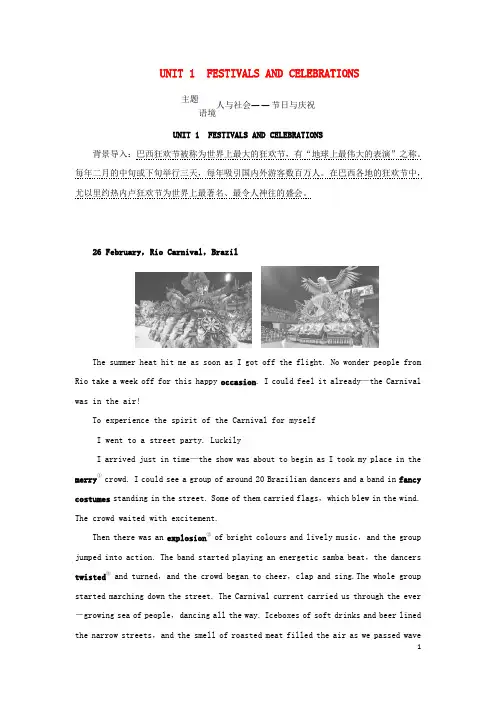
UNIT 1 FESTIVALS AND CELEBRATIONS主题人与社会——节日与庆祝语境UNIT 1FESTIVALS AND CELEBRATIONS背景导入:巴西狂欢节被称为世界上最大的狂欢节,有“地球上最伟大的表演”之称。
每年二月的中旬或下旬举行三天,每年吸引国内外游客数百万人。
在巴西各地的狂欢节中,尤以里约热内卢狂欢节为世界上最著名、最令人神往的盛会。
26 February,Rio Carnival,BrazilThe summer heat hit me as soon as I got off the flight. No wonder people from Rio take a week off for this happy occasion. I could feel it already—the Carnival was in the air!To experience the spirit of the Carnival for myselfI went to a street party. LuckilyI arrived just in time—the show was about to begin as I took my place in the merry①crowd. I could see a group of around 20 Brazilian dancers and a band in fancy costumes standing in the street. Some of them carried flags,which blew in the wind. The crowd waited with excitement.Then there was an explosion②of bright colours and lively music,and the group jumped into action. The band started playing an energetic samba beat,the dancers twisted③ and turned,and the crowd began to cheer,clap and sing.The whole group started marching down the street. The Carnival current carried us through the ever -growing sea of people,dancing all the way. Iceboxes of soft drinks and beer lined the narrow streets,and the smell of roasted meat filled the air as we passed waveafter wave of street stands. I was so caught up in④ the party fever that I hardly noticed five hours fly by!Even as I lay in bed that evening,the bright colours and lively music were still swimming all around me. What an amazing first day in Rio!(选自译林版新教材必修第二册Unit 3)①merry /'meri/ adj.欢乐的,愉快的②explosion /ɪk'spləʊʒn/n.爆炸;爆炸声③twist /twɪst/ vt. &vi.缠绕;扭动(身体部位)④be caught up in 被卷入,陷入I was so caught up in the party fever that I hardly noticed five hours fly by!我沉浸在派对狂热中,几乎没有注意到五个小时过去了![句式分析] 此句含有so...that...“如此……以至于……”的句型。
高中英语必修三Unit1 Festivals and celebrations节日和庆典课文及听力文

1.必修三Unit1 Festivals and celebrations节日和庆典Festivals and celebrations of all kinds have been held everywhere since ancient times. 自古以来,世界各地就有各种各样的节日和庆典。
Most ancient festivals would celebrate the end of cold weather, planting in spring and harvest in autumn. 最古老的节日总是庆祝严寒的结束、春季的种植和秋天的收割。
Sometimes celebrate would be held after hunters had caught animals. 有时,在猎人捕获猎物后,也举行庆祝活动。
At that time people would starve if food was difficult to find, especially during the cold winter months. 在那个时代,如果食物难以找到,特别是在寒冷的冬月,人们会挨饿。
Today’s festivals have many origins ,some religious, some seasonal, and some for special people or events. 现在的节日有很多由来,一些是宗教上的,一些是季节性的,一些是纪念特殊的人和事件的。
Festivals of the Dead亡灵节Some festivals are held to honour the dead or to satisfy the ancestors, who might return either to help or to do harm. 有些节日,是为了纪念死者,或使祖先得到满足,因为祖先们有可能回到世上(给人们)提供帮助,也有可能带来危害。
2020新人教版高中英语必修三词汇专练-有答案
新人教版高中英语必修三词汇专练Unit I Festivals and Celebrations一,单词拼写1,We should offer to their team on winning the march.2,The of the Dragon Boat Festival is to recall the soul of Qu Yuan.3,Even to this day, Lincoln is regarded as one of the most inspiring in the world.4,She brought (快乐) to countless people through her music.5,The number of people employed in has fallen in the last decade.6,They were all (聚集)round the TV.7,I am extremely (感谢)to all the teachers for their help.8,Teamwork is a key (特点) of the training programme.9,The cake was to look like a car.10,Your work has shown a (显著的)improvement.11,This is a ( 典型的) example of Roman pottery.12,Each company is fighting to protect its own (商业的)interests.13,Last but not least, I feel it an honour to (代表)my class to take part in the group dancing competition.14,It seems beautiful that the tall buildings are in the lake around which there are many trees.15,We've lost (相信)in the government's promises.二,从方框中选择适当的短语,并用其适当形式完成下列句子。
高一英语新人教版必修三Unit1FESTIVALSANDCELEBRATIONS
Unit 1 Festivals and Celebrations交流用语1. 打电话用语:May I speak to Lily? —Hold on / Just a moment, please. —Sorry, he isn ’ tI in’ . ll r—ing her up later. 邀请:—I wonder if you are interested in... Would you like to go... with me? I ’ d like to invite you to g.o..不能去:I ’d love to, but I have to take care of my little brother. —Thank you so much./Don ’ t mention it./It ’ s a pleasure.2.节日话题:What ’ s your favorite holiday of the year?What festivals or celebrations do you enjoy in your city or town?*Do you like spending festivals with your family or with your friends?*What part of a festival do you like best —the music, the things to see, the visit or the food?*Festivals let us enjoy life, be proud of our customs and forget our daily life for a little while.词语辨析1. Discuss when they take place , what they celebrate and what people do at that time.辨析:take place, happen, break out, occur, come about 均表示“出现,发生” ,均为不及物动词,没有被动语态,不能直接跟宾语。
2020年新人教版必修三《Unit 1 Festivals and Celebrations》单元教案(附导学案)1
Unit 1 Festivals and CelebrationsListening and speaking & Listening and talking【教材分析】本板块的活动主题是“谈论节日活动”(Talk about festival activities),主要是从贴近学生日常生活的角度来切入“节日”主题。
学生会听到发生在三个国家不同节日场景下的简短对话,对话中的人们正在参与或将要亲历不同的庆祝活动。
随着全球化的进程加速,国际交流日益频繁,无论是国人走出国门还是外国友人访问中国,都已成为司空见惯的事情。
因此,该板块所选取的三个典型节日场景都是属于跨文化交际语境,不仅每组对话中的人物来自不同的文化背景,对话者的身份和关系也不尽相同。
【教学目标】1. Master the new words related to holiday: lantern, carnival, costume, dress (sb) up, march, congratulation, congratulate, riddle, ceremony, samba, make-up, after all.2. To understand the origin of major world festivals and the activities held to celebrate them and the significance of these activities;3. Improve listening comprehension and oral expression of the topic by listening and talking about traditional festivals around the world;4. Improve students’ understanding of the topic by watching pictures and videos about different traditional festivals around the world;5. Review the common assimilation phenomenon in English phonetics, distinguish the assimilated phonemes in the natural language flow, and consciously use the assimilation skill in oral expression.【教学重难点】Importance:1. Guide students to pay attention to the attitude of the speaker in the process of listening, and identify the relationship between the characters;2. Inspire students to use topic words to describe the festival activities based on their background knowledge.Difficulties:In the process of listening to the correct understanding of the speaker’s attitude, accurately identify the relationship between the characters.【课前准备】1. To understand the origin of traditional festivals in the world, the celebration activities (customs) of these festivals and the meaning of these activities;2. Talk about holiday celebrations;3. Preview: understand the new words according to the context.【教学过程】Step 1 Lead-inTeachers talk about the world’s traditional festivals, such as the Lantern Festival in China, adults’ day in foreign countries, carnivals and so on.Step 2 Watching and talkingActivity 11. Teacher lets Ss look at some pictures about festival activities. During talking about these activities, teacher can add some background knowledge about festivals.Questions:①What festivals do the pictures show us?②In which country do you think people celebrate each festival?③How do people celebrate each festival?2. Ask sb to choose some words or phrases from the box to celebrate eachfestival.3. Teacher can show students how to use these word blocks and learn to describeholiday activities in groups. For example:On the Coming-of-Age Day, young girls in Japan would wear traditional costumes.One of the most important activities during the Lantern Festival is to guess riddles.During the Rio Carnival, you can watch wonderful samba dances.4. The teacher asks students to report the results of the group lecture. Ask thesequestions:①What do people do to celebrate the Chinese Lantern festival?②Who will celebrate Coming-of-Age Day? What do they do to celebrate it?③What do you expect to see if you go to the Rio Carnival?5. Learn some words and phrases in the box.Step 3 ListeningActivity 21. Teacher asks sb to read “Listen for relationships”, In pairs, discuss how to identify relationships between people based on their tone and content. The teacher can provide the following questions to inspire students to discuss.①What does a tour guide usually say to a tour group? What expressions arefrequently used?②What questions does an interviewer usually ask during an interview?③What would a reporter say or do if he/she wants to interview a tourist?④How do friends usually talk?2. Some group representatives are invited to communicate and speak in class.3. Teacher plays the listening tape for students to listen to and write the order of the conversations next to the names of the festivals.4. Play the tape again, students match each conversation with the relationship between the speakers.5. Check the answers with class.Activities 3-41. Teacher asks students to look at the tasks and requirements of activity 3. Then read the main ideas of the three dialogues. (Guide the students to guess and fill in the words according to the context. Let the students analyze the English syntactic structure based on the meaning of the sentence and make reasonable inferences.)2. Teacher plays the tape for the second time. After listening to the tape, students discuss the answers in pairs. Then the class communicates and checks the answers.3. Teacher lets students listen to the tape for the third time (Before the teacher plays the recording for the third time, the teacher should prepare the students to takenotes and remind them to catch key words, especially phrasal verbs.).Step 4 SpeakingActivity 51. Lead the dialogue by asking questions. Let students understand how to discuss their favorite festivals and give their reasons.E.g.,Conversation 1T: Which of the three festivals do you like best?S1: I think the Coming-of-Age Day is the most interesting.T: Why is it your favourite?S1: Because I like to see women dressed up in their colorful traditional kimonos.Conversation 2T: Which of the three festivals attracts you most?S2: The Chinese Lantern Festival.T: I suppose you like yuanxiao, the sweet dumplings.S2: Not only that. I especially like guessing riddles and I’m good at it.2. Follow the example of the conversation in activity 5 and work in pairs to discuss your favorite holiday and explain why. After the discussion, the teacher asks some groups to show the dialogue.Step 5 ActingOne student plays the role of a journalist. The other three students play the roles of the characters in the listening dialogue. They are the Japanese girl attending the coming-of-age ceremony, the girl attending the Rio carnival, and the tourist visiting China. The following questions can be used in the interview:①What is the purpose of this festival?②How do you usually celebrate this festival?③What do you like best about this festival?Step 6 Pronunciation1. Help students recognize speech assimilation.(1)Teacher plays the recording of activity 1 and asks the students to pay attention to the pronunciation changes of bold letters while listening.(2)Teacher organizes students to carry out activities in pairs: the teacher plays the recording, one person in the group reads after the words and phrases in activity 1, the other person compares the pronunciation of the recording with that of his partner carefully, and points out the pronunciation problem of his/her partner if there is any difference. Then switch roles, listen to the tape again and complete the same task.2. Let students imitate and read.(1)Teacher guides students to understand the requirements of activity 2. Before listening to the tape, the teacher asks the question for students to think: “How does your pronunciation change while reading the sentences?”(2)Teacher plays the tape for the first time. The students read after the sentences in activity 2.(3)Teacher plays the tape for the second time, the students repeat the sentences again, and then discuss with their partners the differences between the pronunciation of the bold consonants in words and the pronunciation in sentences, and describe the phonetic assimilation in the flow.(4)Teacher asks different students to read the six sentences of activity 2 and report the result of the discussion on phonetic assimilation. The teacher supplements and corrects the students’conclusion, explains it appropriately, and writes the assimilation pronunciation in these sentences on the blackboard or presents it to the students through the courseware.Step 7 Listening and TalkingActivity 61. Learn the new words about the festivals.2. Look at the pictures and predict what festival Song Lin and Max are going to talk about.3. Listen and answer the questions.①What festival is Max talking about?②What did Max’s mother cook?③What did Max do during the festival?④What did Max and his family do during and after the dinner?⑤What was the best part of the festival?4. Listen again and check the answers with class.Answers:①Christmas experiences.②Roast turkey, mashed potatoes and Christmas pudding, …③He helped decorate the Christmas tree and put presents under it, then helped his mum prepare for the family dinner.④During dinner they shared stories and told jokes, afterwards they played games, opened their presents.⑤The best part was opening their presents on Christmas morning.5. Listen again and tick the phrases that Max or Song Lin uses. Then check the answers with class.6. Have a conversation with the help of these questions:①What is the recent festival you have had?②How did you celebrate it?③How do you feel about the festival? Why?Step 8 Homework1)Read the passage again and understand the food culture from a cross-cultural perspective.2)Remember the new words and learn the usages of them.【教学反思】1、通过本节内容学习,学生能否理解发生在三个国家不同节日场景下的简短对话,对话中的人们正在参与或将要亲历不同的庆祝活动;2、通过本节内容学习,学生能否辨别对话中人物之间的关系;3、通过本节内容学习,学生能否掌握听力训练中的听力策略。
高一英语(人教版)-必修三 Unit 1 Festivals And Celebrations
Read and find out
1. Why do people celebrate the harvest festivals?
…People celebrate to show that they are grateful for the year’s supply of food.(Para. 2)
Read and find out
Read after the tape and underline the topic sentence of each paragraph that gives the main idea.
Para 3: Customs play a significant role in festivals but sometimes they can change over time.
Why do we celebrate festivals?
harvest festivals (Para. 2) customs and traditions (Para. 3) commercialisation (Para. 4) other reasons (Para. 5)
Identify the main idea of a paragraph
Read and find out
Read after the tape and underline the topic sentence of each paragraph that gives the main idea.
Para 2: Of all the traditional festivals, the harvest festival can be found in almost every culture.