
高三年级英语语法-虚拟语气全总结
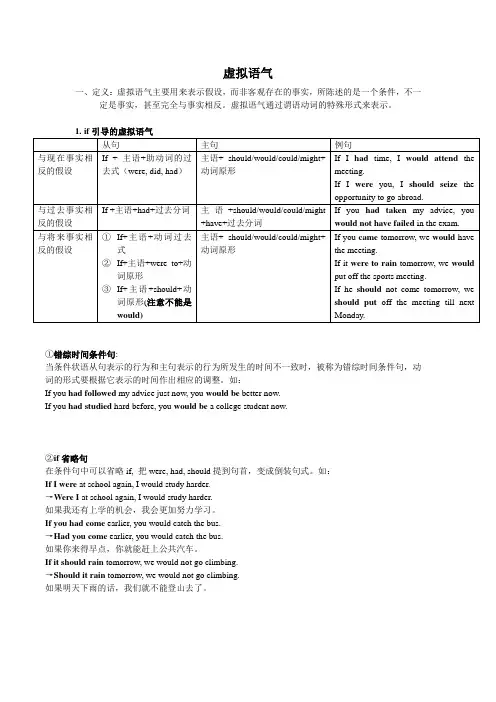
虚拟语气在非真实条件句中①错综时间条件句:当条件状语从句表示的行为和主句表示的行为所发生的时间不一致时,被称为错综时间条件句,动词的形式要根据它表示的时间作出相应的调整。
如:If you had followed my advice just now, you would be better now.If you had studied hard before, you would be a college student now.②if省略句在条件句中可以省略if, 把were, had, should提到句首,变成倒装句式。
否定句时not留在原来位置不变。
如:If I were at school again, I would study harder.→Were I at school again, I would study harder.如果我还有上学的机会,我会更加努力学习。
If you had come earlier, you would catch the bus.→Had you come earlier, you would catch the bus.如果你来得早点,你就能赶上公共汽车。
If it should rain tomorrow, we would not go climbing.→Should it rain tomorrow, we would not go climbing.如果明天下雨的话,我们就不能登山去了。
③用介词代替条件状语从句常用的介词有with, without, but for。
如:What would you do with a million dollars? (=if you had a million dollars)如果你有100万元,你会做什么?We couldn‟t have finished the work ahead of time without your help. (=if we hadn‟t got your help) 没有你的帮助,我们不可能提前完成这项工作。
Without your help, we couldn‟t have finished the work ahead of time.= But for your help, …= If it had not been for your help, …= Had it not been for you help, …没有你的帮助,我们不可能提前完成这项工作。
④含蓄条件句有时在虚拟语气中并不总是出现if引导的条件句,而是通过其他手段来代替条件句。
如:I was ill that day. Otherwise, I would have taken part in the sports meeting. (副词)He telephoned to inform me of your birthday, or I would have known nothing about it. (连词)A man who stopped drinking water would be dead in about seven days. (定语从句)I might have given you more help, but I was too busy. (连词)Everything taken into consideration, they would have raised their output quickly. (独立主格结构) ⑤even if, even though也可用于虚拟语气,其形式与if 从句在虚拟语气中的形式相同。
习题1. If my lawyer___here last Saturday, he___me from going.A.had been, would have preventedB.had been, would preventC.were, would preventD.were, would have prevented2. If it___for the snow, we___the mountain yesterday.A.were not, could have climbedB.were not, could climbC.had not been, could have climbedD.had not been, could climb3. Without electricity(电) human life___quite difficult today.A. isB. will beC. would have beenD. would be4. I didn‟t see your sister at the meeting, if she___, she would have met my brother.A. has comeB. did comeC. cameD. had come5. When the pencil is partly in a glass of water, it looks as if it___.A. breaksB. has brokenC. were brokenD. had been broken6. He hesitated(犹豫) for a moment before kicking(踢) the ball. Otherwise he___a goal.A. had scoredB. scoredC. would scoreD. would have scored7. ___right now, she would get there on Sunday.A.Would she leaveB.If she leavesC.Were she to leaveD.If she had left8. Had he worked harder, he___the exam.A.must have got throughB.would have got throughC.would get throughD.could get through9. He must have had an accident, or he___then.A.would have been hereB.had to be hereC.should be hereD.would be here10. ___for my illness I would have lent him a helping hand.A.Not beingB.Had it not beenC.Without beingD.Not having been11. We didn‟t know his telephone number, otherwise we___him.A.would have calledB.must have telephonedC.would telephoneD.had telephoned虚拟语气(1)复习题1.He ___you more help, even though he was very busy.A. might have givenB. might giveC. may have givenD. may give2.___for your laziness(懒惰), you could have finished the assignment(任务) bynow.A. Had it not beenB. It were notC. weren‟t itD. Had not it been3.If I hadn‟t stood under the ladder(梯子) to catch you when you fell, you ___now.A. wouldn‟t be smilingB. couldn‟t have smiledC. won‟t smileD. didn‟t smile4.If it ___Professor Johnson‟s recommendation(推荐), I wouldn‟t have been admitted to the graduate school(研究生学院).A. were not forB. had not been forC. were notD. had it not been5.If we do not develop a new kind of car, air pollution ___even more dangerous.A. should have becomeB. will becomeC. would have becomeD. must have become6.But for the stormy weather, we ___earlier.A. should arriveB. shall arriveC. should have arrivedD. shall have arrived7.If we ___their terms(条款,条件), we would go bankrupt(破产).A. acceptB. should acceptC. had acceptedD. are to accept8.John would never have gone to the hospital ___that Tom would be there, too.A. he did not knowB. if had he knownC. had he knownD. he would have known9.Had he been more careful, he ___that accident.A. would avoidB. would have avoidedC. avoidedD. should avoid10.But that he came to help me, I ___there earlier.A. could not arriveB. could not have arrivedC. did not arriveD. can not arrive11.She could look more attractive(有魅力的,吸引人的) but she ___no attention to her clothes.A. paysB. was payingC. paidD. had paid12.If I ___in his place, I would do that, too.A. wasB. wereC. amD. had been虚拟语气(2)——虚拟语气在名词从句中1.在由suggest, demand, require, request, insist, order, command, propose等表示建议、请求、命令、愿望等动词或其同根词引出的名词从句中,名词从句虚拟句的谓语变化的形式只有一条规律——名词从句虚拟句无论其主句的谓语动词时何种形式,从句的谓语形式均为should+动词原形,其中should可以省去。
(完整版)英语虚拟语气语法归纳总结

(完整版)英语虚拟语气语法归纳总结英语中的虚拟语气是一种表示非事实或想象的语气,用来表达对现实情况的猜测、愿望、要求、建议、命令和反讽等。
虚拟语气主要通过动词的形式和句子的结构来表达。
一、虚拟语气的用法:1.表达建议、要求、命令、禁止:- 主语+动词原形+宾语(动词原形要用动词底形、如be);- 主语+动词原形+that从句(用于表达建议、命令、禁止,动词原形用“should + 动词原形”或用情态动词)。
例句:- It is important that he be present at the meeting.(建议)- I suggest that he should go to the doctor.(建议)- They insisted that he leave the room immediately.(命令)2.表达愿望、请求、要求:-主语+动词过去式;- 主语+would/could/might + 动词原形;- 主语+动词过去式+宾语+should + 动词原形。
例句:- I wish I could fly.(愿望)- I would appreciate it if you could help me.(请求)3.表示虚拟条件:- If条件从句中的谓语动词用过去完成时,主句用would/should/might/could + have + 过去分词;- If条件从句中的谓语动词用过去时,主句用would/should/could + 动词原形。
例句:- If I had known his phone number, I would have called him.(虚拟条件)- If you had listened to me, we could have finished the project earlier.(虚拟条件)4.表达建议、要求、祝愿:- If only内部称述 + 主语 + 过去式。
英语语法 虚拟语气的知识点归纳
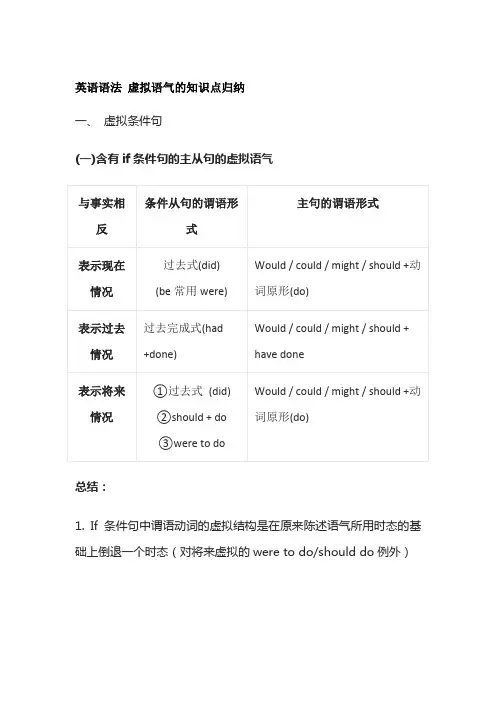
英语语法虚拟语气的知识点归纳一、虚拟条件句(一)含有if条件句的主从句的虚拟语气总结:1. If 条件句中谓语动词的虚拟结构是在原来陈述语气所用时态的基础上倒退一个时态(对将来虚拟的were to do/should do例外)2. 主句要借助于情态动词的过去式,后跟动词原形(现在或将来)或have done(过去);if条件句中只出现一个情态动词,即对将来虚拟的should.3.做此类题目时一定要分清是从句还是主句谓语动词的虚拟,还要把握好时态。
注意:1. 在虚拟条件从句中,动词“be”的过去时态一律用”were”,不用was。
2. 在虚拟条件状语中如果有were, should, had这三个词中任何一个,可省略if,把这三个词提到主语之前, 变成:were/should/had +主语+剩余成分。
3.在虚拟条件状语从句中,省略连词的倒装形式的句首不能用动词的缩略形式。
如我们可说Were I not to do., 而不能说Weren‘t I to do。
4.在表示与将来事实相反的条件句中,只能用should,而不能用would,could和might 等。
5.主句中的should通常用于第一人称,would,could以及might 可以用于各种人称eg :①If I were a bird, I could fly in the air.如果我是一只小鸟,我就能在空中飞行。
②I wish I could pass the examination.我希望我能通过考试。
在虚拟条件句中,对于与将来事实相反的情形,请注意以下几点:(1)条件从句表示的内容与将来事实相反,实为对将来情况的推测,用过去时表示虚拟;(2)条件从句谓语除用过去式外,有时也用“should+动词原形(表示可能性极小,常译为“万一”)”或“were to+动词原形(表示与将来事实相反的假设)”;(3)条件从句使用“should+动词原形”这样的谓语形式时,主句谓语除可用“should (would, could, might)+动词原形”这样的虚拟语气形式外,也可用直陈语气或祈使语气。
高中英语语法-虚拟语气全总结
《小小设计师》教案一、教学目标:1. 让学生了解设计的基本概念和原则,培养学生的创新意识和审美能力。
2. 引导学生运用设计思维,解决实际问题,提高学生的实践能力。
3. 培养学生团队协作和沟通能力,提升学生的综合素质。
二、教学内容:1. 设计的基本概念:介绍设计的定义、目的和作用。
2. 设计的原则:讲解平衡、对比、重复、对齐和亲密性等设计原则。
3. 设计思维:引导学生运用设计思维,发现和解决实际问题。
4. 设计流程:介绍设计的基本流程,包括需求分析、创意构思、草图绘制、设计制作和评价反馈。
5. 设计工具:介绍常用的设计工具,如Photoshop、Illustrator和Sketch等。
三、教学方法:1. 讲授法:讲解设计的基本概念、原则和流程。
2. 案例分析法:分析经典设计案例,引导学生理解设计思维。
3. 实践操作法:让学生动手实践,运用设计工具进行实际操作。
4. 小组讨论法:分组讨论,培养学生的团队协作和沟通能力。
四、教学准备:1. 教材:《小小设计师》教程。
2. 电脑、投影仪和音响设备。
3. 设计工具软件。
4. 设计案例素材。
五、教学过程:1. 导入:通过展示经典设计案例,引发学生对设计的兴趣。
2. 讲解设计的基本概念和原则,让学生了解设计的重要性。
3. 讲解设计思维,引导学生运用设计思维解决实际问题。
4. 介绍设计流程,让学生掌握设计的基本步骤。
5. 讲解设计工具的使用,让学生学会运用设计工具进行实际操作。
6. 开展小组讨论,培养学生团队协作和沟通能力。
7. 布置课后作业,让学生巩固所学知识。
9. 对学生的作业进行评价,给予反馈意见。
10. 定期举办设计比赛,激发学生的创新潜能。
六、教学评价:1. 课堂表现:观察学生在课堂上的参与程度、提问回答情况和团队协作表现,给予相应的评价。
2. 课后作业:评估学生作业的质量,包括设计理念、创意构思和执行效果等方面。
3. 小组项目:对小组合作完成的Design Project 进行评价,关注学生的设计思路、创意实现和团队协作能力。
虚拟语气英语知识点总结

虚拟语气英语知识点总结一、虚拟语气的概念。
虚拟语气是一种特殊的动词形式,用来表示说话人所说的话不是一个事实,而是一种假设、愿望、怀疑、猜测或建议等。
二、虚拟语气在条件句中的用法。
1. 与现在事实相反的虚拟条件句。
- 结构:从句(If + 主语+ 动词的过去式(be动词一般用were)),主句(主语+ would/should/could/might+动词原形)。
- 例如:If I were you, I would study harder.(如果我是你,我会更努力学习。
实际上我不是你)2. 与过去事实相反的虚拟条件句。
- 结构:从句(If+主语+had+过去分词),主句(主语+would/should/could/might + have+过去分词)。
- 例如:If he had taken my advice, he would have passed the exam.(如果他听了我的建议,他就会通过考试了。
实际上他没听建议,也没通过考试)3. 与将来事实相反的虚拟条件句。
- 结构:从句(If+主语+动词的过去式/should+动词原形/were to+动词原形),主句(主语+would/should/could/might+动词原形)。
- 例如:If it rained tomorrow, we would stay at home.(如果明天下雨,我们就会待在家里。
明天是否下雨还不确定,但这是一种假设情况)- 或者If he should come tomorrow, I would tell him the news.(如果他明天来,我就会告诉他这个消息)- 以及If I were to see her tomorrow, I would give her the book.(如果我明天见到她,我就会把书给她)三、虚拟语气在宾语从句中的用法。
1. wish后的宾语从句。
- 表示与现在事实相反的愿望,从句谓语动词用过去式(be动词用were)。
高中英语语法个人复习总结:虚拟语气
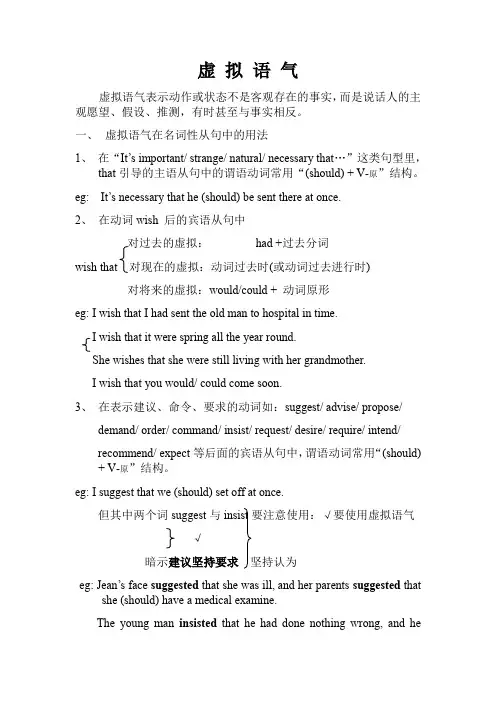
虚拟语气虚拟语气表示动作或状态不是客观存在的事实,而是说话人的主观愿望、假设、推测,有时甚至与事实相反。
一、虚拟语气在名词性从句中的用法1、在“It’s important/ strange/ natural/ necessary that…”这类句型里,that引导的主语从句中的谓语动词常用“(should) + V-原”结构。
eg: It’s necessary that he (should) be sent there at once.2、在动词wish 后的宾语从句中对过去的虚拟:had +过去分词wish that 对现在的虚拟:动词过去时(或动词过去进行时)对将来的虚拟:would/could + 动词原形eg: I wish that I had sent the old man to hospital in time.I wish that it were spring all the year round.She wishes that she were still living with her grandmother.I wish that you would/ could come soon.3、在表示建议、命令、要求的动词如:suggest/ advise/ propose/demand/ order/ command/ insist/ request/ desire/ require/ intend/recommend/ expect等后面的宾语从句中,谓语动词常用“(should) + V-原”结构。
eg: I suggest that we (should) set off at once.但其中两个词suggest与insist要注意使用:√要使用虚拟语气√暗示建议坚持要求坚持认为eg: Jean’s face suggested that she was ill, and her parents suggested that she (should) have a medical examine.The young man insisted that he had done nothing wrong, and heinsisted that he (should) be set free.4、在advice/ idea/ order/ demand/ plan/ proposal/ suggestion/ request等名词后面的表语从句和同位语从句中,谓语动词常用“(should) + V-原”结构。
高三英语虚拟语气知识点

高三英语虚拟语气知识点虚拟语气是英语语法中的一种特殊语气,用来表示与事实相反、与现实不一致、或者表达愿望、建议、命令、要求等情态。
掌握虚拟语气的用法对于高三英语考试非常重要。
本文将介绍虚拟语气的常见用法及例句。
一、与现在事实相反的虚拟语气虚拟语气常用于表示与现在事实相反的情况。
以下是一些常见的虚拟语气用法:1. 与现在事实相反的虚拟语气:如果主句是现在时,从句用过去时。
例句:- If I were you, I would study harder.(与现实相反)- I wish I had more time to travel.(与现实相反)2. 表达建议、要求或命令等的虚拟语气:主句用“should”或“ought to”引导,从句用动词原形。
例句:- It is necessary that she should arrive on time.(建议)- He demanded that they leave immediately.(命令)二、与过去事实相反的虚拟语气虚拟语气还可以用来表示与过去事实相反的情况。
以下是一些常见的虚拟语气用法:1. 与过去事实相反的虚拟语气:如果主句是过去时,从句用过去完成时。
例句:- If he had studied harder, he would have passed the exam.(与过去事实相反)- I wish I hadn't eaten so much.(与过去事实相反)2. 表达愿望、建议或命令等的虚拟语气:主句用“should”或“ought to”引导,从句用动词原形或过去时。
例句:- It is high time that he applied for a job.(建议)- I wish he would stop talking.(愿望)三、与将来事实相反的虚拟语气虚拟语气还可以用来表示与将来事实相反的情况。
以下是一些常见的虚拟语气用法:1. 与将来事实相反的虚拟语气:如果主句是将来时,从句用过去完成时。
高三英语语法讲解----虚拟语气
(1)表示说话人所说的话不是事实,而是一种假设、猜测、怀疑 等,假设是不可能或者不大可能发生或实现的;
(2)表示说话人的愿望、要求、命令、建议等
02 related concept
虚拟语气的基本用法:
if条件句中的虚拟语气:
虚拟语气的基本用法:
在if引导的虚拟条件状语从句中,谓语动词含有had、were、should时, 可以把if省略,将had、were、should、could提到句首,变成倒装句。 If I were in your position,I would do the same. →Were I in your position,I would do the same. 假如我处在你的位置,我也会这样干的。 If you had come earlier,you would have caught the bus. →Had you cght the bus. 如果你来得早些,你就会赶上公共汽车了。 If it should rain tomorrow,we would not go climbing. →Should it rain tomorrow,we would not go climbing. 如果明天下雨的话,我们就不去爬山了。
If从句
与现在相反
did(be用were)
与过去相反 与将来相反
had +done
did(be用were) were to+ do should +do
主句
would /should /could / might
+do
would /should /could / might +have + done
高中英语虚拟语气(绝对全)
If my brother were here, everything would be all right. 要是我哥哥在这儿,一切都没问题虚拟语气表示所说的话只是一种主观愿望、假设或建议等。
虚拟语气的重点是:虚拟语气的特殊形式,即用来表示要求、建议、命令、提议、意愿等的主语从句、宾语从句、表语从句和同位语从句中的虚拟形式,含蓄条件句中的虚拟语气和表示愿望的虚拟形式等。
(一)虚拟语气的常见句型●与现在事实相反的虚拟语气与现在相反的虚拟语气的结构为:条件句动词为were或动词的过去式,主句为would/should/could/might+动词原形了。
If you had taken my advice,you wouldn't (couldn’t) have failed in the exam. 如果你按●与过去事实相反的虚拟语气与过去相反的虚拟语气的结构为:从句用had+过去分词,主句用would/should/could/might+have done照我的建议去做,你一定不会(不可能)考试不及格。
●与将来事实相反的虚拟语气If it were Sunday tomorrow, I should (would,could,might) go to see my grandmother. 与将来相反的虚拟语气的结构为:从句谓语动词为动词过去式或“should+动词原形”或“were to+动词原形”,主句为would/could/might +动词原形如果明天是星期天,我就(可能)去看望我奶奶。
If it were to snow this evening, they would not go out. 如果今晚下雪,他们将不出去了。
●省略if形式的虚拟语气有时条件从句中的动作和主句中的动作发生的时间不一致(表示错综时间的虚拟语气),省略连词if。
在书面语中,如果虚拟条件从句中有were,had 或should,可以把if省略,把这几个词放到主语之前,构成主谓倒装。
虚拟语气用法总结(完整)
虚拟语气用法总结(完整)if+主语+had+过去分词+其他+主语+should/would/could/might+have+过去分词+其他例:1.XXX,XXX如果我知道你要来,我就会准备些食物的。
(事实:我不知道)2.XXX,XXX.如果我当时研究更努力些,我就能通过考试了。
(事实:我没有用功研究)3、表示与将来事实相反的情况:if+主语+were/should+动词原形+其他+主语+would/could/might+动词原形+其他例:1.IfIwereyou,XXX.如果我是你,我不会那样做。
(将来:我不可能成为你)2.XXX,XXX.如果下雨了,带上这把伞。
(将来:不一定会下雨)1.If I had arrived earlier。
I would have been able to meet her。
(Fact: I arrived late)2.If he had XXX my advice。
he would not have made such a mistake。
(Fact: He didn't listen to me)3.If he were to come here tomorrow。
I would talk to him。
(Fact: It's XXX he will come)In expressing ns。
orders。
requests。
etc。
the subjunctive mood is often used in the object clause。
with the verb in the form of "should + infinitive," which can be omitted.Other uses of XXX:1.The subjunctive mood is used in the object clause after "wish" to express a XXX fact。
英语《虚拟语气》语法知识总结归纳
英语《虚拟语气》语法知识总结归纳虚拟语气(Subjunctive mood)是英语中一种特殊的语气形式,用于表示说话人的假设、愿望、建议、要求、命令等非真实情况。
虚拟语气在句子中通常与动词的调整和语法结构上的变化相关。
以下是对虚拟语气的语法知识的总结归纳:1.条件句中的虚拟语气:1.1 条件句中表示对现在的假设:使用虚拟语气的一般公式是:if + 主语 + 过去式,主句使用would/could/should/might + 动词原形。
例如:- If I were you, I would go to the meeting.(如果我是你,我会去开会。
)注意,这里的"were"是一个特殊的虚拟语气形式,用于所有人称和数。
- If she had studied harder, she might have passed the exam.(如果她努力学习,她可能会通过考试。
)1.2 条件句中表示对过去的假设:使用虚拟语气的一般公式是:if + 主语 + 过去完成时,主句使用would/could/should/might + have + 过去分词。
例如:- If I had known it, I would have told you.(如果我知道了,我会告诉你的。
)- If she had arrived earlier, she might have caught the bus.(如果她早点到,她可能会赶上公共汽车。
)2.虚拟条件句中的特殊情况:2.1 在虚拟条件句中表示命令、建议时,主句中的动词可以使用动词原形(而不是would/could/should/might + 动词原形)。
例如:- If you have any questions, please let me know.(如果你有任何问题,请告诉我。
)- If I were you, I would take a break.(如果我是你,我会休息一下。