
外研版2019选择性必修第一册Unit 1 Laugh Out Loud! Grammar(共24张PPT)
(2) Things will turn out contrary to one's wishes, as/which is often the case. 事与愿违,这是常有的事。
(3) As the saying goes, “A year's work begins with Spring.” 正如俗语所说,一年之计在于春。
a I walk through the doors into the waiting area, where there's a familiar atmosphere oSfebnotreendcoems anadndtebnsion.
clauses with esxttirlal minafkoermseantisoen. b ughter produces chemicals to make people feel better, which means clown doctors can be helpful.
2. I speak with the on-duty nurse, who tells me that Lara's parents rushed her to the hospital after she fell off her bicycle.
3. We have to be very sensitive and work closely with the doctors and nurses, who keep us updated on each patient.
b(2e)aTuthiefuwl ocmit若yani去ndt掉ohwe,nwto不hreld影. street, whos响e c句hil子dre含n 义are the
same age as yours, invited us
to swim.
(3) D无o y逗ou号kn与ow主the reason why t句he隔tfsohkre开ywrehiasastob?nlue?
(1) St Petersburg, which is a very beautiful city, was once called Leningrad. (2) Yesterday I met Li Ping, who seemed to be very busy. (3) He came to the United States in 1914, when World WarⅠbroke out. (4) Singapore, where I have lived for ten years, is a nice place. (5) The Queen will visit the town in May, when she will open the new hospital.
Fill in the blanks with who or which.
1. People sit uncomfortably on plastic chairs, looking through old magazines, all of _w_h_i_c_h___ have been read hundreds of times previously.
which指前面的整个主句, 在从句作主语
(4)பைடு நூலகம்He was late again, which made the teacher very
unhappy. which指前面的整个主句,在从句作主语
as 可以像which 一样引导一个定语从句修饰整 个先行主句,而不是某一个单词,常常可以译 为“正如,正像;这”,而which 一般译为“这”; as是关系词中唯一可以置于句首的关系词。
What's the dRiffeearedncaesnbdetDweiesncduesfisning attributive
Grcoluapu1s:eDseafnindinngon-defining atGtrriobuuptiv2e: Ncolanu-dseefsin?ing
Attributive Clauses
over for dinner next week. (3) The movie, which is my favorite comedy of all time, is
(4) She's the person whose being 有sho逗wn号o与n T主V
daughter goes to Harvard. tomor句row隔n开ight.
Fill in the blanks and compare.
(1) This is the photo__(w__h_ic_h_/_t_h_a_t)__ I took. (2) This is the pen ___(_w_h_i_c_h_/t_h_a_t_)_ he bought yesterday. (3) She is the woman _(w__h_o_/w__h_o_m__/t_h_a_t_) I know. (4) This is the book __(t_h_a_t_/w__h_ic_h_)__ you asked for. (5) That's the reason __w__h_y__ he is leaving so early.
3. 名词/代词/ 数词+ of + whom/which引 导的非限制性定语从句。 注:whose+ n. (人/物) = the + n. + of whom/which = of whom/which + the + n.
(1) Many young people, most of whom were welleducated, headed for remote regions to chase their dreams. (2016江苏,23) (2) This is the house, the window of which broke last night. (= whose window = of which the window) (3) The people, all of whose homes had been damaged by the flood, were given help by the Red Cross.
closely with the doctors and nurses, _w__h_o_keep us updated on each patient .
1. 了解非限制性定语从句中关系 词的使用规则及其与限制性定语 从句的异同; 2. 能够正确理解并运用非限制性 定语从句。
1. 同限制性定语从句一样,非限制性定语从句 也可由关系代词/关系副词引导,但从句中的 关系词不可省略,关系代词that和关系副词 why不可用于非限制性定语从句。
注:which引导的非限制性定语从句,其先 行词可以是主句中的一个名词(指物),也 可以是整个句子;which在从句中可作主语、 宾语或定语等。
(1) Beijing, which is the capital of China, has a
very long history. which指Beijing,在从句中作主语
c I spent much of the time wThheenmI ewaansinthgeorfesfeenetlienngce c
frightened...
is incomplete.
a clause with essential information
1. People sit uncomfortably on plastic chairs, looking through old magazines, all of which have been read hundreds of times previously.
(6) The shed in our garden, __w_h__ic_h___ my father built many years ago, has lasted for a long time. (7) She married Joe, _w_h_i_c_h___ surprised everyone. (8) The river, __w_h_i_c_h__ is now clean enough to swim in, was polluted several years ago. (9) The author of the book, _w__h_o_m___ I met at a party last week, proved to be a well-known journalist.
(2) This is New York, which I have visited for
several times. which指New York, 在从句作宾语,不可省略
(3) He seems not to have grasped what I meant,
which greatly upsets me.
go 2. I speak with the on-duty nurse, _w__h_o_ tells
Ready? me that Lara's parents rushed her to the
hospital after she fell off her bicycle. 3. We have to be very sensitive and work
Attributive Clauses
(1) I saw the guy who
Unit 1 Laugh out Loud!语言点课件-高二英语外研版(2019)选择性必修第一册
~ forward to doing期待
~ over 检查
in pain 处于痛苦中
Since getting here, Lara has spent her time crying in pain. 自从来到这里,劳拉就因为疼痛而一直大哭。(教材P2) (1) take (great) pains to do/in doing/with sth.煞费苦心/努力做某事
in conclusion 最后,总之 arrive at/come to/draw/reach a conclusion得出结论 Being able to read people helps kids from misreading a situation and jumping to false conclusions. 能理解他人帮助孩子避免错误判断处境并贸然得出错误的结论。
扭地坐在塑料椅上,翻阅着那些已经被读过数百遍的旧杂志。(教材P2)
look into调查
~ around 环顾,参观
~ on/upon ... as ... 把...视为...
~ on 旁观
~ down on/upon俯视;轻视,瞧不起 ~ up to尊敬
~ out (for)小心;当心
~ up向上看;查阅;好转
宾语是房屋、土地等 rent a house form sb. 租某人的房子
employ vt. 雇佣;利用(时间、精力等)
employer 雇佣者,雇主 employee n. 雇员 employment n. 工作;雇佣;就业 employ sb. as sth. 雇佣某人当 employ sb. to do sth. 雇佣某人做某事 be employed in doing sth. = employ oneself in doing sth. 从事某事,忙于做某事
新教材高中英语UNIT1Laughoutloud!课件外研版选择性必修第一册

impressive adj.令人钦佩的,给人深刻印象的 8. emotive adj.使情绪激动的→ emotion n.强烈的感情;情感;情绪→
emotional adj.感情的;情感的;情绪的;有感染力的 9. interaction n.交流→ interact v.交流,沟通,合作;相互影响,相互作用 10. cruel adj.残忍的→ cruelty n.(尤指蓄意的)残酷,残忍,残暴→ cruelly adv.残酷地;残暴地
5. advertisement n.广告→ advertise v.(为……)做广告;登广告;公布,征聘;展 现,宣传 6. employer n.雇用者,雇主→ employ v.使用,运用;雇用;利用→ employee n.雇员→ employment n.雇用 7. impress v.使钦佩,使留下深刻印象→ impression n.印象,感想→
11. gently adv.温和地;轻柔地→ gentle adj.温和的;温柔的→ gentleness n.温和;和善;彬彬有礼 12. conclude v.结束,终止→ conclusion n.结束;结论 13. composer n.作曲家→ compose v.构成,组成;使镇静;创作;撰写
外研版(2019) 选择性必修第一册 Unit 1 Laugh out Loud! 课件
Careful reading
Would you like to work as a clown doctor? Why or why not?
➢ I’d like to work as a clown doctor because it’s helpful ...
➢ I wouldn’t like to be a clown doctor because I am a shy person ...
physical exercise. It speeds up our heart rate, increases our blood pressure and quickens our breathing.
THANKS 非常感谢您的聆听
find out the answers.
Fast reading
Read and Think
1. What is special about this clown’s job?
This clown works in a hospital or other health care facilities. His job is to comfort, entertain and cheer up patients, their families as well as the hospital staff in order to remove their nervousness and make them feel better.
humour is preferred, of course ➢ usually help patients of all ages ➢ give medical prescriptions ➢ relieve patients’ physical pain
Unit+1+Laugh+out+loud!+知识点复习记忆课件外研版(2019)选择性必修第一册

cruel
→cruelty
→cruelly
gently
→gentle
n.交流 v.交流,互动
adj.交互的,互动的 adj.残忍的 n.残忍 adv.残忍地;残酷地 adv.温和地;轻柔地 adj.温和的;文雅的
12
conclude
v.结束,终止
→conclusion
n.结论
13
composer
n.作曲家
Once,having been invited to dinner at a university,he was put on the spot when the president suddenly asked him to give a speech.(be put on the spot when...) 有一次,他被邀请去一所大学吃晚饭,当校长突然让他做演讲时,他感到很为难。
→compose
v.作曲;组成,构成
→composition n.成分;(音乐、艺术、诗歌的)作品
增加词汇来助力
disability disadvantage discipline discount discourage discrimination dismiss
n.残疾;无能 n.不利条件;弱点
Ⅲ.知拓展单词
1
amusement n.娱乐,消遣
→amuse
vt.使发笑
→amusing
adj.有趣的;逗人笑的
→amused
adj.觉得好笑的;愉快的,开心的
entertain
v.使快乐;招待,款待
→entertaining adj.使人愉快的
→entertainment n.娱乐;招待
2019外研版高中英语选择性必修一Unit1 Laugh out loud知识
Unit1 Laugh out loud 知识点I.核心单词(A)写作词汇——写词形1.__________ n.心情2.__________ v.应得,应受到3.__________ n.概念,观念4.__________ n.地点,处所5.__________ adj.残忍的6.__________ v.悄声说,低语7.__________ adv.轻柔地;温和地(B)阅读词汇——明词义1. circus n.__________2. ankle n. __________3. fame n. __________4. interaction n. __________5. shave n. __________6. fellow n. __________7. roar v. __________8. curly adj. __________9. wig n. __________10. badge n. __________11. clown n. __________12. grin v. __________13. linguist n. __________14. witty adj. __________15. medieval adj. __________16. emotive adj. __________17. mischievous adj. __________18. remark n. __________19. barber n. __________20. brand n. __________21. illuminate v. __________22. equation n. __________(C)拓展词汇——灵活用1.___________ n.娱乐,消遣→___________ vt. 娱乐;消遣;逗笑→___________ adj.逗人笑的;有乐趣的→___________ adj.逗乐的;觉得好笑的2. ___________v.使快乐→___________ n.娱乐;招待;款待3.___________v.检查(身体)→___________n.考试;检查;审查→___________n.考官;主考人;审查人4.___________n.广告→___________v.(为……)做广告;登广告→___________n.做广告;广告业→___________n.广告商5.___________n.雇用者,雇主→___________v.雇用;使用→___________n.使用;雇用;职业→___________n.雇员6.___________adj.极其重要的,必不可少的→___________adv.本质上;根本上7.___________v.使钦佩,使留下深刻印象→___________n.印象;感想→___________ adj.令人赞叹的;令人钦佩的8.___________ adj.难懂的;难处理的→___________vt.使复杂化→___________n.使更复杂化(或更困难)的事物;并发症9.___________v.结束,终止→___________n.结论;结尾10. ___________n.作曲家→___________vt.组成;作曲→___________n.作文;作曲;构成;成分II.重点短语1.______________(使)高兴起来,(使)振作起来2.______________奏效,达到预期效果3.______________(故意提出难以回答或尴尬的问题)使某人难堪4.______________斥责,责骂5.______________不能按时完成(工作)6.______________游乐场7.______________医疗保健8.______________愁眉苦脸9.______________笑料,笑柄10.______________笑了起来11.______________恶作剧12.______________某种类型的幽默13. walk off______________14. fall over______________15. ______________处于痛苦中16. be designed for______________17. more often than not______________18. feel like______________19. concentrate on______________20.in turn______________21. as for______________22. ______________毕竟;终究;别忘了23. ______________需要24. make sense______________25. add...to…______________26. come true ______________27. make comments______________28. ______________尤其,特别29.be regarded as______________30. ______________被称为;被认为是31. cross out ______________32. for instance______________III.经典结构1.焦虑的父母尽其所能安抚紧张和哭泣的孩子。
外研版(2019)选择性必修第一册Unit 1 Laugh out loud 大单元四步复习法素材
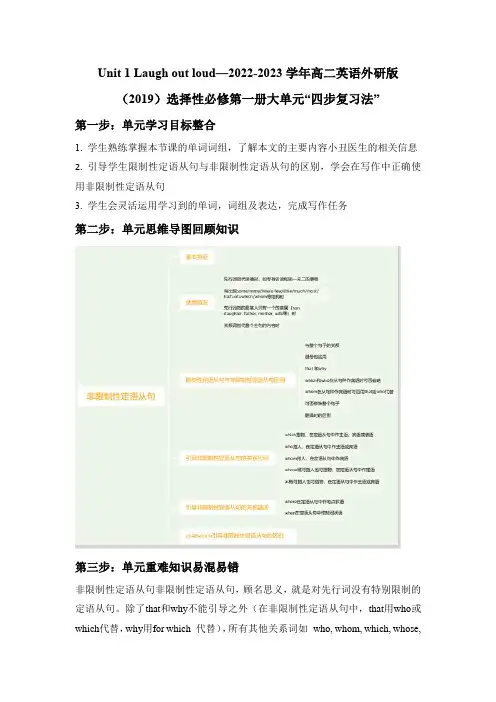
Unit 1 Laugh out loud—2022-2023学年高二英语外研版(2019)选择性必修第一册大单元“四步复习法”第一步:单元学习目标整合1. 学生熟练掌握本节课的单词词组,了解本文的主要内容小丑医生的相关信息2.引导学生限制性定语从句与非限制性定语从句的区别,学会在写作中正确使用非限制性定语从句3. 学生会灵活运用学习到的单词,词组及表达,完成写作任务第二步:单元思维导图回顾知识第三步:单元重难知识易混易错非限制性定语从句非限制性定语从句,顾名思义,就是对先行词没有特别限制的定语从句。
除了that和why不能引导之外(在非限制性定语从句中,that用who或which代替,why用for which 代替),所有其他关系词如who, whom, which, whose,as, when, where等均可引导。
1. 非限制性定语从句的基本特征非限制性定语从句与主句的关系不像限制性定语从句那样紧密,只是对先行词作些附加说明,即使去掉,主句的意思依然清楚完整。
它与主句之间通常用逗号分开。
翻译时常常不译作定语,而是译成与主句并列的句子,或者状语从句。
Last night I saw a very good film, which was about the Second World War.昨晚我看了一部非常好的电影,是关于第二次世界大战的。
My parents live in my hometown, which is about 30 kilometres from here.我的父母住我的家乡,离这里大约30公里。
Milla, who is a distant relative of mine, studies in the Yale now.米拉是我的一位远房亲戚,她现在在耶鲁学习。
The house, where a murder case happened last year, has got a lovely garden.那栋房子有一个漂亮的花园,去年那栋房子里发生过一起谋杀案。
Unit 1 Laugh Out Loud - 高中英语外研版(选择性必修第一册)
Copernicus presented a new concept regarding the solar system.
concept n. 概念;观念; 想法
He marked many spots he wanted to go on the map.
The man impressed the audience with his amazing magic.
impress v. 给......留下深 刻印象;使 钦佩;使牢 记
The horse grinned when I told it a joke.
grin v. 露齿而笑, 咧嘴一笑 n.龇牙笑
entertain v. 使娱乐;招 待,款待; 消遣
Good health care is important to all families.
health care 卫生保健
His friend’s encouraging words cheered him up.
cheer up 使高兴;使 振奋
amusement n. 娱乐;消遣; 乐趣;娱乐 活动
I want to go to this amusement park.
amusement park 游乐场
Her hair is so curly because she uses a special hair product.
curly adj. 卷曲的,卷 毛的,弯曲 的
This pill should do the trick. You’ll feel much better soon.
do the trick 达到目的; 有效
The doctor is examining my dog’s ear.
Unit 1 Laugh out loud 单元词汇课件高中英语外研版(2019)选择性必修第一册
complicated /ˈkɒmplɪkeɪtɪd/ adj. 难处理的;难懂的
conclude /kənˈkluːd/ v. 结束,终止;推论,推断出 conclude with... 以…结束 conclude from... 从…中得出结论 _c_o_n_cl_u_s_io_n____ n. 结论;结束 in conclusion 总之,综上所述 come to/reach/draw a conclusion 得出结论
employer /ɪmˈplɔɪə/ n. 雇用者,雇主 e_m__p_lo_y______ vt. 雇用;利用=hire e_m__p_lo_y_e_e____ n. 雇员 e_m__p_lo_y_m__e_n_t _ n. 就业;工作;受雇 employ sb _t_o_d_o__ sth 雇佣某人做某事 be employed in d_o_i_n_g_ sth 忙于做某事=employ oneself in doing sth
spot—spotted—spotting spot sb. _d_o_i_n_g_ sth. 发现某人正在做某事 put sb. on the spot (故意提出难以回答或尴尬的问题)使某人难堪
cruel /ˈkruːəl/ adj. 残忍的 _c_ru_e_l_ty___ n. 残忍,残酷 _c_r_u_el_l_y__ adv. 残忍地
grin /ɡrɪn/ v. 露齿而笑,咧着嘴笑 grin from ear to ear 笑得合不拢嘴
deserve /dɪˈzɜːv/ v. (不用于进行时)应得,应受到;值得 deserve sth. 应得某物 deserve to do 应该得到,值得做… deserve to be done=deserve doing 应该/值得被…
外研版2019高中英语选择性必修第一册Unit 1 Laugh out Loud! (2)
Whom 引导的非限定性定语从句,whom在从句中做动词或介词的宾语,对某人进行 补充说明
1. 彼得现在回巴黎了,你在伦敦见过他。 句子结构分析:主干为“彼得现在回巴黎了”,“你在伦敦见过他”对Peter补充说明, 此处可以用非限定性定语从句,如果放在中间的位置,前后都要有逗号“”隔开。
Mr Smith, from whom I have learned a lot, is a famous scientist.
Whose引导的非限定性定语从句,whose是关系代词who的所有格形式,在从句中作定 语,说明某物与某人或某物之间的所属关系。whose通常指人,也可指动物或无生命的 事物。
句子结构分析:主干为“在树林的高处是山”,“其壮丽的景色完全映照在河面上” 是补充信息,此处表示“山的壮丽景色”,可以用非限定性定语从句,如果放在中 间的位置,前后都要有逗号“”隔开。
Above the trees are the mountains, whose magnificent scenery totally reflects on the surface.
2. ... laughter produces chemicals to make people feel better, which means clown
doctors can be helpful. 先行词为整个主句
从句前有逗号, 与主句隔开
该信息为补充 信息,非必要 信息
Three factors we have to consider when using defining or non-defining atributives:
2019版外研社高中英语必选择性必修一Unit 1 Laugh out loud! 单词表
默写
mood
/muːd/
n.心情
circus
/ˈsɜːkəs/
n.马戏团
amusement
/əˈmjuːzmənt/
n.娱乐,消遣
amusement park游乐场
curly
/ˈkɜːli/
adj.卷曲的
wig
/wɪɡ/
n.假发
badge
/bædʒ/
n.徽章
ankle
/ˈæŋkl/
n.脚踝
clown
/klaʊn/
n.小丑
entertain
/ˌentəˈteɪn/
v.使快乐
health care医疗保健
cheer up (使)高兴起来, (使)振作起来
do the trick奏效,达到预期效果
examine
/ɪɡˈzæmɪn/
v.检查(身体)
advertisement
adj.中世纪的,中古时期的
emotive*
/ɪˈməʊtɪv/
adj.使情绪激动的
mischievous*
/ˈmɪstʃɪvəs/
adj.调皮的,淘气的
remark*
/rɪˈmɑːk/
n.言论;意见,评论
interaction
/ˌɪntərˈækʃən/
n.交流
barber*
/ˈbɑːbə(r)/
cruel
/ˈkruːəl/
adj.残忍的
whisper
/ˈwɪspə(r)/
v.悄声说,低语
roar*
/rɔː(r)/
v.哄笑,大笑
gently*
/ˈdʒentli/