
人教版八上英语Unit 5-6 语法总结
Unit 5-6 语法总结
1. go to the doctor/dentist = go to see the doctor /dentist去看医生/牙医
2. study for …. 为了….而学习
3. have lessons 上课have an English lesson
4. help sb do sth = help sb with sth 帮某人做某事
5. ----Can/Could you do sth ?
----Sure/Certain ly/Of course, I’d love/like to.
----Sorry/I’m sorry, I can’t.
6. another + 数词+可名复再----- eg: Iwant to study music another 3 years. 我想
再学3年音乐。
7. one…. The other… 一个…..,另一个….. eg: I have 2 sisters . One is a
nurse ,the other is an actor .
8. Some ….., the others…. 一些…., 其余的….. eg: Some teachers want
computers , theothers want bikes .
9. all + 限定词+可名单=限定词+whole+可名单eg: allmy family = my whole
family 我的所有家庭成员
10.比较级用法:a. a little (一点点),much = a lot (…得多),still(仍然),even
(更,甚)…. 可修饰比较级。
eg: My house is a little farther/further than hers. 我家比她家要远一点点。
I was heavier than my sister last year , Iam still heavier than her this year . 去年我比我妹妹胖,今年我仍然比她胖。
b .
比较级and 比较级/ more and more + 原级(多音节和部分双音节的形容词或副词)eg : The life is better and better .生活是越来越
好。
c. The +比较级+句子, the +比较级+句子. ….越…, …就越…eg : The more you want , the less you get . 你想要的多,你得到的就越少。
11. be serious about + doing / sth 对做/ 某事认真/执着eg : Heis serious about
studying English .
12. the mening of … …的意思
13. on sb’s way to sw 在某人去某地的路上
14. in some ways 在某些方面in other ways 在其他方面in different ways 在不
同的方面
15. more than one + 可名单(作主语时,谓语用第三人称单数)不止一… eg: More
than one boy likes the games .
16. more than + 数字= over +数字多于,超过
eg : There are more than 200 teachers inour school . 在我们学校有着超过200名
教师。
17.the same + n. as … as + adv/adj …+as和…一样…
eg :Lucy has the same age as Lily .= Lucy isas old as Lily . Lucy 和Lily 一样大。
18. not as/so + adj/adv …. +as不如…一样eg : I amn’t as/so good at English as
you . 我不如你一样擅长英语。
19. look the same ------ look different
20. both … and … …和… 作主语时,谓语动词用复数eg :Both my sister and I
are students . 我和我妹妹都是学生。
21. make faces 做鬼脸make friends with sb 和某人做朋友make money 赚钱
makekung fu tea 泡功夫茶
22. make sb sth = make sth for sb 给某人制作某物
23. make sb + n. eg : We make him our monitor . 我们让他做我们的班长。
24. make sb/sth adj eg : Don’t make me angry . 不要让我生气。
25. make sb do sth 让某人做某事eg :Don’t make me feel angry . 不要让我感到生
气。
26.have/feel/show/take interest in + doing/sth= be interested in doing /sth 对….感兴
趣
27. have/feel/show/take interest no interestin + doing /sth 对…不感兴趣
28. lose interest in 失去…的兴趣
29. beat 宾语为人或团队beat sb in doing/sth 在做/某事上打败某人eg:The
Chinese team beat the Japanese team in ping-pangball .
win 宾语为物(如:match, prize, war, game, medal)eg:Li Na won the gold medal . 李娜获得了金牌。
30. take care 小心eg: Take care ! A snake is in the front of you . 小心!你前面有一条蛇。
人教版英语八上语法知识篇
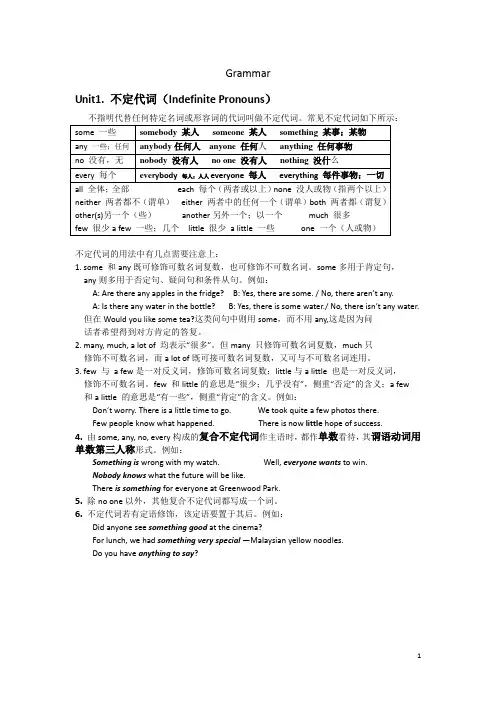
GrammarUnit1. 不定代词(Indefinite Pronouns)不定代词的用法中有几点需要注意上:1. some 和any既可修饰可数名词复数,也可修饰不可数名词。
some多用于肯定句,any则多用于否定句、疑问句和条件从句。
例如:A: Are there any apples in the fridge? B: Yes, there are some. / No, there aren’t any.A: Is there any water in the bottle? B: Yes, there is some water./ No, there isn’t any water.但在Would you like some tea?这类问句中则用some,而不用any,这是因为问话者希望得到对方肯定的答复。
2. many, much, a lot of 均表示“很多”。
但many 只修饰可数名词复数,much只修饰不可数名词,而a lot of既可接可数名词复数,又可与不可数名词连用。
3. few 与a few是一对反义词,修饰可数名词复数;little与a little 也是一对反义词,修饰不可数名词。
few 和little的意思是“很少;几乎没有”,侧重“否定”的含义;a few 和a little 的意思是“有一些”,侧重“肯定”的含义。
例如:Don’t worry. There is a little time to go. We took quite a few photos there.Few people know what happened. There is now little hope of success.4.由some, any, no, every构成的复合不定代词作主语时,都作单数看待,其谓语动词用单数第三人称形式。
例如:Something is wrong with my watch. Well, everyone wants to win.Nobody knows what the future will be like.There is something for everyone at Greenwood Park.5.除no one以外,其他复合不定代词都写成一个词。
人教版八年级上册英语Unit5知识点梳理及语法讲义(学生版)

1. stand(v.忍受;站立) —(过去式)
2. educational(adj.有教育意义的) —(n.教育)
3. discussion(n.讨论;商量) —(v.讨论)
4. meaningless(adj.毫无意义的) —(反义词:有意义的)—(n.意思)
5. action(n.动作) —(v.行动)—(n.演员)
3.The boy____________(stand) up and then ran away.
4.Tom and Jerry is a____________ (success)cartoon.People of all ages like it.
5.It’s time for us to put the plan into____________ (act).
6.When this cartoon came out in New York on November 18, 1928...当这部卡通片于1928年11月18日在纽约上映时……
【用法详解】e out意为“”
【拓展延伸】“动词+out”型的其他短语:
7.In his early films, Mickey was unlucky and had many problems such as losing his house or girlfriend, Minnie.在他早期的电影里,米奇是不幸的,他遇到了许多问题,比如失去他的房子或者女朋友米妮。
Eg.—Would you mind repeating what you said, Diana?戴安娜,你介意把你说的重复一遍吗?
—No, of course not.不,当然不介意。
人教版八年级上册英语 Unit 6 语法知识点总结

Section Abe going to do 打算做某事want to do sth.想要做某事want to be + 职业想成为He wants to be an artist.他想成为一名画家How are you going to become a writer?你打算怎样成为一名作家?when 当........时候,引导时间状语从句。
在含有 when 引导的从句中,如果主句和从句的动作都发生在将来,主句用将来时,从句用一般现在时表将来,反之,主句用一般现在时,从句用一般将来时。
e.g.When I go to Lisa’s party, I’ll call you.我去参加莉莎的聚会时会给你打电话的。
[拓展]while1.)表示“当.......时候”,一般强调主从句的动作同时发生e.g.Lisa was singing while her mother was playing the piano.莉莎在唱歌,而她妈妈在弹钢琴。
2.)并列连词,而,却,表示对比关系。
e.g.Tom is strong while his younger brother is weak.汤姆很强壮,而他弟弟却很瘦弱。
practice doing 练习做某事keep on doing sth.不断地做某事finish doing sth.做完某事promise to do sth.许诺去做某事help to do sth.帮助某人做某事remember to do sth.记住做某事agree to do sth.同意做某事Keep on doing… 不断的做…(表示动作的反复)e.g.This old man kept on coming to offer us hot water. 这位老人不断地给我们送热水。
keep doing表示动作或状态的持续e.g.He kept standing there for an hour without moving. 他在那儿一动不动地站了一个小时。
人教版英语八年级上Unit 5-6知识清单

八上Unit 5-6知识清单一、单词扩展cate (v.) 教育→education(n.)教育→educational (adj.)教育的,有教育意义的2.discuss (v.)讨论→discussion (n.)讨论,商量3.expect (v.)预料,期待→unexpected(adj.)难以预料的→expectation(n.) 期待4.mean (v.)意思是→meaning (n.)意思,含义→meaningful(adj.)有意义的→meaningless(adj.)毫无意义的;意思不明确的5.act (v. & n.)行动→action(n.)行动→actor (n.)演员,男演员→actress (n.)女演员6.culture (n.) 文化→cultural (adj.)文化的7.fame (n.)名声→famous (adj.)著名的;出名的8.appear (v.) 出现→disappear(v.)消失→appearance (n.)外表,露面,出现9.succeed (v.) →success(n.)→successful(adj.)成功的→successfully(adv.)成功地10.luck (n.) 幸运→lucky(adj.幸运的→unlucky(adj.)不幸的→unluckily(adv.)不幸地mon (adj.) 普通的,常见的→uncommon(adj.)不常见的12.simple(adj.)简单的→simply(adv.)简单地13.medicine (n.) 药;医学→medical(adj.)医学的14.foreign (adj.) 外国的→foreigner (n.)外国人15.improve (v.)改进,改善→improvement (n.)改进,改善16.agree (v.) 同意→disagree(v.)不同意→agreement(n.)同意17.relate (v.) 联系,关联→relation(n.)关系→relationship(n.)关系,联系二、必背短语1.don’t mind sth/doing sth不介意某事/做某事2.can’t stand sb/sth不能忍受某人/某事3.learn…from从…学习4.plan to do sth计划做某事5.hope to do sth 希望做某事6.find out发现,查明e out出版,发行8.expect to do sth期待做某事9.think of 想起,认为10. try to do sth.尽力做某事try doing sth. 尝试做某事11.such as 例如12.be ready to do sth 准备着做某事13.try one’s best尽某人最大努力14.dress up like/as 打扮成,装扮成15.take one’s place代替某人的位置16.do a good job干得好17.grow up长大,成长18.be good at在……方面擅长19.keep on doing sth坚持做某事20.be sure about sth对…确信的21.make sure 确保22.take acting/singing lessons 上表演/歌唱课23.go to a cooking school 上烹饪学校24.make promises to sb 向某人作出承诺25.at the beginning of 在…开始26.write down 写下27.have to do with sth 和…有关28.take up 开始从事三、重点句子1.-Do you want to watch the news? Yes, I do.你想看新闻吗?是的。
人教版英语八年级上册Unit5(语法全解):动词不定式
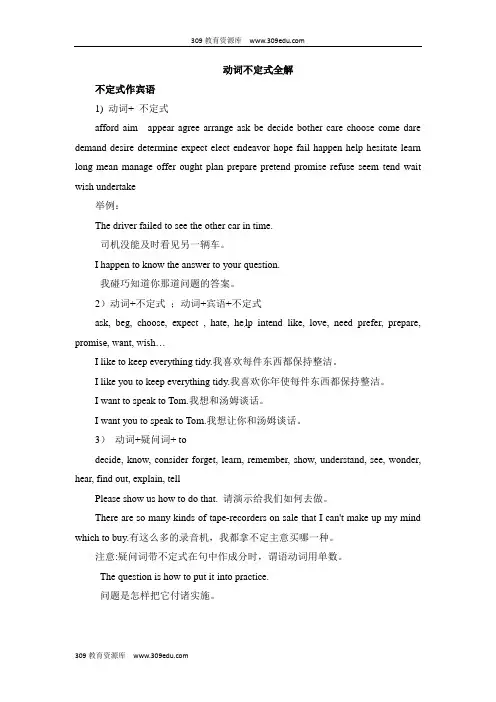
动词不定式全解不定式作宾语1) 动词+ 不定式afford aim appear agree arrange ask be decide bother care choose come dare demand desire determine expect elect endeavor hope fail happen help hesitate learn long mean manage offer ought plan prepare pretend promise refuse seem tend wait wish undertake举例:The driver failed to see the other car in time.司机没能及时看见另一辆车。
I happen to know the answer to your question.我碰巧知道你那道问题的答案。
2)动词+不定式;动词+宾语+不定式ask, beg, choose, expect , hate, he lp intend like, love, need prefer, prepare, p romise, want, wish…I like to keep everything tidy.我喜欢每件东西都保持整洁。
I like you to keep everything tidy.我喜欢你年使每件东西都保持整洁。
I want to speak to Tom.我想和汤姆谈话。
I want you to speak to Tom.我想让你和汤姆谈话。
3)动词+疑问词+ todecide, know, consider forget, learn, remember, show, understand, see, wonder, hear, find out, explain, tellPlease show us how to do that. 请演示给我们如何去做。
人教版八年级上册英语 知识点语法归纳总结 Unit 5

Unit 5 Do you want to watch a game show?1.短语归纳2.典句必背3.用法集萃(1)What do you want to watch? 你想看什么?❖辨析: look,see,watch与notice(2)I don’t mind them. 我不介意它们。
❖mind用作动词时,意思是“介意”,常用于否定句、疑问句中,其后通常跟名词、动名词、代词或从句。
例:I don’t mind the noise during the day. 我并不介意白天的噪声(名词)Would you mind waiting outside for a moment? 您介意在外面等一会儿吗?(动名词)Do you mind if I ask you one more question? 您介意我再问您一个问题吗?(从句)(3)Do you plan to watch the news tonight? 今晚你打算看新闻吗?❖plan作动词时,意为“计划,打算”,其现在分词形式为planning,过去式为planned。
plan 常见的用法有:(4)Because I hope to find out what’s going on around the world.因为我希望弄清楚世界各地正在发生的事❖hope的用法❖辨析:expect, hope, wish与look forward to(5)Oh, I can’t stand them. 哦,我受不了它们。
❖ stand 在这里是一个及物动词,意思是“忍受,容忍”。
后面接名词、代词或动名词作宾语。
stand 的常见用法如下:(6) ..but you can expect to learn a lot from them. 但是你可以期望从它们中学到很多东西 ❖ expect 意为“期待,期望”,其具体用法如下:(7) But one very famous symbol in American culture is a cartoon.但是在美国文化中一个非常有名的代表就是卡通片。
最新人教版英语中考总复习教材知识点总结第七节 八年级(上)Unit 5~Unit 6
英语
( B )1.A.by
B.with
C.of
D.beyond
( C )2.A.appear B.appears C.appeared D.was appearing
( A )3.A.When B.As
C.Since D.Until
( B )4.A.success B.successful C.succeed D.successfully
返回
英语
21.普通的 common . 22.电影 film . 23.失去 lose . 24.愿意的 ready . 25.简单的 simple . 26.陆军 army.
返回
英语
(二)常考短语 1.让某人做某事 let sb.do sth. . 2.从……获得 learn from . 3.打算/计划做某事 plan to do sth. . 4.希望做某事 hope to do sth. . 5.查明 find out .
( B )10.A.famous
B.more famous
C.most famous
D.the most famous
返回
英语
语言综合运用 一、语法选择
Mel found a wallet on her way back home.She picked 1 up and there was five hundred dollars inside! Mel always wanted 2 a bike but her mum said they had no money.No one had seen her.She put it into her schoolbag and ran home fast.
最全面新人教版八年级上册英语单元语法及知识点归纳汇总(精华版)
新人教版八年级上册英语单元语法及知识点归纳Unit1 Where did you go on vacation?【重点语法】不定代词:不指名代替任何特定名词或形容词的代词叫做不定代词。
用法注意:1. some 和any +可数名/不可数名。
some 多用于肯定句,any多用于否定句、疑问句和条件从句。
有些问句中用some,不用any, 问话者希望得到对方肯定回答。
2. 由some, any, no, every 与body, one, thing构成的复合不定代词作主语时,其谓语动词用三单。
3. 不定代词若有定语修饰,该定语要置于其后:如:something interesting【重点短语】1. buy sth for ab./ buy sb. sth 为某人买某物2. taste + adj. 尝起来……3. nothing...but + V.(原形) 除了……之外什么都没有4. seem + (to be) + adj 看起来5. arrive in + 大地方/ arrive at + 小地方到达某地6. decide to do sth. 决定做某事7. try doing sth. 尝试做某事/ try to do sth. 尽力做某事8. enjoy doing sth. 喜欢做某事9. want to do sth. 想去做某事10. start doing sth. 开始做某事=begin doing sth.11. stop doing sth. 停止做某事区分:stop to do sth. 停下来去做某事12. dislike doing sth. 不喜欢做某事14. so + adj + that + 从句如此……以至于……16. tell sb. (not) to do sth. 告诉某人(不要)做某事17. keep doing sth. 继续做某事18. forget to do sth. 忘记去做某事/ forget doing sth 忘记做过某事【词语辨析】1. take a photo/ take photos 拍照quite a few+名词复数“许多…”2. seem + 形容词看起来…... You seem happy today.seem + to do sth. 似乎/好像做某事I seem to have a coldIt seems + 从句似乎..…. It seems that no one believe you.seem like ... 好像,似乎….. It seems like a good idea.3. arrive in +大地点= get to= reach+地点名“到达......”arrive at +小地点(注:若后跟地点副词here/there/home, 介词需省略,如:arrive here; get home)4. feel like sth 感觉像…feel doing sth. 想要做某事5. wonder(想知道)+疑问词(who, what, why)引导的从句。
最新人教版八年级英语上册Unit5重点单词加语法小结
最新人教版八年级英语上册Unit5重点单
词加语法小结
本文主要总结了最新人教版八年级英语上册Unit5的重点单词和语法知识。
以下是重点单词和语法的详细内容:
重点单词:
1.adventure - 冒险
2.countryside - 农村
3.festival - 节日
4.cliff - 悬崖
5.forest - 森林
6.ancient - 古代的
7.ruin - 废墟
8.site - 地点
9.symbol - 象征
10.haunted - 闹鬼的
语法小结:
1.形容词的比较级和最高级:在比较两个人或物时,用比较级;在比较三个或三个以上人或物时,用最高级。
形容词比较级的构成:原级 + -er(如:taller)
形容词最高级的构成:原级 + -est(如:tallest)
不规则变化:good - better - best、bad - worse - worst
2.介词短语用于描述位置:介词短语可以用来描述人或物的位
置关系。
on the left/right - 在左/右边
in front of - 在。
的前面
___ - 在。
的后面
next to - 在。
的旁边
3.定语从句:定语从句用来对名词进行修饰。
关系代词who。
that。
which可用来引导定语从句
关系代词在定语从句中作主语时,不可省略
关系代词在定语从句中作宾语时,可以省略
以上是最新人教版八年级英语上册Unit5的重点单词和语法小结。
希望对你的学习有所帮助!。
人教版八年级上册英语Unit 6 知识点语法归纳总结
人教版八年级上册英语Unit 6 知识点语法归纳总结Unit 6 Grammar SummaryIn this unit, we have learned several important grammar points related to tenses, sentence structures, and word usage. In this summary, we will outline and explain these points to reinforce our understanding.1. Present tenses:- Present simple: Used for habitual actions and general truths. Formed with the base form of the verb, adding 's' or 'es' for third-person singular subjects.- Present continuous: Used for actions happening at the moment of speaking or temporary actions. Formed with the present tense of the verb 'be' (am, is, are) + the present participle (-ing form) of the main verb.2. Past tenses:- Simple past: Used for completed actions in the past. Regular verbs are formed by adding '-ed' to the base form, while irregular verbs have specific forms.- Past continuous: Used for actions that were in progress at a specific time in the past. Formed with the past tense of the verb 'be' (was, were) + the present participle (-ing form) of the main verb.3. Future tenses:- Will + base form: Used for future predictions, decisions, and promises.- Be going to + base form: Used for future plans or intentions.- Present continuous: Used for future arrangements or fixed plans.4. Gerunds and infinitives:- Gerunds: Verb forms ending in '-ing' that function as nouns.- Infinitives: Base form of the verb preceded by 'to' that can function as nouns, adjectives, or adverbs.5. Passive voice:- Formed with the auxiliary verb 'be' + past participle. The subject of the active voice sentence becomes the object in the passive voice.6. Reported speech:- Reporting verbs such as say, tell, ask, etc., are used to report what someone said.- Reported speech involves changing verb tenses, pronouns, time expressions, and place expressions.7. Conditional sentences:- Zero Conditional: Used for general truths and facts. Formed with present simple in both the if-clause and the main clause.- First Conditional: Used for possible events in the future. Formed with present simple in the if-clause and future simple (will + base form) in the main clause.- Second Conditional: Used for hypothetical or unreal events in the present or future. Formed with past simple in the if-clause and would + base form in the main clause.- Third Conditional: Used for hypothetical or unreal events in the past. Formed with past perfect in the if-clause and would have + past participle in the main clause.8. Comparative and superlative forms:- Comparative: Used to compare two things. Most adjectives add '-er' or use 'more' before the adjective. Irregular forms have specific comparative forms.- Superlative: Used to compare three or more things. Most adjectives add '-est' or use 'most' before the adjective. Irregular forms have specific superlative forms.Remember to practice these grammar points through exercises and conversation to develop a strong foundation in English grammar.。