
人教版英语九年级Unit12 Section B 知识点讲解
After that, We had a P.E. class .Although I like P.E. very much,I was very hungry and couldn't do any exercise.
Finally, when I got back home after school, I was very tired and hungry,because I ate nothing all day.
A. given out B. looked out C. sold out D. come out
7.— How many people were invited to the meeting?
— About six ____. A. hundred B. hundreds C. hundred of D. hundreds of
• costume n.(特定场合穿的)服装;装束 • costume party化装舞会
• embarrass v. 使尴尬→embarrassed adj.窘 迫的; 尴尬的(用来修饰人)
→embarrassing adj. 令人难堪的(修饰物)
eg:His________________words made everyone_______________.他那令人窘迫的 话使每个人都感到尴尬。
【易错题】The policemen will go to_________the truth.
A. find
B. find out
C. decide
D. look for
4.Many April Fool’s jokes may end up being not very funny.(2b)
end up最终成为; 最后处于;结 束=finish ① end (up) with以……结束----begin/start with eg:Our class ended up with a stroy. ② end up in+地点 eg:If you continue to steal,you'll end up in prison. ③end up doing以做……结束 eg:The party ended up singing an English song
John and Mary have been married for 4 years. be/get married to sb.和某人结婚
eg:He wants to get married to a teacher.
My unlucky day I will always remember the date February 28,2014. This was the unluckiest day of my life. When I woke up that morning, it was already 8:00 am.So I had to run to school without eating breakfast.But by the time I got to school, The bell had rung.And when I went into the classroom the teacher had begun the class. Later that day,I found that I had left my wallet at home and I had no money to buy lunch.I couldn't delieve it.
st Friday night, my friend invited me to his birthday party .
invite v. → invitation n.邀请 invite sb. to +地点 邀请某人到某地 invite sb. to do sth 邀请某人做某事
Lucy is shy.She would not invite her classmates________dancing with her.
( ) It's impolite to laugh at, stare at or play _____on disabled people
A. fun B. jokes C. tricks D. parts 【连接】laugh at 嘲笑 make fun of 取笑;使……开
玩笑
2. Many people ran to their local
A.clearly B.more clearly C.most clearly D.the most clearly
4.---Dad,why must I stop_______computer games?
---For your health,my boy. A.play B.to play C.to playing D.playing
3. By the end of the day, more than 10,000 people had phoned the TV station to find out how to get the water. 一天之内有一万多人打电话给电视台, 询问如何弄到这种水。(2b)
find out “找出,查明,弄清楚”,后可接名词/名 词性短语或宾语从句
8.When he arrived at the airport, Lee Minho found that ____ fans were waiting for him there. A. hundred B. hundreds C. hundred of D. hundreds of
2.— Jack, could you help me ____ when the plane will take off on the Internet? A. get out B. look out C. take out D. find out
3.The volunteer spoke as_______as she could to make the visitors understand her.
Unit 12
Section B
New words
• fool (1) n. 傻子 呆子 (2) v. 愚弄 欺骗 →foolish adj. 愚蠢的
on April Fool’s Day 愚人节 make a fool of sb. 愚弄某人 eg:He is a fool.(名词)
We can’t fool our teacher. (动词) Don't make a fool of her.
【辨析】find out, look for 与 find (1)find out 强调经过调查、询问、研究等曲折过程
后才能找出。如:
Please find out when the train leaves. (2)look for 意为“寻找”,强调寻找的过程。如: I'm looking for it everywhere.我正在到处找它。 (3)find 意为“发现,找到”,强调寻找的结果。如: I can't find my pet dog.我找不到我的宠物狗。
5.He asked her to marry him. The lady was so happy because she really wanted to get married.他向她求婚。 marry v.嫁;结婚 marry sb和某人结婚;嫁给某人
eg: John married Mary last week. marry sb to sb把ห้องสมุดไป่ตู้让某人嫁/娶给某人
A.practice B.practices C.practicing
D.to practice
eg:Did you get an invitation to the party?
New words
• announce v.宣布;宣告 eg:A reporter in England announced that there would be no more spaghetti. • spaghetti n.意大利面条 • hoax n.骗局;恶作剧
• sell out卖光
eg:The shop sold out all the shirts. (用物作主语时,常用于被动语态 be sold
out 被卖光)
Tickets for the football match were sold
out in two hours. • discovery n.发现;发觉 (pl.)discoveries • lady n.女士 • cancel v.取消;终止
I think that was the worst day I'd had in along time.
What an unlucky day.
1.Catherine got married______ a policeman twenty years ago. A.with B.for C.to
英语人教版九年级全册Unit 12 SectionB
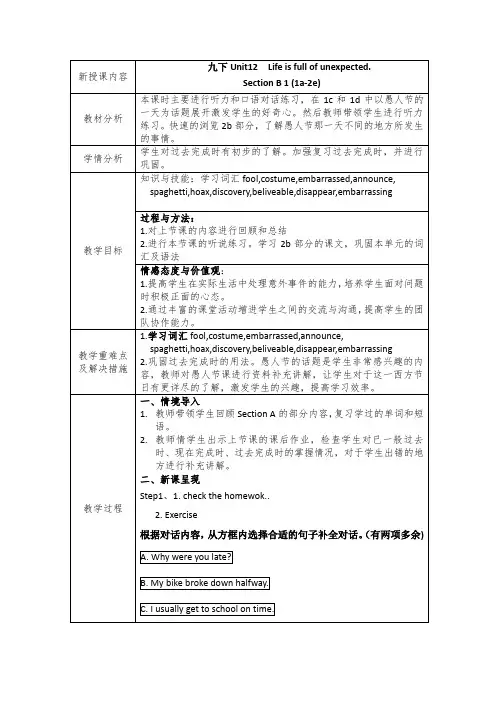
时、现在完成时、过去完成时的掌握情况,对于学生出错的地 方进行补充讲解。 二、新课呈现
Step1、1. check the homewok..
2. Exercise
根据对话内容,从方框内选择合适的句子补全对话。(有两项多余)
A. Why were you late?
新授课内容 教材分析 学情分析
九下 Unit12 Life is full of unexpected.
Section B 1 (1a-2e)
本课时主要进行听力和口语对话练习,在 1c 和 1d 中以愚人节的 一天为话题展开激发学生的好奇心。然后教师带领学生进行听力 练习。快速的浏览 2b 部分,了解愚人节那一天不同的地方所发生 的事情。 学生对过去完成时有初步的了解。加强复习过去完成时,并进行 巩固。 知识与技能:学习词汇 fool,costume,embarrassed,announce,
B: It’s my pleasure.
Keys: 1—5 D A F G E
Step2. Lead in
1.new words.
2.. Finish 1a. Put these words in the correct columns in the chart.
Some words can go in more than one column.
F. I rushed to the bus shop without breakfast.
G. By I got to the school, the class had been on 15 minutes.
A: Can I ask you some questions, Lisa?
九年级下册英语第十二单元2b知识点

九年级下册英语第十二单元2b知识点回顾回顾内容多样,涵盖了语法、词汇和阅读理解,本篇文章将从这些方面进行探讨和总结。
一、语法知识点回顾本单元的语法重点是情态动词的用法。
情态动词包括can、could、may、might、must、shall、should、will、would等。
它们常用来表达说话人的态度、意愿、推测、能力等。
例如,can表示能力,如I can swim. could表示过去的能力或者礼貌地请求,如He could swim when he was five. May表示询问许可,如May I go to the bathroom? Must表示必须,如You must study hard.等。
另外,情态动词后面接动词原形,不能加动词的第三人称单数变化,也不能用于一般现在时和一般过去时。
例如,She can swim very well. (正确) She cans swim very well. (错误)二、词汇知识点回顾本单元的词汇重点涉及与学校生活相关的词汇,如classroom、library、canteen、playground等。
另外,本单元还涉及到一些与健康和生活方式相关的词汇,如healthy、diet、exercise、vegetables等。
这些词汇对于我们日常生活的交流和阅读理解都非常重要。
三、阅读理解知识点回顾本单元的阅读理解主要包括两篇短文,一篇是关于健康生活的建议,另一篇是关于学校图书馆的介绍。
阅读理解题目涉及的内容包括主旨大意、细节理解、推理判断等。
在解答题目时,要仔细阅读全文,理解每段的主题和内容,同时要注意细节的把握和推理能力的运用。
例如,通过阅读健康生活的建议,我们可以了解到健康的生活方式,如每天做锻炼、多吃蔬菜水果等。
通过阅读学校图书馆的介绍,我们可以了解到学校图书馆的位置、开放时间、借还书规则等。
四、总结和思考通过对的回顾,我们可以发现,掌握语法、词汇和阅读理解技巧对于学好英语非常重要。
人教版英语九年级下册Unit 12 Section B (2a-2e)
By the time people realized that the story was a hoax, all of the
卖光
spaghetti across the country had been sold out. In another famous
trick a TV show in England reported the discovery of special water.
2.By the end of the day,more than 10,000 people had phoned the TV station to find out how to get this water. ➢To learn the reading skill and know more about April Fool’s Day.
Time
On April Fool’s Day
Place
Trick
A famous TV star asked his girlfriend ___t_o_m__a_rr_y__h_im___.
Result
The TV star lost _h_is_g_i_r_lf_r_ie_n_d____ and his show ____w_a_s_c_a_n_c_e_le_d_.
They said this water would help
and连接的并列的宾语从句
people lose weight and that one customer had already lost a lot of weight in第ju一st个f宾ou语r从m句o省nt略hs了. tBhayt, 第th二e个en宾d语o从f 句ththeatd不a可y,省m略ore than
九年级英语下册课件:unit 12 第六课时 Section B (3a-3b)——单元同步作文指导

③Before I got to the bus stop,the bus had already left.在我到达公共汽车 站之前,公共汽车已经离开了。
⑥This was the luckiest/unluckiest day of my life.这是我生命中最幸运/最 不幸的一天。
⑦What a lucky/an unlucky day!多么幸运/不幸的一天啊!
经典范文展示一
生活就像一盒巧克力,你永远不知道会得到什么,每一天的生活都充 满不确定性。这一天可能是幸运的,也可能是倒霉的;这一天可能是快 乐的,也可能是悲伤的。请你以“My ________ Day”为题写一篇英语短文, 说一说你的一天。
要求:1.在题目中填入适当的形容词,如lucky,unlucky,happy或sad 等;
2.语句连贯,表达准确。 3.90词左右。
My Unlucky Day Today is one of the unluckiest day of my life. In the morning my clock didn't go off,so I got up late.I quickly put on my clothes and rushed out of the house without eating breakfast.When I arrived at school,the class had already begun.I was fifteen minutes late.In English class, I realized that I had left my English textbook at home.After school,I couldn't go into my house when I got home because I had left my keys at home. What an unlucky day!
人教版英语九年级全一册 Unit12 SectionB 2b--2d 课件

have a very happy ending. The TV star lost his girlfriend and his show was canceled.
One of the world’s most famous tricks, however, happened in October rather than April. In that month in 1938, actor Orson Welles announced on his radio program that aliens from Mars had landed on the earth.
Unit 12
Life is full of the unexpected
announce spaghetti hoax sell out lady cancel officer believable disappear embarrassing Italy Mars
April Fool’s Day is a celebration that takes place in different countries around the world. It happens on April 1st every year and is a day when many people play all kinds of tricks and jokes on each other.
USING BACKGROUND KNOWLEDGE Carefully reading the first sentence in each paragraph can activate your own knowledge of the topic and help you guess what the whole text is about.
初三英语第12单元2b短语和时态复习
3. The lady was so happy because she really wanted to get married.
marry v. “嫁,娶,结婚” ⑴ marry sb. 表示“嫁给某人”、 “娶了某人” ⑵ get/be married to sb. “和某人 结婚”
1) John is going to marry Jane. 约翰要娶简为妻了。
L7 across the whole country (遍及)整个国家
L8 officer n. 官员;军官 L9 thousands of 许多;几千
5
重难点理解:
1.It happens on April 1st every year and is a day when many people play all kinds of tricks and jokes on each other.
Section B Period 3
1
2
第一段:L1 take place (happen)发生
L2-3 around the world= all over the world (遍及)全世界
on A pril 1st 在四月1号
L4-5 play all kinds of tricks and jokes on each other 对某人各种各样恶作剧和开玩笑 第二段:
sell(sold) out 卖光 had been sold out L6 discovery n.发现;发觉(V. discover) L7 lose weight 减肥 put on weight L8 by the end of (the day )在……结束前
第三段:L1 end up being 最终成为
九年级全一册英语第十二单元2b知识点
九年级全一册英语第十二单元2b知识点Title: Exploring Key Concepts from Unit 12 Lesson 2B in Grade 9 English CurriculumIntroduction:The Grade 9 English curriculum covers a wide range of compelling topics to enhance students' language skills. In the twelfth unit, Lesson 2B focuses on various essential knowledge points. In this article, we delve into these key concepts without delving into unrelated tangents. Through a comprehensive exploration of this lesson, we aim to offer a deeper understanding of the subject matter.Vocabulary Building:Vocabulary building is crucial in language learning. Lesson 2B introduces new words such as "navigate," "splash," and "altitude." Understanding their meanings and usage is vital for effective communication. To facilitate vocabulary retention, one can associate these words with real-life scenarios. For example, "navigate" could be linked to using a GPS for directions, "splash" with jumping into a pool, and "altitude" with airplanes soaring high in the sky.Structuring Sentences:Lesson 2B emphasizes the structure and organization of sentences. Students are introduced to the concept of subject-verb-object formation, which is the basic grammatical structure of an English sentence. Practice exercises allow students to become familiar with constructing meaningful sentences using this pattern. Incorporating activities where students engage in dialogue or write compositions can further reinforce their understanding and application of sentence structure.Using Comparatives:Comparative forms are often used to compare two or more things. Lesson 2B explores the use of comparative adjectives, such as "bigger," "faster," and "more beautiful." Students learn to identify the attributes being compared and correctly form sentences using appropriate comparative terms. Engaging in discussions on various comparative scenarios, such as comparing cities, books, or movies, helps students grasp the concept effectively.Expressing Preference:The ability to express preferences is an essential aspect of communication. Lesson 2B introduces phrases such as "I prefer," "I'd rather," and "I like... better than." Through practice exercises, students learn to express their personal preferences and make informed choices.Incorporating role-play activities or debates can encourage students to express their opinions more confidently and convincingly.Understanding Idioms:Idioms play a significant role in everyday English conversation, adding color and depth to language. Lesson 2B introduces idiomatic expressions such as "down to earth" and "on top of the world." Understanding the meanings of these phrases in context helps students decode figurative language and improve their overall comprehension skills. Incorporating idioms into storytelling exercises or discussing popular idioms in media can make learning idiomatic expressions more engaging and memorable.Conclusion:The twelfth unit's Lesson 2B in the Grade 9 English curriculum explores a range of important language concepts. By delving into vocabulary building, sentence structure, comparative forms, expressing preferences, and idiomatic expressions, students can enhance their language skills comprehensively. Incorporating various interactive activities and real-life examples can foster a deeper understanding and appreciation for these key knowledge points. Continual practice and engagement with the subject matter will ultimately pave the way for proficiency in the English language.。
Unit12第4课时 Section B(1a -1e)(教学课件)-九年级英语全一册(人教新目标)
costume, embarrassed
A boy wears a costume to the party while others don’t.
a costume party
化装舞会
Lead-in
It was originated from the UK in 18th century,
and now it is popular in western countries.
On March 31, Joe’s friend told him they _w_o_u_ld__h_av_e___ a math test the next day. By the time he _g_o_t__to math class, he was __t_ir_e_d__ because he __h_a_d_s_ta_y_e_d_u_p___ all night studying. Then he found out his friend ___h_a_d_f_oo_l_e_d___ him. There was no math test at all!
a monster mask, shocked
The boy is fooled by another boy who wears a monster mask.
人教版英语九年级Unit12 Section AB知识点讲解
rush v.&n.仓促;急促 rush to do sth赶紧/抢着做某事
eg:They all rushed out to help the old man. rush to...冲/奔向......
1.By the time I got up, my brother _h_a_d___already _g_o_t_te_n_ in the shower. (1b)我 起床时,我弟弟已经进入浴室了。
by the time "在……以前;到.....时候",引导 的时间状语从句若是过去时,主句常用过 去完成时,即"had+动词过去分词"。
Unit 12
New words
• unexpected adj.出乎意料的;始料未及的 • by the time....在......以前 • backpack n.背包;旅行包 • oversleep(overslept,overslept)睡过头;睡得
太久 eg:He overslept and missed the train. • ring v.(rang,rung)(钟、铃)铃;响
4 .By the time she arrived at the airport , the plane ______ .
A .has taken off B .was taking off C. had taken off D. would take off
1.By the time of last term, we ______ all the lessons.
人教版九年级英语12单元2b知识点
人教版九年级英语12单元2b知识点Unit 12 Lesson 2B: Knowledge PointsIn this lesson, we will explore the knowledge points covered in Unit 12 Lesson 2B of the 9th-grade English textbook by People's Education Press. We will delve into various concepts and ideas that are essential for a better understanding of the English language. Let's get started!1. Vocabulary Expansion:One crucial aspect of learning any language is expanding vocabulary. This lesson introduces us to several new words and expressions. It is essential to familiarize ourselves with them to enhance our communication skills. Some of the words we encounter in this lesson include "ignite," "approachable," and "unforgettable." By incorporating these words into our daily conversation and writing, we can enhance our fluency and diversify our language usage.2. Grammar: Modal Verbs:Modal verbs play a significant role in English grammar, expressing possibility, ability, necessity, and permission. In this lesson, we come across modal verbs such as "can," "could," and "may." Understanding their usage can help us convey our thoughts accurately. For example,"can" is used to express general ability, while "could" is used for specific past ability. "May" is often used to seek permission or express possibility. Mastering modal verbs can enhance our language proficiency and enable us to communicate effectively.3. Listening Comprehension:Listening skills are essential for effective communication in any language. This lesson includes a listening comprehension exercise to help us improve our listening abilities. By carefully listening to the audio and understanding the context, we can develop our comprehension skills. Additionally, this exercise helps us become familiar with different accents and adjust our listening accordingly - an essential skill in today's globalized world.4. Reading Comprehension: Context Clues:Understanding the meaning of unfamiliar words while reading is crucial. In this lesson, we encounter unfamiliar words and phrases, and the context clues provided in the text help us decipher their meanings. By paying attention to the surrounding words and sentences, we can make educated guesses about the meaning of unknown vocabulary. This skill not only enhances our reading comprehension but also helps in building our vocabulary.5. Writing Practice: Descriptive Writing:Descriptive writing is an integral part of English language skills. It allows us to vividly paint a picture with words, engaging the reader's senses. In this lesson, we are encouraged to write a descriptive paragraph on a memorable experience. By employing appropriate adjectives, strong verbs, and sensory details, we can bring our experiences to life on paper. This exercise improves our writing skills and enables us to express ourselves more effectively.6. Translation: Translating Sentences:Developing translation skills can help bridge the gap between different languages and facilitate communication. This lesson provides us with a sentence translation activity, where we are required to translate English sentences into Chinese. By accurately conveying the meaning and nuances of the original sentence, we sharpen our language understanding and ensure effective communication between English and Chinese languages.In conclusion, Unit 12 Lesson 2B of the 9th-grade English textbook offers valuable knowledge points to enhance our language skills. From expanding vocabulary to mastering grammar, listening comprehension, reading comprehension, writing, and translation, each aspect plays a significant role in our language development. By focusing on theseknowledge points and practicing them regularly, we can strengthen our English proficiency and become confident communicators in the language.。