
《英语教学法》期末考试试题之一答案和评分标准
福建师范《英语教学法》期末试卷a

福建师范《英语教学法》期末试卷a▆ ■ ■ ■ ■ ■ ■ ■ ■ ■ ■ ■ ■▆ 《英语教学法》试卷共2页(第 1 页)答案务必写在对应的作答区域内,否则不得分,超出黑色边框区域的答案无效!《英语教学法》期末考试A 卷姓名:专业:学号:学习中心:成绩:一、名词解释( 40分) 1. 教学资源教学资源是为教学的有效开展提供的素du 材等各种可被利用的条件,通常包括教材、案例、影视、图片、课件等,也包括教师资源、教具、基础设施等,广义也应该涉及到教育政策等内容。
2. 英语写作策略是学生学习英语和培养语言能力的主要内容,教师应充分利用教材内容,由浅入深,由简到繁,指导学生进行多种形式的写作训练.3. 教学设计是根据课程标准的要求和教学对象的特点,将教学诸要素有序安排,确定合适的教学方案的设想和计划。
4. 发现式教学法发现式教学法又称问题教学法,是指教师不直接把现成的知识传授给学生,而是引导学生在教师事先精心设计、周密组织安排的一系列学习活动中,通过自主探索、合作交流,像数学家那样去自己发现数学事实、主动获取数学知识的一种教学方法.二、论述题( 30分)1. PWP 教学过程的本质特征是什么?答:教学过程的本质在于它是一种特定的认识活动,是实现学生身心发展的过程。
表现在:(1)教学过程主要是一种认识过程教学过程是教师教与学生学的统一,但这两种活动却有着不同的性质。
一方面,在教师教的活动中,教师是活动的主体,学生是活动的客体,教师教的活动是属于变革和改造客体的实践活动的范畴。
另一方面在学生学的活动中,学生是学习的主体,课程和教材是学生学习的客体。
学生的学习活动应属于认识活动的范畴。
学生的认识活动是教学中最主要的活动,教学过程主要是一种认识过程。
(2)教学过程是一种特殊的认识过程其特殊性表现在:①间接性与简捷性;②交往性与实践性;③教育性与发展性;④引导性与指导性。
2. 英语教学中如何进行教材的整合。
请举例说明。
英语专业英语教学法试题、试题答案及评分标准.doc

电大英语教学法模拟题Information for the examinees:This examination consists of THREE sections. They are:Section I : Basic Theories and Principles (30 points, 20 minutes)Section II: Problem Solving (30 points, 50 minutes)Section III: Mini-lesson Plan (40 points, 50 minutes)The total marks for this examination are 100 points. Time allowed for completing this examination is 2 hours.You must write all your answers on the Answer Sheet.注意事项一、将你的准考证号、学生证号、姓名及分校(工作站)名称填写在答题纸的规定栏内。
考试结束后,把试卷和答题纸放在桌上。
试卷和答题纸均不得带出考场。
二、仔细阅读题目的说明,并按题目要求答题。
答案一定要写在答题纸的指定位置上, 写在试卷上的答案无效。
三、用蓝、黑圆珠笔或钢笔答题,使用铅笔答题无效。
Section I : Basic Theories and Principles30 pointsQuestions 1-15 are based on this part.Directions: Choose the best answer for the following questions and write your answers on the answer sheet.1.Among the factors affecting a lesson plan, which of the following is human factor?A.personality of the teacherB.class sizeC・ course requirement2.What should a required lesson plan look like?A.a copy of explanation of words and structuresB.a timetable for activitiesC・ transcribed procedure of classroom instruction3.When should the teacher issue the instruction?A・ as soon as class beginsB. when students9 attention is directed to the teacherC・ when class is silent4・ Which of the following arrangements of seats is most suitable for presentation?5・ For better classroom management, what should the .teacher do while the students a doing activities?A.participate in a groupB.prepare for the next procedureC.circulate around the class to monitor, prompt and help6.Which of the following expresses instrumental motivation?A.I learn English in order to survive in the target language country.B.I learn English just because of interest.C.I learn English in order to get promoted in one*s position.7.Which of the following activities can best motivate junior learners?A・ gamesB・ recitationC. role-play of dialogues8.To cultivate communicative competence, what should conection focus on?A.linguistic formsmunicative strategiesC・ grammatical rules9.Which of the following activity is most demanding?A.list what you can buy at a supermarketB.list what you can buy at a supermarket in five minutesC.list at least 15 things in you can buy at a supermarket in five minutes10- Which of the following activity is most productive?A. read the text and then choose the best answer to the questionsB・ discuss on the given topic according to the text you have just readC・ exchange and edit the writing of your partner11.To help students understand the structure of a text and sentence sequencing, we could use ___________ for students to rearrange the sentences in the right order・A.cohesive devicesB.a coherent textC.scrambled sentences12.The purpose of the outline is to enable the students to have a clear organization of ideas and a structure that can guide them _____________ •A.in the actual writingB.in free writingC・ in controlled writing13.__________ tell you what you should use in order to produce accurate utterances.A.The descriptive grammarB.The prescriptive grammarC.The traditional grammar14.The grammar rules are often given first and explained to the students and then the students have to apply the rules to given situations. This approach is called ______________ .A.deductive grammar teachingB.inductive grammar teachingC・ prescriptive grammar teaching15・ It is easier for students to remember new words if they are designed in__________ and if they are and again and again in _____________ situations and contexts.A.context, sameB.context, differentC・ concept, difficultSection II: Problem Solving30 pointsDirections: Five situations in classroom teaching are provided here. In each situation there are some problems. Firstly,identify the problems; Secondly, provide your own solutions according to the communicative language teaching principles. You must elaborate on the problem (s) and solutions in about 50-70 words.Situation 1In a writing lesson, the teacher writes the topic 'Environmental Awareness11 on the blackboard, and then asks the students to write an essay of 150 words in half an hour in class. Half an hour later, the teacher collects the writings・Situation 2At the practice stage of a grammar lesson, the teacher designs an activity with multiple choice questions to practise the grammatical items the students learned・Situation 3At the production stage of a speaking lesson, the teacher divides the students into 6 groups to do the discussion. And then the teacher retreats to a corner of the classroom to prepare for the next activity. Situation 4In an oral class, a teacher asks students to answer questions. To ensure smooth progress of his lesson, he always asks the excellent students to answer questions・Situation 5In a reading lesson, at the while-reading stage, the teacher assigns some skimming tasks, but some students are consulting their dictionaries for new words and expressions. The teacher notices all this but pretends not to see.Section III: Mini-lesson Plan 40 pointsDirections: Read the following two texts carefully and complete the teaching plans.1 • The following is an abstract from Senior I , Student Book. Please design a teaching plan with the text.2. The following is an abstract from Senior II, Student Book ・ Please design a teaching plan with the text. Noun Clauses as the AppositiveThe idea that computers will recognize human voices surprises many people.The possibility that the majority of the labor force will work at home is often discussed.Grammar(供参考)Section I :Basic Theories and Principles30 points共30分,每题2分1. A2. C3. B4. B5. C6. C7. A8. B9. C1(). B11. C 12. A 13. B 14. A 15. BSection II:Problem Solving30 points共30分,每题6分(找出问题得3分,根据交际法原则提出合理的解决方案得3分,问题和解决方案应有50至70词的阐述,并应基本包括参考答案所涉及的要点。
《英语教学法》期末考试A卷 BB

▆ ■ ■ ■ ■ ■ ■ ■ ■ ■ ■ ■ ■▆ 《英语教学法》 试卷 共2页(第 1 页) 答案务必写在答题纸上,否则不得分,超出黑色边框区域的答案无效! ▆《英语教学法》期末考试A 卷 开卷考试时间90分钟,答题卡作答姓名: 专业:学号: 学习中心:缺考标记,考生禁填! □成绩:一、名词解释(答案务必写在答题纸上,40分)1. 教学资源答:教学资源是为教学的有效开展提供的素材等各种可被利用的条件,通常包括教材、案例、影视、图片、课件等,也包括教师资源、教具、基础设施等,广义也应该涉及到教育政策等内容。
2. 英语写作策略 答:是学生学习英语和培养语言能力的主要内容,教师应充分利用教材内容,由浅入深,由简到繁,指导学生进行多种形式的写作训练.3. 教学设计答:是根据课程标准的要求和教学对象的特点,将教学诸要素有序安排,确定合适的教学方案的设想和计划。
一般包括教学目标、教学重难点、教学方法、教学步骤与时间分配等环节。
4. 发现式教学法答:亦称假设法和探究法,这是一种基于问题学习的教学方法,是指教师在学生学习概念和原理时,不是将学习的内容直接提供给学生,而是向学生提供一种问题情境,只是给学生一些事实(例)和问题,让学生积极思考,独立探究,自行发现并掌握相应的原理和结论的一种方法。
二、论述题(答案务必写在答题纸上,30分)1. PWP 教学过程的本质特征是什么?答:英语阅读教学中的PWP 过程指的是将整个学习过程分为学习前(pre-learning )、学习中(while-learning )和学习后(post-learning )三个阶段。
PWP 模式简洁实用,对促进教师的"教"与学生的"学"有很大作用。
关键是在新课标下如何运用PWP 来整合课程内容资源,使阅读教学简约高效。
2. 英语教学中如何进行教材的整合。
请举例说明。
答:人教版《普通高中课程标准实验教科书》中每一个模块的每个单元都围绕一个主要话题开展听、说、读、写活动,各个部分的教学目标明确,不分课次和顺序,方便教师根据教学的实际情况灵活使用教材。
2014年秋季《英语教学法(高起专 )》期末考核-完整答案

期末作业考核《英语教学法》满分100分I. Fill in the blanks.(每题1分,共38分)1. For both native speakers and non-native speakers, fluency includes accuracy (1), fluency (2),appropriacy (3) and aesthetics (4). Fluency is a general term for good speaking ability(5).2. For different level accuracy means different things which go from grammar (6) correctness (7)To pragmatic(8) appropriateness (9).3. In studying the relation between fluency and accuracy, there is one point to be sure, that is, fluency does not neglect (10) accuracy at all.4. Humans acquire language by understanding messages or by receiving comprehensible (11)input (12)in the interactive(13) process.5. Engaging learners in meaningful (14) interaction in the second or foreign language classroom is essential and involves the processes of both acquiring (15) and conscious (16)studying (17).6. In Krashen’s theory, adults have two distinctive ways of developing competence in second or foreign language learning, that is, acquisition (18) and learning (19).7. Anderson’s theory is that of the acquisition of cognitive skills, on simple interpretation, ranging from controlled (20) practice (21) to automatic (22)process (23) .8. Teachers should provide good (24)input (25) to prepare the learners with their storage of language information and interactive (26) process (27) for learners to communicate and to control their production. Teachers’ role is not limited as an imparter; instead teachers should be communicator (28) with learners too.9. Between input and output, there is, usually, a period of silence (29) .10. Learning by doing encourages students to experience (30) the language, which is a process of acquisition(31) that leads to high level of proficiency.11. There are two ways to improve students’oral production. One is to practice speaking based on structure (32)and the other is based on topic (33) and function(34).12. There are two kinds of speaking activities. One is factual (35) information (36) exchange; the other ispersonal (37) idea (38) exchange.II. Explain the following terms。
2018.8《英语教学法》试卷及答案

▆■■■■■■■■■■■■《英语教学法》期末考试卫金珍一、名词解释(40%)1、英语情感教学情感是非智力因素,它提倡每一个教学阶段和每一门学科都应该关注学生的情感。
心理学研究表明:人只有在和谐、愉快、积极进取的心理氛围中才有可能发挥其才能。
在英语教学中实施情感教学是培养学生积极情感、克服消极情感,促进学生健全人格发展的重要方式。
英语教师在平时的教学中要做个有心人,注重学生的情感起伏,探索有效的教学技巧,激发学生的学习欲望。
2、形成性评价形成性评价是相对于传统的终结性评价得的成绩以及所反映出的情感、态度、策略等方面的发展做出的评价,是基于对学生学习的全过程的持续观察、记录、反思而做出的发展性评价。
其目的是“激励学生学习,帮助学生有效调控自己的学习过程,使学生获得成就感,增强自信心,培养合作精神”。
形成性评价使学生“从被动接受评价转变成为评价的主体和积极参与者”。
3、图式理论所谓图式是指围绕某一个主题组织起来的知识的表征和贮存方式。
图式理论是最早是由德国哲学家、心理学家康德(Kant)于1781年提出的。
1932年,人工智能学家F.C.Bartlett发展了图式理论。
后来,人工智能学家 D.E.Rumehart(1980)和P.L .Carrel(1983)把该理论加以完善并定义为:阅读理解产生于文字及文字含义与读者的背景知识的有机结合。
4、元认知策略元认知又称反审认知、反省认知、超认知、后设认知。
元认知就是个体关于自己的认知过程的知识和调节这些过程的能力。
元认知策略是一种典型的学习策略,指学生对自己的认知过程及结果的有效监视及控制的策略。
5、考试焦虑考试焦虑是人由于面临考试而产生的一种特殊的心理反应,它是在应试情境刺激下,受个人的认知、评价、个性、特点等影响而产生的以对考试成败的担忧和情绪紧张为主要特征的心理反应状态。
二、论述题(30%)1、听、说、读、写语言技能之间的关系如何?请结合英语教学实际说明在教学中如何提高学生的语言综合技能。
2021国家开放大学电大专科《英语教学法》期末试题及答案(试卷号:2145)
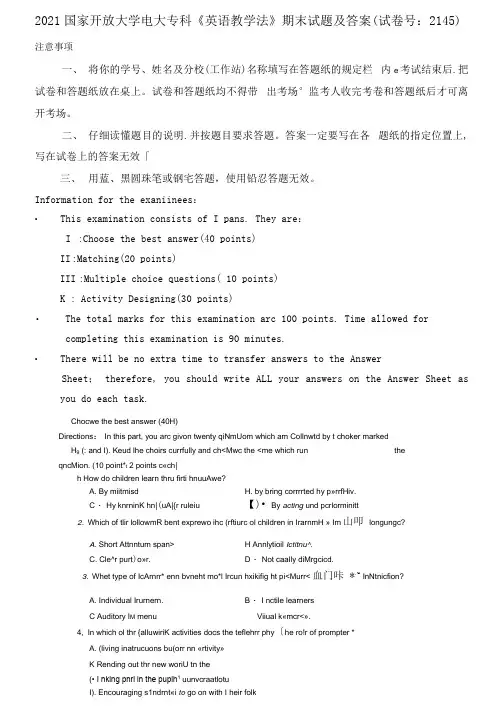
2021国家开放大学电大专科《英语教学法》期末试题及答案(试卷号:2145) 注意事项一、将你的学号、姓名及分校(工作站)名称填写在答题纸的规定栏内e考试结束后.把试卷和答题纸放在桌上。
试卷和答题纸均不得带出考场°监考人收完考卷和答题纸后才可离开考场。
二、仔细读懂题目的说明.并按题目要求答题。
答案一定要写在各题纸的指定位置上,写在试卷上的答案无效「三、用蓝、黑圆珠笔或钢宅答题,使用铅忍答题无效。
Information for the exaniinees:•This examination consists of I pans. They are:I:Choose the best answer(40 points)II:Matching(20 points)III:Multiple choice questions( 10 points)K : Activity Designing(30 points)•The total marks for this examination arc 100 points. Time allowed for completing this examination is 90 minutes.•There will be no extra time to transfer answers to the AnswerSheet; therefore, you should write ALL your answers on the Answer Sheet as you do each task.Chocwe the best answer (40H)Directions: In this part, you arc givon twenty qiNmUom which am Collnwtd by t choker markedH9 (: and I). Keud lhe choirs currfully and ch<Mwc the <me which run the qncMion. (10 point*t 2 points c«ch|h How do children learn thru firti hnuuAwe?A. By miitmisd H. by bring corrrrted hy p»rrfHiv.C・ Hy knrninK hn|(uA|{r ruleiu 【)• By acting und pcrlorminitt2. Which of tlir lollowmR bent exprewo ihc (rftiurc ol children in IrarnmH » Im山叩longungc?A. Short Attnntum span> H Annlytioil Ictitnu^.C. Cle^r purt)o»r. D・ Not caally diMrgcicd.3. Whet type of IcArnrr* enn bvneht mo*l Ircun hxikifig ht pi<Murr< 血门咔 *,u InNtnicfion?A. Individual Irurnern. B・ I nctile learnersC Auditory I M menu Viiual k«mcr<».4, In which ol thr {alluwiriK activities docs the teflehrr phy〔he ro!r of prompter *A. (living inatrucuons bu(orr nn «rtivity»K Rending out thr new woriU tn the(• I nking pnrl in the pupih1 uunvcraatlotuI). Encouraging s1ndrnt«i to go on with I heir folkWhin type of inteiliKencc H cMniinx best wuited for? A. IrHrr 舛rtorud infclligrncr. I 、Muwtol intcllitfrniT> Q LuW ・l intelliicenrr.□ Linguistic lntelh«encr.6. What doe ・ thr Following pruetiM? ♦ Frrr anJ I u5 tu tht ctnrmu y^Urrday. Pm ,and + / wr”f In th^ cinrmaP”,and I wrn/ to the ^cinffna y^tlerday^ P ・” UR U / wrnl In tAr cinftnaA. Stre«A A ArticukitioB C LuritonU tritonftiiqn7. Which of thr following gramTnar artivittr* u tnn<t cornmuniriiivr^A. StibMittitiom K Complctioru (L PrrnArAtionfar a vriOift Coevm 姑& Which ol ihc folluwinM i» ^uitublw for npcftking?A. I PR actioniu K Drawing pictures C Role pky«I). Llatcn and act«乳 Which uf thr (ollowinR activity enn train ImtrninK?A. Ijibrhng I hr pict uren* K Writing cAptinnn for pictures C. "Simon w”” gme.IX Brnwing wnd 。
福建师范大学2024年2月课程考试《英语教学法》作业考核试题
《英语教学法》期末考试(A卷)答题纸姓名:专业:学号:学习中心:成绩:注意:全卷请在答题纸上作答,否则不得分!题号 1 2 3 4 5 6 7 8 9 10答案 A C A A D C B C C A二、名词解释(20分)1. 听力的文本驱动模式本模式认为听力就是一个语音解码过程。
听者利用语音、词汇和句子本身的知识进行语言因素分析达到对听力材料的理解。
理解是从语音、单词、句子到整个讲篇逐步理解的过程2. 归纳法归纳法一般指归纳推理。
归纳推理是一种由个别到一般的推理。
由一定程度的关于个别事物的观点过渡到范围较大的观点,由特殊具体的事例推导出一般原理、原则的解释方法。
自然界和社会中的一般,都存在于个别、特殊之中,并通过个别而存在3. 文化教学英语教育中要注重开展文化教学,引导学生多阅读一些英语名著,全面了解文化差异充分认识到西方文化的魅力,也可以运用多媒体,根据放英语视频、英语电影呈现出生动形象的英语文化,实现渗近文化教学的目的,使学生深入理解英语文化的含义,明确英语知识的文化背景,扩展学生文化知识面,从而逐步提高学生的文化素养。
4. 图式理论所谓图式理论,是指围绕某一个主题组织起来的知识的表征和贮存方式为基础的理论三、简答题(20分)1. 中小学英语教学内容必须具备哪些特征?1 教学要贴近生活1.1 教学内容要贴近小学生的日常生活,学生才能将所学的内容应用到他们所熟悉的生活中去。
例如:在学习Farm Animals这一单元时,课前我先让学生回家仔细观察并模仿家中动物的叫声,然后在课堂上让他们充分施展自己的表演才能,再让其他同学参与到“guessing game”的游戏当中,猜出What animal is it ?在学习Fruit这一单元时,我利用各种水果,进行实物教学。
对于当时无法找到的水果,就用图片代替;在学习cat、dog时可使用绕口令“a cat ,a cat , miao ,miao, miao。
英语教学法答案
英语教学法答案《英语教学法》期末复习资料参考答案一、名词解释1、多元智能理论多元智能理论美国哈佛大学著名心理学家Howard Gardner于20世纪80年代所提出的一种智能理论。
该理论注重学生的智能多种性、整体性、开发性和差异性,鼓励教师配合学生的学习策略,采取多元模式的教学方式,以发挥教与学的功效。
2、形成性评价形成性评价是指在教学过程中针对学生的学习行为与能力发展所进行的过程性评价。
形成性评价是一种质化评价,它具有反馈调节、展示激励、反思总结、记录成长、积极导向的功能,以及全面性、真实性和情景性等特征,能够对学生日常学习过程中的表现、所取得的成绩以及所反映出的情感、态度、策略等方面的发展做出评价。
3、图式理论图式(schema)是由过去的经验或背景知识组成的。
图式理论认为,任何语言材料,无论是口头的还是书面的,本身并无意义,它只指导听者或读者如何根据自己原有的知识将其恢复或构成意思。
当读者把大脑中的图式和语言材料所提供的信息联系起来时,就能理解所阅读的材料。
图式具有激活的作用,当文章的一些刺激物(语言的、内容的或修辞的)向读者示意时,读者就会寻找和想起相关图式并完成阅读任务。
4、元认知策略元认知”是有关认知过程的知识,包括提前准备、集中注意、选择注意、自我管理、事先练习、自我监控、延迟表达和自我评价等。
例如决定注意某个通知,激发学习某些东西,监控学习和评价学习。
5、动机:是直接推动人从事某种行为以达到一定目的的源动力。
学习动机是直接推动学生进行学习活动的内部动力。
它是一种学习的需要,是社会和教育对学生学习的客观要求在学生头脑里的反映。
它表现为学习的意向、愿望或兴趣等形式,对学习起着推动作用。
6、英语情感教学:就是教师在教学中“以人为本”,运用心理学的理论和方法,有意识地激发和调动学生有利于英语学习的积极情感因素,培养学习兴趣,增强学习动机、自信心、主动性和目的性,提高英语教学效果,从而实现教学中的师生共同参与并和谐发展,促进学生整体素质的提高和个性的发展的方法。
《英语教学法》题库及答案
《英语教学法》题库及答案Part I Basic Ideas in Language TeachingDirections: In this part, there are 24 statements about teaching in English, and four answers after each one. You are to choose from each of the following statements the best answer according to what we have learnt in the book of “A Course in English Language Teaching ".1.To learn a language means to learn these structural items so as to be able to understand and produce language.A. This is the behaviorist view of language.B . This is the structural view of language.C . This is the functional view of language.D . This is the interactive view of language.2. Learners should know the grammar and vocabulary, but as importantly they should know the rules for using them in s whole range of communicative contexts.A. This is the behaviorist view of language.B . This is the structural view of language.C . This is the functional view of language.D . This is the interactive view of language.3. According to cognitive theory, .A. students learn language by repeating what teachers sayB . students are asked to think and createC . students learn a language as animals do thingsD . students respond when teachers give stimulus4. By audio-lingua method, students should always .A. be allowed to create their own sentences based on their understanding of certain rulesB . be trained to form good habits in learningC . relate their rules learned to their uses in real lifeD . be able to communicate with others in practice5. Language is regarded as a communicative tool, whose main use to build up and maintain social relations between people.A. This is the interactional view of language.B . This is the functional view of language.C . This view of language has no basis of theory.D . The view may be out of date in language teaching.6. What is the main idea of Communicative Approach?A. To teach language in a global and meaningful way.B . To teach language in a communicative method.C . To teach language in training of habits.D . To teach language by asking students to repeat and memorize forms.7. What is a good language teacher?A. A person who has a good command of English.B . A person who is armed with a specific range of skills and strategies.C . A person who has ethic devotion, desirable personal styles and professional qualities.D . A person who has professional competence.8 . To attain the professional competence, a teacher should have training, learning, practice and .A. experienceB . educational psychologyC.received knowledgeD.reflection9 . According to Hymes, in a successful language communication, one' s utterance should beA. reliable and clear B . possible and feasibleC . appropriate and authenticD . possible, feasible, appropriate and really used10 . Learning a language means being able to do things with it in some sense..A. This is the behaviorist view of language.B . This is the structural view of language.C . This is the functional view of language.D . This is the interactive view of language1 1 . Behaviorist view of language holds .A. students learn language by repeating what teachers sayB . students are asked to think and createC . students learn a language as animals do thingsD . students respond when teachers give answers12. A teacher should have training, learning, practice and to attain the professional competence,.A. experienceB . educational psychologyC.received knowledgeD.reflection1 3 . Task principle means activities in which language is used for carrying out meaningful tasks that promote learning.A. This is the view of communicative approach about competenceB . This involves the function/notion methodC . This is the view of behaviorism in language teaching.D. Not sure.1 4 . We train students to learn a language just as we train animals to do things.A. This can be classified into functional grammar.B . The typical behaviorist view of language learning.C . The view is taken by those who hold grammar-translation method.D . None in history had the view of language learning.1 5 . According to Chomsky, language is not a form of behavior; it is an intricate rule based system. A. It is still a behaviorist view.B . It is functional view of language.C . It is audio lingua method.D . It is the mentalist view.2 6 . Mistakes should immediately corrected and correct utterances should be immediately praised.A. Audio-lingual methodB . Communicative approachC . Mentalist viewD. Silent way17 . Language is a system of structurally related elements for the coding of meaning.A. Structural view.B . Mentalist view.C . Meaningful way of learningD. Natural approach18 . We all set up our own perspective of the world, through individual experiences and schema.A. Mentalist oneB . Not based on any theoryC . Typical constructivist view of learningD. Functional one19 . Changes in behavior are observed, and used as indicators as to what is happening inside the learner's mind.A. Audio-lingual oneB . Constructivist viewC . Behaviorist oneD . Cognitive view of language20 . Language teaching and learning are focused on a new behavioral pattern being repeated until it becomes automatic.A.Behaviorist view of learningB.Constructivism C . Cognitive view D. Not sure2 1. Listening activities always test the students ' memory rather than other abilities.A. The test is the typical one practiced by communicative approach.B . This kind of view is actually the way of functional method.C . Any traditional teaching way will do in this way.D . Memory training is of course the cognitive approach.2 2 . The communicative activities in classroom should be the one with.A. teacher interventionB . materials under controlC . simple language and no variantsD . content on focus not forms2 3 . Process-oriented theories are concerned with.A. how materials are organized togetherB . how hypothesis is testedC . how the mind processes new informationD . how learners receive input2 4 . Condition-oriented theories emphasize.A. the human and physical context in learningB . the nature of habit formationC . the making of inferenceD . the learning processPart II Teaching ActivitiesDirections: There are 24 activities described below. For each one, you are to judge whether it is the communicative one or not. If you think it a communicative activity, put a tick( V ) in bracket, otherwise, mark a cross( x).2 5 . Student A uses a questionnaire to interview his partner, student B, and makes notes.()2 6. As two students are talking about their experience, the teacher asks other students to take down their information.()2 7. . Listening to tapes with headphones and then answering listening comprehension questions. ()2 8 . When reading in a foreign language, students are asked to mentally translate everything in orderto understand.()2 9. “Write a composition with a t itle of 'A Day on the Factory ' in classroom "()3 0 . Information-gap activities in spoken lesson.()3 1 . Use English-English dictionary to understand the meaning of vocabulary.()3 2 . The teacher writes a set of words on the blackb oard and asks the students to find the "odd man out".()3 3 . Ask students to read phonetic transcripts of words.()3 4 . Make students in groups to say out grammatical rules.()3 5 . Teachers help learners in any way that motivates them to work with the language.()3 6 . The target language system will be learned best through the process of struggling to repeatand practice rote learning.()3 7 . Pattern drills are practiced peripherally.()3 8 . Ask students to use authentic and natural language.()3 9. In any teaching class, teachers ingrate the four skills.()4 0. In teaching we should always prevent students from making errors.()4 1 . The linguistic competence is the desired goal in teaching.()4 2 . Communicative activities come after a long process of rigid drills and exercises.()4 3 . Teachers practice bottom-up mode activity and start from a linear process in reading])4 4. To use transition device so that visualization is realized in reading.()4 5 . Working in lockstep, the teacher expresses clearly and as much as possible.()4 6. To use substitution drills and prompts in grammar teaching.()4 7. An activity in classroom for students to practice language, which involves no definite or correct answers in the task.()4 8 . Ask students to bridge their information gap in speaking.()Part III Teaching PrinciplesDirections: In this part of the test, there are some Teaching Principles that need your evaluation.Please choose the ones you think them correct and in accordance with what we have learnt and put a tick( V ) after them .4 9 . The main implication for teaching is that we need to be aware of the discourse features of a text and to be able to make students aware of them.()5 0. A group of students working together to brainstorm topics and ideas will be more productive because their thoughts can be inspired by each other ' s ideas.()5 1 . The teaching activities must be designed to be done by the individual students rather than all of them, and the activities shouldalso involve the teacher correcting or evaluating how the student do these activities.()5 2. A teacher is a resource-provider.()5 3. It is not the teachers ' work to choose topics and tasks so as to activate students in teaching.()5 4 . Teachers need not have extra materials prepared to cope with slower/faster-working students.()5 5 . Different approaches stipulate different teacher roles, but there are some common roles that teachers play.()5 6 . Teachers can do nothing to increase and maintain the motivation of students by the types of tasks.()5 7 . Teaching listening should focus on the result of listening rather than the process of listening.()5 8 . The trick to working with drills is to work on individual sounds for more than few minutes a time.()5 9 . Ask students to make a list of optimal solutions to the problem addressed.()6 0 . We should require the students to acquire native-like pronunciation.()6 1 . Good planning tactics never indicate the importance of knowing what you need to take with you or to arrange to have in your classroom.()6 2 . The first step of lesson planning will already have been performed for you: choosing what to teach.6 3. A teacher can play the roles as controller, assessor, organizer, prompter, participant andresources provider, but they should not play all of them at one time.()6 4. A normal class should be in such a way in which students can raise questions and challenges to teachers.()6 5 . Emotions cannot run high whenever language learners are asked to develop new pronunciation habits. ()6 6. In practice, we need mechanical and meaningful practice. One way is to practice our pronunciation in English chunks, ready-made chunks.()6 7 . The introduction of authentic texts into the learning situation.()6 8 . Functional grammar holds that a language will play three functions, the idea of which can beused in teaching of language skills.()6 9 . Take care of trivial details in reading and listening so that students may have a full understanding of the text.()7 0. In writing, teachers help students recognize their own composing process.()7 1 . We design speaking tasks that do allow outspoken students to dominate discussion.()7 2 . We in teaching clarify fixed rules and standards, and are consistent in applying them.()Part IV Teaching of Language and Language SkillsDirections: In this part of the test, you are to decide whether you agree or disagree.Part V Teaching PlanningDirections: In this part of the test, you are to give a "Teaching Plan ' according to the material(a text) given below. Your plan should cover 'aims, language contents, stages and procedures '.(Text 1.)Nature gives plants and trees four ways to scatter their seeds. The first is by wind.The seed of some plants are very light, like the dandelion and the sycamore. They have wings or parachutes so that the wind can carry them easily. The second is by birds and animals.Someseeds, like the seeds of burdock stick to the fur of animals, and drop off as the animals move about. Birds carry others, such as berries. The third way is by the plant itself. The plant itself twists and breaks the walls of the fruit. It throws out or shakes out the seeds. The last is by water. The seeds float on the water either because they are very light, or because they have air inside them.Lesson PlanAIMS: A)B)NEW LEXIS: A)B)GRAMMAR/STRUCTURE:PROCEDUREActivitiesA)B)C)Stage 1:A)B)C)Stage 2:A)B)C)Stage 3:A)B)C)Homework:Reserve activityVisual aids:(Text 2 .)A doctor working in a village was very annoyed because many people used to stop him in the street and asked him for advice. In this way, he was never paid for his services, and he never managed to earn much money. He made up his mind to put an end to this. He was stopped by a young man who said to him, “Oh, doctor, I ' m so glad to see you. I ' ve got a severe pa in in my left side ” . The doctor pretended to be interested and said, “Shut your eyes and stick your tongue out of your month” . Then, he went away, leaving the man standing in the street with his tongue hanging out •••and a large crowdof people laughing at him. Lesson Plan AIMS: A)B)NEW LEXIS: A)B)GRAMMAR/STRUCTURE:PROCEDUREActivitiesA) B) C) Stage 1: A) B) C)Stage 2:A)B)Stage 3:A)B)C)Homework:Reserve activityVisual aids:(Text 3 .)Clerk: Good morning, Sir. What can I do for you?Monty: Good morning. I ' ve lost my briefcase.Clerk: Where do you think you lost it?Monty: I was on the 8:30 train to Stockport.Clerk: Right. Can you give me your name, Sir?Monty: Yes. Monty Ball.Clerk: And your address?Monty: I live at 26 Ash Avenue, Manchester.Clerk: Can you describe your briefcase, please?Monty: Yes. It ' s black and made of leather ---one of those flat sided ones.Clerk: Anything in it?Monty: Not much. Just my lunch and a few papers.Clerk: Well, if it turns up we ' ll let you know. Where can we ring you?Monty: At my office---the number is 483 7692.Clerk: Right, Mr. Ball. I ' ll see w hat I can do.Monty: Thanks a lot. Bye.Lesson PlanAIMS: A)B)NEW LEXIS: A)B)GRAMMAR/STRUCTURE:PROCEDUREActivitiesA)B)C)Stage 1:A)B)C)Stage 2:B)C)Stage 3:A)B)C)Homework:Reserve activityVisual aids:Part VI Comment and EvaluationDirections: In this part, you are to give your commentor evaluation on the following terms in language teaching.1.PrompterMacro planningTraditional pedagogyLanguage formRole-plays2.Function/notion approachconsistencytask-based methoddeductive and inductive methodprompter3.Prompter:Linguistic competence:Role-plays:Bottom-up and Top-down models:Behaviorism:Part I Basic Ideas in Language TeachingDirections: In this part, there are ten statements about language and language learning, You are to make your judgment whether they are structural view, functional view, interactional view, or theyare behaviorist theory, cognitive theory or communicative view and write down your answers after these statements.1.Day to day language use involves activities such as offering, suggesting, advising and apologizing. Learners learn a language inorder to be able to do things with it.nguage is a system and so its subsystems include phonological, morphological and lexical itemswhich constitute sentence. Welearn these items so as to be able to understand and produce language.3.Teaching actually involves endless listen and repeat drilling excises and promotes reinforcement.4.In the whole process of language learning, stimulus-response can form very good habits which are the basis for good language training.5.When we learn language, we should always think and ask questions about not only how but also why.6.Learners are trained to express notions that complete their tasks. The notions include conceptof present, past and future time, the expressions of certainty and possibility and so on.7.We should learn language in the way that is used in the real world and therefore we frequently bridge the gap between the use of languagein real life and the teaching or learning pedagogy in classroom.8.When learning language, we should know not only the language code or the form of language, but also what to say to whom and how to sayit appropriately in any given situation.nguage is a linguistic system make of various subsystems from phonological, morphological and lexical to sentences. Human beingsput all the items together to understand language and produce language.nguage is seen as a linguistic system and a means for doing things. To complete these, learners need to know how to combine thegrammatical rules and the vocabulary to express notion.11.Learners have to study the patterns and rules of language above the sentence level to learn howlanguage is used in different speech contexts.12. A language learner acquires language competence which enables him to produce language.Part II Teaching ActivitiesDirections: There are five activities stated below. For each one, you are to describe it with simple example.1.( discovering differences )2.( pooling information to solve a problem )3.( simulation activity )4.( identifying pictures )5.( work in pairs )6.( role playing )Part III Teaching PrinciplesDirections: In this part of the test, Wallace' s 'reflective model' is to be completed to demonstrate the development of professional competence. You are to fill the blanks with proper terms.Note: The possible selected terms would be: practice, language learning, language practice, own experience, own knowledge, professional competence, received knowledge, development, reflection, oth ers ' knowledge, others ' experience, response and stimuli, language training, stage, goal, etc.11.The efficient teaching implies that we should know the discourse features of any text and makestudents well informed of them.()Advantages/disadvantages:12.To inspire students ' productive thoughts in group discussion by means of brainstorming topics and ideas.()Advantages/disadvantages:13.The teacher carefully designs activities for the individual students to complete the tasks and evaluates the whole process.()Advantages/disadvantages:14.To vary teaching techniques and train students learning strategy in class.()Advantages/disadvantages:15.Extra materials are prepared to cope with slower/faster-working students.()Advantages/disadvantages:Part IV Teacher ' s role in language teachingDirections: In this part of the test, there are things listed below that teachers often do in thelanguage classroom. You are to decide what role the teacher is playing in each one. Put corresponding letters in the bracketsa. controllerb. assessorc. organizerd. promptere. participant()1. When students are doing a group-work task, the teacher joints on or two groups for s short period of time.()2. The teacher asks a student a question “Have you ever bought clothes with problems?” If the student doesn ' t seem to be ready, the teacher says “for example, a shirt without …”and points to the button on his won shirt of jacket.()3. The teacher writes one of five numbers on a number of cards. Each student draws on card.Those who have drawn number 1 will form group 1, and those who have drawn number 2 will form group 2. Thus the students areput into five groups in a random way.()4. When the students have in groups decided where to go for a spring outing, the teacher asks each group to tell the others why they have made such a choice.()5. The teacher asks the students to produce conversations by using particular patterns or expressions they have just learned.a. controllerb. assessorc. organizerd. promptere. participant()6. The teacher asks the students to take turns to make sentences with a newly learned structure.If someone makes an error, the teacher asks him or her to revise.()7. Whena student has madea sentence with “borrow" ,"I borrowed a paper to write a letter ", the teacher says, “Well, we don ' t say a paper, we say a piece of paper ”.()8. The teacher writes one of five numbers on a number of cards. Each student draws on card.Those who have drawn number 1 will form group 1, and those who have drawn number 2 will form group 2. Thus the studentsare put into five groups in a random way.()9. T: Do you have any hobbies?D: Yes, I like singing and dancing.T: Uhm, and …?D: I also collect coins.()10. The teacher has a word in his mind and asks students to guess by asking only Yes/No questions until they make the correct guess. Part V Teaching Planning ( 20%)Directions: In th is part of the test, you are to give a Teaching Plan ' according to the material(a text) given below. Your plan should cover 'aims, language contents, stages and procedures '.(Text)Soon we were on our way to Castle Dracula. The mountains were all around us and the moonwas behind black cloud. I could see nothing, but I could still hear the wolves. The horseswent faster and faster, and the driver laughed wildly. Suddenly the carriage stopped. I openedthe door and got out. At once the carriage drove away and I was alone in front of the dark, silent castle. I stood there, looking up at it, and slowly the big wooden door opened. A tall man stood in front of me. His hair was while and he was dressed in black from head to foot.Lesson PlanAIMS: A)B)NEW LEXIS: A)B)GRAMMAR/STRUCTURE:PROCEDURE ActivitiesA)B)C)Stage 1:A)B)C)Stage 2:A)B)C)Stage 3:A)B)C)Homework:Reserve activityVisual aids:《英语教学法》作业参考答案Part I Basic Ideas in Language Teaching1 .B2 . D3 . B4 . B5 . A6 . A7 .C 8 . D 9 . D 10 「C 11 A 1 2 . D1 3 . A 1 4 . B 1 5 . D 1 6 . A 1 7 .A 18. C1 9 . D2 0 . A 2 1 . C 2 2 . D 23 .C 2 4. APart II Teaching Activities( 客观试题,每题1 分,共10分)2 5 . V 2 6 . V 2 7.X 2 8.X 2 9.X3 0 . V3 1 . X 3 2 . V 3 3.X 3 4.X 3 5 . V 3 6 . X3 7 . V 3 8 . V 3 9 . V4 0.X 4 1 . X 4 2 . X4 3 . X 4 4 . V 4 5.X 4 6.X 4 7.X 4 8 . VPart III T eaching Principles4 9 . V5 0 . V 5 1.X 5 2 . V 5 3.X 5 4 . V5 5 . V 56 . X 5 7.X 5 8.X 5 9 . V 6 0 . X61 . X 6 2 . V 6 3.X 6 4 . V 65.X 6 6 . V67 . V 6 8 . V 6 9.X 7 0 . V 7 1 . X 7 2 . VPart IV Teaching of Language and Language Skills7 3 . disagree 7 4 . ,d isagree 7 5 .agree a 6 . agree 77 .agree7 8 . agree 7 9 . ,disagree 8 0 . Disagree 8 1 . Agree 8 2 . agree8 3 . agree8 4 .Disagree 8 5 . Disagree 8 6. d isagree8 7 .Agree8 8 . Agree 8 9 . Agree 9 0 . Agree 9 1 . Agree 9 2 . Disagree9 3 . Agree 9 4 . Disagree 9 5 . Agree 9 6 . AgreePart V Teaching Planning1. Lesson PlanAIMS: A) To have students learn simple present tenseB) To know scientific reportNEW LEXIS: A) seed, dandelion, sycamore, parachute, parachute, burdock, fur8)scatter, stick to, twist, throws out, shakes out, drop outGRAMMAR/STRUCTURE: by wind, by bird, like, so that..PROCEDUREWARM-UP ACTIVITIES (5min)A)warm-up, game, picture of Nature,B)free discussion of natural phenomenon, questionsC)review of present tense by using daily examplesStage 1: PRESENTATIOON (10min)A)read aloud, general impression of the storyB)introduction, story of seedsC)vocabulary, its use in everyday life,Stage 2: PRACTICE (15min)A)write more examples in groupsB)discuss seeds and students ' own experiencesC)give cues for students to add more to the role of Nature in scattering seeds everywhere Stage 3: PRODUCTION (10MIN)A)write natural phenomenon, papers exchange,B)use present tense to report, arguments,C)make dialogues about NatureHomework: write something about wind, bird, rain, etc.Reserve activity: analogy of seeds, human beings and seedsVisual aids: flash, slide show 2 . Lesson PlanAIMS: A) To learn simple past tense, describe past actionsB) To learn the structure of "to do" as objectNEWLEXIS: be annoyed, manage to, make up one' s mind, put an end to, pretend to, out of mouth… GRAMMAR/STRUCTURE: to leave someone doing,PROCEDUREWARM-UP ACTIVITIES (5min)A)warm-up, game, picture of seeing a doctorB)free discussion of hospital or clinicC)review of past tense by using daily examplesStage 1: PRESENTATIOON (10min)A)read aloud, general impression of the storyB)introduction, story of the joke,C)vocabulary, its use in everyday life, Stage 2: PRACTICE (15min)A)write more one' s own experience in hospital in groupsB)discuss doctors and patients and students ' own experiencesC)give cues for students to add more to doctors ' way of prescription in treating patientsStage 3: PRODUCTION (10MIN)A)tell class the own story, papers exchange,B)use past tense to report, arguments,C)make dialogues about seeing a doctorHomework: write something about illnessReserve activity: noneVisual aids: flash, slide show, short video (aims, language contents, stages and procedures '.3 . Lesson PlanAIMS: A) Speaking lesson, for teaching chunksB) ask for helpNEW LEXIS: A) few or noneB) names of people and placesGRAMMAR/STRUCTURE: if can you …?PROCEDUREWARM-UP ACTIVITIES (5min)A)Listening to the dialogueB)GamesC)Ask students to say anything as if they have lost somethingStage 1: PRESENTATIOON (10min)A)proper names background knowledgeB)role-play based on the dialogueC)exercise of “can I ••• .can you?"Stage 2: PRACTICE (15min)A)examples of chunks as “thanks a lot " ,"not much",..B)ellipsisC)informal style in spoken languageStage 3: PRODUCTION (10MIN)A)to design an active to practice the way of asking for help in pairsB)ask them to present their pair workC)explain the function of each chunksHomework: listen moreReserve activityVisual aids: noPart VI Comment and Evaluation1. Prompter: in teaching sometime teachers give students hints to start an activity.Macro planning: the general aims or ideas about the teaching, not in detail. The time may cover as long as a term.Traditional pedagogy: teacher-centered, audio-lingua method, teaching language componentsLanguage form: behaviorist view of language emphasizes the importance of language form, instead of language meaning.Role-plays: interaction, meaningful, functional2. Function/notion approach: they regard language as functions and we have some notions to realize these functions Consistency: in language learning, pronunciation should be smooth and naturalTask-based method: the teaching activities are based on variety of tasksDeductive and inductive method: two opposite ways of grammar teaching. That is, from examplesto rules and from rules to examples in detailPrompter: teachers sometime should be a person always giving hints or cues or prompts to students so as to help them in learning3. Prompter: teacher who provides the hints or cues for studentsLinguistic competence: contrasted to communicative competenceRole-plays: tasks designed for students to play someone so as to practice real situationBottom-up and Top-down models: letter to words process and the whole to detail process in learning Behaviorism: key words: pattern drills, reinforcement, S-R, native language, repetition,。
英语教学法考试
英语教学法考试第一篇:英语教学法考试1.In the past century, language teaching and learning practice has been influencedby three different views on language.What are they? What is their main idea of language?1)Structural view: Language is a linguistic system made up of various subsystems: phonology, morphology, lexicology and syntacx.To learn a language is to learn its vocabulary and structural rules.2)Functional view: Language is a linguistic system as well as a means for doing things.Learners learn a language in order to be able to do things with it(use it).To perform functions, learners need to know how to combine the grammatical rules and the vocabulary to express notions that perform the functions3)Interactional view: Language is a communicative tool to build up and maintain social relations between people.Learners need to know the rules of a language and where, when and how it is appropriate to use them.2. List different views on language learning.Behaviorist theoryCognitive theoryConstructivist theorySocio-constructivist theory 3. What are the qualities of a good language teacher?ethic devotion, professional quality and personal styles.How can one become a good language teacher?Wallace‟s Reflective modelStage 1: language development Stage 2: learning, practice, reflectiongoal:development of professional1).learn from others' experience2).learn received knowledge3).learn from one's own experiencepseudo practice and The real classroom teaching4. What is communicative competence?Communicative competence include both the knowledge about the language and the knowledge about how to use the language appropriately in communicative situations.Five components of communicative competence:Linguistic competence, Pragmatic competence , Discourse competence, Strategic competence, Fluency5. What is CLT? Comment on municative Language Teaching is an approach to teaching of foreign language that emphasize interaction as both the means and ultimate goal of learning a language.It is also referred to as “communicative approach to the teaching of foreign” or simply the “communicative approach”.6.What is TBLT? Comment on TBLT.Task-based Language Teaching,TBLT is a further development of CLT.It shares the same belief in the use of language in real life, but stresses the importance to combine form-focused teaching with communication-focused teaching。