
比较状语从句和方式状语从句_状语从句 英语语法.doc
比较状语从句和方式状语从句_状语从句1.表示比较的状语从句
这类从句都由than或as引起:
She likes Danny better than she likes me.
她喜欢丹妮胜过喜欢我。
He can run faster than I do.
他跑得比我快。
It is not so difficult as you think.
它没有你想的那么困难。
She is not so energetic as she used to be.
她不像过去那样充满活力了。
有时许多词省略,只剩下一个词:
She is four years younger than me.
她比我小四岁。
It made him queerer than ever.
这使他变得比过去更古怪。
She was as much interested in music as ever.
她还是和过去一样对音乐有兴趣。
She is as clever as(she is) beautiful.
她聪明又美丽。
2.方式状语从句
这类从句多由as,as if,as though,like等引起:
He was allowed t do as he liked.
他们允许他爱怎么干就怎么干。
It swims on the sea floor just as its ancestors did.
在海底游动,就像它的祖辈那样。
I like the freedom to plan my day exactly as I want.
我喜欢有自由完全按照我自己的意愿安排一天的活动。
She acts as though she owns the place.
她表现得仿佛她是这里的主人。
She treats him as if he was her own son.
她把他像亲儿子一般对待。
He looked like he had seen a ghost.
他看起来就像见到鬼了似的。
You talk just like your father does.
你讲起话来就像你爸爸。
I was never allowed to sing the way I wanted to.
他们从来不容许我按我自己的想法演唱。
I’ll help you any way I can.我将以任何可能的方式帮助你。
英语语法:状语从句归纳整理

状语从句在复合句中,充当状语的从句叫作状语从句,一般修饰谓语动词或整个主句。
状语从句一般可分为时间状语从句、地点状语从句、原因状语从句、目的状语从句、结果状语从句、条件状语从句、让步状语从句、比较状语从句和方式状语从句等。
一、时间状语从句在复合句中起时间状语作用的从句称为时间状语从句,可放在句首、句中或句尾。
(二)until 和 till的用法1.肯定句:主句的谓语动词必须是延续性动词,主句、从句都为肯定式,意为“直到……为止”;2.否定句:主句的谓语动词必须是非延续性动词,从句为肯定式,表示“某动作直到某时才开始”;3.till 不可以置于句首,而until可以。
例:They waited till / until I returned.他们一直在等我回来。
You may stay here until / till the rain stops.你可以待在这里直到雨停。
He won’t go to bed until / till she returns.直到她回来,他才上床睡觉。
Until you told me I had no idea of it.直到你告诉我,我才知道这件事。
(三)since的用法(四)before的用法一般情况下before表示“在……之前”,有时根据上下文,还可表示“还未……就……” “不到……就……” “……才……” “趁……还未……”等例:Please write it down before you forget it.趁你还没忘,请把它记下来。
I must finish this letter before I go home.我必须在回家之前完成这封信。
Before I could get in a word, he had measured me.我还没来得及插话,他就给我量好了尺寸。
We had sailed four days and four nights before we saw land.我们航行了四天四夜才看到陆地。
高中英语语法状语从句-精品文档

状语从句的分类
1. While I was wondering at this, our schoolmaster took 2. his place. 时间 ( ) 2. Where there is a will, there is a way. ( 地点 ) 3. Now that/Since everybody is here, let’s begin our meeting. ( 原因 ) 4. I’ll speak slowly so that you can understand me. (目的) 5. So clever was he a student that he was able to work out all the difficult problems. ( 结果 ) 6. As long as you don’t lose heart, you’ll succeed. (条件 ) 7. Try as he might, he could not find a job. ( 让步 ) 8. The old lady treats the boy as if he were his own son. ( 方式 )
高三英语第一轮复习
Revision of the Adverbial Clauses 状语从句复习
九 种 常 用 的 状 语 从 句 及 其 常 用 的 连 接 词
时间状语从句 地点状语从句
原因状语从句
条件状语从句
让步状语从句
结果状语从句
目的状语从句
方式状语从句 比较状语从句
时间状语从句
九 种 常 用 的 状 语 从 句 及 其 常 用 的 连 接 词
when, while, as, before, after, as soon as till, until, not…until, the first/second…/last time, the momen the minute, the instant, immediately, directly, instantly, hardly…when, scarcely…when, no sooner…than where, wherever because, since, as, now that, seeing that, considering that
英语中状语从句用法及例句总结(完整)
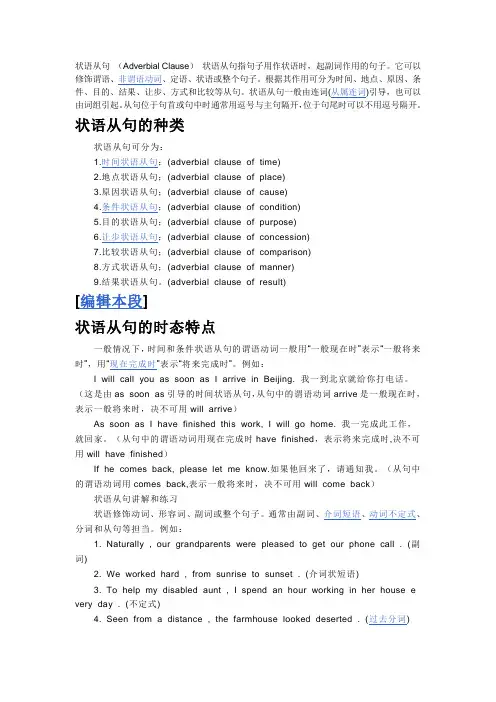
状语从句(Adverbial Clause)状语从句指句子用作状语时,起副词作用的句子。
它可以修饰谓语、非谓语动词、定语、状语或整个句子。
根据其作用可分为时间、地点、原因、条件、目的、结果、让步、方式和比较等从句。
状语从句一般由连词(从属连词)引导,也可以由词组引起。
从句位于句首或句中时通常用逗号与主句隔开,位于句尾时可以不用逗号隔开。
状语从句的种类状语从句可分为:1.时间状语从句;(adverbial clause of time)2.地点状语从句;(adverbial clause of place)3.原因状语从句;(adverbial clause of cause)4.条件状语从句;(adverbial clause of condition)5.目的状语从句;(adverbial clause of purpose)6.让步状语从句;(adverbial clause of concession)7.比较状语从句;(adverbial clause of comparison)8.方式状语从句;(adverbial clause of manner)9.结果状语从句。
(adverbial clause of result)[编辑本段]状语从句的时态特点一般情况下,时间和条件状语从句的谓语动词一般用“一般现在时”表示“一般将来时”,用“现在完成时”表示“将来完成时”。
例如:I will call you as soon as I arrive in Beijing. 我一到北京就给你打电话。
(这是由as soon as引导的时间状语从句,从句中的谓语动词arrive是一般现在时,表示一般将来时,决不可用will arrive)As soon as I have finished this work, I will go home. 我一完成此工作,就回家。
(从句中的谓语动词用现在完成时have finished,表示将来完成时,决不可用will have finished)If he comes back, please let me know.如果他回来了,请通知我。
状语从句完整版
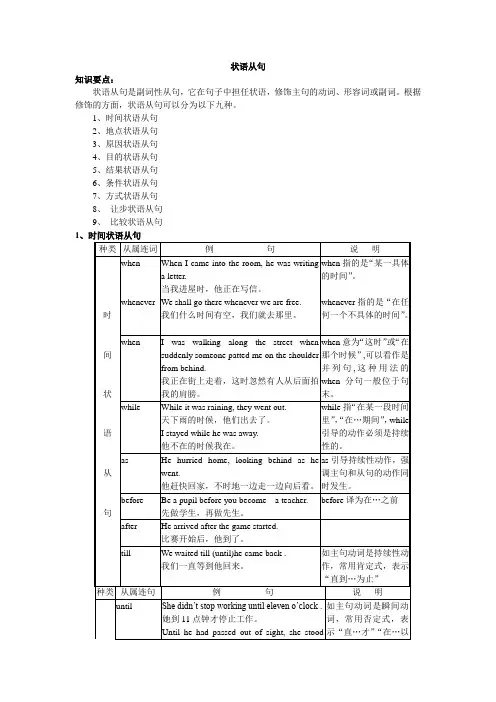
间
状
when
I was walking along the street when suddenly someone patted me on the shoulder from behind.
我正在街上走着,这时忽然有人从后面拍我的肩膀。
when意为“这时”或“在那个时候”,可以看作是并列句,这种用法的when分句一般位于句末。
万一我忘了,请提醒我一下。
So far as I know, the book will be published next month.
据我所知,那本书下月出版。
unless从句的谓语只能用肯定式。unless和if…not同义,unless是书面语,if…not是口语,通常二者可以换用。
条件状语从句中的谓语动词的时态一般要用现在时或过去时代替一般将来时或过去将来时。
他的行动就好象什么也没有发生。
They treat the black boy as if (though) he were an animal.
他们对待这黑孩子仿佛他是一头牲口。
此处as译为,按照或正如
as if或as though的意义和用法基本一样。从句中可以用现在时表示可能符合事实,也可以用虚拟语气。
It is so interesting a novel that all of us want to read it.
这是一本十分有意思的书,大家都想看。
such…that的such后面跟名词,如果名词是单数就要用such a /an…that还可以转换用so…that,语气较强
种类
从属连句
例句
说明
即使明天下雨,我也要去。
初中英语语法之状语从句类型及考点讲义
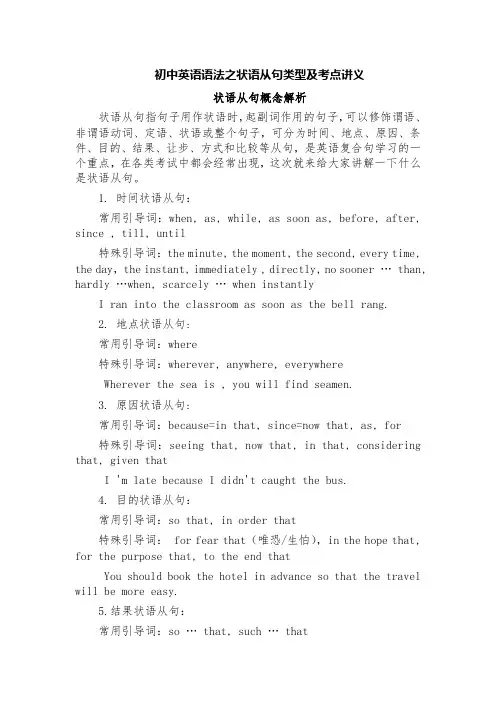
初中英语语法之状语从句类型及考点讲义状语从句概念解析状语从句指句子用作状语时,起副词作用的句子,可以修饰谓语、非谓语动词、定语、状语或整个句子,可分为时间、地点、原因、条件、目的、结果、让步、方式和比较等从句,是英语复合句学习的一个重点,在各类考试中都会经常出现,这次就来给大家讲解一下什么是状语从句。
1. 时间状语从句:常用引导词:when, as, while, as soon as, before, after, since , till, until特殊引导词:the minute, the moment, the second, every time, the day,the instant, immediately , directly, no sooner … than, hardly …when, scarcely … when instantlyI ran into the classroom as soon as the bell rang.2. 地点状语从句:常用引导词:where特殊引导词:wherever, anywhere, everywhereWherever the sea is , you will find seamen.3. 原因状语从句:常用引导词:because=in that, since=now that, as, for特殊引导词:seeing that, now that, in that, considering that, given thatI 'm late because I didn't caught the bus.4. 目的状语从句:常用引导词:so that, in order that特殊引导词: for fear that(唯恐/生怕),in the hope that, for the purpose that, to the end thatYou should book the hotel in advance so that the travel will be more easy.5.结果状语从句:常用引导词:so … that, such … that特殊引导词:such that, to the degree that, to the extent that, to such a degree thatHe is so young that he can't have meal by himself.6. 条件状语从句:常用引导词:if, unless,特殊引导词:as/so long as(只要), only if, providing/provided that(倘若), supposing that(倘若), in case that(以防), on condition thatYou can go to London as long as you have passport.7.让步状语从句:常用引导词:though, although, even if, even though特殊引导词: as(用在让步状语从句中必须要倒装),while,no matter …, in spite of the fact that, whatever, whoever, wherever, whenever, however, whichever, as if=as thoughThough we are old, we still can do these by ourselves.8. 比较状语从句:常用引导词:as(同级比较), than(不同程度的比较)特殊引导词:the more …the more …; just as …,so…,no … more than; not A so much as BShe is as pretty as her mother.9. 方式状语从句:常用引导词:as, as if, how特殊引导词:the wayHe didn't so it the way his brother did.辨析:while,when,as三者引导的时间状语从句时间状语从句算是状语从句中最简单的一类,也是我们日常生活交流中最常用的一类,虽然难度不大,但引导词也不少,仍然有不少同学会弄混那几个常见引导词的用法,这次就为大家带来as,when,while这几个词的辨析方法,一起看看吧。
(word完整版)高中英语语法-状语从句归纳总结,推荐文档
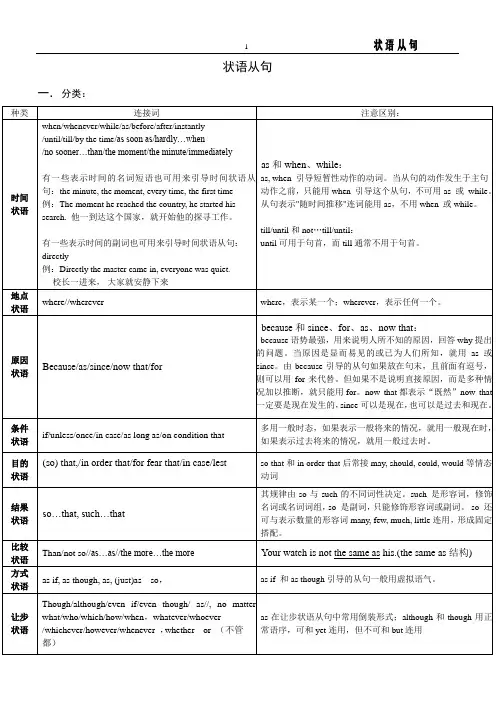
状语从句一.分类:when (当……的时候) while (在……期间) as (当……的时候, 一边……一边……)before (在……之前) since (自从……以来) till/until (直到) hardly…when… (刚……就) as soon as (一……就……)after (在……之后) not…till/until(直到……才)no sooner…than…(刚……就) 地点状语从句:where (在那里) wherever(无论哪里)原因状语从句:because (因为) since (因为,既然) as (由于) for (为了) now that(既然)目的状语从句:(so)that=in order that(以便)so as(not)to (以便[不])in case(以免)lest(以免)结果状语从句:so+adj./adv.+that(如此……以致)so that(结果……)such+n.+that(如果……以致)that(所以,因此)让步状语从句:though/although不可同but连用。
though/although (虽然)however (可是)even though/if(即使)no matter+what/which/where/who/when =whatever/whichever/wherever/whoever/whenever(不论什么/哪一个/哪里/谁/何时)比较状语从句:as (正如)as…as(和……一样)not as/so … as (不如……)than(比……更)the+比较级…+the+比较级(越……越……)条件状语从句:if(假设)unless(如果不)so long as(只要)on condition that (如果)方式状语从句:as(像……那样地)just as(正像)as if(好像)as though(好像)二.各种状语从句的简化方法:1作状语。
高中英语状语从句用法详解文档
高中英语状语从句用法详解文档四维教育状语从句用法详解在主从复合句中修饰主句的动词、形容词、副词等的从句叫状语从句。
一般可分为:时间状语从句、地点状语从句、原因状语从句、目的状语从句、结果状语从句、条件状语从句、让步状语从句、比较状语从句、方式状语从句。
I时间状语从句:起时间状语作用的从句。
(时间状语从句位置灵活,可以在句首,也可在句末)常用来引导时间状语从句的引导词有:when, while, as, after, before,until/till, since, as soon as, immediately, the moment, every time, whenever等。
1.when, while, asI was very happy when I heard from you.收到你的时我非常兴奋。
When you deal with them, you should be cautious.跟他们打交道时,你应当郑重。
when指导时间状语从句中的谓语动词能够用非延续性动词,也可用延续性动词。
When I was young, I went to town myself.当我还年青时,我本人独自去城里。
(延续性动词)When I lived in country, I used to carry some water for him.我住在农村时,常常为他担水。
(延续性动词)When he received the letter, he'll tell us.当他接到后,他会告诉我们的。
(非延续性动词)When the fire broke out, all the students were sleeping soundly.火灾发生时,所有的学生正在熟睡。
(非延续性动词)注意:当when引导的时间状语从句为系表结构,而且其主语和主句的主语一致,其表语又是一个名词时,就能够用由as指导的省略句来代替when指导的从句。
高考英语语法复习:八种状语从句的用法
高考英语语法复习:八种状语从句的用法状语从句状语从句有时间、地点、原因、目的、方式、结果、条件、让步等八种。
一、时间状语从句:引导词有after,before,as,once,since,till,until,when,whenever,while,as soon as,the moment/minute…(一…就),the time,the day,every time,next time,each time,by the time of,no sooner…than(一…就),hardly…when(一…就).例如:Each/Every time he comes here,he will drop in on me.每次他来这儿他都顺便看我.He was ill last time I saw him.上次我见到他时他病了.No sooner had she heard the news than she cried.她一听到这个消息就哭了.[辨析]when与whilewhen引导的从句动词可以是延续性的或短暂性的,while引导的从句中动词必须是延续性的;在“be…when…”句式中when表“at that time(就在这时)”意,这样用的when不能换为while;while有时并不表示时间,而表示对比,意“而”、“却”,when无这样的用法。
例如:When I got home I found the door locked./While(或When)we were working in the fields,it suddenly began to rain./He was wandering through the streets when a bike hit him./His pencil is red,while mine is yellow.[辨析]till与until一般情况下可以互换,但until可以位于句首,till则不能。
【最新2019】状语从句知识点总结:比较状语从句与方式状语从句word版本 (1页)
【最新2019】状语从句知识点总结:比较状语从句与方式状语从句word版本本文部分内容来自网络整理,本司不为其真实性负责,如有异议或侵权请及时联系,本司将立即删除!== 本文为word格式,下载后可方便编辑和修改! ==状语从句知识点总结:比较状语从句与方式状语从句【导语】英语语法让很多学生都头疼,因为复杂难懂的句式和词组有时难以记忆。
英语网为大家整理了英语语法大全,希望对同学们的英语语法学习有所帮助。
更多内容尽在英语网。
一、比较状语从句引导比较状语从句的从属连词为 as ... as (和一样), not as / so ... as (和不一样), than (比), the more ... the more (越越)。
这类从句常以省略形式出现。
如:The work is not so difficult as you imagine . 这工作不像你想像的那么困难。
You look younger than you are . 你看上去比你的实际年龄要年轻。
The more you study , the more knowledge you can get . 你学的知识越多,你的知识越丰富。
He doesnt work as hard as she ( does ). 他工作不像她那样努力。
二、方式状语从句引导方式状语从句的从属连词有 as (正如), as if 或 as though (好像)等。
如:Do as I told you . 按我告诉你的那样做。
As a man lives , so he dies . 正如人能活,也能死。
I remember the whole thing as if it happened yesterday . 整个这件事我记得很清楚,就仿佛是昨天发生似的。
注:口语中 like 也可用连词引导方式状语从句。
如:。
完整版英语语法状语从句的归纳总结
英语语法状语从句的归纳总结在复合句中修饰主句或主句中的某一成分的从句叫状语从句。
状语从句通常由从属连词或起连词作用的词组引导,有时甚至不需要连词直接和主句连接起来。
状语从句根据它表达的意思不同,可分为时间、地点、原因、目的、结果、条件、方式、比较、让步等九类。
一、时间状语从句时间状语从句是表示时间关系的从句。
可以引导时间状语从句的连词很多,根据意义和主从句之间的时间关系,通常可分为以下几种情况:A.when, while, as, wheneverwhen, while, as表示主句谓语作和从句的谓语动作同时发生或几乎同时发生。
1.when①when表示点时间时,从句中用短暂性动词;表示段时间时,用持续性动词。
When I got home, my family were already having dinner.我到家的时候,全家已在吃晚饭。
(when表示点时间)When they were still talking and laughing, the teacher came in.当他们还在说笑的时候,老师进来了。
(when表示段时间)He waved a hello when he saw her.当他看见她的时候,就挥手打了个招呼。
(when表示点时间)When you think you know nothing, you begin to know something.当你认为自己一无所知的时候,就开始知道一些事情了。
(when表示段时间)注意:当when意思是正当……时候(and at that moment)时,when只能跟在前一分句之后。
He was about to go to bed when the doorbel rang.他正要上床,忽然门铃响了。
They were watching the World Cup when suddenly the lights went out.他们正看着世界杯比赛,突然灯灭了。