
高三英语一轮复习专题9情态动词与虚拟语气
高考英语一轮复习 考点 情态动词和虚拟语气考点归纳高三全册英语试题
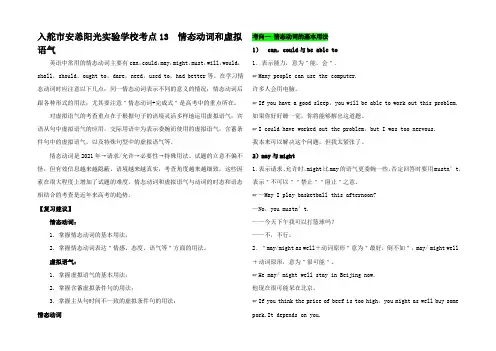
入舵市安恙阳光实验学校考点13 情态动词和虚拟语气英语中常用的情态动词主要有can,could,may,might,must,will,would,shall,should,ought to,dare,need,used to,had better等。
在学习情态动词时应注意以下几点:同一情态动词表示不同的意义的情况;情态动词后跟各种形式的用法;尤其要注意"情态动词+完成式"是高考中的重点所在。
对虚拟语气的考查重点在于根据句子的语境灵活多样地运用虚拟语气,宾语从句中虚拟语气的应用,交际用语中为表示委婉而使用的虚拟语气,含蓄条件句中的虚拟语气,以及特殊句型中的虚拟语气等。
情态动词是2021年→请求/允许→必要性→特殊用法。
试题的立意不偏不怪,但有效信息越来越隐蔽,语境越来越真实,考查角度越来越细致,这些因素在很大程度上增加了试题的难度。
情态动词和虚拟语气与动词的时态和语态相结合的考查是近年来高考的趋势。
【复习建议】情态动词:1. 掌握情态动词的基本用法;2. 掌握情态动词表达"情感、态度、语气等"方面的用法。
虚拟语气:1. 掌握虚拟语气的基本用法;2. 掌握含蓄虚拟条件句的用法;3. 掌握主从句时间不一致的虚拟条件句的用法;情态动词考向一情态动词的基本用法1)can,could与be able to1.表示能力,意为"能,会"。
☞Many people can use the computer.许多人会用电脑。
☞If you have a good sleep,you will be able to work out this problem.如果你好好睡一觉,你将能够解出这道题。
☞I could have worked out the problem,but I was too nervous.我本来可以解决这个问题,但我太紧张了。
2)may与might1.表示请求、允许时,might比may的语气更委婉一些,否定回答时要用mustn’t,表示"不可以""禁止""阻止"之意。
高考英语一轮复习情态动词和虚拟语气复习
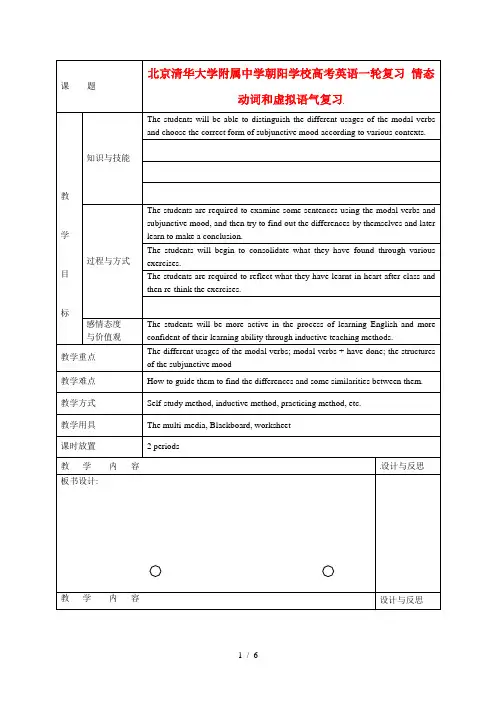
课题北京清华大学附属中学朝阳学校高考英语一轮复习情态动词和虚拟语气复习教学目标知识与技能The students will be able to distinguish the different usages of the modal verbsand choose the correct form of subjunctive mood according to various contexts. 过程与方式The students are required to examine some sentences using the modal verbs andsubjunctive mood, and then try to find out the differences by themselves and laterlearn to make a conclusion.The students will begin to consolidate what they have found through variousexercises.The students are required to reflect what they have learnt in heart after class andthen re-think the exercises.感情态度与价值观The students will be more active in the process of learning English and moreconfident of their learning ability through inductive teaching methods.教学重点The different usages of the modal verbs; modal verbs + have done; the structures of the subjunctive mood教学难点How to guide them to find the differences and some similarities between them. 教学方式Self-study method, inductive method, practicing method, etc.教学用具The multi-media, Blackboard, worksheet课时放置 2 periods教学内容设计与反思板书设计:教学内容设计与反思Step 1 情态动词考题印证1.—Good morning. I've got an appointment with Miss Smith in the Personnel Departme nt.—Ah,good morning. You ________ be Mrs. Peters.A.might B.must C.would D.can2.—I haven't got the reference book yet,but I'll have a test on the subject next month. —Don't worry. You ________ have it by Friday.A.could B.shall C.must D.may3.—May I take this book out of the reading room?—No,you ________. You read it in here.A.mightn't B.won't C.needn't D.mustn't4.Jack described his father,who ________ a brave boy many years ago,as a strong-willed man.A.would be B.would have beenC.must be D.must have been情态动词的基本用法1.can 和could的用法(1)暗示惊讶,常用在否认句和疑问句中。
高三英语一轮语法复习情态动词和虚拟语气课件

1. 对现在或将来的推测(结构:情态动词+do) 情态动词可以用来表示对现在或将来的情况进行推测 She could be lost. 她可能迷路了。 注意 如果是对现在或未来正在发生的事情进行推测,可以使用“情 态动词+be doing”结构。 My friend may be still sleeping at home now. 我的朋友现在可能正在家里睡觉。
(2)表示推测,表示“肯定,一定”之意,此时,must只用于肯定句。在否定句 或疑问句中,用can / could。
(3)表示“偏偏,非要,硬要”,有时表示不巧,有时表示固执,
通常都是指令人不快的事。
4. shall的用法
(1)用于第二、三人称,表示说话人的命令、警告、强制、允诺、威胁或 决心等。
考点3 “情态动词+have done”表示责备的语气
可用于表责备语气的情态动词有:should, ought to, could, might, need等,它们常被用来表示说话人对过去事情的不满或遗憾,带 有较强 烈的责备语气,其结构为“情态动词+have done”。
1. should(ought to)have done“本应该……” 表示过去应该做而(实际)没有做的事情,含有责备或遗憾的语 气,其否定形式为“should not/ought not to have done”。should have done 还可以用来表示惊讶、赞叹等情绪 2. could/might have done “本来能够(会)……” 表示过去本来能够(可以)做某事,但实际上没有做到。 3. need+have+done “原本需要做……” 表示本来需要做某事而没有做,“needn’t+have+done”则表示“本来 不必做某事而做了”。
高三一轮复习情态动词和虚拟语气 李洁雄】
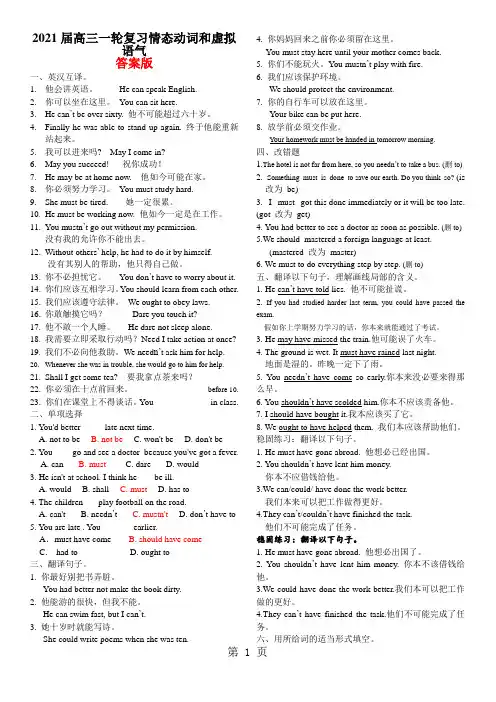
2021届高三一轮复习情态动词和虚拟语气答案版一、英汉互译。
1.他会讲英语。
He can speak English.2.你可以坐在这里。
You can sit here.3.He can’t be over sixty. 他不可能超过六十岁。
4.Finally he was able to stand up again. 终于他能重新站起来。
5.我可以进来吗? May I come in?6.May you succeed! 祝你成功!7.He may be at home now. 他如今可能在家。
8.你必须努力学习。
You must study hard.9.She must be tired. 她一定很累。
10.He must be working now. 他如今一定是在工作。
11.You mustn’t go out without my permission.没有我的允许你不能出去。
12.Without others’ help, he had to do it by himself.没有其别人的帮助,他只得自己做。
13.你不必担忧它。
You don’t have to worry about it.14.你们应该互相学习。
You should learn from each other.15.我们应该遵守法律。
We ought to obey laws.16.你敢触摸它吗?Dare you touch it?17.他不敢一个人睡。
He dare not sleep alone.18.我需要立即采取行动吗?Need I take action at once?19.我们不必向他救助。
We need n’t ask him for help.20.Whenever she was in trouble, she would go to him for help.21.Shall I get some tea? 要我拿点茶来吗?22. 你必须在十点前回来。
高三英语一轮复习语法第9讲情态动词和虚拟语气讲义
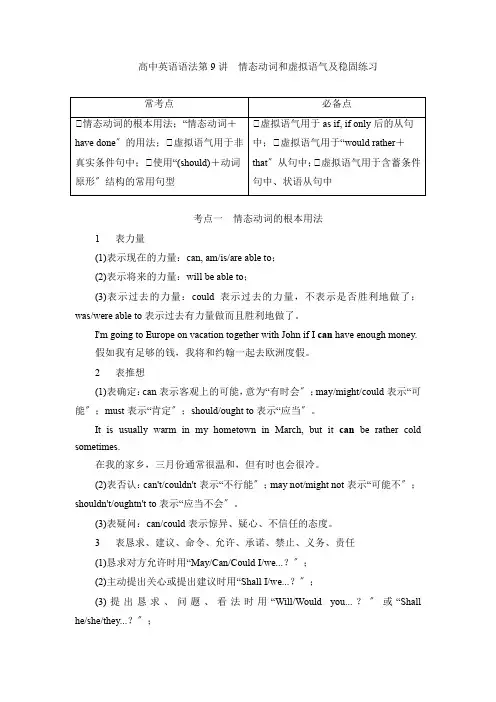
高中英语语法第9讲情态动词和虚拟语气及稳固练习考点一情态动词的根本用法1 表力量(1)表示现在的力量:can, am/is/are able to;(2)表示将来的力量:will be able to;(3)表示过去的力量:could表示过去的力量,不表示是否胜利地做了;was/were able to表示过去有力量做而且胜利地做了。
I'm going to Europe on vacation together with John if I can have enough money.假如我有足够的钱,我将和约翰一起去欧洲度假。
2 表推想(1)表确定:can表示客观上的可能,意为“有时会〞;may/might/could表示“可能〞;must表示“肯定〞;should/ought to表示“应当〞。
It is usually warm in my hometown in March, but it can be rather cold sometimes.在我的家乡,三月份通常很温和,但有时也会很冷。
(2)表否认:can't/couldn't表示“不行能〞;may not/might not表示“可能不〞;shouldn't/oughtn't to表示“应当不会〞。
(3)表疑问:can/could表示惊异、疑心、不信任的态度。
3 表恳求、建议、命令、允许、承诺、禁止、义务、责任(1)恳求对方允许时用“May/Can/Could I/we...?〞;(2)主动提出关心或提出建议时用“Shall I/we...?〞;(3)提出恳求、问题、看法时用“Will/Would you...?〞或“Shall he/she/they...?〞;(4)should/ought to表示“应当〞,shouldn't/oughtn't to表示“不应当〞;(5)may/can表示允许、许可;(6)must表示“必需〞,mustn't表示“禁止〞;(7)shall与其次、三人称连用,用于陈述句,表示命令、警告、承诺、威逼;当宣布法律、规定时也常用shall。
高三英语高考语法知识点归纳总结情态动词和虚拟语气 情态动词
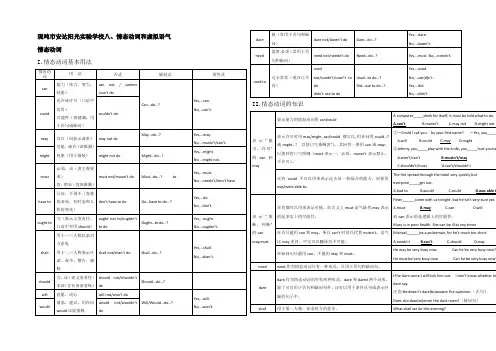
will/would
请求、建议,would比will委婉客气。
Would you pass me the book?
表示意志、愿望和决心。
I will never do that again.
They asked us if we would do that again
Mary is in poor health. She can be ill at any times.
在否只能用can和may。所以can’t时用以代替mustn’t,语气比may更肯。中文可以翻译为不可能。
Michael______be a policeman, for he’s much too short.
couldn’t do
may
可以(问表示请求)
可能,或许(表推测)
祝愿(用于倒装)
may not do
May…do…?
Yes,…may.
No,…mustn’t/can’t.
might
might not do
Might…do…?
Yes,…might
No,…might not.
must
必须,该(表主观要求)
①—Could I call you by your first name?—Yes, you______
A.will B.couldC.mayD.might
②Johnny, you_____play with the knife, you_____hurt yourself.
A.won’t/can’tB.mustn’t/may
You shall fail if you don’t work harder.警告
高考英语情态动词与虚拟语气汇编
高考英语--情态动词与虚拟语气情态动词与虚拟语气情态动词(Modal Verbs)1.情态动词记忆口诀情态动词①二要点:动词原形跟后面,说话语气委婉。
can表“能力”may“许可”,must“责任”或“义务”,否定回答needn't换②;“需要”need、dare“敢③”,should“应该”、would“愿”,have to“被迫”表客观。
说明:①情态动词:can(could)、may(might)、must(must)、need、dare、will(would)、shall(should)等。
②对must构成的一般疑问句作否定回答只能用needn’t。
③dare和need一般在疑问句或否定句中作情态动词,而肯定句中作行为动词。
2.may,can和must的否定式①may常表示“许可”和“可能”People may not pick flowers in this park.Borrowers may not take out of the library more than two books at a time.有时may not可以由must not替换,且must not更为普通。
That may not be true.=It is possible that that is not true.He may not be serious.一、can通常表示“能力(ability,power,capacity)”、“允许(permission)”、“可能(possibility)”。
1.can表示“能力”时,它的否定式表示客观上或主观上没有这种能力。
如:、 “He can ’t speak English.I can come to your party, but Alice can ’t, she ’s got to go to a meeting.当 can 与表示感觉和心理状态的动词(see, hear, understand 等)连用时,往往 失去情态意义。
2024届高三英语一轮复习情态动词和虚拟语气的语法复习课件
2. 在表命令、建议、要求或请求等一类动词后面的宾语从句中使用虚拟结构, 即 (should) do,常见动词有: 一个坚持:insist 两个命令:order, command 三个建议:advise, suggest, recommend 四个要求:demand, require, request, desire
六、would would 可 表 示 过 去 反 复 发 生 的 动 作 或 某 种 倾 向 , 常 与 every day, often, frequently等连用;would表示估计、猜想,或在虚拟结构中用于对过去或将 来的假设或愿望。
I still remember my happy childhood when my mother would often take me to Disneyland.
一、虚拟语气在状语从句中的用法
1、关于 if 的主句及从句的虚拟结构 ③表示将来不太可能实现的条件,其从句结构为“If+主语+动词过去式/were to+ 动词原形/should+动词原形”。主句结构:主语+should/would/might/could+do 例如:If he should come here tomorrow, I would take to him.如果他明天来这的话, 我就跟他谈谈。(事实:来的可能性很小,不可能)
“should+have+done”意思是“本来应该做某事,而实际没做。” “shouldn't+have+done”表示 本来不应该做某事,而实际做了。含有指责对方或自责的含意。
“ought to+have+done”表示过去应该做而实际并没有做,译成“理应做……”,往往表示遗 憾。与“should+have+done”用法基本一样。
第九节情态动词和虚拟语气讲义-高三英语一轮复习
第九节情态动词和虚拟语气〔真题演练〕1. (经典高考)I can’t find my purse. I could (leave)it in the supermarket yesterday, but I’m not sure.2. (经典高考)Truly elegant chopsticks might (make)of gold and silver with Chinese characters.3. (经典高考)What a pity! You missed the sightseeing, or we(have) a good time together.4. (经典高考)If we (catch)the flight yesterday, we would be enjoying our holiday on the beach now.〔必备知识〕考点一情态动词1.情态动词的基本用法情态动词用法例句can/could表示“能力”,意为“能,会”Samuel, the tallest boy in our class,can easily reach the books on the top shelf. Samuel是我们班最高的男孩,他能轻易地拿到书架顶层的书。
表示推测,意为“可能”,往往用于否定句或疑问句中。
can比could语气强That can’t be Mary—she is in London now.那不可能是玛丽——她现在在伦敦。
表示客观可能性,意为“有时候会”,多用于肯定句Credit cards provide us with lots of convenience, but sometimes they can lead to problems.信用卡给我们提供了许多方便,但有时候会带来一些问题。
表示礼貌地请求,意为“能,可以”。
在疑问句中could可代替can, 语气更委婉Can you tell us your recipe for happiness and a long life?你能告诉我们你幸福和长寿的秘诀吗?固定句式:can’t...too/enough“无论多么……也不过分”“越……越好”I can’t thank you too much for all your help to my son while we were away from home.我非常感谢你在我们不在家时对我儿子的帮助。
情态动词和虚拟语气+讲义 高三英语一轮复习
英语语法-情态动词和虚拟语气[高考考查分析]全国卷的语法填空近几年没有考查情态动词的题目,这应该与题型特点有关,并不能说明可以忽视情态动词的学习。
有些自主命题省份的试卷的单项填空题涉及对此项考点的考查。
[调取储备知识]1.情态动词的基本用法情态动词用法can/could (1)表示能力,意为“能、会”。
can可用于肯定句、疑问句或否定句。
could主要用于过去时。
(2)表示客观的可能性,主要用于否定句和疑问句。
当表示一时的可能或理论上的可能时,可用于肯定句。
如:The temperature can fall to-200℃,that is 200℃ below freezing.(3)表示允许、许可。
在口语中can可以代替may表示许可,而may比较正式。
如:Can(May)I do it?(4)表示请求。
could可以代替can,表示语气更委婉,答语中用can。
如:—Could I borrow your dictionary?—Yes,of course/you can(may)/help yourself.(5)表示惊异、怀疑、不相信。
主要用于否定句、疑问句和感叹句。
如:How can you be so careless?may/might (1)表允许或请求,might比may语气更委婉。
如:—May I watch TV after supper?—Yes,you may.(Yes,please/certainly)/No,you mustn't(may not/had better not).(2)表推测,意为“可能”,may用于肯定句和否定句中,might比may语气更加不肯定。
(3)表祝愿,用于祈使句中。
如:May you succeed!must (1)表主观需要,意为“必须”。
否定形式must not(mustn't)表示“不允许”“不准”“禁止”等。
在回答带有must的问句时,不用mustn't而用needn't或don't have to。