
广州小学英语六年级英语总复习资料
广州小学英语六年级英语总复习资料一:学生易错词汇1. a, an的选择: 元音字母开头的单词用an,辅音字母开头的单词用a.2. am , is , are的选择: 单数用is , 复数用are. I 用am , you 用are.3. have , has 的选择: 表示某人有某物.单数用has , 复数用have. I ,you 用have .4. there is, there are 的选择:表示某地有某物,某人.单数用there is , 复数用there are.5. some, any 的选择:肯定句用some, 疑问句和否定句用any.6. 疑问词的选择:what (什么) who (谁) where (哪里) whose (谁的) why(为什么)when(什么时候)which(哪一个)how old (多大) how many (多少)how much(多少钱)二:形容词比较级详解当我们需要对事物作出比较时,需要用到比较级.比较级的句子结构通常是:什么+ 动词be (am , is , are ) + 形容词比较级+ than(比)+ 什么,如:I'm taller and heavier than you. (我比你更高和更重.)An elephant is bigger than a tiger. (一只大象比一只老虎更大.)形容词的比较级是在形容词的基础上变化而来的,它的变化规则是:①一般的直接在词尾加er ,如tall - taller , strong - stronger ,②以e结尾的,直接加r ,如fine – finer ,③以辅音字母加y结尾的,先改y为i再加er,如funny - funnier④双写最后的字母再加er,如big – bigger, thin – thinner ,hot – hotter☆注意☆比较的两者应该是互相对应的可比较的东西.典型错误:My hair is longer than you.(我的头发比你更长.)比较的两者是我的头发,你(整个人),那么比较的对象就没有可比性.应该改为:My hair is longer than yours. 或My hair is longer than your hair.比较级专项练习: 一,从方框中选出合适的单词完成句子heavy tall long big(1) How is the Yellow River(2) How is Mr Green He's 175cm.(3) How are your feet I wear size 18.(4)How is the fish It's 2kg.三:动词过去式详解动词的过去式的构成规则有:A,规则动词①一般直接在动词的后面加ed:如worked , learned , cleaned , visited②以e结尾的动词直接加d:如lived , danced , used③以辅音字母加y结尾的动词要改y为i再加ed(此类动词较少)如study – studied carry –carried worry – worried (注意play,stay不是辅音字母加y,所以不属于此类)④双写最后一个字母(此类动词较少)如stoppedB,不规则动词(此类词并无规则,须熟记)小学阶段要记住以下动词的原形和过去式:sing –sang , eat – ate , see – saw , have – had , do – did , go - went , take - took , buy - bought , get - got , read - read ,fly - flew , am/is - was ,are - were , say - said , leave - left , swim - swam , tell - told , draw - drew , come - came , lose - lost , find - found , drink - drank , hurt - hurt , feel - felt四:动词现在分词详解动词的ing形式的构成规则:①一般的直接在后面加上ing , 如doing , going , working , singing , eating②以e 结尾的动词,要先去e再加ing ,如having , writing③双写最后一个字母的(此类动词极少)有:running , swimming , sitting , getting五:人称代词与物主代词一、人称代词二、物主代词六:句型专项归类1.肯定句:是指用肯定的语气来陈述的句子,如:I'm a student. She is a doctor. He works in a hospital.There are four fans in our classroom. He will eat lunch at 12:00. I watched TV yesterday evening.2,否定句:含有否定词或表示否定意义词的句子,如:I'm not a student. She is not (isn't) a doctor.He does not (doesn't) work in a hospital. There are not (aren't) four fans in our classroom. He will not (won't) eat lunch at 12:00. I did not (didn't) watch TV yesterday evening.☆注意☆小结:否定句主要是在肯定句的基础上加上了否定词"not".有动词be的句子则"not"加在be后面,可缩写成"isn't,aren't",但am not 一般都分开写.没有动词be的句子则要先在主要动词的前面加上一个助动词(do,does,did),然后在它后面加上"not",你也可以把它们缩写在一起如"don't , doesn't , didn't ).这三个助动词要根据人称和时态来选择,其中"does"只用于一般现在时主语是第三人称单数的情况,而"did"只用于一般过去时,不论主语是什么人称和数,都用"did" .3,一般疑问句:是指询问事实的句子,此类句子必须用"yes",或"no"来回答.如:Are you a student Yes, I am / No, I'm not.Is she a doctor Yes, she is. / No, she isn't.Does he work in a hospital Yes, he does. / No, he doesn't.Are there four fans in our classroom Yes, there are. / No, there aren't.Are you going to buy a comic book tonight Yes, I am. / No, I am not. (Yes, we are. / No, we aren't.)Will he eat lunch at 12:00 Yes, I will. / No, I will not(won't).Are they swimming Yes, they are. / No, they aren't.Did you watch TV yesterday evening Yes, I did. / No, I didn't.☆注意☆小结:一般疑问句是在肯定句的基础上,①把动词be调到首位,其他照写,末尾标点符号变成问号即可.②没有动词be的句子则要在句首加上一个助动词(do,does,did)再把紧跟在后面的动词变回原形,末尾标点符号变成问号即可.这三个助动词也要根据人称和时态来选择,其中"does"只用于一般现在时主语是第三人称单数的情况,而"did"只用于一般过去时,不论主语是什么人称和数,都用"did" .一般疑问句有个重要的原则就是问和答要一致,即问句里的第一个单词(助动词)和简略答句里的这个词是一致的.4,特殊疑问句:以特殊疑问词(what , where , who , which , when , whose , why , how等)开头引导的句子.此类句子应该问什么就答什么,不能用"yes ,no"来回答.如:What is this It's a computer.What does he do He's a doctor.Where are you going I'm going to Beijing.Who played football with you yesterday afternoon Mike.Which season do you like best Summer.When do you usually get up I usually get up at 6:30.Whose skirt is this It's Amy's.Why do you like spring best Because I can plant trees.How are you I'm fine. / I'm happy.How did you go to Xinjiang I went to Xinjiang by train.☆其中how又可以和其他一些形容词连用组成特殊疑问词组用来提问,如: how many(多少(数量)), how much(多少(钱)), how tall(多高), how long(多长), how big(多大), how heavy(多重)例句:How many pencils do you have I have three pencils.How many girls can you see I can see four girls.How many desks are there in your classroom There are 51.☆小结:how many 用来提问可数名词的数量,主要有以上三种句式搭配,How many + 名词复数+ do you have 你有多少……How many + 名词复数+ can you see 你能看见多少……How many + 名词复数+ are there… 有多少……七:完全,缩略形式: I'm=I am he's=he is she's=she is they're=they are you're=you are there's=there is they're=they are can't=can not don't=do not doesn't=does not isn't=is not aren't=are not let's=let us won't=will not I'll=I will wasn't=was not总结:通常情况下,'m即am,'s即is(但let's=let us), 're即are ,n't即not (但can't=can not)八:小学英语词汇不完全归类表学习用品(school things):pen钢笔pencil铅笔pencil-case铅笔盒ruler尺子book书bag 包comic book漫画书post card明信片newspaper报纸schoolbag书包eraser橡皮crayon蜡笔sharpener卷笔刀story-book故事书notebook笔记本Chinese book语文书English book英语书math book数学书magazine杂志dictionary词典人体(body):foot脚head头face脸hair头发nose鼻子mouth嘴eye眼睛ear耳朵arm 手臂hand手finger手指leg腿tail尾巴颜色(colours):red红blue蓝yellow黄green绿white白black黑pink粉红purple紫orange橙brown棕动物(animals):cat猫dog狗pig猪duck鸭rabbit兔horse马elephant大象ant蚂蚁fish鱼bird鸟eagle鹰beaver海狸snake蛇mouse老鼠squirrel松鼠kangaroo袋鼠monkey猴panda熊猫bear熊lion狮子tiger老虎fox狐狸zebra斑马deer鹿giraffe 长颈鹿goose鹅hen母鸡turkey火鸡lamb小羊sheep绵羊goat山羊cow奶牛donkey驴squid鱿鱼lobster龙虾shark鲨鱼seal海豹sperm whale抹香鲸killer whale 虎鲸人物(people):friend朋友boy男孩girl女孩mother母亲father父亲sister姐妹brother 兄弟uncle叔叔;舅舅man男人woman女人Mr.先生Miss小姐lady女士;小姐mom妈妈dad爸爸parents父母grandparents祖父母grandma/grandmother(外)祖母grandpa/grandfather(外)祖父aunt姑姑cousin堂(表)兄弟;堂(表)姐妹son儿子daughter 女儿baby婴儿kid小孩classmate同学queen女王visitor参观者neighbour邻居principal校长university student大学生pen pal笔友tourist旅行者people人物robot机器人职业(jobs):teacher教师student学生doctor医生nurse护士driver司机farmer农民singer歌唱家writer作家actor男演员actress女演员artist画家TV reporter电视台记者engineer工程师accountant会计policeman(男)警察salesperson销售员cleaner清洁工baseball player棒球运动员assistant售货员police警察食品,饮料(food & drink):rice米饭bread面包beef牛肉milk牛奶water水egg蛋fish鱼tofu豆腐cake蛋糕hot dog热狗hamburger汉堡包French fries炸薯条cookie曲奇biscuit饼干jam果酱noodles面条meat肉chicken鸡肉pork猪肉mutton羊肉vegetable蔬菜salad沙拉soup汤ice冰ice-cream冰淇淋Coke可乐juice果汁tea茶coffee咖啡breakfast早餐lunch午餐dinner/supper晚餐meal一餐水果,蔬菜(fruit & vegetables):apple苹果banana香蕉pear梨orange橙watermelon西瓜grape葡萄eggplant茄子green beans青豆tomato西红柿potato土豆peach桃strawberry草莓cucumber黄瓜onion洋葱carrot胡萝卜cabbage卷心菜衣服(clothes):jacket夹克衫shirt衬衫T-shirt丅恤衫skirt短裙子dress连衣裙jeans牛仔裤pants长裤socks袜子shoes鞋子sweater毛衣coat上衣raincoat雨衣shorts短裤sneakers网球鞋slippers拖鞋sandals凉鞋boots靴子hat(有沿的)帽子cap便帽sunglasses太阳镜tie领带scarf围巾gloves手套trousers裤子cloth布交通工具(vehicles):bike自行车bus公共汽车train火车boat小船ship轮船yacht快艇car小汽车taxi出租车jeep吉普车van小货车;面包车plane/airplane飞机subway/underground地铁motor cycle摩托车杂物(other things): window窗户door门desk课桌chair椅子bed床computer计算机board写字板fan风扇light灯teacher's desk讲台picture图画;照片wall墙壁floor地板curtain窗帘trash bin垃圾箱closet壁橱mirror镜子end table床头柜football/soccer足球present礼物walkman随身听lamp台灯phone电话sofa沙发shelf书架fridge冰箱table桌子TV电视air-conditioner空调key钥匙lock锁photo照片chart图表plate盘子knife刀fork叉spoon勺子chopsticks筷子pot锅gift礼物toy玩具doll洋娃娃ball 球balloon气球kite风筝jigsaw puzzle拼图游戏box盒子umbrella伞zipper拉链violin 小提琴yo-yo溜溜球nest鸟窝hole洞tube管子toothbrush牙刷menu菜单e-card电子卡片e-mail电子邮件traffic light交通灯money钱medicine药地点(locations):home家room房间bedroom卧室bathroom卫生间living room起居室kitchen厨房classroom教室school学校park公园library图书馆post office邮局police office警察局hospital医院cinema电影院bookstore书店farm农场zoo动物园garden 花园study书房playground操场canteen食堂teacher's office教师办公室library图书馆gym体育馆washroom卫生间art room绘画教室computer room计算机教室music room 音乐教室TV room电视机房flat公寓company公司factory工厂fruit stand水果摊pet shop宠物商店nature park自然公园theme park主题公园science museum科学博物馆the Great Wall长城supermarket超市bank银行country国家village乡村city城市hometown家乡bus stop公交车站课程(classes): sports体育运动science科学Moral Education思想品德课Social Studies 社会课Chinese语文math数学PE体育课English英语课国家,城市(countries & cities): China/PRC中国America/USA美国UK联合王国England 英国Canada/CAN加拿大Australia澳大利亚New York纽约London伦敦Sydney悉尼Moscow莫斯科Cairo开罗气象(weather): cold寒冷的warm温暖的cool凉爽的snowy下雪的sunny晴朗的hot炎热的rainy下雨的windy有风的cloudy多云的weather report天气预报景物(nature): river河流lake湖泊stream河;溪forest森林path小道road公路house房子bridge桥building建筑物rain雨cloud云sun太阳mountain山sky天空rainbow 彩虹wind风air空气moon月亮植物(plants): flower花grass草tree树seed种子sprout苗plant植物rose玫瑰leaf 叶子星期(week): Monday星期一Tuesday星期二Wednesday星期三Thursday星期四Friday星期五Saturday星期六Sunday星期天weekend周末月份(months): Jan. (January)一月Feb.(February)二月Mar.(March)三月April四月May 五月June六月July七月Aug.(August)八月Sept.(September)九月Oct.(October)十月Nov.(November)十一月Dec.(December)十二月季节(seasons): spring春summer夏fall/autumn秋winter冬方位(directions): south南north北east东west西left 左边right右边患病(illness): have a fever发烧hurt疼痛have a cold感冒have a toothache牙疼have a headache头疼have a sore throat喉咙疼数词(numbers): one一two二three三four四five五six六seven七eight八nine九ten十eleven十一twelve十二thirteen十三fourteen十四fifteen十五sixteen十六seventeen十七eighteen十八nineteen十九twenty二十thirty三十forty四十fifty五十sixty六十seventy七十eighty八十ninety九十forty-two四十二hundred百one/a hundred and thirty-six一百三十六first第一second第二third第三fourth第四fifth第五eighth第八ninth第九twelfth第十二twentieth第二十thirtieth第三十fortieth第四十fiftieth第五十sixtieth第六十seventieth第七十eightieth第八十ninetieth第九十fifty-sixth第五十六形容词(adj.): big大的small小的long长的tall高的short短的;矮的young年轻的old 旧的;老的strong健壮的thin瘦的active积极活跃的quiet安静的nice好看的kind和蔼亲切的strict严格的smart聪明的funny滑稽可笑的tasty好吃的sweet甜的salty咸的sour酸的fresh新鲜的favourite最喜爱的clean干净的tired疲劳的excited兴奋的angry生气的happy高兴的bored无聊的sad忧愁的taller更高的shorter更矮的stronger更强壮的older年龄更大的younger更年轻的bigger更大的heavier更重的longer更长的thinner更瘦的smaller更小的good好的fine好的great很好的heavy 重的new新的fat胖的happy快乐的right对的hungry饥饿的cute逗人喜爱的little小的lovely可爱的beautiful漂亮的colourful色彩鲜艳的pretty漂亮的cheap便宜的expensive昂贵的juicy多汁的tender嫩的healthy健康的ill有病的helpful有帮助的high高的easy简单的proud骄傲的sick有病的better更好的higher更高的介词(prep.): in在……里on在……上;在……时候under在……下面near在……的旁边behind在……后边next to与……相邻over在……上面in front of在……前面代词(pron.): I我we我们you你;你们he他she她it它they他(她,它)们my我的our 我们的your你的;你们的his他的her她的动词(v.):play(.ed)玩;踢swim(swam)游泳skate滑冰fly(flew)飞jump跳walk走run(ran)跑climb爬fight(fought)打架swing(swung)荡eat(ate)吃sleep(slept)睡觉like像,喜欢have(had)有;吃turn转弯buy(bought)买take(took)买;带live居住teach(taught)教go(went)去study(studied)学习learn学习sing(sang)唱歌dance跳舞row划do(did)做do homework做作业do housework做家务watch TV看电视read(read) books读书cook the meals做饭water the flowers浇花sweep(swept) the floor扫地clean the bedroom打扫卧室make(made) the bed铺床set(set) the table摆饭桌wash the clothes洗衣服do the dishes洗碗碟use a computer使用计算机do morning exercises晨练;做广播操eat breakfast吃早饭eat dinner吃晚饭go to school上学have English class上英语课play sports进行体育运动get(got)up起床climb mountains爬山go shopping买东西play the piano弹钢琴visit grandparents看望(外)祖父母go hiking去远足fly kites放风筝make a snowman堆雪人plant trees种树draw(drew) pictures画画cook dinner做饭read a book 看书answer the phone接电话listen to music听音乐clean the room打扫房间write(wrote) a letter写信write an e-mail写电子邮件drink(drank) water喝水take pictures 照相watch insects观察昆虫pick up leaves采摘树叶do an experiment做实验catch butterflies捉蝴蝶count insects数昆虫collect insects收集昆虫collect leaves收集树叶write a report写报告play chess下棋have a picnic举行野餐get to到达ride(rode) a bike 骑自行车play the violin拉小提琴make kites制作风筝collect stamps集邮meet(met)见面welcome欢迎thank谢谢love爱work工作drink(drank)喝taste尝smell闻feed(fed)喂养shear剪milk挤奶look看guess猜help帮助pass传递show展示use 使用clean打扫open打开close关上put放paint绘画tell(told)告诉kick踢bounce反弹ride(rode)骑stop(stopped)停wait等find(found)寻找到drive(drove)驾驶fold折send(sent)寄wash洗shine照耀become变成feel(felt)感觉到think(thought)思考meet(met)遇见fall(fell)落下leave(left)离开wake(woke) up醒来put on穿上take off脱掉hang up挂起wear(wore)穿go home回家go to bed上床睡觉play computer games 玩电脑游戏play chess下棋empty the trash倒垃圾put away the clothes收拾衣服get off下车take a trip去旅行read a magazine读杂志go to the cinema去看电影go straight 向前直走。
广州小学英语六年级知识点

广州小学英语六年级知识点六年级是小学阶段的最后一年,是英语学习的关键时期。
在这一年级,学生将逐渐掌握英语的基本语法和词汇,以及继续提高听、说、读、写的能力。
下面是广州小学英语六年级的主要知识点。
一、语法知识点1. 动词时态:学生需要掌握一般现在时、一般过去时和将来时的用法。
他们需要理解不同时态所表达的时间概念,并正确运用到句子中。
2. 名词单复数:学生需要学会将单数名词变为复数形式,以及在句子中正确使用单复数名词。
3. 形容词和副词的比较级和最高级:学生需要学会比较级和最高级的构成方式,并能够正确地运用到句子中。
4. 介词和介词短语:学生需要学会使用常见的介词和介词短语,使句子更加准确地表达。
5. 基本句型:学生需要学会构造基本的英语句型,包括肯定句、否定句、疑问句等。
6. 从句的用法:学生需要学会理解和使用主从复合句,包括宾语从句、定语从句和状语从句等。
二、词汇知识点1. 常见的动词、形容词和副词:学生需要掌握基本的动词、形容词和副词,以丰富自己的词汇量。
2. 日常生活用词:学生需要熟悉和运用日常生活中常见的词汇,包括食物、衣物、家居用品等。
3. 学科课程用词:学生需要掌握与学科相关的词汇,包括数学、科学、地理等。
4. 动物和植物的名称:学生需要熟悉并记住常见的动物和植物的名称。
5. 人体部位和感觉词汇:学生需要学会使用描述人体部位和感觉的词汇,以便进行交流。
三、听力知识点1. 听懂日常用语:学生需要通过听力练习,逐渐提高对日常用语的理解能力。
2. 听懂简短对话和问题:学生需要通过听取简短对话和问题,理解并正确回答相关问题。
3. 听懂短文和故事:学生需要通过听取短文和故事,能够理解并记住主要内容,并回答相关问题。
四、阅读知识点1. 阅读理解:学生需要通过阅读短文,理解并回答相关问题。
他们需要掌握基本的阅读技巧,如寻找关键词、推测词义等。
2. 词汇理解:学生需要通过阅读,掌握理解生词的技巧,如通过上下文推测词义等。
广州最新版小学六年级英语下册知识点归纳和习题(全册)
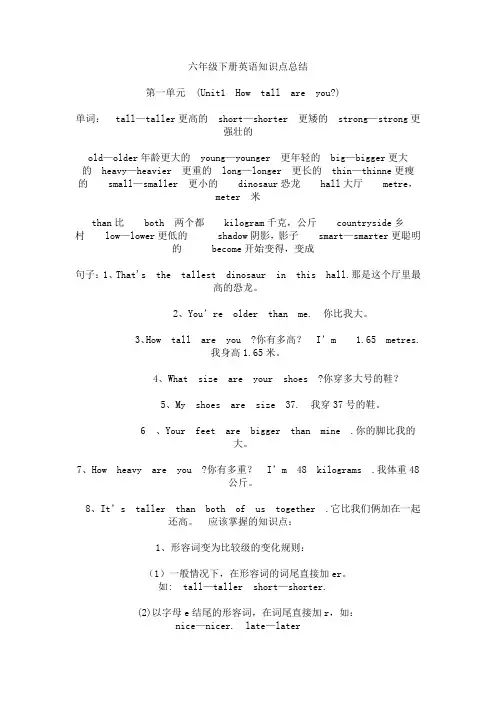
六年级下册英语知识点总结第一单元(Unit1 How tall are you?)单词:tall—taller更高的short—shorter 更矮的strong—strong更强壮的old—older年龄更大的young—younger 更年轻的big—bigger更大的heavy—heavier 更重的long—longer 更长的thin—thinne更瘦的small—smaller 更小的dinosaur恐龙hall大厅metre,meter 米than比both 两个都kilogram千克,公斤countryside乡村low—lower更低的shadow阴影,影子smart—smarter更聪明的become开始变得,变成句子:1、That's the tallest dinosaur in this hall.那是这个厅里最高的恐龙。
2、You’re older than me. 你比我大。
3、How tall are you ?你有多高?I’m 1.65 metres.我身高1.65米。
4、What size are your shoes ?你穿多大号的鞋?5、My shoes are size 37. 我穿37号的鞋。
6 、Your feet are bigger than mine .你的脚比我的大。
7、How heavy are you ?你有多重?I’m48 kilograms .我体重48公斤。
8、It’s taller than both of us together .它比我们俩加在一起还高。
应该掌握的知识点:1、形容词变为比较级的变化规则:(1)一般情况下,在形容词的词尾直接加er。
如: tall—taller short—shorter.(2)以字母e结尾的形容词,在词尾直接加r,如:nice—nicer. late—later(3)以重读闭音节结尾,且结尾只有一个辅音字母的词,先双写这个辅音字母,再加er.如:big—bigger thin—thinner fat—fatter(4)以辅音字母加y结尾的双音节形容词,先变y为i , 再加er。
六年级广东版英语知识点
六年级广东版英语知识点六年级的学生在广东版英语课程中,将会接触到许多新的知识点。
这些知识点不仅包括基础的语法和词汇,还涉及了阅读、写作、听说等综合语言技能的培养。
以下是一些六年级广东版英语的主要知识点:1. 词汇:学生将学习与日常生活、学校活动、节日等主题相关的词汇。
词汇量的增加有助于他们更好地理解和表达英语。
2. 语法:重点学习时态的使用,如现在进行时、一般过去时和一般将来时。
同时,也会学习名词的复数形式、形容词的比较级和最高级等。
3. 阅读理解:通过阅读短文,学生将练习提取信息、理解主旨大意和推理判断等技能。
阅读材料可能包括故事、对话、说明文等。
4. 写作:学生将学习如何写简单的句子和段落,包括叙述文、议论文和应用文。
写作练习将帮助他们组织思想和清晰表达。
5. 听力理解:通过听英语对话、故事和歌曲,学生将提高他们的听力技能,包括理解细节、主旨大意和推断。
6. 口语表达:学生将通过角色扮演、讨论和演讲等活动,练习英语口语。
这有助于提高他们的流利度和自信心。
7. 文化意识:通过学习英语国家的文化习俗和节日,学生将增强跨文化交流的能力。
8. 综合运用:学生将通过项目作业、小组合作和课堂展示等活动,将所学的语言知识综合运用到实际情境中。
9. 自我评价:鼓励学生进行自我反思和评价,以提高自主学习能力和自我监控能力。
10. 学习策略:教授学生有效的学习策略,如预习、复习、笔记技巧等,帮助他们更有效地学习英语。
通过这些知识点的学习,六年级的学生将为进一步的英语学习打下坚实的基础,并为将来的学术和职业生涯做好准备。
记住,学习语言是一个持续的过程,需要耐心和持续的努力。
广州六年级英语知识点总结

广州六年级英语知识点总结一、语法知识点1. 时态和语态在六年级英语中,时态和语态的掌握是非常重要的。
学生需要熟练掌握一般现在时、一般过去时、一般将来时等基础时态的用法,并能够正确运用于句子中。
此外,被动语态的学习也是其中的一部分内容,包括被动语态的构成和用法。
2. 从句和复合句六年级英语要求学生能够理解从句和复合句的概念,并能熟练运用在句子中。
学生需要学会如何使用关系代词和关系副词引导从句,并能正确运用于句子中。
3. 名词、代词和形容词名词、代词和形容词是语言中常见的词类,在英语学习中也是重要的知识点。
学生需要学会如何正确使用不同的名词、代词和形容词,并能运用于句子中,使句子表达更加准确和丰富。
4. 冠词和介词冠词和介词是英语中的虚词,但其在句子中的作用不可小觑。
学生需要能够正确使用不同的冠词和介词,并将其运用于句子中,使句子的表达更加准确和自然。
5. 句型转换和句型仿写在六年级英语中,学生需要通过句型转换和句型仿写的练习来加深对语法知识点的理解和掌握。
通过转换和仿写不同的句子,学生可以更加灵活地运用所学的语法知识。
二、词汇知识点1. 同义词和反义词学生需要学会识别和运用同义词和反义词。
通过对同义词和反义词的学习,学生可以丰富自己的词汇量,并能够更加准确地理解和运用单词。
2. 词组和短语词组和短语在英语中也是非常常见的,学生需要学会识别和使用不同的词组和短语,并能将其运用于句子中,使句子更加地道和流畅。
3. 常见固定搭配在六年级英语中,有一些常见的固定搭配需要学生掌握,如动词搭配介词、动词搭配副词等。
学生需要学会识别这些常见的固定搭配,并能正确地运用于句子中。
4. 词形变化学生还需要学习一些常见的词形变化规则,如动词的过去式和过去分词形式等。
通过对词形变化规则的学习,学生可以更加准确地运用单词,并扩大自己的词汇量。
三、阅读理解知识点1. 短文理解学生需要学会如何从短文中抓取关键信息,并能根据短文内容回答问题。
广州版小学英语六年级上册复习归纳1
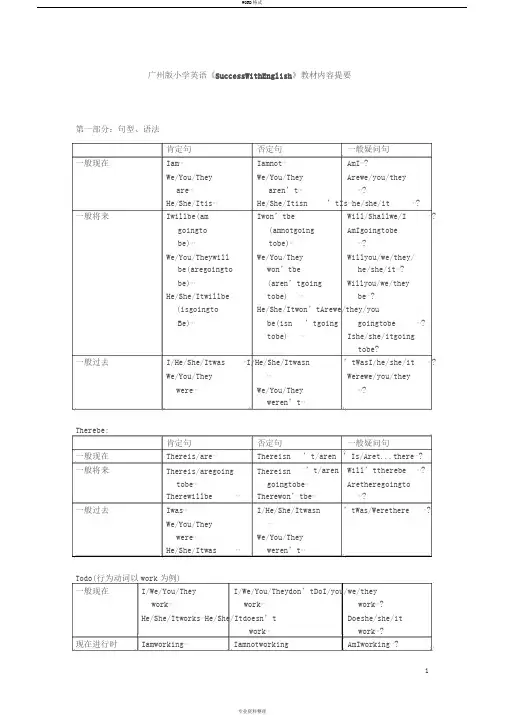
广州版小学英语《SuccessWithEnglish》教材内容提要第一部分:句型、语法肯定句否定句一般疑问句一般现在Iam⋯Iamnot⋯AmI⋯?We/You/They We/You/They Arewe/you/theyare⋯aren’t⋯⋯?He/She/Itis⋯He/She/Itisn ’tIs⋯he/she/it ⋯?一般将来Iwillbe(am Iwon’tbe Will/Shallwe/I ⋯?goingto (amnotgoing AmIgoingtobebe)⋯tobe)⋯⋯?We/You/Theywill We/You/They Willyou/we/they/be(aregoingto won’tbe he/she/it⋯?be)⋯(aren’tgoing Willyou/we/theyHe/She/Itwillbe tobe) ⋯be⋯?(isgoingto He/She/Itwon’t Arewe/they/youBe)⋯be(isn ’tgoing goingtobe ⋯?tobe) ⋯Ishe/she/itgoingtobe?一般过去I/He/She/Itwas ⋯I/He/She/Itwasn ’t WasI/he/she/it ⋯?We/You/They ⋯Werewe/you/theywere⋯We/You/They ⋯?weren’t⋯Therebe:肯定句否定句一般疑问句一般现在Thereis/are⋯Thereisn ’t/aren ’Is/Aret...there⋯?一般将来Thereis/aregoing Thereisn ’t/aren Will’t therebe ⋯?tobe⋯goingtobe⋯AretheregoingtoTherewillbe ⋯Therewon’tbe⋯⋯?一般过去Iwas⋯I/He/She/Itwasn ’t Was/Werethere⋯?We/You/They ⋯were⋯We/You/TheyHe/She/Itwas ⋯weren’t⋯Todo(行为动词以work为例)一般现在I/We/You/TheyI/We/You/Theydon’t DoI/you/we/theywork⋯work⋯work⋯?He/She/Itworks⋯He/She/Itdoesn’t Doeshe/she/itwork⋯work⋯?现在进行时Iamworking⋯Iamnotworking AmIworking⋯?1We/You/Theyare ⋯Areyou/we/theyworking⋯We/You/Theyaren’t working⋯?He/She/Itis working⋯Ishe/she/itWorking⋯He/She/Itisn ’t working⋯?working⋯一般将来I/We/You/He/She/It I/We/You/He/She/It/They WillI/we/you//Theywillwork won’twork ⋯they/he/she/it⋯I’mnotgoingtowork ⋯work⋯?I’mgoingtowork We/You/Theyaren’t AmIgoingto⋯goingtowork ⋯work⋯?We/You/Theyare He/She/Itisn ’tgoingtoAreyou/we/theygoingtowork ⋯work⋯goingtoworkHe/She/Itisgoing ⋯?towork⋯Ishe/shegoingtowork⋯?一般过去I/We/You/They/He/ I/We/You/They/He/ DidI/we/you/they/She/Itworked ⋯She/Itdidn ’twork ⋯/he/she/itwork⋯?1.读下面的特殊疑问式的句子,你能总结一些特殊疑问句的构成的规律吗?I.Wholivesthere.Whoissingingintheroom?Whowasathomeyesterday?II.Whatdoeshedo?Whatishedoing?Whatdidtheydo?Whendoesheusuallygetup?Whendidshehavedinneryesterday?Whereishenow?Wherearetheyplantingtrees?Wheredidtheyplayfootball?Howisyourmother?Howishecoming?Howdidtheygetthere?Whydoeshegothere?Whydidshegothere?III.Whosebookisthis?Whoseparentsarecominghere?Whichbookisyours?Whichpresentsdidhegiveyou?22.关于形容词、副词的比较级和最高级(1)你知道形容词、副词的比较级和最高级构成的一些规律吗?A.一般情况下加-er,-est:long–longer,longest;small–smaller,smallestB.重读闭音节,双写最后一个字母再加-er,-est:big–bigger,biggest; hot–hotter,hottestC.辅音字母加y,改作后一个字母y为i再加-er,-est:funny–funnier,funniest, lucky–luckier,luckiestD.部分双音节和多音节词,加more,most:slowly–moreslowly,mostslowly; moredelicious,mostdeliciousE.不规则变化:good–better,best; bad–worse,worst(2)你知道形容词、副词的比较级和最高级句子的构成吗?A.Thisbookisnewerthanthatone.TheEnglishbookisthenewestofthethree.MikerunsfasterthanJohn.Mikerunsfastestinhisclass.B.Thisflowerismorebeautifulthanthatone.Thistreeistheoldestinthepark.Thegirlisswimmingbetterthanthegirl.Jimswimsbestinhisgroup.C.Snakesaremoredangerousthanfrogs.Themeetingisthemostimportant.Theoldmanwalksmoreslowlytheyoungman.Katejumpshighestinherclass.D.TimhasmorebooksthanJim.Timhasthemoststampsinhisclass.3.关于代词some-,any-,no-,every-:(1)some-多用在肯定句表示请求得到某些东西的句子:Someonewillcomehere.Wouldyoulikesomethingtoeat.(2)any-多用于疑问句或否定句:Isthereanythinginthebox?Wedon’twanttoseeanyoneofthem?(3)no-是事实的否定:Thereisnothingintheroom.Nobodycandothat.(4)代词some-,any-,no-,every-语法上看成是第三人称单数:Thereissomethinginthebottle.Everyonelikesit.3表1:小学教材各话题板块涉及的主要内容话题板主要涉主要涉及单词快及模块数字、B1M6 基数、序数、星期、数量、B3M5-6 日期、月份、季节、时间、B5M1 年份、钟点的表达、日期计量单位等购物B3M1 money,change,shopB4M4 assistant,vendor人物:年B1M2 表男女老少的类别龄、体貌B2M3 名、身体部位名、服衣着、性B3M1-4 饰名、体质与外貌形格、职业、B4M1-2 容词、性格形容词、爱好与特B5M2 职业、表特长爱好的长、理想、B8M3 动词生平B8M5学校生B4M3 科目名、作息动词、活:课B5M1 运动、娱乐动词程、作B6M1息、课B6M3外活动家庭生B2M1 家庭成员名、职业名、活:家B3M6 爱好特长动词、娱乐庭成员B4M4 形式名词及动词、家及其职B5M1 务动词、频度副词业与爱好、家务与休闲食品B4M4 食品名、三餐名、进B6M5 食动词生活习B6M2 描述体质的形容词、惯与健B6M5 描述身体感觉的形容康词、生活习惯的动词、主要涉及语法、功能等名词复数;Howmany/Howheavy/Howlong/Whattime/When 等引导的疑问句和回答等;时间、星期、日期的询问与表达;招呼与应答;表达要买某种商品或询问是否有某种商品;对商品的评论;询问价格;询问是否还需其他商品及应答;找零描述体质外貌的各种句式:be+adj,has/have+n,with+n,in+n 的用法表示爱好与特长的句式: likesth/doingsth,begood/badat⋯,do(es)⋯well;描述爱好与行为习惯等的一般现在时:Hereadsalot.HewatchesTVveryoften等;表示职业、愿望的句式:be+jobs;Iwanttobea⋯whenIgrowup.IhopeIcan⋯叙述生平的句式:beborn⋯一般现在时的各种句式一般现在时的各种句式;询问与表达频度;谈论对娱乐节目的爱好;评论娱乐节目三餐时间;谈论饮食习惯;对饮食的偏好与评论;待客用语及应答描述身体感觉和状况看病用语情态动词 should的用法祈使句4(电B7M3-4话)邀约与聚会动物、B1M2 植物B2M2B5M2-3B5M5B6M4 天气与B6M1 季节B6M6节假B1M5 日、旅B5M4行、城B7M1-2市、计B7M6划与建B7M3-4议地点、B2M4-6方位与B5M6 方向变化:B6M3 人的变B8M1 化、地方的变化过去的B7M5事情B8M2-4邀请与应答电话用语商量聚/约会时间、地点、交通方式等动植物名、动物行为描述动物外貌和习性的一般现在时方式动词、公园行为祈使句动词、描述动作的副规则的表达(can,need,must,mustn’t)词天气形容词、气象名询问与描述天气词、季节性娱乐和体比较天气育活动动词谈论对季节的偏好节假日名、交通方式询问计划和称述计划名、国家与城市名、各种提建议的句式描述城市的形容词、描述和比较城市休闲娱乐动词描述传统节日房间名、家具名、场描述位置关系所名、学校场室名、问路和指路方位介词、描述场室描述场室的形容词动词的过去式描述体貌性格、职业身份、行为习惯、能力、场所处室、天气等各种变化动词的过去式讲述过去的事情故事中的词组描述人物的生平讲述故事表2:小学教材话题分配Module Book1Book2Book3Book4Book5Book6Book7Book81 GreetingsRelationships Clothes Age Routines OurLifePlansChanges√/Shopping √And√√√√Dates√2 MyBody Animals People Activities AbilitiesSeeing aCitiesDiaries√√√/Hobbies√√Doctor√√√3 StationeryNationalitiesOccupations Sports Plants Our an Famous√√√School Invitation People √√and Our5Class √4 Colours MyRoom PeopleWho Entertainment TravelWildOnthe Stories √ HelpUs √√ Animals telephon e and√√Fables√√5 Transport MyHouseTime Foodand Zoo Eating ThePast Hopes√ √ √ Drink Animals Habits √and √ √Fantasi es √ √6 Numbers MySchool DaysOfThe Shoppin g Directio ns Weather Festivals andShapes √ Week √ √ √ √√ √表3:小学教材动词分类日常作息:wakeupgetupgetdressedwashtheface brush theteeth have breakfastgo to school goto workhave lessons havelunchtakearest play sport s takeexercises go(back)homehavedinnerdohomework haveabathgotobedsleepeatdrinkcook娱乐休闲:haveapartyhaveapicnic dosomereading doshoppinggoshopping goboatinggoswimming gosightseein ggofishinggotravelinggoonarivercruise gotothecircus goto theflower show goto th e cinema gotoa footbal l matchwatch afootball matchonTVcome to tea seea filmwatch thebirds listen to music / theradiowatch TV climbthemountain playcards e-mailafriendwritealettervisitafriend/Beijingmeetafriend爱好与特长: singdrawpaintplaythepiano/theguitar dowellin ⋯makeashipmodelplaycardsplaychess体育运动: runswimskiprope swim play basketball playfootball playtabletennisplaytennisplaybadmintondoweight-lifting家务:watertheflowersdogardeningplanttrees/flowerscleanthehousesweepthefloor washthedishes cook washthecar washclothes feedthepet学习:read listen speak write study learn practice hand inthehomework borrowabook returnabook catchupwithteach markthehomework preparethelessons tellastory6心理和情感活动:want love enjoy like dislike love prefer hope wish agreewith think dream feelsad/happy/excited/boredworry身体健康:takeexercise seeadoctorhaveacold/fever/toothache/headacheeat drink takethemedicine goonadiet feeltired/hot/cold/ill/sick感官动词:listento hear lookat see watchfeelhot/cold/tired soundinteresting/different/greatlookyoung/tall/beautiful/fresh/good种植活动:grow/plantatree grow/plantflowers watertheflowers digahole fillintheearth pickupthefruit appear位置移动:leave leavefor startfor move bring take climb run walk swim jump fly sitdown standup throw⋯at⋯travel go comegetto⋯getoutof⋯getdown fall fallover与职业有关的动词:work putoutfires cleanupeverythingdeliverletterscatchcriminals servefoodanddrinks helpinashopdriveataxi/anambulance checkyourteeth helpustolearnhelpsickpeople与“说”有关的动词:say speak talk tell与“看”有关的动作:look lookat lookfor watch see其它动词:last begin start end finish bite blow blow outbuy call carry catch change check close open countcostcover crash cut decorate free changegive grow /grow uphelpinvite getwet kill keep look for make need put onputout show turn waitfor runinto crashinto weighhavehavearest haveabath haveacold haveagoodtime havebeento⋯havealook havefun havetotaketakeamessage takearest takemedicine takeexercise takephotos takeabus takemetotheflowershow takethethirdleft I’lltakeit.WORD格式playplay computergames play cards playbasketball playmusicalinstruments playthepiano7专业资料整理。
六年级复习资料广州版六年级英语
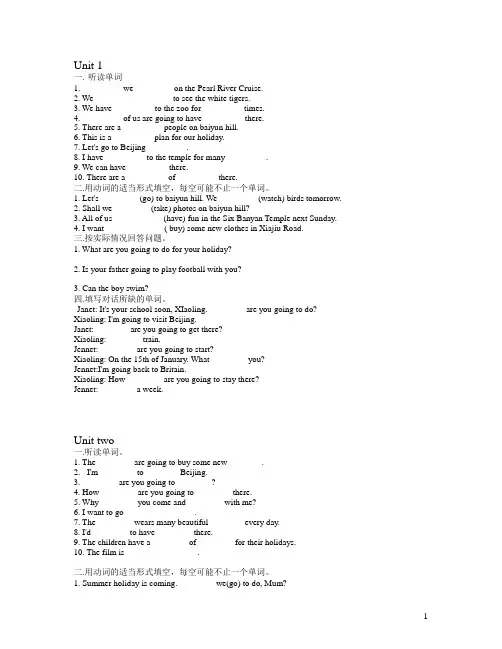
Unit 1一. 听读单词1. _________ we_________ on the Pearl River Cruise.2. We__________________ to see the white tigers.3. We have _________ to the zoo for _________ times.4. _________ of us are going to have _________ there.5. There are a _________ people on baiyun hill.6. This is a _________ plan for our holiday.7. Let's go to Beijing _________.8. I have _________ to the temple for many _________.9. We can have _________ there.10. There are a _________ of _________ there.二.用动词的适当形式填空,每空可能不止一个单词。
1. Let's _________(go) to baiyun hill. We _________(watch) birds tomorrow.2. Shall we_________(take) photos on baiyun hill?3. All of us____________(have) fun in the Six Banyan Temple next Sunday.4. I want______________( buy) some new clothes in Xiajiu Road.三.按实际情况回答问题。
1. What are you going to do for your holiday?____________________________________________2. Is your father going to play football with you?_____________________________________________3. Can the boy swim?四.填写对话所缺的单词。
广东六年级英语复习资料
广东六年级英语复习资料六年级是小学生活的最后一年,也是距离升入初中仅剩的一年时间。
考试成绩对于学生和家长而言尤为重要。
在英语学习方面,要想取得好成绩,重点在于词语和语法的积累。
下面是一些广东六年级英语复习资料,供学生和家长参考。
一、词汇学习英语的第一步是学会词汇。
以下是常用的词汇表:1.家庭成员:father, mother, brother, sister, uncle, aunt, grandfather, grandmother, cousin等。
2.食物:apple, orange, pear, peach, banana, watermelon, chicken, beef, pork, fish, rice, bread, milk, egg, cheese等。
3.学校物品:pen, pencil, ruler, sharpener, eraser, book, notebook, bag, computer, desktop, laptop, keyboard, mouse等。
4.时间和日期:weekday, weekend, Monday, Tuesday, Wednesday, Thursday, Friday, Saturday, Sunday, year, month, day, date等。
5.颜色:red, yellow, blue, green, purple, black, white, orange等。
二、语法英语语法对学生而言通常是一个难点,需要大量练习和记忆才能掌握。
以下是常见的语法知识点:1.动词时态:常见的有现在时、过去时、将来时等;2.语句构成:由主语和谓语构成,常见的情况包括肯定句、否定句、疑问句等;3.名词:包括可数和不可数名词,常见的有单数和复数、名词所有格等;4.形容词和副词:形容词作用是修饰名词,而副词则修饰动词、形容词和其他副词;5.介词:用于表达时间、地点或方式,例如in, on, at, to, from 等。
小学六年级英语总复习资料
小学六年级英语总复习资料Class Name Number一、词汇归类1.数词number2.代词be动词is, am, are的选择: 单数时用is,复数时用are, I 用am, you 用are3.介词in +较长的段的时间in a year/spring/month/September/week;in the morning/afternoon/eveningon+具体的某一天On Sunday/Monday/Tuesday/Wednesday/Thursday/Friday;on June 30that+时间点/在…岁时/在….的期间at 11:00;at the age of 12;at noon; at night;at the beginning of…方位介词(on、in、at、under、bebind、above、over、in front of):表示事物存在的方向和位置4.特殊疑问词5.同音词I—eye, for—four, where—wear, pear—pair, see—sea, right-- write board—bored, sun—son, hour—our, one—won, here—hear, deer—dear, no—know, there—their, to-- too—two, by-- bye—buy6.缩写形式与完整形式isn’t=is not aren’t=are not I’m=I am it’s=it is can’t=can not could not=couldn’t she’s=she is he’s=he is you’re=you are we’re=we are don’t=do not doesn’t=does not they’re=they are what’s=what is who’s=who is that’s =that is did not=didn’t let’s=let us 二、Let’s spell三、语法点归类1.名词的运用单数名词:一般情况下用a可数名词以元音开头的单词用an (元音字母有:a e i o u)(如:an umbrella/ apple/egg/e-mail/ice cream/orange/umbrella/ elephant)复数名词:一般在词尾加s不可数名词如meat/milk/juice/water/tea/coffee/ soup2.名词单数变复数的规则3.形容词的比较级①形容词比较级的运用:将两个事物或人进行比较要用比较级,句型结构:4.四种时态(一般现在时、现在进行时、一般过去时、一般将来时)⑴一般现在时①用法:表示经常反复发生的动作、存在的状态或习惯性的动作的时态。
广州版英语六年级上总复习资料归纳M2答案.docx
[解析] 文段的前半部分是说对先秦诸子的划分有“六 家”“十家”,“杨朱与老子、庄子不同,其观点立场更不 一样,不宜列入道家,应是独立的一家”,由此可以判断① 处应是后一部分领起句,应填写对这种划分法并不敢苟同之 类的内容;根据文段末尾一句,可以判定②处亦为领起句, 应填同一流派中有继承更有发展之类的内容。
[例 2] 根据下面的文字,补写后面总括性的句子,每句 补写部分不超过 15 个字。
关于低碳经济的解释较多,例如:“低碳经济是以低能耗、 低污染、低排放为基础的经济模式”“低碳经济就是能源高效 利用、清洁能源开发、追求绿色 GDP”,“低碳经济是通过 技术创新、制度创新、产业转型、新能源开发等多种手段,达 到经济社会发展与生态环境保护双赢的一种经济发展形 态”“低碳经济是能源技术和减排技术创新、产业结构和制度 创新,以及人类生存发展观念的根本性转变”。在低碳经济的 背景下,“低碳技术”“低碳发展”“低碳生活方式”“低碳 社会”“低碳观念”等一系列新概念应运而生。
[典例] (2016·全国丙卷) 在下面一段文字横线处补写恰当的语句,使整段文字语意完整连 贯,内容贴切,逻辑严密。每处不超过 10 个字。 自第一颗人造地球卫星进入太空以来,除了载人航天飞行器会回 收之外,其他上天的人造物体陆续被遗弃在太空中, ① 。太空垃 圾已经威胁到人类的航天活动。比如厄瓜多尔的一颗卫星升空后不到 一个月,就与太空中的火箭残骸相撞而报废。这种威胁不仅仅发生在 太空,甚至地球上的人类生活也会 ② 。因此, ③ ,应是人类 接下来要解决的一个重要课题。
[参考答案] ①没有约定俗成的定义 ②广泛的产业领域 和管理领域
(二)阐述转换句的定位补写 阐述转换句多出现在同一个句子的上半句或下半句中, 通常是并列关系复句的另一半,条件关系复句的“条件”或 “结果”等。补写时或合理推出语段未有的新内容,或根据 上下文推出已有的内容。阐述句的补写在语句补写题中有上 升趋势,在复习中应引起关注。
广州教科版六年级上册英语复习整理.doc
广州教科版六年级上册英语复习整理M1 Country life(一)1.村 country2.田 field3.摘 pick4.草 grass5.give6.奶牛;母牛cow7.羊sheep8.其他的other9.极少few10.江;河river11.祖父母grandparent12.奶milk13.ride14.花take15.仍然still16.空气air(二)短1.几个 a few +可数名2.帮助⋯做help⋯ With ⋯3.喂物feed the animals4.摘一些苹果pick some apples5.种花grow flowers6.植plant trees7.自行ride bike8.多plenty of(三)句型1.you can (原形)if you want.2.There is\are + 名3. ⋯ because ⋯M2 City life(一)1.城市city2.学生student3.安静的quiet4.便宜的cheap5.代化的modern6.嘈的noisy7.的wide8.的crowded9.舒服的10. 的 ,大量的 heavy11. 慢 ,慢 slow12. 明信片 postcard13. 的 dirty14. 害怕 afraid15. 因 because16. 出售 sell17. 村 countryside18. 院 theatre(二)短1. 不同于⋯ be different to2. 害怕 be afraid3. 整天 all day(三)句型1.Where are you from?I’m from⋯⋯2.What ’s New York like?It is ⋯⋯3.It’s very different to our home on the farm4.I am afraid to go outside.5.There is much more to do in the city than in the country.6.I can’twait to get back home.M3 Health(一)1.健康healthy2.事情matter3.病的ill4.胃疼stomachache5.牙疼toothache6.疼headache7.fever8.听到hear9.medicine10. 刷 brush11. 两次 twice12. 断了的 broken13. 手指 finger14. 休息 rest15. 秘密 secret16. 的 simple17. 最少 least18. 少的 less19. 最后的 finally20. 食 diet21. 多油的 oily22. 微笑 smile23. 甚至 even(二)短1.check-up2.服take medicine3.休息take a rest4.感冒have a cold5.一天三次three times a day6.持一周for one week7.至少at least8.食on a diet(三)句型1.What ’s the matter?What ’s the matter with you?I feel ill\bad.I feel better.2.I’m sorry to hear that.3.He gave me a check-up.4.I think you ’ll be well soon.5.Keep a good diet6.Eat more vegetables and less meat.7.To be happy.M4 Past experiences(一)1.昨天yesterday2.生气的angry3.可怜的poor4.最近的 ,上一个last5.年 year6.日diary7.后来later 8.直到until9.更好better10.惊的surprised(二)短1.一点都不no/not at all2.一点 a little3.去物go shopping4.待家里stay at home5.看影see a film6.上周末last weekend7.去旅游go on a trip8.关于talk about9.照相take a photo(三)句型1.What did you do?2.Where did you go?3.It was no fun at all.M5 Changes(一)1.有礼貌的polite2.肥胖的fat3.哭 cry4.⋯之前ago5.村子village6.附近nearby7.公室office8.商店store(二)短1.当 back then2.上网 surf the Internet3.遥 far away4.百公司 department store5.在上 in the picture6.留短 keep it short7.常笑 smile a lot8.大多数人 most of the people9.三年前 three years ago(三)句型1.Who is that in the picture?2.When you were five years old.When I was ⋯⋯3.Was I a good girl back then? Yes,you were./ No, you weren ’t4. But now I am still very good.M6 Festival(一)1.春Spring Festival2.礼物gift3.希望;祝愿wish4.子jiaozi5.中秋Mid-autumn Festival6.月亮moon7.月mooncake8.端午Dragon Boat Festival9.dragon10.粽子zongzi11.比race12.重阳Chongyang Festival13.圣Christmas14.分享share15.奇妙wonderful16.匆忙hurry17.来bring18.火腿ham19.火turkey(二)短1.lucky money2.起put up3.打房子clean the house4.新衣服buy new clothes5.互相each other6.拜家人visit the family7.吃大餐have a big dinner8.最重要的the most important(三)句型1.What ’syour favourite festival?My favourite festival is⋯I like ⋯ best.2.so much funSo many things3.Wish them a happy Spring Festival.4.It sounds great.重点法一.人称代我你他她它我你他I you he she it we you they Me you him her it us you them 我的你的他的她的它的My your his her itsBe 用法口:I 用am,you用areis 着他她它数名用 is,复数名全用 are 疑 ,往前提 ,句末号莫弃否定 ,更容易 ,be 后 not 莫忘二、一般去1.志:去的点yesterday, last night, last night, last weekend, three years ago⋯⋯2.构:主+去式+其他1)否定句:主+didn’ t+原形+其他.如: We didn ’ t go to the party.2)一般疑句:Did+主 +原形 +其他 ?Yes, 主 +did. / No, 主 +didn ’ t.3.一般去式化1)直接加“ ed:”work —— worked2 )以不音的字母“ e”尾的,直接加“ d:”live ——lived hope ——hoped3)以音字母 +y 尾的 , y i 加“ ed:” study ——studied carry ——carried4.特殊去式1.( ride ): rode2.花( take ): took3.出售( sell): sold4.听到( hear ): heard5.吃( eat): ate6.( give): gave7.穿( wear ): wore8.更( can): could9.( buy): boughtcame11.遇( meet ): met12.看( see): saw13.( read): read14.感( feel ): felt15.坐( sit): sat16.来( bring ): brought17.do/does - did18.am/is/ - wasare - were。