
检验英文
项目代码缩 写英文临床生化Clinical Biochemistry血清谷丙转氨酶ALT s-ALT Alanine Aminotransferase血清谷草转氨酶AST s-AST Aspartate Aminotransferase血清总胆红素TBIL s-TBIL Total Bilirubin直接胆红素DBIL s-DBIL Direct Dilirubin血清碱性磷酸酶ALP s-ALP Alkaline phosphataser-谷氨酰转肽酶GGT s-GGTγ-Glutamyltransferase血清乳酸脱氢酶LDH s-LDH Lactate dehydrogenase血清总蛋白TP s-TP Total Protein血清白蛋白Alb s-Alb Albumin总胆汁酸TBA TBA Total Bile Acid血糖Glu s-GLU Glucose血清肌酐Creat s-Creat Creatinine血清尿素Urea s-Urea Urea血清尿酸UA s-UA Uric acid血清钾K Potassium血清钠Na Sodium血清氯Cl Cholride血清钙Ca Ca Calcium血清镁Mg Mg Magnesium血清磷Phos Phos Inorganic phosphorus血清甘油三酯TG Triglycerides血清总胆固醇Chol Cholesterol Total高密度胆固醇HDL-C HDL Cholesterol低密度胆固醇LDL-C LDL cholesterol载脂蛋白A1ApoA1Apolipoprotein A-1载脂蛋白B ApoB Apolipoprotein B脂蛋白(a)LP(a)Lipoprotein (a)血清肌酸激酶CK CK Creatine Kinase淀粉酶AMY AMY Amylase尿淀粉酶U-AMY U-AMY Urine Amylase超敏C-反应蛋白hsCRP hsCRP High Sensitive C-Reaction ProteinD-二聚体D-Dimer D-Dimer D-Dimer乳酸LAC LAC L-Lactate腺苷脱氨酶ADA ADA Adenosine deaminase血氨NH4AMM Ammonia糖化血清蛋白GSP GSP Lglucosylated serum proteins内生肌肝清除率Ccr Ccr Endogenous creatinine clearance rate24小时尿量U-Volume Urine Volume二氧化碳分压PCO2Partial pressure of carbon dioxide氧分压PO2Partisl pressure of oxygen缓冲碱BB Buffer base血氧含量O2Cont Oxygen cotent血氧饱和度O2sat Oxygen saturation剩余碱BE Base excess实际碱剩余BEact Base excess at actual oxygen saturation 标准酸碱度St.pH Standard pH氢离子浓度cH+Concentration of H+酸碱度pH Negative log of hydrogenion concmtra ion 标准碳酸氢根St.HCO3Standard HCO3实际碳酸氢盐HCO3Actual bicarbonate呼吸商#RQ Respiratory quotient体温#Temp Temperature肌钙蛋白cTNI cTNI Troponin I肌酸激酶同功酶MB质量CK-Mbmass CK-MBmass CK-MBmass肌红蛋白MYO MYO MyoglobinB型钠尿钛BNP BNP B-type Natriuretic PeptideN端前BNP NTproBNP NTproBNP NTproBNP同型半胱氨酸Hcy Hcy Homocysteine地高辛Dig Dig Digoxine促甲状腺素TSH Thyroid stimulating hormone 游离T3FT3Free triodothyronine游离甲状腺素FT4Free thyroxine胰岛素INSULIN INSULIN Insulin组合肝功能1号LF-1LF-1Liver Function 1肝功能2号LF-2LF-2Liver Function 2肾功能RP RP Renal Function血脂1号LP-1LP-1Lipid Series 1血脂2号LP-2LP-2Lipid Series 2电解质1号EL-1EL-1Electrolyte 1电解质2号El-2EL-2Electrolyte 2生化全套Biochem Biochem Biochemistry血气分析BGA BGA Blood Gas Array心肌标志物Heart-MK Heart-Maker Heart-Maker甲状腺功能全套HH-chem HH-chem Hypothyroid Function葡萄糖耐量实验OGTT OGTT Glucose Tolerance Test胰岛素释放试验胰岛素释放胰岛素释放Insulin Sensitivity Test项目缩 写英文临床免疫Clinical Immunology检验项目乙肝表面抗原HBsAg Hepatitis B surface antigen 乙肝表面抗体HBsAb Hepatitis B antibody乙肝e抗原HBeAg Hepatitis B e antibody乙肝e抗体HBeAb Hepatitis B e antigen乙肝核心抗体HBcAb Hepatitis B core amtibody丙肝-IgG HCV HCV-IgG Hepatitis C virus marker抗甲肝IgM抗体HAV抗HAVIgM Hepatitis A virus marker梅毒试验TP TP Syphilis test抗艾滋病抗体HIV抗HIV HIV antibody甲胎蛋白AFP AFPα1-fetoprotein癌胚抗原CEA CEA Carcinoembryonic Antigen 抗链球菌溶血素“O”ASO ASO Anti-Streptolysin O Test类风湿因子RF RF Rheumatoid FactorC-反应蛋白CRP C-Reaction Protein抗链球菌DNA酶B ADNase Anti-streptococcal Dnase抗心肌抗体HRAb-IgM Myocardial antibody柯萨奇病毒抗体CVB-IgM Coxsackje virus IgM抗甲状腺球蛋白抗体anti-TG Anti-thyroidglobulin抗甲状腺微粒体抗体anti-TM Anti-thyroid microsome结核抗体-IgG A-TB-IgG Anti-Tuberculosis-IgG结核抗体-IgM A-TB-IgM Anti-Tuberculosis-IgM抗核抗体ANA Antinuclear Antibody可提取性核抗原ENA Extractable Nuclear antigen双链DNA抗体抗ds-DNA Double strand DNA Antibody抗拓朴异构酶Ⅰ抗体Scl-70Scl-70 AntibodySS-A抗体抗SS-A SS-A AntibodySS-B抗体抗SS-B SS-B Antibody抗Sm抗体Anti-Sm Anti-Smith组氨酰t-RNA合成酶抗体抗Jo-1Anti-Jo-1抗核糖核蛋白抗体Anti-RNP Anti-RNP胱氨酸蛋白酶抑制剂C Cys-C Cys-C Cystatin C免疫球蛋白G S-IgG Immunoglobulin G免疫球蛋白A S-IgA Immunoglobulin A免疫球蛋白M S-IgM Immunoglobulin M补体3S-C3Complement 3补体4S-C4Complement 4尿α1微球蛋白U-α1-mg U-α1-mg urine-α1-Microglobulin尿微白蛋白U-mAlb U-mAlb urine-min Alb尿IgG U-IgG U-IgG urine-IgG尿转铁蛋白U-TRF U-TRF Urine-Transferrin尿本周氏蛋白定性试验B-J Pro B-J Pro Bence-Jones Protein组合项目乙肝标志物HBV HBV-Maker HBV-Maker传染病筛选试验Infection Infection Infection Filtration风湿1号RF1RF1Rheumatoid Series 1风湿2号RF2RF2Rheumatoid Series 2尿微蛋白全套UMP-W UMP-W Urine mini Protein结核抗体全套TB-Ab全套TB-Ab全套Tuberculosis antibody免疫全套Immu-CHEM Immu-CHEM Immue Series甲状腺免疫全套甲免全套甲免全套Hypothyroid Immue Series检验项目代码缩 写英文临床血液体液Clinical Hematology红细胞计数W-RBC Red blood cell count血红蛋白W-HGB Hemoglobin assay平均血红蛋白含量W-MCH Mean cell hemoglobin红细胞比积W-HCT Hematocrit平均红细胞体积W-MCV Mean corpuscular volume平均血红蛋白浓度W-MCHC Mean cell hemoglobin concentration红细胞体积分布宽度W-RDW Red blood cell volume distrbution width 白细胞计数W-WBC White blood cell count中性粒细胞百分率NEUT%Neutrophil percent中性粒细胞绝对值NEUT#Neutrophil absolute count淋巴细胞百分率LYM%Lymphoeyte percent淋巴细胞绝对值LYM#Lymphocyte absolute count单核细胞百分率MON%Monocytes percent单核细胞绝对值MON#Monocytes absolute count嗜酸性粒细胞百分率EO%Eosinophils percent嗜酸性粒细胞绝对值EO#Eosinophil absolute count嗜碱性粒细胞百分率BASO%Basophils percent嗜碱性粒细胞绝对值BASO#Baso absolute count血小板W-PLT Platelet count血小板体积分布宽度W-PDW Platelet distribution width血小板平均体积W-MPV Mean platelet volume大型血小板率W-P-LCR Large Platelet Rate凝血酶原时间PT Prothrombin Time部分凝血活酶时间APTT APTT Activated Partial Thromboplastin Time 凝血酶时间TT Thrombin Time纤维蛋白原Fib Fibrinogen国际标准化指数INR International normalized ratio纤维蛋白降解产物FDP FDP Fibrinogen degradation product3P试验3P3P Plasma protamine paracoagulantion Test 红细胞沉降率ESR ESR Erythrocyte Sedimentetion Rate网织红细胞计数Ret Ret Reticulocyte count红斑狼疮细胞检查LEC LEC Lupus Erythematosus Cell check高铁血红素白蛋白高铁血红素高铁血红素游离血红蛋白F-Hb F-Hb Free hemoglobin酸碱度U-pH Negative log of hydrogenion concmtra ion 尿葡萄糖U-GLU Urine Glucose尿胆红素U-BIL Urine Bilirubin尿酮体U-KET Urine Ketone尿比重U-SG Urine Specific gtavity尿隐血U-BLD Urine Occult blood尿蛋白U-PRO Urine Protein尿尿胆原U-URO Urobilinogen尿亚硝酸盐U-NIT Nitrite尿白细胞U-WBC White blood cell尿绒毛膜促性腺激素U-HCG U-HCG Human chorionic gonadotrophin尿红细胞计数U-RBC-UF Urine RBC Count尿白细胞计数U-WBC-UF Urine WBC Count尿上皮细胞计数U-EC-UF Urine Epithelial Cell尿管形计数U-CAST Urine Cast Count尿细菌计数U-BACT Urine Bacteria Count尿病理管形计数U-P.CAST Urine Pathological Cast Count尿结晶计数U-X'TAL Urine Crystal Count尿小圆细胞计数U-SRC Urine Small Round Epithelial CEll Count 尿类酵母细胞计数U-YLC Urine Yeast Like Cell Count尿电导率测定U-Cond.Urine Conductinity尿红细胞信息R-Inform Urine RBC Information红细胞形态学检查Rce Rce Red cell examine乳糜实验乳糜实验乳糜实验Chyle test脑脊液CSF CSF Cerebrospinal fluid血红蛋白测定Hb Hb Hemoglobin Determination17羟皮质类固醇17-OHCS17-OHCS17-Hydroxycorticosteroids17酮类固醇17-KS17-KS17-ketosteroids尿香草扁桃酸VMA VMA Urin vanillylmandelic Acid疟原虫检查MP MP plasmodium check隐血试验OB OB Occult blood组合项目血液分析BR BR Blood Routine凝血常规1号CR1CR1Coagulation Routine 1凝血常规2号CR2CR2Coagulation Routine 2尿液分析Urine-R Urine-R Urine Routine尿沉渣与干化学分析尿沉渣分析尿沉渣分析Urine Cell Analyze项目缩 写英文Clinical Microbiology 临床微生物血培养BC BC Blood Culture痰培养SPC SPC Sputum Culture咽拭子培养TSC TSC Throat Swab Culture真菌培养Fungi-C Fungi-C Fungi Culture大便培养SC SC Stool Culture尿培养UC UC Urine Culture脓及分泌物培养Pus or s Pus or s Pus or secrection Culture脑脊液培养CSFC CSFC Cerebrospinal fluid culture胆汁培养Gastric Gastric Gastric juic bile抗菌药物敏感性试验Pharms Pharms Antimicrobial susceptibility test漂浮导管培养PFDGC Floating Duct Culture细菌涂片染色检查BE BE Bacteria colored Examination涂片找结核杆菌T.B T.B Tuberculosis colored Examination涂片找霉菌 F.J F.J Fungi colored Examination项目缩 写英文血库Blood Bank血型鉴定1号BG1BG1Blood Group 1血型鉴定2号BG2BG2Blood Group 2不规则抗体筛检抗体筛检抗体筛检Anomalous Antibody Filtration交叉配血BloodCross BloodCross Cross matching浓缩红细胞CRC CRC concentrated red blood cells悬浮红细胞CRCS CRCS suspended red blood cells少白细胞红细胞LPRC LPRC leukocyte-reduced red blood cells洗涤红细胞WRC WRC washed red blood cells冰冻红细胞FTRC FTRC frozen red blood cells单采血小板PC-2PC-2apheresis platelets单采粒细胞GRANs GRANs apheresis granulocytes新鲜冰冻血浆FFP FFP fresh frozen plasma普通冰冻血浆FP FP frozen plasma冷沉淀CRYO CRYO cryoprecipitate复检血型复检血型复检血型Blood group recheck。
IQC、IPQC、FQC、OQC、QAQE质量检验有关的概念

IQC、IPQC、FQC、OQC、QA/QE质量检验有关的概念一、IQC进货检验,英文就是Incoming Quality Control进货检验其主要职责如下:1、对供应商所送货物,按照技术标准,工作指示用最好的测量系统进行检验;2、对供应商所送货物料进行质量评估,如月报,季度评估;3、对供应商所送货物的异常进行反馈、跟踪,并协助供应商进行改善;二、IPQC过程检验,英文就是In Process Quality Contrl简单的说:工作内容包括:首件检查、各类变更文件的跟踪。
4M1E的巡查。
发现异常的提出、跟踪与验证。
详细的说:过程检验(IPQC)目的是为了防止出现大批不合格品,避免不合格品流入下道工序去继续进行加工。
因此,过程检验不仅要检验产品,还要检定影响产品质量的主要工序要素(如4MIE)。
实际上,在正常生产成熟产品的过程中,任何质量问题都可以归结为4M1E中的一个或多个要素出现变异导致,因此,过程检验可起到两种作用:1.根据检测结果对产品做出判走,即产品质量是否符合规格和标准的要求;2.根据检测结果对工序做出判定,即过程各个要素是否处于正常的稳定状态;从而决定工序是否应该继续进行生产。
为了达到这一目的,过程检验中常常与使用控制图相结合。
过程检验通常有三种形式:(1)首件检验:首件检验也称为“首检制”,长期实践经验证明,首检制是一项尽早发现问题、防止产品成批报废的有效措施。
通过首件检验,可以发现诸如工夹具严重磨损或安装定位错误、测量仪器精度变差、看错图纸、投料或配方错误等系统性原因存在,从而采取纠正或改进措施,以防止批次性不合格品发生。
通常在下列情况下应该进行首件检验:①一批产品开始投产时;②设备重新调整或工艺有重大变化时;③轮班或操作工人变化时;④毛坯种类或材料发生变化时。
首件检验一般采用“三检制”的办法,即操作工人实行自检,班组长或质量员进行复检,检验员进行专检。
首件检验后是否合格,最后应得到专职检验人员的认可,检验员对检验合格的首件产品,应打上规定的标记,并保持到本班或一批产品加工完了为止。
临床检验诊断学英语

临床检验诊断学英语英文回答:Clinical Laboratory Diagnostics, also known as Clinical Chemistry and Laboratory Medicine, is a branch of medicine that involves the analysis of body fluids, tissues, and cells to aid in the diagnosis and treatment of diseases. It is a crucial part of modern healthcare, providing critical information about a patient's health and facilitating appropriate medical interventions.Clinical laboratory diagnostics encompass a wide range of tests, including:Blood tests: These tests analyze the cellular and biochemical components of blood to assess organ function, electrolyte balance, blood glucose levels, and the presence of infections or diseases.Urine analysis: This test examines the physical andchemical properties of urine to evaluate kidney function and detect abnormalities that may indicate underlying health conditions.Tissue biopsy: A biopsy involves the removal of a small piece of tissue for microscopic examination. This procedure can help diagnose cancer, infections, and other diseases.Microbiology: This discipline focuses on the identification and characterization of microorganisms, such as bacteria and viruses, to diagnose and treat infectious diseases.Immunology: Immunology tests measure the body's immune response to antigens, aiding in the diagnosis and monitoring of autoimmune diseases, allergies, and immunodeficiencies.Clinical laboratory diagnostics play a pivotal role in modern healthcare by:Confirming or excluding diagnoses: Laboratory testscan provide definitive evidence of a disease or rule out potential diagnoses.Monitoring disease progression and treatment: Serial laboratory tests can track the effectiveness of treatment and monitor the progression of diseases over time.Assessing risk factors and predicting disease outcomes: Laboratory tests can identify individuals at risk forcertain diseases and predict the likelihood of disease progression or recurrence.Guiding treatment decisions: Laboratory results can guide healthcare professionals in selecting appropriate treatments and therapies based on the patient's specific needs.To ensure accuracy and reliability, clinicallaboratories follow strict protocols and adhere to quality control measures. The field of clinical laboratory diagnostics is continuously evolving, with new technologiesand advancements emerging to enhance diagnosticcapabilities and improve patient care.中文回答:临床检验诊断学,又称临床化学和检验医学,是医学的一个分支,涉及分析体液、组织和细胞,以辅助疾病的诊断和治疗。
检验评估英文
检验评估英文Evaluation and assessment are critical components of any learning process. They help educators measure the effectiveness of their teaching methods and guide students towards achieving desired learning outcomes. In this essay, we will discuss the importance of evaluation and assessment in an educational context and explore different methods used for this purpose.Evaluation and assessment provide valuable insights into the learning progress of students. They enable educators to identify the strengths and weaknesses of their teaching strategies and make necessary adjustments. For students, assessment serves as a way to gauge their understanding of the subject matter and identify areas where they need further improvement. It also provides a sense of accomplishment and motivation when they see the progress they have made.There are several methods used for evaluation and assessment in education. One common method is the use of tests and quizzes. These assess the students' knowledge and understanding of the material taught. However, it is important to note that tests and quizzes should be designed in a way that tests not only the rote memorization of facts but also the application of knowledge and critical thinking skills.Another method is through projects and assignments. These allow students to demonstrate their understanding of the subject matter in a more creative and practical manner. Projects and assignments can be individual or group-based, depending on the desired learning outcomes. They not only assess the content knowledge but also thepresentation and communication skills of the students.Formative assessment is another valuable tool that provides feedback to both students and educators during the learning process. It involves regularly collecting information about students' understanding and progress. This feedback allows educators to modify their teaching approaches and provide additional support to students who may be struggling.In addition to traditional methods, technology has provided new avenues for evaluation and assessment. Online platforms and learning management systems have made it possible to administer quizzes and tests electronically, making it more convenient and efficient. It also allows for immediate feedback, enabling students to reflect on their mistakes and learn from them.Despite the importance of evaluation and assessment, it is crucial to ensure that these methods are fair and unbiased. Different students have different learning styles and abilities, and educators must consider these factors when designing assessments. It is important to use a variety of assessment methods to accommodate different learning styles and provide a comprehensive understanding of students' capabilities.In conclusion, evaluation and assessment play a crucial role in the educational process. They help educators measure the effectiveness of their teaching methods and guide students towards achieving their learning goals. Various methods such as tests, projects, and formative assessments are used to assess students' understanding and progress. It is important for educators to use a variety ofassessment methods to ensure fairness and to cater to different learning styles.。
假设检验 英文
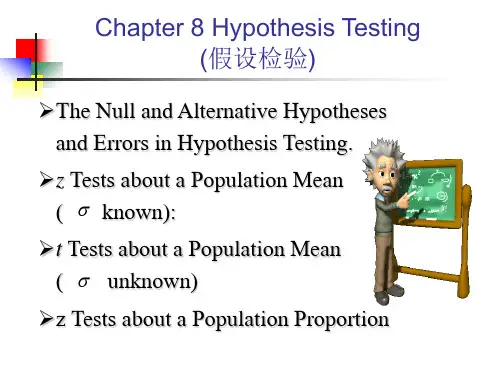
/2
3
H0: μ = 3 Ha: μ ≠ 3 H0: μ ≤ 50 Ha: μ > 50
/2
Two-tail test
Represents critical value Rejection region is shaded
Upper-tail test
Challenges the existing state Never contains the “=” , “≤” or “” sign May or may not be proven Is generally the hypothesis that the researcher is trying to prove
Determine the critical Z values for a specified level of significance from a table or computer Decision Rule: If the test statistic falls in the rejection region, reject H0 ; otherwise do not reject H0
Types of Decisions
As a result of testing H0 vs. Ha, will have to decide either of the following decisions for the null hypothesis H0:
Do not reject H0 OR
X
If it is unlikely that we would get a sample mean of this value ...
检验报告常用英文汇总
【简要介绍】除了上次介绍的血常规检查以外,血生化也是一项很常见的化验检查项目。
本文想介绍的“血生化”检查,英文叫:Comprehensive Metabolic Panel,简写为CMP。
我不是特别肯定其“标准”中文翻译,印象中叫“血生化全项”或“大生化”。
这项检查在英文中也有不同的名字,例如:Chemistry Panel等。
CMP是相对于BMP(Basic Metabolic Panel)而言的。
BMP俗称“小生化”,或“基本生化”。
BMP包括8项“核心”生化检查。
CMP 则在BMP所检查的8项核心内容的基础上,又添加了6项检查,共14项,因此称为“生化全项”。
另外,在一些国家和地区,除了CMP中的14项检查外,更进一步添加另外6项内容,合称“血生化20项”,英文简写为SMA-20,或SMAC-20,或Chem 20等。
【检查项目】本文主要介绍生化20项中除了血胆固醇外的19项内容,并另外加上一项“血镁”。
有关血胆固醇的信息将在以后的“血脂”检查中进一步讨论。
主要项目有:1。
BMP。
包括5项基本电解质:钠(Sodium,,Na),钾(Potassium,K),氯(Chloride,,Cl),碳酸氢离子(Bicarbonate,HCO3),以及钙(Calcium Ca)。
2项肾功能检查:肌酐(Creatinine),及尿素氮(Blood Urea Nitrogen,BUN)。
再加1项血糖(Glucose)。
2。
CMP中另外6项。
包括2项蛋白指标:总蛋白(Total Protein,TP)及白蛋白(Albumin)。
和4项肝功能检查:碱性磷酸酶(Alkaline Phosphatase,ALP),谷丙转氨酶(Alanine amino Transferase,ALT/SGPT),谷草转氨酶(Aspartate amino Transferase,ALT/SGOT),和胆红素(Bilirubin)。
检验医学英语词汇_文档

医学检验专业speciality of medical laboratory sciencesWBC white blood cell count BPC blood platelet count血小板 [pleitlit] GR% granulocyte[ɡrænjuləsait]中性粒细胞百分比LY% lymphocyte[lɪmfəsaɪt]淋巴细胞百分比AL% allergy(过敏)[ælədʒi:] HB hemoglobin 血红蛋白HCT hematocrit 红细胞比积MCV mean corpuscular volume红细胞平均体积MCH mean corpuscular hemoglobin平均红细胞血红蛋白MCHC mean corpuscular hemoglobin concentration 平均红细胞血红蛋白浓度MPV mean platelet volume 平均血小板体积PCT plateletocrit 血小板比积PDW platelet distribution width 血小板分布宽度大小便常规PH acidity 酸碱度PRO protein 尿蛋白NIT nitrite 亚硝酸盐GLU glucose 尿糖SG specific gravity 比重BLD blood 隐血BIL bilirubin 尿胆红素URO urobilinogen 尿胆原addish计数addish count 艾迪氏计数/HP high power objective 每高倍视野/LP low power objective 每低倍视野OB occult blood test 大便隐血试验CSF cerebrospinal 脑积夜Pandy 庞氏试验TB total bilirubin 总胆红素DB direct bilirubin 直接胆红素ALB albumin 白蛋白GLOB globulin 球蛋白UREA urea 尿素CREA creatinine 肌肝UA uric acid 尿酸GLU glucose 血糖ALT alanine amiotransferase 丙氨酸氨基转移酶AST aspartate aminotransferase 门冬氨酸氨基转移酶GGT γ-glutamyl transpeptadase 谷氨酰转肽酶CK creatine kinase 肌酸肌酶CK-MB creatine kinase-MB 肌酸肌酶同工酶LDH lactate dehydrogenase 乳酸脱氢酶α-HBD α-hydroxybutyric dehydrogenase α-羟丁酸脱氢酶AMY serum amylase 血淀粉酶TG triglyceride 肝油三脂CHOL cholesterol 胆固醇HDL-c high-density lipoprotein cholesterol 高密度脂蛋白LDL-c low-density lipoprotein cholesterol 低密度脂蛋白VLDL very low-density lipoprotein 极低密度脂蛋白Ca serum calcium 钙Mg serum magnesium 镁IP inorganic phosphate 无机磷ALP alkaline phosphatase 碱性磷酸酶TBA total biliary acid 总胆汁酸ASO antistreptolysin 抗链球菌溶血素Oa-AG a-acid glycoprotein a-酸性糖蛋白RF rheumatoid factor 类风湿因子MTP mili-total protein 微量蛋白IgG immunoglobin G 免疫球蛋白G C3 complement C3 补体C3 cTNT troponin T 肌钙蛋白TMYOG myoglobin 肌红蛋白Na sodium 钠K kalium 钾Cl chloride 氯Ga calcium 钙Mg magnesium 镁HBV hepatitis B virus 乙肝病毒HBsAg hepatitis B surface antigen 乙肝表面抗原HBsAb antibody to hepatitis surface antigen 乙肝表面抗体HBcAg hepatitis B core antigen 乙肝核心抗原HBcAb antibody to hepatitis B core antigen 乙肝核心抗体HBeAg hepatitis B e-antigen 乙肝e抗原HBeAb antibody to hepatitis B e-antigen 乙肝e抗体ELISA enzymelinked immunosorbentassy 酶联免疫吸附试验英文缩写英文全称中文全称TP treponema pallidum 梅毒螺旋体HIV human immunodeficiency virus 人类免疫缺陷病毒AKP/ALP alkaline phosphatase 碱性磷酸酶ACP acid phosphatase 酸性磷酸酶AAP alanimine peptidase 丙氨酸氨基肽酶ALA aminolenulinic acid 氨基- γ- 酮戊酸ABU asymptomatic bacteriuria 无症状性菌尿AFB acid-fast bacillus 抗酸杆菌AIDS acquired immune deficidency syndrome 爱滋病ACB antibody-coated bactia 抗体包被的细菌ADH anti-diuretic hormone 抗利尿剂agg agglutination 凝集AGN acute glomerulonephritis 急性肾小球肾炎ACD acid-citrate dextrose 枸橼酸- 枸橼酸盐葡萄糖( 储血稳定剂) AFP alpha-fetoprotein 甲胎蛋白临床实验室ADP adenosine diphospate 二磷酸腺苷AMP aednosine monophospate 一磷酸腺苷ATP aednosine triphospate 三磷酸腺苷ACT actived clitting time 活化凝血时间AHG antiiheomphilie globulin 抗血友病球蛋白AMI acute myocardial infarction 急性心肌梗死α2-AP α2-antiplasmin α2- 抗纤溶酶APC actived protein C 活化蛋白CAPTT actived partial thrombolastin time 活化部分凝血酶时间α1-AT α1-antitrypsin α1- 抗胰蛋白酶AT acutalase time 蕲蛇酶时间AT-III antinyombin-III 抗凝血酶IIIATP-LT adenosine triphospate liberate test ATP 释放试验ATT aspirin tolerance test 阿司匹林耐量试验BBS barbitone buffer 巴比妥缓冲液ALL acute lymphatic leukemia 急性淋巴细胞白血病AML acute myelogenous leukimia 急性粒细胞白血病AG anion gap 阴离子间隙ANA antinucleus antibody 抗核抗体ASO antistreptolysin-O 抗链球菌溶血素OABC absolute basophil count 储碱性白细胞绝对值计数ABR agglutination test for brucellosis 布氏杆菌凝集试验A/G albumin-globulin ratio 白蛋白- 球蛋白比值B barometrie 大气压B bacillus 杆菌Bac bacteria 细菌BB buffer base 缓冲碱BG blood group 血型BCG buomocresol green 溴甲酚绿BJ(BJP) Bence Jones Protein 本- 周氏蛋白BTB bromothymol blue 溴麝香草酚兰BMR basal metabolic rate 基础代谢率BUN blood urea nitrogen 血液尿素氮BBS barbitone buffer 巴比妥缓冲液BSA bovine serum albumin 牛血清白蛋白BSS Bernard-soulier syndyome 巨大血小板综合症B-TGT Bigg's thromboplastin generation test Bigg's 凝血活酶生成试验BT bleeding time 出血时间BMR bone marrow 骨髓BSR blood sedimentation rate 血球沉降率BSS buffered salt or saline solution 缓冲液CAF ceuuolse-acetafolic 醋酸纤维薄膜C3 complement 3 补体C3 Ca carcinoma/cancer 癌CGN chronic glomerulone phritis 慢性肾小球肾炎CR creatinine clearance 肌酐清除试验CL chlorine,chloride 氯化物、氯元素符号CO/CHO cholesterol 胆固醇CHE cholinestetrase 胆碱脂酶CMML chronic 慢性粒- 单细胞白血病CR creatinine 肌酐CRE creatine 肌酸CU(CUR) urea clearance 尿素清除(廓清)率CK/CPK creatine kinase/phosphokinase 肌酸(磷酸)激酶CV coefficient of vaviation 变异系数CEA carcinoembyonic antigen 癌胚抗原CLL chronic lymphocytic leukemia 慢性淋巴细胞性白血病CGL chronic garnulocytic leukemia 慢性粒细胞性白血病CML chronic myelogneous leukemia 慢性骨髓性白血病CO 2 CP carbon dioxide combiding power 二氧化碳结合力CR clot retraction 血块收缩CR complete remission 完全缓解CRT clot retraction time 血块收缩时间CSF cerebral spinal fluid 脑脊液CT coagulation time 凝血时间CBC complete blood count 全血细胞计数CHA cold hemaglutination test 红细胞冷凝集试验CMV cytomegalovirus 巨细胞病毒COHB carboxyhemoglobin 碳氧血红蛋白临床实验室DC differential count of leucocyte 白细胞分类计数DIC disseminated intravascular coagulation 弥漫性血管内凝血DNA deoxyrinbonucleic acid 脱氧核糖核酸DD D-dimer D- 二聚体DB direct bilirubin 直接胆红素DFA duodenal fluid analysis 十二指肠液分析DW distilled water 蒸馏水E enzyme 酶EOS eosinophil 嗜酸性粒细胞EC eosinophil count 嗜酸性粒细胞计数ELISA enzyme linked immunosorbent assay 酶联免疫吸附试验ELT euglobulin lysis time 优球蛋白溶解时间EIA enzyme immunoassay 酶免疫测定法EPEC enteropathogenic eseherichia coli 致病性大肠杆菌ERFT E-rosette forming test E 玫瑰花环形成试验(正常34-62% )ESR erythrocyte sedimentdetion rate 红细胞沉降率ET estriol test 雌三醇试验EP electrophoersis 电泳FG fobrinogen 纤维蛋白原FDP fobrinogen degradation product 纤维蛋白原降解产物FIT 乳胶凝集试验FPA fibronopeptide A 纤维蛋白肽AFPB fibronopeptide B 纤维蛋白肽BFFA free fatty acid 游离脂肪酸GC gonococcus 淋球菌GC granular cast 颗粒管型GGT gama glutamyltransferase γ- 谷胺酰基转移酶GLU glucose 葡萄糖GLC gas-liquid chromatography 气液相色谱法GN gram's negative 革兰氏阴性GA gastric analysis 胃液分析GDH Glutamate dehydrogenase 谷氨酸脱氢酶G6PD glucose-6-phosphate dehydrogenase 葡萄糖-6- 磷酸脱氢酶GOD glucose oxiddase 葡萄糖氧化酶GPB(GPC) gram's positive bacillus 革兰氏阳性杆菌γ-GTP γ-glutamyl-transpeptidase γ- 谷氨酸转肽酶GTT glucose tolerance test 葡萄糖耐量试验临床实验室HBDH hydroxybutyrate dehydrogenase 羟丁酸脱氢酶HB-F hemoglobin fetal form 胎儿型血红蛋白HB-S hemoglobin, from found in sickle cell 镰刀型红细胞中发现血红蛋白HDL high-density lipoprotein 高密度脂蛋白HAIT hemoagglutinationinhibition test 血球凝集抑制试验HB(HGB) hemoglobin 血红蛋白HC hyaline cast 透明管型HCG human chorionic gonadotropin 人绒毛膜促性腺激素17-HOCS 17-hydroxycortico steroid 17- 羟类固醇HP high power 高倍(显微镜用语)HPF high power field 高倍视野(显微镜用语)HSLC high speed liquid chromatography 高速液相色谱法HPLC high gerformence liquid chromatography 高效液相色谱法HCT hematocrit 红细胞压积HC heavy chain 重链5-HT 5-hydroxy-tryptamince 5- 羟色胺HR hemorrheology 血液流变学Ham's Ham's 酸溶血试验HAV hepatitis A virus 甲型肝炎病毒HBV hepatitis B virus 乙型肝炎病毒HCV hepatitis C virus 丙型肝炎病毒HDV hepatitis D virus 丁型肝炎病毒HEV hepatitis E virus 戊型肝炎病毒HbsAg hepatitis B surface antigen 乙型肝炎表面抗原HbsAb hepatitis B surface antibody 乙型肝炎表面抗体HbeAb hepatitis B e antibody 乙型肝炎e 抗体HbeAg hepatitis B e antigen 乙型肝炎e 抗原HbcAg hepatitis B core antigen 乙型肝炎核心抗原HbcAb hepatitis B core antibody 乙型肝炎核心抗体HHB heinz bodies 变形珠蛋白小体试验HLA human leukocyte antigen 人类白细胞抗原HDL-C high density lipoprotein cholesterol 高密度脂蛋白胆固醇HICN 氰化高铁血红蛋白HA hemolytic anemia 溶血性贫血HA-Ag hepatitis A antigen 甲型肝炎抗原HPV Human papilloma virus 人郛头瘤状病毒HRP horseradish peroxidase 辣根过氧化物酶HSV herpes simple virus 单纯疱疹病毒HT =HCT HX hexokinase 己糖(磷酸)激酶HCL hairycell leukemia 毛细胞白血病Ig immunoglobulin 免疫球蛋白IgA immunoglobulin A 免疫球蛋白AIgG immunoglobulin G 免疫球蛋白GIgM immunoglobulin M 免疫球蛋白MIgE immunoglobulin E 免疫球蛋白EIgD immunoglobulin D 免疫球蛋白DIP inorganic phosphorus 无机磷IU international unit 国际单位IRMA immnnoradiometric assay 放射免疫试验IDL intermediate-density lipoprotein 中间密度脂蛋白IB indirect bilirubin 间接胆红素IBP iron binding protein 铁结合蛋白IC immune complex 免疫复合物ICC immunological competent cell 免疫活性细胞IDA iron deficiency anemia 缺铁性贫血ITP idiopathic thrombocytopenic purpura 原发性血小板减少性紫IE immune electrophoresis 免疫电泳IFA indirect fluorescent antibody 间接荧光抗体试验IM infectious mononucleosis 传染性单核细胞增多症KET Ketone-bodies 酮体17-KST 17-ketosteroid test 17- 酮类固醇试验KG kilogram 千克KU karmen unit 卡门氏单位KPTT kaolin activated partial thrombplastin time 白陶土活化部分凝血酶时间LDH lactate dehydrogenase 郛酸脱氢酶LDL low-density lipoprotein 低密度脂蛋白LEC lupus erythematosus cell 红斑狼疮细胞LP low power 低倍(显微镜用语)LYM lymphocyte 淋巴细胞LAP leucine aminopeptidase 亮氨酸氨基肽酶LAT latex agglutination test 郛胶凝集试验LDL-C low-density lipoprotein cholesterol 低密度脂蛋白胆固醇β-LP β-lipoprotein β- 脂蛋白LPE lipoprotein electrophoresis 脂蛋白电泳LPA latex particles agglutination 郛胶凝集反应LEU leukocyte 白细胞LYZ lysozyme 溶菌酶MDS mydldysplastic syndrome 骨髓异常增生综合症M mol 摩尔M(MON) monocyte 单核细胞Mb myoglobin 肌红蛋白MDH malate dehydrogenase 苹果酸脱氢酶临床实验室Mf microfilariae 微丝蚴β2-MG β2-microglobulin β2- 微球蛋白Mg magnesium 镁mM millimol 毫克分子MSU mid-stream urine spceimen 中段尿标本MOSM miuiosmol 毫渗量MCV mean corpuscular volume 平均红细胞体积MCH mean corpuscular hemoglubin 平均红细胞血红蛋白量MCHC mean corpuscular hemoglubin concentration 平均红细胞血红蛋白浓度MPV mean platelet volume 平均血小板体积MAO micromine oxidase 单胺氧化酶NEG negative 阴性NIT nitrite test 亚硝酸盐NR normal range 正常范围N neuthophil leukocyte nuetro 嗜中性粒细胞ANAE α-naphthol acetate esterase α- 醋酸萘酚酯酶NRBC nucleared red blood cell 有核红细胞NS normal saline 生理盐NS normal serum 正常血清OB occult blood 隐血17-OHCS 17-hydroxycorticosteroid 17- 羟皮质类固醇OSM osmol 渗透压(量)OD optical density 光密度ODC ornithine decarboxylase 鸟氨酸脱氢酶P plasma 血浆P phosphorus 磷PCR polymerase chain reaction 聚合酶链式反应PR protein 蛋白质PAGE polyacry lamide gel electrothoresis 聚丙烯酰胺凝胶电泳PG hydrogen jon exponent 酸碱度、氢离子浓度PCH paroxysmal cold hemoglobinuria 阵发性冷血红蛋白尿PNH paroxysmal nocturnal hemoglobinuria 阵发性夜间血红蛋白尿PKU phenyketonuria 苯丙酮尿症POS positive 阳性PPT precipitate 沉淀物PR henol red 酚红PST phenol sulfonphthalein test 酚红排泄试验PG picogram 微微克(10 -12 克),皮克PTH proxjmal renaltubular acidosis 甲状旁腺激素3P plasma protamine paracoaggulation test 血浆硫酸鱼精蛋白副凝固试验PADT platelet adhension test 血小板粘附试验PAF platelet activiting factor 血小板活化因子PAGT platelet aggregate test 血小板聚集试验PSB phosphate buffer 磷酸盐缓冲液PC protein C 蛋白CPCT prothrombin consume test 凝血酶原消耗试验PD phosphodiesterase 磷酸二酯酶PEG polyethylene glycol 聚乙二醇PF3 platelet factor 3 血小板第3 因子PF4 platelet factor 4 血小板第4 因子PPP platelet poor plasma 贫血小板血浆PRP platelet rich plasma 富血小板血浆PLT platelet 血小板PLC platelet count 血小板计数PRT plasma reclcification time 血浆复钙时间PT prothrombin time 血浆凝血酶原时间PTT partial thrombplastin time 部分凝血酶时间P CO2 partial pressure of carbon dioxide 二氧化碳分压P O2 partial pressure of oxygen 氧分压临床实验室Paco2 arterial carbondioxide tension 动脉二氧化碳分压PBL peripheral blood lymphocyte 末稍血液淋巴细胞PCL plasma cell leukemia 浆细胞性白血病PCV pollycythemia vera 真性红细胞增多症PHA phxtohemagglutimin 植物血凝素PI isoelectric point 等电点PLFT platelet immunofluoresence test 血小板免疫荧光试验PPM parts per million 百万分之一POX peroxidase 过氧化物酶PAS periodic acid schiff's reaction 过碘酸- 雪夫氏反应法R reaction 反应RBC red blood cell 红细胞red blood cell count 红细胞计数REV/MIN revolutions per minute 转/ 分RIA radio immunoassay 放射免疫分析RT routine 常规RVVT russcll viper venon time 蝰蛇毒时间RNA ribonucleic acid 核糖核酸RET reticulockyte 网织红细胞RF rhermatoid factor 类风湿因子RPR rapid plasma reaction test 快速血浆反应时间S standard 标准S serum 血清SOL solution 溶液SPE serum protein electrophoresis 血清蛋白电泳SPEC specimen 标本SOD superoxide dismubase 超氧化物岐化酶SEG(SG )segeroxide dismutase 中性分叶核白细胞SI international system unit 国际单位制SOLAQ aqueous solution 水溶液SOLSAT solutionsaturata 饱和溶液SPF spectorphofluorometer 分光光度荧光计SG psecific gravity 比重SAT 血氧饱和度SI serum iron 血清铁SBC 标准碱量SPU selective proteinuria 选择性蛋白尿ST staff nedutdrophil 嗜中性杆状核粒细胞SH shigella 志贺氏菌属STA staphylococcus 葡萄球菌STR streptocdccus 链球菌属SU sulfa 磺胺类SFC spinal fluid count 脑脊液细胞计数SLE system lupus erythematosis 系统性红斑狼疮SD standard deviation 标准差T test 试验、测定T time 时间TB tubercle bacillus 结核杆菌TP tatal protein 总蛋白TVU tatal volumn urine 总尿量TCO2 二氧化碳总量TG triglyceride 甘油三酯TTT thymol turbidity test 麝香草酚浊度试验TA transfer agent 转移因子TB(TBIL) total bilirubin 总胆红素TIBC total iron binging capacity 总铁结合力TRT T-cell rosette formation T- 细胞花环形成试验TST triple sugar iron test 三糖铁试验U unit 单位U urine 尿液UCR urine creatine 尿肌酐UCRE urine creatine 尿肌酸UCL urea clearance 尿素清除率UR urine routine 尿常规URANAL urine analysis 尿分析URO urobilinogen 尿胆素原UUA urine urea acid 尿尿酸UUN urine urea nitrigen 尿尿素氮UD urine acid 尿酸V volume 体积VMA vanillyl mandelic acid 香草酸杏仁酸VWD von willebrand disease 血管性假血友病VLDL very low-density lipoprotein 极低密度脂蛋白WBC white blood cell 白细胞计数各字母分别表示:N :嗜中性粒细胞B :嗜碱性粒细胞E :嗜酸性粒细胞M :成熟细胞J :幼稚细胞st :杆状核细胞sg :分叶核细胞L :淋巴细胞mon :单核细胞WCC white cell cast 白细胞管型WFR weil-felix reaction 外- 裴氏反应WHO world heath organization 世界卫生组织WL wave length 波长WP weakly positive 弱阳性W/W weight in weight 重量与重量比临床实验室XLP x-lipoprotein X- 脂蛋白XM x-matching , cross matching 交叉配血XY 为正常男性染色体XX 为正常女性染色体文章来自临床实验室仪器信息网() - 详文链接:/html/linjian/shenghua/200908/17-6613.html寡糖oligosaccharide二糖disaccharide三糖trisaccharide四糖tetrasaccharide五糖pentosaccharide多糖polysaccharide菊糖inulin黏液mucilage树胶gum果胶pectin半纤维素hemicellulose纤维素cellulose甲壳质chitin肝素heparin硫酸软骨素chondroitin sulfate 玻璃酸hyaluronic acid直链淀粉amylose支链淀粉amylopectin糖原glycogen费林试验Fehling test苷glycoside。
校验的英语单词
校验的英语单词全文共四篇示例,供读者参考第一篇示例:校验(Validation)是指确定数据或信息是否准确、完整且符合规则的过程。
校验通常是在数据输入、传输或处理的各个阶段进行的,旨在确保数据的准确性和一致性,并避免出现错误。
在计算机领域中,校验是确保系统正常运行和数据可靠性的重要步骤。
校验可以分为两种类型:格式校验和逻辑校验。
格式校验是指检查输入数据是否符合指定的格式要求,例如日期、邮箱地址或电话号码等。
逻辑校验是指根据预先设定的规则或逻辑关系对数据进行验证,以确保数据之间的逻辑一致性。
在日常生活中,我们经常会进行各种形式的校验。
在填写网上表格时,系统会提示是否填写正确的邮箱地址或密码格式;在购物时,银行会通过短信验证码或网上银行密码进行身份验证。
这些都是校验的一种形式,可以有效防止错误数据输入或未授权访问。
在计算机编程中,校验也是一个重要的概念。
程序员通常会编写校验逻辑来确保输入数据的准确性和有效性。
通过检查用户输入的数据类型、范围和格式,可以避免程序因错误数据输入而崩溃或产生不正确的结果。
在数据传输过程中,校验和校验和算法可以帮助检测数据是否被篡改或损坏。
校验是保障数据质量和安全的重要手段。
在信息化时代,大量的数据和信息需要被处理和传输,校验可以有效减少数据错误和风险,提高数据的可靠性和完整性。
做好数据校验工作是每个组织和个人的责任,只有通过细致入微的校验工作,才能确保数据的准确性和安全性。
校验是一个重要的概念,它贯穿于我们生活和工作的方方面面。
通过对数据和信息的认真审核和验证,可以有效地保护数据不受损害,确保系统的稳定运行。
我们应该重视校验工作,不断提高自身的校验能力,以更好地保护数据安全和质量。
【这里是所需字数的一半,接下来将继续增加内容】。
在实际的工作中,校验工作还可以分为人工校验和自动校验两种方式。
人工校验是指由人员手动核对数据或信息的正确性,通常用于较为复杂或敏感的数据处理场景;自动校验则是通过计算机程序或算法对数据进行检测和验证,可提高工作效率和准确性。
质检专有名词
质检工作中的专有名词IQC:进料检验Incoming Quality Control;其主要职责如下: 1、对供应商所送货物,按照技术标准,工作指示用最好的测量系统进行检验;2、对供应商所送货物料进行质量评估,如月报,季度评估;3、对供应商所送货物的异常进行反馈、跟踪,并协助供应商进行改善;IQC(incoming quality control)意思是来料的质量控制,简称来料控制。
但也许有的技术人员,包括一些专业的开发人员对此也不是很清楚。
之所以在此谈IQC,而不是IPQC(制程质量控制),FQC(成品质量控制)等。
是因为个人觉得在物欲横流的社会里,各种假货,劣质产品在不断地侵蚀着我们,面对这些劣质产品,可能一个小小的失误就可能给我们造成巨大的财产损失或断送了我们的前程。
所以作好来料的质量控制对每个工厂来说,都已经是迫在眉及了。
因为巧妇也难为无米之炊呀,只有材料好了,才可以制造出好的产品来。
编辑词条OQCOutgoing Quality Control, OQC (出货品质管制)供应商在产品出货时,必须按照双方合约或订单议定的标准,实施出货检验。
OQC即是产品出货前的品质管制,主要针对出货品的包装状态、防撞材料、产品识别/ 安全标示、配件(Accessory Kits)、使用手册/ 保证书、附加软体光碟、产品性能检测报告、外箱标签等,做一全面性的查核,以确保客户收货时和约定内容符合一致。
经由OQC后所发现之不合格品的处理,端看不合格状况的不同,而可能回到制程前段或是半成品阶段进行重工或修理,之后再通过OQC检测一次。
若产品发生无法重工或修理的品质缺失,就会被直接报废,算入生产耗损的成本项目内;或被降级(降低品级,Down Grade)处理,销售给品质要求较低的客层。
有些厂商的「出货品管」,会对准备出货的产品再进行一次品质管制的抽检活动,则此一阶段的品检著重是「抽样检查」,而跟FQC阶段的「全部检查」有所不同。
检验方法标准 英文
检验方法标准英文Evaluation Methods and StandardsEvaluation is a critical aspect of any process or activity, as it allows for the assessment of performance, the identification of areas for improvement, and the validation of the effectiveness of the implemented strategies. In the context of various fields, the development and implementation of reliable and standardized evaluation methods are essential to ensure the consistency, objectivity, and accuracy of the assessment process. This paper will explore the importance of evaluation methods and standards, their application in different domains, and the key considerations in establishing effective evaluation frameworks.Importance of Evaluation Methods and StandardsEvaluation methods and standards serve several crucial purposes in various contexts. Firstly, they provide a systematic and structured approach to assessing the quality, effectiveness, and efficiency of products, services, or processes. By establishing clear criteria and protocols, evaluation methods ensure that the assessment is conducted in a consistent and objective manner, reducing the potential for bias or subjectivity. This is particularly important infields where decision-making or resource allocation is heavily dependent on the outcomes of the evaluation process.Secondly, evaluation methods and standards help to establish a common language and frame of reference among stakeholders, facilitating effective communication and collaboration. When all parties involved in an evaluation process share a common understanding of the criteria and methodologies used, it becomes easier to interpret and compare the results, leading to more informed decision-making and consensus-building.Thirdly, well-designed evaluation methods and standards can contribute to the continuous improvement of the evaluated entities. By identifying strengths, weaknesses, and areas for development, the evaluation process provides valuable feedback that can be used to inform and refine future strategies, policies, or interventions. This feedback loop is essential for driving progress and enhancing the overall quality and performance of the evaluated system.Finally, the establishment of evaluation methods and standards can foster accountability and transparency within organizations or systems. By clearly defining the criteria and procedures for assessment, stakeholders can hold the evaluated entities accountable for their performance and ensure that the evaluation process is fair and impartial.Application of Evaluation Methods and StandardsEvaluation methods and standards are widely applied across various domains, including but not limited to:1. Education: In the educational sector, evaluation methods and standards are used to assess student learning outcomes, the effectiveness of teaching practices, the quality of educational programs, and the overall performance of educational institutions. Standardized tests, rubrics, and accreditation frameworks are examples of evaluation tools used in this context.2. Healthcare: In the healthcare industry, evaluation methods and standards are employed to assess the quality of medical care, the safety and efficacy of healthcare interventions, the performance of healthcare providers, and the overall efficiency of healthcare systems. Clinical practice guidelines, patient satisfaction surveys, and performance indicators are commonly used evaluation tools.3. Business and Management: In the business and management domain, evaluation methods and standards are applied to assess the performance of organizations, the effectiveness of management strategies, the quality of products or services, and the return on investment for various initiatives. Key performance indicators (KPIs), balanced scorecards, and quality management systems are examplesof evaluation frameworks used in this context.4. Public Policy and Administration: In the realm of public policy and administration, evaluation methods and standards are utilized to assess the impact, effectiveness, and efficiency of government programs, policies, and initiatives. Cost-benefit analysis, program evaluation, and performance measurement are some of the evaluation approaches employed in this domain.5. Environmental and Sustainability: In the environmental and sustainability fields, evaluation methods and standards are used to assess the environmental impact of products, processes, or activities, as well as the effectiveness of sustainability-focused initiatives. Life cycle assessment, environmental impact assessments, and sustainability reporting frameworks are examples of evaluation tools in this context.6. Research and Development: In the research and development (R&D) domain, evaluation methods and standards are employed to assess the quality, rigor, and impact of scientific research, the effectiveness of research programs, and the potential for commercialization of research outputs. Peer review, bibliometric analysis, and technology readiness level assessments are some of the evaluation approaches used in this field.Key Considerations in Establishing Effective Evaluation Methods and StandardsDeveloping and implementing effective evaluation methods and standards involve several key considerations:1. Clearly defined objectives and scope: The first step in establishing evaluation methods and standards is to clearly define the objectives and scope of the evaluation process. This includes identifying the specific areas or aspects that need to be assessed, the intended outcomes, and the stakeholders involved.2. Stakeholder engagement and collaboration: Effective evaluation methods and standards are often the result of collaborative efforts involving various stakeholders, such as subject matter experts, practitioners, policymakers, and end-users. By engaging with these stakeholders, the evaluation process can be tailored to meet the needs and expectations of all parties involved.3. Validity and reliability: Evaluation methods and standards must be designed to ensure the validity and reliability of the assessment process. This means that the evaluation tools and criteria used must accurately measure the intended aspects and produce consistent results, regardless of the evaluator or the context.4. Adaptability and flexibility: Evaluation methods and standardsshould be adaptable and flexible to accommodate changes in the evaluated entities, the external environment, or the evolving needs and priorities of stakeholders. Periodic review and refinement of the evaluation frameworks are essential to maintain their relevance and effectiveness.5. Transparency and accountability: The evaluation process should be transparent, with clearly documented methodologies, criteria, and decision-making processes. This promotes accountability and builds trust among stakeholders, ensuring that the evaluation outcomes are perceived as fair and credible.6. Continuous improvement: Evaluation methods and standards should be subject to ongoing review and improvement. By analyzing the performance and outcomes of the evaluation process, opportunities for enhancement can be identified, and the frameworks can be continuously refined to enhance their effectiveness and relevance.ConclusionEvaluation methods and standards play a crucial role in various domains, providing a systematic and objective approach to assessing performance, effectiveness, and quality. By establishing clear criteria and protocols, evaluation frameworks contribute to informed decision-making, continuous improvement, and accountability. Asthe complexity and demands of different fields continue to evolve, the development and implementation of effective evaluation methods and standards will remain a critical priority for organizations and systems seeking to enhance their overall performance and achieve their desired outcomes.。
质量检验基础中的质量术语
质量检验基础中的术语和英文简写
测量:measurement 以确定量值为目的的一组操作
计量:metrology 实现单位统一、量值,准确的测量
试验:test 为了解某物的性能或某事的结果而进行的尝试性活动
实验:experience 设计来检验一个理论或证实一种假设而进行的一系列操作或活动
测试:test 测量+试验用指定的方法检验测试某种物体指定的技术性能指标,通常指一系列
完整的操作过程。
检测:test、detection 测试
检验:inspection 通过观察和判断,必要时结合测量和试验所进行的符合性评价。
验证:verify 通过提供客观证据对规定按要求已得满足的认定
质量检验:quality Inspection :对产品一个或多个质量特性进行观察、试验、测量并将结果
与规定的质量要求进行比较,以确定每项质量特性合格与否
的技术性检查活动。
抽样检验Sampling Inspection :按照规定的抽样方案,随机地从一批或一个过程中抽取少量
个体(作为样本)进行的检验,根据样本检验的结果判定一
批产品或一个过程是否可以被接收。
全面质量管理TQM Total Quality Management
国家标准化管理委员会SAC Standardization Administration of the People’s Republic of China 全数检验One hundred Percent Inspection
检验设施Quality Inspection Facilities。