
牛津译林版八年级英语上册unit 8 Natural disasters单元测试(含答案)
A test for unit 8Ⅰ. 根据句意及首字母或汉语提示完成句子1. I want to tell you a (真的) story.2. A car crashed into the bridge and fell into the river. The police are checking what_____________(引起) the disaster.3. The animals ran in all (方向) when they heard the big noise.4. White snow ____________(覆盖)the land and everything looks white and clean.5. His car _____________ (猛撞) into a tree, so he called 120 for help.6. In 1976, a terrible e happened in Tangshan in China.7. Many people had to leave their homes because of the f .8. T always comes after lighting.9. Taking a short rest at noon is good for your body and m__________.10. Listen! We can hear the strong wind b________ outside.Ⅱ. 用所给词的适当形式填空1. I hope this information will help you understand the ________ (important) of study.2. If more and more wetlands disappear, there will be ________ and ________(little) space forplants and animals.3. Milk is the ________ (nature) food for young babies.4. Animals ran ________ (wild) everywhere.5. He always tells lies to me. I think he is a ______ (honest)boy, so I can’t believe him.6. It was very clear that he was very angry because he looked at me __________ (angry).7. I_______ (read) at 9:00 last night. What ________you________(do) at that time?8. While Mrs. Smith______ (wait) in line last evening, Mr. Smith (stand) beside her.9. My mother (cook) when I (arrive) home yesterday.10. _____ Amy ____ (visit) the Science Museum from 9:00 a.m. to 11:00 a.m. yesterday?Ⅲ. 单项选择( )1. —________ is the weather like today?—It’s _________.A. How; windyB. What; windyC. How; windD. What; wind( )2. Last night I heard a noise _________ thunder.A. asB. likeC. soD. from( )3. My school is about twenty ________ walk from here.A. minuteB. minutesC. minute’sD. minutes’( )4. The snowstorm killed _________ people.A. over eight hundred ofB. hundreds ofC. more than eight hundredsD. eight hundreds( )5. The cleaners rolled ________ their trousers and were in a hurry ________ the snow.A. up; to removeB. up; removedC. /; to removeD. /; removed( )6. The headmaster _________ the students to leave school early.A. madeB. letC. orderedD. had( )7. You will find _________ useful to learn even a little English.A. thatB. itC. thisD. they( )8. Which of the symbols means “per cent”?A. @B. $C. &D. %( )9. You felt unhappy yesterday, __________?A. didn’t youB. did youC. don’t youD. do you( )10. Shanghai is _____the east of China. Japan is ______the east of China.A. in; inB. at; onC. in; toD. at; to( )11. There ______ a large number of students in our school. The number of the students _______ over three thousand.A. is; isB. are; areC. is; areD. are; is( )12. I don’t know if Tom _________ here tomorrow. If he ________, I’ll tell you.A. comes; comesB. will com; comesC. comes; will comeD. will come; will come( )13. The teacher told me _________when I left the classroom.A. lock the doorB. to lock the doorC. to knock at the doorD. knock at the door( )14. The wetland can ________ food and shelter ______ plants and animals, including different kinds of birds.A. provide; forB. provide; withC. make; forD. provides; for( )15. When I was working on a Maths problem, a good idea went ______my head.A. overB. inC. aboutD. throughⅣ. 句型转换1. He was doing his homework at eight last night.(改为否定句)______________________________________________________________2. My brother is watching TV now.(用this time yesterday改写句子)________________________________________________________________________ 3. My father was searching the Internet at that moment. (对画线部分提问)____________________________________________________________________________ 4. I was surfing the Internet. Andy came in. (合并为一句)____________________________________________________________________________ Ⅴ. 根据汉语意思完成句子1. 我们领居的房子着火了,因为闪电击中了他的房子。
Our neighbour’s house _________ _________ because the lightning __________ his house.2. 他的到来使我们很惊讶。
__________ ___________ made us ____________.3. 坏天气有时会引起自然灾害。
Bad weather can sometimes _________ _________ __________.4. 大火没有持续多久,消防员在五分钟之内赶到并扑灭了大火。
The big fire didn’t ________ _________. The firemen arrived _________ __________ _________ and _________ __________ the fire.Ⅵ. 完形填空We cannot stop earthquakes, but we can do things to make sure they do not destroy (破坏) whole cities. First, it is not a __1__ idea to build houses along the lines where__ 2__of the earth’s plates join together. Second, if you think there __3__ be an earthquake, it is better to build houses on rock, not on __4__. Third, you must make the houses as __5__ as possible. Weak buildings will fall down in an earthquake, but strong ones may __6__.Scientists are __7__ that one day an even bigger earthquake will hit the part around San Francisco. They call it “The Big One”. But people today are still building more __8__. The population in and around San Francisco __9__ is ten times more than it was in 1906. This meansthat __10__ there is another earthquake, a great many houses and buildings will be destroyed. ()1. A. bad B. good C. poor D. new()2. A. one B. most C. two D. none()3. A. may B. should C. can’t D. won’t()4. A. sea B. land C. space D. sand()5. A. high B. big C. strong D. low()6. A. keep up B. set up C. stay up D. grow up()7. A. sorry B. pleased C. afraid D. wondering()8. A. walls B. stories C. cities D. houses()9. A. now B. still C. always D. never()10. A. before B. if C. or D. untilⅦ. 阅读理解Many animals do strange things before an earthquake. This news may be important. Earthquakes can kill people and knock down homes. The animals may help to save lives.Some animals make a lot of noise before an earthquake. Farmers have told about this. Dogs that are usually quiet have started to bark(吠). Horses on farms have run around in circles. Mice have left their holes and run away. Cows have given less milk.In a town in Italy, cats raced down the street in a group. That happened only a few hours before an earthquake. In San Francisco, a man kept tiny pet frogs. One Sunday, the frogs jumped around more than ever. They made loud noises, like bigger frogs. That night, an earthquake struck the city.People want to know when an earthquake is coming. Then they could get away safely. Right now, there is no sure way to know ahead of time. Maybe the best idea is watching the animals. ( )1. This passage is mainly about _____.A. how animals act before an earthquakeB. how an earthquake startsC. how mice leave their homesD. how animals live every day( )2. Before the earthquake in Italy, quiet dogs _____.A. ran awayB. started to barkC. climbed treesD. jump into the water( )3. Before the earthquake in Italy, the frogs _____.A. sangB. jumped into the waterC. diedD. jumped around a lot( )4. There have been earthquakes in _____.A. most countriesB. England, FranceC. Italy and San FranciscoD. Chicago and Spain( )5. People want to _____.A. be in earthquakeB. find out early about an earthquakeC. run around in circlesD. follow the animals to run quicklyⅧ. 书面表达2008年初,我国南方遭遇了50年来最大的雪灾。
牛津译林版八年级上册Unit8《Naturaldisasters》(Reading2)说课稿
牛津译林版八年级上册Unit 8《Natural disasters》(Reading 2)说课稿一. 教材分析《牛津译林版八年级上册Unit 8 Natural disasters》的Reading 2部分主要介绍了龙卷风的发生原因、特点以及给人们带来的危害。
文章通过讲述一个发生在龙卷风中的真实故事,让学生了解和认识这一自然灾害。
文章语言简练,内容丰富,贴近学生生活,能够激发学生的学习兴趣,培养他们关爱生命、敬畏自然的意识。
二. 学情分析八年级的学生已经具备了一定的英语基础,能够听、说、读、写简单的英语句子。
但他们在阅读理解方面还存在一定的困难,特别是对于长篇文章的理解和分析能力。
此外,学生对于龙卷风这一自然灾害的了解并不深入,因此需要在课堂上进行引导和拓展。
三. 说教学目标1.知识目标:学生能够掌握Reading 2中出现的关键词汇和短语,如tornado、destroy、emergency等;能够理解文章的主旨大意,了解龙卷风的成因、特点和危害。
2.能力目标:学生能够运用所学知识,进行阅读理解和信息提取;能够运用英语进行简单的交流和讨论。
3.情感目标:学生能够培养关爱自然、敬畏生命的意识,提高自我保护能力。
四. 说教学重难点1.重点:学生能够掌握Reading 2中出现的关键词汇和短语,理解文章的主旨大意。
2.难点:学生能够运用所学知识,进行阅读理解和信息提取;能够运用英语进行关于龙卷风的讨论。
五. 说教学方法与手段1.教学方法:采用任务型教学法,让学生在完成任务的过程中,掌握知识、提高能力。
2.教学手段:利用多媒体课件、图片、视频等辅助教学,激发学生的学习兴趣,提高课堂效果。
六. 说教学过程1.导入:通过展示龙卷风的图片和视频,引导学生关注这一自然灾害,激发学习兴趣。
2.预习:让学生预习Reading 2,自主学习生词和短语,了解文章大意。
3.课堂讲解:教师引导学生学习Reading 2,讲解生词和短语,分析文章结构,讲解龙卷风的成因、特点和危害。
牛津译林版英语八年级上 Unit 8 Natural disasters Welcome to the unit 课件(共24张PPT)
Talk
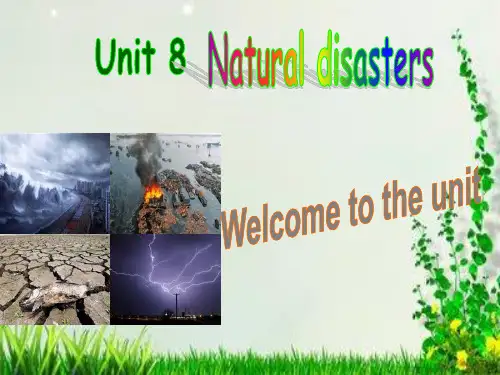
1. What was the weather like when Hobo was sleeping? It was rainy./It was raining heavily. 2. When there’s too much rain in a short time, what will it cause? It will cause flood. 3. What does flood belong to? Natural disaster or accident?
Yes, sometimes the wind is so heavy that it blows trees down. And I can’t see anything at all in the street.
......
Hobo has some trouble. What happened to him?
around his house. His furniture and all his books got wet. B: Did your friend leave his house? A: Yes. He and his family moved to his uncle’s house, as his uncle lived far away and there was no flood there.
请点击
Complete the following sCehnetceknycoesu.r answer
1. 1998年的特大洪水冲走了许多房屋和 大树。 The big flood in 1998 _w_a_s_h_e_d__a_l_o_t_o_f_ _h_o_u_s_es__a_n_d_t_r_e_e_s_a_w_a_y_.__
牛津译林版八年级上册Unit8《Naturaldisasters》(Grammar)说课稿
牛津译林版八年级上册Unit 8《Natural disasters》(Grammar)说课稿一. 教材分析《Natural disasters》是人教版牛津译林八年级上册的一篇课文,主要介绍了一些自然灾害的成因及应对方法。
通过本节课的学习,学生能够掌握一般现在时的被动语态,提高阅读理解能力,同时增强对自然灾害的防范意识。
二. 学情分析八年级的学生已经具备了一定的英语基础,对一般现在时态和被动语态有所了解。
但部分学生对英语阅读兴趣不高,且对于自然灾害相关知识了解有限。
因此,在教学过程中,需要关注学生的兴趣,引导学生主动参与课堂活动,提高他们的阅读理解能力。
三. 说教学目标1.知识目标:学生能够掌握一般现在时的被动语态,正确运用动词的过去式和被动式。
2.能力目标:学生能够阅读并理解关于自然灾害的英语文章,提高阅读理解能力。
3.情感目标:学生能够增强对自然灾害的防范意识,学会保护自己和他人。
四. 说教学重难点1.重点:学生能够掌握一般现在时的被动语态。
2.难点:学生能够运用一般现在时的被动语态描述自然灾害。
五. 说教学方法与手段1.教学方法:采用任务型教学法,让学生在完成任务的过程中,自然而然地掌握语言知识。
2.教学手段:利用多媒体课件、图片、视频等,激发学生的学习兴趣,提高课堂效果。
六. 说教学过程1.导入:展示一些自然灾害的图片,如地震、洪水等,引导学生谈论对这些灾害的了解和感受。
2.阅读理解:让学生阅读课文《Natural disasters》,回答相关问题,检测学生对文章内容的理解。
3.语法讲解:讲解一般现在时的被动语态,让学生通过例句和实践,掌握这一语法知识。
4.小组讨论:学生分成小组,讨论如何用英语描述一种自然灾害,以及如何防范。
5.展示与评价:每个小组选择一名代表,展示他们的讨论成果,其他同学和老师进行评价。
6.总结与反思:教师引导学生总结课堂所学,让学生反思自己在课堂上的表现,以及如何提高。
牛津译林版八年级上Unit8 Natural disasters Reading课件

4. Timmy was trapped in a dark place after the earthquake stopped.
5. There was not enough space for Timmy to pull himself through.
6. People found Timmy soon after he
suddenly slip past one another.
1999年台湾9Biblioteka 21大地震1999年9月21日凌晨1时47分,台湾省南
投县集集发生7.6级大地震,震源深度10
公里左右,重灾区在日月潭地区。该区 有许多活断层,开始是“双冬断层”发 生活动,同时牵动相邻的车笼埔断层的 大规模滑动,导致断层沿岸的丰原、大 境、务峰、中兴新村、南投和名间、竹 川
一点也不 conj. 是否 adj. 紧张不安的 n. 心脏 vi. & vt. 使规律作响 adj. 困住的 n. 头脑
Words review calm calm down since still alive dark find one’s
vi. & vt.(使) 平静 冷静 conj. 由于,既然 adv. 仍然 adj. 活着的 n. 黑暗 找到出路
was trapped.
B2. Matching the pictures with the captions. Then put the pictures into the correct order. I saw the bright daylight. I was trapped. The walls came down. I screamed for help. Some people ran out of the building. The earth started to shake.
牛津译林版-英语-八上-8单元 Natural disasters pronunciation
初中英语牛津译林版八年级上册Unit 8 Natural disasters pronunciationContent:Speak up and pronunciationPeriod:10-8Teaching aims and demands:1.To describe an disaster or accident by responding to questions and interacting with others .2.To identify a natural disaster ,describe it and explain the results .3.To identify the intonat ion pattern of statements . .Key points:1.To describe a disaster or accident by responding to questions and interacting with others .2.To identify the intonation pattern of statementsDifficult points:To describe an disaster or accident by responding to questions and interacting with others . Teaching aids:A tape recorder and some picturesTeaching methods:Pair work and practicingTeaching procedures:复备栏目Step 1 RevisionRevise the words and phrases in Integrated skillsStep 2 PresentationShow pictures of different kinds of bad weather and disasters . Get thestudents to talk about the results of the m .T explains that Sandy and Amy are talking about a natural disaster . Invitethem to listen to the tape and try to answer the questions .1.What are they talking about ?2.How did it happen ?3.Was anybody hurt ? Why or Why not ?Step 3 PracticeGet students to read the dialogue aloud .Ask students to pay attention to theintonation of different sentences .We use a rising tone for generalquestions .We use falling tones for ‘wh-’questions or statements .Ask Ss to read the dialogue again . Then get Ss to practice and act in pairs .Step 4 Listening and reading1.Ss liste n to the sentences on Page 104 and pay attention to the end of thesentences . Make the voice fall at the end of the sentences .2.Get them to read the dialogue on Page 104 pay attention to the intonationpatterns. Put a following arrow in the box if they think her voice should fallhere .Ask them to focus on what Sandy said about the fire and get the mainpoints .Step5 ProductionAsk Ss to make up new dialogues. They can talk about a natural disaster theykno w . Pay special attention to the intonation .Step 6 Homework1.Read the dialogues in correct intonation .2.Finish off more exercises.3.Preview Main task: find the new phrases and try to re member them.教学反思:达标检测Unit 6 Speak up and pronunciation (30’)一、用所给的汉语或英语单词的适当形式填空(9’)1.He felt cold and ___________ (frighten ), but he couldn’t move .2.They sent the __________ (受害者) to the hospital at once .3.The snowstorm started again in the afternoon and it got ______ (bad) later .4.Mrs Su hurt her leg but it was not _________ (严重的).5.The snow was heavy and it _______ (覆盖)everything .6.This morning I read a newspaper article about a car ________ (事故).7.I was surprised to see that my pet dog was still _____ (live) after the earthquake .8.The number of the _____________ (survive) of the Titanic was less than eight hundred .9.Pe ople ran in all _______ (direct) when they heard the sudden gun .二、用正确的语音和语调朗读下列句子(8’)1. Did you hear about the flood in Wuhan last month ?2. Were you alone in the car ?3.When will they arrive in Beijing ?4.How much does the baby mouse weigh ?5.Who is the busiest in your family ?6.There was water all round her house .7.He and his family moved his uncle’s house8.The whole road was covered with snow and we couldn’t get out .三、用所给动词的适当形式填空(13’)1.Who is ________ (mop) up the f loor ? It’s so clean .2.It’s unlucky ______ (lose)the game or get ______(lose) in a new city .3.We should try our best ________ (prevent) the sand from _______ (come) to the good farmland in the south .4.Timmy ________ (trap) in a dark place when the earthquake _______ (stop) .5.The radio says that the temperature __________ (drop)a little tomorrow .6.When they _______ (hear)the big noise like thunder ,they ______ (tell) themselves _______ (keep) calm .7.The firemen________ ( put) out the fire soon .8.Bad weather ________ (cause) natural disaster .。
牛津译林版八年级英语上册Unit8Naturaldisasters单元测试题(答案+解析)
牛津译林版八年级英语上册Unit8Naturaldisasters单元测试题学校:___________姓名:___________班级:___________考号:___________一、单选题1.The floor is all wet.Would you like to ________?A.mop it up B.mop them upC.mop up it D.mop up them2.—Wow, Wendy, it’s cool to make a short video with your mobile phone.—Just with a software called Meipai. Let me show you .A.which to use B.how to use itC.what to use D.where to use it3.--- _______ will you finish writing the review of the Indian movie Dangal?--- In two days.A.How far B.How often C.How soon D.How long 4.Teachers' Day is ________ September 10, and the Spring Festival is usually________ February.A.in; on B.in; in C.on; in D.in; at5.(题文)I was writing a diary ______ my brother was watching TV yesterday evening. A.before B.after C.until D.while6.一Where were Bill and David when the teacher came in?一They in the hallway.A.are talking B.have talked C.were talking D.talk7.The song sounds . I like it of all the English songs.A.well; best B.well; betterC.nice; best D.nice; better8.________ exciting it is! Our country put her first homemade aircraft carrier(国产航空母舰) in the water on April 26 in Dalian.A.How B.WhatC.How an D.What an9.Two ________students in our school are from the countryside.A.hundred of B.hundreds ofC.hundred D.hundreds10.You'll get better grades________ you follow the teachers' advice.A.if B.until C.though D.while二、完型填空One day, several young people went for a picnic. They walked in the open air with 11 . As soon as they came to a river, they 12 by the clear and calm water. They played with cool water excitedly. Suddenly, a lovely 13 passed by Tom. He tried to catch it,14 the fish was just swimming a few feet ahead of him. He ran 15 it, hoping to catch it.Gradually, Tom came to the water with waist deep. He felt 16 , so he wanted to jump out of the water. 17 up and down in the water, he went farther and farther away from the bank. Just at the time, Barry saw this, he offered 18 help to Tom at once. Tom saw someone 19 to him, and he caught the person 20 was close to him. Unfortunately, Barry was dragged into the water. The two struggled in the water 21 . Amy, on the bank, noticed that, and she 22 others near the bank.Hearing their cries, two farmers near the river took a long rope there. They threw one end of the rope to 23 of them in the water. Together, all the people on the bank pulled 24 end. Finally, the two boys were saved!The experience has told us 25 we should do something to help others correctly. 11.A.sad B.sadness C.joy D.joyful 12.A.are attracted B.were attracted C.attract D.attracted 13.A.fish B.frog C.bird D.insect 14.A.so B.then C.or D.but 15.A.before B.after C.beside D.back 16.A.happy B.bored C.excited D.nervous 17.A.Laughing B.Jumping C.Driving D.Playing 18.A.them B.their C.him D.his 19.A.swimming B.is swimming C.be swimming D.to swimming 20.A.which B.whose C.whom D.who 21.A.tired B.hardly C.hard D.weak 22.A.turned off B.turned on C.turned to D.turned down 23.A.all B.neither C.both D.none 24.A.another B.either C.the others D.the other 25.A.what B.how C.why D.when三、阅读单选“Please take my penny(便士),” Maggie said to old Dan, the fisherman, who sat on a bench repairing his nets. “Please take it,” she said again. Old Dan smiled, and took it. “Thank you,little girl,” he said.After that, Maggie went to the beach to collect sea shells. She never thought how fast time went by. Two hours later, she sat down on a rock beside a little pool, and Dan's large dog Rover jumped down from a rock! He made a loud noise, and then began to pull her coat gently. “Rover wishes me to leave here, I see,” she said, and she rose from the rock and began to go home. However, she found the places she had got down easily was now very difficult to climb up, and because the tide(潮水) had been in for some time, she found some of the stones wet and smooth.What could poor Maggie do? She felt sad and cried, but the tide made a much louder noise than she could make. Rover jumped upon a big stone and raised his loud bark until even the tide could not drown(淹没) it. Finally, Dan heard the loud barking of the dog. He came in a boat and brought Maggie and Rover safely to the land!“It was the penny that did it, Madam,” Dan said to Maggie's mother later. “I saw Rover looking at her when she put the penny so kindly into my hand—just as if he would have said, ‘Rover will be your friend now, little girl.’ And I am thinking he has looked after h er all day, because he never came near me after that.”Some years later, Rover came to Maggie's home with a little note, in which was written—“Will Maggie help Rover?—his master is dead.”26.What is Maggie like according to the passage?A.Smart. B.Kind. C.Creative. D.Brave. 27.Who brought Maggie to the land safely in the end?A.Rover. B.Maggie's mother.C.Herself. D.Old Dan.28.Which is the RIGHT order of the following events?①Maggie went to the beach to play.②Rover barked for help and they were saved.③Maggie gave a penny to Dan, the old fisherman.④Maggie found it hard to get back from the rock.A.①③④②B.③①④②C.③①②④D.①③②④29.Why did Rover look after Maggie all day according to Dan's words?A.Because Rover noticed Maggie's kind action and felt like being with her.B.Because Maggie was a friend of Dan's family.C.Because Maggie often came to play with Rover.D.Because Rover was a naughty dog and liked to play with little kids on the beach. 30.What is the best title for the passage?A.Rover and his masterB.Rover's new friendC.A brave dogD.What Maggie's penny did四、用所给单词的正确形式填空用括号中所给词的适当形式填空31.It's much ________(safe) to eat food cooked at home.32.I saw Eric ________ (play) basketball when I walked past the playground.33.All of them were ________(sleep) at home when the flood came.34.The teacher speaks ________ (loud) so that the students can hear him clearly. 35.After the earthquake, Timmy stayed ________(live) and found his way out.五、完成句子根据汉语意思完成句子36.这场洪水把两个小孩冲走了。
Unit 8 Natural disasters Welcome-课件 八年级英语上册(牛津译林版)
Presentation
Listen and Answer
1. What happened to Vivien’s school last week?
There was a heavy storm with thunder and
lightning, and the school caught fire. 2. What caused the fire in Vivien’s school?
A: Did you hear about the…+时间?
B: No. What happened? A: It was in +地点.... (描述)
what
a flood
when
last month
where
Wuhan
consequence It washed away villages.
s(后果)
Presentation
Listen and imitate
Presentation
1. Pay attention to your tone and intonation (语调);
2. Use your body language.
Presentation
Let’s fill
一:此句是由when连接的复
typhoon
Sometimes bad weather may cause disasters.
Free Talk
A: What’s the weather like?
B: It’s…
foggy
windy
snowy
y
牛津译林版八年级上册Unit 8《Natural disasters》(Task)说课稿
牛津译林版八年级上册Unit 8《Natural disasters》(Task)说课稿一. 教材分析《牛津译林版八年级上册Unit 8 Natural disasters》是围绕自然灾害展开的一篇文章。
本节课的主要内容是让学生通过阅读文章,了解自然灾害对人类生活的影响以及如何在自然灾害面前保护自己。
教材内容丰富,插图生动,激发了学生学习兴趣。
同时,本节课还设计了丰富的口语、写作和听力活动,帮助学生全面提高英语能力。
二. 学情分析八年级的学生已经具备了一定的英语基础,对于一些简单的自然灾害词汇和表达方式有所了解。
但他们在阅读长篇文章、理解复杂信息方面还存在一定的困难。
因此,在教学过程中,我需要关注学生的个体差异,调整教学策略,确保每个学生都能参与到课堂活动中来。
三. 说教学目标1.知识目标:学生能够掌握与自然灾害相关的词汇和表达方式,如earthquake、tsunami、hurricane等。
2.能力目标:学生能够通过阅读文章,理解自然灾害对人类生活的影响,提高阅读理解能力。
3.情感目标:培养学生关爱生命、珍惜生命的意识,以及面对自然灾害时的自我保护能力。
四. 说教学重难点1.重点:学生能够掌握与自然灾害相关的词汇和表达方式,理解文章内容。
2.难点:学生能够运用所学知识,就自然灾害话题进行口语交流和写作表达。
五. 说教学方法与手段1.任务型教学法:通过完成各种任务,激发学生的学习兴趣,提高学生的参与度。
2.情境教学法:创设生动的情境,让学生在真实的环境中学习英语。
3.交际式教学法:鼓励学生积极参与课堂交流,提高口语表达能力。
4.利用多媒体教学手段:通过播放视频、图片等,丰富教学内容,提高学生的学习兴趣。
六. 说教学过程1.导入:以一段关于自然灾害的视频导入,激发学生的学习兴趣。
2.阅读理解:学生阅读文章,回答相关问题,了解自然灾害对人类生活的影响。
3.词汇学习:学生通过小组合作,归纳总结文章中出现的自然灾害词汇。
牛津译林版八年级上册Unit 8《Natural disasters》(Reading 1)课件
he was trapped?
Para3-5
He told himself to calm down. He shouted for help.
He started to pull himself slowly through the dark.
He tried to find his way out.
when the earthquake came (Para. 1-2)
after the earthquake (Para.3-5)
Group work Para.1-2
When the earthquake came, what did Timmy …?
feel a slight shake
a loud noise like thunder
Brainstorm
shake
run wildly earthquake
scream = shout loudly
bombs fall down
finrigfehatrened
run in all directions
/di‘rekʃn/
The Taiwan earthquake
Time: 1999 Situation:
Was it thunder? I was trapped.
People ran out of Help came. I screamed for hel the Shopping center The wall came down.
Help! Help!
Task Three
The Taiwan earthquake
1.What was Timmy doing when the earthquake started ?
专题08 Unit 8 Natural disasters 八年级英语上同步单元卷(牛津译林版)
C.next to , behindD.in , behind
19.There is ________ much traffic in the countryside.
A.aB.anC.theD./
20.You will be sorryif you don't catchthe chance.
2.The flood washed ________ many houses.
A.offB.backwardsC.outD.away
3.It’s safer_______ when the ground stops_______ .
A.move; shakingB.to move; to shakeC.to move; shakingD.moving; shaking
﹣Sorry.It's so noisy that I have____him.
A.to shout to,to shout at.B.shouting at,to shout to.
C.shouting at,shouting to.D.to shout to,to shout at.
10.Theboy___________andthenhe__________afterhetookthemedicine.
A.rise; burningB.rise; burned
C.rising; burnedD.rising; burning
15.— ________ terrible mess you have made!
— Sorry, I will ______ right now.
A.What; clear up itB.What a; clear it up