
M8U4LISTENING
8. Where did the music audiences heard during silent films come from?
When people went to see them, there would be a piano player, or even an orchestra in the theatre to provide music.
Part B: Listen to Part B and answer Questions7,11 7. What is a studio?
We use the word ‘studio’ to describe a company with sound stages. The word refers to both the company and the place where it makes its film.
Part A: Questions
5. Name three differences between old and modern films.
One big difference is the speed of the filming; Another big difference is that old films had no sound; One other thing you will notice if you watch an older film is that they were all in black and white. (The speed, the sound and the color of the film.)
Part A: Questions
10. What was the title of the first color film?
One interesting fact is that while we know the first words spoken on film, and where the first film was made, we have no idea what the first color film was.
Part A: Questions
4. Which city was the first film made in?
In the 1880s, William Friese-Green was the first man to record and then play back what we now think of as a film. He made his film in Hyde Park, London.
Part C: finish Question 2,6,12 in Part A.
2. What did Auguste Lumiere say about cinema?
He said, ‘Cinema … has no commercial future.’
Part C: Question 6
Part B: Questions 11
11. How long does it take to make a film?
It can take up to a few years, if you include all the steps.
Part C:Read the web page to find the remaining information and finish the quiz.
Part A: Questions
3. When we watch a film, what are we actually seeing?
At first, cameras were operated by hand, and it was hard to keep the film moving at the same speed all the time. When we see these old films today, the actors look like they are moving too fast. (Moving pictures.)
Part A: Questions
9. What was the title of the first ‘talk film’?
The first ‘talking film’ or film with sound was shown in New York in nineteen twenty-seven. It was called The Jazz Singer.
U4 LISTENING
Part A: Questions
1. Who are the ‘fathers of modern film’?
On the 28th of Dec 1895, two Frenchmen, the Lumiere brothers, made a film and presented it to paying audiences. They are often considered the “fathers of the modern film industry.”
6. What is the largest amount of money ever made by a silent film?
$10,000,000
Part C: 12 in Part A.
12. Name four of the top Hollywood film studios.
20th Century Fox, Universal Studios, Warner Bros and MGM.
Some notes to skills building 2:
Conquering Jun Mountain 定军山 The Difficult Couple 难夫难妻 The Songstress , Red Peony 歌女红牡丹 Dong Cunrui 董存瑞 The Red Detachment of Women 红色娘子军 Ju Dou 菊豆 Farewell, My Concubine 霸王别姬 Beijing Bicycle 十七岁的单车
外研版选修八 Module 4 Listening and speaking,and Everyday English教学课件

Conversation 2
WOMAN I need to get_____. a bus I’m in a hurry. MAN Where you want to go, missus? but I can’t see no bus.
WOMAN I gotta to get_______________, to the hospital
a straight answer when I give me _________________
asked him his opinions about the matter.
Speaking
Speaking—1 Work in pairs and discuss these questions. 1. Can you hear the difference between different accents in English? 2. What do you think the differences are?
• 1. –When is the sports meeting going to be held? - __________________. You can ask the I’ve got no idea monitor.
- 2. – He missed the plane to Paris.
WOMAN I’m sorry sir. I’ve got no idea
what’s happened.
Conversation 4
MAN Are you free? TAXI DRIVER Yes sir. Sit in the_____ front seat, please, if you don’t mind. back MAN Can’t I sit in the______? TAXI DRIVER There’s a problem with the ______ back seat. The last passenger spilt tea
M8U4-Reading语言点课件

films. (P51)
实际上, 戛纳电影节创立于1939年,
就是因为当时许多人觉得威尼斯电影
节只给德国和意大利电影颁奖。
精选2021版课件
25
[分析] 这是一个复合句。The Cannes Film Festival was started in 1939是主句; because引导一个原因状语从句, 其中, 从 句the Venice Film Festival … Italian films 作谓语动词felt的宾语。
big Hollywood films, but wanted to
expose the public to films made outside
of the Hollywood system that ordinary
people might have no access to otherwise.
The United Kingdom includes Northern Ireland and Wales. 联合王国包括北爱尔兰和威尔士。
精选2021版课件
9
5.Kathy: The Sundance Film Festival deliberately boycotts all Hollywood films, and we don’t foresee ever including them.
blank. 他直截了当地拒绝了他们的邀请。
精选2021版课件
17
We rejected his idea for a music club, and decided to have an art club instead. 我们没有采纳他关于成立音乐俱乐部的 想法, 而是决定成立艺术俱乐部。
八年级英语下册unit4 听力
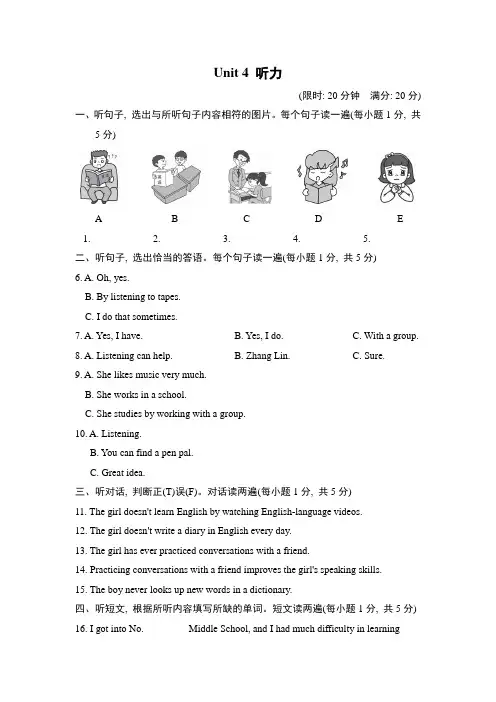
Unit 4 听力(限时: 20分钟满分: 20分) 一、听句子, 选出与所听句子内容相符的图片。
每个句子读一遍(每小题1分, 共5分)A B C D E1. ________2. ________3. ________4. ________5. ________二、听句子, 选出恰当的答语。
每个句子读一遍(每小题1分, 共5分)6. A. Oh, yes.B. By listening to tapes.C. I do that sometimes.7. A. Yes, I have. B. Yes, I do. C. With a group.8. A. Listening can help. B. Zhang Lin. C. Sure.9. A. She likes music very much.B. She works in a school.C. She studies by working with a group.10. A. Listening.B. You can find a pen pal.C. Great idea.三、听对话, 判断正(T)误(F)。
对话读两遍(每小题1分, 共5分)11. The girl doesn't learn English by watching English-language videos.12. The girl doesn't write a diary in English every day.13. The girl has ever practiced conversations with a friend.14. Practicing conversations with a friend improves the girl's speaking skills.15. The boy never looks up new words in a dictionary.四、听短文, 根据所听内容填写所缺的单词。
【课件】选修四Unit4listeningandspeaking---Meetstudentvolu

How things would look if you had cataracts. /ˈkætərækt/(白内障)
Professor Fred Hollows showing Vietnamese (越 南人)doctors how to prepare a patient for surgery(手术).
Listen to the conversation again and then answer the following questions.
1. Why does Tony want to join the meeting for student
volunteers?
此处音频见课件列表:【配套音频】 (PPT)P8+选修四+Unit4+listening
Listen to the conversation again and then answer the following questions. P42
1. WHehyusdeodestoTvoonlyunwtaenert taot jhoiisnhtihgehmsceheotionlgin fAormsetruidcean, tsovohleuwntaenetresd? to try it in China.
此处音频见课件列表:【配套音频】(PPT) P7+选修四+Unit4+listening and speaking -Meet student volunteers--Using
ListenLatnogutahgee 2conversation and complete the table below.
2. Do you know what a “cataract”is? It’s when the lens of your eye b__e_c__o_m__e__s_m___o_r_e__a__n_d__m___o_r_e__c_l_o__u_d__y_ until eventually you can’t see anything. That sounds terrible but the treaitsmuesnuta_ll_y__p__o_s_s_i_b__le___.
新人教新课标版英语选修八单元练习:Unit4Pygmalion
Unit4 Pygmalion单元练习一、听力(听力)(共20小题;共20分)第一节(共5小题;每小题1.5分,满分7.5分)听下面5段对话。
每段对话后有一个小题,从题中所给的A、B、C三个选项中选出最佳选项,并标在试卷的相应位置。
听完每段对话后,你都有10秒钟的时间来回答有关小题和阅读下一小题。
每段对话仅读一遍。
1. Which of the following plays of Shakespeare has the woman read?A. Romeo and Juliet.B. Twelfth Night.C. Hamlet.2. What is the woman's problem?A. She could see the map clearly.B. She couldn't understand the map.C. The map was too small for her to see.3. What is the woman interested in?A. She is interested in literature.B. She is interested in science.C. She is interested in physics.4. What will the woman probably do after the conversation?A. Buy a copy of the English Coaching Paper from a bookstore.B. Borrow it from Jim.C. She won't read it.5. What do we learn from the conversation?A. Lucy enjoys learning mathematics.B. Lucy is not good at mathematics.C. Lucy must be good at mathematics.第二节(共15小题;每小题1.5分,满分22.5分)听下面5段对话或独白。
人教课标版高中英语选修8Unit4 Listening and speaking (共19张PPT)

Personality
Higgins Eliza
She’s no use at all. Take her away. But if I teach you, I’ll be worse than a father. Ok, I’ll teach you. But she’ll need to be cleaned first.
2020/6/16
9
Further thinking
What led to the conflict between them?
Because the poor couldn’t get along with the rich. Because they lived in a society where social classes and money were the most important .
1W1 haemn
2020/6/16
The play MaWkehaatbet
HWHioghgueisrnees’
4
1. This text is mainly about Henry Higgins and Colonel Pickering _________ about teaching Eliza. A. making a conversation
2
Unit 4 Pygmalion
Listening and speaking (Act Two, Scene 1)
George 2020/6/16 Bernard Shaw Pygmalion
My Fair Lady 3
Listening
Main plot(情节)
ElPiziacW,kHehirgiongign, s,
标准大学英语第四册第三单元Listening
Discriminative Listening
Comprehension
Listening
Critical Listening ️
Identifying sounds,
Understanding the main
spoken messages,
educational stories.
DifferentSources of English Listening
M aterials: Audio, Video, and enline
tesources
Audio Resources
Listen to podcasts, audiobooks, and recordings to develop your listening skills and eSpand
Daily Practice
Auditory Exposure
Audiobooks and Podcasts
Set aside dedicated time
Watch movies, TV shows, or
each day to listen to English
documentaries in English to
insights.
qost-ListeningActivities: teflection,
Evaluation, andFeedback
1
teflection ✨
Take a moment to think about what
Evaluation ⚖️
2
set goals for future practice.
[高中英语]选修八Unit4 Listening
The improvements What still needs to be
in Eliza
improved
1. her dress
1. her grammar
2. her pronunciation 2. her choice of
3. her manners
conversation topics
Mr Prommuck’s Evidence to prove
ideas about Eliza
he is wrong
2. She speaks English 2. She cannot be
so well that she
Hungarian as she
must be a foreigner, does not
2. Clara is confused with Eliza’s use of English because Eliza is using slang and also talking of subjects not discussed in polite society. Clara would not have heard them discussed before.
Listening on Page 70
大学英语听说教程4听力原文Unit5
⼤学英语听说教程4听⼒原⽂Unit5Unit5PartBHow Our Memory WorksTry to imagine a life without a memory. It would be impossible. You couldn't use a language, because you wouldn't remember the words. You couldn't understand a film, because you need to hold the first part of the story in your mind in order to understand the later parts. You wouldn't be able to recognize anyone - even members of your own family. You would live in a permanent present. You would have no past and you wouldn't be able to imagine a future.Human beings have amazing memories. Apart from all our personal memories about our own lives, we can recall between 20,000 and 100,000 words in our own language as well as possibly thousands more in a foreign language. We have all sorts of information about different subjects such as history, science, and geography, and we have complex skills such as driving a car or playing a musical instrument. All these things and countless others depend on our memory.How well you remember things depends on many different factors. Firstly, some people naturally have better memories than others, in just the same way as some people are taller than others, or have different color eyes. Some top chess players, for example, can remember every move of every game that they have ever seen or played.Secondly, research shows that different things are stored in different parts of the brain. Ideas, words, and numbers are stored in the left-hand side, while the right-hand side remembers images, sounds, and smells. In most people one side of the brain is more developed than the other, and this may explain why some people can remember people's faces easily, but can't remember their names.Thirdly, we all remember exciting, frightening, or dramatic events more easily. This is because these experiences produce chemicals such as adrenaline, which boost your memory. They say that anyone who is old enough to remember knows exactly where they were on Tuesday, September 11, 2001, when radio and TV programs around the world were interrupted with the shocking news that the twin towers of the World Trade Center in New York were hit.Fourthly, the context in which you learn something can affect how well you remember it. Tests on divers, for example, showed that when they learned things underwater, they could also remember those things best when they were underwater.Lastly, the more often you recall a memory the more likely you are to remember it. If you don't use it, you'll lose it. A telephone number that you dial frequently will stay in your memory easily, but you will probably have to write down one that you use only now and again.Questions:1. What does the passage mainly tell us?2. What can be inferred from the passage?3. Which of the following is stated to be true?4. Why can we remember exciting, dramatic, or frightening events better?PartCAdditional ListeningsTechniques to Help Us Remember BetterWe all have problems remembering things, but there are some techniques that you can use to help you remember.First of all, remember the names and jobs of the people and where they come from. Here, the best thing is to imagine images of the people and the names that you want to remember. And you should try to think of funny images as they are easier to remember. For example, we have Tom the student from Australia. Well, for Tom you might imagine a tomato. Then Australia has a shape a bit like a dog. Now let's imagine it's a very clever dog and is studying. So imagine Tom's face as a tomato and he's with a dog and the dog is reading a book. So now we have a picture of Tom the student from Australia.Now let's take the numbers. The best thing to do here is to break a large number up into smaller numbers and then think of things that the numbers remind you of, such as a birthday, a particular year, the number of a house. Or with a number like 747 you might think of a jumbo jet -- a Boeing 747.With the directions, the best thing is to imagine yourself following the directions. Create a picture in your mind of yourself going down the street. Count the turnings 1, 2, ... Then turn left. Now imagine going past a supermarket and a cinema and so on.When you have to remember lists of words, try to build them into a story. So with our words we might start with, 'The sun was shining, so I went for a walk. I saw a horse wearing trousers. It was kicking some bananas over a television. The bananas landed in a bag.' And so on. Again the funnier the story, the better.Try some of these techniques and you'll be amazed at what you can remember.Questions:1. How many techniques are mentioned in the talk?2. Why should we imagine a dog in order to remember that Tom is from Australia?3. What should we do to remember a large number?4. How can we remember the directions to a certain place?5. How can we remember lists of words?PartDImprove Your MemoryTo many people advancing age means losing your hair, your waistline and your memory. But is it an inescapable fact that the older you get, the less you remember? Well, as time goes by, we tend to blame age for problems that are not necessarily age-related.When a teenager can't find her keys, she thinks it's because she's distracted or disorganized, but a 70-year-old blames her memory. In fact, the 70-year-old may have been misplacing things for decades -- like we all do from time to time.In healthy people, memory doesn't deteriorate as quickly as many of us think. According to psychologists, as we age, our memory mechanism isn't broken, it's just different. The brain's processing time slows down over the years, though no one knows exactly why. Recent research suggests that nerve cells lose efficiency and that there's less activity in the part of the brain that decides whether to store information or not. But it's not clear that less activity is worse. A beginning athlete is winded more easily than a trained athlete. In the same way, as the brain gets more skilled at a task, it spends less energy on it.There are steps you can take to improve your memory, though you have to work to keep your brain in shape. It's like having a good body. You can't go to the gym once a year and expect to stay in top form.Some memory enhancement experts suggest using the AM principle. Pay attention to whatyou want to remember. Then give some meaning to it. We remember things when we focus on them, whether we intend to or not. That helps explain why jingles stick in our minds. They are played on loud, flashy TV commercials. They also use rhyme and music to help us remember better.Basic organization helps us remember the boring stuff. For example, rather than trying to recall a random list of groceries, we can divide them into categories, such as dairy, meat, and produce. For important things like keys and money, we can set up a "forget-me-not" spot where we always keep them.We can also eat to aid our memory power. Whole grains, fruits and vegetables are excellent sources of glucose, the brain's preferred fuel. Another low-tech way to improve memory is to get adequate rest. Sleep may allow our brain time to encode memories.Interest in friends, family and hobbies does wonders for our memory. A sense of passion or purpose helps us remember. Memory requires us to pay attention to our lives, allowing us to discover in them everything worth remembering. Statements:1. It is not always true that the older you get, the less you remember.2. It can be inferred from the passage that memory problems are not really age-related.3. As we get older, our memory mechanism is broken, and so cannot be the same as it was before.4. Scientists have discovered that memory loss is caused by lack of activity in the part of the brain that decides what information to store.5. You must work hard to keep your brain active, just as you work hard to keep yourself in shape.6. In the AM principle, the letters A and M most likely refer to attention and memory respectively.7. A right choice of food and plenty of rest help improve our memory.8. Memory requires us to have purpose or passion in what we do.。
人教版八年级下册英语第四单元听力
人教版八年级下册英语第四单元听力Listening is an important skill in learning a language. In the People's Education Press Eighth Grade English Book, Unit Four focuses on listening skills. This unit aims to help students improve their listening abilities through various exercises and activities.The listening materials in this unit cover a wide range of topics, including daily routines, hobbies, school life, and travel. These topics are designed to be relevant and interesting to students, making it easier for them to engage with the material.One of the key features of this unit is the variety of listening exercises. Students are exposed to different types of listening tasks, such as listening for specific information, listening for main ideas, and listening for details. These exercises help students develop their listening comprehension skills in a systematic way.In addition to listening exercises, this unit also includes listening strategies to help students improve their listening abilities. These strategies include using context clues, predicting content, and taking notes while listening. By practicing these strategies, students can become more effective listeners.Overall, Unit Four of the People's Education Press Eighth Grade English Book is a valuable resource for students looking to improve their listening skills. With engaging topics, a variety of listening exercises, and helpful strategies, this unit provides students with the tools they need to become better listeners.。