
译林七年级英语下册第三单元知识点
第1页Unit3WelcometoSunshineTown!3.1Comicstrip&Welcometotheunit【要点梳理】句型知识点解析1.Anoldfriendofmineiscomingtoseeme,Hobo.霍波,我的一位老朋友要来看望我。1).Anoldfriendofmine=oneofmyoldfriends我的一位老朋友2).此句中“iscoming”相当于“isgoingtocome”是现在进行时表示将来的用法。2.Isitenoughforatinofdogfood?一罐狗食够了吗?1).enoughadj.(形容词),“足够的”,可作表语;也可作定语,放在被修饰名词的前面和后面均可。如:我们有足够的钱。Wehaveenoughmony.=Wehavemonyenough.2).enoughadv.(副词)修饰形容词和副词时只能放在被修饰词的后面且常与不定式连用。……adj/adv+enough+todosth.如:他到了上学的年龄了。Heisoldenoughtogotoschool.3.Maybewecanorderapizza…order在本句中用作及物动词,意思是“叫或点(饭菜、饮料等)”。Iwanttoorderacupofcoffee.我想点一杯咖啡。第2
页3.2Reading【要点梳理】1.词汇运用2.句型“Whoisthe+名词+in+表示衣服的名词”要点一:词汇运用Westernadj.西方的westn.西方Western通常与名词连用而west通常用在词组inthewest(of).......如:西方国家Westerncountries西方人Westernpeople在西方inthewest在中国的西部inthewestofChina=intheWesternpartofChina要点二:.句型解析1.Ittakesonly40minutesfromthecentreofBeijingbyunderground.从北京市中心乘地铁只需40分钟。知识点:byunderground的用法[指点迷津]byunderground的意思是“乘地铁”。类似的短语有bybus/train/plane/bike等。byunderground相当于onthe/anunderground.在句中作状语。作谓语时要用takethe/anunderground。Doyouusuallygotoworkbyunderground?=Doyouusuallytakethe/anundergroundtowork?你通常乘地铁去上班吗?2.IftheydonotlikeChinesefood,therearesomeWesternrestaurantstoo.如果他们不喜欢中国食物,也有一些西餐馆。此句中的“if”是连词作“如果”,“假如”讲,引导一个条件状语从句。第3页注意:if引导的条件状语从句,主句如果是将来时,从句只能用一般现在时。例如:如果明天下雨,我们将不开运动会。Ifitrainstomorrow,wewon’thaveasportsmeeting.3.TherearelotsofthingstodoinSunshineTown.在阳光镇有许多事情可做。“Thereis/are+名词+todo..”意为“有......可做”,其中动词不定式用来修饰它前面的名词,作后置定语,且两者之间存在逻辑上的动宾关系。例句:Thereissomehomeworktodothisweekend.这个周末有一些家庭作业要做。【拓展】“Thereis/are+名词+v.-ing..”也是一个常用的句型,动词的-ing形式作后置定语,前面的名词与后面的v-ing形式也是逻辑上的主谓关系。有许多人在公园里玩。Therearemanypeopleplayinginthepark.4.Beijingduckisveryfamous.北京烤鸭是很著名的。famousadj.意为“著名的,有名的”,既可以作表语,也可以作定语。其同义词是well-known,反义词为unknown。【拓展】1).befamousfor...因......而著名/出名中国因长城而文明。ChinaisfamousfortheGreatWall.2).befamousas...作为......而出名他作为一名歌唱家而出名。Heisfamousasasinger.第4
页3.3Grammar【要点梳理】1.人称代词与物主代词主格宾格形物名物我IMeMyMine你YouYouYourYours他HeHimHisHis她SheHerHerHers它ItItIts/我们WeusOurOurs你们YouYouYourYours他们theyThemtheirtheirs2.名词所有格的构成:1)单数名词或人名后加’sthestudent’sbagTom’sbook2)以s或es结尾的复数,其所有格加’;thestudents’classroomstheteachers’offices3)不以s结尾的名词复数,其所有格后加’sChildren’sDaytheoldpeople’shomeWomen’sDay第5页4)两人所共有,则在第二个人后面加’s;分别所有,各自加’sLucyandLily’sdeskLucy’sandLily’sdesks5)表示无生命名词的所有关系用of(也能用于有生命名词的所有格)thewindowofthehouseafriendofmineateacherofmybrother’s6)一些用于表距离、时间、国家或城镇等无生命的名词,也可使用’s表所有格。tenminutes’walkChina’shistorytoday’snewspaper7)用“belongto属于”表示所有sth.belong(s)tosb.=sth.issb’seg.ThisbookbelongstoLily.=Thisbookismine3.4Integratedskills&Studyskills【要点梳理】:重点句子解析1.WhynotvisitourlocaltheatreandenjoyBeijingopera?为什么参观我们当地的剧院并且欣赏京剧呢?Whynotdosth.?=Whydon’tyoudosth.?为什么不做某事?2.Wearelookingforwardtomeetingyousoon.lookforwardtosth.期待某物lookforwardtodoingsth.期待做某事eg.Wearealllookingforwardtothesummerholiday.我们都盼望着暑假。第6页3.Don’tmissthem.别错过它们。misssth/doingsth(错过)misssb.(想念)MissSmith史密斯小姐(未婚)eg.Idon’twanttomissthelastbus.Imissmymotherverymuch.4.GotoBaohePalacetoseeworksofart去保和殿看艺术品workn.作品,著作(可数)n.工作(不可数)v.工作workhard努力工作5.Howfarisitfromthehotel?它离公园有多远?howfar“多远”,对距离进行提问howsoon“多久以后”用“in+一段时间”回答。howlong“多久,多长”,对一段时间或物体长度进行提问eg.Howlongdoesittakeyoutogetfromhometoschool?从家到学校花费你多长时间?Howlongisthisruler?这把尺有多长?Howsoonwilltheycomeback?他们要过多久才回来?------They’llcomebackintwoweeks.他们两周之后回来。第7
页3.5Task【要点梳理】1.固定搭配show...around...2.hearsb.do与hearsb.doing3.some...others要点一:固定搭配show...around...I’mgoingtoshowyouaroundmyhometown.我要带你参观我的家乡。showsb.around(+地点)带领某人参观……showsb.sth.=showsth.tosb.向某人展示某物shown.演出,展览,节目要点二:hearsb.do与hearsb.doingIcansmellflowersandhearthebirdssing.我能闻到花香,听见鸟唱歌。hear/see/watch/find/noticesb.doingsth.听见/看见/看到/发现/注意到某人做某事的状态hear/see/watch/find/noticesb.dosth.①听见/看见/看到/发现/注意到某人做某事的全过程②或指经常看到某事发生第8页要点三:some...othersSomefamiliesraisecows,andothersgrowwheat.一些家庭养牛,另一些家庭种植小麦。some……,andothers……意为“一些……,其他的……”other意为“别的,其他的”+复数名词others=other+n.eg.Thereareotherpeopleintheroom.theother作代词,指两者中的“另一个”,常用于“one……,theother……”eg.Therearemanytreesontheothersideoftheriver.another泛指三者或三者以上的同类事物中的“另一个”,强调“再,又”,常接单数名词eg.Thiscoatistoolargeforme.Pleaseshowmeanotherone.也有“another+数词+名词复数”的结构,意为在原来的基础上再加一些,=数词+more+名词复数eg.Fiveapplesarenotenough.Pleasegivemeanotherfive(apples).(=fivemoreapples)theothers在具体的语境中特指“其他的XXX”eg.ThesethreebooksareLily’s.Theothersareyours.(指三本以外剩下的书)=theotherbooks.
译林版英语七年级下册Unit 3单词及短语
Unit 3 Welcome to Sunshine Town! 名词Nouns 1. air 空气,大气
e.g.: Let’s go out for some fresh air.
2. underground 地铁
e.g.: It takes only 40 minutes by underground.
3. theatre 戏院,剧场 = theater
e.g.: Why not visit our local theatre and enjoy Beijing opera?
4. postcard 明信片
e.g.: Have you sent a postcard to your mother yet?
5. key 钥匙
e.g.: We’ll have a duplicate key cut (=made).
6. ring 环,圈;戒指 – key ring
e.g.: The ring has always brought me good luck.
7. pencil case 笔盒,笔袋
e.g.: It’s next to Amy’s pencil case.
8. work 作品,著作 – work of art 艺术品
e.g.: She’s an artist whose work I really admire.
9. hotel 旅馆
e.g.: Let’s meet in front of your hotel at 8:30 tomorrow morning.
10. hometown 家乡
e.g.: I’m going to show you around my hometown.
11. yuan 元(人民币单位)
e.g.: We only have five yuan.
12. tin 罐,听
e.g.: Is it enough for a tin of dog food?
牛津译林版英语七年级下册Unit3知识点精讲(下)
优选精品 欢迎下载
1 / 12 U3基础知识梳理(下)
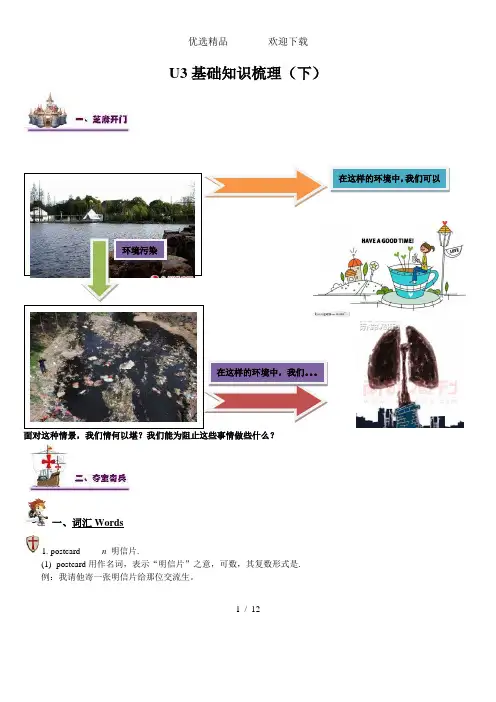
面对这种情景,我们情何以堪?我们能为阻止这些事情做些什么?
一、词汇Words
1. postcard n 明信片.
(1) postcard用作名词,表示“明信片”之意,可数,其复数形式是.
例:我请他寄一张明信片给那位交流生。
在这样的环境中,我们可以
环境污染
在这样的环境中,我们。。。
优选精品 欢迎下载
2 / 12
2. key n 钥匙,答案,键,关键
key用作名词,意为“钥匙;答案;关键”,其复数形式是。
(1) key表示“钥匙”之意时,常用“这个门的钥匙”固定搭配。
例:我没有前门的钥匙。
(2) key表示“答案”之意时,常用“这个问题答案”固定搭配。
例:我知道第一个问题的答案。
(3) key表示“键”之意时,是指电脑、打字机、钢琴等“键盘上”的“键”。
例:这个键盘上有六排键。
(4) key 也可以用作名词,表示“关键”性的人或人事。
例:那个人可能是这个学校的关键人物。
3.ring n 环,圈;戒指
(1)ring用作名词,表示“环;圈;戒指”,是可数名词,其复数形式是
例:桌子上的指环不是我的。
(2)ring用作名词,也可以表示“打电话”之意,常用“给某人打电话”固定搭配。
例:他经常星期天给我打电话。
4.all over 到处,遍及
(1) all over 表示“到处”之意时,与副词everywhere 意义接近。
例:孩子们全身都湿透了。
(2) all over 表示“遍及”之意时,相当于介词throughout ,后面要接名词、代词等作宾语:
“全世界”.
例:全中国已经发生了巨大的变化。
全世界的儿童都喜欢看电视。(all over)
________________________________________________
译林版英语七年级下册知识点总结
译林版英语七年级下册知识点总结
Unit 1: My School Life
- Talking about school facilities and subjects
- Expressing preferences and opinions
- Using the simple present tense to describe daily routines
Unit 2: My Friends
- Describing friends' appearance and personality
- Talking about activities with friends
- Using the present continuous tense to talk about future plans
Unit 3: My Weekend Plans
- Talking about weekend activities
- Making and responding to invitations
- Using the future tense to talk about future plans
Unit 4: My Room
- Describing the layout and furniture in a room
- Talking about personal belongings - Using prepositions to describe location
Unit 5: My Family
- Talking about family members and relationships
- Describing family members' appearances and personalities
- Using possessive adjectives to indicate ownership
【同步练习】译林版初一英语下册 Unit3 Grammar重点语法 名词所有格和物主代词

Unit 3 Welcome to Sunshine Town!
名词所有格和物主代词
(时间:60分钟,满分:100分)
一、单项选择(本大题共40小题,每小题2分,共80分)
1.(2022春·江苏泰州·七年级校考阶段练习)—Is that your father?
—No, he’s ________.
A.Lily and Lucy B.Lily and Lucy’s
C.Lily’s and Lucy’s D.Lily’s and Lucy
2.(2022春·江苏无锡·七年级宜兴市树人中学校联考阶段练习)—I think ________ is ________ favourite
sport.
— Yes, he likes it best.
A.swim; To B.swimming; Tom’s C.swimming; Tom D.swim; Tom’s
3.(2022秋·江苏苏州·七年级统考期末)The two women are good friends and they are _________ mothers.
A.Tom and Jerry B.Tom and Jerry’s C.Tom’s and Jerry’s D.Tom’s and Jerry
4.(2022秋·江苏苏州·七年级校考期中) ________ teacher usually teaches ________ English at the
weekend.
A.Lily and Nick; their B.Lily’s and Nick’s; them
C.Lily and Nick’s; their D.Lily and Nick’s; them
5.(2022春·江苏镇江·七年级校考阶段练习)The car isn’t ________car. It’s ________. ________ is red.
七年级下册第三单元英语翻译全书译林

七年级下册第三单元英语翻译全书译林
Section A、让我们先看看熊猫。
为什么?
因为它们很可爱。
1c、让我们看狮子吧。
你为什么想看狮子?
因为它们可爱。
2b、让我们看树袋熊吧。
你为什么喜欢树袋熊?
因为它们很可爱。
哦,我喜欢海豚。
你为什么喜欢海豚?
因为它们很有趣。
2c、你喜欢长颈鹿吗?
是的,我喜欢。
为什么?
因为它们很有趣。
Grammar Focus、你为什么喜欢熊猫?因为它们非常可爱。
他为什么喜欢树袋熊?因为它们有点有趣。
3b、狮子来自哪?狮子来自南非。
Section B
3、你喜欢什么动物? 我喜欢大象。它们可爱。
你喜欢别的什么动物?
我也喜欢狗。
为什么?
因为它们友好又聪明。
3a、莫利 这是莫利,她十二岁。她来自非洲。她喜欢和她的朋友一起玩,并且喜欢吃草。
玲玲 这是玲玲,她五岁,她来自中国。她非常漂亮,但是很害羞。所以请保持安静。
比尔 这是比尔。难道他不可爱吗?他来自澳大利亚。他白天睡觉,但晚上起来吃树叶。
3b、这是拉里。他来自非洲。他八岁。他吃肉。拉里很懒。他通常每天要睡觉放松20个小时!
4、(它)是长颈鹿!不,不是!
Self check
1、熊猫 树袋熊 长颈鹿 狮子 老虎 海豚 企鹅 大象 可爱的 有好的
丑陋的 聪明的 美丽的 害羞的漂亮的澳大利亚 中国 非洲 有点儿
非常
3 、这是维克托。他是一头大象。他是友好的和安静的。
Just for fun 他们为什么看着我?因为你非常招人喜爱!
牛津译林版七年级英语下册Unit3知识考点专项练习
牛津译林版七年级英语下册Unit3知识考点专项练习
1. 重点单词短语熟记
2. 掌握重点句型
3. 掌握语法
【聚焦中考】:Unit3 必考知识点汇编
考点一:考查交际用语
Shall we invite them to have dinner with us?
我们邀请他们和我们一起吃饭行吗?(教材第31页)
➢ 中考链接
一Shall we make a cake by ourselves instead of buying one?
—_______.
A. That’s a good idea B. Don’t worry
C. Never mind D. The same to you
【答案】A
【解析】本题考查交际用语。That’s a good idea.意为“好主意”;Don’t worry.意为“别担心”;Never mind.意为“不介意”;The same to you意为“你也一样”。根据句意可知,这是向对方提出建议,故选A。
考点二:考查非谓语动词
2. It takes only 40 minutes by underground.乘地铁只要40分钟。(教材第32页)
➢ 中考链接
It _____ me about 10 days _____ painting the walls,
A. took, to finish B. cost, finishing
C. took, finishing D. spent, to finish Unit 3 Welcome to Sunshine Town
【答案】A
【解析】本题考查非谓语动词。It takes/took sb some money/time to do sth.是固定句型,意为“某人花一些金钱/时间做某事”,故选A。
牛津译林版英语七年级下册Unit3重点词汇复习
牛津译林版七年级下册Unit3重点词汇复习
【知识梳理】
1.A friend of mine is coming to visit me, Hobo. (P30)
(1) a friend of mine ,这是一个 结构。
例:the English book of your sister’s 你姐姐的英语书
an old friend of my mother’s 我母亲的一位老朋友
(2) is coming 用的是 形式,表示 ,意思是 。可以用现在进行时态表示将来动作的有 等表示位移的动词。
例:I’m leaving for Shanghai tomorrow.我明天就要动身去上海了
批注:讲解时提醒学生注意a friend of mine这一双重所有格的用法,本单元会重点讲解到,就相当于a friend of my friends.
答案:(1) a friend of mine“我的一个朋友”,这是一个双重所有格结构。
(2) is coming 用的是现在进行时形式,表示将来将要发生的动作,意思是“将要来”。可以用现在进行时态表示将来动作的有come, leave, stay, arrive, go 等表示位移的动词。
2.But there’s nothing in the fridge. (P30)
nothing是 ,用在句子中代替物体,意为 ,具有否定意义,相当于
【拓展】
(1) nothing一般用于回答 引导的疑问句,表示 。
牛津译林版英语七年级下册第三单元词组
7b unit3 重点短语,句子
一.重点短语
1. an old friend of mine 我的一个老朋友 a friend of +名代
2. wait a minute =just a moment 请稍侯 Good idea 好主意
3. oder a pizza 定一个比萨饼 of course not . 当然不
4. a group of exchange students 一群交换生
5. take them to the cinema 带他们去电影院 take sb to sp 带某人去某地
6. watch some wonderful films 观看精彩的电影
7. take the boys to our school’s football field 带男孩子们去我们学校的足球场
8. invite them to have dinner with us 邀请他们和我们一起共进晚宴
9. invite sb to do sth邀请某人做某事 invite sb to a party /邀请某人参加聚会/某人的生日
10. try some Western food 尝一些西餐 Western restaurants 西餐馆
11. there is…….to do 有…..可以做 sb have/has …..to do 某人有….要做
12. stay in a quiet town 呆在一个安静的小镇
13. fresh air 新鲜的空气 local people 当地的人
译林版牛津英语七年级下册全册Unites1-8单元知识点及语法归纳
第 1 页 共 62 页 译林版牛津英语七年级下册全册Unites1-8单元知识点及语法归纳
一、重点词组、句型
1、Would you like to live in the palace, Eddie? 埃迪,你想住宫殿里吗?
①Would you like sth? 肯定答复: Yes, please. 否认答复: No, thanks.
②Would you like to do sth? 肯定答复:Yes, I’d
like/love to. 否认答复:I’d like/love to, but…
2、There are twenty restaurants in town. 镇上有二十家餐馆。
There are about 8,000,000 people living in London.
大约有八百万人住在伦敦。
①表示某地有……,用there be 句型,谓语动词就近原那么。
There __________(be) an art room, a music room and
two puter rooms in our school.
②表示有事情要做,用there be sth to do。 There
are lots of things ___________(see) in Beijing.. 第 2 页 共 62 页 ③表示有某人正在做某事,用there be sb doing
sth.。
On game shows, there are always famous
people___________(talk) about their lives.
3、I live in a town 15 miles from London. 我住在离伦敦15英里的一个镇上。
be far (away) from 离……远,但出现详细间隔 时,不用far
My home is __________________from the school.
2022-2023学年牛津译林版英语七年级下册全册知识点整理
Unit1Dream homes 1、Would you like to live in a palace, Eddie艾迪,你想住在宫殿里吗
这里 would like是“想,想要”的意思,后面可以加名词或动词或动词不定式。
如:I’d like to go to the USA next year. 明年我想去美国。
2、I’d like to live next to a restaurant. 我想住在餐馆附近。
这里 next to 是“附近,靠近的”的意思,相当于 near。 如:The table is next to the window.
这张桌子在窗户旁。
3、Which country is this photo from, Amy艾米,这幅照片来自哪个国家
这里 be from 相当于 come from, 是“来自……”的意思。 如:Where is Mr Black from
布莱克先生来自于哪儿
4、Is Tokyo the capital of Japan东京是日本的首都吗
句型结构为:The capital of +国家is +首都。如:The capital of the UK is London. 英国首都是伦敦。
[拓展]
(1)capital n.省会 The capital of Jiangsu is Nanjing. 江苏省会是南京。
(2)capital n.大写字母
We should write in a capital at the beginning of a sentence. 句子的开头我们应该用大写字母。
(3)capital n.资本,资金,资产 personal capital 个人资产
(4)capital adj.顶好的,一流的
He came up with a capital idea. 他想好一个绝妙的主意。 5、I like the kitchen best. 我最喜欢厨房。 Like…best 意为“最喜欢……”,相当于like…most。如:The girl likes playing the piano best/most.