
上海牛津沪教版七年级(下)同步讲义unit4
第四讲Unit4 Let's go shopping教学过程一、课堂导入教师讲述一个与本节课题目有关的英文小故事,引出今日所要讲解的知识点,然后让学生简单梳理一下所涉及的问题,带着问题学习本节课的内容。
二、复习预习教师引导学生复习上节课学的重点内容,检测单词的用法,(以提问、回顾的形式进行),针对上节课的作业进行讲评、订正、答疑,并通过英文小故事导入本节课所要学习的新知识。
三、知识讲解1. 知识点一:重点单词1)kid [kɪd]【词性】n.【词义】小孩;年轻人【易混淆点】kid n. 小孩kid v. 开玩笑【经典例句】Don’t kid me, I know you're not telling the truth.别哄我,我知道你没说真话。
2)fashion ['fæʃn]【词性】n.【词义】时尚【经典例句】She was dressed in the latest fashion.她穿着最新时装。
3)check [tʃek]【词性】n.【词义】方格图案;格子【易混淆点】check n. 方格图案;格子check v. 检查;核对【经典例句】Check to see if the students have memorized the dialogue.检查一下学生是否记住了那段对话。
4)excuse [ɪk'skjuːz]【词性】v.【词义】原谅【易混淆点】excuse v. 原谅excuse n. 借口【经典例句】I hope you'll excuse me.我希望你能原谅我。
2. 知识点二:重点词组1)excuse me 劳驾;请原谅2)over there 在那边3)changing room 试衣间4)a new pair of jeans 一条新牛仔裤5)buy you a shirt=buy a shirt for you 给你买一件衬衫6)go shopping 去购物7)jeans with blue belt 带蓝色皮带的牛仔裤8)try on 试穿9)too long and loose 太长太松10)in one’s size 某人的尺寸3. 知识点三:重点句型1)Would you like to come?你们一起去吗?2)I need to buy a computer book for your dad and a pair of shoes for myself.我要给你们爸爸卖一本电脑书,给我自己买一双鞋。
3)We’ll go to Girl’s Fashion and Cool Clothes.我们要去“少女时装店”和“酷装店”看看。
4)Alice, do you like the jeans with the yellow belt or the ones with the blue belt?艾丽斯,你喜欢配黄色皮带的牛仔裤呢,还是配蓝色皮带的?I like the ones with the blue belt.我喜欢配蓝色皮带的。
5)Excuse me. Can I try on the jeans with the blue belt, please?劳驾,我可以试穿一下这条配蓝色皮带的牛仔裤吗?Certainly. The changing rooms are over there.当然可以。
试衣间在那边。
Do you have them in my size? I wear medium.你们有我的尺码吗?我穿中号。
Sorry, we don’t have them in your size.对不起,我们没有你穿的尺码。
4. 知识点四:常见语法1)need用法①need 做情态动词 need do sth.e.g. I need go shopping.我需要去购物。
② need 做实意动词 need sth./to do sth.e.g. I need to have a rest.我需要休息一下。
2)介词短语作定语介词短语可作定语修饰或限制名词,这时它置于名词之后。
e.g. Alice, do you like the jeans with the yellow belt orthe oneswith the blue belt?艾丽斯,你喜欢配黄色皮带的牛仔裤呢,还是配蓝色皮带的?3)一般现在时运用一般现在时除了表示主语的现在常规活动,助于现在拥有某种东西,还可以表示:①主语现在的特征②主语现在的身份职业③助于现在的感情、愿望、理解④主语现在的居住、穿着、归属⑤对主语的说明、解释、测定⑥用于谚语中e.g. David wants a holiday.大卫想要一个假期。
四、例题精析【例题1】【题干】We have got so many toys. We _______ go to Toys for kids.A. need not toB. need toC. don’t needD. don’t need to【答案】D【解析】本题考核need用法。
need情态动词,need do, needn’t;实意动词need to do, don’t need,故选D。
【例题2】【题干】A waiter ___________ to people.A. brings foodB. cooks foodC. grows foodD. deliver food【答案】A【解析】本题考核一般现在时。
bring带来;cook烹饪;grow种植;deliver递送,没有变三单, 故选A。
五、课堂运用【基础】1. Danny bought her a pair of sport shoes.(改为同义句)Danny bought a pair of sport shoes【答案】for her【解析】本题考核buy用法。
buy sb. sth.=buy sth. for sb. 故填for her。
2. Who swims (slow) Tim or Tonny?【答案】more slowly【解析】本题考核副词比较级。
两个人比较,且修饰动词swim要用副词,故填more slowly。
3. I like this shirt. I wear medium Shall I (try on it/try it on)【答案】try it on【解析】本题考核词组用法。
try on 接名词可中间可后面;接代词必须放中间,故填try it on。
4. Aunt Lucy ___________ in a medicine company, doesn’t she?A. isB. worksC. doesn’t workD. isn’t【答案】B【解析】本题考核反义疑问句。
由反问部分可判断出,前面为肯定句,且谓语动词为实义动词,故选B。
5. ---Have a good time!---_____________.A. That’s a good idea!B. Thank you!C. I know.D. Why not?【答案】B【解析】本题考核情景交际。
have a good time 玩的开心,是别人的一种祝愿,故选B。
【巩固】1. Bill broke the window. His mother was looking _________ at him.A. angryB. angrilyC. happyD. happily【答案】B【解析】本题考核look。
此处look为实意动词,look at表示看,而不是做系动词表示看起来,故选B。
2. I’ve lived in my grandma’s house ____________ I was born.A. forB. becauseC. whenD. since【答案】D【解析】本题考核现在完成时。
since+过去时间点,用于现在完成时,故选D。
3. There is little milk in the fridge, __________?A. is itB. isn’t itC. is thereD. isn’t there【答案】C【解析】本题考核反义疑问句。
There be 反义疑问句用be there来反问,little为否定,后用肯定,故选C 。
4. My father is ______ engineer. He works in a company.A. aB. theC. /D. an【答案】D【解析】本题考核冠词。
engineer第一个发音音标为元音,故选D。
5. Turn right _________ Water Street and you will find a bank .A. intoB. onC. inD. at 【答案】A【解析】本题考核词组。
turn right into右转进入到,故选A。
【拔高】1. Alice ________ a teacher for more than 5 years.A. becameB. has becomeC. wasD. has been【答案】D【解析】本题考核现在完成时。
for+一段时间用于现在完成时,故选D。
2. It’s the best time _______children ________go to bed .A. to ….forB. to ……toC. for …..toD. for ……for【答案】C【解析】本题考核句型。
It’s time for sb. to do sth.到某人做某事的时间了,故选C。
3. I bought a pair of trousers _______ stripes.A. inB. onC. ofD. with【答案】D【解析】本题考核介词短语作定语。
介词短语作定语修饰名词,放在名词之后,带条纹的裤子用介词with表达,故选D。
4. I will buy a new watch ______ my brother.A. forB.toC. inD. with 【答案】A【解析】本题考核buy的用法。
buy sth. for sb.故选A。
5. Look! The students _________ happily.A. swimB. swimsC. swamD. are swimming 【答案】D【解析】本题考核时态。
Look!强调正在进行的动作,故选D。
课程小结本节课对七年级(下)U4单元内容进行详细解析,主要针对该单元里常考的知识点进行归纳提炼,同时按照基础、巩固和提高三个层次的标准配以相应的习题,希望学生在熟悉本节课知识点的基础上重点掌握易考点,并对易混淆点进行归纳区分,以达到最佳的学习效果。
上海牛津版七年级下册Unit4 Let's go shopping 同步讲义 原卷版
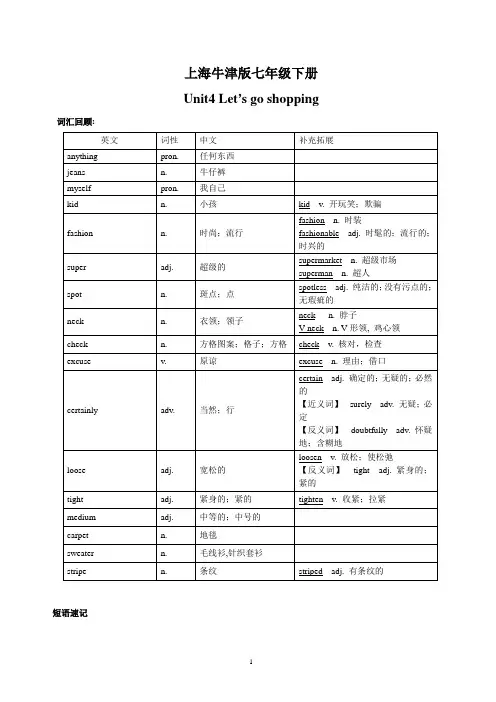
上海牛津版七年级下册Unit4 Let’s go shopping短语速记词汇积累与练习Ⅰ. Words.1. anything pron. 任何东西eg. I don’ t have anything but will. 除了意志我一无所有。
Do you have anything to say? 你有什么话要说吗?【友情提示】anything表示“某事;某物”,修饰anything的形容词应置于其后。
anything多用于否定句、疑问句;也可表示“任何事;任何东西”,主要用于肯定句(有时也可用于其他句型)。
eg.Has anything interesting happened? 发生了什么有趣的事吗?We can’t believe anything he says. 无论他说什么,我们都不能相信。
I want something to eat, and anything will do. 我想弄点吃的,什么都行。
Did you hear anything interesting there? 你在那儿有没有听说什么趣事?2. * jeans n. 牛仔裤eg. Lots of young people wear jeans nowadays. 现在,很多年轻人穿牛仔裤。
3. myself pron. 我自己eg. I learn French by myself. 我自学法语。
I finished the crossword (all)by myself. 我自己(一个人)猜出了纵横填字字谜。
4. kid n. 小孩eg.Our kids are playing football. 我们的孩子们正在踢足球。
【友情提示】kid为口语,书面语中应使用child。
【拓展】kid v. 开玩笑;欺骗:I'm not kidding. 我没开玩笑。
5. fashion n. 时尚;流行eg. Long skirts have come into fashion again. Jeans are still in fashion too. 又开始流行长裙了。
2015-2016学年牛津沪教版初中英语七年级下Unit_4__Save_the_trees__教案含练习
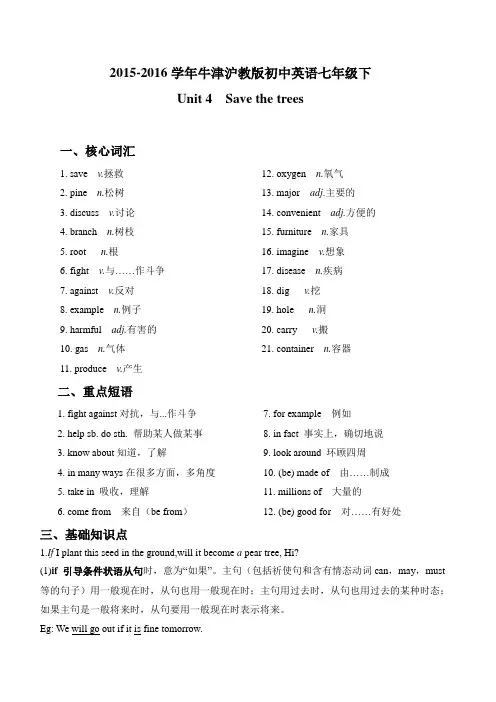
2015-2016学年牛津沪教版初中英语七年级下Unit 4 Save the trees一、核心词汇1. save v.拯救2. pine n.松树3. discuss v.讨论4. branch n.树枝5. root n.根6. fight v.与……作斗争7. against v.反对8. example n.例子9. harmful adj.有害的10. gas n.气体11. produce v.产生12. oxygen n.氧气13. major adj.主要的14. convenient adj.方便的15. furniture n.家具16. imagine v.想象17. disease n.疾病18. dig v.挖19. hole n.洞20. carry v.搬21. container n.容器二、重点短语1. fight against对抗,与...作斗争2. help sb. do sth. 帮助某人做某事3. know about知道,了解4. in many ways在很多方面,多角度5. take in 吸收,理解6. come from 来自(be from)7. for example 例如8. in fact 事实上,确切地说9. look around 环顾四周10. (be) made of 由……制成11. millions of 大量的12. (be) good for 对……有好处三、基础知识点1.If I plant this seed in the ground,will it become a pear tree, Hi?(1)if 引导条件状语从句时,意为“如果”。
主句(包括祈使句和含有情态动词can,may,must 等的句子)用一般现在时,从句也用一般现在时;主句用过去时,从句也用过去的某种时态;如果主句是一般将来时,从句要用一般现在时表示将来。
牛津沪教版英语七年级下Module 1Unit4辅导讲义
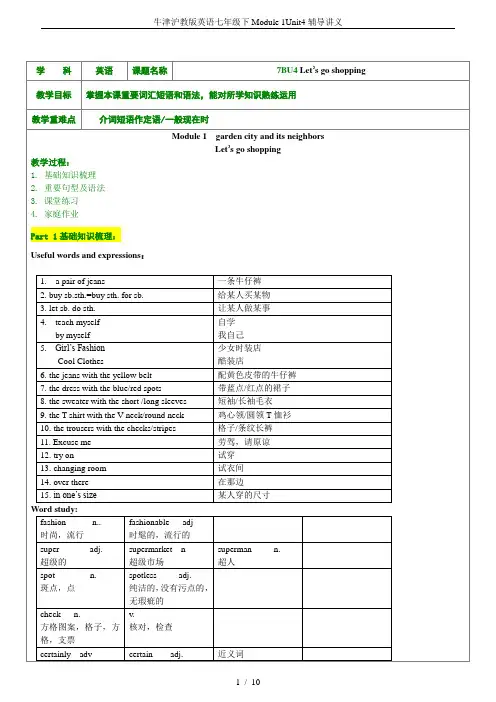
学科英语课题名称7BU4 Let’s go shopping 教学目标掌握本课重要词汇短语和语法,能对所学知识熟练运用教学重难点介词短语作定语/一般现在时Module 1 garden city and its neighborsLet’s go shopping教学过程:1. 基础知识梳理2. 重要句型及语法3. 课堂练习4. 家庭作业Part 1基础知识梳理:Useful words and expressions:1. a pair of jeans 一条牛仔裤2. buy sb.sth.=buy sth. for sb. 给某人买某物3. let sb. do sth. 让某人做某事4.teach myselfby myself 自学我自己5.Girl’s FashionCool Clothes 少女时装店酷装店6. the jeans with the yellow belt 配黄色皮带的牛仔裤7. the dress with the blue/red spots 带蓝点/红点的裙子8. the sweater with the short /long sleeves 短袖/长袖毛衣9. the T-shirt with the V-neck/round neck 鸡心领/圆领T恤衫10. the trousers with the checks/stripes 格子/条纹长裤11. Excuse me 劳驾,请原谅12. try on 试穿13. changing room 试衣间14. over there 在那边15. in one’s size某人穿的尺寸Word study:fashion n.. 时尚,流行fashionable adj 时髦的,流行的super adj. 超级的supermarket n超级市场superman n.超人spot n. 斑点,点spotless adj.纯洁的,没有污点的,无瑕疵的check n.方格图案,格子,方格,支票v.核对,检查certainly adv certain adj. 近义词当然,行确定的,无疑的surely adv.的确地loose adj. 宽松的反义词tight adj. 紧身的,紧的kid n 小孩kid v. 开玩笑,欺骗Part 2重要句型和语法I. Language explanation:1. anything pron. 任何东西(1)某事,某物:多用于否定句,疑问句及条件句中代替somethinge.g. Do you hear anything interesting there? 你在那儿有没有听说什么趣事?(修饰anything的形容词应置于其后)We can’t believe anything he says.无论他说什么,我们都不能相信。
Unit 4 第1课时 课本讲解及词汇拓展-七年级英语下册(牛津上海版)

12. loose adj. 宽松的 She wore a loose dress yesterday. 昨天她穿了一条宽松的
连衣裙。
I have got a loose tooth. 我有一颗牙齿松动了。
【反义词】 tight adj. 紧身的;紧的
10. excuse v.原谅 Please excuse my bad handwriting. 请原谅我的字写得不好。
【拓展】 excuse n. 理由;借口
His excuse for being late was that he had missed the train. 他 迟到的理由是没有赶上那班火车。
homework. 20.John doesn’t like the tigers because he thinks they are really _________
(scare).
11.sleepy 【详解】句意:我昨晚看足球比赛很晚才睡觉,现在我觉得很困。根据“I went to bed late to watch the soccer game last night and now I feel very...”可知,睡得晚,所以很困,sleepy“困倦的”,在句中作表语。故填sleepy。 12.sunny 【详解】句意:今天天气晴朗,所以刚好可以出去走走。空处缺少形容词作表语,结合所给单词,sunny“晴朗的”,故填sunny。 13.European 【详解】句意:杰夫正在一个欧洲国家学习。名词country前需用形容词修饰,应用Europe的形容词European表示“欧洲的”,在句 中作定语,符合题意。故填European。 14.meaningless 【详解】句意:孩子们不应该读无意义的书。mean“意思是”,动词。根据“Children shouldn’t read...books.”可知,孩子们不应该读 没有意义的书。meaningless“没有意义的”,形容词。故填meaningless。 15.American 【详解】句意:吉姆是一个有蓝眼睛的美国男孩。America“美国”,此处是指美国男孩,应用American“美国的”修饰,故填 American。 16.friendly 【详解】句意:我的老师对我们很友好。我们非常爱他。 此空为形容词作表语,friendly表示“友好的”。故填friendly。 17.quick 【详解】句意:他早上没有太多时间准备上学。所以他通常吃一顿快早餐。根据“a ... breakfast”可知用形容词作定语,quick“快的 ”,形容词。故填quick。 18.interesting 【详解】句意:我想看狮子,因为它们很有趣。interest“兴趣”。根据“I want to see the lions because they’re”可知,空格处应用形容 词作表语,interest的形容词有interesting和interested,interesting“有趣的”,修饰物;interested“感到有趣的”,修饰人。结合语境可 知,此处句子主语为“狮子”,故应用interesting。故填interesting。 19.relaxing 【详解】句意:写完作业以后,你可以读一些令人放松的故事。stories是名词,前面应该用形容词来修饰名词。relax是动词,其 形容词形式为relaxed“感到放松的”和relaxing“令人放松的”。此处修饰的是物,应该用relaxing。故填relaxing。 20.scary
沪教牛津版初一下册英语unit4savethetrees单元全套教案(教学设计)
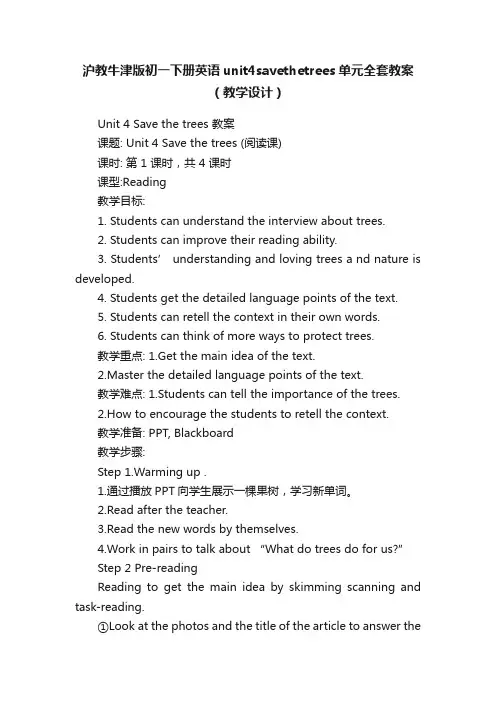
沪教牛津版初一下册英语unit4savethetrees单元全套教案(教学设计)Unit 4 Save the trees 教案课题: Unit 4 Save the trees (阅读课)课时: 第 1 课时,共 4 课时课型:Reading教学目标:1. Students can understand the interview about trees.2. Students can improve their reading ability.3. Students’ understanding and loving trees a nd nature is developed.4. Students get the detailed language points of the text.5. Students can retell the context in their own words.6. Students can think of more ways to protect trees.教学重点: 1.Get the main idea of the text.2.Master the detailed language points of the text.教学难点: 1.Students can tell the importance of the trees.2.How to encourage the students to retell the context.教学准备: PPT, Blackboard教学步骤:Step 1.Warming up .1.通过播放PPT向学生展示一棵果树,学习新单词。
2.Read after the teacher.3.Read the new words by themselves.4.Work in pairs to talk about “What do trees do for us?”Step 2 Pre-readingReading to get the main idea by skimming scanning and task-reading.①Look at the photos and the title of the article to answer thequestions.1. What do you think the interview is about?2.What can we make from trees? (3 examples)②Fast reading1.Ask students to read the article quickly then finish Part C1.2.Check their answers.③Careful reading1.Ask students to read the article carefully,then finish C2 and D1.2.Check their answers.Step 3. Discussion1.Ask students to work in groups to discuss the question “Why does Rebecca says “I can’t imagine a world wi thout trees”?2.Check their answers.Step 4 Retell the text, according to the key words(group work) .1. Practice retelling the text one by one in groups.2. Help them to review the key sentences or words and encourage them to retell the text.Step5 Reading comprehension.Read the passage and finish the exercise in 5minutes.(check the answer in groups)Step 6: Language points. Self- study.①Read the text to find the important sentences .②Learn the learning sheet to finish the related exercise .③Group work to share the learning result and help to solve the different points.④show the learning result by groups.Step 7 Using the language points.(games :lucky member)Step 8 DiscussionSolve the problems given by the teacher to earn marks for their group.Step9 Sum upSummarize the language points and group work resultStep10 HomeworkStep11 The blackboard designUnit 4 Save the treeskeep sth adj 使某物…take in 吸收come from 来自于cut down 砍伐课题: Unit 4 Save the trees 教案(听说课)课时: 第 2 课时,共 4 课时课型: Listening & Speaking教学目标:1. Students can listen to some information about pine trees.2. Students can talk about the usage of pine trees.3. Students know more about trees.教学重点: listen to some information about pine trees.教学难点: talk about the usage of pine trees.教学准备: PPT, Blackboard, music教学步骤:Step1.Warming up.1.GroupworkAsk students to work in groups to talk about “ Why d oes Rebecca say “I can’t imagine a world without trees”?”Before listening2.Top tip1)Introduce some link words,such as “then,next,after.”2)Ask students to pay attention to them while listening.3)讲述“then,next,after”的用法及作用。
沪教牛津版牛津版七年级下册英语知识点总结Unit4Save the trees

沪教牛津版牛津版七年级下册英语知识点总结Unit4 Save the trees重点短语:1.save vt. 拯救;解救Eg. Let’s do something to save the animals in danger.The police saved the child from the fire.【拓展】save “节省、储蓄” Eg. save money save time【变形】safe adj. safety n.2.discuss vt “讨论” 后接名词(短语)或wh-从句及wh-短语discussion n.Eg. We discussed the problem.We will discuss who should do it.We will discuss what to teach next term.3.leaf n. “树叶”复数:leavesEg. The fall of one leaf is enough to tell the coming of autumn. 一叶知秋。
The leaves turn green in spring. 变绿4.help+do = help + to do “帮忙做……”help+名词+(to)do “帮(某人)做……”Eg. I helped (to) wash the car.I helped him (to) look for his key.【拓展】help+with...或help+名词+with... “在某方面帮忙”Eg.Can I help you with your work?Can you help me with my homework, Mary?5.fight for... “为……而战”fight过去式:foughtfight against “与……作斗争”Eg. He is fighting against his sickness.They fight for freedom.6.provide sb. with sth. = provide sth. for sb. 提供给某人……,为某人提供…… Eg. Sheep provide us with wool. = Sheep provide wool for us.【短语】by the way 顺便说一下 in a way 在某种程度上in the way of sb. 妨碍某人 on the way to...在去……的途中in this way 用这种方法8.keep “使维持(某种状态)”keep+名词+形容词 Eg. The noise kept him awake.keep+名词+副词/介词短语Eg. Don’t keep the boy outside/ in the room.keep +名词+doing Eg. She kept me waiting for half an hour.9.take in... “接受……,吸收……”Eg. The kind man would like to take in the poor boy.Fish take in oxygen through their gills. 鱼用腮吸氧气10.breathe[i:] v. breath[e] n.11.make 普通用词,指任何东西的制造或制造过程 Eg.He made the desk himself. produce 正式用词,除表示大量生产制造外,还表示创造Eg. The tree will produce some blossom next year.12.in fact 实际上,事实上。
2015-2016学年牛津沪教版初中英语七年级下同步课堂笔记Unit_4__Save_the_trees
2015-2016学年牛津沪教版初中英语七年级下同步课堂笔记Unit 4 Save the treesI. WordsW1. save v. 拯救;储蓄;贮存safe adj. 安全的safely adv. 安全地safety n. 安全≈rescue v. 拯救save money 存钱save water 节水e.g. He saved the boy from the fire.He saved a lot of money.Let’s sa ve the Earth together because it is in danger(处于危险之中).W2. pine n. 松树v. 渴望(pine to do sth. 渴望做某事)pine tree 松树pine nut 松子pine cone 松球pine needle 松针squirrel n. 松鼠pineapple n. 菠萝e.g. The hill is covered with pines.She is pining to travel abroad.W3. discuss v. 讨论≈talk about 谈论;讨论discussion n. 讨论;商讨discuss sth. 讨论某事discuss sth. with sb. 与某人讨论某事discuss dong sth. 讨论做某事have a (hot) discussion about/on sth. 对某事进行(热烈的)讨论e.g. I discussed the problem with my parents.We had an interesting discussion about philosophy.同义句:We are discussing the matter with the teachers. = We are having a discussionabout/on the matter with the teachers.W4. branch n. 树枝;分公司;分店;分行;分支(pl. branches)a branch of a river 河的支流e.g. We often cut some branches off the trees in our city in early spring.The bank has branches all over the country.Birds are on the branches.W5. root n. 根the root 根源;基础rooter 拉拉队员the root of a plant 植物的根the root of a tooth 牙根pull up by the roots 连根拔起take a root 生根remove a disease root and branch 彻底治疗疾病e.g. Trees need roots to take in water and food from the soil(土壤).Let’s get to the root of this matter.W6. fight v. 与……作斗争;打架;战斗;争吵;争取fight-fought-foughtfighter n. 战士;斗士区别:flight n. 航班fright n. 惊吓fight an enemy 打敌人fight the fire 救火fight a battle 打仗fight用法:(1)fight for后面一般接抽象名词(如自由、真理、权利等):e.g. They are fighting for freedom.(2)fight against后面接事物名词或人和国家名词:e.g. They fought against the enemies.(3)fight with后面接人或国家名词,表示“同……并肩战斗”:e.g. They fought with the Italians in the last war, but they fought against them in this.W7. against prep. 反对≠for prep. 赞成e.g. We are for peace and against war.Many people are against the plan.against其它用法:(1)against表示“靠;倚”:e.g. I put the ladder(梯子)against the wall.(2)against表示“防止;预防”:e.g. Have you had an injection against the disease?(3)against表示“撞击;碰着”:e.g. He hit against a tree.Rain beats against the window.W8. example n. 例子=instance n. 例子;实例for example(举众多例子中的其中一个)for instance(举出一个实例,一个事实)such as(举多个例子)e.g. This dictionary gives many examples of how words are used in sentences.There are jobs more dangerous than truck driving; for instance, training lions.I have been to many places, such as Beijing, Shanghai and Shenzhen.W9. harmful adj. 有害的≠harmless adj. 无害的harmfully adv. 有害地≠harmlessly adv. 无害地harm n./ v. 伤害;损害;危害e.g. These chemicals harm the environment.Make sure the children don’t come t o any harm.do sb. harm=do harm to sb.=be harmful to sb. 对某人有害;损害某人be harmless to sb. 对某人无害e.g. Strong sunlight can be harmful to your baby.Harmful gas is bad for us.W10. gas n. 气体;汽油【美】;毒气v. 加油liquid n. 液体solid n. 固体step on the gas 踩油门turn on the gas 开煤气;开始吹牛turn off the gas 关煤气;停止吹牛e.g. Hydrogen(氢气)and oxygen(氧气)are gases.Gas has hardly any weight.W11. produce v. 产生;生产product n. 产品;制品production n. 生产;制作;产品e.g. The factory produces cars.The company has just launched a new product.The bigger problem is cost of production.W12. oxygen n. 氧气oxygen mask 氧气罩produce oxygen 生产氧气e.g. We need oxygen to breathe.W13. major adj. 主要的n. 专业;主要科目v. 主修≈main adj. 主要的≠minor adj. 次要的majority n. 多数;法定年龄;成年major road 要道 a major operation 大手术 a major party 主要政党 amajor illness 严重疾病e.g. There are airports in all the major cities.The major part of the town was ruined(变成废墟)by the earthquake.同义句:Maths is my major.=My major is Maths.=I major in Maths.W14. convenient adj. 方便的convenience n. 方便;便利conveniently adv. 方便地≠inconvenient adj. 不方便的a convenient time 方便的时间 a convenient place 合适的地方a convenient store 便利店e.g. Let’s meet on Friday. What’s the most convenient time for you?Our house is very convenient for the shop.W15. furniture n. 家具【U】a piece of furniture 一件家具a set of furniture 一套家具e.g. All the furniture is very old.The only piece of furniture in the room was a large bed.W16. imagine v. 想象;设想≈guess v. 推测;猜测imagination n. 想象力;想象e.g. Can you imagine life without electricity?I closed my eyes and imagined I was lying on a beach.W17. disease n. 疾病【C】(指特定的具体疾病)→heart disease 心脏病≈illness/sickness n. 生病【U】(表示抽象的疾病和生病的状态)→a long period ofillness/sickness 长期患病e.g. Malaria(痢疾)and measles(麻疹)are diseases.He died after a long illness.提问:“你生什么病?”如何表达?What’s your trouble?(√)What’s your disease/illness/sickness?(×)W18. dig v. 挖dig-digging dig-dug-dugdig for 挖掘dig...from... 从......挖出...... dig down 挖下去;掏腰包e.g. They dug a tunnel through the mountain for the new railway.W19. hole n. 洞同音词:whole adj. 全部的n. 整体drill a hole in the ground 在地上钻洞make a hole 挖一个洞stop a hole 堵塞一个洞bore a hole in the door 在门上钻个洞prick a hole with a pin 用针刺个洞e.g. My socks are full of hole.W20. carry v. 搬;扛;背;运送e.g. He carried the suitcase to my room.Special fast trains carry people to the city centre.carry短语:(1)carry out 执行,实行;贯彻;实现;完成(2)carry on 开展;维持;继续(3)carry to 把什么拿到哪里(4)carry for 为了谁拿什么(一般后面接家人)(5)carry away 拿走;带走;使激动(6)carry forward 发扬, 结转(7)carry through 帮(某人)渡过难关;使(某人)保持勇气(8)carry off 夺去;获得;使丧命;成功地处理(9)carry on with (与)…调情;与…有暧昧关系(10)carry about 随身携带W21. container n. 容器contain v. 包含;容纳a container ship 集装箱船e.g. The volume(容积;体积)of the plastic container is three times that of the metal one.W22. Amazon n. 亚马孙;亚马孙河e.g. They were exploring the Amazon jungle.W23. rainforest n. 雨林(rainforest=rain + forest;合成词)e.g. Most rainforest timber(木材)is used locally(本地地).W24. square kilometre 平方千米;平方公里(km2)square metre 平方米square decimetre 平方分米square centimetre 平方厘米W25. basin n. 盆地basis n. 基础basic adj. 基础的Turpan Basin 吐鲁番盆地Sichuan Basin 四川盆地W26. spread v. 延伸;铺开n. 范围e.g. The conditions are ripe(成熟的)for the spread of disease.W27. destroy v. 破坏e.g. Every breath you take will eventually destroy your future.各种“破坏”:(1)break:普通用词,指某物因被打破或撕破而受到破坏,可指有形或无形的破坏。
上海牛津版七年级下册Unit4 Let's go shopping 同步讲义 解析版
上海牛津版七年级下册Unit4 Let’s go shopping短语速记词汇积累与练习Ⅰ. Words.1. anything pron. 任何东西eg. I don’ t have anything but will. 除了意志我一无所有。
Do you have anything to say? 你有什么话要说吗?【友情提示】anything表示“某事;某物”,修饰anything的形容词应置于其后。
anything多用于否定句、疑问句;也可表示“任何事;任何东西”,主要用于肯定句(有时也可用于其他句型)。
eg.Has anything interesting happened? 发生了什么有趣的事吗?We can’t believe anything he says. 无论他说什么,我们都不能相信。
I want something to eat, and anything will do. 我想弄点吃的,什么都行。
Did you hear anything interesting there? 你在那儿有没有听说什么趣事?2. * jeans n. 牛仔裤eg. Lots of young people wear jeans nowadays. 现在,很多年轻人穿牛仔裤。
注:在英语中,表示“裤子”的词通常都使用复数。
如:trousers(长裤),pants(裤子),shorts(短裤)等。
3. myself pron. 我自己eg. I learn French by myself. 我自学法语。
I finished the crossword (all)by myself. 我自己(一个人)猜出了纵横填字字谜。
注:除了我自己,可以给学生拓展下其他反身代词:yourself, herself, himself, itself, ourselves, yourselves, ourselves, 第一人称和第二人称用所有格+self(selves), 第三人称用宾格+self(selves)4. kid n. 小孩eg.Our kids are playing football. 我们的孩子们正在踢足球。
牛津版上海版七年级下册_unit_4_let's_go_shopping_教案(1)教案
Unit 4 Let’s go shopping1新设计Unit 7 Rainbow eating from New Treasure Plus 1BReading: Eat a rainbow and stay healthy2教学目标1. Learn the meaning and effects of rainbow eating.2. Learn how to get general and specific information in a feature article.3. Learn to give suggestions to other people about rainbow eating.Be able to make a healthy food list.3学情分析Students have learned some words about food items.4重点难点1. Learn the meaning and effects of rainbow eating.2. Give suggestions to other people about rainbow eating.5教学过程第一学时教学目标1. Learn the meaning and effects of rainbow eating.2. Learn how to get general and specific information in a feature article.3. Learn to give suggestions to other people about rainbow eating.4. Be able to make a healthy food list.学时重点1. Learn the meaning and effects of rainbow eating.2. Give suggestions to other people about rainbow eating.学时难点1. Learn the meaning and effects of rainbow eating.2. Give suggestions to other people about rainbow eating.教学活动活动1【导入】Lead inAnswer questions.Task 1: Write down as many food items as possible in 1 minute.活动2【讲授】Pre-readingTask 2: Classify the food into healthy and unhealthy groups.Task 3: Have a guess: what is rainbow eating?活动3【讲授】While-readingTask 4: Find out the main idea of the article as quickly as possible.Task 5: Skim the article and find out the main idea of each paragraph.Task 6: Scan the article and fill in the blanks of Chart 1.Task 7: Read paragraph 3 carefully and fill in the blanks of Chart 2.Task 8: Read the article carefully and discuss with group members to raise several questions based on the details. Ask others or answer others’ questions.活动4【讲授】Post-readingTask 9: Make a healthy food list for Sonia in groups, give reasons and share with the whole class.活动5【讲授】SummaryGive grade A, B or C to each task to evaluate your learning activity.活动6【作业】HomeworkWrite a letter to introduce your healthy food list in 80 words.。
沪教版(牛津)七年级英语下册Unit 4 Save the trees - Period 2 公开课PPT课件
Facts What to do?
papers and pencils
furniturefrLeabharlann it and oiltea
People cut down
millions of
trees every year. We should stop
cutting down
so many trees.
Brainstorming
Oxford English
Unit
4
Module 2 Man’s best friends
Save the trees
Period 2 Reading (2)
Checking-up
Why are trees so important in our daily lives?
Revision
Read a paragraph about the importance of trees. Complete it with appropriate words.
Trees make our lives more c_o_n_ve_n__ie_n_t__. For
example, the w_o_o_d___ in your pencil, the paper in your notebook and the f_u_rn_i_tu__re___ in your