
start to do sth 与start doing sth的区别
start to do sth 与start doing sth的区别
start doing sth和start to do的区别
begin / start to do sth
begin / start doing sth.
1) 谈及一项长期活动或开始一种习惯时,使用doing.
How old were you when you first started playing the piano?
你几岁时开始弹钢琴?
2) begin, start用进行时时,后面动词用不定式to do
I was beginning to get angry。
我开始生起气来。
3) 在attempt, intend, begin, start 后接know, understand, realize这类动词时,常用不定式to do。
I begin to understand the truth。
我开始明白真相。
4) 物作主语时
It began to melt
另:英语中的begin 与start 都有“开始”的意思,但在实际运用中,却有很多不同
一 . 相同之处
1. 意为“开始;发生;发起”时,两者可互换。
如:
Then he began/ started a series of experiments. 然后他就开始做一系列的实验。
How did the accident begin/ start?事故是怎样发生的?
2. 表示开始某一动作时,后面跟不定式或动名词所表达的意思是相同的。
但当表示开始一项较长时间或经常性的活动时,后接动名词的形式则更为常见。
如:
The child began crying/ to cry. 那小孩开始哭了。
3. 两者在下列情况下常接不定式,不接动名词:
( 1 )主语是无生命的事物,而不是人时。
如:
The ice began/ started to melt. 冰开始融化了。
( 2 )当began 和start 用于进行时态时。
如:
The plaster was beginning / starting to fall from the walls. 墙上的灰泥开始脱落了。
( 3 )当begin 和start 后接表示心理状态或精神活动的动词时。
如:
Mary began/ started to guess what is in the bag. 玛丽开始猜包里有什么东西了。
4. 两者都具有及物动词词性和不及物物动词词性。
如:
What time do you begin/ start school?你是什么时候开始上学的?
His work starts/ begins at half past eight and finishes at a quarter to five. 他的工作八点半开始,四点四十五分结束。
5. begin/ start with 意为“从……开始”。
如:
Which lesson shall I begin / start with?我应从哪一课开始?
6. begin 和start 均为终止性动词,因此不能与段时间状语连用。
如:
电影开始10 分钟了。
误:The film has begun/ started for ten minutes.
正:The film began ten minutes ago.
正:The film has been on for ten minutes.
正:It's ten minutes since the film began.
二 . 不同之处
1. 表示(机器)开始、启动时,用start ,不用begin ,时此的start 相当于set going .如:
How do you start the washing machine?洗衣机怎么启动?
The man can't start the car. 这个人无法发动这辆车。
2. 表示创办、开设时,用start ,不用begin .此时的start 相当于set up 或establish .如:
He started a new shop last year. 去年他新开了一家商店。
3. 表示动身、出发、启程时,用start ,不用begin ,此时的start 相当于set out 或set off .如:
He started for America last week. 他上周动身去美国了。
4. 表示开始使用时,用start ,不用begin ,此时的start 相当于begin to use .如:
You have used up this bottle of ink. Will you start another one?你已用完了这瓶墨水,打算再用一瓶吗?
5. 表示惊动、惊起时,用start ,不用begin ,此时的start 相当于be started .如:
She started at the sound of my voice. 她听到我的声音吓了一跳。
6. 表示提出问题时,用start ,不用begin ,此时的start 相当于raise 或put up .如:
John started a question at the meeting. 约翰在会上提出了一个问题。
7. 表示怀孕(口语)时,用start ,不用begin ,此时的start 相当于carry 或be in a family way .如:
Linda has started a baby. 琳达怀孕了。
8. 指一段时间的开始常用begin ,而不用start .如:
The new school year will begin soon. 新学年很快就要开始了。
另外,begin 表示的开始往往指从起点开始,而start 则不一定。
因此当一件事中断后再开始时应用start again ,而begin again 则含有“从头再来”(= begin afresh )的意思。
如:
Conversation started and stopped ,and after a long pause ,started again. 谈话开始后又停止了,过了好长一会儿才又开始。
Don't lose heart;let's begin again (afresh ) . 别灰心,让我们从头再来。
动词后加doing的归纳
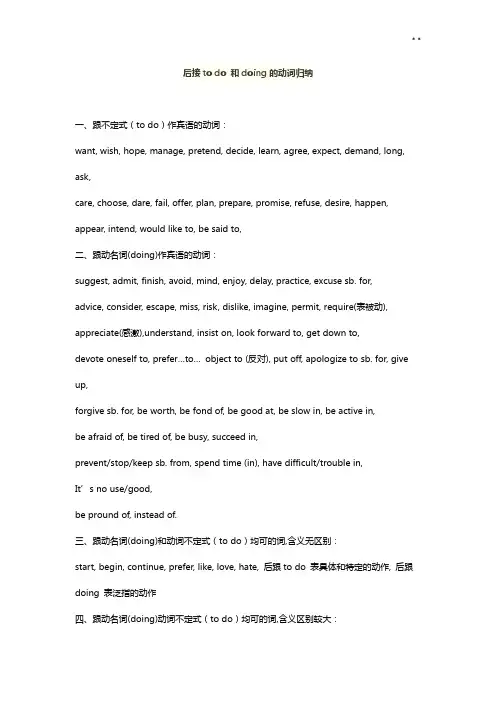
后接to do 和doing的动词归纳一、跟不定式(to do)作宾语的动词:want, wish, hope, manage, pretend, decide, learn, agree, expect, demand, long, ask,care, choose, dare, fail, offer, plan, prepare, promise, refuse, desire, happen, appear, intend, would like to, be said to,二、跟动名词(doing)作宾语的动词:suggest, admit, finish, avoid, mind, enjoy, delay, practice, excuse sb. for, advice, consider, escape, miss, risk, dislike, imagine, permit, require(表被动), appreciate(感激),understand, insist on, look forward to, get down to,devote oneself to, prefer…to…object to (反对), put off, apologize to sb. for, give up,forgive sb. for, be worth, be fond of, be good at, be slow in, be active in,be afraid of, be tired of, be busy, succeed in,prevent/stop/keep sb. from, spend time (in), have difficult/trouble in,It’s no use/good,be pround of, instead of.三、跟动名词(doing)和动词不定式(to do)均可的词,含义无区别:start, begin, continue, prefer, like, love, hate, 后跟to do 表具体和特定的动作, 后跟doing 表泛指的动作四、跟动名词(doing)动词不定式(to do)均可的词,含义区别较大:1. stop to do2. mean to do3. try to do4. agree to dostop doing mean doing try doing agree to sb doing5. be afraid to do6. remember to do7. forget to do8. allow/permit/advise sb. to dobe afraid of doing remember doing forget doing allow/permit/advise doing9. regret to do10. want to do11. need to do12. go on to doregret doing want doing (表被动) need(表被动) go on doing13. can’t help to do14. forbid sb. to do=forbid sb’s doingcan’t help doing forbid doing15.感官动词+ doing/to do感官动词see, watch, observe, notice, look at, hear, listen to, smell, taste, feel + do 表示动作的完整性,真实性;+doing 表示动作的连续性,进行性I saw him work in the garden yesterday.昨天我看见他在花园里干活了.(强调"我看见了"这个事实)I saw him working in the garden yesterday.(强调"我见他正干活"这个动作)昨天我见他正在花园里干活.典型例题1)They knew her very well. They had seen her ___ up from childhood.A. growB. grewC. was growingD. to grow答案:A.因题意为,他们看着她长大,因此强调的是成长的过程,而非正在长的动作,因此用see sb do sth 的句型.2)The missing boy was last seen ___ near the river.A. playingB. to be playingC. playD. to play答案A. 本题强调其动作,正在河边玩,应此用see sb. doing sth句型中学英语中哪些动词后加to do sth和加doing sth一、接不定式(而不接动名词)作宾语的24个常用动词afford to do sth. 负担得起做某事agree to do sth. 同意做某事arrange to do sth.安排做某事ask to do sth. 要求做某事beg to do sth. 请求做某事choose to do sth. 决定做某事decide to do sth. 决定做某事demand to do sth. 要求做某事determine to do sth. 决心做某事expect to do sth. 期待做某事fear to do sth. 害怕做某事help to do sth. 帮助做某事hope to do sth. 希望做某事learn to do sth. 学习做某事manage to do sth. 设法做某事offer to do sth. 主动提出做某事plan to do sth. 计划做某事prepare to do sth. 准备做某事pretend to do sth. 假装做某事promise to do sth. 答应做某事refuse to do sth. 拒绝做某事want to do sth. 想要做某事wish to do sth. 希望做某事注:有些不及物动词后习惯上也接不定式,不接动名词:aim to do sth. 打算做某事fail to do sth. 未能做某事happen to do sth. 碰巧做某事hesitate to do sth. 犹豫做某事struggle to do sth. 努力做某事二、接不定式作宾补的36个常用动词advise sb. to do sth. 建议某人做某事allow sb. to do sth. 允许某人做某事ask sb. to do sth.请(叫)某人做某事bear sb. to do sth.忍受某人做某事beg sb. to do sth. 请求某人做某事cause sb. to do sth. 导致某人做某事command sb. to do sth. 命令某人做某事drive sb. to do sth .驱使某人做某事elect sb. to do sth. 选举某人做某事encourage sb. to do sth. 鼓励某人做某事expect sb. to do sth. 期望某人做某事forbid sb. to do sth. 禁止某人做某事force sb. to do sth. 强迫某人做某事get sb. to do sth. 使(要)某人做某事hate sb. to do sth. 讨厌某人做某事help sb. to do sth. 帮助某人做某事intend sb. to do sth. 打算要某人做某事invite sb. to do sth. 邀请某人做某事leave sb. to do sth. 留下某人做某事like sb. to do sth. 喜欢某人做某事mean sb. to do sth. 打算要某人做某事need sb. to do sth. 需要某人做某事oblige sb. to do sth. 迫使某人做某事order sb. to do sth. 命令某人做某事permit sb. to do sth. 允许某人做某事persuade sb. to do sth. 说服某人做某事prefer sb. to do sth. 宁愿某人做某事request sb. to do sth. 要求某人做某事remind sb. to do sth. 提醒某人做某事teach sb. to do sth .教某人做某事tell sb. to do sth. 告诉某人做某事train sb. to do sth. 训练某人做某事trouble sb. to do sth. 麻烦某人做某事want sb. to do sth. 想要某人做某事warn sb. to do sth. 警告某人做某事wish sb. to do sth. 希望某人做某事注:不要受汉语意思的影响而误用以下动词句型:汉语说:“害怕某人做某事”,但英语不说fear sb. to do sth.。
Do、To do、Doing 的用法

Do/To do/Doing 的用法1.+ to do=+ doing:开始做某事begin to do/doing =start to do / doing 不喜欢dislike to do / doing 憎恨做某事hate to do/ doing喜欢做某事like / love to do / doing2.+ to do≠+ doing:忘记去做某事forget to do忘记已经做过某事forget doing记住去做某事(未做)remember to do记得已经做过某事remember doing 继续另一件事go on to do继续做原来的事go on doing 停下来去做某事stop to do 停止做某事stop doing 努力做某事try to do试着做某事try doing悔恨没做某事regret to do 后悔已做某事regret doing3.+ do帮助做某事help (to) do宁愿(不)做某事would rather (not) do最好(不)做某事had better (not) do4.+ doing:完成做某事finish doing喜欢做某事enjoy doing一直做某事keep doing练习做某事practise doing考虑做某事consider doing坚持做某事insist on / upon doing避免做某事avoid doing建议做某事suggest doing错过做某事miss doing想象做某事imagine doing介意做某事mind doing忍不住做某事can’t help doing坚持做某事keep on/ carry on doing成功做某事succeed/ be successful in doing 忙于做某事be busy (in) doing…怎么样? What /How about doing?对做某事感兴趣be interested in doing 因某事谢谢某人thank you for doing(非常)值得被…be (well) worth doing因为…because of doing而不是instead of doing(没)有做某事without/ with doing通过做某事by doing sth担心做某事worry about doing害怕做某事be afraid of doing放弃做某事give up doing做某事有麻烦have trouble / problems /difficulty (in) doing做某事开心have fun/ a good time/enjoy oneself (in) doing浪费时间做某事lose/waste time (in) doing sth 将某人的精力投入到…put one’s effort into doing 某人花费时/钱做某事sb spend +时间/钱(in) doing梦想做某事dream of/about doing5.+to do :选择做某事choose to do拒绝做某事refuse to do需要做某事need to do=require to do迫不及待做某事can’t wait to do准备做某事prepare to do=be ready to do 计划做某事plan to do决定做某事decide to do = make a decision to do = make up one’s mind(s) to do学习learn to do继续做某事continue to do付得起做某事afford to do 似乎做某事seem to do过去常常做某事used to do敢做某事dare to do梦见做某事dream to do碰巧做某事happen to do想做某事would like to do = want to do 别无选择做某事have no choice but to do 同意做某事agree to do希望做某事hope to do希望做某事wish to do不得不做某事have to do做某事失败fail to do答应做某事promise to do逐步做某事get to do更喜欢做某事prefer to do设法做某事manage to do应该做某事ought to do主动做某事offer to do尽某人最大努力做某事try/ do one’s best to do 采取措施做某事take action(s)/steps to do 等着轮到某人做某事wait for one’s turn to do轮流做某事take one’s turn to do有机会做某事have a chance to do没有时间做某事have no time to do与…比起来宁愿做某事prefer to do rather than do =would rather do than do足够…做某事enough+n.+ to do ,adj./adv.+enough+ to do为了… to do = in order to do= so as to do=for doing6.to doing :盼望做某事look forward to doing 习惯于做某事be used to doing 致力于做某事devote …to doing 与…比起来宁愿做某事prefer doing to doing 对…做出贡献make contribution(s) to doing 导致lead to donig7. sb to do :命令某人做某事order sb to do答应某人做某事promise sb to do邀请某人做某事invite sb to do警告某人(不)做某事warn sb (not) to do请求某人(不)做某事ask sb (not ) to do吩咐某人(不)做某事tell sb (not) to do想要某人(不)做某事would like sb(not) to do 需要某人做某事need /require sb (not) to do 鼓励某人做某事encourage sb to do使用某人做某事use sth to do教某人做某事teach sb to do 导致某人做某事cause sb to do训练某人做某事train sb to do建议某人做某事advise sb to do允许某人做某事allow sb to do希望某人做某事wish sb to do让某人做木事get sb to do提醒某人做某事remind sb to do拒绝某人做某事refuse sb to do迫使某人做某事force sb to do (agree sb to do是错的,hope sb to do 是错的)8.sb doing:使某人一直做某事keep sb doing sth 介意某人做某事mind sb/ sb’s doing 阻止某人做某事prevent /stop sb (from )doing = keep sb from doing 发现某人正在做某事find sb doing9.sb do/doing看见某人做某事see sb do/ doing 观看某人做某事watch sb do/ doing 听见某人做某事hear sb do/ doing 注意某人做某事notice sb do/ doing(句中有表示时点的词用doing, 有表示频度和感情的词用do)10.sb do:使某人做某事make sb do 让某人做某事let/have sb do帮助某人做某事help sb do = help sb to do11.关于to do/doing/do的句型(1)做某事花费某人…It takes /took+sb+ 时间+ to do (2)做某事对某人而言是…的It’s + adj. for sb/ of sb to do (3)做某事对某人而言是一个遗憾It’s a pity for sb to do(4)是某人第一次做某事It’s one’s first time to do(5)到了(某人)做某事的时候了。
七年级英语动词不定式与动名词的用法辨析及例句分析单选题40题
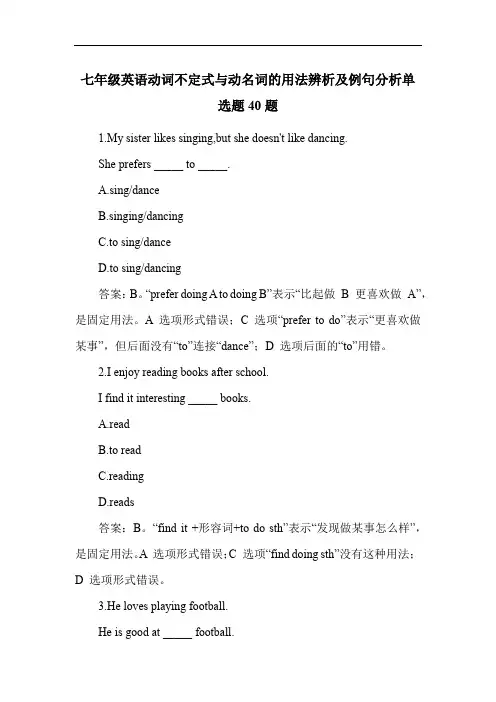
七年级英语动词不定式与动名词的用法辨析及例句分析单选题40题1.My sister likes singing,but she doesn't like dancing.She prefers _____ to _____.A.sing/danceB.singing/dancingC.to sing/danceD.to sing/dancing答案:B。
“prefer doing A to doing B”表示“比起做B 更喜欢做A”,是固定用法。
A 选项形式错误;C 选项“prefer to do”表示“更喜欢做某事”,但后面没有“to”连接“dance”;D 选项后面的“to”用错。
2.I enjoy reading books after school.I find it interesting _____ books.A.readB.to readC.readingD.reads答案:B。
“find it +形容词+to do sth”表示“发现做某事怎么样”,是固定用法。
A 选项形式错误;C 选项“find doing sth”没有这种用法;D 选项形式错误。
3.He loves playing football.He is good at _____ football.A.playB.to playC.playingD.plays答案:C。
“be good at doing sth”表示“擅长做某事”,是固定用法。
A 选项形式错误;B 选项“be good at to do”没有这种用法;D 选项形式错误。
4.She wants to learn English well.She tries _____ hard every day.A.studyB.to studyC.studyingD.studies答案:B。
“try to do sth”表示“努力做某事”,是固定用法。
五年级英语非谓语动词造句单选题40题
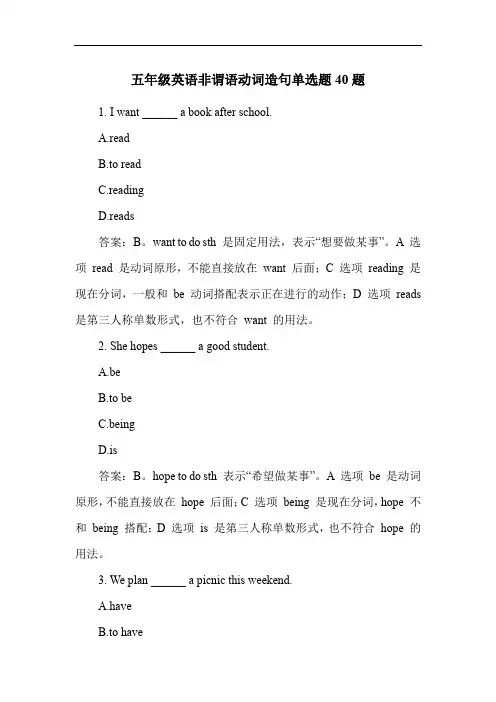
五年级英语非谓语动词造句单选题40题1. I want ______ a book after school.A.readB.to readC.readingD.reads答案:B。
want to do sth 是固定用法,表示“想要做某事”。
A 选项read 是动词原形,不能直接放在want 后面;C 选项reading 是现在分词,一般和be 动词搭配表示正在进行的动作;D 选项reads 是第三人称单数形式,也不符合want 的用法。
2. She hopes ______ a good student.A.beB.to beC.beingD.is答案:B。
hope to do sth 表示“希望做某事”。
A 选项be 是动词原形,不能直接放在hope 后面;C 选项being 是现在分词,hope 不和being 搭配;D 选项is 是第三人称单数形式,也不符合hope 的用法。
3. We plan ______ a picnic this weekend.A.haveB.to haveC.havingD.has答案:B。
plan to do sth 表示“计划做某事”。
A 选项have 是动词原形,不能直接放在plan 后面;C 选项having 是现在分词,plan 不和having 搭配;D 选项has 是第三人称单数形式,也不符合plan 的用法。
4. He decides ______ his homework first.A.doB.to doC.doingD.does答案:B。
decide to do sth 表示“决定做某事”。
A 选项do 是动词原形,不能直接放在decide 后面;C 选项doing 是现在分词,decide 不和doing 搭配;D 选项does 是第三人称单数形式,也不符合decide 的用法。
5. They start ______ English songs.A.singB.to singC.singingD.sings答案:B。
(完整版)新人教版八年级英语上册unit1知识点总结
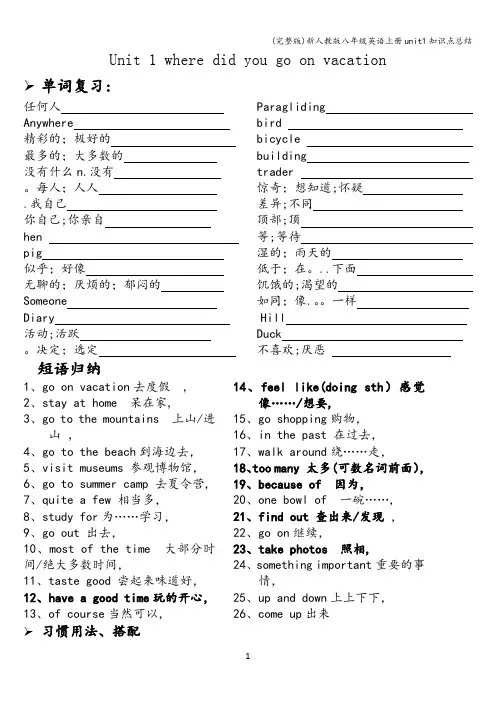
Unit 1 where did you go on vacation ➢单词复习:任何人Anywhere 精彩的;极好的最多的;大多数的没有什么n.没有。
每人;人人.我自己你自己;你亲自hen pig似乎;好像无聊的;厌烦的;郁闷的Someone Diary 活动;活跃。
决定;选定Paragliding bird bicycle building trader惊奇;想知道;怀疑差异;不同顶部;顶等;等待湿的;雨天的低于;在。
..下面饥饿的;渴望的如同;像.。
一样HillDuck不喜欢;厌恶短语归纳1、go on vacation去度假 ,2、stay at home 呆在家,3、go to the mountains 上山/进山,4、go to the beach到海边去,5、visit museums 参观博物馆,6、go to summer camp 去夏令营,7、quite a few 相当多,8、study for为……学习,9、go out 出去,10、most of the time 大部分时间/绝大多数时间,11、taste good 尝起来味道好,12、have a good time玩的开心,13、of course当然可以,14、feel like(doing sth)感觉像……/想要,15、go shopping购物,16、in the past 在过去,17、walk around绕……走,18、too many 太多(可数名词前面),19、because of 因为,20、one bowl of 一碗……,21、find out 查出来/发现,22、go on继续,23、take photos 照相,24、something important重要的事情,25、up and down上上下下,26、come up出来➢习惯用法、搭配1. buy sth。
for sb.=buy sb. sth。
2013新人教版八年级上册英语全册短语句型辨析语法讲解与练习

Unit 1 Where did you go on vacation?短语:go on vacation stay at homego to the mountains go to the beach visit museumsgo to summer camp quite a few study forgo outmost of the time taste goodhave a good time of course feel likego shoppingin the pastwalk aroundtoo many because ofone bowl offind outgo ontake photos something important up and downcome up语法:Where did you go on vacation? I went to New York City.Did you go out with anyone? No, No one was here. Everyone was on vacation.Did you buy anything special? Yes, I bought something for my father.How was the food? Everything tasted really good.Did everyone have a good time? Oh,yes. Everything was excellent.惯用法:1. buy sth for ab./ buy sb. sth 为某人买某物2. taste + adj. 尝起来……3. nothing ….but + V.(原形) 除了……之外什么都没有4. seem + (to be) + adj 看起来5. arrive in + 大地方/ arrive at + 小地方到达某地6. decide to do sth. 决定做某事7. try doing sth. 尝试做某事/ try to do sth. 尽力做某事8. enjoy doing sth. 喜欢做某事9. want to do sth. 想去做某事10. start doing sth. 开始做某事11. stop doing sth. 停止做某事12. look + adj 看起来13. dislike doing sth. 不喜欢做某事14. Why not do sth. 为什么不做…….呢?15. so + adj + that + 从句如此……以至于……16. tell sb. (not) to do sth. 告诉某人(不要)做某事17. keep doing sth. 继续做某事18. forget to do sth. 忘记去做某事/ forget doing sth 忘记做过某事词语辨析:1.anywhere 与somewhere 两者都是不定副词。
初中英语语法之动词后跟to do 和doing的短语解析
初中英语语法之动词后跟to do 和doing的短语解析※一、跟to do 不定式的短语句型1、afford to do sth 承担得起做某事His mother couldn’t afford to pay for her child’s education.他母亲承担不起自己孩子的教育费用。
2、agree to do sth 同意做某事Mum and Dad have agreed to have a party at home.妈妈和爸爸已经同意在家里举办一次聚会。
3、aim to do sth 目的是做某事The class aims to teach the students how to play basketball.这节课的目的是教这些学生如何打篮球。
4、appear to do sth 好像/ 似乎做某事She appears to have many friends.她好像有很多朋友。
5、arrange to do sth 安排/ 计划做某事We arranged to meet at 7:00 to play football.我们计划七点集合去踢足球。
6、ask to do sth 要求做某事The boy asks to go to school by bike.这个男孩要求骑自行车去上学。
7、choose to do sth 选择做某事Half of the students choose to go to big cities.一半的学生选择去大城市。
8、decide to do sth 决定做某事He decided to be a firefighter.他决定当一名消防员。
9、expect to do sth 期望做某事You can’t expect to learn a foreign language in a few months.你不要指望在几个月内就能学会一门外语。
start的用法总结大全
start的用法总结大全想了解start的用法吗?今天就给大家带来了start的用法,希望能够帮助到大家,下面就和大家分享,来欣赏一下吧。
start的用法总结大全start的意思n. 开始,动身,开动,起点vt. vi. 出发,启程vt. 起动,提出(问题),开办,使开始vi. 起始,突然出现,突然跳起,突然涌出变形:过去式: started; 现在分词:starting; 过去分词:started;start用法start可以用作动词start的基本意思是“从静止状态转移到运动状态”,可指工作、活动等的开始; 战争、火灾等的发生; 也可指人开始工作,着手某项活动等; 还可指人、事物使某事情发生或引起某事情。
start可用作不及物动词,也可用作及物动词。
用作及物动词时,可接名词、代词、动名词、动词不定式作宾语,也可接以现在分词充当补足语的复合宾语。
start偶尔还可用作系动词,接形容词作表语。
start可用一般现在时或现在进行时来表示将来。
start用作动词的用法例句It started to rain.下起雨来了.I used to start work at 9 oclock every day.我过去常在每天9:00开始工作。
We are just about to start.我们正要出发。
start可以用作名词start用作可数名词的基本意思是“开始,出发,起点”,可指做某件事情的开始,也可指某件事情的开始地点,是可数名词。
start也可用于表示某件事开始时就有“领先地位,有利条件”,通常用作不可数名词,但可用不定冠词a修饰。
start还可作“惊动,惊起”解,一般为可数名词,经常用单数形式,与不定冠词a连用。
start用作名词的用法例句He knew from the start the idea was hopeless.一开始他就知道这主意行不通。
What a start you gave me!你吓了我一大跳!He has a good start in business.他在生意上起步时占了很大的优势。
start-to-do-sth-与start-doing-sth的区别讲课教案
start to do sth 与start doing sth的区别start doing sth和start to do的区别begin / start to do sthbegin / start doing sth.1) 谈及一项长期活动或开始一种习惯时,使用doing.How old were you when you first started playing the piano?你几岁时开始弹钢琴?2) begin, start用进行时时,后面动词用不定式to doI was beginning to get angry。
我开始生起气来。
3) 在attempt, intend, begin, start 后接know, understand, realize这类动词时,常用不定式to do。
I begin to understand the truth。
我开始明白真相。
4) 物作主语时It began to melt另:英语中的begin 与start 都有“开始”的意思,但在实际运用中,却有很多不同一 . 相同之处1. 意为“开始;发生;发起”时,两者可互换。
如:Then he began/ started a series of experiments. 然后他就开始做一系列的实验。
How did the accident begin/ start?事故是怎样发生的?2. 表示开始某一动作时,后面跟不定式或动名词所表达的意思是相同的。
但当表示开始一项较长时间或经常性的活动时,后接动名词的形式则更为常见。
如:The child began crying/ to cry. 那小孩开始哭了。
3. 两者在下列情况下常接不定式,不接动名词:( 1 )主语是无生命的事物,而不是人时。
如:The ice began/ started to melt. 冰开始融化了。
( 2 )当began 和start 用于进行时态时。
人教版初中英语八年级上册Unit1知识点总结
一、句子默写:1.好久不见。
Long time no see.2.那里太漂亮了!我们在那照了相当多的照片。
It was wonderful!We took quite a few photos there.(短语:quite a few 相当多)3.事实上不是,大部分时间我只是呆在家里阅读和放松。
Not really,I just syayed at home most of the time to read and relax.(短语:most of the time=most time 大部分时间)4.我买了许多东西给父母,但是没有买我们自己的。
I bought something for my parents,but nothing for myself.5.你去有趣的地方了吗?Did you go anywhere interesting?6.我们喂了许多母鸡还看了许多猪宝宝。
他们是那么可爱!We fed some hens and saw some baby pigs.They were so cute!7.唯一的问题是这里除了读书没有更多的事可做,仍然没有人感到无趣。
The only problem was that there was nothing much to do in the evening but read.Still no one seemsd to be bored.(短语:在晚上in the evening)8.你发现有什么令人愉快的活动了吗?What activities do you find enjoyable?9.我感觉我像一只鸟。
I felt like I was a bird.(短语:feel like ...感觉;感受到)10.这里有许多新的建筑,但是许多旧建筑仍然在那。
There are a lot of new buildings now,but many of the old buildings are still there.11.我想知道过去这里的生活是怎么样的。