
冀教英语九年级上第六单元第一课时
5.Do you want to make one in class? 【辨析】 one,it,that,ones,them,those (1)one用来替代前面出现的泛指的可数名词单 数,相当于“a/an+可数名词单数”;ones用来替代 前面出现的泛指的可数名词复数。 (2)it指代上文出现的可数名词单数或不可数名 词,them指代前面出现的可数名词复数。 (3)that用来替代前面出现的特指的可数名词单 数或不可数名词;those用来替代前面出现的特指 的可数名词复数。
4.Most of you have seen movies or plays in a theatre,but have you ever been involved in making a movie or a play? ◆most of意为“……中的大多数”,其中most 为代词,意为“大部分,大多数”,作主语时,谓语 动词取决于most of后所修饰名词的单复数。 ◆involve为及物动词,意为“参与,专心 于”,involve in doing sth.表示“参与做某事”, 如果表示“参与某事”用involve in sth.。
Read the text and find ouhrases: · be involved in · divide up · know about · work on · talk about · most of · in the same way · the answer to
9.To do good research,you need to ask good questions. To do good research在句中作目的状语。动词不定式 用于句首属于强调性用法,即强调动词的目的,意为“为 了”。 10.Have movies always been made in the same way? in the same way意为“以同样的方式”。 11.I don’t know the answer to any of those questions. the answer to意为“……的答案”。to在这里为介词, 意为“指向,对于,针对”。
6.What do you think is needed to make a movie or a play? do you think在本句中为插入语,意为“你认 为……”,不影响句子的结构。 7.A good script needs to be written. 本句中的to be written是不定式的被动结构,need后 接不定式的被动结构表示“需要被做”,此时还可用 need接动名词来替换。 8.What else is needed? What else…?意为“别的什么……?”,else意为“别 的,另外的”,修饰不定代词、疑问代词或副词时须后 置。
九年级英语上
新课标 [冀教]
Unit 6 Movies and Theatre Lesson 31
A Movie or a Play
Think about it !
●Have you ever been in a theatre? What did you watch? ●What do you know about making movies?
Main sentences:
· Do you want to make one in class? · What do you think is needed to make a movie or a play? · A good script needs to be written. · What else is needed? · To do good research,you need to ask good questions. ·That’s what group work is for! ·Let’s get to work in groups.
☆教材解读☆ 1.What do you know about making movies? know about意为“了解,知道……的情况”,about为介 词,其后接名词或动名词作宾语。 2.Ms. Cox always tries to find interesting information and projects for her class to work on. work on在本文中意为“从事,致力于”。还可意为 “继续工作,不断工作”。 3.Today let’s talk about movies and plays. talk about意为“谈论,讨论”,强调谈论的具体内容及 细节,about为介词,后面可接名词、代词。
New Words
background costume
involve script direct task director
Read the lesson and write true(T)or false(F).
(1)Most of the students in Ms.Cox’s class have been to a theatre before. T (2)Ms. Cox thinks making a short movie or a play will interest the students. T (3)We have to take care of lots of things when T making a movie or a play. (4)Actors are the people who direct F movies. (5)Some background research is necessary T before making a movie.
最新新冀教版九年级英语全册第1课课件说课讲解
Look and say
fever
n. 发烧;发热
She was knocked over by fever. 她由于发烧而病倒了。 Packs of ice were put on my forehead to keep down the fever. 冰袋放在额头上用来降温。
Look and say
to feel sorry about something you have done or about something that you have not been able to do Do as I tell you, or you'll regret it later on. 照我的话去做,否则你以后会后悔的。
Answer the questions
1
11..WBehcyaduoseeshDe adnoneysnw’tafkeeeul pwhelils. pHaisrents esatorlmy ainchthheumrtso.rning?
22..WHeharet gdroeets eDaatninngy sroegmreatndyodinogn?uts.
Free talk
When you don’t feel well, what do you usually do?
What is the worst illness you’ve ever had?
Task one
Read the text and find the phrases: 叫醒 __w_a_k_e__u_p_____
感觉很好_f_e_e_l _w_e_ll_____
Read the lesson 开始哭__st_a_r_ta_ton__dc_ray_n_s_w__er the 带某人去医院q_bu_re_isn_tg_io_snb_s._.t_o_h_o_s_pital
九年级英语冀教版上1-6单元教案
英语课教学进度表科目英语教学班级九年级教科书名称LearningEnglish上课日期8 ,27每周节数6节总授课节数108 考试次数 2周次时间起讫预定进度页数起讫实际进度出入原因说明1 2 3 4 5 6 7 8 9101112131415161718192021Unit 1: The Olympics!(lesson 1-lesson 8)GENERAL OBJECTIVESThis unit focuses on the Olympics issues, and what takes place during the history of the Olympics, how, what, where and when did the Olympics start, then something about China’s Olympics, such as XuHaifeng,ZhuangYong,Fu Mingxia.这个单元重点谈论关于奥林匹克运动会的话题,尤其关注了奥林匹克运动会的发展以及中国奥林匹克运动史上的一些重点事件。
它重点列举了中国奥林匹克运动史上的一些重点事件,并且通过这些成功事件调动学生表达自己的愿望和祝福。
同时,通过一些体育项目的活动,号召学生们行动起来锻炼身体,为国争光。
学生们要掌握有关奥林匹克运动的的单词和词组,以及表达自己的愿望和祝福的交际用语,并且会使用间接引语转述他人的话。
2008年在中国举办的奥林匹克运动会是一个实际性的话题,因此青年学生有必要关注自己以及周边的体育运动,尽自己的微薄之力为国添彩。
TEACHING RESOURCES多媒体教学工具;录音机;磁带;投影仪;幻灯片,卡片;挂图等。
Step 1: Teaching Words of Unit 1Teaching Aims: to learn the new words of unit 1 in one class, make sure that the students can read ,listen, say and know the changes of them, also some of the students can remember 40% in this class.Key steps:Step1: Make a duty report about the summer holidays.Step2: Revise the pronunciation of the letters or the letter forms , write some of them on the blackboard and ask the students to read loudly, pay attention to correct their mistakes when they are reading.Step3: Look at the words and expressions of unit 1, find out all the verbs at first, then try to read them loudly, if it is possible , the teacher lead them to read, ; next find out the nouns, adjs. , advs. , teach them in the same way.Step4: Now try to find the words that has the same pronunciations , get the students to read them together loudly.Step5: Explain the changing of some words, make sure that the students can sum up and know the rules of their changes.Step6: Read and read the words in different ways, make sure that the students can read them correctly . If the time is possible, get the students try to remember some of them and check each other.Class Closing.Ask the students to read and remember the new words of unit 1 after the class, then prepare lesson1.Step2: lesson 1: Higher, Faster, StrongerTeaching aims and demands:1.To teach the passage, get the students listen ,read and say something about the Olympics.2. To grasp the words:modern, gold, record, event, Olympics, ancient, Athens, Beamon, medal, silver, bronze, sprint, win a gold medal.Teaching important points1. Practice speaking.2. Talk about the Olympics.Teaching difficult points:get to know the OlympicsTeaching Methods:1. Watch and say.2. Group work.3. Questions and answers.Teaching aids: A recordTeaching main procedures.Class opening.Read the words of unit1 and check them of lesson 1, see if they can remember. Then make a duty report about the Olympics.Key stepsStep1: Ask the students that if they know the most important thing in China in 2008 and if they had ever watched the Olympics on TV, and what is their favourite Olympic sport, if they think thatthe Olympic are important , why or why not.Step2: Have the class discuss these questions:When were the first Olympics?When did the modern Olympics start?Do you know something amazing about Olympic athletes?What are they?Step3: Let the students listen to the audiotape , at first ,just listen; then , try to follow it with opening books, now try to follow the audiotape loudly without looking at the books, till they can read it well.Step4: Divide the class into two groups and ask them to ask and answer the passage loudly. Then read the passage by themselves.Step5: Explain the main words and expressions with examples , make sure that the students can use these words correctly, they can make the sentences with these words or fill in the blanks. Step 6: Come to “ Let’s Do it!”Class closing.Ask the students to read the passage after the class, and prepare lesson 2, get to know China’s first gold in swimming.Homework: Finish off the exercises and prepare the next reading. Blackboard Design :lesson 1: Higher, Faster, Stronger1.Olympics:(奥林匹克)ancient Olympics ,modern Olympics2.in 776BCpete for4. at the opening eventAfter the flu:Lesson 2: Swimming for gold!Teaching aims:1. Let the students understand the meaning of the text and know something about China’s first gold swimming.2.To grasp the words and expressions: close, race, seem, up and down, the others, catch up with, , Barcelona, freestyle, Thompson, swimmer, spectator, up and down, the others, catch up withTeaching important points1. Practice speaking.2. Talk about China’s first gold swimming.Teaching difficult points:China’s first gold swimming.Teaching Methods:Four in oneTeaching aids: A recordTeaching main procedures.Class openingMake a duty report about Olympics. Then check the words of lesson1 orally. Try to make some sentences with the words and expressions of lesson 1.Key steps:Step 1. The teacher shows body languages about swimming and make sure that the students know what I am doing and today’s topic. Collect something message about swimming and Olympics by asking and answering. Such as listing some sports they are good at.Step 2. Ask the student to look at the picture and answer my questions:What is the man doing ? Where is he swimming?How is he swimming? W here do you like to swim?Who are they ? What are they doing?Why do they do so?Check their answers and pay attention to emphasize the new words.Step3. Read the passage loudly following the teacher once and then by themselves twice.Step 4. Explain the problem they have. Pay attention to these words or expressions: swam her way to a gold, the women’s 100-metre freestyle , a time of 54.64 seconds, as fast as they can: possible, it seemed that..., at the same time, jump up and down, be excited at, had been slower, set a world record, catch up with, the others.Step 5. Open their books again and divide the students into groups to read the passage by themselves.Underline some sentences about indirect speech.Do some exercises on the exercises books.Class closing.Ask the students to read the passage of lesson 2 and prepare the next reading. Homework: Finish off the exercises and prepare the next reading.Blackboard Design :lesson 2: Swimming for gold1.China’s first gold in swimming2.women’s 100-meter freestyle swimming race3.set a world record4. with a time of 54.48 seconds5. beat and winAfter the flu:Lesson 3 : Are you an athletes?Teaching aims:1. Let the students understand the meaning of the text and do some sports in the classroom.2.To grasp the words and expressions: luck, tennis, rope, jump rope, push-up,Teaching important points1. Practice speaking.2. Act out some directionsTeaching difficult points:classroom OlympicsTeaching Methods:Four in oneTeaching aids: A recordTeaching main procedures.Class opening.Make a duty report about swimming. Then check the words of lesson2 orally. Try to make some sentences with the words and expressions of lesson 2.Key steps:Step 1:Lead in:What sports can you do to make your body stronger?How can you do ? What do you like to do?Let the students talk in pairs about what they usually do to exercise Then come to the topic today.Step 2:Ask the students to think a good idea foe an event in school sports meeting.Step 3:Read the dialogue.Ask the students to listen to it while thinking about the following questions:What are they doing? What is Jenny’s idea?Does Brain like it? What is Danny’s idea?Discuss and check the answersStep 4:Divide the class into small groups.Ask each group to read the dialogue.According to the reading,what can we do in the classroom or school yard to makeour bodies stronger, if we are good athlete, try to say English as much as possible. Step 5. Open their books and ask the students to read the passage by themselves and try to do these exercises.Explain the problem they have.Underline some sentences about indirect speech.Do some exercises.Class ClosingAsk the students to read the passage of lesson 3 and prepare the next reading.Homework: Finish off the exercises and prepare the next reading.Blackboard Design :Lesson 3 : Are you an athletes?1.need : need to do sth. , need doing sth.2.each and every3.wh +不定式4. as … as5. two more times :another two times.After the flu:lesson 4: Good luck to you! Teaching aims:1.To teach the song , get the students listen and sing after the audiotape, make sure that the students can sing it beautifully.2. To grasp the words: give up, believe, dive,Teaching important points1. Practice singing the song .2. understand the meaning of the song and remember some phrases.Teaching difficult points:understand the meaning of the song and remember some phrases.Teaching Methods:Four in oneTeaching aids: A recordTeaching main procedures.Class opening.Make a duty report about a good athlete. Check the words or expressions of Lesson3.Key stepsStep1: Ask the students that if they would like to do some sports or watch matches on TV.Step2: Have the class read the lyrics aloud as a poem. Divide the class into two groups and ask them to read one line and one line .Make sure that the students can read rhythmically with a good sense of the rhymes!Step3: Let the students to learn to sing the song after the audiotape , at first ,just listen; then , try to sing in a low voice; now try to sing the song follow the audiotape loudly till they can sing it well. Step4: Divide the class into two groups and ask them to sing the song loudly. They can have a match about singing .Step5: Explain the main words and expressions with examples , make sure that the students can use these words correctly, they can make the sentences with these words or fill in the blanks. Class closing.Ask the students to sing the song after the class, and prepare lesson 5.Homework: Finish off the exercises and prepare the next reading.Blackboard Design :Lesson4.Good luck to you1.believe in ,believe sb. ,believe in oneself .2.do one’s best ,do one’s best to do sth.3.give up doing sth.4. make your country proud !(make+宾语+宾补),make sb do sth, be made to do sth,.After the flu:Lesson 5 : Danny’s very special guest! Teaching aims:1. Let the students understand the meaning of the text and know Danny’s very special guest.2.To grasp the words and expressions: guest, such, able, Jeff, Johnson, great, practise, Teaching important points1. Practice speaking.2. Talk about Danny’s very special guest.Teaching difficult points:Talk about Danny’s very special guest.Teaching Methods: Four in oneTeaching aids:A recordTeaching main procedures.Class openingMake a duty report about designing an event. Then check the words of lesson5 orally. Try to make some sentences with the words and expressions of lesson 4.Key stepsStep1 .Come to ‘ Think about it.”Step2. Ask the student to read the diary in three minute and answer the questions on the Bb.Who is Danny’s special guest?Step3. Now let the students read the diary after the teacher twice and answer some questions according to the diary.Step 4. Read the diary together and then explain some problem of the diary.Step5. Ask the students to try to retell the diary.Underline some sentences about indirect speech.Do the exercises on the books.CLASSCLOSING·the next reading in the book·the remaining exercises·write a diary of one day.Homework: Finish off the exercises and prepare the next reading.Blackboard Design :Lesson5.Danny’s special guest!1.such and so: such an interesting book ,so interesting a book ,so many books2.be able to : can3.take part in and join .4.stop doing ,stop to do sth.5.some day ,one day6. while and when .After the flu:Lesson 6: Diving “ Dream Team”Teaching aims:1. Let the students understand the meaning of the text and know Dream Team2.To grasp the words and expressions: dream, include, age, few. diving, Dream Team, Sydney, dive, diver, Atlanta, platform, springboard, champion, victory, coach.Teaching important points1. Practice speaking.2.Read and understand the meaning of the passage.Teaching difficult points:Read and understand the meaning of the passage Teaching Methods :Four in oneTeaching aids:A recordTeaching main procedures.Class openin gMake a duty report about designing an event. Then check the words of lesson6 orally. Try to make some sentences with the words and expressions of lesson 5.KEYSTEPSStep1:Lead in:Ask a volunteer who likes basketball very much to explain the “Dream Team”Step 2:Come to“Think About it”.[Step 3:Ask the student to name the best-known members of China’s Olympic Diving team.Then have a Quick Quiz about diving.Step4. Now let the students read the paragraph one and two , let them understand the dream Team in diving.Step5:Ask the students to look at the picture and read the other paragraph and have a further study about it. Know more about China’s diving team, especially Fu Mingxia and the developing of the world diving .Explain the problem they have.Read the passage more .Underline some sentences about indirect speech.If time is possible do the exercises on the books.Step6:Come to“Let's Do it”.Class closing and homework·the next reading in the book·the remaining exercises in the exercise book··read the passage fluently after the class.Blackboard Design :Lesson6.Diving “Dream team”1.since and for : since two years ago : for two years2.It is adj. for sb. to do sth.3.with and without .4.catch up with .5.a three-year-old girl6. at age thieteen.After the flu:Lesson 7 : Don’t fall off the Pizzas!Teaching aims:1. Let the students understand the meaning of the text2.To grasp the words and expressions: fewTeaching important points1. Practice speaking.2.Read and understand the meaning of the passage.Teaching difficult points:Read and understand the meaning of the passage Teaching Methods: English four in oneTeaching aids:A recordTeaching main procedures.Class openin gClass openingMake a duty report about designing an event. Then check the words of lesson7 orally. Try to make some sentences with the words and expressions of lesson 6.KEYSTEPSStep 1:Ask the students to revise the form of e-mail.Step 2:Let the students read the e-mail one in five minutes and try to tell me what is its main idea in English with few words. Read the e-mail following the teacher. If they ca understand the e-mail one , see if they can make a race about Danny’s event in the classroom ( ask some students to prepare some tools before the class.).Step3:Ask the m to read the first e-mail together.Step4:Still working in small groups,have the students read and discuss the second e-mail, let me see if they can understand it by themselves.Underline some sentences about indirect speech.Explain the problem they have.Do the exercises on the activity books.Step6:Come to“Let's Do it”.CLASS CLOSING·1.The next reading in the book·2.The remaining exercises in the exercise book··3.Read the passage fluently after the class.Blackboard Design :Lesson7.Don’t fall off the pizza!1.one by one : The students went into the classroom one by one.2.a few, few, a little, little .3.think of/ about/over..4.maybe, may be .5.keep doingAfter the flu:Lesson 8: Unit review(in 90 minutes)Teaching aims: 1. Let the students revise what they had learned in this unit.2.To reuse the words and expressions of this unit.Teaching important points1. Practice what they have learned in this unit .Teaching difficult points:.sum up and understand the grammar in this unit .Teaching Methods : English four in oneTeaching aids:A recordTeaching main procedures.Class openin gMake a duty report about Olympics. Then check the words of unit1 with a dictation .Key steps( During the first class)Step1. Ask the students What they had learnt from this unit, What they had done after knowing that. Have the class to discuss these questions.Step2. Revise what Danny, Jenny, Brain had done during this week?Step3. To revise the words and expressions of this unit and do the exercises1 on the students’books. Then the exercises about the words and expressions on Exercises( During the second class)Step1 . Ask the students to read the sentence that we underlined before and get them try to findthe rules of them. Explain for them that they are all the indirect speech, write the direct speech for each of them on the Bb and ask the students to look at them carefully, try to sum up the rules for their changing. Tell them that if they want to change direct speech into indirect speech , they must pay attention to these three points: first they must add up proper conjunctions between two parts; second they should change subordinate clause into the statement; third to change the tenseof the subordinate according to the main clause. Give them different examples .Step2. Get the students to do the exercises 2 on their book of lesson 8 and Exercises.Class closing.Finish the other exercises on Exercises.Prepare the next unit.Lesson8 Unit Review1. at the end of ,by the end of, in the end2. amazing ,amazed3.do one’s best to do4.direct speech and indirect speech1> I said to him : “I want to be in the Olympics some day.”I told him that I wanted to be in the Olympics some dayAfter the flu:Unit 2: Biggest, longest, widest!(lesson 9-lesson 16)GENERAL OBJECTIVES这个单元重点谈论关于运动的话题,关注了各种活动记录,以及运用这些活动和一些世界之最进行比较。
冀教版九年级上册《unit 6 accidents》教案和练习下(重点资料).doc

2011-2012学年9年级英语(冀教版)上册素材(含教案和练习)Unit6 Accidents一. 教学内容:Unit 6 Accidents(Lesson 41—Lesson 44 )1. 重点单词。
n. accident acting victimwarning reporter ceilingladder fault ambulanceinjury patient safetyrule height bellv. pretend refuse injurerecover bounce rush dropadj. careful serious patient icycareless2. 重点短语。
have an accident 出事故fall on top of 掉到了……上面be mad at…生……的气happen to 碰巧in a hurry 匆忙3. 交际用语。
提出警告。
二. 重点、难点解析及词语辨析:1. after an accident 交通事故后(L41)accident n. 事故,意外①Luckily, he was not badly hurt in the traffic accident.幸运地是,他在这场交通事故中受伤不严重。
拓展 by accident 偶然;无意中②I met Lucy by accident today. 今天我偶然遇到Lucy。
2. What happened? 发生了什么事?(L41)happen vi.“发生”,没有被动语态。
多指没有计划的发生;take place “发生”,多强调按计划发生。
例如:①What happened to him last night?昨天晚上发生什么事了?②Many great changes have taken place in China since 1978.1978年以来,中国发生了许多翻天覆地的变化。
冀教版英语九年级上册课件:Unit 1 Lesson 6课件
English classes. (5) I will _ta_k_e__a_v_a_c_a_t_io_n__ to Hawaii this
如果你困了,上床睡觉。
I couldn’t sleep because of the noise. 我没法睡觉,太吵了。
I’m too tired and I need to get some sleep. 我太累了,我需要睡觉。
sleepy, asleep & sleep
1) sleepy是形容词,可意为 “困倦的;瞌 睡的”,可作定语和表语。 e.g. Look at that sleepy child. 看那个瞌睡的小孩。 I’ll go to bed. I’m sleepy. 我要睡觉了。我困了。
3. What did Danny’s mother give him? His mother brought him some new books to read.
Read the lesson and answer the questions.
1. Why did Danny stay in the hospital? Because he had appendicitis.
2) asleep是形容词,意思是“睡着的”,强调 状
态,常作表语。短语fall asleep意为“入睡; 睡着”。
e.g. She was asleep with her head on her arms. 她头枕着胳膊睡着了。
【冀教版】九年级英语上册Lesson 6Stay Away from the Hospital课件
A.Listening to the hospital radio.
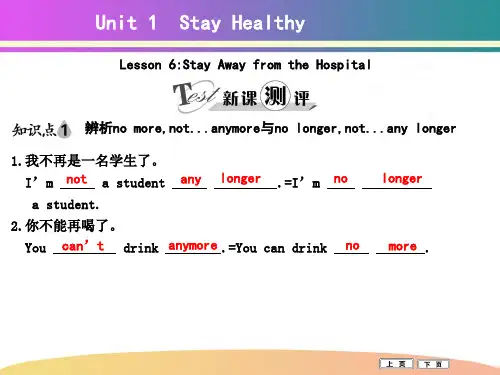
B.Visiting patients in the morning. C.Smoking in the smoking-rooms. D.Getting up early in the morning. ( D )29.What program will follow this radio talk? A.Hospital rules. C.A free talk. B.A weather report. D.A music program D.No people.
2.Where is your new mobile phone? A.Take out it C.Take it off B.Take it out D.Take off it
and let me have a look.
Unit 1
Stay Healthy
plenty of的用法 1.碗橱里有足够的盘子。 There are plenty of plates in the cupboard.
Unit 1
Stay Healthy
四、根据汉语提示完成句子
21.昨天我在家睡了一整天。 day I slept all at home yesterday.
22.医生告诉我要多喝水。
The doctor told me to drink plenty
23.我的奶奶卧病在床,所以我必须照顾她。 bed , My grandmother is ill in her. 24.听到那个我很难过。 hear I am sorry to
.=I’m
no
longer .
2.你不能再喝了。 You can’t drink anymore .=You can drink
冀教版九年级英语上册 Lesson 6 【精品课件】
I will write to you again soon. Your friend, Danny
因为,由于,语气较弱,所 As it was late ,we 引导的从句表示的是不言而 came back soon. 由于 as 喻、显而易见的原因和理由,时间很晚了,我们很 其从句一般放在主句前。 快就回来了。
because引导的从句表示直接 We couldn't go out 的原因和理由,表示按因果 because it was too because 关系的推断,语气很强,用 cold.因为天气太冷, 来回答why的提问, 一般位 我们不能外出。 于主句之后。
易错点 辨析now that, since, for, as和because
既然,由于,因为。
now that
n语ow气t比habt同ecasuinscee弱相,似,Ni你t of做owr吧tyhoa。ut.y既ou然ar你e b忙us,y,就let让m我e d给o
强调人们已知的事实。
既然,由于,因为。 Since you can't answer the
考向二【易错点】 与take有关的短语: take away 拿走;消除 eg:I want to take away this book. 我想拿走这本书。 take back 退回;收回 eg:I take back what I said. 我收回我说过的话。 take down 记下;写下;拿下 eg:Please take down the pictures from the wall. 请把画从墙上拿下来。 take off 起飞;脱掉;取消
冀教九年级上英语第六单元课件
目 录
• Unit Overview and Learning Objectives • Detailed explanation of vocabulary and
Example sentence
Your support can make a difference in the lives of these children
Means
finally; To sum up
Example sentence
In conclusion, I want to thank everyone for their contributions to this project
sustainable development
Course arrangement and time planning
Course Content:
+Lesson 1: Introduction to Environmental Protection and Sustainable Development
Familiarize students with different types of reading comprehension questions, such as multiple choices, short answers, and essay questions
Guide students in analyzing and evaluating the author's purpose, point of view, and use of language in the text
2022-2023学年冀教版英语九年级全册 Unit 1 Lesson 6 课件
mention的固定搭配有:
Don't mention it. 不客气。 e.g. —Thank you very much.多谢了。
—Don't mention it. 不客气。 not to mention 更不用说 e.g. He can speak German and Japanese,
Language points
②The doctor took it out!
take out 拿出; 切除 动副结构短语
e.g. Let’s begin our class. Please take out your books. 让我们开始上课吧。请把你们的书拿出来。 You’d better take it out. 你最好把它取出来。 He took his phone out of his bag slowly. 他慢吞吞地把他的手机从他的包里掏了出来。
not to mention English. 他会说德语和日语,更不用说英语了。
Summary
本节课主要学习了: 重点单词: sleepy/mention 重点短语: take out/much better 重点句式: now that…/ so that…
Homework
• 1. Remember the mastery words in this lesson. • 2. Finish the exercise book of lesson 6. • 3. Preview the “Think about It” in next lesson.
healthy and stay away from the hospital!
What's wrong with…? She / He...
九年级英语上册Unit6TheFishermanandtheGoldfishⅠ课件新版冀教版ppt
12. (易错题)—Mr. White, when shall I hand as it ___D___ tomorrow.
A. finishes
B. will finish
C. will be finished
D. is finished
【点拨】主语it与动词finish之间是动宾关系,要用一般 现在时的被动语态, D项符合题意。故选D。
13. It’s time ___B___ you ______ home.
A. for; go back
B. for; to go back
C. to; go back
D. to; to go back
14. The policeman comes up to the old woman and asks
Ⅵ. 任务型阅读。
请同学们看《点拨训练》第86页原文。
31 题完成句子。 31. Aunt Kim fails __to__p_r_o_te_c_t__Bowie.
【点拨】根据原文倒数第二段中句子In the face of danger, Aunt Kim tries her best to protect Bowie, but she fails.可知答案。
Ⅱ.用所给单词的适当形式填空。 6. The two ___fi_s_h_e_r_m_e_n___(fisherman) are good friends.
7. —What about going __f_i_sh__in_g___(fish) tomorrow? —That sounds great.
A. standing
B. to stand
C. stand
D. stands
英语冀教版九年级上unit6课件、教案Lesson 33 The Fisherman and th
3 • The fisherman let the talking fish go.
2 • The fisherman caught a talking fish.
2. Complete the dialogue with the words or phrases in the box.
together with their family. 4. I __w__is_h__fo_r_ a chance to go abroad. 5. He __w_i_ll_o_p__en__u_p_ a new shop next month.
by sea by the sea on the sea by sea 乘船; 由海路 by the sea 在海边,在海岸上 on the sea 在海上 in the sea 在海里,在海中
in the sea
Practice: 用 by sea, by the sea, on the sea, in the sea 填空 He lived in a small town _b_y__th_e__s_ea_. He saw something floating _o_n__th_e__s_ea__. They went to Japan __b_y_s_e_a__. There are different fishes __in__th__e_s_e_a_.
wish v. 希望;愿望
1. wish +名词 Do you wish a pen or a book?
2. wish +双宾语 I wish you success.
3. wish +不定式 I wish to go with her.