
英语种时态大语态完整版
【注】本人就是根据这套时态讲解学懂了语法,语法是关键,不管背单词还是课文弄懂了语法背起来非常轻松所谓磨刀不误砍柴工,语法是学习英语的重要精髓,单一的词汇累积死记硬背真正到了国外是无法交流的,各位烤鸭们现在开始认真学习语法吧一、一般现在时(The Simple Present Tense)1、结构1)(Active) do; does2)(Passive) is (am, are) done2、主要用法①表示经常发生的动作和存在的状态。
. I often come to school early.②表示主语的特征,性格和能力。
. He is an engineer. He looks young.③表示客观事实,或普遍真理。
. The teacher told us that light travels faster than sound.Practice makes perfect. 熟能生巧。
④在时间,条件状语从句中表示将来的动作。
. I’ll tell him about it when he returns home.⑤表示按时刻表计划或安排好的动作。
(只限于表示起始或移动意义的动词。
begin, come, leave, start, arrive, go, etc.). I will find out when the train leaves.The plane for San Francisco takes off at three ..3、与一般现在时连用的时间状语:every day, once a week, twice a week,always, usually, often, sometimes, seldom, never etc.. I go to the cinema once a week.. Sometimes we work until twelve o’clock.4、主动变被动1)Do you often clean your room?Is your room often cleaned?2)People speak English in many countries.English is spoken in many countries.二、一般过去时(The Simple Past Tense)1、结构1)(Active) did2)(Passive) was/were done2、主要用法①表示过去的动作或状态。
②表示过去一段时间内经常或反复发生的动作,也可用:used to + v. 或would + v.. He used to have two brothers.. When he was free, he would go and help others.③在条件和时间状语从句中,表示过去将来的动作。
. I told him I would lend him my bike if Mr. Smith returned it to me the next day.3、一般过去时常与这些时间状语连用:yesterday, before liberation, in 1960, two years ago, last month, in the past, the other day, etc. . I happened to meet him in the street the other day.4、主动变被动1)The tiger in the zoo frightened the little girl.The little girl was frightened by the tiger in the zoo.2)They gave him a medal for his wonderful work.He was given a medal for his wonderful work.三、一般将来时(The Simple Future Tense)1、结构1)(Active) will do /shall2)(Passive) will/shall be done2、主要用法①表示将来的动作和状态。
. The farmers will begin to pick apples next Monday.. He will come to see us tomorrow.②表示将来的其他用法:<1>be going to + v. 表示打算、准备做的事,或根据迹象表明即将发生或肯定要发生的事。
. How are you going to spend your holidays?It’s going to snow.There’s going to be a lot of trouble about this.<2>be about to + v.表示即刻要发生的动作。
*be about to…when…. I was about to go swimming when luckily our guide saw me and shouted at me “stop!”<3>be to + v. 表示安排或计划好的动作。
. A new hospital is to be built in our district.We are to meet at the school gate at five o’clock this afternoon. <4>现在进行时表示按计划安排要发生的事。
限于某些瞬时动词,如:leave, go, come, arrive, start, etc.. My uncle is arriving at 3:. tomorrow.3、一般将来时常与这些时间状语连用:tomorrow, next week, in a moment, in the future, etc.. ---How soon will he be back?---He will be back in two weeks.4、主动变被动1)People will laugh at you if you wear that dress.You will be laughed at if you wear that dress.2)They won't hold the meeting until next Friday.The meeting won’t be held until next Friday.3)The doctor will ask the patient some questions before he givesher medicine.The patient will be asked some questions before she is given the medicine.四、过去将来时(The Past Future Tense)1、结构1)(Active) would do2)(Passive) would be done2、用法说明不能独立使用,通常用在宾语从句中,表示从过去某一点看,在将来发生的动作或存在的状态。
. He told me that he would go to Beijing the next month.At that time I did not know if he would be able to finish the work on time.五、现在进行时(The Present Continuous Tense)1、结构1)(Active) is/am/are doing2)(Passive) is/am/are being done2、主要用法①表示说话的时刻正在进行的动作。
. ---What are they doing?---They are playing in the garden.②表示现阶段正在进行的动作,尽管此刻这个动作可能并不在进行。
. The manager is typing his letters these days.He is a teacher of physics, but he is now teaching math.She is working in a bookshop. 他目前在一家书店工作。
③现在进行时用来表示将来(Future use),即表示按计划或安排在最近将要进行的动作。
这种用法仅限于少数表示动作的动词,如arrive, come, go, have, leave, start, stay等。
. How long are you staying in Xi'an? 你将在西安呆多久?We're having a holiday next Monday. 我们将在下星期一放假。
④现在进行时态如果同副词always, constantly, continually 等连用,常带有或褒或贬的语气。
. He is always helping me with my English.(称赞)She is constantly coming late. 她老迟到。
(不满)3、注意*下列动词不能用进行时态:感官类:see, hear, smell, taste, feel, notice, look, seem, appear 等感觉类:hate, love, fear, like, want, wish, prefer, refuse, forgive 等存在类:be, exist, remain, stay, obtain占有从属类:have, possess, own, contain, belong, consist of等认知类:understand, know, believe, think, doubt, forget, remember 等. I understand what you mean.I love our great motherland.I (can) smell something burning.The flower smells sweet.六、过去进行时(The Past Continuous Tense)1、结构1)(Active) was/were doing2)(Passive) was/were being done2、主要用法①表示过去某一时刻正在进行的动作。
. What were you doing this time yesterday?I was writing a letter when she came in.②表示过去某阶段在进行的暂时性习惯动作。
(完整版)16种时态及语态总结
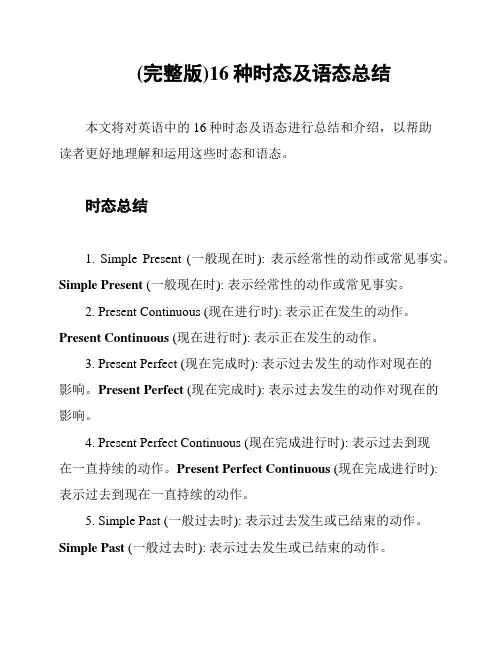
(完整版)16种时态及语态总结本文将对英语中的16种时态及语态进行总结和介绍,以帮助读者更好地理解和运用这些时态和语态。
时态总结1. Simple Present (一般现在时): 表示经常性的动作或常见事实。
Simple Present (一般现在时): 表示经常性的动作或常见事实。
2. Present Continuous (现在进行时): 表示正在发生的动作。
Present Continuous (现在进行时): 表示正在发生的动作。
3. Present Perfect (现在完成时): 表示过去发生的动作对现在的影响。
Present Perfect (现在完成时): 表示过去发生的动作对现在的影响。
4. Present Perfect Continuous (现在完成进行时): 表示过去到现在一直持续的动作。
Present Perfect Continuous (现在完成进行时): 表示过去到现在一直持续的动作。
5. Simple Past (一般过去时): 表示过去发生或已结束的动作。
Simple Past (一般过去时): 表示过去发生或已结束的动作。
6. Past Continuous (过去进行时): 表示过去某个时间段内正在进行的动作。
Past Continuous (过去进行时): 表示过去某个时间段内正在进行的动作。
7. Past Perfect (过去完成时): 表示过去某个时间点之前已经完成的动作。
Past Perfect (过去完成时): 表示过去某个时间点之前已经完成的动作。
8. Past Perfect Continuous (过去完成进行时): 表示过去某个时间点之前一直持续的动作。
Past Perfect Continuous (过去完成进行时): 表示过去某个时间点之前一直持续的动作。
9. Simple Future (一般将来时): 表示将来要发生的动作。
英语中的时态与语态-精讲

英语中的16种时态⑶现在进行时→ is/am/are +doing (v-ing )⑷过去进行时→ was/were +doing (v-ing )⑸现在完成时→ have/has + done (过去分词)⑹过去完成时→ had +done (过去分词)⑺一般将来时 →⑻过去将来时 →⑼将来进行时→ shall/will be +doing (v-ing )⑽现在完成进行时→ have/has been +doing (v-ing )⑾过去将来进行时→ should/would be +doing (v-ing )⑿将来完成时→shall/will have +done (过去分词)⒀将来完成进行时→ shall/will have been +doing (v-ing )⒁过去完成进行时→had been +doing (v-ing ) ⒂过去将来完成时→⒃过去将来完成进行时→ should/would have been +doing (v-ing )16种时态中的被动语态主动:A + 一般动词(do )+ B被动:B + be done (过去分词)+ by Aeg. You play basketball.⑴一般现在时:The by you.→⑵一般过去时:→⑶现在进行时:The by you.→⑷过去进行时:The by you.→⑸现在完成时:The by you.→⑹过去完成时:The by you.→⑺一般将来时:The by you.→⑻过去将来时:The by you.→⑼将来进行时:The by you.→⑽现在完成进行时:The by you.→⑾过去将来进行时:Theby⑿将来完成时:The by you.→⒀将来完成进行时:Theby you.→⒁过去完成进行时:The by you.→⒂过去将来完成时:The by you.→⒃过去将来完成进行时:Theby you.注:红体字部分为常用时态的被动形式附录:动词(被动形式)搭配表。
最新16种英语时态和语态
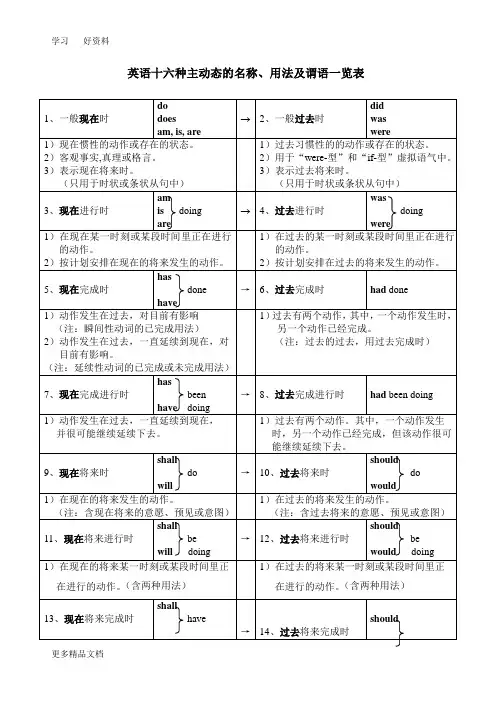
的动作。
2)按计划安排在过去的将来发生的动作。
5、现在完成时
has
beendone
have
→
6、过去完成时
hadbeendone
1)动作发生在过去,对目前有影响
(注:瞬间性动词的已完成用法)
2)动作发生在过去,一直延续到现在,对
目前有影响。
(注:延续性动词的已完成或未完成用法)
has
been
havedoing
→
8、过去完成进行时
hadbeen doing
1)动作发生在过去,一直延续到现在,
并很可能继续延续下去。
1)过去有两个动作。其中,一个动作发生
时,另一个动作已经完成,但该动作很可能继续延续下去。
9、现在将来时
shall
do
will
→
10、过去将来时
should
do
would
1)在现在的将来发生的动作。
(注:含现在将来的意愿、预见或意图)
1)在过去的将来发生的动作。
(注:含过去将来的意愿、预见或意图)
11、现在将来进行时
shall
be
willdoing
→
12、过去将来进行时
should
be
woulddoing
1)在现在的将来某一时刻或某段时间里正
在进行的动作。(含两种用法)
3)表示过去将来时。
(只用于时状或条状从句中)
3、现在进行时
am
isdoing
are
4、过去进行时
was
dபைடு நூலகம்ing
were
1)在现在某一时刻或某段时间里正在进行的动作。
16种时态及语态总结
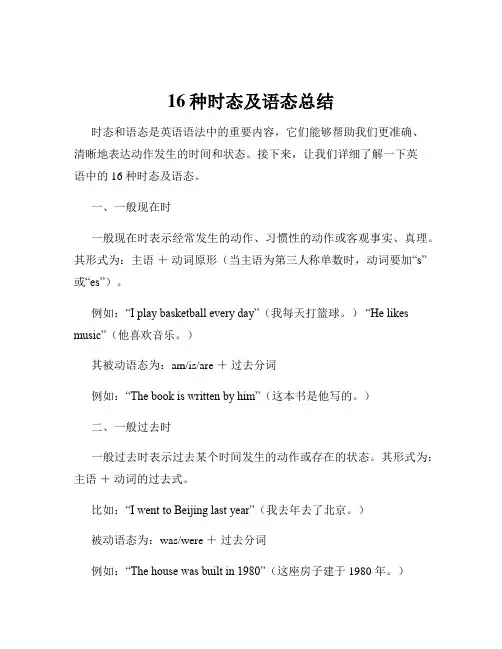
16种时态及语态总结时态和语态是英语语法中的重要内容,它们能够帮助我们更准确、清晰地表达动作发生的时间和状态。
接下来,让我们详细了解一下英语中的 16 种时态及语态。
一、一般现在时一般现在时表示经常发生的动作、习惯性的动作或客观事实、真理。
其形式为:主语+动词原形(当主语为第三人称单数时,动词要加“s”或“es”)。
例如:“I play basketball every day”(我每天打篮球。
)“He likes music”(他喜欢音乐。
)其被动语态为:am/is/are +过去分词例如:“The book is written by him”(这本书是他写的。
)二、一般过去时一般过去时表示过去某个时间发生的动作或存在的状态。
其形式为:主语+动词的过去式。
比如:“I went to Beijing last year”(我去年去了北京。
)被动语态为:was/were +过去分词例如:“The house was built in 1980”(这座房子建于 1980 年。
)三、一般将来时一般将来时表示将来要发生的动作或存在的状态。
常见形式有:will +动词原形;be going to +动词原形。
例如:“I will visit my grandparents next week”(下周我将看望我的祖父母。
)“She is going to have a party”(她打算举办一个聚会。
)其被动语态为:will be +过去分词;be going to be +过去分词例如:“The meeting will be held tomorrow”(会议将在明天举行。
)“The sports meeting is going to be cancelled”(运动会将要被取消。
)四、过去将来时过去将来时表示从过去的某一时间来看将来要发生的动作或存在的状态。
其形式为:would +动词原形;was/were going to +动词原形。
(完整版)英语时态总结(完整)
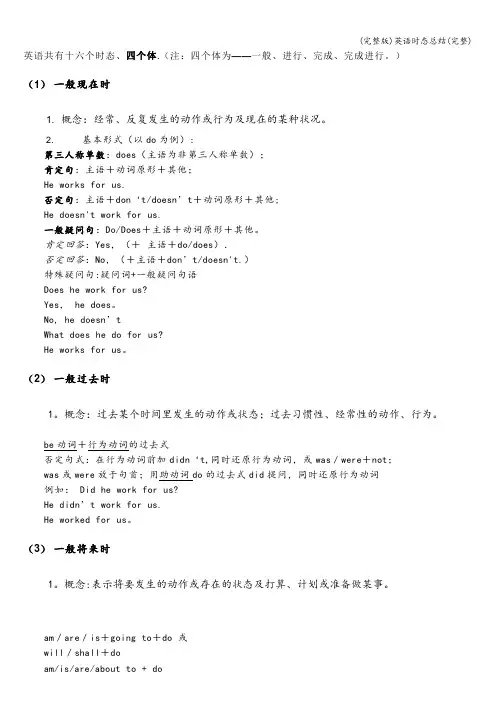
英语共有十六个时态、四个体.(注:四个体为——一般、进行、完成、完成进行。
)(1)一般现在时1. 概念:经常、反复发生的动作或行为及现在的某种状况。
2. 基本形式(以do为例):第三人称单数:does(主语为非第三人称单数);肯定句:主语+动词原形+其他;He works for us.否定句:主语+don‘t/doesn’t+动词原形+其他;He doesn't work for us.一般疑问句:Do/Does+主语+动词原形+其他。
肯定回答:Yes,(+主语+do/does).否定回答:No,(+主语+don’t/doesn't.)特殊疑问句:疑问词+一般疑问句语Does he work for us?Yes, he does。
No, he doesn’tWhat does he do for us?He works for us。
(2)一般过去时1。
概念:过去某个时间里发生的动作或状态;过去习惯性、经常性的动作、行为。
be动词+行为动词的过去式否定句式:在行为动词前加didn‘t,同时还原行为动词,或was/were+not;was或were放于句首;用助动词do的过去式did提问,同时还原行为动词例如: Did he work for us?He didn’t work for us.He worked for us。
(3)一般将来时1。
概念:表示将要发生的动作或存在的状态及打算、计划或准备做某事。
am/are/is+going to+do 或will/shall+doam/is/are/about to + doam/is/are to + do;一般将来时的表达方法be going to +动词原形be +不定式,be to+动词原形,be about to +动词原形be able to +不定式be about to+动词原形will + 动词原形;例如:He is going to work for us。
英语八种时态及语态

英语八种时态及语态一.现在进行时态(正在进行)1.结构:Be + V- ing . 被动语态结构am/is /are + being+ p.p2.关键词;look , listen , now, at the moment , at presente. g The students ----------( play ) at five o’clock in the afternoon.二.一般现在时态(经常性,反复性)1.结构 A. be型am/ is are + n / adj/ prep phrase被动语态结构am/is/are +p.pe. g I am a student . / He is tired . / They are at home.一般疑问句将be 提前,否定句在be 后加not.B.行为动词:1). S+ V (主语除第三人称单数)e. g We study English. / Do you study English ? / We don’t study English. 一般疑问句加助动词do ,否定句加助动词don’t.They do their homework. / Do they do their homework ? / They don’t do their homework.2). S + V(单三)。
主语是第三人称(he, she, your mother, lily); 动词第三人称变化相当于名词变复数。
E. g His brother studies hard every day. /Does his brother study hard every day ?His brother doesn’t study hard every day.一般疑问句在加Does, 否定句加doesn’t. 后要还原动词原形。
e. g Her sister does some cooking in the evening. / Does her sister do some cooking in theevening .? Her sister doesn’t do some cooking in the evening.3. 关键词:every day ( week / month / year) / in the morning ( afternoon / evening)On Monday (s) at weekend (s)Always /often / usually /sometimes= at times. Once a week (how often)三.一般过去时态(过去的动作,状态)1.结构。
英语十六种时态和8种语态以及区别注意事项
目录16种时态 (1)1. 一般现在时 (2)2. 现在进行时(be doing) (3)3. 现在完成时(have done) (4)4. 现在完成进行时(have been doing) (5)5. 一般过去时 (6)6. 过去完成时(had done) (7)7. 过去将来时(would/ should do) (7)8. 过去进行时(was/ were doing) (8)9. 一般将来时 (8)10. 将来进行时(will be doing) (10)11. 将来完成时(will have done) (10)12将来完成进行时:shall have been doing ,will have been doing (11)13过去完成进行时:had been doing (11)14过去将来进行时:should be doing , would be doing (11)15 过去将来完成时:should have done , would have done (11)16 过去将来完成进行时:should have been doing , would have been doing (12)一、一般过去时与现在完成时的转换 (12)二、一般现在时与现在进行时的转换 (12)三、现在进行时与一般将来时的转换 (13)四、“be going to+动词原形”与“will(shall)+动词原形”结构的转换 (13)We shall visit the Great Wall next Sunday (13)时态区别 (13)一、现在完成时和一般过去时的区别 (13)二、现在完成进行时和一般进行时 (14)三、现在完成进行时和现在完成时 (15)四、过去进行时和过去时的区别 (16)8种被动语态的构成 (17)(一)语态的基本概念和种类 (18)(二)被动语态的构成 (18)(三)被动语态的用法 (19)(四)主动语态变被动语态的方法与注意事项 (19)(五)不用被动语态的情况 (20)(六)复习时需要注意的要点 (22)附:英语语法术语的英文表达 (22)时态(Tense)是表示行为、动作和状态在各种时间条件下的动词形式。
(完整)高中英语语法(时态和语态)
高中英语语法(时态和语态)一.动词的时态时态是谓语动词所表示的动作或情况发生时间的各种形式。
英语动词有16种时态,但是常见的只有九种:一般现在时、一般过去时、一般将来时、现在进行时、过去进行时、现在完成时、过去完成时、过去将来时、现在完成进行时。
(一)一般现在时(do / does)1.具体用法1) 表示经常性或习惯性动作We always care for each other and help each other. 我们总是互相关心互相帮助。
He goes to school every day.2)表示现在的特征或状态He is very happy.Do you sing? ----A little.3)表示普遍真理Light travels faster than sound. 光速比声速快。
Actions speak louder than words. 行动胜过言语。
* 常与一般现在时态连用的词或短语主要有:often, usually, sometimes, every day,every morning/afternoon, on Sundays/weekends等等。
I often go to the cinema on Sundays. 我经常星期天去看电影。
He goes to work early every day. 他每天上班很早。
(二)一般过去时( did )(1)表示过去某一特定时间所发生的、可完成的动作或状态,常与表示确切过去时间的词、短语或从句连用。
例如:We went to the pictures last night and saw a very interesting film.(2)表示过去习惯性动作。
例如:He always went to class last.I used to do my homework in the library.(三)一般将来时( will / shall do)1)表示将来打算进行或期待发生的动作或状态。
13种英语时态详解
13种英语动词时态语态分为两种:1、主动语态:主语+谓语(主语发出动作)2、被动语态:主语+系(be/情态词)+表语(主语承受动作,动作变过去分词)动词的加工分为16种,动词的加工就是时态。
以下讨论的是所有16种时态中的13种。
其余的不讨论。
一、一般现在时一般现在时表示经常发生的动作或存在的状态例如习惯、客观事实、和普遍真理等。
例句:The earth revolves around the sun.地球围着太阳转。
【注】当主句为现在或将来时态时,则按实际句意可使用各种相应时态。
谓语/ be(is am are)/情态动词:原形/第三人称单数二、一般过去时一般过去时表示过去发生的动作或存在的状态。
这种动作或状态可能只限于一次,也可能是过去经常发生的。
1.用过去时的动词表示:A.动作状态出现在过去,与其它内容成份无关:动词(谓/系/情)用过去式B.用“used+to+do”表示过去习惯动作或存在状态,而“would+do”表示过去多次动作。
When I lived in Shanghai,I used to learn Chinese from Mr.Fang.当我住在上海时,我常向方先生学习汉语。
三、一般将来时一般将来时表示将来发生的动作或存在的状态(动作、状态发生在将来):will/shall+动词(谓/系/情)原形This afternoon we shall go to the net friend club.今天下午我们将去网友俱乐部。
【注】will/shall的用法:1. 【注】主将从现:在以when,if等连接的时间或条件状语从句内,要用现在时态替代将来时:I shall give you the book when I see you tomorrow.明天见到你时,我就将书交给你。
2.将来时还可以用来表示一种倾向或一种固有的特性:Without air and water a living thing will die.没有空气和水,生物便会死亡。
(word完整版)史上最全 英语中的16种时态
动词16个时态一、一般现在时1.概念:表示经常发生的情况;有规律出现的情况;总是发生的;和事实真理。
2.时间状语:Always, usually, often, sometimes, every week (day,year, month…),once a week(day, year,month…),on Sundays(on Mondays …),3。
基本结构:动词原形(如主语为第三人称单数,动词上要改为第三人称单数形式)4。
否定形式:主语 + am/is/are + no t + 其他;此时态的谓语动词若为行为动词,则在其前加don’t,如主语为第三人称单数,则用doesn't,同时还原行为动词。
5.一般疑问句:把be动词放于句首;用助动词do提问,如主语为第三人称单数,则用does,同时,还原行为动词。
6.例句:It seldom snows here。
这里很少下雪。
He is always ready to help others.他总是乐于帮助别人。
Action speaks louder than words。
事实胜于雄辩。
二、一般过去时1.概念:过去某个时间里发生的动作或状态;过去习惯性、经常性的动作、行为。
2.时间状语:ago, yesterday, the day before yesterday, last week, last(year, night,month…),in 1989,just now, at the age of 5,one day, long long ago, once upon a time, etc。
3。
基本结构:主语 + 动词的过去式或be的过去式+名词4.否定形式:主语 + was/were + not + 其他;在行为动词前加didn’t,同时还原行为动词.5.一般疑问句:was或were放于句首;用助动词do的过去式did 提问,同时还原行为动词。