
新冀教版初中英语八年级下册Lesson 8
______________________________________________. 15.lToroeke,schoenlpfidpeenocpel,eyionum, baenayuwtiafuyls, makes
______________________________________________. Confidence makes you look beautiful
来自《 》
1.Food is our__b_a_s_ic___(基本的) need. pleasant
2.They have a________(令人愉快的) trip. shade
3.People like to have a rest in the________(阴凉处)of the
tree.
本节课我们主要学习了以下重点内容: (1)重点短语:in a word (3)重点句式:It is + adj. + (for sb.) to do sth.
1.熟记本课时的词汇 2.完成本课时的课后作业(ppt+word)
THINK ABOUT IT ·What plants grow near your home? ·Why do we need trees?
Danny, Jenny and Brian are walking in a forest. Jenny: I love this forest. There
9) shade under a tree.
Let's Do It !
2) Complete the passage with the correct forms of the
words in the box.
basic shade forest cover pleasant There are many trees and plantpsl.eIat’ssan_t_______to walk in
讲解来自《 》
既可作表语也可作定 This is a pleasant
pleasant adj. 语,多用于修饰事物,journey.
令人愉快的 表示“某事(或某物)令 这是个令人愉快
人愉快”。
的旅行。
p愉满le快意as;ed高ad兴j. ;一容某兴般 人 事 或(不,满或作表意某定示”人。语“)某感,人到多对高形
√2) □People can eat plants or use them as medicine. √3) □Plants help make the air clean and fresh. √4) □Many animals live in the forest.
5) □Books,paper,pencils and erasers all come
√ from plants.
√ 6)
□Animals eat the fruit from the trees.
√ 7)
□The plants cover the soil and can stop the dust.
√8) □When the weather is sunny and hot,people can sit in the
They help us fulfill our basic needs.
Brian:That’s for sure. People use trees and other plants in many ways. The trees and plants take energy from the sun and turn it into food. Medicine and clothing are also made from trees and plants.
If you jump the
queue, others will
not be pleased. 如果你插队,别 人会不高兴的。
讲解来自《 》
知识点 2 in a word总而言之,相当于in one word
eg:In a word, I can’t go out as I have many things to do. 总而言之, 我不能出去, 因为我有许 多事情要做。
Let's Do It !
3) Work in pairs. Think about why we need plants.
Discuss it and fill in the mind map.
You can use some ideas from Activity 1.
Food or medicine: ____________________
三、连词成句
来自《 》
11.play, the, under, shall, tree, we
____S_h_a_l_l_w_e__p_la_y__u_n_d_e_r__th_e__tr_e_e___________________? 12.fulfill, basic, what, needs, our, can
the fsohraedset. When the weather is sunny and hot,you canbassiticin
the _______under a tree. Trefoersesatn(sd) other plants are one of our
cover ________needs for life. Many things are made from trees and
Jenny:The forest is important to animals, too. Many animals live in the forest and eat the fruit from the trees. They eat other plants, too.
Brian: And plants cover the soil. That way, the wind and water don’t carry the soil away. Plants also make everything look beautiful.
carefully. 认真听老师讲是重要的。
讲解来自《 》
典例 ____D____ is really hard ________ them to climb
such a high mountain.
(白银)
A.This; to
B.It; to
C.This; for
D.It; for
考向二 辨析 pleasant与pleased
in other words 换言之;换句话说
In other words, you’ll come
instead of him. Right? 换句话说,你将代替他来。对吗?
Let's Do It !
1) Read the lesson and tick the items mentioned.
Clothing and school things: _____________________
Functions of trees (plants)
Shelter: ____________________
Environment: ____________________
一、根据提示及句意完成句子
Danny: In a word❷, we can’t live without plants!
知识点
讲解来自《 》
1 It’s pleasant to walk in the forest. 在森林里散步令人愉快。
考向一 在这句话中,It作形式主语。It is + adj. + (for sb. )to do sth. 意为“做某事(对于某人来说) 是……”。 eg:It is important to listen to teachers
are so many trees and plants. The air is always clean and fresh. Brian: Yes. Trees and other plants help clean the air.
Jenny: That’s true. It’s pleasant to walk in the forest. ❶ When the weather is sunny and hot, you can sit in the shade under a tree. It’s nice and cool.
讲解来自《 》
考向 与word有关的其他短语:
have a word with Can I have a word with you? e words with. . . 与……争吵
He had words with his wife last night. 昨晚他和他的妻子吵了一 架。
____W__h_a_t__ca_n__f_u_lf_i_ll_o_u_r__b_a_s_ic__n_e_ed__s _______________? 13.a, it's, have, pleasant, trip, to
_1_4.___wIt_a'_sy_ps_,l_eha_es_lap_n,_ti_n_t,o_t_hr_eae_vs_e,_ma__tar_ni_py_, _p_e_o_p_le______________.
Unit 2 Plant a Plant!
Lesson 8 Why Are Plants Important?
同学们,上一课学习的单词、短语和句型你们都掌 握了吗?现在大家来检验一下,点击下面的音频开始听 写吧!
Answer the following question: 1. How many kinds of trees do you know? 2. Do you know the importance of trees?
冀教版八年级下册Lesson8WhyArePlantsImportant课件

Look at the things on your desk. Books, paper, pencils, erasers and the ink in your pen all come from plants.
Plants help make the air clean and fresh. The plants cover the soil and can stop the dust.
be made from 由(看不出原料)制成 be made of be made by be made in 由(看出原料)制成 被(某人)制造 在(某地)制造
6. We can’t live without plants without 介词 “没有”
e.g.他没有吃早饭就去上学了. He went to school without breakfast. 没有水鱼就不能活. Fish can’t live without water.
We make many medicine from plants. What’s medicine? Doctors use medicine to help sick people.
We use wood from trees to build houses and furniture. Tables, chairs and beds are furniture. So is your desk. Many animals live in the forest.
5.Plants cover the soil. That way, the wind and water don’t carry the soil away. 6.Plants also make everything look beautiful. 7.Many animals live in the forest and eat the fruit from the trees.
冀教版八年级下册英语Unit8教案
Unit 8 Save Our World石泉四中英语教研组单元备课:一、本单元语言知识(1)本单元应掌握的词汇:Yard, rubbish, bit ,bag, less, environment, least, waste, fix, sort, metal, heaven, weight, truck, object, picnic, mend, must, repair, more, most, bad, litter, seat(2)本单元接触的词汇:save, garbage, pollution, reusable, pollute, leak, litre, leaky, tap, recycle, plastic, packaging, tear, cassette, deck, buzz, exactly, reuse, power, can, clean-up, lid(3)词组和句型clean up, pick up, a bit of, finish doing… , get to work, throw away, take out, turn off, leak out, take a walk, have a fit , a little bit, sort…into… , take a trip, Good heavens!(4)功能意念:Offering help提供帮助。
(5) 语法:Object clauses 宾语从句;二、语言技能听:1.听懂关于环境问题的谈话和描述,并提取有关信息;2.以词或者词组的形式记录有关信息;说:1.就有关地理方面的话题提供信息,表达自己的观点,参与讨论;2.有效询问信息,合作完成任务;读:1.连贯、流畅的读课文;2.利用字典来阅读课外书,从而丰富自己的知识。
写:1.利用所获取的信息来写作;2.掌握根据所给的表格或图示写出简单的段落;三、学习策略:1.出不利用图书馆和网络上的学习资源;2.使用简单的工具书查找信息;3.总结所学语言材料中的语言规律并加以利用;4.善于抓住英语交际的机会。
冀教版英语八年级下册单元课件-Unit 8课件
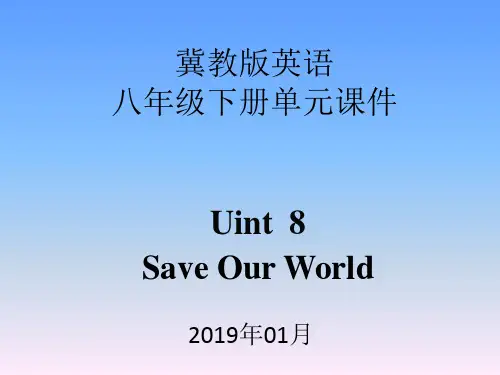
Marina: If this goes on, the fish will die. People pollution should do something to stop the ________. agree Let’s do something to draw Jeff: I ________. people’s ________ attention to this problem. How about putting up a poster? schoolyard Marina: Good idea. Jeff, I think our __________ is also quite dirty. Let’s call our classmates to help clean it before the new term starts. cleaning in an hour! Jeff: OK. We would finish ________
冀教版英语 八年级下册单元课件
Uint 8 Save Our World
2019年01月
Unit 8 Save Our World
• Lesson43 • Lesson44
• Lesson45
• Lesson46 • Lesson47 • Lesson48
• 单击上面每一课课题进入相对应幻灯片
八年级英语下(JJ) 教学课件
Ⅰ. Listen to the dialse (F).
T
F
F
T
Ⅱ. Read the dialogue and answer the questions.
1. What is the meaning of "rubbish"? It is something worthless, or something that you don’t need anymore. It means "garbage" in American English.
Lesson8教案冀教版八年级英语下册
Lesson 8:Why Are Plants Important? 教学设计Teaching Aims:1.Say out and know the meanings of the important words.2.Read the dialogue and plete the mind map by group work.3.Let them know more about the importance of plants and build the students’ sense of taking care of environment.Teaching Material:Unit 2 lesson 8: Why Are Plants Important?Teaching Difficult and Important Points:1.plete the mind map.2.Build the students’ sense of taking care of environment.Teaching Methods:Taskbased teaching methodTeaching Preparation:PowerPoint, video and blackboardTeaching Procedures:Step1:LeadinLead in the topic by asking two questions:Q1: Do you know when the World Forest Day is?Q2: Why do we have World Forest Day?Students think about the questions and give their answers.(设计意图:本节课上课时间为3月20日,恰好第二天为世界森林日,以此引出主题,既符合实际,又拓宽学生视野,引起学生兴趣。
冀教版英语八年级下册Unit 2:Lesson 8 Why are Plants Important

A Brief Instruction to the topic of“Lesson8 Why Are Plants Important?”说课稿My name is Zhang Birong. I come from from Zheng Jia Middle School in Xun Yi. Today I’m going to talk about the topic” L esson8:” Why Are Plants Important?” .I will divide the instruction into seven parts:they are Teaching material Analysis, Teaching aims, Teaching difficulties, Teaching methods, Teaching aids and Teaching procedures.Part 1 Teaching material analysisThis period is from Unit 2 of Ji Jiao English book 3 :”Plant a Plant “ First of all, I’d like to talk about my understanding about this lesson8. We have learned weather in Unit 1 and how to plant trees in Lesson7 of Unit 2. So we have learned some words and phrases about plants. Today we are going to learn the importances of plants. So this unit links with a special meaning of Unit 1 and Unit 2. This period is the first lesson of Reading. The main idea of the topic is how to express their ideas about plants .We are going to learn the ways to practice writing and stress in following lessons. So this period is very important in this unit.Part 2 Teaching aims1.Aims of the knowledge:(1)To know the pronunciation and spelling of some words and some phrases.(2)To learn something about useful of trees.(3)To grasp the main idea of dialogue and use the information to talk to others about the importances of plants and write a passage .2.Aims of the abilities:(1)To improve the ability of getting information by reading.(2)To improve the ability of writing.3.Aims of the emotion:(1)To understand how to write about plants and to express their ideas. (2)To ask for some information to discuss the topic.Part 3 Teaching difficulties1.To recognize and understand vocabulary about plants.2.To practice the passage.Part 4 Teaching methodsIn this topic, I will use skimming, task-based method and debate method..I design some tasks to help the students learn. I think if I want to improve the students’ oral English, I shoul d give them enough chancesto practice and I will use pair work and group work to let the students take an active part in all kinds of activities. That is “Learning by doing, learning by using”. Let the students be the masters of the class teaching ,thus, student-centered teaching method is well shown.Part 5 Teaching aidsProjector,tape recorder and blackboardPart 6 Teaching procedureStep Ⅰ.Lead-inThe purpose is to arouse the students’ interest of study.Step Ⅱ.ReadingI will use three- step to read the dialogue . The first step is listening and reading. The purpose is to make students understand the important words and phrases . The second step is pre-reading. The purpose is to make students understand the dialogue and practise the dialogue in roles. The third step is while-reading . The purpose is to help students get the information of topic and gain the main idea of the dialogue.Step Ⅲ.Discuss in groups’’ Why do we need trees?’’Purpose of my designing: This step is employed to make the Ss get the general idea of the dialogue as a whole one. At the same time let the Ss have a chance to practise their listening and spoken ability. “Task-based” teaching method is used here to develop the Ss’ ability of communication and also their ability of co-operation will be well trained. Tell the Ss we should protect the plants and take good care of them. I think proper competition can arouse the Ss’ interest in English learning. If the Ss can finish this task well, they will benefit a lot in their spoken English.Step Ⅳ.language pointsThe purpose is to develop the skills of scanning and how to gain the details from the dialogue.1. Try to understand the words and phrases2. Ask students to make sentences with phrases .Step Ⅴ.Practice1. I’ll ask some Ss of the grou ps to write these answers on theblackboard. Then check their handwriting, answers, correct their mistakes. Find out who will write well and whose answers and handing is the best.2. Purpose of my designing: To check the knowledge Ss have learned inthis lesson.Step VI: Summary and homeworkThe purpose is to help the students a clear idea of what they have learned in the lesson.1.Ask students to revise the words and phrases2.Ask students to write a passage about plants’ important.Blackboard DesignLesson8: Why Are the Plants important?Words:pleasant, shade, fulfill, basic, soil•Phrases:•take energy from…•in a word•be made from•carry awayPatterns:It’s pleasant to do …主语+can’t …without…Discuss in groups: Why do we need trees ?Group1Group2Group3Group4Group5During my teaching,I’ll try my best to get my class alive and encourage the students to talk with each other in English. I think the general aim of English teaching is to improve the ability of using English. And I’ll use this to guide my teaching.Thank you!。
英语八年级下册冀教版unit8全单元教案

Unit 8 Save Our WorldLesson 57: Let’s Clean Up!Teaching Content:Mastery words and expressions: yard, rubbish, pick up, bit, a bit of, bigOral words and expressions: garbage, pollution, finish doing, get to workTeaching Aims:1.Let the students understand to protect our environment is our duty.2.We should keep our school yard clean.Teaching Important Points:1.Know how many ways we can say “garbage”.2.Talk about the destroy of the rubbish.Teaching Difficult Points:Some words and expressions, such as: pick up, clean upTeaching Preparation: picturesTeaching Aids: audiotape, flashcards, picturesType of lesson: new lessonTeaching Procedure:Step1. Come to “TALK ABOUT IT.”Step2. Show the new words to the students. Let the students read the words first. Then let them read after the tape.Step3. Listen to the tape and do Exercise 3 in activity book.Step4. Read the text and check the answers silently. At the same time, answer the following questions:1. Where are Jenny, Brian and Danny?2. How’s the w eather?3.What do English people call “rubbish”?4.What is Jenny studying in class this week?5.What does the teacher think of Jenny’s idea?Step5. Read the text in roles loudly. Then let some students act it out in front of the class.Step6. PracticeExplain some language points to the class. Then ask the students to make up sentences with them.1.But look at all of the rubbish!2.Somebody should pick up that garbage!3.It would take too long.4.Each student could clean up a bit of the school yard.5.We would finish cleaning in an hour.Step7. Come to “LET’S DO IT.”Work in teams with three or four people. Let some students act their dialogue out in front of the class.Step 8. Homework1.Finish off the exercises in activity book.2.Go on the next reading in the student book.Summary:This lesson is close to our life. Try to take the students out of the classroom and show the garbage to them. Then let them say what they feel about the garbage. Ask them to act the dialogue out in the school yard. Advice the students to pick up the garbage and clean up the school yard.Lesson 58: Stop PollutionTeaching Content:Mastery words and expressions: less, environment, throw away, least, take out, waste, fix, toiletOral words and expressions: reusable, pollute, leak, litre, leaky, sink, tap, recycle, save, take out, turn off, leak outTeaching Aims:1.This lesson focuses on the environment issues.2.It presents some solutions to the problems that pollution poses.Teaching Important Points:1.It presents thought-provoking facts and figures abut pollution in North America.2.Call on the students to take personal action to reduce pollution.Teaching Difficult Points:Find more solutions to protect our environment.Teaching Preparation: picturesTeaching Aids: audiotape, flashcards, picturesType of lesson: new lessonTeaching Procedure:Step1. Come to “THINK ABOUT IT.”Step2. Show the new words to the class. First let them read them by themselves. Then read them after the teacher. Practice the words for a while.Step3. Talk about the questions:Show some pictures about our environment to the class. Let the students work in three or four to finish the task.1.What do you think our environment?2.What can we do to reduce pollution?3.Do you know anything about the environment in foreign countries? Can you give an example? Step4. Listen to the tape and finish Exercise 2 in activity book.1.In North America, many students help their school make more pollution.2.In an environment club, people work together to make the environment clean.3.Environment clubs encourage students to bring their lunches in plastic bags.4.They give prizes to the classes that make the least garbage.5.On a no-car day, only teachers come to school by car. No students come to school by car.6.A leaking toilet can waster twenty to forty litres of water an hour.7.In environment clubs, students don’t fix leaky toilets and sinks.8.A hundred kilograms of recycled paper saves seventeen trees.Step5. Read the text in silence. Check the answers. Then let the students read the text in class loudly.Step6. Analyze the text and make a further discussion about it. Let’ s discuss its details.1.What do people in an environment club do?2.On no-car day, how do people come to work? How do students come to school?3.What do you know about a leaking toilet?Step7. Come to “LET’S DO IT.”Step8. Homework1.Finish off the exercises in activity book.2.Go on the next reading in the student book.Summary:It is a subject that is close to the student life about how to stop pollution. We must give examples in students’ daily life. Discuss with the students: how to reduce waste paper; how to save water; how to save money.Lesson 59: Let’s look at Garbage!Teaching Content:Mastery words and expressions: sort, metal, weight, percentOral words and expressions: plastic, packagingTeaching Aims:1.Call on the students to take actions to protect our environment.2.Learn about the pollution problems in our life.Teaching Important Points:1.Offering help.2.Learn new vocabulary for describing materials and for comparing qualities. Teaching Difficult Points:Describe materials and comparing qualities.Teaching Preparation: picturesTeaching Aids: audiotape, flashcards, picturesTeaching Procedure:Step1. Remind the students:1.What kinds of rubbish do you throw every day? Can you name them?2.What can be recycled?Step2. Work in groups.Let the students go to the dustbin to collect some garbage and take them to the classroom. Ask the students name them and compare the qualities.Let the students look up the books and the dictionaries when they are in trouble. Help them when they can’t express correctly.Step 3. Listen to the tape finish Exercise 2 in the activity book.1.Every year, each person in North America makes about 1000 kilograms of garbage.2.Plastic makes the most garbage.3.In just one day, Americans throw out 136 million kilograms of packaging.4.Packaging makes the most garbage.5.People often use packaging, and they never throw it away.6.About the percent of packaging is plastic.7.Each day, Americans throw out ten thousand small cars.Step4. Read the text and check the answers.Let the students read the text in roles. Then ask several students to act out the dialogue. Step5. Come to “PROJECT”.Bring the students to pick up the garbage in the school yard. Put the garbage into bags and bring it to school for our project.Take a walk around your neighbourhood, take a bag with you and pick up any garbage you see. Wear gloves, because garbage in dirty.Now sort the garbage into paper, plastic, metal, glass and others.Then compare the garbage in school yard with that in neighbourhood.Have students work in the same groups or in new groups. Each group will make a poster about what things they can do to help reduce pollution in the world.Step6. Homework1.Finish off the exercises in activity book.2.Go on reading in the next book.Summary:We all think the garbage is dirty. In order to increase the students’ interests, we have to face the garbage and sort it in groups. When we do this, we can find many people are wasting things around us. Learn to recycle things with the students. Let’s see how many new things we can make out of it.Lesson 60: Fix and MendTeaching Content:Mastery words and expressions: mend, must, touch, repairOral words and expressions: tear, cassette, deck, buzz, exactly, reuse, power Teaching Aims:1.Learn about the knowledge of environment.2.Tell the students to save and protect the resources is our duty.Teaching Important Points:1.In order to save our environment, we should fix and mend something in our daily life.2.Feel the beauty of music.Teaching Difficult Points:Some words and expressions, such as: fit, fix, mendTeaching Preparation: picturesTeaching Aids: audiotape, flashcards, picturesType of lesson: new lessonTeaching procedure:Step1. Ask the students the questions:What do you do when your pants have a hole?What do you do with when your shoes have a tear?Work in pairs and discuss the questions. They can ask many other questions. Then let them give a report to the class.Step2. Listen to the tape. Feel the rhythm of the song.Step3. Read the song as a lyric poem. Let the students read after you. Then let them read and translate it. They must add their feelings in it.Step4. Listen to the tape again. Let’s sing after it.Step5. Ask some volunteers to come to the front and act it out.Step6. PracticeWork in groups of three or four. Give examples of the things that we can do around us. Discuss and give a report to the class.Step7. C ome to “LET’S DO IT.”Step8. Homework1.Finish off the exercises in activity book.2.Go on the next reading in the student book.Summary:In order to save our environment, we must do the little things around us. Let the students search on the Internet to get more information about waste. If we all save sources, we can get more energy form the nature. Tell the students to save water is an important thing in our life. Water is the most important source. We cant’ live without water.Lesson 61: What Was in the Bags?Teaching Content:Mastery words and expressions: more, most, bad, litterOral words and expressions: a little bitTeaching Aims:1.Build the belief to save our earth.2.Cultivate the feelings of responsibilities.Teaching Important Points:1.Learn new vocabulary for describing materials and for comparing quantities.2.Learn common expressions for offering assistance.Teaching Difficult Points:New words and phrases to compare quantities.Teaching Preparation: garbageTeaching Aids: audiotape, flashcards, garbageType of lesson: new lessonTeaching Procedure:Step1. Take out the garbage and put it on the floor. Let’s discuss what we can reuse and recycle. Ask the students work in their groups and imagine what we can do with it. Give a report to the class.Step2. Listen to the tape and finish Exercise 2 in activity book.Danny and Jenny are very _______ to know that people throw ______ _______ waste things away.Danny finds a _______ ______. One of the ________ is broken. He will take it _______ and _______ it. After he _______ it, he will give it to_________ _______, Debbie. ________ should throw away a toy like tat. It’s not _______ to waster things.A lot of the ______ is broken. That’s bad! Once Danny _______ his foot on a piece of broken glass.Step3. Read the text and check the answers. Let the students it loudly in class. Then read it in roles.Step4. Use the garbage we have brought to the class. Act the dialogue out in front of the class.Step5. Practice some words and expressions: too much, m ore…than…, most, less…than…too much:S1: There is too much garbage in the school yard.S2: There was too much rain last summer.more…than…S3: I have more glass than metal.S4: they have more dresses than pants.mostS5: Who has the most paper?less…than…S6: Do you have less plastic than metal?Step6. PracticeDo Exercise 3 in activity.Fill in the blanks according to the text.There are 10 kilograms of paper, 8 kilograms of plastic, and 5 kilograms of metal. There ______ 3 kilograms of glass. So there is ______ paper than plastic, and ______ metal than plastic. Glass is the ______. Paper is the ______. Some of _______ is only use on ______ side. We can ______ it.Step7. Discuss the text in detail.1.Is the garbage in the book the same as that we collect in the school yard?2.What can we use the garbage to do?3.What do you feel about the garbage?Step8. Come to “LET’S DO IT”.Step9. Homework1.Finish off the exercises in activity book.2.Go on the next reading in the student book.Lesson 62: Take Short Showers!Teaching Content:Oral words and expressions: can, take showers, make…into…Teaching Aims:1.Know about the pollution in our country.2.We all should take care of our environment.Teaching Important Points:1.How do you think the pollution in our country?2.What should we do to stop pollution?Teaching Difficult Points:Some words and expressionsTeaching Preparation: picturesTeaching Aids: audiotape, flashcards, picturesType of lesson: new lessonTeaching Procedure:Step1. Come to “THINK ABOUT IT.”Step2. Listen to the tape and fill in the blanks:Our city is clean, but I think we _____ things. I think we waste ______ the most. People waste water, ______. I try not to waste water. I take short ______.A bike ______ make any pollution. It makes the _____ pollution of all types of transportation. Buses make ______ pollution, but ______ of people can travel on a bus. Buses make ______ pollution than cars.Step3. Read the text silently and check the answers. Then read it again and finish the exercises in activity book.1.Why does Liu Yan worry about pollution too much? Because ______.A. She doesn’t like DalianB. the air and water are clean in DalianC. people don’t throw garbage on the groundD. Both B and C2.What do people in Dalian waste most?A. GlassB. PaperC. MetalD. Plastic3.How often does a truck pick up the cans and cardboard? ________.A. Every dayB. Every weekC. NeverD. Twice a week4.What does Liu think can make the most pollution? _______.A. CarsB. Big factoriesC. BikesD. Both A and B5.What makes the least pollution of all types of transportation? _______.A. CarsB. BusesC. BikesD. Ships6.How does Liu Yan go to school every day? _______.A. On footB. By bikeC. By carD. By busStep4. Play the tape again. Let the students read after it for several times. Ask the students to read the text loudly in class.Step5. PracticeWork in groups. Discuss the following questions.1.What do you think of the city in which you live?2.What’s your adv ice to stop pollution?3.What’s your plan to reduce pollution?Step6. Come to “LET’S DO IT!”Step7. Homework1.Finish off the activity book.2.Go on the next reading in the student book.Summary:There are many kinds of pollution. We know air pollution, water pollution and air pollution. It’s very bad for our life. We must do something to reduce the pollution from the three ways. According to the real situation, make a certain plan with the students. We must remember to carry it out as time goes on.Lesson 63: Garbage Is Interesting!Teaching Content:Mastery words and expressions: take a walk, seatOral words and expressions: can, clean-up, lid, sort…into…, take a tripTeaching Aims:1.Call on the students to protect the environment.2.Think about many ways to reduce pollution.Teaching Important Points:1.Sum what we learn in this unit.2.Learn the knowledge of protecting environment.Teaching Difficult Points:Grasp the ways to reduce the pollution.Teaching Preparation: picturesTeaching Aids: audiotape, flashcards, picturesType of lesson: new lessonTeaching Procedure:Step1. Let the students sum what we learn in this unit. Ask them to repeat the main idea, but not word by word.Step2. Listen to the tape and fill in the blanks according to the text.On Tuesday, we started a school yard clean-up. We all took bags and worked _______. We picked up all the _______.On Wednesday, Brian, Danny and I took a _______ through our neighbourhood. We _______ up any garbage we _______. Danny found a ______ car with a broken wheel. He took it home, cleaned it and ______ it.The next day, we _______ all the garbage into plastic, metal, glass and _______.Most of garbage was paper. People ________ a lot of paper.Step3. Read the text silently and check the answers. Then read it again and do the exercises. Read the diary and answer true (T) or false (F).1.Jenny learned something about geography this week.2.On Tuesday, Jenny and her friends started a school yard clean-up.3.On Thursday, Danny found a toy car with one broken wheel.4.On Thursday, they took their bags of garbage to school and sorted all of it.5.Most of the rubbish was plastic.6.They didn’t know how garbage is recycled.7.Today, Danny made a car out of garbage.8.Danny used pieces of wood for the car’s body and cardboard box for the car’s seats. Step4. Analyze the text with the students. Discuss the main idea of this text. Let the students sum some language points and practice in class.Step5. Ask the students show what they have make out of the garbage. Present them to the class. Explain to the students how them work. Demonstrate in the class.Step6. Talk about what do you feel about our environment. After they learn the text, what do they want to do? What are they doing these days?Step7. Come to “LET’S DO IT!”Step8. Homework1.Finish off the exercises in activity book.2.Write a composition about the pollution. Remember to write: how to save the earth?Summary:Writing is very important in learning English. How to save the earth is a subject that has much to say. They can use the Internet when they are in trouble. The teacher helps them when they can’t express themselves.Lesson 64: Unit ReviewTeaching Content:Mastery words and expressions from Lesson 57 to Lesson 63.Oral words and expressions form Lesson 57 to Lesson 63.Teaching Aims:1.Learn to save the sources and the earth.2.Reducing pollution is our duty.Teaching Important Points:1.Learn some words and expressions about the materials and quantities.2.Learn to sort and recycle the garbage.Teaching Difficult Points:Create the feelings of loving our country and the earth.Teaching Preparation: picturesTeaching Aids: audiotape, flashcards, picturesType of lesson: review lessonTeaching Procedure:Step1. Play the audiotape. Let’s sing the son g in this unit together. At the same time, show some pictures of fixing and mending to the students.Step2. Talk about the meaning of saving our environment and reducing the pollution. Work in groups and talk freely. Then all the students in the groups sum their ideas on a piece of paper. Then give a report in class.Step3. Practice the main grammar: the Object ClauseLet some students come to the front and write their sentences on the blackboard. Ask them to explain them in English.Step4. Review some language points in this unit.The styles are making up sentences or making dialogues.Step5. Do with the exercises in this lesson. Discuss some difficulties on the blackboard together.Step6. Come to “Do you know”.Show the sentences or pictures with the flash. Then sum the grammars.Step7. Homework1.Finish off the exercises in activity book.2.Practice the speaking language in this unit.Summary:When the teachers show some pictures of waste and pollution to the students. It is easy to stimulate the students’ interests. They also have much to say. What should they do? What actions can save our earth? Encourage them to image and do what they should do from now on.。
冀教版八年级下册 lesson 8:Why are plants important 课程教学设计
熟悉课文中提到的植物作用的句子;能用英语表达植物的重要性。
3.Emotional aims:
通过了解植物的重要性,增加人们保护植物的意识。
教学重点
Master the words and phrases.
教学难点
Talk about the importance of plants.
Learn phrases:出示短语take energy from, in a word, be made from, It’s pleasant to do, fulfill one’s basic needs
Listen & Do (Listen to the tape and do the following exercises)
5.When the weather is sunny and hot, you can sit in theshadeunder a tree.
6.
Read and Answer
1.What are Danny, Jenny and Brian talking about?
2.Where can the trees and plants take energy from?
第一课时
教学目标
1.Knowledge aims:
Master the words and phrases: basic, pleasant, shade, fulfill, soil; It’s pleasant to do..., take energy from, be made from, in a word
授课反思本课为对话课主要让学生能够从文中勾画出描植物功能的句子并用自己的语言描述植物的重要性在教学过程中我注重学生基础知识的掌握在充分练习了本课的单词和短语的基础上让学生们熟读课文并在图片的指引下让学生们共同探究出植物分别对人类对动物对环境和对世界的重要性
冀教版八年级英语下册unit8说课稿范例
冀教版八年级英语下册unit8 说课稿范例提前做好规划对于做好一件事情可以较高的提高效率,下文为大家带来了unit8 说课稿范例,欢迎大家阅读。
Unit 8 Save Our World一.教学内容:Unit 8 Save Our WorldLesson 57~ Lesson 601. 单词和短语n. yard rubbish garbage bit a bit of pollution bag environment litre toilet sink tap metal plastic weight packaging percent cassette deck buzz powerv. pick up throw away pollute take out leak waste fix recycle save sort mend tear(tore/ torn) must reuse touch repairadj. less reusable least leaky plasticadv. exactly2. 语法(1)学习如何提供帮助(2)宾语从句用法3. 语言目标(1)Can I help you? What can I do for you?(2)I dont think(that)he will come.二. 重点、难点分析:1. sunny adj 阳光充足的,照耀的,快乐的a sunny day 晴朗的日子a sunny room 阳光充足的房间a sunny smile 温和的微笑The day was bright and sunny. 阳光灿烂的日子。
sun n. 太阳;阳光;向阳处;有阳光的地方The sun rose at six oclock. 太阳六点钟升起。
sit in the sun 坐在阳光下2. rubbish n. 垃圾,废物,废话同义词:garbagerubbish collection 垃圾堆rubbish pail 垃圾桶garbage can/truck 垃圾箱/车household garbage 生活垃圾literary garbage 无聊读物表示垃圾的词:(1)trash n. 垃圾。
冀教版英语八年级下册Unit 2:Lesson 8 Why are Plants Important
Lesson8 Why Are Plants Important?Teaching aims:1、Master new words and phrases:pleasant basic cool2、Know about how to introduce the impotance of plant3、Know about the noun about plantTeaching importance and difficulty:1、Master new words about introducing the importance of plant2、Explain the plant’s importance to others3、Master the following important sentences:It’s pleasant to walk in the forestIt’s nice and coolTrees and other plants are important to peoplePlants also make everything look beautifulTeaching tools:Record Pictures PPT a bunch of flowersTeaching steps:Step1:lead inTeacher has a short conversation about plants, Then lead in new lesson Step2:Play the tapeListen to the tape and fill in the blanks with the words you hear:❖With plants, the air is and .❖When the weather is and ,you can sit in the under the tree.❖Donuts don’t grow the tree.❖They help us our basic needs.❖The trees and plants from the sun and it food ❖That way,the wind and the water don’t the soil .❖Nobody can live plants.Finish the task in class orally and then ask some volunteers to fill tthese blanksStep3:ReadingHave the students read the dialogue with the following questions, Then ask some volunteers to answer it.1、What can we feel in the shade?2、Is there a donut tree?3、What is medicine made from?Step4: Read the text againhave the students read the text and understand it ,at the same time ,let the students master how to introduce the importance of the plants ,Then ask some volunteers to say out in front of the students★Trees and other plants help clean the air★Trees and other plants help us fulfill our basic needs★Medicine and clothing are also made from trees and plants★Many animals live in the forest and eat the fruit from the trees, They eat other plants ,too.★Plants cover the soil, That way, the wind and water don’t carry the soil away★Plants also make everything look beautifulStep5:Working in groupsLet the students read and understand the dialogue in group, at the same time , Ask them to pick out some important phrases and sentences, Teacher explains them to the students.❖It’s pleasant to walk in the forest本句的结构为“It’s+形容词+(for sb.)+to do sth.”意为“做某事(对某人来说)是······的”。
八年级英语下册 Lesson 8 Why Are Plants Important导学案(新版)冀教版
八年级英语下册 Lesson 8 Why Are Plants Important导学案(新版)冀教版Plants Important一、学习目标1、掌握下列单词和短语:pleasant 、 shade 、fulfill 、 basic 、 soil 、It’s pleasant to do … take energy form 、 in a word2、掌握下列句子1)Trees and other plants help clean the air、2)It’s pleasant to walk in the forest、3)They help us fulfill our basic needs、4)Medicine and clothing are also made from trees and plants、5)In a word, we can’t live without plants!3、提高自己能力能力目标: Discussion and analysis of the importance of plant 情感目标:Importance of education students to take care of plants二、教学重难点:Think about why we need plants、三、Learning Steps:(一)课前预习导学 (常规口语表达3分钟)I 预习课文完成下列各题(5分钟)(1)Why are plants important?(2)Can we live without plants?英汉互译,并背诵。
(7分钟)(1) so many ________ (2)help to do ________ (3)in the shade ___________(4)be important to ___________ (5)basic needs ________ (6)take energy from…_____ (7)be made from _______ (8)in a word _____________II预习课文,查阅资料,掌握知识点。