
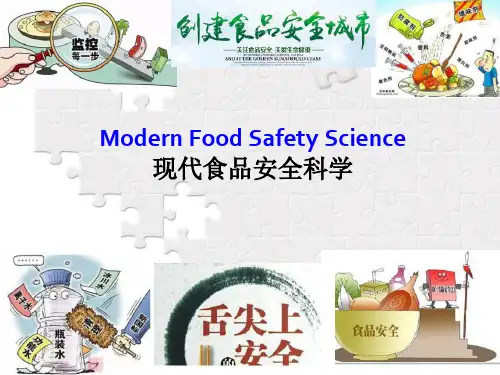
Food-safety---食品安全---英文版--PPT
As individuals
• Enhance our ability of health food from bad food. • improve awareness of selfprotection. • Fresh and green food is a good choice.
That's all
Health hazards
These subtances do a lot of harm to our health.such as indigestion ,diarrhea (腹 泻),and many different types of cancer
“Shou Rou Jing” poisoning accident in GuangZhou and ShangHai(2006)
The third point is that customers can not distinguish the quilities of food. And the forth point is that the supervision of food by government was not in adequate .
Swill-cooked dirty oil (地沟油)
It's from sewer(下水道) being extracted from the catering industry waste, and sometimes called hogwash oil because it is inedible and unsanitary .
请带上你的好心情 … …
Follow Me
பைடு நூலகம்
Here are some harmful food additives(添加剂)
What is food safety ?
Food safety that poisonous and harmful substances
in food will affect public health.
In that way
What should we do ?
Government & Individuals
Government’s duty
• Carry out professional moral education and legal education actively to improve food jobholders’ professionalism. • Strengthen the supervision of the food quality
Why are there so many food safety accidents in our life?
I think the reasons include the following points
The first point is drive of profit . The second point is that the professional and manager lack professional knowledge and safety-crisis consciousness in food corporation.
Melamine (三聚氰胺)
• Melamine is a chemical used in making plastics and fertilizer. • Many milk manufacturers add too much melamine to increase milk protein content .
Thank you
The end
Goodbye· goodlock
It was firstly found in Sanlu milk
• By November on 27 in 2008 there were 294,000 babies suffering from urinary tract stones and 11 died of drinking the milk which were added too much melamine.
FSMS

食品安全管理体系
食品安全管理体系
FOOD SAFETY MANAGEMENT SYSTEM • 食品安全管理体系 食品安全管理体系(FSMS)是根据危害分析 和关键控制点原理, 设置的一个逐步完善的 食品安全管理体系. 是通过从选择配料直至 将食品供应给顾客的每一个操作过程,得出 什么时候及如何控制这些危害. •它是专为43家香格里拉酒店,控制食品安全问题 而建立的与国际接轨的安全体系.我酒店配有专职 卫生管理经理在店内督导,检查.
培训内容
第一部分: 第一部分: FSMS
• • • • • FSMS DLC公司简介 食物中毒的危害 洗手八步骤 总结
第二部分: 第二部分: SARS
什么是FSMS? 什么是FSMS?
•F = Food 食品 •S = Safety安全 •M = Management 管理 •S = System 体系
症状
• 起病急,发热为最先症状,且多为高热(超过 度), 起病急,发热为最先症状,且多为高热 超过38度 高热( 有些人有畏寒怕冷症状。 有些人有畏寒怕冷症状。 • 伴有头痛、全身酸痛、无力。 伴有头痛、全身酸痛、无力。 • 随后出现咳嗽,多为干咳、少痰,偶有血丝痰。 随后出现咳嗽,多为干咳、少痰,偶有血丝痰。 干咳 • 病情严重会出现呼吸加速、气促、呼吸困难或进展为严 病情严重会出现呼吸加速、气促、 的呼吸困难。 重 的呼吸困难。 • 肺部 线检查 均有不同程度的 片状阴影或称网状样改变。 肺部X线检查 片状阴影或称网状样改变 或称网状样改变。 • 实验室检查白细胞计数一般不升高或下降。 实验室检查白细胞计数一般不升高或下降。 白细胞计数一般不升高或下降
P1 P2 P2a P3 P4 P5 P6 P7 P8 P9 P10 P11 P12 P13 P14 P15 P16 P17 P18 P19 P20 P21 P22 P23 P24 P24a P25 P26 P27
食品安全英语作文

食品安全英语作文Food Safety。
Food safety is a topic that concerns everyone, as it directly impacts our health and well-being. In recent years, there have been numerous cases of foodborne illnesses and contamination, making it more important than ever to pay attention to the safety of the food we consume.First and foremost, it is crucial to understand the importance of proper food handling and storage. This includes washing fruits and vegetables thoroughly, cooking meats to the appropriate temperature, and storing perishable items in the refrigerator. By following these simple guidelines, we can greatly reduce the risk of consuming contaminated food.Furthermore, it is essential for consumers to be aware of food labeling and expiration dates. Reading and understanding food labels can help us make informed choices about the products we purchase. Additionally, being mindful of expiration dates can prevent us from consuming spoiled or expired food, which can lead to food poisoning and other health issues.In addition to personal responsibility, food safety also requires the cooperation of food producers and suppliers. It is important for them to adhere to strict hygiene and sanitation standards in order to prevent contamination during the production and distribution process. Regular inspections and quality control measures should be implemented to ensure that the food reaching consumers is safe for consumption.Moreover, government regulations and policies play a significant role in ensuring food safety. Authorities should establish and enforce food safety standards to hold food producers and suppliers accountable for the quality and safety of their products. This can help prevent the spread of foodborne illnesses and protect the public from potential health risks.In conclusion, food safety is a shared responsibility that requires the cooperation of consumers, food producers, suppliers, and government authorities. By understanding theimportance of proper food handling, being mindful of food labeling and expiration dates, and implementing strict regulations and standards, we can work together to ensure the safety of the food supply. Ultimately, this will lead to a healthier and safer environment for everyone. Let us all do our part in promoting and maintaining food safety in our daily lives.。
英文教材食品安全Overview_food_safety
Safety or quality issue?
Unusual kidney stone 三鹿结石宝宝
September 11, 2008 Exposed in News - Stone kidney baby in Gansu To 12 October, Sufferred baby 52,857 12800 Hospitalized
How will study this course?
Lecture references
Nollet, L. M. L and Toldra, F. (2007). Advances in Food Diagnostics. Paster, T. (2007). The HACCP Training Food Safety. Motarjemi, Y. & Adams, M. (2006). Emerging Food Borne Pathogens. Rasco, B. A. (2005). Bioterrorism & Food Safety. Lees, M. (2003). Food Authenticity & Traceability. D`Mello, J. P. F. (2003). Food Safety. Riviere, J. (2002). Chemical Food Safety.
1. "Access by all people at all times to enough food for an
active, healthy life." (World Bank) 2. "All people at all times have both physical and economic
食品专业英语课件
译文
重组DNA技术在食品和食品配料的生产应用的20年的时间 里,已经从基础研究的水平发展成商业化的地步。
Part 2 食品科技英语的阅读
Lesson 1 WHO Strategy on Food Safety
From the very beginning, development and use of genetic engineering have been accompanied by strict regulations. These regulatory requirements cover the contained use of genetically modified organisms (GMO), their deliberate release into the environment as well as the placing on the market of products containing or consisting of GMO.
B. Most developing countries are willing to be responsible for the consequence of using the new technology.
C. Most developed countries are not willing to be responsible for the consequence of using the new technology.
到目前为止,还没有关于由人们消费转基因食品所产生的 译文 负面影响的报道。然而,转基因食品的本质(伦理问题)
和发展速度引起了消费者的恐慌。
Par Strategy on Food Safety
英语关于食物介绍-foodPPT课件

Pizza is another iconic American dish, with many different styles and toppings. It originates from Italy but has become so popular in the United States that it has been adapted and changed to suit American tastes.
European cuisine
Italian cuisine
Pizza, pasta, and Italian sauces are some of the most famous Italian dishes. Italians place a strong emphasis on fresh ingredients and simple yet delicious recipes, making their food both healthy and satisfying.
Chicken
A source of protein and iron. Some common types of meat include beef, chicken, pork, lamb, and veal.
A white meat that is a popular choice for many dishes. It can be roasted, grilled, or cooked in a curry dish.
African cuisine
Ethiopian cuisine
Ethiopian food is known for its unique flavors and spices, often using berbere, a spice mix that gives many Ethiopian dishes their characteristic heat and flavor. Dishes such as injera (a spongy bread) and various stews are common in Ethiopian cuisine.
食品安全法英文版
Food Safety Law of the People’s Republic of ChinaIssued by: The National People’s CongressDoc No.: President Order No.5 of the People’s Republic of ChinaIssued on: February 28, 2009Effective from: June 1, 2009Valid till:Category: national lawSource from: President Order of the People’s Republic of ChinaFood Safety Law of the People’s Republic of China has been adopted at the 7th Session of the 11th Standing Committee of the National People’s Congress of the People’s Republic of Chi na on February 28, 2009, and it is now issued and shall be effective as of June 1, 2009.President of the People’s Republic of ChinaHu JintaoFebruary 28, 2009Food Safety Law of the People’s Republic of China(adopted at the 7th Session of the 11th Stan ding Committee of the National People’s Congress of the People’s Republic of China on February 28, 2009)Table of ContentChapter 1. General ProvisionsChapter 2. Surveillance and Assessment of Food Safety RisksChapter 3. Food Safety StandardsChapter 4. Food Production and TradeChapter 5. Inspection and Testing of FoodChapter 6. Food Import and ExportChapter 7. Response to Food Safety IncidentsChapter 8. Supervision and AdministrationChapter 9. Legal LiabilitiesChapter 10. Supplementary ProvisionsFood Safety Law of the People’s Republic of ChinaChapter 1: General ProvisionsArticle 1 This Law is formulated to assure food safety, and safeguard people's health hand life.Article 2 Whenever the following activities are carried out in the territory of the People's Republic of China, this Law must be observed:1)Food production and processing (referred to as “Food Production” hereafter); food distribution and cateringservice (referred to as “Food Trading” hereafter);2)Production and trading of food additives;3)Production and trading of packing materials, vessels, detergents and disinfectants for food as well as utensilsand equipment used in food production and trading (referred to as “Food-Related Products” hereafter);4)Food additives and food-related products used by food producers and traders;5)Safety management of food, food additives and food-related products.The quality and safety management of primary agricultural products for consumption (hereinafter referred to as “Edible Agricultural Products”) shall be in accordance with the Quality and Safety of Agricultural Products Law. However, this Law must be observed in developing quality and safety standards for edible agricultural products and releasing safety information on edible agricultural products.Article 3 Food producers and traders shall strictly follow relevant laws and regulations and food safety standards in their food business activities, be responsible for the public, ensure the food safety, receive the supervision of the public and bear the social responsibility.Article 4 The State Council shall establish the Food Safety Committee, with the responsibilities determined by the State Council.The health authorities under the State Council is responsible for the overall coordin ation for food safety, and food safety assessment, development of food safety standards, publishing of food safety information, development of the certification conditions for qualification of the food inspection and testing agencies and the specification of inspection and testing, and organization for investigation and treatment of the significant food safety accidents.The authorities for quality supervision, administration of industry and commerce and FDA under the State Council shall be responsible for supervision and management of the food production, food distribution and catering service respectively according to the Law and the requirements of the State Council.Article 5 Local people's governments at and above county level shall take overall responsibility for, lead, organize and coordinate the supervision and management of food safety in their jurisdiction; establish and hone food safety coordination mechanisms for the inspection and management of food safety, take the leading and commanding role in dealing with food safety emergencies, develop a food safety accountability system, and review and evaluate the performance of food safety regulatory agencies.The local People’s Government at the county level or above shall define the responsibilities of the administrative departments for health, agriculture, quality supervision, industry and commerce and FDA for supervision and management of food safety, according to the Law and the requirements of the State Council.The relevant authorities shall be in charge of the supervision and management of food safety in the respective jurisdiction.The subordinate administrative divisions set up below a higher level people's government must be under the unified coordination of the lower level government in carrying out their food safety inspection and management.Article 6The administrative departments for health, agriculture, quality supervision, industry and commerce and FDA at the county level or above shall strengthen communication and close cooperation, exercise the right and bear the responsibilities according to the work division.Article 7 The related food industry associations shall strengthen their self-discipline, and guide food producers and traders to conduct production and operation according to law, enhance the construction of the industrial credit, and publicize and disseminate the food safety knowledge.Article 8Civil society and community groups are encouraged to conduct food safety educational activities on understanding of food safety, laws, regulations and standards, to advocate healthy diets and to raise consumer awareness of food safety and looking after their health.The media shall publicize food safety information, laws, regulations and standards and knowledge free of charge, and provide the supervision of public opinion regarding the act in violation of the Law.Article 9 The State encourages and supports basic and applied food-related research, and encourages and supports food producers and traders to apply advanced technologies and good management practices in order to improve food safety.Article 10 Any organization or individual has the right to report and indict behavior in violation of the Law, to request information from relevant agencies, and to propose comments and suggestions on food safety inspection and management. Consumers also have the right to demand compensation according to law for any physical and property damage caused by consumption of food, food additives or food-related products.Chapter 2: Surveillance and Assessment of Food Safety RisksArticle 11 A surveillance system for food safety shall be established nationwide for surveillance over food-borne disease, food contamination and other food-related hazards to human health.The health administrative departments of the State Council shall establish and implement plans for the surveillance of national food safety in conjunction with other departments of the State Council. The health administrative departments of governments of provinces, autonomous regions and municipalities directly under the central government shall establish and implement, according to the national plans for food safety surveillance and taking into consideration regional particularities, the plans and schemes for the surveillance of food safety within their respective jurisdictions.Article 12 The authorities for agriculture, quality supervision, administration of industry and commerce and FDA under the State Council shall, upon knowledge of any information on food safety risk, report to the relevan t authorities under the State Council. The health authorities under the State Council, in conjunction with other relevant authorities, shall verify the information and timely adjust the food safety risk surveillance plan.Article 13 A mechanism to assess food safety risks shall be established nationwide to assess risks of biological, chemical and physical hazards in foods and food additives.The assessment of food safety risk shall be the responsibility of a food safety risk assessment committee composing experts in medicine, agriculture, food, nutrition and other fields invited by the health authorities under the State Council.The assessment of food safety risk for pesticide, fertilizer, growth regulator, animal remedy, animal feed and feed additives, etc. shall be attended with the experts of the food safety risk assessment expert committee.The assessment of food safety risk shall be conducted by utilizing the scientific methods, based on the information of food safety risk surveillance, the scientific data and other relevant information.Article 14 The health authorities under the State Council, upon discovering any possible safety problem through food safety risk surveillance or reporting of other parties, shall immediately organize inspection and assessment of food safety risk.Article 15 The authorities for agriculture, quality supervision, administration of industry and commerce and FDA under the State Council shall propose the suggestions on assessment of the food safety risk, and provide the relevant information.The health authorities under the State Council shall timely report the results of the food safety risk assessment to the relevant authorities under the State Council.Article 16Food safety risk assessment results shall be the scientific basis for developing and modifying food safety standards, and overseeing and administering food safety.If the result of a food safety risk assessment proves food to be unsafe, the authorities for quality supervision, industry and commerce and FDA under the State Council shall promptly take appropriate measures to ensure food producers or traders to suspend or cease trading of such food, and inform consumers to stop use according to their respective duties and responsibilities; if necessary, immediately amend or develop any food safety standard.Article 17 The health authorities under the State Council shall, in conjunction with relevant State Council departments, conduct comprehensive analyses of the food safety situation according to the result of food safety risk assessments and food safety supervision and administration information and draw attention to food safety risks in high risk food.Chapter 3: Food Safety StandardsArticle 18 The food safety standards shall be intended to safeguard the health of the public, to be scientific, reasonable, safe and reliable.Article 19Food safety standards are mandatory. Except for the food safety standards, no other mandatory standards for food shall be developed.Article 20 The food safety standards shall specify:1)The limits to the content or concentration of pathogenic micro organisms, pesticide residues, veterinarymedicine residue, heavy metals, contaminants, and other substances that may be hazardous to human health in food;2)The type, scope of application and dose of allowed food additives;3)The nutritional ingredients requirements for staple and supplementary food exclusively for babies and otherspecific populations;4)The requirements for labels, identification and instructions relevant to food safety and nutrition;5)The health requirements for food production and trading processes;6)The quality requirements related to food safety;7)The methods and procedures for food inspection and testing; and8)Other particulars necessary for developing food safety standards.Article 21 The State Council authorized heath administrative department shall be responsible for developing and publicizing the national food safety standards; and the standardization authorities under the State Council shall provide the national standard number.The limit of pesticide residue and animal remedy residue in foods, and the inspection methods and procedures shall be developed by the health and agricultural authorities under the State Council.The inspection procedures for slaughtering livestock and poultry shall be developed by the competent authorities under the State Council in conjunction with the health authorities under the State Council.The relevant national product standards, if involving the national food safety standard, shall be consistent with the national food safety standard.Article 22The health authorities under the State Council shall integrate the compulsory standards in the applicable edible agricultural product quality and safety standards, food hygiene standards, food q uality standards and relevant industrial standards related to foods, and issue a unified national food safety standard.Before issuance of the national food safety standards specified in the Law, the food producers and traders shall produce or trade foods according to the applicable edible agricultural product quality and safety standards, food hygiene standards, food quality standards and relevant industrial standards related to foods.Article 23 The national food safety standards shall be reviewed and approved by the committee for evaluating national food safety standards comprising experts in medicine, agriculture, food, nutrition and other fields and the representatives from the health authorities under the State Council.National food safety standards shall be developed based on the results of food safety risk assessments and full consideration of the results of quality and safety risk assessments of edible agricultural products, as well as the relevant international standards and international food safety risk assessment results. Due consideration shall also be given to a broad range of opinions of food producers and traders.Article 24 When there is no national food safety standard in any aspect, the local food safety standard may be developed.The health administrative departments of provinces, autonomous regions and municipalities directly under the central government shall develop local food safety standards with reference to articles in this Law relating to development of national food safety standards, and report to the health authorities under the State Council responsible for recording.Article 25 When there is no national or local food safety standard for the food produced by a company, the company may develop the company standard as the basis for the production. The State encourages food producers and traders to develop in-house standards more stringent than the national or local food safety standards. The enterprise standard shall be reported to the provincial level health administration department for filing, and be applicable in the enterprise.Article 26 The food safety standards shall be provided for the free reference of the public.Chapter 4: Food Production and TradeArticle 27 Any food production or trading activities shall meet the food safety standard and be subject to the following conditions:1)Having appropriate facilities for raw material treatment and food packaging and storage that are sufficient forthe variety and quantity of food to be produced or traded, keeping the facilities clean and making sure that appropriate distance has been maintained between such facilities and toxic or hazardous locations and/or other contamination or contaminating sources.2)Having appropriate production or trading equipment and facilities that are sufficient for the variety andquantity of food to be produced or traded, and having appropriate equipment and facilities for disinfection, gowning, washing, lighting, ventilation, anticorrosion, dust-proofing, fly-proofing and rat/pest-proofing and drainage of wastewater and other wastes.3)Having food safety technical professionals, management personnel and the rules and systems to ensure thefood safety;4)Having the reasonable equipment and facility layout and operation procedures, to avoid cross contaminationbetween the food to be produced and the food for direct consumption, raw materials and finished products, and the food contacting the toxic or dirty matters;5)Washing and sterilizing the tableware and containers of foods for direct consumption before use, andwashing and keeping clean after use;6)Using the safe and harmless container, tool and equipment for storage, transport and loading/unloading offoods, keeping them clean to avoid food contamination, and meeting the special requirements on temperature and others required for food safety, and not transporting the food with toxic or harmful goods;7)Using the small package or nontoxic and clean packaging materials and tableware for the foods for directconsumption;8)Causing the personnel to maintain the personal hygiene, wash hand and put on the clean clothing and capduring work; and using the sterile and clean vending tools for the foods for direct consumption without package;9)Using water according to the national living water hygiene standard;10)Using the detergents and disinfectors safe and harmless to human body;11)Conforming to other requirements set forth in laws and regulations.Article 28 Production and trading of the following foods are prohibited:1)Food made with non-food raw material or adding non-edible chemicals or other substances possiblyhazardous to human health to food, or producing food with recovered food as raw materials;2)Food which exceed food safety standard limits in content or concentration of pathogenic microorganisms,pesticide residues, animal medicine residues, heavy metals, contaminants, and other substances that in food may be hazardous to human health;3)Staple and supplementary food exclusively for babies or other specific population, the nutritional ingredientsof which fail to meet food safety standards;4)Food which is rotten or spoilt, or has rancid fat, mildew or insects, or is contaminated or dirty, or containsforeign material or displays any other organoleptic irregularity;5)Meat or products of any bird, livestock, beast, or waterborne animal which has been killed by disease, poisonor any unidentified cause,;6)Meat or meat products which have not been quarantined or inspected by animal health supervisionauthorities or fail to pass such quarantine or inspection;7)Food contaminated by packaging materials, containers or transportation means;8)Food exceeding the shelf life;9)Pre-packaged products without labels;10)Food expressly prohibited by the State from production and trading for disease prevention and controlpurposes;11)Other food failing to meet food safety standards or requirements.Article 29The State implements a licensing system for food production and trading. Any organization or individual shall obtain the food production license, food distribution license or catering service license before starting the food production, food distribution or catering service.The food producer having the food production license is not required to obtain the food distribution license when selling foods produced by itself at its production premises; the catering service provider having the catering service license is not required to obtain the food production/distribution license when selling foods produced by itself at its service premises, and the farmer when selling the self produced edible agricultural products is not required to obtain the food distribution license.Small food workshops and food vendors shall conduct the food related activities according to the food safety requirements corresponding to their production/trading scale and conditions in the Law, and ensure the foods at the sites are clean, nontoxic and harmless. The relevant authorities shall strengthen the supervision and management, with the specific management measures developed by the standing committee of the People’s Congress of the provinces, autonomous regions and municipalities directly under the control of the Central Government according to the Law.Article 30 The local People’s Governments at the county level or above shall encourage the small food workshops to improve the production conditions, and encourage the food vendors to go for operations in the centralized market, the shops and other fixed marketplaces.Article 31The administrative departments for health, agriculture, quality supervision, industry and commerce and FDA at the county level or above shall review materials submitted by the applicants according to Article 27.1 –4 herein and Administrative License Law of The People's Republic of China, and check the places of production and/or trading of the applicants if necessary. Any applicant that meets the conditions shall be granted a permit and issued a license for food production, distribution or provision of catering services; and any applicant failing to meet the licensing conditions will be rejected and given a written explanation of the reasons.。
Unit1-Food Safety and Foodborne Illness
Unit 1: Warm up
Directions: You will hear a passage and you are required to fill in the blanks with the exact words you have just heard.
Food safety is considered to be an important public health issue
foodborne diseases each year has increased rapidly. Moreover,
developing countries bear the main impact of the problem due to the 4. ________ of a wide range of foodborne diseases. The global
Unit 1: Warm up
incidence(发生率) of foodborne disease is difficult to 5. estimate _______. While most foodborne diseases are occasional and often not reported, outbreaks may take on massive proportions(分 foodborne disease 6. ________ derived from 额 , 比 例 ). What’s more, the safety of food 7. ___________ assessed Other biotechnology(生物技术) needs to be carefully 8. ________. addressed to help ensure food safety, challenges, which need to 9. be _____________ include the globalization of trade in food, urbanization( 城市化 ), changes in lifestyles, international travel, environmental pollution, 10. deliberate ________ contamination(污染) and natural and manmade disasters.
第十一章 食品安全性毒理学评价
6
第二节 我国食品安全性毒理学 评价
7
一、制定《食品安全性毒理学评价程 序》的意义
《食品安全性毒理学评价程序》的实施为制定食品卫 生标准及对新产品上市前安全性评价提供了科学依据。
为了保障广大消费者的健康,对于直接和间接用于食 品的化学物质进行安全性评价时一项极为重要的任务。
21
二、转基因食品的概况
1983年的第一株转基因植物
22
23
转基因棉花
中国的转基因羊
日本研发的转基因大豆
各种各样的转基因水果
浙江省种植的转基因油菜
24
转基因食品总体发展状况
1994年,第一例进入市场的转基因食品(转基因番茄)在美国诞生。 随后,转基因食品越来越多
1996年,全球转基因作物的种植面积仅有170万公顷 1997年飙升到l 100万公顷,是1996年6倍多 1998年达2 780万公顷,在1997年的基础上又翻了一番多 1999年上升到3 990万公顷 2000年全球转基因作物种植面积达4 420万公顷 2001年增长到5 260万公顷, 2001年全球有13个国家种植了转基
适用于评价食品添加剂(包括营养强化剂)、 食品新资源及其成分、新资源食品、保健食 品(营养素补充剂)、辐照食品、食品容器 与包装材料、农药残留等的安全性评价
13
二、进行毒理学试验前有关资料的收集 在对待评价物质进行毒理学试验前,必
需尽可能的收集器相关资料,以预测其 毒性并为毒理学实验设计提供参考
80年代以后 :随着改革开放、国民经 济和社会的发展,制订化学物质安全性 评价体系和立法有关法律法规
1983年公布《食品安全性毒理学评价程序(试行)》,1985年经过修订, 正式公布为[(85)卫防字第78号文件]在全国范围内实施。
食品安全知识PPT
● 试验期限 一般情况下,致癌试验试验期,小鼠定为18个月,大 鼠为24个月;对个别生命期较长和自发性肿瘤较低的 动物,可适当延长。 ●指标观察与检测 1. 一般观察 2. 血液学检查 3. 血液生化指标测定 4. 病理检查
●结果判定: 如慢性毒性试验所得的最大无作用剂量 (以毫克/公斤体重计): 1.小于或等于人的可能摄入量的50倍者,表 示毒性较强,应予放弃。 2.大于50倍而小于100倍者,需由有关专家共 同评议。 3.大于或等于100倍者,则可考虑允许使用于 食品,并制定日许量。如在任何一个剂量发 现有致癌作用,且有剂量反应关系,则需由 有关专家共同评议,以作出评价。
2 结果判定: 如以上试验中任何一项的最敏感指标的最大无作用剂 量(以毫克/公斤体重计): 小于或等于人的可能摄入量的100倍者,表示毒性 较强,应予以放弃。 大于100倍而小于300倍者,可进行慢性毒性试验。 大于或等于300倍者,则不必进行慢性试验,可进 行评价。
第四阶段:慢性毒性(包括致癌)试验 在动物的大部分生命期间,经过反复给予受试物后观 察其呈现的慢性毒性作用及其剂量反应关系,尤其是 进行性和不可逆毒性作用及肿瘤疾患,并确定受试物 的无作用剂量(NOEL),作为最终评定受试物能否应 用于食品的依据。 ● 动物组数 除对照组外,一般试验组可分为3-5组,要求最高剂量 组的剂量能引起最小毒性表现,但不影响其正常生长、 发育和寿命。试验组的剂量可按几何级数或其他规律 划分,对照组除不给予受试物外其他条件均与试验相 同。
与食品安全有关的名词
日容许摄入量(ADI)
日容许摄入量( Acceptable Daily Intake)是指人类每日摄 入某物质直至终生,而不产生可检测到的对健康产生危害的量。 以每公斤体重可摄入的量表示,即mg/kg ADI 系将 NOAEL 除以合理的安全系数计算得出。
美好“食”光-安全伴行食品安全主题班会PPT
炸鸡翅
危害度:
★★☆
公众喜欢度:
★★★★
关键词:
薯粉丸 臭鸡翅
罪状揭露:
✓ 快餐店辣鸡翅竟是发臭鸡翅制成
炸油条油饼
危害度:
★★★
公众喜欢度:
★★★★★
关键词:
铝超标 敌敌畏 地沟油
罪状揭露:
✓ 油条八成铝超标 ✓ 过度摄入铝可能致痴呆症
手/牵/手/维/护/食/品/安/全 心/连/心/构/筑/和/谐/校/园
食品安全主题班会
臭豆腐
危害度:
★★★★☆
公众喜欢度:
★★★
关键词:
硫酸亚铁 明矾 垃圾 堆
罪状揭露:
✓ 化工用硫酸亚铁染黑豆腐 ✓ 臭豆腐作坊竟然藏在垃圾堆后 ✓ 化学毒剂“催生”臭豆腐 ✓ 用明矾制作臭豆腐
第三部分
十大垃圾食品
第一:油炸食品
导致心血管疾病 破坏维生素
第二:腌制类食品
导致高血压,肾负担 过重等。
如何分清食品保质期和保存期
保质期(最佳食用期) 是指标签指明的贮存条件下,保持 品质的期限,在一定时间内食品依 然可以食用。
保存期(推荐最后食用日期) 是指标签指明的贮存条件下,预计 的终止食用日期,超过保存期的食 品不宜食用。
第七部分
(一)油炸类食品,主要危害是:
1.油炸淀粉导致心血管疾病; 2.含致癌物质;
(七)罐头类食品(包括鱼肉类和水果类),主要危害是:
1.破坏维生素,使蛋白质变性; 2.热量过多,营养成分低。
(八)话梅蜜饯类食品(果脯),主要危害是:
1.含三大致癌物质之一:亚硝酸盐; 2.盐分过高,含防腐剂、香精,损肝。