
仁爱英语九年级 Unit 1 Topic1 Section C教案
仁爱英语九年级 Unit 1 Topic1 SectionC教案仁爱英语九年级 Unit 1 T教案Ⅰ. Material anal这是九年级第一单元第一话题的第三课时,本课的容量适中,主活动是1a。
1a通过对“Changes in Beijing”这篇文章的学习,进一步训练学生的阅读能力。
1a部分还对学生的阅读策略进行了指导:通过图片和语境来猜测生词。
通过完成1b,培养学生用英语学英语的意识。
1c主要是培养学生寻找段落中心句和归纳文章内容的能力。
2和3是紧密相连的两个任务。
2引导学生就家乡的变化进行交谈,训练学生的口语表达能力,并为3的写作训练做好准备。
3则以2的交流为依托,提高学生的写作能力。
本课通过对北京和家乡今昔的对比,引导学生了解过去,珍惜现在和展望未来,培养学生积极向上的生活态度和爱家爱国的情怀。
Ⅱ.Teaching awledge aims:掌握本课的重点词汇和短语,继续学习现在完成时。
2.Skill aims:培养学生的阅读能力和阅读技巧。
提高学生的口语表达能力和写作能力。
能通过图片和语境猜测词义,减轻学习过程中的压力。
了解T的含义并初步学习如何在口语表达和书面表达中进行运用。
al aims: (optional)引导学生了解过去,珍惜现在和展望未来,培养学生热爱生活的积极态度。
ulture awareness: (optional) 通过对北京今昔变化的对比,引导学生关注自己身边社会的变化,培养他们热爱家乡热爱祖国的情怀。
Ⅲ. Tand difficul:Words and phrases: communicalative, develadical, maapid, progress, already, be crowdedve ago od educauch with, what’ake progress, succeed in doingGrammar: Present P2. Difficul:如何通过语境,猜测生词、短语的意思。
如何在阅读过程中找出各个段落的T。
口头报告和书面写作时,能有意识的使用和supporting details。
Ⅳ. Learning strateg通过任务前活动,引导学生预测阅读内容。
通过找主旨句的方法,教会学生在做口头报告或写作时正确使用。
通过图片和上下文,提升猜测词义和扫清阅读障碍的学习策略。
Ⅴ. Teaching aids单词卡片(如narrow/wide,relative,machine,etc.)或者幻灯片;能反映学生家乡今昔变化的图片或照片等。
Ⅵ. Teaching proceduage(d)InteraaTeacher activudent activRemaGetting students ready for learning(3-5 mins)Class activGreetingT: Good morning, evI have a fuare with you … GreetingSs: Good morning, Miss Tan.…2Rev(3-5 mins)Group wPverbs at random and hold aarou’Then get the girlak ouaand the bay the past participles. Write dowBb.T: Boys and girls, we have learnedlad. Now let’s have a wordI’ll show you some verbs. Girls need to say the paand boys need to say the past participles as quickly as you can. Are you ready?Ss: Yes!T: doGs: didBs: d…PK between boys and girls. Speak out the paand past participlverbvely. Have awhich grouw: Yes! Gs: didBs: d…竞争是激发学生求知的良好方式,也是提升学习效率的有效途径。
建议一:对于基础较好的学生,可以要求他们用该动词的过去分词造句。
Pre-reading(5 mins)Class activPures and gguaningw words.T: Look aug road is very wide, buall road is narrow. So what’aning of “narrow”?Ss: …T: Look auamilunclu…they are all my relatives. So who can tell me what’aning of “relative”?…Guaningwords accordingures and the teacher’s d 教师根据教学实际,采用方便的方式,如图片,照片,幻灯片等都可以,只要达到看图猜词义的目的就行。
While-reading(10 mins)Pair workGroup w: Fast-reading.Gad the passage quickly andb in paanswer in class and givary explanaT: OK, now read the passage quickly andb together with your pa2:ve-reading.Read the passage again and guidd ouPara 2 and Para 3. Then discuss the details of part 2. F(Td paag answacher can encouraggive as many answers aan.) T: Read Para2 and Para3, can you findach para to summawhole passage? Then langes in Beijing.Read the passage quickly andguaningwordab. Discuss the answer with your paRead the passage agaand pay aara2 and para3. Discuanges in Beijing: Para.2…S2: Para. 3…注意用一到两个词语做例子,教会学生通过上下文来推测单词的含义,如communication。
引导学生分别找出主题句和论据细节, 培养学生学习阅读策略。
Post-reading(15 mins)Class activityGroup w: GunderlThen ask quabout the passage and deal with difficult languagT: Now, go ovassagbunderluIf you have any qulease raise up your hand and a2: Showu’ hometowns, givary dand guidgive an oralabouangwT: Now, let’ld pictures. Can you recoglaces?Ss…T: What has happenedlaces?Ss…T: Aanges good or bad?Ss…T: Can you state your reason?…T: Now who can make aabout youwn? Have a try, please!Read the passage carefully, discuss and ask quaboudo not understand. Tawacher gives explanaWork in groups, using 1c as an example, and discuangwns. Land details. Tudach group to givwhole cla学生水平有限的话可以老师直接讲解知识点。
学生直接给口头报告有难度的话老师可以先做一次范例,然后鼓励学生模仿,通过要求使用主题句和细节内容来组织学生的逻辑思维能力。
建议:可处理为读后的一个活动,如果学生水平好,课堂时间允许的话也可以作为一个读-说-写结合的独立活动来重点训练学生说和写的能力。
ummarizing and assigning homew(5 mins)Group w: Sum ulaThen ask one group to give aa2: Assign 3 as the HGo over whaave learned in Groups. Twhole class.Write a passage about changwns according to whaave discussedgroup.Ⅶ. Blackboard designOur country has developed rapidlReview:Clean/cleaned/cleanedFly/flew/flownDo/did/do…HMK: changwnT: …..Details…Languag:narrow, communica…uch with, m ake progucceed in doing……Reading:changes in Beijing:0s, …a has developed rapidly…road, medical care, educaunication, buildings。
新版仁爱英语九年级上册U2T1SA渗透法制教育教案

1Unit 2 Saving the EarthTopic 1 Pollution has caused too many problems.Baini Middle School :Chen WenjuSection AⅠ.Teaching aims (教学目标): 1.Knowledge aims (知识目标):(1)掌握本课的重点词汇和短语,巩固一般过去时和现在完成时的用法和区别。
(2)能够用一般过去时和现在完成时描述过去和现在的变化。
(3)正确使用there be sth./sb. doing sth.来表达“有某人/物正在做某事”。
(4)学习了解《中华人民共和国环境保护法》和《中华人民共和国野生动物保护法》的相关法律知识。
2.Skill aims (能力目标):(1)能听懂描述环境变化的对话,区别一般过去时和现在完成时的用法。
(2)能理解和运用一般过去时和现在完成时来进行听、说、读、写活动。
3.Emotional aims: (情感目标):通过学习了解“动物的生存现状”和环境污染带给动物的危害,让学生了解环境污染的严重性,并让学生树立良好的环保意识,自觉在日常生活中爱护环境,保护环境,珍爱野生动物。
The key points and difficult points (教学重难点): 1. Key points (教学重点):Words and phrases: bee, butterfly, mess, shame, several, pollute, waste, villager, destroy, cut down, goodness, pour, see sb./sth. do sth., see sb./sth. doing sth., cut down, my goodnessSentences: What a shame! / What a mess!The flowers and grass have gone!What has happened here?There be sth./sb. doing sth.There are several factories pouring waste water into the stream.Everything has changed.Grammar: differences between Simple Past and Present Perfect tense.2.Difficult points(教学难点):(1)正确使用there be sth./sb. doing sth.来表达“有某人/物正在做某事” 。
仁爱版九年级英语上册Unit 1 Topic 1 Section C教案

Unit 1 The Changing WorldTopic 1 Section C教案Teaching aims and demands1. Learn some new words and useful expressions: communication, quick, keep in touch with, sort, rapid, progress, make progress2. Go on learning the present perfect tense.3. Compare the living conditions in the past with those at present.4. Learn about the children’s lives in the past and children’s happy life at present.Teaching aids录音机/投影仪/旧北京城的图片/新北京城的图片/多媒体Teaching PlanStep 1 Review1.检查作业,让学生在小组中交流自己的报告,然后小组推荐出一名学生向全体同学报告,师生互动,谈论父母或爷爷奶奶的童年生活。
For example:T: What do you think of your life at present?Ss: We live a happy life.T: Do you know what your granny’s life was like in the past? Who can tell us?S1: I know. She had a hard life during her childhood. Her parents couldn’t afford her education. Her family was very big and poor.S2: She used to be a child laborer…S3: . . .T: Very good. So you should study hard and enjoy today’s life.2.用多媒体或图片展出,旧北京城和现代北京城的照片并做比较从而引出生词。
仁爱版九年级英语上册Unit1Topic1SectionC教案
Section CⅠ. Material analysis这是九年级第一单元第一话题的第三课时,本课的容量适中,主活动是1a。
1a通过对“Changes in Beijing”这篇文章的学习,进一步训练学生的阅读能力。
1a部分还对学生的阅读策略进行了指导:通过图片和语境来猜测生词。
通过完成1b,培养学生用英语学英语的意识。
1c主要是培养学生寻找段落中心句和归纳文章内容的能力。
2和3是紧密相连的两个任务。
2引导学生就家乡的变化进行交谈,训练学生的口语表达能力,并为3的写作训练做好准备。
3则以2的交流为依托,提高学生的写作能力。
本课通过对北京和家乡今昔的对比,引导学生了解过去,珍惜现在和展望未来,培养学生积极向上的生活态度和爱家爱国的情怀。
Ⅱ.Teaching aims1.Knowledge aims:掌握本课的重点词汇和短语,继续学习现在完成时。
2.Skill aims:培养学生的阅读能力和阅读技巧。
提高学生的口语表达能力和写作能力。
能通过图片和语境猜测词义,减轻学习过程中的压力。
了解Topic sentence的含义并初步学习如何在口语表达和书面表达中进行运用。
3.Emotional aims: (optional)引导学生了解过去,珍惜现在和展望未来,培养学生热爱生活的积极态度。
4.Culture awareness: (optional)通过对北京今昔变化的对比,引导学生关注自己身边社会的变化,培养他们热爱家乡热爱祖国的情怀。
Ⅲ. The key points and difficult points1. Key points:Words and phrases: communication, report, relative, develop, since, satisfy, medical, machine, rapid, progress, already, be crowded into, receive agood education, keep in touch with, what’s more, make progress, succeed in doing sth.Grammar: Present Perfect2. Difficult points:如何通过语境,猜测生词、短语的意思。
仁爱版英语九年级上册Unit1TheChangingWorldTopic1SectionD教学设计
5.阅读指导:通过阅读文章,培养学生关注文章主旨和细节的能力。采用问题导向法,设计有针对性的问题,引导学生深入思考,提高阅读理解能力。
6.情感教育:结合本章节主题,开展课堂讨论,引导学生关注世界变化、科技发展和环境保护等问题。同时,通过分享典型事例,激发学生的责任感,培养他们的情感态度和价值观。
7.课后拓展:鼓励学生在课后进行自主学习,关注时事新闻,拓宽知识视野。同时,布置相关作业,巩固所学知识,提高学生的学习效果。
8.评价与反馈:采用多元化的评价方式,如小组互评、教师评价等,关注学生的学习过程和成果。及时给予学生反馈,鼓励他们不断进步。
四、教学内容与过程
(一)导入新课
1.教师通过展示一组描绘世界变化、科技发展和环境保护的图片,引导学生观察并思考:“What is happening in our world?”、“How do you feel about these changes?”等问题。
4.提高学生的听说能力,通过听力练习和口语交流,让学生能够理解并表达关于世界变化、科技发展和环境保护等方面的信息。
5.培养学生的阅读理解能力,通过阅读文章,提取关键信息,理解文章主旨,并学会使用文章中的有用表达。
(二)过程与方法
在本章节的教学过程中,教师将采用以下方法引导学生学习:
1.情境教学法:通过展示图片、视频等教学资源,创设生动、真实的语境,让学生在情境中感知、体验和学习英语。
2.讲解一般现在时、一般过去时和一般将来时三种时态,结合实际语境,让学生在实际运用中掌握语法知识。
3.教师呈现Section D中的重点句型,如:“The world is changing rapidly.”、“We should protect the environment.”等,引导学生学会使用这些句型进行主题相关的讨论。
仁爱版九年级英语上册Unit2Topic1SectionC教学设计
(一)导入新课
1.教学活动设计:教师通过展示一组关于环境问题的图片,如污染、资源浪费等,引发学生对环保话题的关注,激发学生的学习兴趣。
教学语言引导:“Look at these pictures, can you tell me what is happening to our environment? Do you think it is important to protect our environment? Why?”
3.培养学生积极向上的态度,鼓励学生面对困难和挑战时,保持乐观、勇敢面对。
4.借助本章节的学习,引导学生树立正确的人生观、价值观,使学生认识到人与自然的和谐共处的重要性。
二、学情分析ቤተ መጻሕፍቲ ባይዱ
九年级学生已具备一定的英语基础,但在语言运用、思维能力和情感态度方面仍有待提高。在本章节的学习中,他们对于环境问题有一定了解,但可能缺乏深入的认识和关注。在语言技能方面,学生的听、说、读、写能力发展不均衡,部分学生在口语表达和写作方面存在困难。
3.教师总结:教师针对学生的反思和分享进行总结,强调环保意识的重要性,鼓励学生在日常生活中采取行动,保护环境。
教学语言引导:“In conclusion, I hope you can remember what we have learned and apply it to your daily life. Remember that it’s time to take action to protect our environment!”
五、作业布置
为了巩固本章节所学知识,培养学生的实践能力和创新思维,特布置以下作业:
1.写作练习:请运用本节课所学的被动语态和重点词汇,写一篇关于环保的短文,内容可包括环保问题的描述、解决措施及个人观点。要求:80-100词,语言准确,表达清晰。
仁爱英语九年级上Unit 1 Topic1--3同步教学导学案
九年级 Unit 1 The Changing WorldTopic 1 Our country has developed rapidly.Section A 导学案Ⅰ、学习目标: 学会区别have been to 与 have gone toⅠ、学习重点及难点:了解并掌握现在完成时的基本用法。
Step 1. 导入。
(约2分钟)教师播放幻灯片出示问题,学生讨论,导入新课。
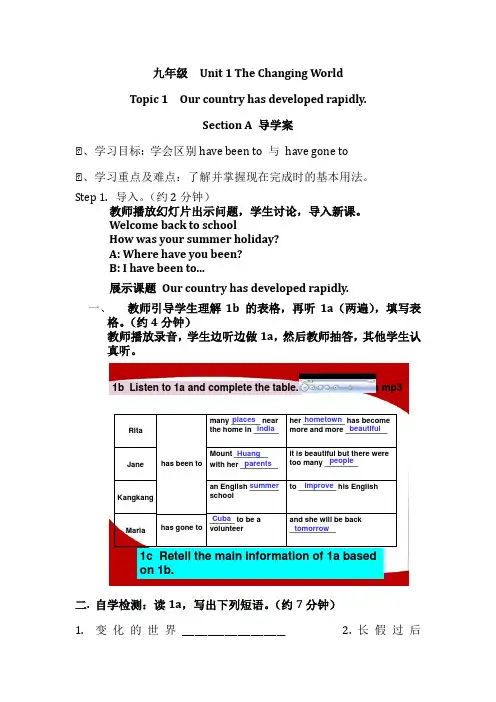
Welcome back to schoolHow was your summer holiday?A: Where have you been?B: I have been to...展示课题 Our country has developed rapidly.一、 教师引导学生理解1b 的表格,再听1a (两遍),填写表格。
(约4分钟)教师播放录音,学生边听边做1a ,然后教师抽答,其他学生认真听。
1b Listen to 1a and complete the table.has gone to to _________ his English it is beautiful but there were too many ________her __________ has become more and more __________Maria Kangkang Jane Rita has been to and she will be back _________________ to be avolunteer an English _______schoolMount ________ with her _________many _______ nearthe home in ______places India hometown beautiful Huangparentspeople summer improve Cuba tomorrow 1c Retell the main information of 1a basedon 1b.P1 1a mp3二. 自学检测:读1a ,写出下列短语。
仁爱版九年级英语上册U1T1SA优质教案
Unit1TheChangingWorldTopic1OurcountryhasdevelopedrapidlySectionAⅠ.Materialanalysis本课是九年级第一单元第一话题的第一课时。
本课内容丰富,主活动为1a和3。
1a部分通过“谈论假期经历”初步感知现在完成时“have/hasbeento和have/hasgoneto”的用法。
1b引导学生运用抓关键字词完成表格的方法,培养学生的听力技能。
1c则是培养学生运用关键词复述课文的能力。
2a通过创设新的语境,在听的过程中进一步体会“h ave/hasbeento和have/hasgoneto”。
然后在2b中让学生通过小组合作的方式总结它们的区别。
通过前几个步骤的学习,学生完全可以口头运用“have/hasbeento和have/hasgoneto”来进行3的对话操练。
这样,在听、说、读、写各个方面都对新语法进行了全方位地复现和操练,有利于巩固新知识。
通过谈论假期生活,既可以相互增长见识又可以增进同学间的友谊。
Ⅱ.Teachingaims1.Knowledgeaims:掌握本课的重点词汇和短语,初步学习现在完成时。
2.Skillaims:培养学生的听力能力。
培养学生的口语表达能力。
能通过整合对话内容,提升综合语言运用能力,为语言输出做好准备。
3.Emotionalaims:(optional)引导学生了解不同的假期生活,热爱生活,增进友谊。
4.Cultureawareness:(optional)通过了解不同的假期生活,引导学生关注不同的生活方式有不同的人生意义,培养他们热爱生活的品质。
Ⅲ.Thekeypointsanddifficultpoints1.Keypoints:Wordsandphrases:bell,takeplace,volunteer,have/hasbeento…,have/hasgoneto…,so…that …,bytheway,behappytodo…Sentences:Theregoesthebell./Itmustbefun.Grammar:PresentPerfect(have/hasbeento和have/hasgoneto的用法) 2.Difficultpoints:能通过听、说和读的方式感知并掌握have/hasdone的用法。
仁爱版九年级英语上Unit1Topic2SectionC教学设计
3.教师提出问题:“What can we do to protect the environment?”,引导学生进行头脑风暴,思考并列举保护环境的措施。
4.引入本节课的主题——Unit1 Topic2 SectionC,告诉学生将通过本节课的学习,了解环境保护的重要性,并学会用英语讨论相关话题。
(二)讲授新知(500字)
1.教师呈现本节课的新词汇,如responsibility, environment, protect, pollute, recycle等,通过例句、图片和实物展示等方式,帮助学生理解和记忆词汇。
2.讲解一般现在时和一般将来时的语法结构,并通过示例句子展示两种时态在句子中的应用。
在具体的教学过程中,教师应关注学生的学习需求,结合学科特点和课程内容,灵活运用多种教学方法和策略,使学生在轻松愉快的氛围中学习英语,提高语言运用能力,同时培养良好的情感态度和价值观。
二、学情分析
九年级学生在经过前两年的英语学习后,已经具备了一定的英语基础和语言运用能力。在此基础上,他们对本章节的学习有以下特点:
2.难点:
-学生的词汇记忆和运用能力,特别是词汇的准确拼写和在不同语境中的正确使用。
-语法结构的灵活运用,特别是时态的正确选择和使用。
-学生在讨论环境保护时,能够结合实际情况,提出合理的建议和行动计划。
(二)教学设想
1.教学方法:
-采用情境教学法,通过多媒体展示环境污染的图片和视频,让学生在具体情境中感受环境保护的紧迫性,激发学习兴趣。
3.教师引导学生结合新学的词汇和语法,进行简单的句子练习,如:“It is our responsibility to protect the environment.”、“We should take action to...”等。
仁爱英语九年级教案语法点
Unit 1 Topic 1 Section A.P1.1. The Changing World "变化中的世界" changing是现在分词,作world的定语。
e.g. a sleeping boy一个在睡觉的男孩P1.2. Rita,you have just come back from your home town. 丽塔,你刚从老家回来。
此句是现在完成时,表示在说话之前已发生或完成的动作对现在造成的影响或结果。
其结构是"助动词have/has+动词的过去分词"。
动词的过去分词的构成:规则变化跟动词的过去式一样,不规则变化见课本后面的附表。
e.g. I have finished that work. 我已经完成了那项工作。
She has bought a new bike. 她买了一辆新自行车。
拓展( 1 ) 否定句:主语+ haven't/hasn’t+动词的过去分词+其他如: He hasn't seen this film. 他没看过这部电影。
They haven't been to the Great Wall. 他们没去过长城。
( 2 ) 一般疑问句: Have/Has +主语+动词的过去分词+其他? 如:Have you cleaned the classroom? 你打扫教室了吗?Has your mother finished cooking? 你妈妈做好饭了吗?( 3 ) 特殊疑问句:特殊疑问词+ have/has +主语+动词的过去分词+其他?如:What has happened? 发生了什么事? Where has he gone?他去哪儿了?P1.3 -Where have you been,Jane? 简,你去哪里了?-I have been to Mount Huang with my parents. 我和父母去了黄山。
仁爱版九年级英语上册 Unit 1 Topic 1 Section C 课件(共21张PPT)
2. China has succeeded in _s_e_n_d_in_g_
(send) Shenzhou Ⅹ into space.
3. I have _a_lr_e_a_d_y_(已经) had lunch. I am full.
Translate the words and phrases.
3. What will … be like in the future?
It is important to write a topic sentence for each paragraph to help organize your thoughts.
3 Write a short passage on the topic Changes in… You should write its situation in the past and at present based on 2.
Homework
1. Read 1a aloud.
2. Finish Section C in your workbook.
3. Write a passage on the topic Changes in… according to Part 3.
4. Preview Section D.
THANK YOU!
确使用所学的现在完成时。
Have you ever been to Beijing?
Do you know about Beijing?
Look at the pictures of Beijing in the past and at present. Then guess the meaning of each word and the main idea of the text.