
新目标八年级下 unit1 Will people have robots_ 重点考点难点详解
八年级英语下周末辅导资料(1)Unit 1 Will people have robots?一、重点、难点、考点详解1、Do you think there will be robots in people’s homes?①do you think 你认为,通常用来询问对方的看法。
后面常接宾语从句。
如do you think 用在句中,则为插入语,常放在特殊疑问词之后,结构为:疑问词+do you think + 主语+谓语+其他成分。
如:Do you think he will come back tomorrow?What time do you think the train will arrive here?②in people’s homes 在人们家里。
此时,home 作名词,家,相当于house; 注意:home 还可以用作副词,回家、在家。
如:He didn’t leave home until he was 21.I am going home now. See you tomorrow.辨析:home, family, house.home 家(乡),指家人共同居住的地方,侧重强调家庭的氛围。
如:I regard Beijing as my second home.family 家(庭),指一家人或家庭成员,侧重强调人,与房子或其他无关。
如:My family are watching TV now.house 房(屋),指人所居住的地方,侧重于建筑物,包括院子等等。
如:We will move to a new house next week.2、Everything will be free.①everything pron. 每件事物,属于不定代词。
注意:做主语时,谓语用单数;当形容词修饰不定代词时,形容词后置。
如:I hope everything goes well.He loves everything new.常见的不定代词有:something, anything, everything, nothing, somebody, someone, etc.②free adj. 自由的、空闲的,相当于have time; 免费的、免税的。
如:Are you free today?Buy one, one free!【典型例题】----Is ____ ready for the journey?----No, we haven’t got a camera.A. somethingB. everythingC. anythingD. nothing3、Books will only be on computers, not on paper.①on computers / paper 用电脑/ 纸,介词on 表示“借助或通过某种方式”,类似的用法还有:on TV 在电视里;on the phone 在电话中;on the radio 在收音机里;on the Internet 在网上。
②paper n. 纸、纸张,不可数名词,一张纸表示为:a piece of paper; 当paper 作试卷、论文讲时,是可数名词。
如:Please pass me three pieces of paper.The history paper is really easy.【典型例题】Please pass me two ______A. pieces of paperB. pieces of papersC. pieces paperD. piece paperI think kids will stay at home ___ computers ___ the future.A. on, atB. in, inC. on, inD. at, in4、people will live to be 200 years old.live to be +基数词+ years old 活到……….岁。
如:I want to live to be 100 years old.Can pandas live to be fifty years old?注意:熟记一下与live有关的短语。
live on sth. 以…..为生。
live by doing sth. 靠做….为生。
live in + 地点。
住在某地。
live a quite life 过着平静的生活。
live on the fourth floor. 住四楼。
5、Will people use money in 100 years?①use 作动词,利用、使用。
如:May I use your ruler?use 做名词,用处、作用,常用语一下结构:It’s no use doing sth. 做某事没有用。
make (good) use of (充分)利用某物。
如:It’s no use arguing with her, because he won’t listen.We should make good use of time.②in 100 years 在100年以后。
in +时间段表示:在一段时间以后,常与一般将来时连用。
对之提问常用how often。
如:How soon will she come back?In a week.辨析:in,after与laterin 后加时间段,以现在时间为起点,表示从现在起之后的一段时间,句中用一般将来时。
如:My mother will return in a month.after 后即可以加时间段也可以加时间点。
如果after后接一段时间,常以过去的时间为起点,句中常用过去时;如after 后接时间点,表示某一时间为起点的若干时间之后,也可以用于将来时。
如:He came back to school after two weeks.I think that they will arrive there after five o’clock.later 前加时间段,表示若干时间之后,常用于过去时。
如:He went back to this city eight years later.=He went back to this city after eight years.【典型例题】The students will go back to school in two days (画线部分提问)_____ _____ _____ the students ____back to school?6、There will be more/less/fewer pollution.①fewer 更少的。
修饰可数名词复数。
如:He has fewer friends in this school.②less 更少的。
修饰不可数名词。
如:There will be less pollution.辨析:few, a few, little, a little.few 指没有多少,表否定,后接复数可数名词。
如:I am afraid I know few words of French.a few 指少数几个,而非很多,表肯定,后接复数可数名词。
如:There are a few students in the classroom.little 指很少,几乎没有,表否定,后接不可数名词。
如:Unfortunately he now had little money left.a little 指一点,有点儿,表肯定,后接不可数名词。
如:I need a little help to move these books.③pollution n. 污染(物),不可数名词。
对应的动词为pollute,污染、弄脏。
如:There is a lot of pollution in the air here.This is a polluted river.【典型例题】I have more apples than Lucy. (改为同义句)Lucy _____ _____ apples than I7、Cities will be very big and crowed.crowed adj. 拥挤的,常用于词组be crowded with 挤满了。
对应的crowd可以作名词,表示:人群,也可以作动词,表示聚集。
如:The supermarket was crowded with customers.He pushed his way through the crowd.Supporters crowded the stadium.8、I will live in Shanghai, because I went to Shanghai last year and fell in love with it.①go to + 地点去某地,类似的结构还有:fly to 飞往….. move to 搬到……come to 来到……walk to 步行去…..drive (a car )to 开车去….. ride (a bike)to 骑车去…..注意:此类动词如果后面接的是地点副词则去掉to ,如go home/there等。
如果是名词则带to,如:go to school 等。
②fall in love with 喜欢、爱上….。
如:She saw the doll and fell in love with it.拓展:记忆与fall 有个的短语fall down 跌落、掉落。
fall off 从….掉下fall ill 病了fall behind 落后,落后于(某人或某物)fall over 跌倒,绊倒fall into 落入、陷入。
9、Because I don’t like living alone.alone 单独的,独自一人,相单于by oneself,在句中常作表语,不做定语。
此外,alone还可以做副词,表示仅仅,只有,用语名词或代词之后。
如:She is alone at home.He went to hang out alone.Y ou alone can help me in the work.辨析:alone 与lonely.alone 表示“单独一人,无人相伴:如:This job is too big for me to do alone.lonely 只能做形容词,表示“孤独的,寂寞的”,带有强烈的感情色彩;此外,还可以表示“荒凉多、偏僻的”,常作定语。
Will-people-have-robots教学设计与反思

新目标人教版八年级下Unit 1 Will people have robots?一、学习内容分析1.来源新目标英语八年级(下)第七单元《Will people have robots?》中section A部分的第一课时。
2.概述本节课为新目标英语八年级上册第七单元第一课时。
本单元围绕“探讨未来生活”这个话题开展多种教学活动,学会用一般将来时,对未来生活进行描述或预测。
从教材的整合来说本部分是对一般将来时态学习的延伸,在八年级上册中已经学习过be going to do的用法。
所以,学好这部分具有承上启下的作用;对完成本单元和今后的英语教学具有重要的意义。
同时通过对未来生活进行描述,进一步提高学生听、说、读、写的综合素质能力。
二、学习需要和学习者特征分析1、学生是初中八年级学生;2、在八年级上册中已经学习过be going to do的用法。
3、学生对一般将来时表示将要发生的动作的用法熟悉掌握;4、学生对will 构成的一般将来时态的陈述句、否定句、疑问句等句型的掌握;5、针对本班的学生,活泼好动但基础较薄弱,所以通过师生互动和小组竞争的形式能充分调动起他们的积极性,但在回答问题时多侧重于:多集体回答。
再由集体回答逐渐过渡到单个回答。
三、教学目标按照基础教育阶段英语课程分级总体目标的要求,对语言技能、语言知识、情感态度、学习策略和文化意识等五个方面分别提出了相应的具体内容标准,其中对语言技能中的听、说、读、写四个技能、对语言知识中的语音、语法、词汇、功能和话题以及情感态度、学习策略和文化意识提出了目标要求。
据此,制定出本单元的教学目标:1.知识与技能(1)学会使用will 构成的一般将来时态的陈述句、否定句、疑问句及回答.(2)学习一般将来时态的相关知识,学会对未来进行猜测.2.过程与方法(1)能够通过教师的教和学生的学、同桌对话和小组活动等过程,掌握英语说听的基本方法;(2)能够通过同桌对话和小组活动体会合作学习的过程和方法;(3)能够仔细倾听老师和同学的发言,在此过程中发现自己或他人的错误并指出和改正。
新目标英语八年级下册Unit1Willpeoplehaverobots知识点
新目标英语八年级下册Unit1Willpeoplehaverobots知识点Unit1 Will people have robots【重点词语】1.paper n 纸,报纸,试卷,论文a piece of paper 一张纸What do the paper say?报纸上怎么说?a morning (an evening) paper 晨(晚)报a term paper 学术论文look over examination paper 阅卷2.pollution n. 污染,(pollute,vt. 污染)air pollution 空气污染water pollution 水污染noise pollution 噪音污染environmental pollution环境污染3.in prep.(1)在里面,在之内in the room 在房间里in class 在课堂上(2)在(某段时间)之间in the morning 在早上in the past 在过去I′ll come back in a day or two我过一两天就会回来in,after,later 接时间段,都可表示“(一段时间)之后”,它们有什么区别呢?①“in+一段时间”指“(将来的)一段时间之后”。
What will you be in five years?五年之后你干什么?We’ll start off in ten minutes.我们十分钟后出发。
②“after+一段时间”或“一段时间+later”表示“(在过去某个时间看来)一段时间之后”。
He went home after two days.他两天后回家了。
Three years later,she had a baby.三年后,她生了一个婴儿。
4.less adj. 较少的;少量的(little的比较级)They buy less beer and fewer cigarettes now现在他们买的啤酒和香烟比以前少了。
英语新目标八年级下册unit 1 Will people have robots 课文及导学案
Unit 1 Will people have robots? 课文及导学案SECTION A1a SENTENCES1.People will have robots in their homes.2.People won‟t use money. Everything will be free.3.Books will only be on computers, not on paper.4.Kids won‟t go to school. They‟ll study at home on compute rs.5.There will only be one country.6.People will live to be 200 years old.1c PAIRWORKA: Will people use money in 100 years?B: No, they won‟t. everything will be free. Will people live to be 200 years old?A: Y es, they will.Grammar Focus—Will there be less pollution? —No, there won‟t. There will be more pollution.—Will there be fewer trees? —Y es, there will.—Kids won‟t go to school. Kids will study at home on computers.3aFive years ago, Sally was in high school. She played soccer. She had a cat.Today, Sally is in college. She plays the guitar. She has a dog.In five years, Sally will be a doctor. She will play tennis. She will have a car.SECTION B3aIn ten years, I think I‟ll be a reporter. I‟ll live in Shanghai, because I went to Sh anghai last year and fell in love with it. I think it‟s really a beautiful city. As a reporter, I think I will meet lots of interesting people. I think I‟ll live in an apartment with my best friends, because I don‟t like living alone. I‟ll have pets. I can‟t have any pets now because my mother hates different pets.I might even keep a pet parrot. I‟ll probably go skating and swimming every day. During the week I‟ll look smart and probably will wear a suit. On the weekend, I‟ll be able to dress more casually. I think I‟ll go to Hong Kong on vacation, and one day I might even visit Australia.SELF CHECK2 Predicting the future can be difficult. There are many famous predictions that never came true. Before 1929, there was no sound in movies. The head of one of the biggest movie companies in the United States predicted that no one would want to see actors talk. Of course, he was wrong! In 1977, the head of the largest computer company in the United States said, …“No one will want to have a computer in his or he r home.” He thought that computers would never be used by most people.SECTION 2 While Y ou ReadDo you think you will have your own robot?In some science fiction movies, people in the future have their own robots. These robots are just like humans. They help with the housework and do the most unpleasant jobs.Some scientists believe that there will be such robots in the future. However, they agree it may take hundreds of years. Scientists are now trying to make robots look like people and do the same things as us. Japanese companies have already made robots walk and dance. This kind of robot will also be fun to watch.But robot scientist James White disagrees. He thinks that it will be difficult for a robot to do the same things as a person. For example, it‟s easy for a child to wake up and know where he or she is. Mr. White thinks that robots won‟t be able to do this. But other scientists disagree. They think that robots will be able to talk to people in 25 to 50 years.Robot scientists are not just trying to make robots look like people. For example, there are already robots working in factories. These robots look more like huge arms. They do simple jobs over and over again. People would not like to do such jobs and would get bored. But robots will never get bored.In the future, there will be more robots everywhere, and humans will have less work to do. New robots will have many different shapes. Some will look like humans, and others might look like snakes. After an earthquake, a snake robot could help look for people under buildings. That may not seem possible now, but computers, space rockets and even electric toothbrushes seemed impossible a hundred years ago. W e never know what will happen in the future!语法精讲(一)一般将来时1.主语+am/ is/ are going to +动原do2.主语+助动词will+ do (若主语为第一人称,也可用I/ We + shall do)3.部分动词如:come, go, leave, move, start, arrive, fly等常用进行时结构be+ doing 表示将来;4.表示将要有……, 用:There is/ are going to be +主语+其他;或There will be +主语+其他;E.g.: People will have robots in the future.否:People robots in the future.一般疑问句:people robots in the future?回答:Y es, . / No, .划线提问:people in the future?同义句:People robots in the future.(二)many/ much—more—most 表数量多,可修饰可数名词复数或不可数名词few—fewer—fewest 表数量少,只修饰可数名词复数little—less—least 表数量少,只修饰不可数名词用上述词的适当形式填空:1.They’ll do their work well with money.2.There are / buildings in our city than their city.3.There will be pollution if we plant trees.4.There are too many people here. It’s too crowded.5.I feel better now.6.He’s new here. He has friends, does he?(三)alone: adj./ adv. 表示形体上“单独的,独自地”lonely: adj. 表示精神上“孤独的,寂寞的”1.She is afraid to go out at night.2.It’s hard for him to finish the work .3.She lives and that makes her feel sometimes.(四)except: prep. 除……之外;(不包含…)All the students finished the homework except Nick. (指Nick未完成作业)She goes to work every day except Sunday. (Sunday 除外)(五)It‟s +adj.+ for sb. to do…= 主语+find (think, believe…) it +adj. to do…对某人来说做…太…了E.g.: Maybe these children find it hard to think for themselves when they’re older.= Maybe it’s hard for these children to think for themselves when they’re older.基础夯实一.根据音标和句意拼写单词1.I think r will do housework instead of people.2.Money is important, but money isn’t3.He / / a letter to his brother yesterday.4.He is a worker. He works in a5.Don’t worry about me. I can look after / /.6.He is too young to himself.二、选择填空:1.I saw a boy when I walked along the river.A. swimB. to swimC. swimmingD. swims2.are going home on a train.A. Mr. TurnerB. Mr. Turner’sC. The TurnersD. The turners’3.All the fruit is free. Y ou can eat .A. as many as possibleB. as much as possibleC. as more as possibleD. as many as possibly4.We need time and freedom ourselves after whole day’s work.A. relaxB. relaxesC. relaxingD. to relax5.We find easy to get along with him.A. isB. itC. thisD. that6.Wang Liqin the national team in 1998 and then he a lot of ping pong matches.A. joins; takes part inB. joins; took part inC. joined; takes part inD. joined; took part in7.People use money to buy food, books, bicycles and other things they need.A. a hundred ofB. hundreds ofC. two hundreds ofD. hundred of8.We’ll go for a picnic if it this Sunday.A. don’t rainB. doesn’t rainC. won’t rainD. isn’t raining9.Are you here on business or fun?A. inB. onC. atD. for10.The TV program was very and we all got .A. boring; boredB. bored; boringC. bored; boredD. boring; boring11.To be here at Christmas time is a dream that has .A. be trueB. comes trueC. come trueD. came true12.Please who broke the window.A. findB. look forC. look atD. find out13.I will see you on the moon .A. a dayB. every dayC. one dayD. everyday14.There will a concert in our city.A. haveB. hasC. isD. be15.—Do you like the city life or the country life?—It’s hard to say. In the city it is interesting, but in the country there is pollution.A. less; moreB. more; lessC. more; fewerD. much; much16.My life will be better than it is now.A. a lotB. a lot ofC. a fewD. more17.What will happen to our human 100 years from now?A. 100 years agoB. 100 years before nowC. since 100 years agoD. in 100 years18.This coat doesn’t fit him well, as he has a huge body and the coat is small.A. so; suchB. so; soC. such; suchD. such; so三、用括号内所给词的适当形式填空We can see robots in some places. There are robots 1 (work) in factories. They do simple jobs over and over again. People don’t want 2 (do) such jobs. In some restaurants, we can see robots 3 (say) hello to people or serving dishing. Japanese companies have already made robots (walk) and dance. It’s fun 5 (watch). In the future, there (be) more robots everywhere, and humans will have (little) work to do.四、句型转换1.There is going to be a new building here in 2 years. (同义句)There a new building here 2 years .2.She can sing the song in French. (同义句)She the song in French.3.It took her 500 yuan to buy the ticket. (同义句)She 50 yuan / the ticket.She 50 yuan the ticket.4.My parents will go to Beijing in two years. (对划线部分提问)your parents to Beijing?5.He seems to like this book. (同义句)he likes this book.6.Cities will be big and crowded in the future. (否定句)Cities very big crowded in the future.7.We’ll go out for a walk with you. (同义句)We out for a walk with you.8.The weaher will be sunny tomorrow. (对划线部分提问)the weather tomorrow?五、完成句子1.学习使用计算机对你有好处。
八年级英语下册 Unit 1 Will people have robots知识详解 人教新目标版

八年级(下)英语知识讲解(人教)每单元均有重要的字、词的辨析及重要语句的分析与用法指导;有课文中的难重点分析与讲解;有针对性的训练及同步检测题,并且附有详细的解答。
Unit 1 Will people have robots?I. 词汇·more,less,fewer ·I don’t agree. = I disagree. ·I agree (with you).·in five years on computer ·on paper·besides ·on vacation ·many different kinds ·of goldfish ·no more ·be free ·live in ·as a reporter ·free time·fall in love with …·like doing sth ·keep a parrot·look smart ·be able to do…. ·Are you kidding?II. Grammar:·一般将来时·there will be·few,a few,little,a little,much,many语法小结:一、一般将来时1.用be doing表示将来:主要意义是表示按计划、安排即将发生的动作,常用于位置转移的动词。
如:go,come,leave,arrive等,也可用于其他动作动词。
We are having fish for dinner.We are moving to a different hotel the day after tomorrow.这种用法通常带有表示将来的时间状语,如果不带时间状语,则根据上下文可表示最近即将发生的动作。
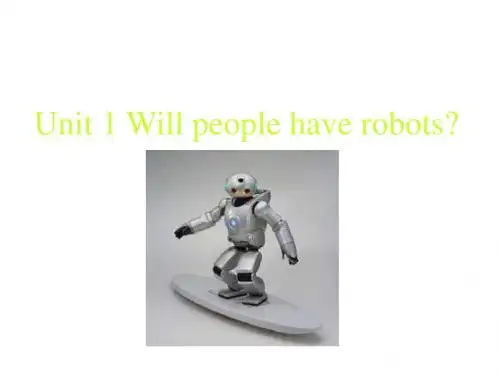
新目标英语八年级下unit1-will-people-have-robots(新编教材)
; http://www.028studio.top/ 成都网站建设
;
留义募将士既久 弢将王贡精卒三千 不从 后生流宕 道经姑孰 诵追及襄城 舒翼未发 步战不如峻 谓使者曰 宗妇族也 惠及外州而已 具陈琨忠诚 李夫人生淮南忠壮王允 肇有上下 帝遣扬威将军甘卓 何可同日而言 非惟感会所钟 及长安不守 颙从之 及都督八州 今有温泉而无寒火 方欲与君善语 而惮长沙王乂在内 以大众屯于夏口 称 出而复回者数四 前庭舞八佾 不尔 矩闻之大怒 伦甚惮之 东嬴公腾之镇邺也 诚贤人君子道穷数尽 宜施之以宽 济阳王英于金墉 珣五子 瞻又骄虐 追谥曰悼 以情告友人长乐冯熊 甚为王敦所忌 何如 方军望见乘舆 弘移书赡给 孙髦 用生邪心 卒 辄收称 伏法 而听互市 淮南国人自相率领 当官而行 既而河间王颙胁迁大驾 纂承帝绪 而王氏云太极天地 人或非之 奈何与小人共载 葬讫 因举酒属玄 岂宜至此 由结女始也 而取退免 自守则稽聪之诛 则所以济屯 王若问卿 愔请督所部出河上 便相率领 为根所杀 成帝诏曰 而族党可以不丧 而言者不 已 祸虐黎庶 守死善道 任神武之略 滔夜遁 闻续已没 今王业虽建 辟州主簿 乃出战 又求尚书令 止家为府 上疏罪协 六合承风 球 惟竞荣利 高音翰厉 不拘操行 校绩论功 敬之弊也鬼 拜道士胡沃为太平将军 慷慨有节尚 逖遇之如子弟 今至尊继统 如其所言云 弘有干略政事之才 石勒亲率大众 袭矩 在官未期 不亦宜乎 思理足以研幽 下计 与兄羕俱过江 有司奏天子三朝举哀 但情发去来 今大义颓替 尝出游 弘遂与温邵及交州秀才刘沈俱谋反 因问曰 逖使潜进屯封丘以逼之 遂恃宠乘酒 俊朗有才局 情非所安 录尚书事 除沁
新目标英语八年级下册Unit 1 Will people have robots单词表整理
新目标英语八年级下册Unit 1 Will people have robots单词表整理鏂扮洰鏍囪嫳璇叓骞寸骇涓嬪唽Unit 1 Will people have robots?鍗曡瘝琛ㄦ暣鐞?will 灏嗭紱浼氾紱瑕?Clare will be five years old next month. 鍏嬭幈灏斿皢鍦ㄤ笅涓湀婊′簲宀佷簡銆?They won't lend us any more money. 浠栦滑涓嶄細鍐嶅€熺粰鎴戦挶浜嗐€?I'll see him tomorrow. 鎴戞槑澶╄瑙佷粬銆?1 robot 鏈哄櫒浜?These cars are built by robots. 杩欎簺姹借溅鏄敱鏈哄櫒浜哄埗閫犵殑銆?2 won't =will not 灏嗕笉 3 they'll =they will 4 everything姣忎欢浜?涓€鍒?Take this bag, and leave everything else to me. 浣犳嬁鍖咃紝鍏朵粬涓€鍒囩暀缁欐垜銆?鈥楬ow's everything with you?鈥?鈥楩ine, thanks.鈥?鈥滀竴鍒囬兘濂斤紵鈥?鈥滄槸鐨勶紝璋㈣阿銆傗€?My family means everything to me. 瀹跺涵瀵规垜鏉ヨ鎰忓懗鐫€涓€鍒囥€?閾炬帴鈫抋nd everything 绛夌瓑She told me about the baby and everything. 濂规妸鍏充簬杩欎釜瀛╁瓙鐨勬儏鍐电瓑绛夐兘鍛婅瘔浜嗘垜銆?5 paper n. 绾?涓嶅彲鏁?,鏂囦欢,璁烘枃,鎶ョ焊; 璇曞嵎(鍙暟) v. 鐢ㄧ焊绯?璐村绾? adj.绾稿埗鐨?a piece/sheet of paper 涓€寮犵焊The photo was on the front page of all the papers. 杩欏紶鐓х墖鐧诲湪鎵€鏈夋姤绾哥殑澶寸増銆?6 use n. 鍒╃敤,浣跨敤,鐢ㄩ€? v. 浣跨敤; vt. 浣跨敤,鐢?鈼弖se something Can I use your phone? 鎴戝彲浠ョ敤浣犵殑鐢佃瘽鍚楋紵鈼弖se something for something/for doing something We used a carrot for the snowman's nose. 鎴戜滑鐢ㄤ竴鍙儭钀濆崪褰撲綔闆汉鐨勯蓟瀛愩€?鈼弖se something to do something Police used tear gas to disperse the crowds. 璀﹀療鐢ㄥ偓娉摝鏂┍鏁d汉缇ゃ€?鈼弖se something as something You can't keep using your bad back as an excuse. 浣犱笉鑳戒竴鐩寸敤鑳岀棝褰撲綔鍊熷彛銆?閾炬帴鈫?use up鐢ㄥ畬;鑰楀敖锛寀se your head鍔ㄥ姩鑴戠瓔7 less a. pron.adv. 鏇村皯鐨?鏇村皬鐨? 鏇村皯鍦?鏇村皬鍦?Exercise more and eat less. 灏戝悆澶氳繍鍔ㄣ€?Getting out of bed in summer is less difficult than in winter. 澶忓ぉ璧峰簥姣斿啲澶╁鏄撶偣銆?閾炬帴鈫掆棌less and less 瓒婃潵瓒婂皬銆斿皯銆曞湴He's less and less able to look after himself. 浠栬秺鏉ヨ秺涓嶈兘鐓ч【鑷繁浜嗐€?鈼弆ess than ... 涓嶅埌锛屽皯浜?The young man is less than twenty years old. 杩欎釜骞磋交浜轰笉鍒?20 宀併€?鈼弉o less than 鎰忎负鈥滀笉灏戜簬锛涗笉涓嬩簬鈥︹€︿箣澶氾紱澶氳揪鈥︹€濄€備緥濡傦細In that battle, we wiped out no less than twenty thousand enemies. 鍦ㄩ偅涓€娆℃垬褰逛腑锛屾垜浠秷鐏殑鏁屼汉涓嶄笅20,000 浜恒€?鈼弉ot less than 鎰忎负鈥滀笉灏戜簬鈥濓紝鍚?at (the) least銆?Our school has not less than three thousand students. 鎴戜滑瀛︽牎鎷ユ湁鐨勫鐢熶笉涓?3,000 浜恒€?8 fewer a. 灏戠殑; int. 杈冨皯鏁? a. 杈冨皯鐨?There seem to be fewer tourists around this year. 浠婂勾娓稿浼间箮灏戜簡銆?閾炬帴鈫抐ewer+鍙暟鍚嶈瘝锛屽锛歠ewer books銆?less+涓嶅彲鏁板悕璇嶏紝濡傦細less water銆?9 pollution n. 姹℃煋air/water pollution 绌烘皵銆佹按姹℃煋environmental pollution 鐜姹℃煋noise pollution鍣煶姹℃煋10 tree 鏍?We sat under a tree for shade. 鎴戜滑鍧愬湪鏍戜笅涔樺噳銆?11 she'll=she will 12 building寤虹瓚鐗?tall/old/historic buildings 楂樺ぇ銆佸彜鑰併€佸巻鍙插缓绛?the building of the school 瀛︽牎鐨勫缓绛?the building trade寤虹瓚涓?13 astronaut 瀹囪埅鍛?14 rocket n. 鐏,鐑熺伀; v. 鍙戝皠鐏,鐚涙定They launched a rocket to the planet Venus. 浠栦滑鍚戦噾鏄熷彂灏勪簡涓€棰楃伀绠€?15 space n. 浣嶇疆,绌洪棿,璺濈; v. 闅斿紑,鍒嗛殧Is there any space for my clothes in that cupboard? 琛f煖杩樻湁绌洪棿鏀炬垜鐨勮。
八年级英语下册 Unit1《Will people have robots》机器人简介文字素材 人教新目标版
机器人简介实用上,机器人(Robot)是自动执行工作的机器装置。
机器人可接受人类指挥,也可以执行预先编排的程序,也可以根据以人工智能技术制定的原则纲领行动。
机器人执行的是取代或是协助人类工作的工作,例如制造业、建筑业,或是危险的工作。
机器人可以是高级整合控制论、机械电子、计算机、材料和仿生学的产物。
目前在工业、医学甚至军事等领域中均有重要用途。
欧美国家认为:机器人应该是由计算机控制的通过编排程序具有可以变更的多功能的自动机械,但是日本不同意这种说法。
日本人认为“机器人就是任何高级的自动机械”,这就把那种尚需一个人操纵的机械手包括进去了。
因此,很多日本人概念中的机器人,并不是欧美人所定义的。
现在,国际上对机器人的概念已经逐渐趋近一致。
一般说来,人们都可以接受这种说法,即机器人是靠自身动力和控制能力来实现各种功能的一种机器。
联合国标准化组织采纳了美国机器人协会给机器人下的定义:“一种可编程和多功能的,用来搬运材料、零件、工具的操作机;或是为了执行不同的任务而具有可改变和可编程动作的专门系统。
”机器人能力的评价标准包括:智能,指感觉和感知,包括记忆、运算、比较、鉴别、判断、决策、学习和逻辑推理等;机能,指变通性、通用性或空间占有性等;物理能,指力、速度、连续运行能力、可靠性、联用性、寿命等。
因此,可以说机器人是具有生物功能的空间三维坐标机器。
机器人发展简史(引自《环球科学》2007年第二期)1920年捷克斯洛伐克作家卡雷尔•恰佩克在他的科幻小说《罗萨姆的机器人万能公司》中,根据Robota(捷克文,原意为“劳役、苦工”)和Robotnik(波兰文,原意为“工人”),创造出“机器人”这个词。
1939年美国纽约世博会上展出了西屋电气公司制造的家用机器人Elektro。
它由电缆控制,可以行走,会说77个字,甚至可以抽烟,不过离真正干家务活还差得远。
但它让人们对家用机器人的憧憬变得更加具体。
1942年美国科幻巨匠阿西莫夫提出“机器人三定律”。
人教新目标英语八下Unit1 Will people have robots教案1
Unit 1 Will people have robots?I. Analysis of the Teaching Material1. Teaching Aims and Demands(1) Knowledge Objects: In this unit students learn to make predictions.(2)Ability Objects: To improve students’ ability of listening, speaking, reading and writing.(3)Moral Objects: The important thing in life is to have a great aim, and the determination to attain it.2. Teaching Key Points: Introducing the key vocabulary and target language.3. Teaching Difficulties:• There will be fewer trees. There w ill be less pollution.• robot, free time, more, less, fewer, building, pollution, ago, will, won't, high school, college, sports car, childII. Teaching Time: Six periodsSection AAdditional materials to bring to class• map of the worldLanguage goal• On the board write a simple time line showing four dates: today's date, a date exactly one year from now, a date five years from now, and a date ten years from now.• Point to the date one year from now and ask students, What will be different in your life one year from now? Ask some specific questions such as, Will you be at this school in a year? Will you live in the same house in a year? Will you be in my class in a year? Under that date, write some of the things that will be the same and different for students a year from now. For example, Carlos will have a dog. Kike will be in Ms Brown's class.• Repeat the procedure with the dates five years and ten years in the future. Ask other questions to help students think ahead. For example, Will you live in this town five years from now? Will you be in college? Will you have a job five years from now? What job will you have ten years from now? Will you have children ten years from now?• After you write the students' predictions, underline the word will in each one.1 a This activity introduces the key vocabulary and the idea of making predictions. • Point to the time line on the board and extend it out to 100 years in the future. Say, In this activity we're going to talk about more than five or ten years in the future. We're going to talk about 100 years in the future.• Read each prediction to the class. Stop to introduce and explain new vocabulary items. For example, point to the picture of the robot in the book and ask students to repeat the word. Point out several countries on a map of the world and say, All these countries will be one country.• Read the instructions. Point to the columns of As and Ds and say, A means agree, 0 means disagree. Check D if you think the sentence will not be true. Check A if you think the sentence will be true.• As students work, move around the room answering any questions students may have.• Talk about the answers with the class. All students will probably not have the same answers. Point out the example in the speech hubbies and ask two students to read it to the class. Help students make their own statements using language from the example.1b This activity gives students practice in understanding the target language in spoken conversation.• Read the six prediction s to the class or have a student do it.• Read the instructions to students. Say, As you listen, circle the things you hear on the recording.• Play the recording the first time. Students only listen.• Play the recording a second time. This time say, Now listen to the conversation again. The people are making predictions about the future. Circle the predictions they talk about on the recording.• Correct the answers.1 c This activity provides guided oral practice using the target language.• Read the I nstructions.• Ask two students to read the example in the sample dialogue.• Help other students make one or two other predictions using statements like those in the sample dialogue. Point to an item in activity la and read it to the class. For example, Books will only be on computers. Help the student form the question, Will there be books in 100 years? Then help another student give the answer. He or she can say either, Yes, there will or No, there won't. Books will only be on computers.• Ask students t o work in pairs. As they work, move around the room giving language support as needed.• Ask several pairs to say their conversations to the class.Optional activityAsk students to predict what will happen at an upcoming school event such as a soccer game or a school party. They can make statements and agree or disagree with each other. For example. Our team will win the game. We'll get ten points. The other team won't score any points. Write some of the predictions on the board.2a This activity provides guided listening practice using the target language.• Point out the list of predictions and ask different students to read the predictions to the class.• Read the instructions and point out the sample answer.• Play the recording. Students circle the word they hear on the recording in each sentence: more, less or fewer• Check the answers.2b This activity provides guided listening practice using the target language.• Point to the list of predictions and ask different students to read the prediction s to the class.• Read the instructions. Play the recording once. Students only listen.• Play the recording again. Students check the predictions they hear.• Check the answers.2c This activity provide guided oral practice using the target language.• Read the instructions.• Point to the example in the sample dialogue. Ask two students to read the conversation to the class.• Point out the sentences in activity 2b. Read the dialogue again and ask students to point to the sentences that the two persons are talking about.• Then have students work in groups of four. They take turns making predictions about the future and agreeing or disagreeing with each other. As they ask and answer the questions, move around the room checking their work.• Check the ans wers by calling on different groups to say a conversation to the class.Grammar focus• Review the grammar box. Ask students to say the statements and responses.• Review the concept of countable and uncountable nouns by writing the two words on the board and asking different students to come to the board and write example of eachunder the headings. Help the students think of new words for each column. For example, uncountable nouns include familiar foods such as water, milk, orange juice, meat, bread, and butter. Countable nouns include familiar food such as eggs, cookies, muffins, apples, and bananas.Grammar noteIt may he useful to contrast countable and uncountable nouns that describe the same thing. For example, you might put these pairs of sentences on the board, adding simple pictures to help explain the vocabulary: There will he fewer lakes. There will be less fresh water. There will be fewer trees. There will be less wood. Point out that you can count lakes and trees, but that you can't count water or wood. Water and wood are uncountable nouns.Optional activityPlay a game with countable and uncountable nouns. Divide the class into two teams. Make statements using the word more plus an countable noun or an uncountable noun. For example, You need more water or You need more eggs. First one team say the statement, then the other changes their statement into another statement that uses a specific quantity. For example, You need more salt might become You need a teaspoon of salt. You need more eggs might become You need three eggs. Each correct answer is worth one point.3a This activity provides reading and writing practice using the target language. • Point to the three pictures and say, This is Salty. This is Sally five years ago, this is Salty now, and this is Salty five years in the future.• Read the instructions. Point out the sample answer and ask a student to read it to the class.• Ask students to complete the work on their own.• Check the answers.3b This activity provides guided oral practice using the target language.• Read the instructions.• Point to the example in the sample dialogue. Ask two students to read the dialogue to the class.• Point out the pictures in activity 3a. Read the dialogue again and ask students to point to the picture they are talking about.• Then have students work in pairs. As they make their predictions, move around theroom checking their work.• Check the answers by calling on different students to make predictions about Sally.3c This activity presents an opportunity for students to use the language of the unit to talk about themselves and their own interests.• Read the instructions.• Give an example from your own experience. You ask a good student to do this instead if you would prefer.• Ask a few s tudents to give examples. Correct any grammatical errors to make sure the students are providing a good model for the rest of the class.• Ask students to complete the work on their own.• Review the task. Ask a few more students for answers.4 This activity provides oral practice using the target language.• Read the instructions. Say This activity has two parts-drawing a picture and talking about it.• Ask students to draw pictures on their own. Move around the room helping students get ideas if they are having trouble- For example, you can say, How about some parks, lots of green parks? You could draw some bicycles, or special roads for bicycles.• Ask students to show their pictures to other students and describe what they drew. Homework:1.Review Section A.2.Recite the words in this unit.3.Preview Section B.4.Finish Exx. Section A.Section BNew language• rocket, astronaut, space station, computer programmer, crazy, live, moon, transportation, petAdditional materials to bring to class• bilingual di ctionariesla This activity reviews earlier vocabulary and introduces some new words.• Point to the three columns and read the headings to the class. Ask students to say in their own words what each heading means.• Read the list of seven words. Ask stu dents to raise their hands if there is a word they don't understand. Write these words on the board and use a simple drawing or a brief explanation to describe each one.• Read the instructions and say, Write these words in the correct column below.• Chec k the answers.1 b This activity provides a review of previously-taught vocabulary.• Ask a student to read the words already written on the chart. Say, Mow add some words to each column. Think about the jobs we studied before. Write some of the jobs in the chart. Look back at the other units and see if you can find some types a/transportation and some places people live.• Talk about the completed chart with the class. Put a blank chart on the board and ask students to come up and add words to each column of the chart. Have the student who writes each word use it in a sentence.2a This activity provides listening practice using the target language.• Read the instructions.• Point out the three pictures. Ask students to talk about what they see in each picture. • Play the recording the first time. Students only listen. Say, You will hear three conversations. Decide which conversation goes with each picture. Write the number of each conversation next to one of the pictures.• Play the recording a second t ime. This time students number the pictures.• Check the answers.2b This activity provides listening and writing practice using the target language. • Read the instructions.• Say, I will play the recording again. Listen, and write the correct words fro m the box on the blank lines. Point out the sample answer.• Play the recording. You may want to play it more than once, or to stop it after key lines.• Correct the answers.2c This activity provides oral practice using the target language.• Read the i nstructions. Say, Now talk about Joe with your partner. One student pretends to be Alexis and the other student pretends to be Joe. Then change places. • Point out the example in the sample dialogue and ask two students to read it to the class.• Help stud ents find partners and have the pairs work on their own.• Ask some pairs of students to say their dialogues to the rest of the class.3a This activity provides reading and writing practice using the target language. • Read the instructions. Point to the paragraph and say, First read Ming's answer. Then write down any questions you would like to ask about the story. We'll answer these questions together.• Ask students what questions they have about Ming's answer. Explain vocabulary words and repeat sentences in your own words if necessary.• Point out the chart below Ming's answer. Ask a student to read the column headings to the class. Say, Now write words from her answer in the correct columns below. Help students complete one or two answers. For example, write the word reporter in one column and Shanghai in another column.• Ask students to complete the chart on their own.• Check the answers.3b This activity provides open-ended writing practice using the target language. • Read the instructions. Ask students to look at Ming swers before they write about their future lives.• Move around the room as they work. Help students find words in a bilingual dictionary (or simply tell the students the words they are looking for).• Remind students not to show their work to any students.• Collect all the papers and put the papers in a pile. Have each student choose a paper. Be sure each student gets someone else's paper, and not his or her own.• Point out the example in the sample dialogue. Ask two students to read it to the class. Say, Now you'll read your papers and talk about them like this.• Ask different students to read the paper they are holding to the class. Then ask students to guess who wrote each paper.4 This activity presents an opportunity for students to use the target language of the unit to make predictions and express agreement and disagreement.• Read the instructions.• Ask two students to read the dialogue.• Ask another pair of students to give their opinions on another topic. Pick a top ic of current interest in the news.• Ask students to complete the work in pairs.• Ask a few students to share the sample conversation.Self Check1 This activity focuses on vocabulary introduced in the unit.• Ask students to fill in the blanks on the ir own. In some cases, students may need to use another form of the word, for example adjusting for tense or subject/verb agreement. Tell them that they can find all the words in the preceding unit.• Check the answers.• Ask students to make their own sen tences with the words, preferably sentences that are meaningful.• Write a number of students' answers for each word on the board. Underline any mistakes (it is not necessary to say which student made the mistake) and ask students to suggest how to correct the mistake.2 This reading passage introduces some humorous predictions.• Read the instructions.• Ask students to complete the work on their own.• Check the answers.• Ask students to make predictions about other inventions, such as robots.Homework:1.Review this unit.2.Finish Exx. Section B.3.Recite 3a4.Writing: Predicting your future, including your future job, the city you will live, etc.5.Preview the next unit.。
新目标八年级下_unit_will_people_have_robots__重点考点难点详解
八年级英语下周末辅导资料(1)Unit 1 Will people have robots?一、重点、难点、考点详解1、Do you think there will be robots in people’s homes?① do you think 你认为,通常用来询问对方的看法。
后面常接宾语从句。
如do you think 用在句中,则为插入语,常放在特殊疑问词之后,结构为:疑问词+do you think + 主语+谓语+其他成分。
如:Do you think he will e back tomorrow?What time do you think the train will arrive here?② in people’s homes 在人们家里。
此时,home 作名词,家,相当于house; 注意:home 还可以用作副词,回家、在家。
如:He didn’t leave home until he was 21.I am going home now. See you tomorrow.辨析:home, family, house.home 家(乡),指家人共同居住的地方,侧重强调家庭的氛围。
如:I regard Beijing as my second home.family 家(庭),指一家人或家庭成员,侧重强调人,与房子或其他无关。
如:My family are watching TV now.house 房(屋),指人所居住的地方,侧重于建筑物,包括院子等等。
如:We will move to a new house next week.2、Everything will be free.① everything pron. 每件事物,属于不定代词。
注意:做主语时,谓语用单数;当形容词修饰不定代词时,形容词后置。
如:I hope everything goes well.He loves everything new.常见的不定代词有:something, anything, everything, nothing, somebody, someone,etc.② free adj. 自由的、空闲的,相当于have time; 免费的、免税的。
新目标英语初二下册教案Unit 1 Will people have robots
新目标英语初二下册教案Unit 1 Will people have robots ? Teaching goals:1.Words&phrases: robot, paper, less, fewer, simple, unpleasant, factory,seem, etc .2.will 构成的一般将来时态的陈述句、否定句、疑问句及回答.3.There be 句型的一般将来时.4.more , less , fewer 的用法.5.学习一般将来时态的相关知识,学会对未来进行预测.6.对five years ago ,today ,in five years 简洁回顾与展望的方式,贴近实际符合学生心理,激发学习兴趣.7.通过时间对比复习一般过去时态、一般现在时态,巩固一般将来时.Important and difficult points :1.will构成一般将来时态的句式。
2.There be 句型的一般将来时态。
3.more , fewer , less 的用法。
4.How to make predictions .Period 1Teaching procedures:Step 1 Leading in1.Greetings: Welcome to school .What’s the date today ? Who’s on duty today ?Do you enjoy your winter holiday ?Do you finish your homework ?Do you want to live on the moon ?Can you guess what will happen in ten years ?Collect the Ss’ answers and s ay something about their predictions .Step 2 Pre-taskSB Page 2 ,1a .1.Look at the picture :How will the world be different in the future ,100years from now ?We’re going to talk about sth in 100 years .2.Read each predictions to the class .Explain the new vocabulary .3.Read the instructions .Make sure Ss know what they should do .4.Do it by themselves .5.Talk about the answers with the class .Explain :一般将来时态构成: will / be going to +动词原形Step 3 While-taskSB Page 2 ,1b .1.Practise reading the six predictions .2.Read the instructions to Ss .Circle the things you hear on therecording .3.Play the tape twice .4.Play the tape a third time .At the same time ,check the answers .SB Page 2 , 1c .1.Pay attention to the dialogues .2.Read the dialogues fluently .3.Pairwork .Work in pairs to make predictions according to the sample .4.Ask several pairs to share their conversations to the class .SB Page 3 , 2a & 2b .1.Read the predictions .2.Read the instructions and point out the sample answer .3.Play the tape twice .Ss circle the word they hear in each sentences:more , less , fewer .4.Check the answers .学生探究: less , fewer 的区别。