
关于杨柳青的神话故事(自编版本)--英文
Once upon a time in the Ming Dynasty in ancient China, there was a small town, people there lived peacefully.There was a young man who lived on drawing.Every one liked him because of his honesty, generosity and kindness.His life was common, just like other people, except that he went to draw the nature every dawn.However, something special happened this day.It was said that the world had been divided into three parts:the hell, the paradise and the mortal world.And every part had its own rules and can not connect with each other.Among them, the paradise was controlled by the Chinese God. He had several daughters who were in charge of different things in the mortal world, but they were not allowed to go there.However, one day, one of his daughter whose name is "Qing er" slipped into the mortal world to play secretly in the dawn in oder to avoid people, and she was the master of all trees in there.When she got to the small town. She found she liked the tress there very much. She kissed the leaves of poplars and touched the branches of willows. She didn't find that a young man was looking at her all the time until he knocked a paintbrush down carelessly.She was shocked and ran away immediately no matter how the young man called her.Backing home, she was still thinking of the young man. When her sight touched his sight, she could feel her heart was beating intensely. She wanted to see him again not just because of the feeling but also of the picture he drew at that time. So one day she went to the mortal world again and found his home with her magic.When she went into the house, she saw lots of pictures hanging on the wall, especially the largest one in the middle. It was her.She was surprise, and at the same time, happy. At this moment , the man came in and asked her if she wanted to buy pictures. When she turned around , he found it was her , the beautiful girl he had met that day.They started to chat happily.Since then, "Qing er" came to date withhim every day, go drawing with him,helping him treating those old patients,cooking for him. Day by day, they fellin love with each other and got marriedwithout telling the Chinese God. Forfear that her father would dispatch hissoldiers find her. She planted a poplarand a willow in front of theirhouse.When someone suspicious came,the two trees will bended and hid thehouse to protect them.However, what should happen finally happened. Her mother came to the mortal world and found him.The young man was shocked when being told the truth. But he promised he would love her forever and never let her go. And "Qing er" said she would never leave him unless she died.Her mother didn't know what to do, so he went back and discuss with the Chinese God. And finally, they came up with a idea......After that , they thought they could live a peaceful life.However, the head of the town came to tell them the young man was chosen for the war and this should be a very proud event. But everyone didn't think so.They all know it was so dangerous that maybe they would never come back.Qing ercould do nothing to help him change the situation. What's worse, she couldn't followed him secretly and use her magic to help him because of the baby they would have. What she could do was to pray and give birth to the new life at home.When she saw him off, she was very worried and sad. The young man told her he would come back when the poplar and the willow turned to green again. She trusted him and waited for the next spring.One year had passed. The willow and the poplar had turned into green and his son was already 6 months. Qing er still waited for her husband day by day. One day, suddenly, she heard someone knocking the door. She took her son to open the door immediately only to get a obituary notice and a sentence form the head of this town," I'm so sorry, but he has dead one weeks ago for saving a brother. Hearing this, she rushed to the room and nestled his son in her arms closely, bursting to cry.The next day, her father , the Chinese God came to find her , andtold her the truth. It was him that use the power of magic to addhis husband's name on the list. She was desperate and blamedherself for leading him to death.After a while, she used her powerto keep the willow and the poplar being green forever, no matterwhat season it was. Then she requested her parents to eliminateher magic and she would never come back to the paradise,because it totally couldn't bring her happy. She stayed in themortal world with her son and drew pictures everyday to finishher husband's dream.She drew year by year, recording what hadhappened in this town, happy or sad, get-together or taking apart.People called the pictures "Nian Hua" and the town"Yang Liu Qing", which is a real town in Xiqing District, Tianjin.A: where the "Yang Liu Qing" is locatedThe red point: where we are。
杨柳青年画中英双语介绍
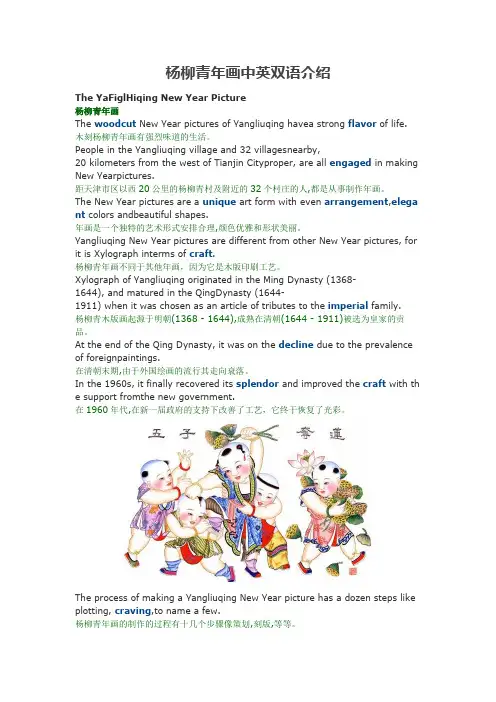
杨柳青年画中英双语介绍The YaFiglHiqing New Year Picture杨柳青年画The woodcut New Year pictures of Yangliuqing havea strong flavor of life.木刻杨柳青年画有强烈味道的生活。
People in the Yangliuqing village and 32 villagesnearby,20 kilometers from the west of Tianjin Cityproper, are all engaged in making New Yearpictures.距天津市区以西20公里的杨柳青村及附近的32个村庄的人,都是从事制作年画。
The New Year pictures are a unique art form with even arrangement,elega nt colors andbeautiful shapes.年画是一个独特的艺术形式安排合理,颜色优雅和形状美丽。
Yangliuqing New Year pictures are different from other New Year pictures, for it is Xylograph interms of craft.杨柳青年画不同于其他年画,因为它是木版印刷工艺。
Xylograph of Yangliuqing originated in the Ming Dynasty (1368-1644), and m atured in the QingDynasty (1644-1911) when it was chosen as an article of tri butes to the imperial family.杨柳青木版画起源于明朝(1368 - 1644),成熟在清朝(1644 - 1911)被选为皇家的贡品。
民间故事英文版:神奇的叶子
There are a lot of things magical in China: the people, the culture, the stories. Sometimes ordinary things seem magical, but in reality, they aren't. It usually takes a great fool to transform the ordinary into magically nothing. In a small village deep in the heart of China, the local tax collector was feared. He taxed the villagers often. If they had no money, he took their possessions. And when possessions were of no interest to the tax collector, he would beat the taxpayers. One day, a poor man entered the village. He had heard of the tax collector and his terrible ways. The poor man was carrying a plant that had many beautiful green leaves. The tax collector stopped the poor man before walking any further and told him he had to pay entrance fee if he wanted to walk through the village. The poor man said he had no money, but only the magic tree he was carrying. The tax collector, intrigued, asked what kind of magical tree it was. The poor man explained that it would make the holder of the leaves invisible. The tax collector snatched the tree from the poor man while striking him across the face. The poor man fell to the ground and was left in the dust of the tax collector's horse. That night, the tax collector picked a leaf from the magic tree and held it up to his forehead. "Wife," he asked, "can you see me?" His wife looked at him strangely, "Yes, I can see you." He picked another leaf and held it to his forehead. "Wife," he asked, "can you see me?" His wife looked at him again, "Yes, I can see you." And with the third leaf, the wife could still see her husband. Same with the fourth. And so on until it was late at night and the wife was ready to sleep. "Wife, can you see me now?" he asked, with the last leaf from the tree up to his forehead. "Husband, I'm tired. No, I can not see you any more," she said exasperated before she closed her eyes to sleep. And her tax-collecting husband smiled. The next morning, the tax collector held up his magical leaf to his forehead as he walked from store to store. The tax collector thought, "Hmmm, this is truly a magical leaf. No one can see me. No one acknowledges my actions." He continued to pass through the village, and no one said a word to him. No one looked at him in the eye. No one spoke to him, not even when he took money from the stores. Not even when he took food from the food stands. Every villager saw him, but in fear of a beating, did not speak to him. The emperor's son was passing through the village that afternoon. He and his entourage were returning from a rewarding hunting expedition. Among his trophies were the pelts of snow leopards and tigers. The tax collector saw the pelts hanging from the back of the royal saddle. Believing he was still invisible, he held his magic leaf to his forehead and reached out for the pelts. "Stop! You there! What do you think you're doing?" one the royal guards exclaimed. The emperor's son shouted, "How dare you steal from me! Did you not think I saw you approach me and attempt to steal my furs? You will pay for this. I will put you away in the palace dungeons." The tax collector was quickly apprehended and taken prisoner. The tax collector feebly tried to explain his tale of the poor man and his magical tree with the leaves to make one invisible. He tried to show the emperor's son the tree, but it had no leaves on it. The emperor's son, tired of listening to the alleged tale, had the tax collector beat by his guards before continuing on their journey homeward. As the royal entourage walked through the village, they passed by the tavern. By the window, the tax collector heard the voice of the poor man he accosted the day before…."And then I handed over the kumquat tree I dug up from his garden, telling him it was a magic tree that could make one invisible!" Then everyone in the tavern laughed and looked out the window at the beaten tax collector. There'sthat old saying, "A fool and his money are easily separated." In this tale, well, the fool got what he was worth.。
中国古代神话英文版

Angrily, he grasped an axe and wielded it with an effort. With a bang, the chaos was split all of a sudden. The light and clear air rose up to the sky, and the heavy and turbid to the earth. After it,Pangu propped up the sky with his head and stepped on the ground with his feet, fearing that they might close. The sky increased its height by 1 zhang daily, and the earth sank by 1 zhang Pangu grew with it.
According to legend, in the beginning of the world, the sky and the earth were not separated, and there was only darkness and chaos.
Our ancestor Pangu,a giant, had been born and growing up in it for 108 000 years. One day, he suddenly woke up. Opening the eyes, he found that everything was blurred and invisible.
So he came to the Yellow River and the Wei River to drink water.
杨柳青年画英语作文

杨柳青年画英语作文Yangliuqing New Year Paintings are a traditional Chinese folk art that originated from Yangliuqing, Tianjin, China.杨柳青年画是源于中国天津的一种传统中国民间艺术。
The paintings are known for their unique and colorful images that depict scenes of daily life, historical events, and folk stories.这些画作以其独特多彩的图像而闻名,描绘了日常生活、历史事件和民间故事的场景。
One of the distinct features of Yangliuqing New Year Paintings is the use of bold and vibrant colors, which add a sense of liveliness and cheerfulness to the artwork.杨柳青年画的一个显著特点是运用大胆鲜艳的颜色,给作品增添了一种生动和欢乐的感觉。
The subjects of the paintings often include folk customs, traditional festivals, and mythical figures, reflecting the cultural heritage and values of the local community.这些画作的主题经常包括民俗风情、传统节日和神话人物,反映了当地社区的文化遗产和价值观。
The craftsmanship and attention to detail in Yangliuqing New Year Paintings are also highly regarded, as artists carefully hand-paint each piece to perfection.杨柳青年画的工艺和对细节的关注也备受赞誉,艺术家们精心绘制每一幅作品,力求完美。
杨柳青年画相关英语作文
杨柳青年画相关英语作文杨柳青年画(Yang Liu Youth Painting) is a traditional Chinese art form that originated in the Yangliuqing town of Tianjin, China. It is known for its bold and vibrant colors, intricate details, and unique storytelling. 杨柳青年画是中国传统艺术形式,起源于中国天津的杨柳青镇。
它以鲜明的色彩、复杂的细节和独特的叙事而闻名。
The art form dates back to the Ming Dynasty and has since evolvedto depict scenes from folktales, historical events, and everyday life. 这种艺术形式可以追溯到明朝,自那时起逐渐演变成了描绘民间故事、历史事件和日常生活场景的画作。
One of the most striking features of Yangliuqing youth painting is its use of bright and vivid colors. Artists often use a combination of red, green, blue, and yellow to create visually stunning pieces that capture the essence of Chinese culture and tradition. 杨柳青年画最引人注目的特点之一是其对明亮鲜艳色彩的运用。
艺术家们常常使用红色、绿色、蓝色和黄色的组合来创作视觉上令人赏心悦目的作品,捕捉中国文化和传统的精髓。
In addition to its use of color, Yangliuqing youth painting is also known for its intricate details and meticulous craftsmanship. Artists spend countless hours perfecting each brushstroke and paying attention to the smallest details to create breathtakingly detailed scenes. 除了色彩运用,杨柳青年画还以其精致的细节和细腻的工艺而闻名。
2022考研英语阅读精选:清明8件事之柳枝
2022考研英语阅读精选:清明8件事之柳枝
柳枝
Legend has it that Clear and Bright is one of three periods during the year in which ghosts come closest to the world of living men. Buddhists believe that willow branches will drive away unwelcome ghosts and evil spirits. Therefore, willow branches are also known as ghost terror wood.
有传说言,清明是三大鬼节之一,一年中鬼魂最接近人们的三个时间。
佛教相信,柳条能有驱鬼辟邪的作用。
因此,柳条也被称为鬼怖木。
Folk proverbs also dictate customs. One proverb states that if a young lady does not wear a willow branch during the Clear and Bright period, she will soon turn old. Another says: If one does not wear a willow, he will become a yellow dog after he dies and is reincarnated.
民间的谚语也有此类习俗。
有谚云: 清明不戴柳,红颜成白首。
亦有谚云:清明不戴柳,死后变黄狗。
1/ 1。
小学英语 英语故事(童话故事)Under the Willow Tree 柳树下的梦
Under the Willow Tree 柳树下的梦The country around the town of Kjöge is very bare. The town itself lies by the seashore, which is always beautiful, although it might be more beautiful than it is, because all around are flat fields, and a forest a long way off. But one always finds something beautiful in the spot that is one's own home, something for which one longs, even when one is in the most wonderful spot in the world.And we must admit that the outer edge of Kjöge, where small, humble gardens line the little stream that flows into the sea, could be very pretty in the summertime. This was the opinion of the two small children, Knud and Johanne, who were playing there, crawling under the gooseberry bushes to reach each other.In one of the gardens there stood an elder tree, in the other an old willow, and under the latter the children were especially fond of playing. Although the tree stood close beside the stream and they might easily have fallen into the water, they were allowed to play there, for the eye of God watches over little ones. Otherwise they would be very badly off indeed. Besides, these two were careful about the water; in fact, the boy was so afraid of it that in the summer he could not be lured into the sea, where the other children were fond of splashing about. As a result, he had to bear the teasing of the others as best he could.But once Johanne, the little girl, dreamed she was out in a boat, and Knud waded out to join her, with the water rising until it closed over his head. And from the moment little Knud heard of this dream he could no longer bear to be called a coward. He might really go into the water now, he said, since Johanne had dreamed it. He never carried that idea into practice, but for all that the dream remained his great pride.Their poor parents often came together, while Knud and Johanne played in the gardens or on the highroad, where a long row of willows had been planted along the ditch. These trees with their polled tops certainly did not look very beautiful, but they were there for use rather than for ornament. The old willow tree in the garden was much lovelier, which was why the children took most delight in sitting under it. In Kjöge itself was a great market place, and at fair time this plaza was gay with whole streets of tents, filled with silk ribbons, boots, and everything a person might desire. There were great crowds then, and generally the weather was rainy. One could easily smell the odor of peasants' clothes, but this could not destroy the fragrance that streamed from a booth full of honey cakes. And best of all, the man who kept this particular booth came every year during fair time to lodge in the house of little Knud's parents. Consequently, every now and then there was a present of a bit of honey cake, and of course Johanne always received her share.But the best thing of all was that this gingerbread dealer knew all sorts of charming stories and could even tell tales about his own gingerbread cakes. One evening he told a story about them which made such a deep impression on the two children that they never forgot it. For that reason perhaps we should hear it, too, especially since it is not very long."On the shop counter," he said, "there once lay two gingerbread cakes. One was in the shape of a man with a hat on, the other of a maiden with no bonnet but with a blot of yellow on top of her head. Both their faces were on the upper side, for that was the side that was supposed to be looked at, and not the other. Indeed, most people have one side from which they should be viewed. On his left side the man wore a bitter almond for a heart; but the maiden, on the other hand, was honey cake all through. They were placed on the counter as samples, so they remained there for a long time, until at last they fell in love with each other. But neither told the other, which they should have done if they had expected anything to come of it." 'He is a man, so he must speak first,' thought the maiden. But she was quite contented, for she knew in her heart that her love was returned. His thoughts were far more extravagant, which is just like a man. He dreamed that he was a street urchin, and that he had four pennies all his own, and that he bought the maiden and ate her up."So they lay on the counter for days and weeks, and grew dry, but the thoughts of the maiden remained still gentle and womanly." 'It's enough for me that I have lived on the same table with him, ' thought the maiden, and then she broke in two." 'If only she had known of my love she would have held together a little longer,' thought he."So that's the story, and here they are, both of them," said the baker. "They're remarkable for their strange history and for their silent love, which never came to anything. And now they're both for you!" With that he gave Johanne the man, who was still in one piece, and Knud got the broken maiden; but the children had been so touched by the story that they couldn't be so bold as to eat up the lovers. Next day they took them out to the Kjöge churchyard, where, winter and summer, lovely ivy covers the church wall like a rich carpet. They stood the two cake figures up among the green leaves in the bright sunshine and told a group of other children the story of the silent love that was useless; that is to say, the love was, for the story was charming, they all found.But when they looked again at the gingerbread couple they found that a mischievous big boy had eaten up the broken maiden. The children cried about that and later - probably so that the poor lover might not be left alone in the world - they ate him up, too. But they never forgot the story. The two children were always together by the elder tree or under the willow, and little Johanne sang the most beautiful songs in a voice as clear as a silver bell. Knud had not a note of music in him, but at least he knew the words of the songs, and that was something. But the people of Kjöge, even the wife of the hardware merchant, stopped and listened when Johanne sang. "She has a very sweet voice, that little girl," she said.Those were glorious days; but glorious days do not last forever, and finally the neighbors separated. Johanne's mother died, and her father planned to marry again in Copenhagen, where he had been promised a position as messenger, a job supposed to be very profitable. While the neighbors parted with regrets, the children wept bitterly, but the parents promised to write to each other at least once a year.And Knud was made apprentice to a shoemaker, for such a big boy was too old to run around wild any longer; and, furthermore, he was confirmed.Oh, how he would have liked to see little Johanne in Copenhagen on that day of celebration! But he didn't go; and he had never been there, although Kjöge is only five Danish miles away. On a clear day Knud could see the distant towers of the city across the bay, and on the day of his confirmation he could even see the golden cross on the tower of the Church of Our Lady glitter in the sun.Ah, how often his thoughts turned toward Johanne! And did she remember him? Yes! At Christmastime a letter came from her father to Knud's parents, saying that they were doing very well in Copenhagen, and Johanne could look forward to a brilliant career on the strength of her lovely voice. She already had a position in the opera house and was already earning a little money, out of which she sent her dear neighbors of Kjöge a dollar for a merry Christmas Eve. Johanne herself added a postscript, asking them to drink to her health, and in the same postscript was also written, "Friendly greetings to Knud!"They all wept; but this was all very pleasant, for they were tears of joy that they shed. Knud's thoughts had been with Johanne every day, and now he knew that she also thought of him. The nearer came the end of his apprenticeship, the more clearly did he realize that he was in love with Johanne and that she must be his little wife. When he thought of this a smile brightened his face, and he drew the thread faster than before and pressed his foot against the knee strap. He didn't even pay any attention when he ran the awl deep into one of his fingers. He was determined that he would not play the silent lover, like the two gingerbread cakes. The story had taught him a lesson.Now he was a journeyman, and his knapsack was packed ready for his trip. At last, for the first time in his life, he was to go to Copenhagen, where a master was already expecting him. How surprised and happy Johanne would be to see him! She was just seventeen now, and he nineteen.He wanted to buy a gold ring for her before he left Kjöge, but then decided he could get a much nicer one in Copenhagen. And so he took leave of his parents, and on a rainy, windy day in autumn set forth on foot from the town of his birth. The damp leaves were dropping from the trees, and he was wet to the skin when he arrived at his new master's home in the big city of Copenhagen. The following Sunday he would pay a visit to Johanne's father!So, on Sunday he put on the new journeyman's clothes, and the new hat from Kjöge that became him very well, for till then he had only worn a cap. He easily found the house he was seeking, and mounted flight after flight of stairs until he became almost dizzy. It seemed terrible to him for people to live piled up on top of each other in this intricate city.Everything in the parlor looked prosperous, and Johanne's father received him in kindly friendship. Knud was a stranger to the new wife, but she too shook hands with him and gave him a cup of coffee."Johanne will be glad to see you," said the father. "You've grown into a nice-looking young man. Yes, wait till you see her. There is a girl who rejoices my heart, andplease God she will rejoice it still more. She has her own room now and pays us rent regularly for it!"Then he knocked quite politely at his daughter's door, as if he were a stranger, and they went in.Oh, how pretty it was! he was certain there wasn't such a lovely room in all Kjöge; the Queen herself could not be more charmingly lodged. There were carpets, and window curtains that hung quite to the floor, and flowers and pictures, and a velvet chair, and even a mirror as large as a door and so clear there was a danger of walking into it.A glance showed all this to Knud, and yet he could look at nothing but Johanne. She was a full-grown maiden now, quite different from Knud's memories of her, and much more beautiful. There wasn't a girl in Kjöge like her. How graceful she was, and with what a strange, unsure gaze she looked at Knud! But that was only for a moment, and then she rushed toward him as if it kiss him. she did not actually do so, but she very nearly did.Yes, she was really happy to see her childhood friend again! There were tears in Johanne's eyes; she had so much to say, and so many questions to ask about everything, from Knud's parents to the elder tree and the willow, which she called Elder Mother and Willow Father just as if they had been human beings; and indeed they might be called so, just as much as the gingerbread cakes. She spoke of them too, and their silent love, and how they had lain on the shop counter and broken in two - and at this she laughed heartily, while the blood rushed to Knud's cheeks and his heart beat faster and faster. No, she had not grown haughty at all.And Knud noticed quite well that it was because of her that her parents invited him to spend the evening. With her won hands she poured out the tea and gave him a cup; and afterward she read aloud to them from a book, and it seemed to Knud that what she read was all about himself and his love, for it matched with his thoughts. Then she sang a simple little song, but her singing made it a real story that seemed to be the outpouring of her very heart.Yes, Knud knew she cared for him. He could not keep tears of joy from rolling down his cheeks, nor could he speak a single word - he seemed struck dumb. But she pressed his hand and murmured, "You have a good heart, Knud. Stay always the way you are now!"That was a magnificent evening; it was impossible to sleep afterward, and accordingly Knud did not sleep.When he had left, Johanne's father had said, "Now, don't forget us altogether. Don't let the whole winter go by before you come to us again!" Knud felt that gave him permission to repeat the call the following Sunday, and determined to do so. But every evening after work - and the working hours lasted until candlelight there - Knud went out into the town. He returned to the street in which Johanne lived, and looked up at her window. It was almost always lighted, and one evening he could even see the shadow of her face quite plainly on the curtain. That was an evening he would never forget. His master's wife did not like his "gallivanting abroad everyevening," as she put it, and shook her head ruefully over him; but the master only smiled."He's just a young fellow," he said."On Sunday we shall see each other," Knud thought, "and I shall tell her how she is always in my thoughts and that she must be my little wife. I know I'm only a poor journeyman shoemaker, but I can become a master, and I'll work and save - yes, I'll tell her that! No good comes from a silent love; I've learned that much from the gingerbread!"Sunday came at last, and Knud set out, but to his great disappointment they had to tell him they were all invited out that evening. But as he left Johanne pressed his hand and said, "Have you ever been to the theater? You must go there sometime. I shall be singing on Wednesday, and if you have time that evening I'll send you a ticket. My father knows where you are living."How kind it was of her! And at noon on Wednesday he received a sealed envelope. There were no words inside, but the ticket was there, and that evening Knud went to the theater for the first time in his life. And what did he see? He saw Johanne, looking more charming and beautiful than he ever could have believed possible! To be sure, she was married to a stranger, but that was just in the play; it was only make-believe, as Knud understood very well. If it had been true, he thought, she would never have had the heart to send him a ticket so that he could go and see it. And everybody shouted and applauded, and Knud cried out, "Hurrah!"Even the King was there, smiling at Johanne, and he seemed to delight in her loveliness. How small Knud felt then! Still he loved her dearly, and felt that she loved him, too; but he knew it was up to the man to speak the first word, as the gingerbread maiden in the story had taught him. Indeed, there was a great deal of truth in that story.So, as soon as Sunday came, he went to see her again, feeling as solemn as if he were going into a church. Johanne was at home alone; it could not have happened more fortunately."I'm glad you came," she said. "I almost sent Father after you, but I felt in my heart that you would be here this evening. I have to tell you that I am leaving for France on Friday; I must study there if I am to become a great artiste!"At those words it seemed to Knud as if the whole room were whirling round and round with him. He felt as if his heart would break; there were no tears in his eyes, but Johanne could not fail to see how stricken he was ."You honest, faithful soul!" she said.And her tenderness loosened his tongue. He told her how much he loved her and begged her to become his little wife. Then he saw Johanne turn pale as she dropped his hand and said seriously and sadly, "Dear Knud, don't make us both unhappy. I shall always be a loving sister to you, one in whom you may trust, but I shall never be anything more."Gently she placed her soft hand on his hot forehead. "God gives us the strength for much," she said, "if only we try to do our best." At that moment her stepmother entered the room, and Johanne said, "Knud is quite heartbroken because I'm going away! Come,be a man," and she laid her hand on his shoulder; it seemed as if they had been talking only of her journey. "You're a child," she laughed, "but now you must be good and reasonable, as you used to be under the willow tree when we were both children!" Knud felt as if the whole world were out of joint, and his thoughts were like a loose thread fluttering in the wind. He remained for tea, though he hardly knew if they had asked him to; and they were kind and gentle, and Johanne poured out his tea and sang to him. Her voice did not have its old tone, but still it was wonderfully beautiful and nearly broke his heart. And then they parted. Knud could not bear to offer his hand, but she took it and said, "Surely you'll shake hands with your sister at parting, old playmate!"She smiled through the tears that were in her own eyes, and repeated the word "brother". Yes, that was supposed to be a great consolation! Such was their parting. She sailed for France, and Knud wandered about the muddy streets of Copenhagen. His comrades in the workshop asked why he was so gloomy and urged him to join them and amuse himself, for he was still a young fellow.So they took him to a dance hall. He saw many pretty girls there, but there was not one to compare with Johanne; here, where he had hoped to forget her, she was more vivid than ever before the eyes of his soul. "God gives us the strength for much," she had said, "if only we try to do our best." Then a devotion came to his mind, and he folded his hands quietly. The violins played, and the girls danced gaily, and suddenly it seemed to him that he should never have brought Johanne into a place like this - for she was there with him, in his heart.Knud ran out and wandered aimlessly through the streets. He passed by the house where she had lived; it was dark there - everywhere were darkness and emptiness and loneliness. The world went in its way, and Knud went his.Winter set in, and the waters froze over; it was as if everything were preparing itself for burial. But when spring returned, and the first steamer was to start, an intense longing seized him to go away, far into the world, anywhere - but not too close to France. So he packed his knapsack and wandered deep into Germany, from town to town, finding rest and peace nowhere. It was not until he came to the glorious old city of Nuremberg that he could quiet his restless spirit, and there he decided to stay.Nuremberg is a strange old city, looking as if it had been cut out of an old-fashioned picture book. The streets seem to wander along just as they please. The houses did not like to stand in regular rows. Gables with little towers, arabesques, and pillars lean out over the walks, and from the queer peaked roofs water-spouts, shaped like dragons or long, slim dogs, push out far over the streets.There in the Nuremberg market place stood Knud, his knapsack, on his back. He was beside one of the old fountains, where splendid bronze figures, scriptural and historical, rose up between the gushing jets of water. A pretty little servant girl was just filling her pails, and she gave Knud a refreshing drink; and as her hand was full of roses she gave him one of them, too, and he accepted that as a good sign. From the church near by came the strains of an organ; they rang as familiar to him as the tones of the organ at home in Kjöge church, and he entered the great cathedral.The sunlight streamed in through the high stained-glass windows and down between the lofty, slender pillars. His spirit found rest.And Knud found a good master in Nuremberg, and he lived in his house, and there learned to speak German.The old moat around the town of Nuremberg has been converted into little kitchen gardens, but the high walls with their heavy towers are standing yet. The ropemaker twists his cords on a wooden gallery along the inside of the town wall, where elderbushes grow out of the cracks and clefts, spreading their green branches over the small, lowly houses below. In one of these houses Knud lived with his master; and over the little garret window where he slept the elder tree waved its branches. Here he lived for a summer and winter. But when spring returned he could bear it no longer, for the elder was blooming and the fragrance of its blossoms carried him back to home and the garden at Kjöge. So Knud left that master and found another farther in town, over whose house no elderbush blossomed.His new workshop was close to one of the old stone bridges, by an ever-foaming, low water mill. The stream roared past it, hemmed in by the houses, whose decayed old balconies looked about to topple into the water. No elder grew here - there was not even a little green plant in a flowerpot - but just opposite stood a grand old willow tree that seemed to cling fast to the house, as if it feared being carried away by the stream. It stretched its branches out over the river, just as the willow at Kjöge spread its arms across the stream by the gardens of home.Yes, Knud had gone from the Elder Mother to the Willow Father. This tree had something, especially on moonlit evenings, that went straight to his heart, and that something was not of the moonlight but of the old willow tree itself.He could not remain there. Why not? Ask the willow tree; ask the blossoming elder! And so he bade farewell to his kind master and to Nuremberg and traveled on further. To no one did he speak of Johanne, but hid his sorrow in his innermost heart; and he thought of the deep meaning of the old story of the gingerbread. Now he understood why the man had a bitter almond for a heart - he himself had felt the bitterness of it. And Johanne, who was always so gentle and smiling, she was only like the honey cake.The strap of Knud's knapsack seemed so tight across his chest that he could scarcely breathe, but even when he loosened it he was not relieved. He saw only half the world around him; the other half he carried within him. That's how it was!Not until he was in sight of the high mountains did the world appear freer to him; now his thoughts were turned outward again, and the tears came into his eyes. The Alps seemed to him like the folded wings of the earth; what if they were to unfold themselves and display their varied pictures of black woods, foaming waters, clouds, and great masses of snow! On the last day, he thought, the world will lift up its mighty wings and mount upward to God, to burst like a soap bubble before the glance of the Highest."Ah," he sighed, "that that last day were here now!"Silently he wandered through a country that seemed to him like an orchard covered with soft turf. From the wooden balconies of the houses girls, busy with theirlacemaking, nodded down at him. The summits of the mountains glowed in the red evening sun; and when he saw the blue lakes gleaming through the dark trees, he thought of the seacoast near Kjöge, and there was a sadness in his heart - but it was pain no longer.There where the Rhine rolls onward like a great wave, and then bursts into snow-white, gleaming, cloudlike masses, as if clouds were being created there, with the rainbow fluttering like a loose band above them - it was there that he thought of the mill at Kjöge, with its rushing, foaming stream.He would have been glad to have remained in the quiet Rhenish town, but here also there were too many elder trees and too many willows, so he traveled on, over the mighty, towering mountains, through shattered walls of rock, and on roads that clung to the mountainsides like the nests of swallows. The waters foamed in the depths, the clouds themselves were below him, and he strode on in the warm summer sun over shiny thistles, Alpine roses and snow. Thus he said farewell to the lands of the North and journeyed on under the shade of blooming chestnut trees, and through vineyards and fields of maize. Now the mountains were a wall between him and all his memories; that was how he wished it to be.At last he reached that great, glorious city called Milan, and here he found a German master who gave him work. The master an his wife, in whose workshop he labored now, were a pious old couple. And they became quite fond of the quiet journeyman, who said little but worked all the harder and led a devout Christian life. And to Knud also it seemed that God had lifted the heavy burden from his heart.His favorite relaxation was to climb from time to time to the mighty marble church, which seemed to him to have been built of the snow of his native Northland, formed into images, pointed towers, and decorated open halls; from every corner and every niche the white statues smiled down upon him. Above him was the blue sky; below him were the city and the wide-spreading green plains of Lombardy, and toward the north the high mountains capped with perpetual snow. Then he thought of the church at Kjöge, with its red ivy-colored walls, but he did not long to go there again. Here, beyond the mountains, he would be buried.He had lived there a year, and three years had passed since he had left his home, when one day his master took him into the city - not to the circus with its daring riders; no, to the great opera, where was an auditorium well worth seeing. There were seven tiers of boxes, and from each beautiful silken curtains hung, while from the ground to the dizzy heights of the roof there sat the most elegant ladies, with corsages in their hands as if they were at a ball, and gentlemen in full dress, many of them with decorations of gold and silver. It was as bright there as in the noonday sunshine, and the music rolled gloriously and beautifully; everything was much more splendid than in the theater at Copenhagen, but then Johanne had been in Copenhagen, and here - -Yes! It was like magic - Johanne was here also! The Curtain rose, and she appeared, clad in silk and gold, with a gold crown upon her head. She sang as none but an angel could sing, and came far forward to the front of the stage, and smiled as only Johanne could smile, and looked straight down at Knud! The poor boy seized his master's armand called out aloud, "Johanne!" The loud music sounded above everything, but no one heard but the master, who nodded his head."Yes," he said, "her name is Johanne!" Then he drew forth his program and showed Knud her name - for the full name was printed there.No, it was not a dream! The great audience applauded and threw wreaths and flowers to Johanne, and every time she went away they called her back on stage, so that she was always going and coming.In the street outside afterward the people crowded about her carriage and drew it away in triumph. Knud was in the first row and shouted as joyfully as any; and when the carriage halted before her brightly lighted house he was standing close beside the door. It opened, and she stepped out; the light fell upon her beloved face, and she smiled, thanked them graciously, and appeared deeply touched. Knud looked straight into her eyes, and she into his, but she never knew him. A gentleman with a decoration glittering on his breast gave her his arm - people said they were betrothed.Then Knud went home and packed his knapsack. He had decided to return to his own home, to the elder and willow trees - ah, beneath the willow tree!The old couple begged him to remain, but no words could change his mind. It was in vain that they pointed out to him that winter was coming and the snow had already fallen in the mountains. He replied that he could march, with his knapsack on his back, and supported by his cane, in the wake of a slow-moving carriage, for which a path would have to be cleared.So Knud left for the mountains and climbed up them and down them. His strength grew less, but still he saw no village or house; always he plodded onward toward the North. High above him the stars gleamed; his feet stumbled, and his head grew dizzy with the heights. Stars seemed to shine deep in the valley, too, as if there were another sky below him. He felt ill. More and more stars became visible below him; they glowed brighter and brighter and moved to and fro. Then he realized it was the lights of a little town that were shining down there. When he was sure of that, he put forth the last of his strength and finally reached the shelter of a humble inn.He remained there that night and the whole of the next day, for his body was in desperate need of rest and refreshment. The ice was beginning to thaw, and there was rain in the valley. But on the second morning a man with a hand organ came to the inn and played a Danish melody - and now Knud could not remain.He resumed his journey northward, tramping on for many days, hurrying as though he were trying to reach home before all were dead there. But to no man did he speak of his longing, for no one would have believed in the sorrow of his spirit, the deepest a human heart can feel. Such grief is not for the world, for it is not amusing; nor is it for friends. And this man had no friends; a stranger, he wandered through strange lands toward his home in the North. He had received only one letter from home, and it was now years since his parents had written. "You are not really Danish as we here at home. We love our country, but you love only a strange country." Thus his parents had written him - yes, they thought they knew him!。
中国神话传说推荐作文英语
中国神话传说推荐作文英语题目,Chinese Mythology: A Source of Inspiration。
Chinese mythology is a treasure trove of captivating stories, rich symbolism, and profound wisdom. From the mystical tales of gods and goddesses to the epic journeysof legendary heroes, Chinese mythology offers a vast reservoir of inspiration that continues to captivatereaders and storytellers alike. In this essay, we willdelve into some of the most renowned myths from Chinese folklore and explore their enduring relevance and influence.One of the most famous myths in Chinese mythology isthe le gend of Nüwa, the creator goddess. According to the myth, in the beginning, the world was in chaos, with no order or life. Nüwa took pity on the barren earth and set out to create living beings. She molded figures out of mud and breathed life into them, thus bringing harmony and balance to the world. This myth highlights the importanceof creation, nurturing, and the balance between yin andyang, themes that are central to Chinese culture and philosophy.Another beloved myth is the story of the Monkey King, also known as Sun Wukong, from the classic novel "Journey to the West." Born from a stone, the Monkey King possesses incredible strength, agility, and magical powers. Throughout his adventures, he challenges authority, overcomes obstacles, and ultimately attains enlightenment. The Monkey King embodies the ideals of perseverance, self-discovery, and the quest for spiritual enlightenment, making him a beloved figure in Chinese literature and popular culture.The myth of the Eight Immortals is yet another captivating tale from Chinese mythology. These legendary figures, each with their unique powers and personalities, embark on fantastical adventures while imparting moral lessons and wisdom to those they encounter. From the mischievous antics of Lu Dongbin to the compassionate deeds of Zhongli Quan, the Eight Immortals represent a diverse array of virtues and values that continue to resonate withaudiences today.Chinese mythology is also replete with stories of love and tragedy, such as the legend of the Cowherd and the Weaver Girl. This poignant tale recounts the forbidden love between a mortal cowherd named Niulang and a celestial weaver named Zhinü. Despite the obstacles that separate them, including the Milky Way, their love perseveres, inspiring countless generations with its enduring power and significance.In addition to its captivating narratives, Chinese mythology is imbued with profound symbolism and allegory. The myth of the Dragon King, for example, symbolizes the power of water and the importance of respecting nature. Similarly, the story of the Four Symbols—Azure Dragon, Vermilion Bird, White Tiger, and Black Tortoise—represents the cardinal directions, seasons, and elements, serving as a cosmological framework for understanding the universe.Furthermore, Chinese mythology reflects the cultural and historical context in which it originated, providingvaluable insights into ancient Chinese society, beliefs, and values. Whether it is the reverence for ancestors, the worship of nature deities, or the rituals associated with festivals like the Lunar New Year, Chinese mythology offers a window into the rich tapestry of Chinese civilization.In conclusion, Chinese mythology is a boundless source of inspiration, wisdom, and cultural heritage. Its timeless tales continue to captivate audiences around the world, transcending geographical and linguistic boundaries. Through its myths and legends, Chinese mythology not only entertains but also educates, enlightens, and enriches our understanding of the human experience. As we celebrate the enduring legacy of Chinese mythology, let us cherish and preserve these cherished stories for generations to come.This essay draws inspiration from the rich tapestry of Chinese mythology, exploring its enduring relevance and influence on literature, culture, and society. From the creation myths of Nüwa to the epic adventures of the Monkey King, Chinese mythology offers a wealth of stories that continue to captivate audiences around the world.Through its timeless tales and profound symbolism, Chinese mythology provides valuable insights into ancient Chinese society, beliefs, and values, while also inspiring creativity, imagination, and cultural exchange. As we delve into the enchanting world of Chinese mythology, let us celebrate its enduring legacy and appreciate the timeless wisdom it imparts.。
一个英文写成的中国传统神话故事
一个英文写成的中国传统神话故事,关于中国四条江的形成Long, long ago, rain stopped falling in China. The people prayed for rain to the Jade Emperor, for it was he who looked after everything in heaven, on the land and in the sea, but no matter how much they prayed, rain did not fall.在很久很久以前的中国,遇到了一次滴水不降的旱灾。
人们就向掌管天上、地下、海洋的玉皇大帝求拜,但无论他们怎么祈求,雨始终不落一滴。
Four dragons lived in the East China Sea in those days. They swam to shore to see what was happening, and saw people tearing grass from the caked ground, for the people had nothing else left to eat.当时,有四条龙住在中国的东海。
他们游到岸边去看怎么回事,看到人们在从结块的土地上拔草吃,因为土地上实在没有别的东西吃了。
"We must do something," Long Dragon said, and Yellow Dragon nodded. "We must help them ourselves," said Pearl Dragon, "for the Jade Emperor will never answer their prayers."“我们得做点什么,”长龙说道,黄龙点头附和。
“我们一定得帮帮他们,”珠龙说,“因为玉帝是不会答应他们的祈求的。
安徒生童话英文版:UndertheWillowTree柳树下的梦
安徒生童话英文版:UndertheWillowTree柳树下的梦The old couple begged him to remain, but no words could change his mind. It was in vain that they pointed out to him that winter was coming and the snow had already fallen in the mountains. He replied that he could march, with his knapsack on his back, and supported by his cane, in the wake of a slow-moving carriage, for which a path would have to be cleared.So Knud left for the mountains and climbed up them and down them. His strength grew less, but still he saw no village or house; always he plodded onward toward the North. High above him the stars gleamed; his feet stumbled, and his head grew dizzy with the heights. Stars seemed to shine deep in the valley, too, as if there were another sky below him. He felt ill. More and more stars became visible below him; they glowed brighter and brighter and moved to and fro. Then he realized it was the lights of a little town that were shining down there. When he was sure of that, he put forth the last of his strength and finally reached the shelter of a humble inn.He remained there that night and the whole of the next day, for his body was in desperate need of rest and refreshment. The ice was beginning to thaw, and there was rain in the valley. But on the second morning a man with a hand organ came to the inn and played a Danish melody - and now Knud could not remain.He resumed his journey northward, tramping on for many days, hurrying as though he were trying to reach home before all were dead there. But to no man did he speak of his longing, for no one would have believed in the sorrow of his spirit, the deepest a human heart can feel. Such grief is not for the world, for it is not amusing; nor is it for friends. And this man had nofriends; a stranger, he wandered through strange lands toward his home in the North. He had received only one letter from home, and it was now years since his parents had written. "You are not really Danish as we here at home. We love our country, but you love only a strange country." Thus his parents had written him - yes, they thought they knew him!Now it was evening. He was tramping along the public highway. The frost had settled down, and the country had become flatter, with fields and meadows on all sides. And near the road there grew a great willow tree! The whole outlook reminded Knud strongly of home; it looked so Danish, and with a deep sigh he sat down under the tree. He was very tired, his head began to nod, and his eyes closed in slumber, but still he seemed to see the tree stretching its arms above him, and in his wandering fancy the tree seemed to be a mighty old man - the Willow Father himself - carrying his tired son in his arms back to his Danish home, to the bare, ble ak shore of Kjöge and the garden of his childhood.Yes, he dreamed that this was the willow tree of Kjöge that had traveled out into the world in search of him, and at last had found him, and had carried him back into the little garden beside the stream. And there stood Johanne, in all her splendor, with the golden crown on her head, just as he had seen her last, and she called out "Welcome!" to him.And before him stood two remarkable figures, looking much more human than he remembered them from his childhood. They had changed too, but they were still the two gingerbread cakes, the man and the maiden, that turned their right sides toward him, and looked very handsome."We thank you!" both said to Knud. "You have loosened ourtongues and taught us that thoughts should be spoken freely or nothing will come of them. And now something has come of them - we are betrothed!"Then they walked hand in hand through the street s of Kjöge, and looked very respectable even on the wrong side; no one could have found any fault with them. On they went, straight toward Kjöge Church, and Knud and Johanne followed them - they, too, walked hand in hand. The church stood there as it had always stood, with the beautiful green ivy growing on its red walls, and the great door of the church swung open, and the organ pealed, and the gingerbread couple walked up the aisle."Our master first," said the cake pair, and made room for Johanne and Knud to kneel before the altar. And she bent her head over him, and the tears fell from her eyes, but they were icy cold, for it was the ice around her heart that was melting, softened by his strong love.The tears fell upon his burning cheeks, and then he awoke - and he was sitting under the old willow tree in a foreign land on that cold winter evening; an icy hail from the could s was beating on his face."That was the most wonderful hour of my life!" he cried. "And it was just a dream. Oh, God, let me dream again!Then he closed his eyes once more and dreamed again.Toward morning there was a great snowstorm, and the wind blew it in drifts over him, and when the villagers came forth to go to church they found a journeyman sitting by the roadside. He was dead - frozen to death beneath the willow tree!。