
新词难词的翻译
新词难词的翻译了解中国最新流行的词汇文化感受时尚语言的前沿魅力!Plasma TV 等离子电视SIM卡(用户身份模组) subscriber identity module爱岗敬业cherish posts and devote wholeheartedly to work按揭贷购房to buy a house on mortgage, to mortgage a house按揭贷款mortgage loan白领丽人white-collar lady百年不遇once-in-a-century, do not occur even in a hundred years傍大款(of a girl ) find a sugar daddy/ be a mistress for a rich man, lean onmoneybags保险精算师actuary保险业the insurance industry暴利sudden huge profits本土化localize蹦迪disco dancing蹦极, 蹦极跳bungee jumping变相涨价disguised inflation标王mark king; bid champion波霸woman with big breasts补发拖欠的养老金clear up pension payments in arrears不良贷款non-performing loan不正当竞争unfair competition擦边球edge ball, touch ball财富论坛Fortune Forum彩信(MMS)Multimedia Messaging Service★英语的变化主要表现于语法和词汇两方面,并籍这两种变化推动发展,构成现代英语的基础。
近二十年来语言学理论最重大的进展之一是出现了“转换--生成语法”(Transformational-generative Grammar),这种语言学理论的诞生使英语进一步科学化。
与此同时,大量新词汇的涌现使英语的表达力加强了,形式丰富了,因而使英语更趋生活化。
新词汇的产生新词汇到底是怎样产生的?当人们发现新事物,遇到新问题,总结了新经验,发展了新思想的时候,便需要新字和新词来表达,这是因为旧有的、沿袭使用的表达方法已经不适合或不敷应用了。
另一方面,由于以英语作母语及第二语言的国家遍及全球各洲,而各地的风土人情、生活习惯和社会环境大有区别,这就必然会出现不同的表达形式和用语,而这些语汇中不少会被逐渐吸收进经典的英语辞典中,成为语言的一部分。
在目前日益进步的社会里,科学和技术是新词汇的主要供应者,每当某一门科学发展到一个新阶段的时候,就有相当大一批新词涌现。
在这些新词当中,很多是该等科学的专用词汇,鲜为外行人所知晓,只有专科字典及词典才有收栽;但是,其中也有不少常被应用和引用,结果成了一般人所喜闻乐道的用语。
例如,当美国太空人成功地登陆用于月球时,英语中出现了moonwalk(月球漫步),lunar rove(月球车),moonrock(月球标本车)等一系列有关的用词。
由于近年发射了不少人造卫星绕月运行,故此就很必要地创出了apolune(远月点)和perilune(近月点)二词。
太空船与太空站在空间会合对接,使docking增添了一个新含义(靠泊),同义的还有linkup。
发射太空船被视为人类科学发展的象征,故很受注意。
因此,不少与太空船有关的用词已被广泛使用,如CM(command module:指令舱,指挥舱),splashdown (溅落),space sickness(宇航病),space age (太空时代)等。
在谈到探索deep space(深空间,远空间)和其他太空现象时,quasar (类星射电源),pulsar(脉冲星),neutron srar(中子星)及神秘的black hole (太空黑洞)等已是耳熟能详的用语。
近二十年来,遗传学的迅速发展创造了许多新词汇,如genetic code(遗传密码),codon (密码子),DNA(脱氧核糖核酸),transfa RNA(传输核糖核酸),messenger RNA(信使核糖核酸),transcription(信使核糖核酸的形成)等。
这些新词流行日广,连到一般的书刊报道都有应用,故此早已为广大读者所接受。
近年来发展迅猛的电脑工业带来的新词汇也着实不少。
常听常用的包括FORTRAM(公式翻译程序语言),COBOL(面向商业的通用语言),ALGOL(算法语言),BASIC(初学者的通用符号指令码),absolute address(绝对地址),data bank(资料库,数据库),floppy disk (柔性塑料磁盘),pushdown(下推存储器)等等。
旧有词如keyboard,terminal,memory bit 等也分别加添了新用法。
医学的飞跃发展同样带来了大批新词,包括了医学上的技术性用语及新制成的药品名称,新发现的病菌、病毒等。
其中如hotoscanning(光扫描),open heart surgery(开心手术),picornabirus(换心人),microcirculation(微血管循环)等都是近期出现的。
一些用词如the pill (口服避孕丸),test-tube baby(试管婴儿),transsexual operation(变性生术)等已成日常用语。
核物理学发展的结果,好象要把人们带进微观世界。
kron(K介子),muon(μ介子),pion(π介子)等陆续发现,lepton(轻子),baryon(重子)的分别,当然还有引起轰动的quark(夸克)。
假设上由各种antimatter(反物质)如antiproton(反质子),antineutrino(反中微子),antiquark(反夸克)等组成的antiworld(反物质世界)也备受重视。
数学和其他学科也在不停地发展。
在通俗的教研、科普读物中,不难发现以下的名词术语:NOT("非"逻辑算子),parametric equation(变数方程),近年中小学推行的newmath(新数),artificial intelligence(人工智能),magnetocardiogram(磁性心动扫描记图),IC (集成电路),piscicide (鱼类灭绝),hot mooner (热月学家),Sealab(海底实验室),radiosterilization(放射性消毒)等。
新的学科也在不断形成,例如bionics(仿生学),cryosurgery(冷冻手术),macrometereology(大气象学),ocean engineering(海洋工程学),phytochemistry(植物化学),biotelemetry(生物遥测学),astrionics(太空电子学)等数十种新的学科在发展和壮大。
军备竞争激烈,武器日新月异,自然也产生了不少新词汇。
ABM(antiballistic missile:反弹道导弹),MIRV(multiple independently-targeted reentry vehicle:多弹头分导重返大气层运载工具),the Bomb(核威慑),helilift(使用直升机运输),Green Berets("绿色贝雷帽"特种部队),grunt(步兵),beam weapons(死光武器)等,几乎成了家喻户晓的用语。
交通工具的改进,也使人有瞠目结舌之感。
天空上充斥着SST(supersonic transport:超音速运输机),airbus(空中巴士),air-taxi(空中的士);英法合制的Concorde(协和式飞机)在航空史上当然也占着重要地位。
HST(hyper-sonic transport:特超音速飞机)的诞生,使飞机工业有了新发展。
一些富裕的有闲人士经常乘搭喷气式飞机到各地旅游集会,成了一个特殊的阶层,称为jetset。
喷气式飞机的乘客有时也会患上这样或那样的不适症状,统称为jetsyndrome。
在水面和陆地上,新型的交通工具接连出现,包括ACV(air-cushion vehicle:气垫式运载工具),ATV(all-terrain vehicle:全地形车),hovercraft(气垫船),freight-liner (货柜火车),bullet train(子弹列车),aerotrain(悬浮火车)等。
除了科学和技术之外,动荡的政局、日趋变革的社会环境和世界性的文化及各方面的交流,也是英文新字的来源。
例如自六十年代初期“-in 运动”的兴起、转化和发展,使这个“家族”膨胀得使人吃惊。
从第一代的sit-in(静坐示威)到第二代的teach-in(宣讲会),以至第三代的be-in(颓废派的社交集会),一共出现了数十个-in的用词,其演变之速,令人咋舌。
近年来,世界政坛风云变幻。
西欧诸国为加强团结,发展贸易,组织了EEC(European Economic Community:欧洲经济共同体)。
中东和南美、非洲的石油输出国也组织了OPEC(Organization of Petroleum Exporting Countries:石油输出国组织)。
在美国爆发了水门事件之后,Watergate一字被广泛应用以指任何的政治丑闻在政府内部,主张用武力解决争端的一派人被称为hawk(鹰派),主张和平手段的称为dove(鸽派),而dawk是介乎鹰派与鸽派的消极反战者。
其他的政治用词如establishment(政府),atomic club(原子俱乐部),advance man(先行人员,助选人员),political animal(政治动物)等亦常见用于报刊之上。
世界性的经济危机,通货膨胀和工商业的发展也是新词的重要来源之一。
ASP(American Selling Price美国售价),slumpflation(萧条膨胀),added-value tax(增值税),Eurodollar(欧洲美元),petrodollar(石油美元),revenue sharing(国库分享)等都是近期产物。
社会的变革在过去两个年代中造成了很大的影响,不少基本意识形态受到了冲击。
女权运动的爆发产生了像Women's Lib(妇解运动),chairperson(主席),malechauvinist(大男子主义者),girlcott(妇女界联合抵制)等新用词,但也促成了Men's Lib(男子解放运动)的诞生。
六十年代末期美国黑人运动Black Power(黑色权力)爆发后,不少表示"…运动"的用语即仿此而出现,计有:Brown Power(褐色权力),Flower Power(花癫派权力),student power(学生权力),Red Power(红色权力)等,更有人戏谑地创出green power一语,意指“金钱魔力”(因美元背面是绿色的)。
英语新词译法
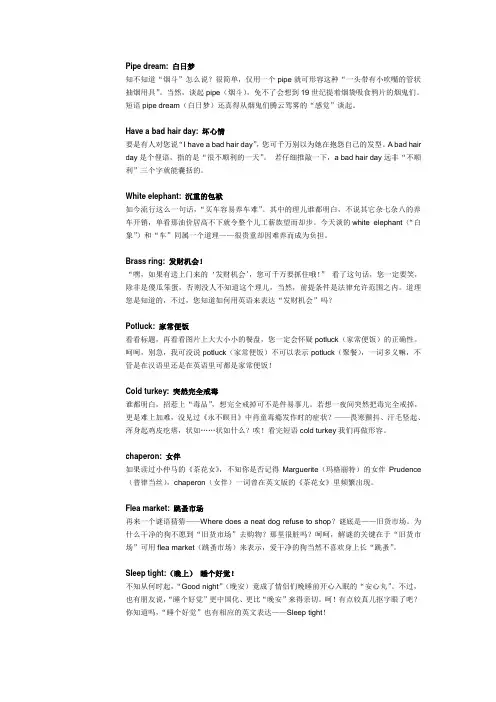
Pipe dream: 白日梦知不知道“烟斗”怎么说?很简单,仅用一个pipe就可形容这种“一头带有小吹嘴的管状抽烟用具”。
当然,谈起pipe(烟斗),免不了会想到19世纪提着烟袋吸食鸦片的烟鬼们。
短语pipe dream(白日梦)还真得从烟鬼们腾云驾雾的“感觉”谈起。
Have a bad hair day: 坏心情要是有人对您说“I have a bad hair day”,您可千万别以为她在抱怨自己的发型。
A bad hair day是个俚语,指的是“很不顺利的一天”。
若仔细推敲一下,a bad hair day远非“不顺利”三个字就能囊括的。
White elephant: 沉重的包袱如今流行这么一句话,“买车容易养车难”。
其中的理儿谁都明白,不说其它杂七杂八的养车开销,单看那油价居高不下就令整个儿工薪族望而却步。
今天谈的white elephant(“白象”)和“车”同属一个道理——很贵重却因难养而成为负担。
Brass ring: 发财机会!“嘿,如果有送上门来的‘发财机会’,您可千万要抓住哦!”看了这句话,您一定要笑,除非是傻瓜笨蛋,否则没人不知道这个理儿,当然,前提条件是法律允许范围之内。
道理您是知道的,不过,您知道如何用英语来表达“发财机会”吗?Potluck: 家常便饭看看标题,再看看图片上大大小小的餐盘,您一定会怀疑potluck(家常便饭)的正确性。
呵呵,别急,我可没说potluck(家常便饭)不可以表示potluck(聚餐),一词多义嘛,不管是在汉语里还是在英语里可都是家常便饭!Cold turkey: 突然完全戒毒谁都明白,招惹上“毒品”,想完全戒掉可不是件易事儿。
若想一夜间突然把毒完全戒掉,更是难上加难,没见过《永不瞑目》中肖童毒瘾发作时的症状?——畏寒颤抖、汗毛竖起、浑身起鸡皮疙瘩,状如……状如什么?唉!看完短语cold turkey我们再做形容。
chaperon: 女伴如果读过小仲马的《茶花女》,不知你是否记得Marguerite(玛格丽特)的女伴Prudence (普律当丝),chaperon(女伴)一词曾在英文版的《茶花女》里频繁出现。
中国新词翻译15
R:人才抄底 (ren2 cai2 chao1 di3)recruit talents at bottom priceSome employers regard the global recession as a great opportunity to get high-quality professionals for a relatively low cost. Several overseas recruitment efforts have focused on overseas Chinese talents, more of whom are willing to work in China.肉食女 (rou4 shi2 nv3)meat-eating girlIn Japanese, it's "Nikushokukei Joshi," which means girls who are aggressive toward men in love, sex or marriage. The reason is simple: men are not approaching women nowadays.人性化服务(ren2xing4hua4 fu2wu4)people-oriented serviceThe city's service industry has been promoting a "people first" practice in order to provide more considerate and satisfactory services to clients.人脸识别系统 (ren2lian3shi2bie2xi4tong3)facial recognition systemBeijing announced lately that it will equip a facial recognition system in 500 shopping malls to improve security measures during the 2008 Olympic Games.人来疯 (ren2lai2feng1)get hyped before crowdMany children tend to close their usual self and turn unruly when guests drop by. It is also used to describe the rarely exhibited showy behavior of an adult at the presence of a crowd of strangers.人脉 (ren2mai4)connectionsRen literally means a human and mai, veins and arteries, which are traditionally deemed essential to good health. Some experts say friendships and other personal relations may push an entrepreneur a solid step toward success.软肋 (ruan3lei4)soft spot, Achilles' heelThe word literally translates as a soft rib, but Chinese people use it to represent the most vulnerable spot of a person, a program or system.软实力 (ruan3shi2li4)soft powerFrom "Soft Power: The Means to Success in World Politics" —a book written by Joseph Nye, who was said to create the concept in the 1990s. Soft power is the ability to get what a country wants by attracting and persuading others to approve and support its goals.软骨症(ruan3gu3zheng4)"soft bone" syndromeThis refers to the phenomenon of some authorities conniving at malpractice by their subordinates after taking bribes from them.人肉布景板 (ren2 rou4 bu4 jing3 ban3)human photo sceneFilm stars and other showbiz icons attract considerable attention from fans, who often ask them to pose for a photo so that they can later show it to others. The celebrities have become a prop in the photo for such fans.软裁 (ruan3 cai2)soft layoff/insidious layoutSome layoffs are done in a subtle manner. Some companies move an employee to a less important or lower pay position or send him or her on frequent business trips without covering the trip's expenses.人气 (ren2qi4)popularityWhen a place attracts a large crowd on a regular basis or is always full of activities, people say it is enjoying high popularity, or in Chinese, it is full of "human smell."软脚蟹(ruan3jiao3xie4)spineless, namby-pambySoft-legged crab, as this term literally translates, is no good because it's premature and yields little meat. It is often used to describe a person deemed a weakling.软文广告 (ruan3wen2 guang3gao4)advertorialThe Chinese term translates literally as "soft-article advertising." It derives from the English word "advertorial," a portmanteau of "advertising" and "editorial." Advertorial is an advertisement presented in the form of a legitimate and independent news story in a publication.肉机(rou4ji1)hacker-controlled computerThis term, "meat machine" as it translates literally, refers to a hacker-controlled computer which has been infected with some sort of malware.软创新 (ruan3 chuang4xin1)soft innovationThis term refers to innovation of macro or micro management systems. They include operation mechanisms, management, policies, organization, business model and production process.热裤 (re4ku4)tight pantsThe word applies particularly to the tight-fitting short pants worn by young Chinese women who prefer to show off their curves, if any. Usually the pants are worn in hot weather, which may explain why the Chinese word for hot, re, is used.惹火 (re3huo3)inviting; hotThe expression is especially used these days by youngsters to refer to sexy and attractive dresses or ladies with curvaceous bodies.忍者贷款 (ren3zhe3dai4kuan3)Ninja loanThis term means a loan or mortgage given to a person who has "no income, no job, and no assets."人肉引擎 (ren2rou4 yin3qing2)social network-based search engineThe phrase refers to a new phenomenon on the Internet when people volunteer to dig out detailed background information about a particular person through their social networks. For example, Internet users exposed the ID number, mobile phone number and even company name of a woman who viciously attacked her husband's ex-wife in her blog.人肉搜索 (ren2rou4sou1suo3)human search engineRefers to Netizens using their human network to track down someone they have seen on the Internet.润物女(rùn wù nǚ)woman of active lifeThis is a phrase coined by Chinese and used as the opposite to the Japanese term "himono onna" or "dried-fish woman." The Japanese term refers to a female who has little activity other than staying home and spending time online. They pursue a simple lifestyle and shy away from complicated social networking. The Chinese term refers to women who love going out, keep fit and enjoy life.软装 (ruan3 zhuang1)soft decorationThe arrangement of potted plants, framed photos, oil paintings and other artworks or accessories in a house is called soft decoration, as compared to the interior decoration featuring plumbing and flooring.软性技能 (ruan3 xing4 ji4 neng2)soft skillIn addition to professional know-how, an employee will be viewed favorably by an employer if he or she possesses personal qualities such as good communication and expression skills and a strong team spirit.人球 (ren2 qiu2)helpless castawayThe term, literally meaning "human ball", refers to poor people for whom no one is willing to provide help. They are kicked around by people just like a tattered football. The term "little human ball" describes those kids whose parents have divorced and neither is willing to look after them.人际泡沫 (ren2 ji4 pao4 mo4)interpersonal bubbleRefers to getting a bunch of name cards every day only to find you are unfamiliar with most of the people or the hundreds of buddies lining up on your MSN or Facebook but you chat with few of them. It is quite often nowadays that a person with a lonely heart is surrounded by a "social bubble. "软岗位 (ruan3 gang3 wei4)soft jobThe UK government is to spend a billion pounds (US$1.7 billion) on creating 150,000 "soft" public sector jobs for unemployed people. Such socially useful jobs include child carers, dance assistants and tourism ambassadors.软外交 (ruan3 wai4 jiao1)soft diplomacyIt refers to diplomatic moves, like investment and cultural exchanges, that contribute quietly to international influence, as opposed to hard diplomacy, like a pre-emptive war. The term is reminiscent of "soft power."E:恶播 (e4 bo1)the vicious TV showThis phrase, meaning literally "vicious broadcasting", has been popping up in Chinese media reports and online posters recently after several provincial TV stations telecast the same series using aggressive and unconventional methods in order to attract audiences. Some broadcast two or three episodes of the series more than 10 times a day, others presented an "abridged" version to "outplay" other TV stations. The phenomenon reflects a serious shortage of good TV products and lack of effective market regulations in the outlying country regions.二维码 (er4 wei2 ma3)QR CodeA QR Code is a matrix code invented by Japanese corporation Denso-Wave in 1994. The QR is derived from "Quick Response." Camera mobile phone users with code-reading software can scan the image of the QR Code and be relinked to a Website that this code represents.二手短信 (er4 shou3 duan3 xin4)second-hand SMSIt refers to mobile phone messages received from, and sent to, others. There are many such messages of greeting in circulation during holiday seasons. Using them displays a lack of originality, and even sincerity, as they are never your own.恶搞 (e4gao3)kusoThe term refers to the online popular fad of turning a famous song, movie or other artwork into a parody that offends some people but amuses others. It is a Japanese word.二房东 (er4fang2dong1)second-hand landlordThe phrase means people who rent an apartment from the owner and then lease to other tenants to make money from the price difference. Many property management companies are complaining that some "second-hand landlords" divide apartments into smaller units to rent to more tenants.二奶 (er4nai3)kept mistressThis Chinese term was used in the past to refer to the number two of a man's wives. But today, it is widely used to call a kept mistress who has an ongoing extramarital sexual relationship with a man. She is usually financially supported by the man.恶帝/恶后 (e4di4/e4hou4)infamous celebrityGuo Jingming, a writer accused of plagiarism and Li Xudan, a TV actress accused of lying about her age, have won this year's "Golden Crow Awards,"a title for the most infamous celebrities on the Chinese mainland.恶趣味(e4qu4wei4)repulsive addictionOriginating in Japan, the term refers to disgusting addictions people indulge in, especially those do not match their social status.二奶专家 (er4nai3 zhuan1jia1)mercenary expertFor years, it's been a trend in China for companies to hire mercenary experts to distort public information for purposes such as promoting their products or protecting their reputation. This Chinese term combines the phrases "kept mistress" and "expert," because people tend to think of such experts as "kept mistresses" of the firms.二次污染 (er4ci4wu1ran2)secondary pollutionUnclean cisterns installed on top of some residential buildings and the landfill sites for wastes often become the source of secondary pollution for tap water and the surrounding environment.恶意圈钱 (e4yi4quan1qian2)malicious money grabbingDomestic stock markets plunged to a seven-month low last week amid mounting apprehension over new share offerings, which investors believed were part of a malicious intent to grab money from the markets. China Securities Regulatory Commission has warned listed firms to consider market conditions, investor sentiment and their own funding needs before deciding the timing and size of refinancing.286 (er4ba1liu4)slow, stupidIt literally refers to the older model of computer running on a 286 CPU, which is slow. Now it's used humorously to mean someone who is slow or stupid.N:脑抽 (nao3 chou1)brain spasmIt is a rude expression used by young Netizens to describe a person who acts or speaks in an insane way as if he or she is suffering from cerebral spasms.牛皮癣 (niu2 pi2 xuan3)street spamThe Chinese term literally means psoriasis, a common but annoying skin disease. It is now often used figuratively to describe usually shoddyprinted ads or signs unsightly plastered on street walls, trees, utility poles, telephone booths or other public places.内功 (nei4gong1)inner powerThe term originally referred to the rare power a kungfu master accumulated in the inner organs, such as control of breathing to enhance the impact of a punch. These days, people often use it to describe an organization's competitiveness and efficiency resulting from its internal system and innovation.农家乐 (nong2jia1le4)farmer's home innDuring the weeklong golden holidays, people often cannot find hotels in popular sites, so some farmers will lend their houses to tourists, which are cheaper than normal hotels. Tourists can also eat with the farmer's family and do farmer chores for fun.裸考 (luo3kao3)naked examThis is word-for-word translation of the newly invented Chinese term. It does not mean that one takes a test with nothing on. It means a "pure test," in which no one can get any special treatment, such as winning additional points because of one's other talents or performance. In the past, student who have artistic or athletic gifts, were often given extra points on their academic exams.闹洞房 (nao4dong4fang2)bridal chamber pranksIt's Chinese tradition that guests crowd into the bridal chamber to tease the newly-wed couple after the wedding banquet. Anything goes here and sometimes it turns into a rather rowdy gathering that lasts late into the night.女猪(nu3zhu1)heroine, female protagonist"pig" and "protagonist" have similar pronunciations in Chinese except for their tones, so do not mistake the term for "female pig" next time you see it online – it is actually a trendy way of saying heroine among the literature fans on the Internet.娘娘腔(niang2niang2qiang1)sissy, pansyThe English phrase originally refers to a weak man or a homosexual. Peoplein Shanghai use the Chinese phrase to describe boys or men who talk or behave in an effeminate way.脑子进水(nao3zijin4shui3)bubble brainIf water is injected into the brain, as this Chinese term reads verbatim, it won't be able to work very well. This term is commonly used these days to mean someone who is being stupid or confused.裸替 (luo3ti4)nude stand-inNude stand-in refers to people who substitute big stars in movies for nudity shots. A nude stand-in for movie star Zhang Ziyi in "The Banquet" recently popped up in the spotlight of the media by telling her own stories and career.脑体倒挂(nao3ti3dao4gua4)limbs before brainsThe phrase refers to the phenomenon that some talent-intensive jobs such as researchers are paid less than labor-intensive ones such as meter readers when industries are not market-oriented.牛皮癣 (niu2pi2xuan3)nagging problem, eyesore adsThe term for a skin disease, psoriasis, is often used to describe a prolonged nagging problem. It may also be used to depict the eyesore ads, such as illicit trashy ads posted or printed on walls, telecomm poles, door steps or even pavements, which are very difficult to get rid of.鸟人族(niao3ren2zu2)bird peopleIn colloquial Chinese, this is not a term for creatures in science fiction, fantasy fiction or mythology. Instead, it refers to people who move their home frequently, on an average of two to three times a year, in a city like Shanghai. Their purposes are to find novel living environments, new lifestyles or to meet particular personal needs, such as sleeping in an absolutely quiet room.内紧外松 (nei4jin3wai4song1)floating duck tacticThis translation is based on the English term of "floating duck syndrome," which describes a situation where a duck paddles frantically underneath in order to keep its body calmly floating on the water. In China, however, people don't see it as a syndrome, but a tactic to hide one's efforts inspeeding up his work or in controlling damages underneath a calm and relaxed appearance.(你)太有才了!(ni3tai4you3cai2le0)You're so gifted!This was the jape repeatedly cited by a female comedian in a show at this yea's Spring Festival television gala, now a sine qua non of the Chinese New Year celebration. Since then it has become so popular, and it is widely used in daily conversations to flatter someone for his/her smarts.内定(nei4ding4)predeterminationIt usually refers to the process of making decisions on choosing candidates or leaders to certain positions in government departments, companies, work units or organizations before the official announcement or going through some prescribed formalities.奶粉钱 (nai3fen3qian2)baby moneyThe Chinese term translates verbatim the money for buying milk powders. It now often refers to the money for raising a new baby.内鬼 (nei4gui3)inner culpritThe Chinese term means literally "inner ghost." It refers to the perpetrators, spies or any kind of wrongdoers inside an organization. Because they work from inside, it's usually rather difficult to discover their moves.暖巢管家 (nuan3chao2 guan3jia1)empty-nest servantA servant offering home services to older citizens whose children have moved out. Empty nest is a term commonly used for families where the children have grown up and moved away, leaving behind their aging parents.诺亚规则 (nuo4ya4 gui1ze2)Noah PrincipleIt refers to the theory that the world should join hands in reining in the trend of global warming before it is too late.暖春之旅 (nuan3chun1zhi1lu3)warm spring tripRefers to the recent visit by Chinese President Hu Jintao to Japan. Hu described his visit as a warm spring trip to indicate the efforts madeby the two countries to enhance their bilateral.农业通胀 (nong2ye4tong1zhang4)agflationA blend of "agriculture and "inflation. It refers to the inflation driven predominantly by rising prices of agricultural products.奶油妈妈 (nai3 yo2u ma1 ma1)milky momThe term refers to mothers who, after the prescribed four-month maternity leave, have to go back to work but keep feeding their babies with their own milk. So, they have to find time and proper places to collect their milk during work hours and then bring the milk home after work. Since thousands of babies have recently fallen sick after taking some tainted milk powder products, the "milky mom" has become a healthy trend.男人妆(nan2ren2zhuang1)unisex makeupSome women make themselves up in a way that is unisex instead of purely feminine.NONO族(NoNo zu2)NONO clanThe word came from best-seller Naomi Klein's book "No Logo" in 2002. It refers to young people who pursue a pure and environmentalfriendly life that refuses any luxurious products. Though well-off, they despise all the famous brands but prefer goods with strong individual styles.逆商 (ni4 shang1)adversity quotientIt is the capability of a person to stand firm against setbacks and pull through hard times. A person with a high AQ is able to survive a career crisis.捏捏族 (nie3 nie3 zu2)package crumbling clanThis new group, mainly made up of young people, vents their rage by crunching food packages such as those of instant noodles in supermarkets. Such harmful behavior is widely condemned on the Internet. Experts suggest proper communication and physical exercise are a better way to beat the pressure.牛奋男 (niu2 fen4 nan2)bull-featured menThis expression is used to describe men who work hard without high incomes for their families. They are increasingly popular among young female white-collar workers for their bull-like characteristics, such as loyalty, diligence and sense of responsibility. Their popularity indicates a change in female office workers's preferences.男人婆 (nan2 ren2 po2)macho womanIt refers to a woman who is preoccupied with the will to gain the upper hand over men, besides her resemblance to a man in behavior.NC63The phrase is short for "No Computer 63 Hours" that refers to a campaign becoming popular in big cities. The organizer of the campaign advises people to shut down their computers at 6pm on Friday and not turn them on again until 9am on Monday to enjoy real life as well as save energy.年午饭 (nian2 wu3 fan4)Lunar New Year's lunchWith Chinese New Year coming, the peak season for restaurants serving New Year Eve's dinner - a tradition for family reunions - is also looming. More families tend to take lunch for year-end meals to avoid the rush.年清族 (nian2 qing1 zu2)yearly spend-allAn expression coined by self-mocking youngsters who spend virtually all their savings within a year in the weeklong Spring Festival on gifts and "red envelopes." The expression plays on the word 清, which means to "use up" here but is pronounced the same as 轻,as in 年轻,which means young.奴现象 (nu2 xian4 xiang4)slave phenomenonThe phrase refers to the huge pressure young people face that has enslaved them with all the burdens of daily life. The young people are overwhelmed by house mortgages and gasoline fees and cannot support a family with monthly incomes already stretched thin. Some even called themselves a festival slave as socializing and gifts cost too much.牛奶大脑 (niu2 nai3 da4 nao3)milk brainThe term refers to feelings of disorientation and mental sluggishness reported by some mothers of newborn babies as a result of their total involvement in the child's care to the exclusion of almost everything else.奈特尔家庭 (nai4 te4 er3 jia1 ting2)NETTEL familyThe term is abbreviated from "Not Enough Time to Enjoy Life Family," referring to those who have a high income but no time to enjoy life because of busy work schedules. Australian sociologists found the number of NETTEL families has increased in their country. However, the sociologists also found that most NETTEL families like their lifestyle because it shows they are successful in business.闹太套(nao4 tai4 tao4)not at allThe term is part of the lyrics of the 2008 Beijing Olympic song "One World One Dream" by singer Huang Xiaoming. It became popular for Huang's awkward Chinglish pronunciation. 嫩模 (nen4 mo2)girl modelGirl models, mostly in their early teens, are slim and not yet curvy, so they're perfect for many trendy styles and unisex street wear. These very young models recently promoted their photo albums at the 21st Hong Kong Book Fair in July.u时代(you2shi2dai4)u (ubiquitous) eraThe world in entering into a ubiquitous era, in which people can live with networked objects everywhere and have interaction with computers any time.。
新词潮词翻译

私酒:bootleg liquor
私奔:elopement
离岛免税政策:offshore duty-free policy
示威民众:the protester
百万富翁游行:Millionaires March
瘦肉精:lean meat powder
电荒:power shortage
爆炸瓜:exploding watermelon
煤尘暴:coal-dust storms
灾后重建:post-disaster reconstruction
漏油:oil leak
海上联合军事演习:joint naval drill
派发现金:cash handout
冬至:Winter Solstice
农夫山泉虫卵事件:worm eggs in Nongfu Spring
农产品供应:farm product supply
典当行:pawnshop
公车私用:use the government cars for private purposes
催熟剂:ripener
洗鼻指数:nasal rinse index
洗涤用品涨价:raise detergent prices
泥石流:mudslide
水利:water conservancy
民工荒:labor shortage
毒黄瓜:contaminated cucumbers
死刑:death sentence
鼠族:mouse tribe
黄牛:Scalper
首航:maiden flight
首善:top philanthropist
晏殊《浣溪沙·一曲新词酒一杯》翻译及赏析

晏殊《浣溪沙·一曲新词酒一杯》翻译及赏析晏殊《浣溪沙·一曲新词酒一杯》翻译及赏析《浣溪沙·一曲新词酒一杯》抒发了作者晏殊悼惜残春之情,表达了时光易逝的感伤之情,以下是小编J.L分享的《浣溪沙·一曲新词酒一杯》翻译及赏析,更多宋代诗人诗词鉴赏请关注。
【作品介绍】《浣溪沙·一曲新词酒一杯》是宋代词人晏殊的代表作。
此词虽含伤春惜时之意,却实为感慨抒怀之情,悼惜残春,感伤年华的飞逝,又暗寓怀人之意。
词之上片绾合今昔,叠印时空,重在思昔;下片则巧借眼前景物,重在伤今。
全词语言圆转流利,通俗晓畅,清丽自然,意蕴深沉,启人神智,耐人寻味。
词中对宇宙人生的深思,给人以哲理性的启迪和美的艺术享受。
其中“无可奈何花落去,似曾相识燕归来”两句历来为人称道。
【原文】浣溪沙⑴一曲新词酒一杯⑵,去年天气旧亭台⑶。
夕阳西下几时回⑷?无可奈何花落去⑸,似曾相识燕归来⑹。
小园香径独徘徊⑺。
【注释】⑴浣溪沙:唐玄宗时教坊曲名,后用为词调。
沙,一作“纱”。
⑵一曲新词酒一杯:此句化用白居易《长安道》诗意:“花枝缺入青楼开,艳歌一曲酒一杯”。
一曲,一首。
因为词是配合音乐唱的,故称“曲”。
新词,刚填好的词,意指新歌。
酒一杯,一杯酒。
⑶去年天气旧亭台:是说天气、亭台都和去年一样。
此句化用五代郑谷《和知己秋日伤怀》诗:“流水歌声共不回,去年天气旧池台。
”晏词“亭台”一本作“池台”。
去年天气,跟去年此日相同的天气。
旧亭台,曾经到过的或熟悉的亭台楼阁。
旧,旧时。
⑷夕阳:落日。
西下:向西方地平线落下。
几时回:什么时候回来。
⑸无可奈何:不得已,没有办法。
⑹似曾相识:好像曾经认识。
形容见过的事物再度出现。
后用作成语,即出自晏殊此句。
燕归来:燕子从南方飞回来。
燕归来,春中常景,在有意无意之间。
⑺小园香径:花草芳香的小径,或指落花散香的小径。
因落花满径,幽香四溢,故云香径。
香径,带着幽香的园中小径。
独:副词,用于谓语前,表示“独自”的意思。
当今热点新词英译集锦时事英语翻译

The Eight-Point Proposal(put forward on January 30 1995 by Chinese President Jiang Zemin on developing cross-straits relations and promoting the peaceful reunification)
bowling alleys 保龄球馆
blind alleys 死胡同 moisturizing face cream/mousse 保湿面霜/摩丝
At present, the Lujiazui Financial and Trade Zone, Jinqiao Export Processing Zone, Waigaoqiao Bonded Zone and Zhangjiang High-tech Park have all embarked on the stage of functional development.
bounder/parvenu/overnight millionaire/vulgarian 暴发户 make something public/expose/reveal
Give public exposure to graft and corruption.
对渎职和腐败等行为给予公开暴光 Yield an unexpected result/produce an unexpected/a long-shot winner 爆冷门 上周的英超足球赛中米德尔斯堡爆冷打败了曼联。 Middlesbrough yielded an unexpected result by defeating Manchester United in last week’s Premiership football match in England. force somebody into a draw/tie 逼和、逼平
英语新词

一、英语新词产生的原因1. 政治的变化。
第二次世界大战以后,特别是近几年来,世界政治形势发生了很大的变化,这些变化不可避免地给英语语言增添了不少新词。
[ 1 ]10由于苏联、美国两大军事集团的长期对峙,形成了诸如cold war (冷战) 、armrace (军备竞赛) 、NATO (North Atlantic Treaty Organization北大西洋公约组织) ,Warsaw Pact (华沙条约组织) 、Superpower (超级大国) 、The Third World (第三世界)等新词。
2001年美国的“9. 11”事件带来了terrorism (恐怖主义) 、Chechen (车臣武装) 、Taliban (塔利班组织) 、United Nations Protection Force (联合国维和部队)等。
西方国家元首上台后各自执行的特色政策也给英语带来了一些新词, 如Blairism (布莱尔的政策) 、Bushism (布什的政策) 。
美国国内的政治动荡也产生了许多新词,像sit - in (静坐示威) 、swim - in (游泳示威) 、teach - in (宣讲会) 、be - in (颓废派的社交集会) 、ride - in (乘车示威)等。
另外,妇女解放运动同样产生了一些新词: chairwoman (女主席) 、feminism(男女平等主义) 、male chauvinist (大男子主义) 、girlcott(抵制)等。
2. 经济的发展。
随着世界各国经济的迅速发展及经济全球一体化的到来,英语语言中便相应地涌现出不少与之相适应的新词。
世界上出现了大量新的经济贸易组织,比较著名的有World Trade Organization (世界贸易组织) 、Organization of Petrol Exporting Countries (石油输出国组织) 、EEC ( European Economic Community欧共体)等。
【最新】英语新词及其翻译
2021/2/2
6
1·1 英语新词的构成
• 1.译介型 (loanwords) • 英语从其他外来语借入的词如法语﹑拉丁
语、意大利语、希腊语、西班牙语、汉语、 日语、印地语等 • 这些外来词大都具有这些国家的民族特色, 简单明了
2021/2/2
7
1·1 英语新词的构成
•如
• latte (牛奶咖啡)
• oxygen bar (吸氧酒吧) Ping - Pong effect(乒乓效应,指人际交往
• 或事务处理过程中踢皮球似地推来推去)
2021/2/2
12
混合法( blending)
• 4. 混合法 ( blending)
• 拼缀法是一种吸取法,即对两个或多个词进行剪裁, 取舍其中的组成部分,然后拼和成一个新词。利用 这种构词手段创造的新词在现代英语中占相当大 的比率
2021/2/2
34
4.英语新词的翻译及定名原则
• 一是政府或行业权威部门对自然科学方面 的术语进行审定,如全国自然科学名词委员 会及隶属国际标准化委员会(ISO)的术语标 准化委员会。
• 二是国内近年出版的一些英汉词典、新词 词典给出一些新词的定义和译法。
2021/2/2
35
I 翻译的策略
1.新词音译 transliteration
2021/2/2
33
3.英语新词的使用和语体色彩
• 有一些新词可能还要归入“时髦词”(vogue words)之类,也许过不了多久就会在英语中消失了, 我们只
• 要能了解它们的涵义就行了。
• 英语口语中现在有人把way用作副词,表示“非常、 很”(way cool/“太酷了”)。
• 流行全球的《哈利·波特》给英语带来了魔法运动 比赛Quidditch“魁地奇”,现在中国的许多电子游 戏玩家也趋之若鹜,但这两个词(尤其是后者)在中 英文中的寿命到底有多长则让人怀疑。
新词翻译
招牌菜 signature dishes
非正常死亡 excess death
影视翻拍 plays reshooting
四大文学名著 the four masterpieces of literature
城市热岛效应 urban heat island effect
逃学 play hooky, 装病不上班 play hooky from work
what's up with the greedy?怎么这么贪啊?
work an extra shift 多轮一班
go on, i dare u!有种你就去!
u r a freak!你这个变态!
I sensed it was u。我感觉到是你了、
I apologize on behalf of him。我替他道歉。
贸易顺差 trade surplus
外汇储备 foreign exchange reserve
潮人:trendsetter
发烧友: fancier
骨感美女:boney beauty
卡奴:card slave
蹦迪:disco dancing
电脑游戏迷:gamer
替罪羔羊 whipping boy
对口支援 partner assistance
扫把星 jinx
最终消费品 final consumption goods
原材料 raw material
制成品 manufactured goods
重工业 heavy industry
入园难 kindergarten crunch
生态补偿 ecological compensation
汉语新词翻译
方法三:回译
●克隆 ●假唱 ●传销 ●白皮书 ●抽脂术 ●露脐装 ●珍珠奶茶 clone lip-sync multi-level marketing white paper liposuction midriff-baring shirt/half shirt tapioca milk tea
方法四:借译
借用词缀
●N(nuclear)型 核工厂 N-plant 禁止使用核武器 N-bans ●防-(anti-,-proof,counter-,-resistant) 防毒软件 anti-virus software ●-less型 无人售票车 conductorless bus
方法五:释义
●脑体倒挂 an abnormal phenomenon that the income of mental labor is lower than that of manual labor ●老少边穷(老革命根据地、少数民族地区、 边远地区和穷困地区) old revolutionary bases,minority nationality regions,frontier regions and povertystriken regions
方法二:直译+注释
●金饭碗 a golden rice bowl (a secured and well-paid job) ●“三讲”教育(讲学习、讲政治、讲正气) three talks (to stress the oretical study,political awareness and good conduct)
方法八:音译+注释
●矮子 calling him aizi-dwarf-and dog’s head (Time,Dec,9,1996) ●痞子 pizi (riffraff) ●北大 Beida (Peking University) ●“大字报“ dazibao (poli ●人口老龄化 restructuring transparency knock-out products graying
中国新词翻译9
周光族 (zhou1 guang1 zu2)weekly spend-allSimilar to, but worse than, people who spend all their monthly income well before pay day, this group spends their monthly wages within a week, sometimes because they earn too little to last through.宅购族 (zhai2 gou4 zu2)otaku shoppersIt refers to those who stay at home during holidays and do online shopping to avoid the crowd on the streets. The Chinese expression is a spin-off from a similar Japanese term otaku (御宅族).植入式广告 (zhi2 ru4 shi4 guang3 gao4)product placementThis refers to the practice of intentionally showing the brand of a product in a movie to promote it in an unostentatious way. For instance, in the popular movie "If You Are the One," certain brands of cell phones and an airline company are displayed.桌游 (zhuo1 you2)board gameBoard games didn't gain popularity in China until recent years. The Chinese expression literally means a table game.撞脸 (zhuang4 lian3)doppelganger, look-alikeThe Chinese term literally means "clash of faces", which refers to two people who look very much like each other.走班族 (zou3 ban1 zu2)walk-to-work clanThe phrase refers to those who choose to go to work on foot instead of taking buses or cars in order to avoid traffic jams and to keep themselves fit.抓手 (zhua1 shou3)handle, key issueOriginally meaning a handgrip or knob, the term is now frequently used to describe an opportunity or means for achieving a goal. It may also mean key issues or points for a breakthrough.中美国 (zhong1 mei3 guo2)chimericaEconomist Niall Ferguson coined the word to emphasize the close and interdependent relations between the world's two major economies, China and America.砖家 (zhuan1 jia1)charlatanThe term, popular on the Internet and with a negative connotation, generally refers to those people who like to brag about their limited knowledge and promote themselves as "experts." The pronunciation of the phrase in Chinese is exactly the same as "expert" and the first character means "brick" in Chinese, which implies these "experts" are so shameless that their faces are tough enough to withstand the force of a brick.纸枷锁 (zhi3 jia1 suo3)paper yokeIn ancient China, some offenders were shackled with a pillory and made to hold a bowl of water with their enclosed hands. If they spilled the water they would be clubbed to death. Now people use paper pillory to refer to subtle oppression one may face in life.蟑螂族 (zhang1 lang2 zu2)cockroach clanThe term is used to describe people who are unperturbed by any negative publicity about them and who insist on living in an environment that is unsuitable for them. Like cockroaches, they have the ability to survive in hostile conditions.周边产品 (zhou1 bian1 chan3 ping3)peripheral goodsA concert by a popular band, a hit TV show, or even a designer's exhibition can spin off a variety of consumer goods ranging from school supplies to fashion accessories, decorated with the characters' figure or logo. The goods meet the needs of fans and are also a good way to cash in on thepopularity of idols.自助自行车 (zi4 zhu4 zi4 xing2 che1)self-service bicycle rentalThe self-service bicycle rental facility has been introduced into a few cities around the country to ease traffic pressure and reduce noxious emissions.坐家 (zuo4 jia1)sedentary workerThis Chinese term, implying a "chair-bound professional, " refers to sedentary workers, such as typists, computer operators and paper pushers.种草莓(zhòng cǎo méi)give a hickeyThe term, meaning literally "planting strawberry" in Chinese, refers to the behavior of giving the skin a reddish mark through amorous kissing.中国宇航员 (zhong1guo2 yu3hang2yuan2)taikonautThis is a hybrid word formed from the Chinese taikong, "space," and Greek nautes, "sailor." It distinguishes Chinese spacemen from the astronauts of the United States, cosmonauts of Russia and spationauts from French-speaking countires.主旋律 ( zhu3xuan2lv4)mainstream ideology or trendThe Chinese term borrows from musicology, which literally means the "key melody." It is now often used to stand for the mainstream (or government-backed) ideology or trend.自闭症儿童 (zi4bi4zheng4 er2tong2)autistic childThere are reportedly more than 10,000 children suffering from autism in Shanghai and there is no know cure. Japan recently donated US$80,000 to a Shanghai kindergarten to improve the treatment for such children.纸黄金 (zhi 3huang2jin1)paper goldA general term to describe gold contrasts, which do not necessarily involve the delivery of physical gold. The International Monetary Fund invented "paper gold" in 1971. The Bank of China Shanghai branch now sells paper gold 24 hours a day.装修房(zhuang1xiu1fang2)finished apartmentThe city plans to promote marketing of more finished apartments, complete with flooring, bathroom and kitchen units and painted walls and windows, in an attempt to cut down noise pollution and prevent destruction of residential buildings resulting from individuals' random plans of installing equipment in and decorating their new homes.撞衫 (zhuang4shan1)clothing clashingThis Chinese term means two or more people appear in a gathering or a public place accidentally wearing identical clothing. So, all fashion-minded ladies would try their very best to avoid zhuangshan or "clothing clashing." For them, clothing clashing is a disaster or an embarrassment, to say the least.自由行 (zi4you2xing2)self-guided tourThis has become an increasingly popular form of travel with urban residents in China, especially among the young people. Having hotel and transport arranged by travel agencies and the itinerary totally controlled in their own hands, the travelers can enjoy the convenience of a package tour and the freedom of backpacking travel.斩冲头 (zhan3chong4tou2)rip off a suckerThis is a Shanghai slang, meaning to treat someone as a pushover or foolish spender in a deal or transaction. If you were persuaded to buy something of poor quality at a high price, you would be called chongtou (sucker) by Shanghainese.种源农业 (zhong3yuan2nong2ye4)seed variety cultivationPlant varieties and seed cultivation are an important part of theso-called modern metropolitan agriculture that has been listed as a major goal of the city in developing its rural areas in the following five years.做秀 (zuo4xiu4)publicity stuntThe term means some exaggerated or unusual behaviors people do to draw public attention to promote themselves, products or anything else. East China Normal University reportedly questioned a housekeeping service company's recent attempt to hire students as temporary ayis was a publicity stunt.招牌菜 (zhao1pai2cai4)signature dishes/house special, a Website recommending famous restaurants and dishes, has recently become popular. You can easily find the most famous dishes of a restaurant on that Website.走光 (zou3guang1)wardrobe malfunctionThis is a euphemism to describe an accidental exposure of some intimate parts of human body. For instance, Janet Jackson blamed her scandalous breakaway dress in her Super Bowl performance in 2004 on a "wardrobe malfunction."足球寡妇 (zu2qiu2 gua3fu4)football widowNot everyone is thrilled about the World Cup, especially the wives of feverish football fans. With shopping discounts and traveling specials offered by sharp-sighted business people, these women will manage through this difficult month.赞 (zan4)superduperThis Chinese word, meaning "to praise," is now widely used on the Internet by Chinese Netizens to extol and recommend a movie, a story or any other things. It conveys the mixed feeling of appraisal, approval, recommendation and admiration.抓辫子(zhua1bian4zi3)catch someone's mistakeThe Chinese term translates literally "pigtail gripping." It used to be a crucial tactic in winning the upper hand in a bare-hand fight during the Qing Dynasty, when every man had to keep a pigtail on the back of his head. Nowadays, however, the term is often used to mean picking out and catching someone's mistakes, particularly in political campaigns.作女 (zuo4nu3)high-maintenance womanSuch women need a lot of care and attention from a partner. Men usually have to spend a lot of money to maintain their relationship because these women tend to have an endless stream of demands.脏话衫(zang1hua4shan1)clothing with expletivesClothes printed with English, Japanese and Korean expletives are popular among local children, especially middle-school students. They think "It's not nice to say these words, but it's cool to wear them." However, their fashion interest at present has worried parents, some of whom even use dictionaries to vet their children's wardrobes.装嫩族 (zhuang1nen4zu2)grupsGrups refers to people who are in their 30s or 40s but act like they're in their 20s. They have been credited with killing off the generation gap as they redefine age. This word originated from a New York magazine that described a "Star Trek" episode featuring a planet run by wild children trapped in perpetual youth. The children call "Captain Kirk" and his crew grups, short for grown-ups.职业舞伴 (zhi2ye4 wu3ban4)taxi dancerParamount, one of the oldest entertainment venues in Shanghai, began recruiting professional "taxi dancers" recently, to dance with guests and guide them.注水剧 (zhu4shui3ju4)soaked soapThese days many soap opera producers are accused of dragging out a plot into an unreasonable length in order to sell the series for a higher price to TV stations.抓狂 (zhua1kuang2)going crazyYoung people these days often use this term to describe a person who is behaving insanely because he is so mad at something or he has lost control of a grim situation.扎台型(zha1tai2xing2)be showy, act dashinglyWhen some people feel too good about themselves and go to the lengths to show it off in front of others, they are "acting dashing." This is a Pidgin English term in Shanghai dialect which borrows the English words "dashing."钟点房 (zhong1dian3fang2)hour-rate room, love hotelMore and more "love hotels" have mushroomed around universities in the city. These hotel rooms are usually priced by the hour. Such hotels are often patronized by students. There's also another kind of hour-rate hotel rooms in airports, which are designed for passengers who have to wait several hours between two flights.走鬼 (zou3gui3)illegal booth ownerThis term is mostly used in Guangdong, which means people who run illegal stalls along the streets and play hide-andseek with police officers. The owners have to push their booths and escape as fast as possible to avoid being caught by police. The Chinese term literally means "walking ghost."做派 (zuopai)acting, way of behaviorThis term originally means the acting or gestures and movements on stage. Now, it is also used to depict a person's way of behavior or manner in doing things or dealing with various situations and people.长草 (zhang3cao3)a growing cravingThis word is to describe the growing of some consumers' desires for certain items. For example, when a girl is interested in cosmetics, clothes or shoes but can't buy them immediately because of high price or other reasons, her desire will grow until buying them. The Chinese literally means "grass-growing" (in the heart), which reflects the robust growing of the desire for the product.中招 (zhongzhao)rise to the bait, hit by virusThe Chinese term usually refers to someone who is caught in a trap set up for him. Now, it is often used to mean that a computer is hit by virus and becomes dysfunctional.走穴(zou3xue4)moonlightingThis term refers specially to actors, actresses or singers and doctors, lecturers or engineers who use their own time to work in something that is not arranged by their employers or take a second or third job for additional income.蛰居族(zhe2ju1zu2)secluded clanCompared with the group of NEET — Not in Employment, Education or Training—these people go further. The secluded clan refers to some young people who do not work, live off their parents and stay at home all the time to avoid any social life or contact with other people.钻石王老五 (zuan4shi2wang2lao3wu3)diamond bachelorThe Chinese term translates directly as "an old Joe with diamonds." A diamond bachelor has usually passed the optimum marriage years, but is much valued because he is successful in his career and has status in society. Many women desire such bachelors.真人秀 (zhen1ren2xiu4)reality showIf refers to TV programs which feature common people caught in real life situations instead of acting as the producer directs.作弊克 (zuo4bi4ke4)anti-cheat sensorChina's education authorities have installed such electronic devices in many schools to prevent examinees cheating via wireless radio signal receivers. The sensor is able to pinpoint dishonest examinees who use an earphone or any other receiver to obtain answers to the exam.子弹头列车 (zi3dan4tou2 lie2che1)bullet trainBullet trains are trains with bullet-shaped locomotives, which are designed according to aerodynamics, allowing the train to run at a high speed. A bullet train arrived in Shanghai on January 15, which will travel between 200 and 250 kilometers an hour.众包 (zhong4bao1)crowdsourcingThis Chinese term is actually a translation of the new English word "crowdsourcing," which means obtaining labor, products, or content from people outside a company, particularly from a large group of customers or amateurs who work for little or no pay.拽 (zhuai3)arrogantThe word originates from a northern dialect but has come into use in daily talk these days to mean those who pride themselves on skills, fame, or income over their rivals or peers.找不着北 (zhao3bu4zhao2bei3)lose one's bearingsIt is a colloquial expression commonly used to refer to someone being baffled by a confusing situation or snapped by overwhelming rivals.砸星运动(za2xing1yun4dong4)star-bashing campaignAfter the father of an Andy Lau fan committed suicide in Hong Kong earlythis year, some young people on the Chinese mainland smashed CDs and tore down posters of pop stars in an attempt to reason with infatuated fans.追星族 (zhui1xing1zu2)star chaser, groupieThe recent suicide of the father of a young woman who is an admirer of Hong Kong pop star Andy Lau points to the concern of the psychological health of some fans of big stars.枕边风(zhen3bian1feng1)pillow talkThis term refers specifically to the private conversions between a husband and wife in China. The "pillowside breeze," as the Chinese term translates literally, usually describes a situation where a wife tries to influence her husband's decisions through gentle whispers in the bed.走过场 (zou3guo4chang3)go through the motionsThis Chinese term, literally "Walk through," means doing things perfunctorily, or merely pretending to do it. Many people say that some public hearings concerning their direct interests organized by local governments are just being held for the sake of holding it.组合拳 (zu3he2quan2)policy package, joint actionIt refers to the practice of resorting to a package of policies or tactics or a multi-prong approach to tackle a specific issue. The term derives from the sport expression of combination blow in kung fu and boxing.主张厌食者 (zhu3zhang1yan4shi2zhe3)pro-anaThis Chinese term derives from the English word pro-ana, a conjunction of the prefix "pro" (in favor of) and "ana" (short for anorexia). It refers to people who support anorexia as a kind of lifestyle.账外账 (zhang4wai4zhang4)concealed accountIt refers to a secret account a company or work unit keeps outside itsofficial account. This practice is frequently uncovered among some state-owned enterprises, whose managers are bent on chiseling away at state-assets.住家男人 (zhu4jia1 nan2ren2)house-husbandA small proportion of married men in large cities quit their job to stay home doing all the chores and taking care of the child, as their wives usually have high-paying jobs.走婚族 (zou3hun1zu2)weekend spousesSome young couples in large Chinese cities live with their respective parents during the working week and live together in their own home only at weekends. The expression comes from a tradition in some matriarchal areas of Yunnan Province where a grown-up woman can invite men to live with her and dismisses them after a child is born.朝九晚无 (zhao1jiu3 wan3wu3)working overtimeThis term is created by employees who always work overtime. They have borrowed it from the common phrase of "nine-to-five" working hours and then changed the last character "five" to "no end," since both characters sound nearly the same in Chinese.纸馅包子(zhi3xian4bao1zi0)cardboard bunIt refers to steamed buns stuffed with a mixture of minced pork and cardboard pulp. Beijing TV Station has been widely criticized for fabricating a "news" story about a Beijing vendor selling steamed buns with cardboard stuffing.斩熟(zhan3shou2)rip off a friendIt's a not-so-rare phenomenon these days for someone swindling his or her friends, colleagues or even relatives for financial gain. They usually sell fake or substandard products to their friends by abusing the latter's trust and friendship. It's particularly common for those involved in pyramid sales schemes.指付通 (zhi3fu4tong1)fingerprint payment terminalThis is a newly developed payment method in Shanghai which allows shoppers to pay for their purchases by pressing fingerprints on a terminal. More than 1,000 retailers have adopted the terminals, which are attached to a bank's network.在线辅导 (zai4xian4 fu3dao3)e-tutoringThis term refers to the practice of tutoring students over a computer network. It has become popular among American students to outsource their homework or outsource for tutors who live as away as India.知音体 (zhi1yin1ti3)"zhiyin" style"zhiyin"(Confidant) refers to a well-known Chinese tabloid magazine which always publishes sensational, agitating and moving love stories. Since many people are addicted to reading them, some authors or editors use a "zhiyin"style headline on some stories to attract more readers.追风车 (zhui1feng1che1)typhoon-tracing vehicleShanghai has sent a vehicle with meteorological facilities to southeast China on two occasions these year to get the first-hand data on typhoons. The vehicle is kind of a mobile meteorological station.职粉 (zhi2fen3)professional fansThese are the professional organizer of fans for popular TV shows featuring singing contests. The organizers post articles in forums, release hot topics, and bid for the maximum votes from fans. They play a vital role in the operation of a fan group. In the hot talent shows "My Hero" and "Happy Boy" this summer, the fan groups appeared more professional with slogans and uniforms.涨板敢死队 (zhang3ting2ban3 gan3si3dui4)upper-limit investorsSome domestic stocks investors speculate in markets by snapping up all available shares of a price-growing stock in a day to drive its price to the 10-percent daily cap. They earn profits by selling all of these stocks at a higher price the next trading day as other investors have been attracted by its strong performance in the previous day and want to buy it.砸票(za2piao4)crazy SMS voteIt refers to fans who spend a lot of money in voting for one candidate by mobile phones, especially in star-making TV programs which select the winner according to the number of SMS votes.足踝靴 (zu2huai2xue1)ankle bootsThese boots are in vogue again, this time covering a women's legs as little as possible, thus exposing the full curves of her legs.纸片人 (zhi3pian4ren2)paper-thin personIt refers to people who are not plump or fat at all but still desperate to lose weight. They are very much likely to become as thin as a piece of paper.煮夫 (zhu3fu4)cooking husbandTraditionally, a wife is supposed to be the one in a Chinese family to take over the cooking chores. But more and more husbands in China, especially in the urban areas, have taken over the responsibility. It is a term playing on the term 主妇,which means a housewife.转型 (zhuan3xing2)stereotype sheddingIt often refers to the case when actors shift from roles of a certain category that earn them fame to other categories. Also it means a breakaway from traditional operation modes.治未病 (zhi4wei4bing4)preventive healthcareIt refers to a new healthcare system in Shanghai in which traditional Chinese medicine doctors advise people on how to live a healthy lifestyle in order to prevent illnesses.知道分子 (zhi1dao4 fen4zi3)communicative expertIt refers to someone who is not only an expert in a certain field, but can also communicate well with others or the general public in layman's language about his specialty. By contrast, there are many people who can hardly explain their professions and special knowledge without using lots of jargon.藏漂族 (zang4piao1zu2)Tibet drifterUnlike Beijing drifters and Shanghai drifters who start careers in the two cities, Tibet drifters tour the autonomous region, then find they can't tear themselves away.掌门驴(zhang3men2lu2)leading tour palPeople who organize travels usually as part of a group. They are the group members who play the role of leaders by organizing and guiding the others.贱女孩 (jian4nu4hai2)low-taste girlSpecifically refers to the twin sisters in Beijing who have opened a blog to ridicule their teachers and rebel against accepted social ethics. 中国式奢侈 (zhong1guo2shi4she1chi3)Chinese-style luxuryIt refers mainly to many local government officials who spend beyond their fiscal means to build super luxury office buildings and buy expensive cars for official use.直播(zhi2bo1)online story, live broadcastOnline term referring to continuous postings by the original writer of a story or series of pictures.指责风暴 (zhi3ze2feng1bao4)blamestormingThis term borrows from "brainstorming". It means a meeting to review a failed project and pin down the person responsible.走餐族(zou3can1zu2)walk-eating clanThe fast pace of urban life has reduced many office workers to eating their breakfast while walking in a hurry to catch buses and subway trains as they head to work during rush hour.在地吃(zai4di4chi1)locavoreThe term refers to consumers who only buy and eat locally made food to prevent environmental damage and save energy created in the manufacture, storage and transport of food. "Locavore" means to eat locally.自梳女(zi4shu1nu3)single womanThe term literally means a woman who combs her hair by herself.诛三 (zhu1 san1)banish the mistressThis term refers to some wives' efforts to force mistresses to leave their husbands. The term comes from "zhu xian," meaning "killing fairies," which became popular after a fiction based on this topic became a bestseller. The word "zhu" means "kill" in Chinese, and the word "san" (three or third) implies mistress, since the "other woman" is often deemed as "the third party" in Chinese.装嫩(zhuāng nèn)act youngSome people, particularly middle-aged women, try to wear clothes, use language and flash gestures and act in a way that is more suitable to people of a much younger age. They are described as "pretending to be tender," as this Chinese term means literally.摘客(zhāi kè)patchwork bloggersWhile some bloggers write their own articles and postings on the Internet, others are regularly copying or compiling others'blogs.自助自行车 (zi4 zhu4 zi4 xing2 che1)self-service bicycle rentalThe self-service bicycle rental service has been introduced into a few cities around the country to ease road congestion and cut emissions.宅内消费 (zhai2 nei4 xiao1 fei4)at-home consumptionWith a financial downturn sweeping across the world, it has become a new trend to switch from consumption away from home to consumption at home. It includes eating at home and watching movies at home.纸片人 (zhi3 pian4 ren2)paper manMany girls dream to have a super slim body, just as thin as a piece of paper. So, this term is often used to describe anyone who is sadly underweight. It may also mean someone who is sensitive and fragile.正太控(zhèng tài kòng)shota complexThe word "shota," derived from Japanese cartoons, refers to those thin and weak Asian boys aged between 3 to 13 years old usually in shorts. Some people, mostly females, take a fancy to comics and stories featuring such characters and pay extra attention to them. They are known to have a shota complex.自来熟(zi4 lai2 shu2)naturally chummy, gregariousIt refers to people who tend to willingly and instantly befriend strangers or newcomers. Some people like this kind of "instant befriending"attitude, but others loathe it.震撼 (zhen4 han4)shocked, dumbfoundedAs a general tendency, Netizens love to use powerful or exaggerated words and phrases to express their feelings. So, they usually employ this Chinese phrase meaning literally "shocking" or "shocked" to say that they are surprised.植物人 (zhi2 wu4 ren2)plant loverIt is used these days in reference to eco-conscious people who like to grow plants near their homes. The Chinese term literally means a person in a comatose state.钟摆族 (zhong1 bai3 zu2)pendulum clanThis term refers to those young white-collar workers who travel a long distance between their offices and homes in the Yangtze River Delta area. It usually takes at least two hours to go from one place to another by train, bus or car.直升机父母(zhi1 sheng1 ji1 fu4 mu3)helicopter parentsThe term refers to parents who are always obsessively worried about their children's future and safety and prefer to do everything for them. They are hovering over their children like helicopters, watchful and noisy.紫领 (zi3 ling3)purple-collarThe people in this group have the brains of the white-collar and the skills of the blue-collar. They are practical, progressive and have unrivaled personal presence that earns them far more income than white-collars and golden-collars combined.自然醒 (zi4 ran2 xing3)wake-up naturallyHow urban employees wish to wake up with their bio-clock, not the alarm clock! But under the pressure of fast-paced city life, having a sound sleep and waking up naturally has become a luxury for many urban workers.租奴 (zu1 nu2)house-rent slaveSome people in big cities like Beijing and Shanghai, especially those young workers from other provinces, have to take out a big part of their salary to pay their rent.诈弹 (zha4dan4)false bombThis Chinese term has the same pronunciation as the Chinese term for "bomb", but with a twist: the first character "zha" here means "false," not "explosive."住车族 (zhu4che1zu2)car living peopleIt refers to some people in California who live in their cars as they have lost jobs and cannot afford rent for housing.职客 (zhi2ke4)job-hunting agentA term used to refer to those who help others find a job and then charge a certain amount as a fee. This kind of self-employed agent sees ajob-wanted post on the Internet and helps find one as specified by using their connections as well as job market information.撞色 (zhuang4se4)color clashSome fashion fans are promoting the intentional match of clothing and accessories in colors that are normally considered to be a poor match because of too-drastic differences or too-similar bright or dark tones.中美国 (zhong1mei3guo2)ChimericaAccording to chaos theory, a single butterfly flapping its wings in the Amazonian jungle may cause a hurricane in Manhattan. In the global economy, this symptom is called "Chimerica," a new portmanteau word that combines "China" and "America," indicating that the two countries share a dependence on one economy, with each side interactive and complementary.众包 (zhong4 bao1)crowd-sourceIt refers to the practice of outsourcing a task usually done by an employee or contractor to a large group of people or community in the form of an open appeal.。