
人教版新目标八年级上册英语units3-4单元测试卷(含答案)
人教版新目标八年级上册英语units3-4单元测试卷(含答案)
1.A。a。an --。Corrected: A。a。an
2.D。as --。Corrected: D。as
3.A。as trendy as --。Corrected: A。as trendy as
4.C。easier --。Corrected: C。easier
5.B。much lighter --。Corrected: B。much lighter
6.B。more important than --。Corrected: B。more important
than
7.A。both --。Corrected: A。both
8.A。share。with --。Corrected: A。share。with
9.B。similar to --。Corrected: B。similar to
1.Do you know the man on TV。Yes。he is an honest person.
2.He likes to do the same things as me.
3.Is this kind of pet as trendy as pet dogs these days?
4.Is chemistry easier than physics。No。XXX.
5.A car is much XXX.
6.Health is wealth。But I think it is more XXX. 7.Before you cross the street。you must look both ways.
8.My friend Lily likes to share her food with me.
9.He is similar to Tom。because they both XXX.
10."Bill。can you please XXX shelf?" asked Daddy.
I'm sorry。Daddy。I can't reach it。It's too high."
11."Which mode of XXX XXX: plane。train。or bus?"
12.Jim is tall。but his sisters Mary and Kathy are both short.
13."Mary is so smart。Out of all the students in her class。she makes the XXX."
14.There was a lot of popcorn in the XXX.
15."Do you have anything else to add to this?"
16.XXX because he has to open the door for others.
17."This book is not as XXX." doesn't have a high school XXX when he was younger。One
day。he meets an old friend who is now a XXX James that he has
been able to achieve his success because he never XXX James to
go back to school and get his GED.
XXX his XXX his XXX process and that there is always
something new to learn.
After completing his GED。XXX's degree in business。With
his new degree。he is able to get a better job and advance in his
career.
XXX XXX is the key to success and that it is never too late to
learn。He XXX and to never。learning.
1.A。unless B。if C。because D。even though
XXX
3.A。quit B。XXX
XXX disappointed
5.A。easy B。hard C。boring D。interesting XXX's degree
XXX embarrassed
XXX school D。online program
9.A。get a worse job B。stay in the same job C。get a better
job D。lose his job
XXX
XXX't study hard when he was in school。and now he spends
all his free time playing instead of using his head。As a result。he
has to do heavy work in the factory to take care of the XXX feels
tired and can't sleep at night。which makes him XXX work.
One morning。XXX。he hoped to go to bed XXX。On his
way home。he saw some people XXX to see what was happening。A few minutes later。he knew everything。"I think the moon is
better than the sun," said James.
Why?" someone asked.
Because the moon shines at night。but the sun comes out in
the daytime when we don't need it."
1.D。so
2.A。make
3.A。a
4.A。on duty
5.B。tired
6.C。go to bed
7.A。to
8.C。quarreling
back to the manager with the boxes of sweets still in his hands.
I’m sorry。”John said。“I couldn’t sell any of them。They’re too bad。”
That’s what I thought。”the manager said。“But you’re not
the best salesman in the
world。”
XXX just
talking。XXX something that people want to buy.
9.Which is the correct form of the verb in the sentence “He
enjoys (listen) to music”? B。to listen to
10.Which is the correct form of the adjective in the sentence
“This book is (useful) than that one”?
B。more useful
A。XXX looking for the best salesman in the world。and he
thought he was perfect for the job。
B。The manager of the job asked John to prove that he was
the best XXX。
C。John tried to sell the sweets in different shops。but he
failed to sell even one box because the sweets were too bad。
D。John realized that being a good salesman is not just about
talking。XXX.
Back to the manager。John apologized and admitted that he
was not the best salesman in the world。However。he knew who
was。The manager asked who it was。and John answered that it
was the person who sold the manager a thousand boxes of sweets.
1.The manager informed John that he was not a good
salesman.
2.XXX get the job if he XXX.
3.The correct order of events is: John read an advertisement in
a newspaper。went to ask for the job。went to sell the sweets。and then told the manager who the best salesman really was。(n C)
4.From this story。we can infer that John did not get the job。but he was XXX.
Jane。XXX。XXX。she noticed a man eating grass in her
front yard。Concerned。she approached him and asked why he
was eating grass。The man explained that he had no money for
food and had been starving for days。Jane invited him to the back
door for food。but when he entered the house。she simply told
him that the grass XXX.
The man's n was dire。as he had not eaten in days due to his
lack of funds。Jane's kind gesture of inviting him to the back door
for food seemed like a beacon of hope to him。However。her true
部编RJ人教版 八年级英语 下册第二学期春 单元考试测验试题(含听力材料及答案)Units 3-4 综合检测题
第 1 页 共 8 页 Units 3-4 综合检测题
时间:120分钟 满分:120分
听力部分(20分)
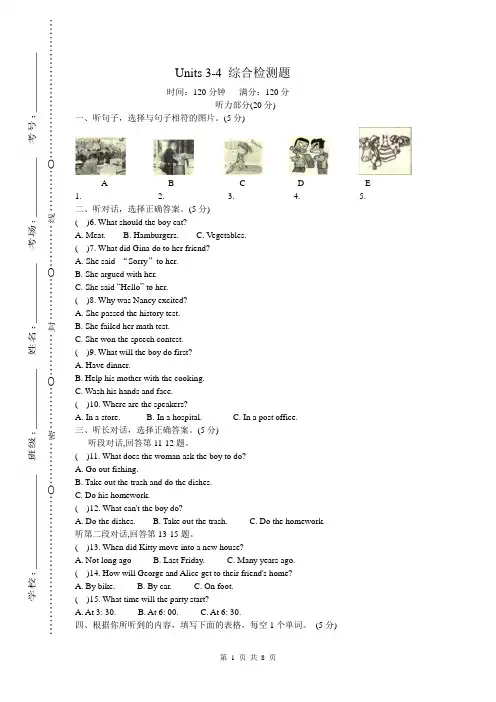
一、听句子,选择与句子相符的图片。(5分)
A B C D E
1. ______ 2. ______ 3. _______ 4. ________ 5. ________
二、听对话,选择正确答案。(5分)
( )6. What should the boy eat?
A. Meat. B. Hamburgers. C. Vegetables.
( )7. What did Gina do to her friend?
A. She said “Sorry”to her.
B. She argued with her.
C. She said “Hello” to her.
( )8. Why was Nancy excited?
A. She passed the history test.
B. She failed her math test.
C. She won the speech contest.
( )9. What will the boy do first?
A. Have dinner.
B. Help his mother with the cooking.
C. Wash his hands and face.
( )10. Where are the speakers?
A. In a store. B. In a hospital. C. In a post office.
新目标英语八年级(上)疑难解析(Units4~5)
日圃圃固
新目标英语八年级(上)疑难解析(units 4~5)
Unit 4 How do you get to school? 江西郭克睛
1.How do you get to school?(P19)你是如何到校的?
get to意为“到达”,to在此是介词,后接表示地点的名词。例如:
He will get tO Tokyo tomorrow.他将于明天到达东京。
David often gets to SChool at seven in the morning.大卫经常在早上
七点钟到校。
注意:get后面直接接home,there,here等表示地点的副词时,不
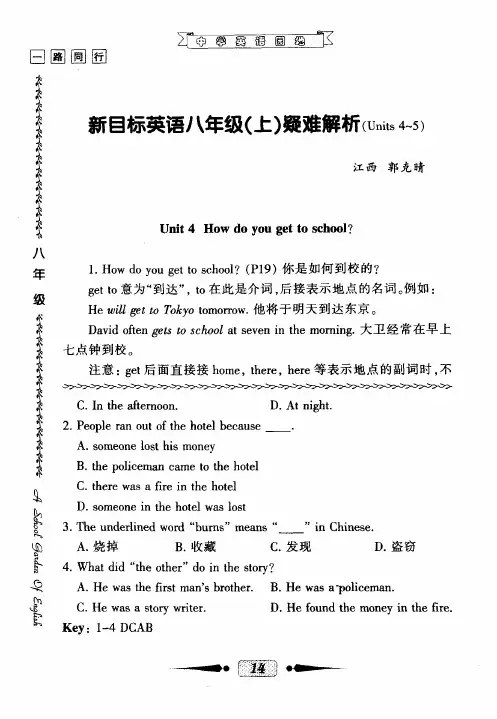
C.In the afternoon.
2.People ran out of the hotel because D.At night.
A.someone lost his money
B.the policeman came to the hotel
C.there was a fire in the hotel
D.someone in the hotel was lost
3.The underlined word“burns”means“ ”in Chinese. A.烧掉 B.收藏 C.发现 D.盗窃
4.What did“the other”do in the story?
A.He was the first man’s brother. B.He was a'policeman.
C.He was a story writer.D.He found the money in the fire.
Key:1-4 DCAB 八年
级 日圆圆囿
再用任何介词。例如:
When do you often get home?你经常什么时候到家?
We got here last night.我们是昨晚到达这里的。
新目标英语八年级(上)疑难解析(units 4~5)
王 互互 日圆圃囿
新目标英语八年级(上)疑难解析(unit 4~5)
Unit 4 How do you get to school? 山东赵修江
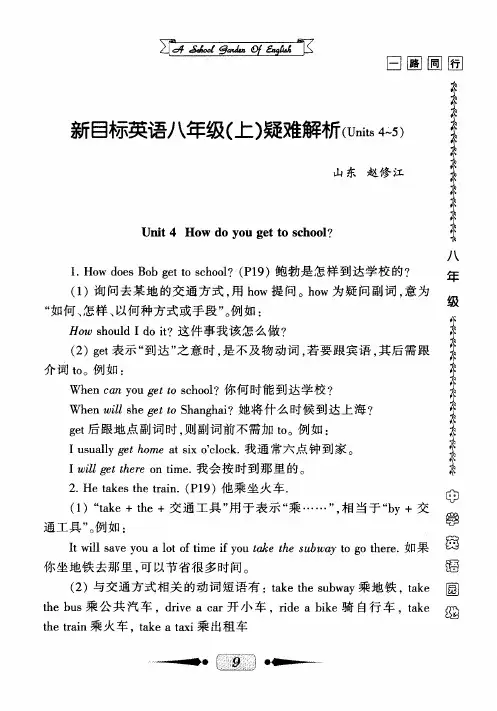
1.How does Bob get to school?(P19)鲍勃是怎样到达学校的?
(1)询问去某地的交通方式,用how提问。how为疑问副词,意为
“如何、怎样、以何种方式或手段”。例如:
How should I d0 it?这件事我该怎么做?
(2)get表示“到达”之意时,是不及物动词,若要跟宾语,其后需跟 介词to。例如:
When CO.n you get to school?你何时能到达学校?
When will she get to Shanghai?她将什么时候到达上海?
get后跟地点副词时,则副词前不需加to。例如:
I usually get home at six o'clock.我通常六点钟到家。
1 will get there on time.我会按时到那里的。
2.He takes the train.(P19)他乘坐火车.
(1)“take+the+交通工具”用于表示“乘……”,相当于“bv+交 通工具”。例如:
It will save you a lot oftime if you take the subway to go there.如果
你坐地铁去那里,可以节省很多时间。
(2)与交通方式相关的动词短语有:take the subway乘地铁.take
the bus乘公共汽车,drive a car开小车,ride a bike骑自行车,take the train乘火车,take a taxi乘出租车 八
年
级
0
释
宙
囤
回
蹈 日圆圆固
八
级 0学宙晤回国
(3)还有一些介词短语也可以表示交通方式,例如:by bus乘公
共汽车,by plane乘飞机,by ship乘轮船,by boat乘船,by train乘火
2014年新目标英语八年级下册Units 3-4专练
2014年新目标英语八年级下册Units 3—4专练
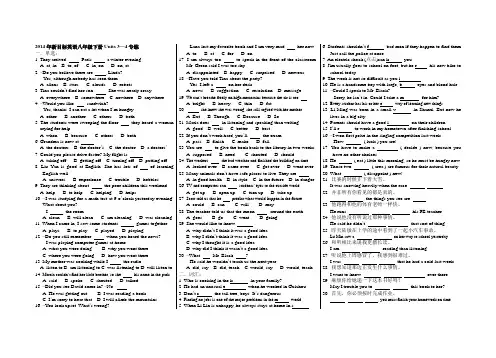
一.单选:
1. They arrived Paris a winter evening.
A. at, in B. to, of C. in, on D. on, at
2. –Do you believe there are , Linda?
--Yes, although nobody has seen them.
A. aliens B. stars C. clouds D. robots
3. Tina couldn’t find her son . She was nearly crazy.
A. everywhere B. somewhere C. nowhere D. anywhere
4. –Would you like sandwich?
--Yes, thanks. I can eat a lot when I’m hungry.
A. other B. another C. others D. both
5. The students were sweeping the floor they heard a woman
crying for help.
A. when B. because C. others D. both
6. Grandma is now at .
A. the doctors B. the doctor’s C. the doctor D. a doctors’
7. Could you please drive faster? My flight is .
A. taking off B. getting off C. turning off D. putting off
八年级下册英语Units3-4单元测试卷(含答案)

八年级下册英语Units3-4单元测试卷
一.单项选择 (本大题共25小题,每小题1分,满分25分)
( )1.Their parents don’t allow them in the river because it's really
dangerous.
A. swim B.swimming C. to swim D.swam
( )2. -Why was your teacher Mark?
-Because he didn't finish his homework on time.
A. different from B.angry with C. similar to D. interested in
( )3. I really hope things .
A.give away B.give out C. put off D. work out
( )4. My uncle told my father yesterday afternoon.
A. call him up B. to call him up
C. call up him D. to call up him
( )5. He is to carry the heavy box.
A.strong enough B. enough strong C. too strong D. so strong
( )6. Here is the book. First it and then tell me what you think of it.
牛津英语译林版八年级上册 8上 阶段评价 Units 3-4 (含答案) - 原题重做
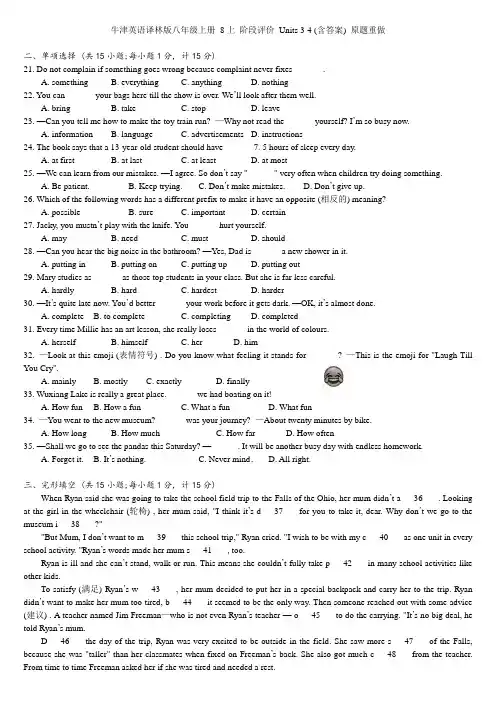
牛津英语译林版八年级上册 8上 阶段评价 Units 3-4 (含答案) 原题重做
二、单项选择 (共15小题;每小题1分, 计15分)
21. Do not complain if something goes wrong because complaint never fixes ______ .
A. something B. everything C. anything D. nothing
22. You can ______ your bags here till the show is over. We’ll look after them well.
A. bring B. take C. stop D. leave
23. —Can you tell me how to make the toy train run? —Why not read the ______ yourself? I’m so busy now.
A. information B. language C. advertisements D. instructions
24. The book says that a 13-year-old student should have ______ 7. 5 hours of sleep every day.
A. at first B. at last C. at least D. at most
25. —We can learn from our mistakes. —I agree. So don’t say "______" very often when children try doing something.
A. Be patient. B. Keep trying. C. Don’t make mistakes. D. Don’t give up.
中考英语总复习-人教版教材知识梳理篇八年级(上)Units 3-4复习指导与作业
八年级(上) Units 3-4教材梳理
教材基础知识梳理
重
点
单
词 A.根据首字母提示写单词。
★1.loudly adv.喧闹地;大声地;响亮地(2013百色79题)
2.quietly adv.轻声地;轻柔地;安静地
petition n.比赛;竞赛;竞争
★4.though adv.不过;可是;然而
conj.虽然;尽管;不过
5.necessary adj.必需的;必要的
ugh v.笑;发笑
n.笑声
★7.reach v.伸手;到达;抵达
8.touch v. 感动;触摸(2015百色81题)
9.fact n.现实;事实
10.worst adj.& adv.最差(的);最坏(的);最糟(的)
11.cheaply adv.便宜地;低廉地
12.choose v.选择;挑选
★13.carefully adv.细致地;小心地,谨慎地(2017百色74题)
14.reporter n.记者
15.worse adj.& adv.更差(的);更坏(的);更糟(的)
16.pretty adv.相当;十分;很
adj.漂亮的
17.winner n.获胜者;优胜者
★18.everybody pron.每人;人人;所有人
★19.seriously adv.严重地;严肃地;认真地 B.根据汉语提示写单词。
20.__outgoing__ adj.爱交际的;友好的;外向的
★21.__both__ adj.& pron.两个;两个都
★22.__clearly__ adv.清楚地;清晰地;明白地
★23.__win__ v.获胜;赢;赢得
24.__talented__ adj.有才能的;有才干的
25.__care__ v.在意;担忧;关心
26.__serious__ adj.严肃的;稳重的
27.__mirror__ n.镜子
★28.__break__ v.(使)破;裂;碎;损坏
(2024年)人教版英语七年级上册Units3-4 阶段测试卷(含答案)
2024版七上英语阶段测试卷
七年级上册英语阶段测试卷Units3-4
时间:100分钟 满分:90分
一、语言知识运用(共35分)
I.从每小题所给的三个选项中,选出一个正确答案。(10分)
( )1.This is________sports field and field is very large.
A.the;a B.a;the C.an;the
( )2.Excuse me, where is the library? I can't it.
A.find B.meet C.take
( )3.—Tom, I don't know this word.
—Well, here is a _________and it can help you.
A.dictionary B.number C.pen
( )4.—Hi,Tom. Is that your schoolbag?
—Yes, it is. And the ruler _________ the schoolbag is mine, too.
A.between B.near C.far
( )5.—Is this flag red?
— .
A.No, it is B.No, this isn't C.Yes, it is
( )6.English is __________useful language,so we should learn it well.
A.an B.a C.the
【仁爱版】八年级英语上册《Review of Units 3-4》词句精讲精练卷附答案
1 八年级英语上册词句精讲精练卷
《Review of Units 3-4》
词汇精讲
1. hobby
hobby作名词,意为“兴趣;爱好”。例如:
His hobby is fishing.
他的爱好是钓鱼。
One of my hobbies is painting.
我的业余爱好之一是画画。
【拓展】
其他表达喜好的句型:
enjoy sth./doing sth.
be keen on sth./doing sth.
be into sth./doing sth.
feel like sth./doing sth.
be fond of sth./doing sth.
be crazy about sth./doing sth.
be inserested in sth./doing sth.
2. collect
collect作及物动词,意为“收集,搜集”。例如:
collect stamps 收集邮票 collect coins 收集硬币
【拓展】collection作名词,意为“收藏品、收集物”。是动词collect 的名词形式,是由动词collect后缀-tion变化来的。collector 名词,意为“收藏家”。例如:
These are my collections.
这些是我的收藏品。
My brother has a very good collection of stamps.
我的弟弟收集了许多邮票。
Mark is a famous stamp collector.
Mark是一位著名的邮票收藏家。
2 3. lend
lend作及物动词,意为“借给,借出”,表示“自己”借给“他人”。常用结构有:lend sb. sth.或lend sth. to sb. 借给某人某物。例如:
Can you lend me your ruler? = Can you lend your ruler to me?
八年级下册 Units 3~4-2023中考英语四轮总复习(人教新目标版)(教师版)
课时11.八年级下册 Units 3~4
单
词
背
默 1.垃圾;废弃物(n.)________
2.折叠;对折(v.)________
3.地板(n.)________
4.杂乱;不整洁(n.)________
5.也不(adv.) 两者都不(pron.)________
6.衬衫(n.)________
7.给;递;走过;通过(v.)________
8.借;借用(v.)________
9.手指(n.)________
10.讨厌;厌恶(v.)________
11.与……同时;当……的时候;而;然而(conj.)________
12.点心;小吃;快餐(n.)________
13.精神压力;心理负担(n.)________
14.提供;供应(v.)________
15.而且;加之(adv.)________
16.因为;既然(conj.) 从……以后;自……以来(prep.,conj.&adv.)________
17.邻居(n.)________
18.有毛病;错误的(adj.)________
19.猜测;估计(v.)________
20.协议;交易(n.)________
21.关系;联系;交往(n.)________
22.云;云朵(n.)________
23.年纪较长的(adj.)________
24.任何;每一(pron.)________
25.焦虑的;担忧的(adj.)________
26.主动提出;自愿给予(v.)________
27.代替;反而;却(adv.)________
28.正确的;恰当的(adj.)________
29.第二;其次(adv.)________
30.清楚易懂的;晴朗的(adj.)________
31.抄袭;模仿;复制;复印(v.)________
32.归还;回来;返回(v.)________
33.(常用于否定句和疑问句末)再也(不);(不)再(adv.)________