
人教版九年级英语Unit 9 知识点总结复习课件(共30张PPT)
九年级英语Unit 9—Unit 10复习人教版(新目标)知识精讲
用心 爱心 专心
初三英语Unit 9—Unit 10复习人教版(新目标)
【本讲教育信息】
一. 教学内容:
Unit 9 — Unit 10 复习
Unit 9 When was it invented?
短语:
according to 根据,按照 in this way 这样
in the end= at last=finally 最后 sth. be invented by sb. 某样东西被谁发明的
the most helpful最有帮助的 the most popular 最受欢迎的
give sb. some time to do sth. 给某人一些时间做某事
fall into 落入,陷入
help sb. do sth. 帮助某人做某事 help you leave the island帮助你离开岛屿
make sb. + adj. 使某人„ make me happy 使我开心
a chef called Black 一个叫布莱克的厨师
sprinkle a lot of salt on chips在薯片上洒大量的盐
decide to do sth. 决定做某事 not…until 直到„才
over three thousand years三千年以上 produce a pleasant smell 产生一股令人愉快的气味
over an open fire在明火上 in nineteenth century 在十九世纪
句型:
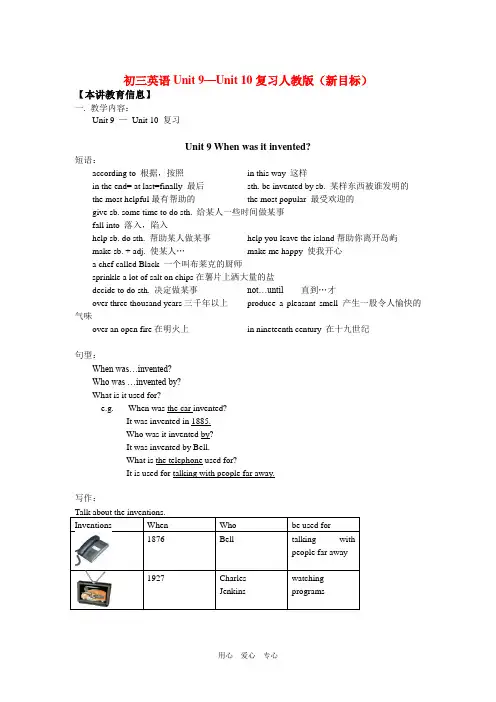
When was…invented?
Who was …invented by?
What is it used for?
e.g. --When was the car invented?
-- It was invented in 1885.
-- Who was it invented by?
人教版英语九年级 Unit1 单元重点知识总结

人教新目标英语九年级
Unit 1 How can we become good learners?
1. 语法by的用法:
⑴含义:
→作介词:
①“在…旁边”→by the sea
②“乘,坐”→by sea
③“(表时间)不迟于,到…为止”→by now/then
④“被,由(被动语态)”→The man is saved by a doctor.
⑤“用…方式,手段”+名词/动名词→by writing/e-mail
→作副词:(位于动词后,单独使用)→pass by/go by
⑵对by表方式,手段提问:how;
⑶介词“用”的区别:
① by “以…方式”+名词/动名词
② with “以…工具”+名词
③ in “以…语言,材料”+名词
eg: ______ hands/reading ______a kinfe/a cup ______Chinese/pencil/ink
2. “变成”的区别:
⑴get “变的…”(天气,形状,状态)+adj.
⑵turn “变的”(颜色)+adj.
⑶become “变成”(结果,指状态=get)+adj./n.
3. a text book on + 学科 “…科教科书”
4. ask sb. for help
5. study for a test
→on a test
6. work/study with …
7. too +adj./adv.+ to do sth. “太…而不能干…”
8. spoken English “口语英语”/written English “写作英语”/English-seaking “说英语的”/speaking skill “拼写技能”
9. have/make a conversation with sb. = talk with sb.
10. improve sb./sth.
(完整版)新版新目标英语九年级unit9知识点总结
Unit9 I like music that I can dance to.
1. prefer v 更喜爱;更喜欢;宁愿= like...better 现在分词preferring、过去式 preferred
prefer sb/sth 更喜欢某人或某物
prefer to do sth 宁愿做某事,更喜欢做某事
prefer doing A to doing B 宁愿做A而不愿做B
prefer sb to do sth 宁愿某人做某事
prefer A to B 喜欢A而不喜欢B to是介词 He prefers apples to bananas.
prefer to do A+ rather than + do B 宁愿做A 而不愿做B=would rather do A than do B
prefer sb to do sth 宁愿某人做某事
2. dance to 随着…..跳舞 to介词 按照,随着 sing to 和着...唱歌
The children danced to the music of the band.
the music that can dance to 能跟着跳舞的音乐
3. along with=together with 伴随着 sing along with 跟着一起唱
4. play different kind of music 演奏不同种类的音乐
5. spare adj 空闲的,不用的 spare time=free time 空闲时间
in one’s spare time 在某人的空闲时间里 have spare time有空闲时间
v 抽出时间,空出房间等 spare sb time 为某人挤出时间
人教版新目标英语九年级上知识点汇总1~12[1]
![人教版新目标英语九年级上知识点汇总1~12[1]](https://360docs-1393072327.cos.ap-beijing.myqcloud.com/6a74e10abb68a98271fefa8c.webp)
人教版新目标英语九年级上知识点汇总 1
Unit1
1. by + doing 通过……方式 如:by studying with a group
by 还可以表示:“在…旁”、“靠近”、“在…期间”、“用、”
“经过”、“乘车”等
如:I live by the river. I have to go back by ten o’clock.
The thief entered the room by the window.
The student went to park by bus.
2. talk about 谈论,议论,讨论 如:The students often talk about
movie after class. 学生们常常在课后讨论电影。
talk to sb. === talk with sb. 与某人说话
3. 提建议的句子:
①What/ how about +doing sth.?
如:What/ How about going shopping?
②Why don’t you + do sth.? 如:Why don’t you go shopping?
③Why not + do sth. ? 如:Why not go shopping?
④Let’s + do sth. 如: Let’s go shopping
⑤Shall we/ I + do sth.? 如:Shall we/ I go shopping?
4. a lot 许多 常用于句末 如:I eat a lot. 我吃了许多。
5. too…to 太…而不能 常用的句型 too+adj./adv. + to do sth.
如:I’m too tired to say anything. 我太累了,什么都不想说。 6. aloud, loud与loudly的用法
人教版九年级英语Unit 9教案
人教版九年级英语Unit 9教案
【教材版本】人民教育出版社 九年级英语
【学习内容】grammar focus, 3a, 3b and 4 of unit 9 when was it invented ?
【学情分析】本节课是第九单元的第二课时, 学习任务是完成课文grammar
focus, 3a, 3b and 4 部分的学习。本单元要求学会谈论重要发明的历史及用途,然后针对各项发明的用处及特点,发表自己的看法,并说明理由。话题一直是围绕着历史上和日常生活中的重要发明,通过使用“passive voice”形式的句型,循序渐进地展开讨论。课本设计的活动情景能够自然地引发学生的好奇心,大家积极地投入到话题讨论中,寓教于乐,容易引起学生的兴趣;同时,它也有利于开阔学生的思路,培养创造精神,展开丰富的想象力,人人都能成为“小发明家”。
学生在第一课时学习了本单元的section a 中的1a至2c部分,基本能听懂、会说本单元要求掌握的部分重要词汇;在图片,相关信息等提示的帮助下,能较好地运用重要句型和掌握主动语态和被动语态及相互转换。但是本班的学生两极分化比较严重,有一部分学生基础知识不牢固,前面提到的学过的单词和句型就忘得差不多了,特别是对于课文中的语法—主动语态和被动语态,被动语态的一般现在时和一般过去时混为一谈。
所以教师在课堂教学中应面向整体,及时复习相关的知识,包括重要词汇和句型,前后知识的衔接。同时在设计上要注意活动的多样性,激发他们的兴趣,让每一位学生能得到不同程度的收获。
【单元整体目标】
重点词汇:salty, sweet, sour, crispy, pleasant, potato chips, slipper,
leaf, fire, scoop, light bulb, microwave oven, abacus, camera, beverage,
be invented by, be used for, by mistake, by accident
新人教版九年级英语Unit 11知识汇总

美多教育九年级英语一对一辅导资料
尽最大的努力 留最小的遗憾 1 Unit 11 Could you please tell me where the restrooms are? 一、本单元重点语法:宾语从句
【江西中考回眸】
①【2011江西】--- Where's Jack?
---
He’s gone either to Hangzhou or to Wuhan, but I'm not sure _________. ( )
A. that
B. which
C. where
D. there
②【2012江西】I know ____ I promised to take you dinner, but I won’t finish working until ten p.m.( )
A. that B. if C. what D. why
③【2013江西】Do you know _______ I saw yesterday? It was my favourite star, Jackie. ( )
A. whom B. where C. when D. how
【宾语从句介绍】
① 定义:宾语从句就是在复合句中作宾语的名词性从句,通常放在主句谓语动词或介词之后
② 宾语从句的引导词
A. that eg. He said (that) he would come.
B. who等特殊疑问词 eg. Could you tell me where the post office is?
人教版新目标英语九年级上知识点汇总1~12……
Unit1
1. by + doing 通过……方式 如:by studying with
a group
by 还可以表示:“在…旁”、“靠近”、“在…期间”、“用、”
“经过”、“乘车”等
如:I live by the river. I have to go back by
ten o’clock.
The thief entered the room by the window.
The student went to park by bus.
2. talk about 谈论,议论,讨论 如:The students
often talk about movie after class. 学生们常常在课后讨论电影。
talk to sb. === talk with sb. 与某人说话
3. 提建议的句子:
①What/ how about +doing sth.?
如:What/ How about going shopping?
②Why don’t you + do sth.? 如:Why don’t you
go shopping?
③Why not + do sth. ? 如:Why not go
shopping?
④Let’s + do sth. 如: Let’s go shopping
⑤Shall we/ I + do sth.? 如:Shall we/ I go
shopping?
4. a lot 许多 常用于句末 如:I eat a lot. 我吃了许多。
5. too…to 太…而不能 常用的句型 too+adj./adv.
+ to do sth.
如:I’m too tired to say anything. 我太累了,什么都不想说。
人教版英语九年级上册Unit9知识点详解
优选精品 欢迎下载
1 / 7 Unit 9知识点讲解
1. dance to music 随着音乐起舞
2. sing along with 随着……一起唱
3. musicians who play different kinds of music
弹奏不同类型音乐的音乐家
4. electronic music 电子音乐
5. not much=nothing much 没什么(事)
6. suppose sb. to do sth. 猜想某人做某事
be supposed to do sth. 应该做某事
suppose sb (to be) +adj. 原以为……
7. have spare time 有空闲时间
in one's spare time 在某人的空闲时间
spare the time to do sth. 抽时间做……
8. think too much 想得太多;过度思考
9 in that case 既然那样
10. World War II 第二次世界大战
11. smooth music 悦耳的音乐
12. prefer A to B 比起B来更喜欢A
prefer doing A to doing B
愿意去做A而不是去做B
prefer to do A rather than do B
宁愿做A而不做B
13. feel like doing sth. 想要做某事
=want to do sth. =would like to do sth.
14. stick to 坚持,固守
15. be down 悲哀,沮丧
16. cheer sb up 使… 高兴/ 振奋
17. have a happy ending 有个美满的结局
18. less serious 不那么严重
人教版九年级英语下册各单元知识点归纳总结
人教版九年级英语下册全册各单元必考知识点
目录
Unit7 知识要点梳理 ............................................................................................................... 2
【重点短语】 .................................................................................................................... 2
【重点句型】 .................................................................................................................... 3
【考点详解】 .................................................................................................................... 4
【重点语法】 .................................................................................................................... 6
Unit8 知识要点梳理 ............................................................................................................... 8
【重点短语】 .................................................................................................................... 8
人教版新目标英语九年级上知识点汇总1~12[1] 2
人教版新目标英语九年级上知识点汇总 1
Unit1
1. by + doing 通过„„方式 如:by studying with a group
by 还可以表示:“在„旁”、“靠近”、“在„期间”、“用、”
“经过”、“乘车”等
如:I live by the river. I have to go back by ten o’clock.
The thief entered the room by the window.
The student went to park by bus.
2. talk about 谈论,议论,讨论 如:The students often talk about movie
after class. 学生们常常在课后讨论电影。
talk to sb. === talk with sb. 与某人说话
3. 提建议的句子:
①What/ how about +doing sth.?
如:What/ How about going shopping?
②Why don’t you + do sth.? 如:Why don’t you go shopping?
③Why not + do sth. ? 如:Why not go shopping?
④Let’s + do sth. 如: Let’s go shopping
⑤Shall we/ I + do sth.? 如:Shall we/ I go shopping?
4. a lot 许多 常用于句末 如:I eat a lot. 我吃了许多。
5. too„to 太„而不能 常用的句型 too+adj./adv. + to do sth.
如:I’m too tired to say anything. 我太累了,什么都不想说。