
人教版英语八年级上册Unit1 讲义
5on vacation
在度假中,在度假时。(固定搭配)(做表语,表示主语此时的状态是在度假的状态;做时间状语。)
e.g. I am on vacation.我在度假。
e.g. I often help my mom on vacation.我在度假时通常帮我妈妈。
2)visit sp.游览某地。参观某地。
e.g. I like to go to different places, and I want to visit China next year.
e.g. I visited the science museum last weekend.
补充:visitor n.拜访的人,拜访者,游客。(可数)。
如请尽量在三十分钟内完成这项工作。Please try to finish the work in 30 minutes.
为什么不试着骑车去学校呢?Why not try riding a bike to school?
我要尽我最大努力来帮助你。I will try my best to help you.
few [fjuː] adj.很少的;n.少量
quite a few相当多;不少(后接可数名词)
most [məʊst] adj.最多的;大多数的;
something ['sʌmθɪŋ] pron.某事物;
nothing(=not…anything) ['nʌθɪŋ] pron.没有什么n.没有
of course [əvkɔːs]当然
in the countryside在乡下feed hens喂母鸡
Section B
along the way沿途another two hours(= two more hours)另外两个小时because of因为
come up升起feel like给……的感觉;感受到find out查明;弄清in the past在过去
试了几次后,他们决定放弃。After a few tries they decided to give up.
4visit v.探望,看望,参观,游览。
常见用法:
1)visit sb.看望某人,探望某人。
e.g. I want to visit my old friends in the US.
e.g. Last week, I visited my grandparents.
1)on a vacation在一次度假中。(做表语,做时间状语)
e.g. I am on vacation.我在度假。
e.g. I helped my mom on a vacation.在一次度假时我帮了我妈妈。
2)on/during(one’s)summer vacation(s)在暑假期间。(作时间状语)
翻译下列句子。
1)你决定去买一些特殊的东西吗?
2)我决定明天不去打篮球了。
3 try“尝试,努力”
既可以作为动词,也可以作为名词。
常用句型为:
1)努力做某事try to do sth.
2)尝试做某事try doing sth.
3)尽某人最大努力做某事try one's best to do sth.
bird [bɜːd] n.鸟;禽
bicycle ['baɪsɪkl] n.自行车
building ['bɪldɪŋ] n.建筑物
trader ['treɪdə(r)] n.商人;商船
wonder ['wʌndə(r)] v.惊奇;想知道;怀疑
difference ['dɪfrəns] n.差异;不同
3能了解以下语法:
—复合不定代词someone, anyone, something, anything等的用法。
—yourself, myself等反身代词的用法。
4一般过去时态的特殊疑问句,一般疑问句及其肯定、否定回答。
重点、难点
1.复合不定代词someone, anyone, something, anything等的用法。
learn something important学一些重要的东西have a fun time过得很开心;玩得非常愉快
in the shopping center在购物中心
三句型
1. Did you buy anything special?
在英语中,anything, something, nothing和everything是用于指代事物的复合不定代词,与之相对应的复合不定代词anyone, someone, no one和everyone (anybody, somebody, nobody和everybody)用于指人。与形容词连用时,形容词必须置于复合不定词之后,语法上称作“后置”。
如I can’t find my keys anywhere.我到处也找不到我的钥匙。
3. We took quite a few photos there.
a few意为“一些,若干(=some)”,后跟可数名词复数形式。
quite a few意为“相当多;不少(=many)”后跟可数名词复数形式。
如I can see someone new in your group.
There’s nothing interesting in the news today.
2. Did you go anywhere interesting?
anywhere意为“在任何地方”,常用于一般疑问句或否定句中,代替somewhere。
myself [maɪ'self] pron.我自己
everyone ['evriwʌn] pron.每人;人人
yourself [jɔː'self] pron.你自己;你亲自
hen [hen] n.母鸡;雌禽
bored [bɔːd] adj.无聊的;厌烦的;郁闷的
pig n.猪
diary ['daɪəri] n.日记;日记簿
few表示否定意义,没有,几乎没有;
a few表示有肯定意思,有几个.例如:
He has few friends here. He feels lonely.他这里没朋友,他感觉寂寞.
There are a few eggs in the basket.篮子里有几个鸡蛋.
little / a little用来修饰不可数名词,
2. yourself, myself等反身代词的用法。
考点及考试要求
1.一般过去时
2.用所学的功能语言交流假期去了哪里旅行。
一、单词
anyone ['eniwʌn] pron.任何人
anywhere ['eniweə(r)] adv.任何地方n.任何(一个)地方
wonderful ['wʌndəfl] adj.精彩的;极好的
go out外出(娱乐) keep a diary记日记long time no see好久不见most of the time大多数时间
study for tests备考quite a few相当多;不少visit museums参观博物馆
visit my uncle拜访我叔叔stay at home待在家taste good尝起来不错
4. I just stayed at home most of the time to read and relax.
seem [siːm] vi.似乎;好像
someone ['sʌmwʌn] pron.某人;有人
activity [æk'tɪvəti] n.活动;活跃
decide [dห้องสมุดไป่ตู้'saɪd] v.决定;选定
try [traɪ] v.尝试;设法;努力
paragliding ['pærəɡlaɪdɪŋ] n.空中滑翔跳伞
e.g. I would like to take/have a vacation this summer.
二短语
Section A
go on vacation去度假go shopping购物buy sth. for sb.给某人买某物
go to summer camp去夏令营go to the beach去海滩go to the mountains去爬山
如. A few girls are playing volleyball.几个女孩正在打排球。
There are quite a few birds in the forest.在那片森林里有很多鸟。
few、a few、little、a little的区别和联系:
few / a few用来修饰可数名词,
重点单词
1 anyone
任何人复合不定代词由any和one组成,用于指人。
2 decide意为“决定”
经常用句型:
1)决定做某事decide to do sth. ;
2)决定不做某事decide not to do sth.。
它的名词形式为decision,常用句型为make a decision to do sth.。
—I don't know. I have ________ information about him because we haven't seen each other for ________ years.
A.a little;a fewB.little;a few C.a few;thatD.few;a little
duck [dʌk] n.鸭肉;鸭
Unit1知识讲义空白单人教版英语八年级上册
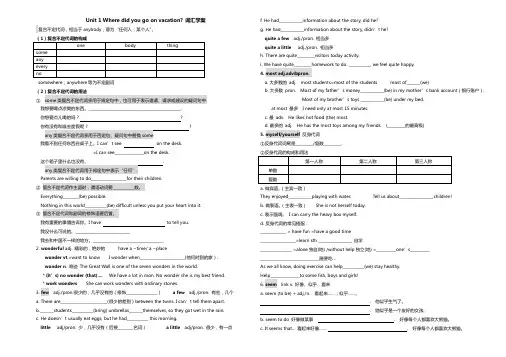
Unit 1 Where did you go on vacation? 词汇学案复合不定代词,相当于anybody ,意为“任何人;某个人”。
somewhere ,anywhere 等为不定副词 (2)复合不定代词的用法①some 类复合不定代词多用于肯定句中,也可用于表示邀请、请求或建议的疑问句中. 我想要喝点凉爽的东西。
_______________________________________________. 你想要点儿喝的吗? ?我看不到任何东西在桌子上。
I can ’t see on the desk.=I can see_______________on the desk.Parents are willing to do__________________for their children. ② 复合不定代词作主语时,谓语动词要___________数。
Everything________(be) possible.Nothing in this world___________(be) difficult unless you put your heart into it. ③ 复合不定代词和副词的修饰语要后置。
我有重要的事情告诉你。
I have to tell you. 我没什么可说的。
____________________________我去和中国不一样的地方。
____________________________________ 2. wonderful adj. 精彩的,绝妙的 have a ~time/ a ~placewonder vt .=want to know I wonder when_______________________(他何时到的家). wonder n . 奇迹 The Great Wall is one of the seven wonders in the world.* (It ’s) no wonder (that).... We have a lot in mon. No wonder she is my best friend. * work wonders She can work wonders with ordinary stones.3. few adj./pron.很少的;几乎没有的(修饰________________) a few adj./pron. 有些,几个 a. There are________________________(很少的差别)between the twins. I can ’t tell them apart. b._______students___________(bring) umbrellas_______themselves, so they got wet in the rain. c. He doesn ’t usually eat eggs, but he had___________ this morning.little adj/pron. 少,几乎没有(后接________名词) a little adj/pron. 很少,有一点f. He had____________information about the story, did he?g. He had____________information about the story, didn ’t he? quite a few adj./pron. 相当多 quite a little adj./pron. 相当多h. There are quite_________visitors today activity.i. We have quite_________homework to do. ___________, we feel quite happy. 4. most adj.adv&pron.a. 大多数的 adj. most students=most of the students most of_______(we)b. 大多数 pron. Most of my father ’s money____________(be) in my mother ’s bank account (银行账户). Most of my brother ’s toys ____________(be) under my bed. at most 最多 I need only at most 15 minutes.c. 最 adv. He likes hot food (the) most.d. 最多的 adj. He has the most toys among my friends. (_________的最高级) 5. myself/yourself 反身代词①反身代词词尾是_________/复数_________. a. 做宾语。
人教版八年级英语上册Unit1电子教材+音频朗读+视频点拨+要点梳理+图文讲解+课堂练习

人教版八年级英语上册Unit1电子教材+音频朗读+视频点拨+要点梳理+图文讲解+课堂练习Unit 1 Where did you go on vacation?Section A 1bListenand number the people in the picture 1-5.Conversation 1Hey, Tina. Where did you go on vacation?I went to the mountains with my family.Did everyone have a good time?Oh, yes. Everything was excellent. Wheredid you go, Xiang Hua?I went to New York City.Conversation 2What did you do on vacation, Sally?Nothing. I just stayed at home. And did youdo anything interesting, Bob?Yes. I visited my uncle. We went fishing,but we didn t get any fish.Conversation 3Did you go anywhere on vacation, Tom?I went to summer camp. Did you go withanyone?Yes. I went with my friends. Everyone had agreat time.Section A 2aListen.Where did the people go on vacation? Complete the chart.Conversation 1Where did you go on vacation, Grace?I went to New York City.Oh, really? Did you go with anyone?Yes. I went with my mother.Did you go to Central Park?Yes, I did. It was really nice.Did you buy anything special?Yes. I bought something for my father.Oh, really? What?I bought him a hat.Conversation 2Where did you go on vacation, Kevin?I went to the beach.Oh, that s nice.Did you play volleyball?No, I didn t.Well, did you swim?Yes, I did. The water was really warm.How was the food?Everything tasted really good!Did you meet anyone interesting?Yes. I met some very interesting people. Conversation 3Where did you go on your vacation, Julie?I stayed at home.Oh. So, did you do anything interesting? No, I didn t.Did you study for your tests?Yes, I did.Did you go out with anyone?No. No one was here. Everyone was onvacation. Section A 2bListenagain. Check (√) Yes, I did or No, I didn t for each question.Conversation 1Where did you go on vacation, Grace?I went to New York City.Oh, really? Did you go with anyone?Yes. I went with my mother.Did you go to Central Park?Yes, I did. It was really nice.Did you buy anything special?Yes. I bought something for my father.Oh, really? What?I bought him a hat.Conversation 2Where did you go on vacation, Kevin?I went to the beach.Oh, that s nice.Did you play volleyball?No, I didn t.Well, did you swim?Yes, I did. The water was really warm.How was the food?Everything tasted really good!Did you meet anyone interesting?Yes. I met some very interesting people. Conversation 3Where did you go on your vacation, Julie?I stayed at home.Oh. So, did you do anything interesting?No, I didn t.Did you study for your tests?Yes, I did.Did you go out with anyone?No. No one was here. Everyone was on vacation. Section A 2dRole-playthe conversation.Hi, Helen. Long time no see.Hi, Rick. Yes, I was on vacation lastmonth. Oh, did you go anywhere interesting?Yes, I went to Guizhou with my family.Wow! Did you see Huang guo shu Waterfall?Yes, I did. It was wonderful! We took quitea few photos there. What about you? Did you do anything special last month?Not really. I just stayed at home most ofthe time to read and relax.Section B 1cListen.Lisa is talking about her vacation. Answer the questions.Hi, Lisa. How was your vacation?It was great! I went to Hong Kong with myfamily.Really? Wow! Did you do anything specialthere?Well, we went to a fun park. It was reallyexciting.Did you go shopping?Yeah, I did.How were the stores?Oh, they were very expensive, but I did buysomething for my best friend.And how were the people? Were theyfriendly?Yeah, they were really friendly. My parentshave some friends there, and we had dinner at their house.How was the food?It was delicious. I loved their homecooking.Did everyone have a good time?Oh, yes, we did. Everything was excellent.Section B 1dListenagain. Fill in the blanks.Hi, Lisa. How was your vacation?It was great! I went to Hong Kong with myfamily.Really? Wow! Did you do anything specialthere?Well, we went to a fun park. It was reallyexciting.Did you go shopping?Yeah, I did.How were the stores?Oh, they were very expensive, but I did buysomething for my best friend.And how were the people? Were theyfriendly?Yeah, they were really friendly. My parentshave some friends there, and we had dinner at their house.How was the food?It was delicious. I loved their homecooking.Did everyone have a good time?Oh, yes, we did. Everything was excellent.Section B 2bReadJane s diary entries about her vacation and answer the questions.Monday, July 15thI arrived in Penang in Malaysia thismorning with my family. It was sunny and hot, so we decided to go to the beachnear out hotel. My sister and I tried paragliding. I felt like I was a bird. Itwas soexciting!For lunch, we had something veryspecial—Malaysian yellow noodles. They were delicious! In the afternoon, werode bicycles to George town. There are a lot of new buildings now, but many ofthe old buildings are still there. In Weld Quay, a really old place inGeorgetown, we saw the houses of the Chinese traders from 100years ago. Iwonder what life was like here in the past.I really enjoyed walking around thetown.Tuesday, July 16thWhat a difference a day makes! My fatherand I decided to go to Penang Hill today. We wanted to walk up tothe top, butthen it started raining a little so we decided to take the train. We waitedover an hour for the train because there were too many people. When we got tothe top, it was raining really hard. We didn t have an umbrella so we were wetand cold. It wasterrible! And because of the bad weather, we couldn tseeanything below. My father didn t bring enough money, so we only had one bowl ofrice and some fish. The food tasted great because I was so hungry!翻译:Section A你去哪里度假了?我去爬山了。
人教版八年级英语上册u1-u10讲义
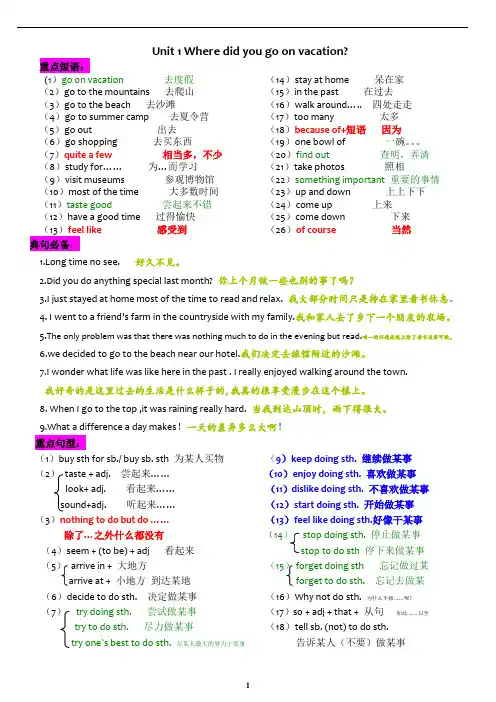
Unit 1 Where did you go on vacation? 重点短语:(1)go on vacation 去度假(2)go to the mountains 去爬山(3)go to the beach 去沙滩(4)go to summer camp 去夏令营(5)go out 出去(6)go shopping 去买东西(7)quite a few 相当多,不少(8)study for…… 为…而学习(9)visit museums 参观博物馆(10)most of the time 大多数时间(11)taste good 尝起来不错(12)have a good time 过得愉快(13)feel like 感受到(14)stay at home 呆在家(15)in the past 在过去(16)walk around….. 四处走走(17)too many 太多(18)because of+短语因为(19)one bowl of 一碗。
(20)find out 查明,弄清(21)take photos 照相(22)something important 重要的事情(23)up and down 上上下下(24)come up 上来(25)come down 下来(26)of course 当然典句必备:1.Long time no see. 好久不见。
2.Did you do anything special last month? 你上个月做一些也别的事了吗?3.I just stayed at home most of the time to read and relax. 我大部分时间只是待在家里看书休息。
4. I went to a friend’s farm in the countryside with my family.我和家人去了乡下一个朋友的农场。
5.The only problem was that there was nothing much to do in the evening but read.唯一的问题是晚上除了读书没事可做。
Unit1 sectionA 知识点讲解 人教版英语八年级上册
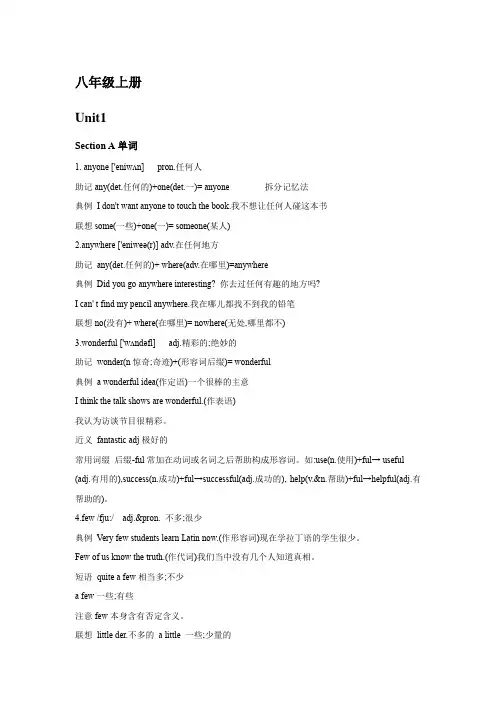
八年级上册Unit1Section A单词1. anyone ['eniwʌn] pron.任何人助记any(det.任何的)+one(det.一)= anyone 拆分记忆法典例I don't want anyone to touch the book.我不想让任何人碰这本书联想some(一些)+one(一)= someone(某人)2.anywhere ['eniweə(r)] adv.在任何地方助记any(det.任何的)+ where(adv.在哪里)=anywhere典例Did you go anywhere interesting? 你去过任何有趣的地方吗?I can' t find my pencil anywhere.我在哪儿都找不到我的铅笔联想no(没有)+ where(在哪里)= nowhere(无处,哪里都不)3.wonderful ['wʌndəfl] adj.精彩的;绝妙的助记wonder(n惊奇;奇迹)+(形容词后缀)= wonderful典例a wonderful idea(作定语)一个很棒的主意I think the talk shows are wonderful.(作表语)我认为访谈节目很精彩。
近义fantastic adj极好的常用词缀后缀-ful常加在动词或名词之后帮助构成形容词。
如:use(n.使用)+ful→ useful (adj.有用的),success(n.成功)+ful→successful(adj.成功的), help(v.&n.帮助)+ful→helpful(adj.有帮助的)。
4.few /fju:/ adj.&pron. 不多;很少典例Very few students learn Latin now.(作形容词)现在学拉丁语的学生很少。
Few of us know the truth.(作代词)我们当中没有几个人知道真相。
Unit1 sectionB 知识点讲解 人教版英语八年级上册
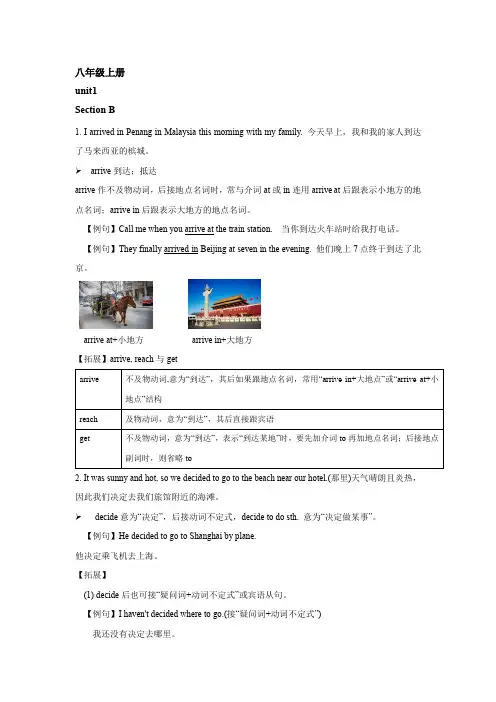
八年级上册unit1Section B1. I arrived in Penang in Malaysia this morning with my family. 今天早上,我和我的家人到达了马来西亚的槟城。
➢arrive到达;抵达arrive作不及物动词,后接地点名词时,常与介词at或in连用arrive at后跟表示小地方的地点名词;arrive in后跟表示大地方的地点名词。
【例句】Call me when you arrive at the train station. 当你到达火车站时给我打电话。
【例句】They finally arrived in Beijing at seven in the evening. 他们晚上7点终于到达了北京。
arrive at+小地方arrive in+大地方【拓展】arrive, reach与get2. It was sunny and hot, so we decided to go to the beach near our hotel.(那里)天气晴朗且炎热,因此我们决定去我们旅馆附近的海滩。
➢decide意为“决定”,后接动词不定式,decide to do sth. 意为“决定做某事”。
【例句】He decided to go to Shanghai by plane.他决定乘飞机去上海。
【拓展】(1) decide后也可接“疑问词+动词不定式”或宾语从句。
【例句】I haven't decided where to go.(接“疑问词+动词不定式”)我还没有决定去哪里。
【例句】The Smiths decided that they would move to Dalian. (接从句)史密斯一家决定他们将搬去大连。
(2) decision是decide的名词形式,意为“决定”,常用短语make a decision 意为“做决定”。
人教版八年级上册英语Unit 1知识点梳理及语法讲义(教师版)

八年级上册英语Unit 1知识点与语法精讲精练词汇梳理(一)完成单词梳理:名词:1. hen母鸡 2. pig 猪 3. diary 日记;记事簿4. activity 活动5. paragliding 滑翔伞运动6. bird 鸟7. bicycle 自行车8. building 建筑物;房子9. trader 商人10. difference 差别;差异11. top 顶部;表面12. umbrella 伞;雨伞13. hill 小山;山丘14. duck 鸭动词:1. seem 好像;似乎;看来 2. decide 决定;选定 3. wonder 想知道;琢磨4. wait 等待;等候代词:1. anyone 任何人 2. something 某事;某物 3. nothing 没有什么4. everyone 每人;人人;所有人5. myself 我自己;我本人6. yourself 你自己;您自己7. someone 某人副词:1. anywhere 在任何地方形容词:1. wonderful 精彩的;绝妙的 2. bored 厌倦的;烦闷的3. enjoyable 有乐趣的;令人愉快的4. wet 湿的;潮湿的5. hungry 饥饿的兼类词:1. few (adj/pron)不多;很少 2. most (adj/adv/pron)最多;大多数3. try (n/v)尝试;设法;努力4. below (prep/adv)在……下面5. enough (adj/adv)足够的(地)6. dislike (v/n)不喜爱(的事物)7. as (adv)像……一样(conj)当……时;如同(二) 词汇变形小结:1. wonder (v. 想知道) — wonderful (adj. 精彩的;绝妙的) — wonderfully (adv. 精彩地)2. bore (v. 使……厌烦) — bored (adj.厌倦的)— boring (adj.令人厌倦的)3. diary (n. 日记) — diaries (复数)4. enjoy (v. 喜爱) — enjoyable (adj. 有乐趣的;令人愉快的)5. activity (n. 活动) — activities (复数)6. decide (v. 决定) — decision (n. 决定)7. build (v. 建造) — building (n. 建筑物;房子)8.trade (n/v贸易;买卖) — trader (n. 商人)9. difference (n. 差别;差异) — different (adj. 不同的)10. wait(v. 等候;等待) — waiter (n. 男服务员) — waitress (n. 女服务员)11. like(v. 喜欢)— dislike 反义词(v.不喜欢)【练一练】用所给词的适当形式填空1.–Mom. I plan to wash clothes by ___myself____(I) this summer vacation.- Good girl! Go for it.2.Can you tell me some __differences___(different) between the two pictures?3.The students have quite a few activities (activity) after class. They can sing, dance and play basketball.4.I think it will be a very enjoyable (enjoy) trip for you to travel to Beijing.5.His cousin is a trader (trade), selling fruit and vegetables.6.The TV show is really boring (bore). I don’t want to watch it.7.As a teacher, Mr. Green always tries to make his lessons _enjoyable__(enjoy).8.This film is _wonderful___ (wonder). I like to see it very much.9.I can look after __myself____(my). Don’t worry about me.10.You must look after __yourself____(you) well while I'm away, Tom.(三) 短语攻关:go on vacation去度假stay at home 待在家里go out 出去quite a few 相当多;不少most of the time大部分时间of course当然have a good time=enjoy oneself 玩得高兴feel like 给……的感觉;感觉像take photos 拍照;照相keep a diary 写日记buy sth for sb 买某物给某人decide to do sth 决定做某事something important 重要的事find out 找出;查明in the past 在过去make a difference 产生影响;起作用enjoy doing sth喜欢做某事too many 太多arrive at/in 到达because of 因为;由于wait for 等待;等候start to do /doing sth开始做某事知识点梳理1.We took a few photos there.我们在那里拍了很多照片。
八年级英语上册-人教版-Unit 1 说课稿
八年级英语上册-人教版-Unit 1 说课稿一. 教材分析人教版八年级英语上册Unit 1主要讲述的是关于人与动物之间的故事。
通过本单元的学习,学生可以掌握一定的动物词汇,学会用英语描述动物的特点以及人与动物之间的关系。
教材内容丰富,插图生动有趣,激发学生的学习兴趣。
同时,本单元还引入了阅读理解和听力训练,有助于提高学生的英语综合运用能力。
二. 学情分析八年级的学生已经具备一定的英语基础,能够进行简单的英语交流。
但部分学生在语法、发音等方面还存在困难,需要加强练习。
此外,学生对于动物主题较为感兴趣,有利于激发学习动机。
三. 说教学目标1.知识目标:学生能够掌握本单元的生词、短语和句型,运用英语描述动物的特点及人与动物之间的关系。
2.能力目标:学生能够听懂、会说、会读本单元的主要内容,提高英语口语表达能力。
3.情感目标:培养学生关爱动物、保护环境的意识。
四. 说教学重难点1.重点:本单元的生词、短语和句型。
2.难点:动物特点的描述以及人与动物之间关系的表达。
五. 说教学方法与手段1.采用任务型教学法,以学生为主体,教师为指导,通过小组合作、讨论等形式,激发学生的学习兴趣和积极性。
2.运用多媒体教学手段,如课件、视频等,为学生提供丰富的视觉、听觉资源,提高教学效果。
3.注重个体差异,针对不同学生的学习需求,给予个别辅导和指导。
六. 说教学过程1.导入:通过展示动物图片,引导学生谈论自己喜欢的动物,激发学生的学习兴趣。
2.新课呈现:讲解本单元的生词、短语和句型,让学生进行实际操作练习。
3.阅读理解:让学生阅读教材中的故事,回答相关问题,提高学生的阅读能力。
4.听力训练:播放教材中的听力材料,学生进行听力练习,提高听力水平。
5.小组讨论:学生分组讨论动物的特点及人与动物之间的关系,培养学生的合作意识。
6.课堂总结:对本单元的主要内容进行总结,帮助学生巩固所学知识。
7.作业布置:布置相关的写作、听力、口语练习,让学生课后巩固所学。
(人教版)2020八年级英语上册 Unit 1 Where did you go on vacation讲义+习题 (新版)人教新目标版
Unit1. Where did you go on vacation因为19.one bowl of… 一碗…… 20.the next day 第二天21.drink tea喝茶22.find out找出;查明23.go on继续24.take photos照相25.something important重要的事 26.up and down上上下下27.have a good time玩得高兴=enjoy oneself=have (great) fun1.与seem有关的句式1)seem + 形容词“看起来…..” You seem happy today.2)seem + to do sth. “似乎、好像做某事” I seem to have a cold3)It seems / seemed + 从句“看起来好像…;似乎…”. It seems that no one believe you.4)seem like ….“好像,似乎…..” It seems like a good idea.2. too many,too much,much too1)too many “太多”,后接可数名词复数。
如:Mother bought too many eggs yesterday.2)too much “太多”,修饰不可数名词或修饰动词作状语。
如:3)much too “太”,修饰形容词或副词。
如:小结:分辨三者的口诀: too much, much too, 用法区别看后头: much 后接不可数, too 后修饰形或副。
too many 要记住,后面名词必复数。
7. because:1)because of 介词短语,“因为,由于”,后接名词、代词或动名词,不能接句子。
如:H e can’t take a walk because of the rain.2)because 连词,“因为”,引导状语从句,表示直接明确的原因或理由。
新人教版英语八年级上册--unit 1 课文重难点讲解
2014八年级上Unit1 Where did you go on vacation?重点单词:anyone anywhere wonderful few mostSomething nothing everyone seem boredsomeone decide try wonder differencewait wet below enough hungryas dislike重点短语quite stay at home of course go shoppingfeel like seem to be because of decide to do sth.go on vacation ride bicycles go to summer camp enough moneystudy for tests the top of the hill重点句型1.----Where did you go on vacation?----I went to New York City.2. Did you go out with anyone?3. ---How was the food?----Everything tasted really good!4. Still no one seemed to be bored.5. And because of the bad weather, we couldn’t see anything below.语法:不定代词和一般过去时态1. go on vacation度假on holiday/vacation spend a holiday2. Did you do anything special last month? 上个月你做了什么特别的事情吗?anything special. something, anything, nothing, somebody, anyone等都是不定代词。
人教版八年级英语上册Unit1知识点讲解
人教版八年级英语上册Unit1知识点讲解Where did you go on vacation?Section A Page 1短语1. 去度假go on vacation2. 去山区go to the mountains3. 呆在家里stay at home4. 去夏令营go to summer camp5. 去海滩go to the beach.语法:1. 一般现在时态和一般过去时态He _______ (read) English every day. But he _________ (watch) TV yesterday.如果要表达“现在某人的行为习惯,即某人经常做某事”,要用一般现在时态。
如果主语是单数第三人称,动词要用单三形式(一般情况加s)。
如果要表达某人过去做过某事,要用一般过去时态,动词要用它的过去式。
动词的过去式变化规则有:①一般情况在动词末尾加______ 如:visit ---________; look ---________;stay---- _______②以不发音的字母e结尾的动词后加_____, 如:decide---_________; taste----_______③在重读音节中,只有____ 个元音字母,并且后紧跟____ 个辅音字母结尾,应该_______ 这个辅音字母再加________. 如:stop---- _________; plan---- __________.④以辅音字母+y结尾, 应改___ 为___, 再加____. 如:study---- __ ___; cry--- ______.⑤有的动词不按上面的4种规律变化,是没有规律的,我们称为不规则动词,只有死记。
好在他们不多。
收录在课本142面。
如:am/ is --- _____; are---______; come---_______; get----_______; do----______; go---- _______; have/ has ----_______; make---_______;助动词的用法①______ he ______ (read) English every day ? ---No,he _______ (not read)English every day.② _______ he ________ (watch)TV last night ?--- No, he ________(not watch) TV last night.我们发现对动词提问或否定,应该用助动词do/does(用于一般现在时态)和did(用于一般过去时态). 并且助动词后接动词原形。