
初中英语_初中英语八年级上册Unit7 Have you been to a museum(Reading)教学设计学情分析教材分析课后反思
U7 Have you been to a museum? Sec. B (阅读课)教学设计【教材、课题】八年级上册Unit7 Have you been to a museum?Section B 2a –2eSingapore--A place You Will Never Forget!【学习目标】1.通过快读每个段落的主旨句进行搭配。
2.通过细读和老师搭建的回答问题,判断正误,填空的多元任务支架完成篇章的信息。
3.通过对新加坡各种文化的了解,加强学生对国外历史文化的认知,培养学生热爱家乡、介绍家乡的感情。
【教学重点】1. 学生学会运用已掌握的阅读技巧,寻找关键信息。
2.学生能通过各种任务支架构建思维导图并能简单地复述课文。
【教学难点】学生能通过各种任务支架构建思维导图并能简单地复述课文。
【教学设计】Before-reading1. Lead in: show some pictures about Singapore.【设计形式】师:Do you like traveling? 出示有关新加坡的旅游图片并问: which country are they about?引出本节课的主题“Singapore”师问:Have you ever been to Singapore? 并告诉学生今天这节课我们要一起去新加坡旅游,引出本节课的题目。
【设计意图】通过新加坡风景名胜的图片引出“Singapore”,并继续问学生是否去过新加坡引出本节课的主题。
学生对旅游这个话题都很感兴趣,将问题带到他们感兴趣的地方会迅速调动学生的注意力于本节课的主题上,和老师一起开启我们今天的新加坡之旅,也能够活跃课堂气氛。
为下一步学习开个好头。
2. Discuss in groups : what should we know before our trip?【设计形式】:小组讨论回答问题。
【设计意图】:通过小组讨论根据自己的生活经验,找出到一个城市旅游之前应该了解哪些知识,为后面课文的学习打下基础并能激发学生学习本节课的兴趣。
While-reading1.Skimming.2.Read the text quickly, match the main idea with the paragraph.Paragraph 1 FoodParagraph 2weatherParagraph 3 language and locationParagraph 4 zoo【设计形式】:扫读文章,了解段落主旨,并进行连线搭配。
【设计意图】作为获取每段大意的重要阅读技巧之一—扫读每段中心句能够迅速获取每段中心思想,学会这个技巧能够提高阅读效率。
学生会找关键词或中心句,通过读关键词或中心句,能够在两分钟之内找出每段主旨。
2.Careful reading.1)Read Para 1 and answer the following questions:1.Where is Singapore?2.What language can we speak in Singapore?Why?【设计形式】:首先默读第一段并回答问题,并根据思维导图复述第一段。
【设计意图】通过第一遍的默读,学生能总结出第一段主要是介绍新加坡的位置和语言两方面的知识,给学生简单介绍新加坡的背景知识,为进一步理解下文做好铺垫。
2)Paragraph 2:Read carefully, tell Ture or False.1.You won’t able to find Chinese Food to eat when you travel in Singapore?( )2.It’s easy for us to find rice, noodles and dumplings in Singapore.( )3.If you want to try some Japanese food, you’ll find it in Singapore.( )【设计形式】:首先学生默读课文根据课文内容判断正误来帮助学生理解大意,再引导学生找出叙述错误部分的原因并进行复述。
【设计意图】首先学生根据课文内容判断正误帮助理解大意,然后在理解大意的基础上引导学生根据思维导图,会用自己的语言对段落进行简单的复述。
3)Paragraph 3: Read carefully and fill in the blanks.1. Singapore has a special zoo called ____________.2. Maybe it seems ______to go to a zoo _________.3. A lot of animals _______ at night, so this is __________ to watch them.4.At the Night Safari, you can watch lions, tigers and foxes in a_______________________than in a normal Zoo。
【设计形式】:首先,默读第三段并填空,用关键词总结本段的大意。
【设计意图】通过默读,学生能根据课文内容填空并能试用自己的语言根据提示句复述本段落。
4)Paragraph 4: Read carefully and answer the questions.1.What is the weather like in Singapore? Why?2.When can we go to Singapore?3. Which season do you think is the best time to visit Singapore? Why?【设计形式】:默读课文回答问题,了解去新加坡旅游的最好时节及其原因。
【设计意图】通过回答问题,引导学生会概括段落大意,为其能概括整篇文章的大意打好基础。
After-reading1. Summarize the text. Try to retell the whole passage according to the mind-map.【设计形式】:学习归纳总结技巧——借助思维导图用自己的话归纳,小组合作试着复述课文,可以任选任意自然段,选出本节课的最佳小导游。
【设计意图】学生通过小组合作根据思维导图对文章进行复述,组内成员可以相互帮助,选出最佳小导游以激发学生的积极性。
3.师总结:Please remember some words: Do as Romans do! When you travel in a foreign country, please always remember : You are a Chinese!【设计形式】:总结-提升。
4.【设计意图】通过本节课的新加坡之旅,加强学生对国外历史文化的认知,培养学生热爱家乡、介绍家乡的感情,同时培养学生尊重国外的风阻习惯,注意文明旅游。
Homework:Weihai has been a national civilized city, please write a passage to introduce your hometown . You can according to the passage we have learned today.【设计形式】写一篇有关家乡的文章。
【设计意图】通过本节课的学习,培养热爱家乡、宣传家乡的感情。
【学情分析】对于八年级学生来说,不论在词汇还是在语法方面都有一定的基础;在阅读技巧方面,八年级学生已经通阅读训练掌握了一些阅读技巧,如skimming, guessing the meaning of the new words, predicting the main ideas of the whole passage according to the title and reading the topic sentences. 本节阅读课中,除了运用这些技巧外,老师提供各种阅读任务支架,来理解课文,搭建思维导图,并在思维导图的帮助下,学生在提升阅读能力的同时,了解不同国家的风土人情和传统生活,从而达到综合运用语言的能力。
Singapore----A Place You Will Never Forget!【效果分析】本节课是一节八年级上册的阅读课,学生主要以阅读理解文本并能初步的运用自己的语言复述课文为目标,我们从以下几个角度进行了学习效果分析:1.85%的学生能够在语境当中感知并基本了解本节课的单词和词组,但拼写不一定很好。
2.90%学生能够通过略读全文,总结出每个段落的主旨,其错误率不超过20%。
3.学生在阅读课文的过程中,70%的学生能够运用各种阅读技巧排除不重要生词、通过上下文推测关键词义,理解篇章。
4.65%的学生可以根据课文的学习,掌握不同国家的风土人情和传统生活。
5.在课堂学习小组活动中,98%学生能积极参与课堂小组活动,克服羞怯心理,加强与伙伴的合作,大胆地表达自己的观点。
6.由于本节课内容与旅游有关,所以通过本节课的学习,激发了学生的学习兴趣以及对英语的喜爱,培养其学英语的积极性和自信心。
7.60%的学生通过细读课文完成老师设定的各种任务支架,搭建思维导图,并能根据思维导图运用自己的语言复述整篇文章。
Singapore--A place You Will Never Forget!【教材分析】本节课是八年级上册的一节阅读课。
本节课主要是从语言、食物、动物园和天气四个方面介绍新加坡。
所以本节课我采用新加坡风景名胜的图片导入,开启本节课的“新加坡之旅”,激发了学生浓厚的学习兴趣;Careful reading 在细读开始之前,提示学生要注意合理运用阅读技巧,通过完成各种任务支架来帮助学生在理解课文的基础上构建思维导图。
这样既可以发展学生的思维,又为后面的复述课文做铺垫。
Unit 7 Have you been to a museum? (Reading)【评测练习】学习目标:5. 通过快读每个段落的主旨句进行搭配。
6. 通过细读和老师搭建的回答问题,判断正误,填空的多元任务支架完成篇章的信息。
7. 通过对新加坡各种文化的了解,加强学生对国外历史文化的认知,培养学生热爱家乡、介绍家乡的感情。
学习过程:Leading in: Show some pictures.Pre -reading: Discuss in groups: what should we know before our trip?Fast reading: Task oneRead the text quickly, match the main idea with the paragraph.Paragraph 1 FoodParagraph 2 weather Paragraph 3 language and locationParagraph 4 zooCareful reading: Paragraph1:3. Where is Singapore?4. What language can we speak in Singapore?Why?Careful reading: Paragraph 2:Read carefully, tell Ture or False. 1.You won’t able to find Chinese Food to eat when you travel in Singapore?( )2.It’s easy for us to find rice, noodles and dumplings in Singapore.( )3.If you want to try some Japanese food, you’ll find it in Singapore.( )Careful reading: Paragraph 3: Read carefully and fill in the blanks.1. Singapore has a special zoo called ____________.2. Maybe it seems ______to go to a zoo _________.3. A lot of animals _______ at night, so this is __________ to watch them.4.At the Night Safari, you can watch lions, tigers and foxes in a _______________________than in a normal Zoo 。
人教版(2023)初中英语八年级上册第七单元:Unit 7 综合训练(含答案)【可编辑可打印】
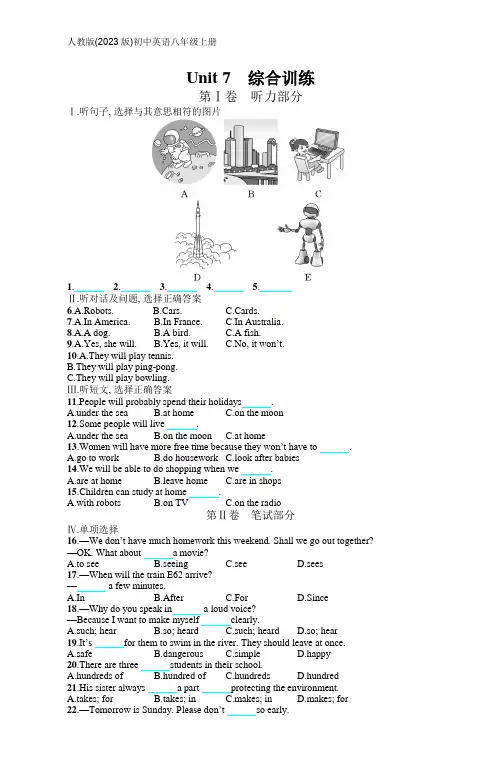
Unit7综合训练第Ⅰ卷听力部分Ⅰ.听句子,选择与其意思相符的图片1.2.3.4.5.Ⅱ.听对话及问题,选择正确答案6.A.Robots. B.Cars. C.Cards.7.A.In America. B.In France. C.In Australia.8.A.A dog. B.A bird. C.A fish.9.A.Yes, she will. B.Yes, it will. C.No, it won’t.10.A.They will play tennis.B.They will play ping-pong.C.They will play bowling.Ⅲ.听短文,选择正确答案11.People will probably spend their holidays.A.under the seaB.at homeC.on the moon12.Some people will live .A.under the seaB.on the moonC.at home13.Women will have more free time because they won’t have to .A.go to workB.do houseworkC.look after babies14.We will be able to do shopping when we .A.are at homeB.leave homeC.are in shops15.Children can study at home .A.with robotsB.on TVC.on the radio第Ⅱ卷笔试部分Ⅳ.单项选择16.—We don’t have much homework this weekend. Shall we go out together? —OK. What about a movie?A.to seeB.seeingC.seeD.sees17.—When will the train E62 arrive?— a few minutes.A.InB.AfterC.ForD.Since18.—Why do you speak in a loud voice?—Because I want to make myself clearly.A.such; hearB.so; heardC.such; heardD.so; hear19.It’s for them to swim in the river. They should leave at once.A.safeB.dangerousC.simpleD.happy20.There are three students in their school.A.hundreds ofB.hundred ofC.hundredsD.hundred21.His sister always a part protecting the environment.A.takes; forB.takes; inC.makes; inD.makes; for22.—Tomorrow is Sunday. Please don’t so early.—OK. But don’t sleep too late.A.take me backB.wake me upC.call me backD.bring me up23.—I got a message saying my phone number won a prize worth $4, 000.—Too good to be true. Don’t it.A.doB.holdC.makeD.believe24.Personally I don’t agree that people dangerous animals as pets.A.pickB.makeC.keepD.follow25.—Do you like the city life or the country life?—It’s hard to say. In the city there is fun, but in the country there ispollution.A.less; moreB.more; lessC.more; fewerD.much; lessⅤ.完形填空Life in the year 3044 is very different 26 life in the 21st century. We still do many things, but we do them 27. For example, we now have e-friends to help us and keep us company. An e-friend is a machine that looks just 28 a human being. It can walk and talk and can do almost 29 we human beings do. My e-friend is a lot like me and we have 30 fun together. She helps me 31 my homework and we often go swimming. She is programmed to take care of me if anything 32, so I always feel safe when we are together. She can also send me messages, just like old-fashioned e-mails, and I can download information from her memory. It’s great 33 an e-friend—I am never lonely and I always have someone to talk 34.I would like to tell you more about life in the year 3044, but I have to send my e-friend to clean up my room. Maybe 35 I will be able to travel back in time and visit you.26.A.of B.from C.in D.with27.A.different B.difference C.differently D.differences28.A.like B.for C.at D.up29.A.something B.all thing C.nothing D.everything30.A.many B.a number of C.a lot of D.the number of31.A.with B.at C.on D.doing32.A.will happen B.happens C.happened D.is going to happen33.A.have B.had C.to have D.has34.A.in B.about C.with D.at35.A.one day B.in one day C.after one day D.with one dayⅥ.阅读理解AMr.Green made a robot. He could say only one sentence—“There is no doubt(疑问)about it.” The robot always repeated the same words when you spoke to him.One day, Mr.Green needed lots of money and he took the robot to the market to sell him.“Who will buy my robot? He is very smart,” he shouted.“Twenty thousand dollars for my robot!”A man was surprised that he was asking for so much money. Instead of asking Mr.Green why he wanted so much money, he decided to speak to the robot.“Are you worth(值)twenty thousand dollars?” he asked the robot.“There is no doubt about it,” answered the robot.Th e man liked the robot’s answer so much that he bought him and carried him home. But very soon he found that the robot could say nothing else. He was sorry that he bought the robot. He stood in front of the robot and said,“How foolish I was to throw so much money away!”“There is no doubt about it,” said the robot.36.How many sentences could the robot say?A.Only one sentence.B.Three sentences.C.Ten sentences.D.Hundreds of sentences.37.Why did Mr.Green sell the robot?A.The robot was bad.B.Mr.Green didn’t like it.C.Mr.Green needed much money.D.The robot was old.38.When the man heard Mr.Green’s words, he thought .A.the robot was unusualB.Mr.Green needed lots of moneyC.the robot was cheapD.Mr.Green didn’t want to sell the robot39.The man was sorry that .A.he met Mr.GreenB.he went to the marketC.he spoke to the robotD.he bought the robot40.At the end of the story, the man probably felt the robot was .A.sorry for himB.afraid of himughing at himD.trying to surprise himBLife in the FutureIn the future, at home, cookers will be ready for you to cook a complete meal at the touch of a switch. Televisions will tell you prices at the shops and news. Videophones will bring pictures as well as sound. Home will become the center of entertainment through televisions and electronic games. Machines will control temperature, lighting, washing and gardening. Lighting serves as wallpaper and it will make your room look nicer. More people will eat out more than they do today, and they will have a lot more kinds of food.At work, robots will take over most jobs in the factories. Working hours will fall to under 30 hours a week. Holidays will get longer.There will be more foreign travel. Space travel will be cheaper. Hobbies and education will become more and more important.41.People will know prices at the shops and news on .putersB.televisionsC.wallpaperD.videophones42.What can make your room look nicer?A.Gardening.B.Switches.C.Lighting.D.Machines.43.People will work for 30 hours a week.A.less thanB.more thanC.as many asD.more or less44.Which of the following sentences is TRUE?A.People will have less free time.B.Robots will do all the jobs at home.C.There will be more people eating out.D.People won’t travel to space.45. will be more and more important.A.Hobbies and educationB.CookersC.TravelD.EntertainmentⅦ.词汇运用A.根据句意及首字母提示完成单词。
人教版初中英语八年级上册Unit7_SectionA_语境中学单词

【2018·湖北武汉】
比较 西瓜被切分开(apart),成了两部 分(part)。
词块拓展
part
(1) __________p_a_r_tl_y_________副词(部分地) (2) __________p_a_r_tn_e_r________名词(搭档) (3) _________p_a_r_t-_t_im__e_______形容词(兼职的) (4) _______p_a_r_t_-_ti_m__e_j_o_b_____兼职工作 (5) _______p_l_a_y_a__p_a_r_t_i_n_____在…….起作用;在…….扮演角色 (6) _______t_a_k_e_p__a_rt__in_______参加 (7) _________p_a_r_t_w__it_h_______(不情愿地)放弃/舍弃 (8) _______im__p_o_r_t_a_n_t_p_a_r_t____重要的部分 (9) _________u_s_e_fu_l__p_a_r_t _____有用的部分
例句 Then, we should protect our water resources and not pollute them.
译 然后,我们应该保护我们的水资源,不要污染它们。
【2018·湖北恩施】
比较 污染物(pollution)泄漏污染 (pollute)了环境。
词块拓展 pollute
例句 It’s no secret that air pollution is a big problem for China. 【2019·湖北武汉】
译 空气污染对中国来说是个大问题, 这不是什么秘密。
比较 污染物(pollution)泄漏污染 (pollute)了环境。
鲁教版(五四学制)英语八年级上册:Unit 7 Have you ever been to a museum. 教案3
Unit 7 Have you ever been to a museum? Period 3e.g.: Have you ever been to Hong Kong?你曾去过香港吗?I haven't ever spoken to her.我未曾和她说过话。
never意为“从来没有”常与before连用,多放在助动词与过去分词之间。
e.g.: I have never travelled by plane before. 我以前从来没有乘飞机旅行过。
3.have been to & have gone to区别。
比较:He has been to Beijing.他曾去过北京。
(人已回来,可能在这儿。
)He has gone to Beijing.他已经去北京了。
(人已走,不在这儿了。
)(1)have / has been (to) 表示“曾经到过某地”,说话时此人不在那里,已经回来。
侧重指经历。
(2)have / has gone (to) 表示某人“已经去某地了”,说话时此人可能在路上或已到那里,反正不在这里。
4.一般过去时与现在完成时的区别。
比较:I have seen the film.我看过这部电影。
(我了解这部电影的内容。
)I saw the film last month.我上个月看了这部电影。
(只说明上星期看了这部电影,不涉及现在情况。
)(1)一般过去时只强调过去的动作;现在完成时强调过去的事情对现在的影响。
(2)一般过去时通常与表示过去的时间状语连用;现在完成时则不能与表示过去的时间状语连用。
(3)一般过去时单纯表示过去的经历;现在完成时表示过去的动作或状态延续到现在并可能持续下去。
一般过去时的时间状语有:yesterday, last week, ago, in1980, in October, just now…共同的时间状语有:this morning, tonight, this summer, before, already现在完成时的时间状语有:for, since, ever, never, just, already, yet, in past years Step 3 Exercises.Finish exercises.1.根据括号内的要求完成下列各句,每空一词(含缩写)。
最新版鲁教版八年级上册英语Unit7单元检测题及答案解析
UNIT 7 Have you ever been to a museum?检测题Ⅰ.听力(20分)(一)听句子,选择你听到的内容。
(句子读一遍)1. A. umbrella B. museum C. brother2. A. tall B. short C. long3. A. dog B.cat C. panda4. A. good B. important C. importance5. A. school B. class C. group(二)听句子,根据所听到的内容选择正确答语。
(句子读一遍)6. A. No, I’d like to. B. Yes, please. C. I don’t want.7. A. Five years ago. B. For ten years. C. In four years.8. A. She likes apples. B. She is a kind-hearted woman.C. I don’t know.9. A. No, she hasn’t. B. Yes, she does. C. No, she isn’t.10. A. It’s fantastic. B. Sorry.C. It tells something about the island.(三)听对话,根据对话内容及问题选择正确答案。
(对话读两遍)11. How long is the history of China?A. 5,000 years.B. About 5,000 years.C. Less than 4,000 years.12. Where is Mr. Green?A. In the library.B. At home.C. In the office.13. When did Mr. Smith move to New York?A. In 2005.B. Six years ago.C. In 2000.14. Which mount did the man visit?A. Mount Hua.B. Mount Tai.C. Mount Heng.15. Whose backpack is it?A. Nancy’s.B. Sally’s.C. Cindy’s.(四)听短文,根据短文内容选择正确答案。
新版英语人教版八年级上册各单元知识点
人教版八年级上册英语单元词组及搭配Unit1Wheredidyougoonvacation?goonvacation去度假stayathome待在家里gotothemountains去爬山gotothebeach去海visitmuseums参博物gotosummercamp去参夏令quite afew相当多studyfor⋯⋯而学goout出去mostofthetime大局部tastegood起来很好吃haveagoodtime玩得高ofcourse当然feellike⋯⋯的感;感受到goshopping去物inthepast在去walkaround四走走becauseof因onebo wlof一⋯碗⋯⋯thenextday第二天drinktea喝茶findout找出;明goontakep hotos照相somethingimportant重要的事upanddown上上下下comeup出来搭配buysth.forsb./buysb.sth.某人某物taste+adj.起来⋯⋯look+adj.看起来⋯⋯nothing⋯but+原形除了⋯⋯之外什么都没有seem+〔tobe〕+adj.看起来⋯⋯arrivein+大地点/arriveat+小地点到达某地decidetodosth.决定去做某事trydoingsth.做某事/trytodosth.尽力去做某事forgetdoingsth.忘做某事/forgettodosth.忘做某事enjoydoingsth.喜做某事wanttodosth.想去做某事startdoingsth.开始做某事stopdoingsth.停止做某事dislikedoingsth.不喜做某事keepdoingsth.做某事Whynotdo.sth.?什么不做⋯⋯呢?so+adj.+that+从句如此⋯⋯以至于⋯⋯tellsb.(not)todosth.告某人〔不要〕做某事语法:不定代词和一般过去时态Unit2Howoftendoyouexercise?词组helpwithhousework帮助做家onweekends在周末howoften多久一次hardlyever几乎从不onceaweek每周一次twiceamonth每月两次everyday每天befree有空gotothemovies去看影usetheInternet用互网swingdance舞playtennis打网球stayuplate熬夜;睡得很晚atleast至少havedanceandpianolessons上舞蹈和琴gotobedearly早点睡playsports行体育活begoodfor⋯⋯有好gocamping去野not⋯atall一点儿也不⋯⋯inone’sfreetime在某人的余themostpopular最受迎的suchas比方;如oldhabitsdiehard改gotothedentist去看牙医mornthan多于;超lessthan 少于搭配helpsb.withsth.帮助某人做某事Howabout⋯?......怎么?/⋯⋯好不好?wantsb.todosth.想某人做某事Howmany+可数名复数+一般疑句?⋯⋯有多少⋯⋯?主+find+that从句.⋯⋯⋯⋯spendtimewithsb.和某人一起度光It’s+adj.+to sthd.做某事的⋯⋯的。
鲁教版五四制八年级上册英语Unit 7 Period 2 Section A (3a—4c)

Unit7Haveyoueverbeentoamuseum?
Period2SectionA (3a—4c)
习题链接
温馨提示:点击 呈现
6 unbelievable; progressed; rapid
2 peaceful
7 wonder; beableto
apid developmentofChinainrecentyears.
5. I’veonlyusedthisbikeforacofweeks, butIlikeit.
ouple
二、用所给词的适当形式填空
6. Wouldyouliketocomeandseeher______p__er_f_o_r_m__ance (perform) intheschoolhalltonight?
he___________h_a_s_g_oBneeitjoingtoseehisparentsandhe’llbe backtomorrow.
13. Tom___h_a_s_b_e_en__in___Chinaforthreeyears. 14. ________youever___________Singapore?
B
Ican’tdecide_________formymom.
—ForMother’sDay, itcan’tbebettertotakesomecarnations(康
乃馨). 【中考·福州】
A. whentochooseB. whichtochoose
C. howtochoose
【点拨】由前句句意“这么多漂亮的花朵!”可知, 后 句指“我不知道要选哪一个”, 用“疑问词+不定式” 结构, 表示“哪一个”用which。
2024-2025学年译林版初中英语八年级(上)教案Unit7Reading
Unit 7 SeasonsReading设计说明教学反思首先通过展示一组四季的照片来让学生们体验四季之美,然后学习一些有关季节的词汇,掌握这些词汇后对课文进行细读,了解四季的变化和特征,继而了解英文小诗的押韵特点。
然后做课后的练习,掌握文章中出现的一些重要知识点,并围绕这些知识点展开一系列的练习进行巩固。
教学目标通过本课节的教学,让学生达成以下目标:1.知识目标:掌握词汇:shower, upon, as, temperature, drop, rise, be full of, forget togrow, fly far away, among flowers, turn brown, fall into piles upon theground, harvest crops2.能力目标:(1)读懂四季小诗;(2)了解四季的变化;(3)复习有关四季气候和特征的词汇。
3.情感目标:学习四季小诗,培养学生热爱自然和保护自然的意识。
重点难点重点:了解四季的变化,复习有关四季气候和特征的词汇。
难点:读懂四季小诗并能找出英文诗中互相押韵的词。
教学准备PPT 课件;相关图片。
授课时数2课时教学过程Step 1 Lead-inShow four pictures about the four seasons.Ask: How many seasons are there in a year? What are they?Which season do you like best? Why?Step 2 PresentationEnjoy the beauty of each season.Say: Different people like different seasons just because each season has its own beauty.(about winter)As the days are shorter and the temperature drops, winter is coming. It’s cold in winter. Sometimes it’s snowy. The ground is covered with snow. Trees and flowers forget to grow. Birds fly far away.(about spring)Spring is the best season of the year. It’s warm and windy. It’s the best time to fly kites. Bees and butterflies play among flowers. If the rain comes, they hide from the April showers.(about summer)Summer is hot, but we can enjoy a long summer holiday. What can we do in summer? It is hot. The sun shines. We can swim in the sea. We can eat ice cream. There are also quiet streams, trees and shade. I like chatting or reading in the shade of trees in the middle of the day. The temperature rises quickly at that time.(about autumn)What colour are the leaves? In autumn. The leaves turn brown. They are yellow, red, gold and brown. They fall into piles upon the ground. Autumn is a harvest season.Step 3 ReadingTask 1 ScanningRead the poem quickly and try to fill in blanks.Winter days are full of___________.Trees and flowers forget to___________.The birds fly____________ away to find a warm and sunny day.Spring is a perfect time to fly__________.We can see some bees and_________.It is so hot in summer that we all like to eat ___________ to feel cool.We can also drink some water from a ___________ between mountains. Autumn leaves turn ___________.They fall into ___________ upon the ground.The days are shorter and the temperature___________.Answers: snow, grow, far,kites, butterflies, ice cream, stream,brown, piles, dropsTask 2 Further reading1. Read the first paragraph of the poem and answer the questions.Q1: Can trees and flowers grow in winter?Q2: Why do the birds fly far away?Answers: 1. No,they cannot. 2. To find a warm and sunny day.2. Read the second paragraph of the poem and answer the question.Q: What do bees and butterflies do in spring?Answer: They play among flowers, and then hide from the April showers.3. Read the third paragraph of the poem and answer the question.Q: Where can we often play in summer?Answer: We can play by quiet streams or under the shade of the trees.4. Read the fourth paragraph of the poem and answer the questions.Q1: Where can we see piles of autumn leaves?Q2: What are farmers busy doing in autumn?Answers: 1. On the ground. 2. They are busy harvesting crops.Task 3 Post readingEnjoy the beauty of the poem.1. Please read together with the tape. Pay attention to the poem’s stops.Winter days/ are full of snow,When trees and flowers/forget to grow,And the birds /fly far awayTo find a warm/ and sunny day.2. Rhymes. Ask the students to pay attention to the words in black below and tellthem that snow rhymes with grow and away rhymes with day.Winter days are full of snow,When trees and flowers forget to grow,And the birds fly far awayTo find a warm and sunny day.3. Finish the Part B1 on page 83. Check the answers with the students on screen. Answers:1.grow 2.day 3.kite4.showers5.shade6.cool7.ground8.drops9.again4. Show another poem and ask them to find out the rhyming words.The starTwinkle, twinkle, little star!How I wonder what you are,Up above the world so high,Like a diamond in the sky.5. Learn about personification (拟人手法) .When trees and flowers forget to grow,(When trees and flowers stop to grow,)Bees and butterflies play among flowers,Then hide from the April showers.Show them three sentences picked in the poem and tell them the words in black are personification. This method can make the poem more vivid. Then ask students to find out more beautiful words or sentences.Step 4 Practice1. Read the Part B2 on page 83. Match each season with the descriptions in thepoem. Write the correct letters in the boxes.Answers: 1 spring—c 2 autumn—d 3 winter—b 4 summer—a2. Read the Part B3 on page 84. Underline the six mistakes and write the correctword above each one.Answers:Shirley: Why do we seldom see birds in winter, Amy?sunny Amy: Because most of them fly away to a warm and windy place.Shirley: Can you describe the weather in spring?windy showers Amy: Yes, It’s cloudy and bright, and in April, the wind may come suddenly.Shirley: How do people feel on a hot summer afternoon?lazyAmy: They feel busy and like to eat ice cream.Shirley: How does the weather change when autumn comes?brown dropsAmy: The leaves turn green and the temperature rises quickly.3. Read the Part B4 on page 84. Read the poem again and complete the articlewith the words in the poem on page 82.Answers: (1) snow (2) temperature (3) perfect (4) Bees(5) hide (6) memories (7) ice cream (8) streams(9) shade (10) leaves (11) fall (12) cropsStep 5 Language points1. Winter days are full of snow. 冬天是雪的世界。
鲁教版八年级英语上册Unit 7 Have you ever been to a 预习学案(无答案)
Unit 7 Have you ever been to a museum?Period1 Section A 1a-2d班级姓名书写等级【知识与技能目标】1.根据拼读规则读写本节课的5个单词和1个短语eg :camera, amusement park。
2.能听懂描述关于人们参观景点经历的听力材料,并完成相关练习。
3.学会用have/has been to...谈论曾经去过的地方。
【学习重点】能够能听懂描述关于人们参观景点经历的听力材料并能够正确使用have/has been to…谈论曾经去过的地方。
【学习难点】1.能够正确地使用现在完成时态来进行描述。
2.能够区分并正确使用have/has been to have/has gone to have/has benn in。
一、预习案【预习指导】仔细阅读课文P49-50内容,阅读过程中翻译并圈出相关的短语以及知识点,理解2d 大意,并用红笔圈出难以理解的地方,用15分钟完成预习任务。
Task1.预习课本P49-50 单词和P49 1a,根据汉语意思进行默写:单词:娱乐,游戏_______________在某处,到某处__________照相机,摄影机____________发明物________________(发明______________)短语:太空博物馆_______________历史博物馆_____________游乐场__________________水上乐园___________________Task2.预习课本P49 1c及P50 2b&2c,完成下列句子。
1.今天让我们去不同的地方吧。
Let’s go today.2.你曾经去过太空博物馆吗?Have you a museum?3.Linda 计划再骑自行车去一次游乐场。
Linda is going to the by bike.Task3.预习课本P50 2d, 完成下列任务。
初中英语八上 Unit7语法知识点总结
Unit7Section ADo you think.....宾语从句及其做插入语的用法There be句型的一般现在时肯定否定回答以及反义疑问句的结构live to be+年龄=live to+年龄=live to the age of....活到...岁在....之后:in+一段时间(将来时);after+时间点(过去和将来时);段时间+later(过去和将来时)提问:how soon——in+段时间how long——for+段时间when——aftereverything 作主语V用单数;形容词修饰时形容词需要后置;与否定词连用表示部分否定。
free免费的有空的空闲的反义:busy原级比较级最高级many/much more mostlittle less leastfew fewer fewestfuture n. 将来未来in the future 在将来in future =from now on 从今以后,今后,往后enviromental 环境enviromental 环境的danger 危险in danger 在危险之中in great danger处于极度危险之中反义:out of danger 脱离危险on the earth 在地球上on earth 究竟me too=me,too=so do I 我也是play a part in 参与.....;在......中起作用;扮演.....角色+名词,代词或动名词做宾语。
I hope so我也希望如此I hope not 我希望不是这样Section BAcross prep./adv. 穿过,横穿,在什么对面(从一边横穿到另外一边)Across from 在....对面= on the other side ofThe shoe store is across from the bank.Walk/go/run/swim 等+across =cross ,与street,bridge,river等连用。
初二英语Unit Have you ever been to a museum?试题
初二英语Unit Have you ever been to a museum?试题1. My uncle has two pet dogs.But________of them is friendly to me.A.eachB.neitherC.eitherD.both【答案】B【解析】由句意“我叔叔养了两只宠物狗,但没有一只对我友好”可知选B。
neither表示“两者都不”。
2. He jumped into the river to save the drowning girl.He was so________.A.afraidB.scaredC.braveD.bored【答案】C【解析】题干中提到“他跳进河里去救那个溺水的女孩”,由此可知他很勇敢。
故所缺的词是brave。
3.—________,Mary?—I have a lot of trouble________the newspaper.A.What’s wrong;readingB.What’s the matter;to readC.What’s matter;readingD.What’s the wrong;to read【答案】A【解析】询问“怎么了”要用What’s wrong?或What’s the matter?先排除C和D;have trouble后若跟动词,只能跟动词-ing形式,故答案为A。
4.I have been to the Space Museum.(对画线部分提问)________ ________you________?【答案】Where have;been【解析】画线部分为地点状语,所以用where提问。
5. Neither this answer nor that one is right.(改为同义句)________ ________the answers________right.【答案】Neither of;is【解析】neither作主语,谓语动词用第三人称单数形式。