
新版九年级英语unit1howcanwebecomegoodlearnerssectiona第一课时课件
_____ d. by listening to tapes
_____ e. by asking the teacher for help
_____ ____________________________________ __________________________________________
1a Check the ways you study English. Then add other ways you sometimes study.
_____ a. by working with friends _____ b. by making word cards
_____ c. by reading the textbook
Role-play the conversation
2. ____ √ Do you have conversations with friends in English? 3. _____ What about listening to tapes? 4. _____ √ What about reading aloud to practice pronunciation?
1b Listen and Number !
Meiping
1. ______ A
Peter
2. ______ C 3. ______ B
Tony
1c Make conversations about how you study for a test? Write letters from 1a above.
语法重点4
sentence作名词,意为“句子”。 e.g.: This is an assertive(陈述) sentence. 还可作名词,意为“判决;宣判;判刑”。 e.g.: She has served her sentence, and will now be released. 作动词,意为“判决;宣判”。 e.g.: He has been sentenced to pay a fine of ¥1000.
Annie: Try to guess a word’s meaning by reading the sentences before and after it. You probably understand more than you think. Jack: That sounds difficult! Annie: Well, be patient. It takes time. You can become better by reading something you enjoy every day. The more you read, the faster you’ll be.
Read the conversation and answer questions
1.Why is Jack a little nervous? 2What advice does Annie give to Jack about how to read quickly?
Reading
d. No. It’s too hard to understand spoken English.
语法重点 2
What about doing…?是交际用语中常见的 结构,不仅可以用来提建议和请求,还可以 用来征询对方的看法和意见、打算、身体状 况、天气状况等。 What about…?(How about…?)表示 “做……怎么样?”其中about是介词,后接名 词、代词或动名词。 e.g.:What / How about that iPhone 4S? What / How about going shopping with me?
B: It’s….
by working with friends
by making word cards
by reading the textbook
by listening to tapes
by studying with a group
By asking the teacher for help. She was very happy.
Unit 1
How can we become good learners?
Do you like English? Yes No
How is your English study?
not good
good
better
Байду номын сангаас
best
A: Do you like English? B:
A: How is your English study?
A: How do you study for a test? B: I study by working with a group.
Name
…… ……
How to study for a test ?
• Report: …. studies for a test by …
2a Listen and check the questions you hear.
5. _____ √ Have you ever studied with a group?
2b Listen and match the questions with their answers.
1. _____ √ Does anyone learn English by watching videos?
语法重点3
ever用于疑问句时,意为“曾经”。该问句 的回答中不能再含有ever,如果是否定回答 则常用never。 E.g.:---Have you ever been to Mount Emei? ---Yes, I have. / No, never. 【2012四川乐山】Tony is very nice. He is the B most enjoyable person I _______. A. meet ever B. have ever met C. had ever met
a. Yes, I have. I’ve learned a lot that way. b. Oh, yes. It really improves my speaking skills.
c. I do that sometimes. I think it helps.
5. _____ √ Have you ever studied with a group?
语法重点1
by: 介词,意为“通过,靠”,此处表示方法、手段,
后接名词或代词;接动词时,须用动名词形式。
例如:我通过制作教学抽认卡来学习.
I study by making flashcards.
例题:【2013重庆】You can improve your English A _______ practicing more. A.by B.with C. of D.in
Jack: Annie, I’m a little nervous. I have to finish reading a book and give a report next Monday. Annie: That doesn’t sound too bad. Jack: But I’m a very slow reader. Annie: Just read quickly to get the main ideas at first. Don’t read word by word. Read word groups. Jack: But I don’t understand many of the words. I have to use a dictionary.
九年级英语全册Unit1Howcanwebecomegoodlearners(第4课时)SectionB(1a_1e)教案(新版)人教新目标版

Unit 1 How can we become good learner?The fourth period: Section B 1a-1eTeaching and learning Goals:一、语言知识1. 能正确使用以下词汇及常用表达(Curriculum words and useful expressions)pronounce,increase, speed, partner, make mistakes, talk to,2. 巩固Section A所学“How” que stions;How do you study for a test? 以及动词+by+动词-ing形式表方式、方法二、语言功能能谈论在学习中遇到的问题和困难并能积极探索解决方案,给他人提出建议(Talk and write students their own problems and how they solve them.)三、学习策略引导学生关注优秀学生的学习方式,借鉴并用于自身。
四、情感教育鼓励学生直面学习困难,积极探索解决方案,不断改进自身学习方法,提高学习效率。
Pre-listening activitiesStep 1 ReviewMake conversations using the sentences “how do you study…, do sth. by doing, do you learn…by , how often…”Step 2 PreviewAsk the Ss to translate the following words and phrases into English orally, then let them write their English down.(1) 英语口语____________ (2)足够的词汇去写作_________________ (3) 使发音正确_____________ (4) 练习写作 _________________(5) 犯错误 ______________[设计意图]:通过翻译重点词组,帮助学生预习,并检测学生的预习效果,教师更有针对性地教,学生也更有针对性的学。
初三英语上册(人教新目标)Unit1Howcanwebecomegoodlearners-知识点总结
初三英语上册(人教新目标)Unit 1 How can we become good learners?知识点总结一、要点词汇conversation·原文再现Do you ever practice conversations with friends?你与朋友一同联系过会话吗?·基本用法n. conversation 谈话;讲话常常用于以下构造中:1. have/hold a conversation with sb与.某人讲话,Did you have a conversation with him?你和他谈过话了吗?2. make conversation with sb.I want to make conversation with her.我想和她讲话。
aloud·原文再现What about reading aloud to practice pronunciation?大声朗诵练习发音怎么样?·基本用法adv. aloud 大声地;大声地,常用来修饰动词。
When we were children, our father read aloud to us.我们小的时候,父亲会给我们朗诵。
·知识拓展 --词义辨析aloud/loud/loudly1.aloud adv. 作声“地”有使能听获得的意味。
如:Please read the story aloud.请朗诵这个故事。
They were shouting aloud.他们在大声地呼叫。
2.loud. adv. 大声“地,大声地,响亮地”,常指在谈笑等方面。
如:Don't talk so loud.不要这样大声地讲话。
Speak louder.说得大声点儿。
3.loudly adv. 大声“地”有时与 loud 通用,但含有喧杂的意味。
如:Someone knocked loudly at the door.有人大声叩门。
人教版英语九年级Unit1《Howcanwebecomegoodlearners》全单元说课稿

人教版英语九年级Unit 1《How can we become good learners》全单元说课稿一. 教材分析人教版英语九年级Unit 1《How can we become good learners》主要讨论了如何成为一名优秀的学习者。
本单元的主题贴近学生的生活,激发学生对学习的思考。
通过本单元的学习,学生可以了解和掌握一些良好的学习方法和技巧,提高学习效率。
二. 学情分析九年级的学生已经具备一定的学习经验和英语基础,但他们在学习方法和策略上可能还存在一些问题。
因此,教师在教学过程中要关注学生的个体差异,引导他们找到适合自己的学习方法,提高学习兴趣和效果。
三. 说教学目标1.知识目标:学生能够掌握本单元的生词和短语,理解课文内容,了解如何成为一名优秀的学习者。
2.能力目标:学生能够运用所学知识,运用不同的学习策略,提高自己的学习效率。
3.情感目标:学生能够激发对学习的热情,培养良好的学习习惯和态度。
四. 说教学重难点1.重点:学生能够掌握本单元的生词和短语,理解课文内容,了解如何成为一名优秀的学习者。
2.难点:学生能够运用所学知识,运用不同的学习策略,提高自己的学习效率。
五. 说教学方法与手段1.任务型教学法:通过完成各种任务,激发学生的学习兴趣,提高他们的学习积极性。
2.合作学习:鼓励学生小组讨论,培养他们的团队协作能力。
3.情境教学法:创设真实的学习情境,让学生在实践中运用所学知识。
4.多媒体辅助教学:运用多媒体课件和教学资源,提高课堂教学效果。
六. 说教学过程1.导入:通过提问方式引导学生思考什么是好的学习者,激发学生的学习兴趣。
2.呈现:展示课文内容,让学生整体理解课文主题。
3.读写:学生独立阅读课文,完成相关练习,巩固所学知识。
4.听说:学生分组讨论,分享自己的学习方法和策略,培养他们的口头表达能力。
5.展示:学生展示自己的学习成果,互相评价,提高自己的学习效果。
6.总结:教师对本节课的内容进行总结,强调良好的学习习惯和态度的重要性。
新人教版九年级Unit1How can we become good learners语法讲解
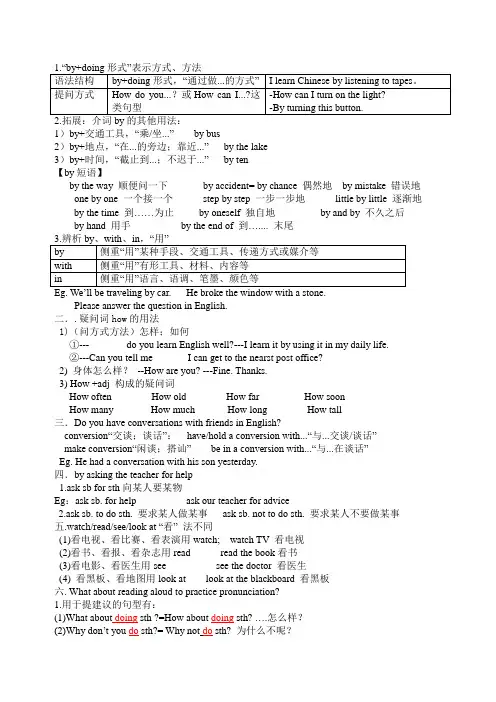
1)by+交通工具,“乘/坐...” by bus2)by+地点,“在...的旁边;靠近...” by the lake3)by+时间,“截止到...;不迟于...” by ten【by短语】by the way 顺便问一下by accident= by chance 偶然地by mistake 错误地one by one 一个接一个step by step 一步一步地little by little 逐渐地by the time 到……为止by oneself 独自地by and by 不久之后by hand 用手by the end of 到….... 末尾Please answer the question in English.二..疑问词how的用法1)(问方式方法)怎样;如何①---_______ do you learn English well?---I learn it by using it in my daily life.②---Can you tell me_______I can get to the nearst post office?2) 身体怎么样?--How are you? ---Fine. Thanks.3) How +adj 构成的疑问词How often______ How old_____ How far____ How soon______How many_______ How much______ How long_____ How tall______三.Do you have conversations with friends in English?conversion“交谈;谈话”:have/hold a conversion with...“与...交谈/谈话”make conver sion“闲谈;搭讪” be in a conversion with...“与...在谈话”Eg. He had a conversation with his son yesterday.四.by asking the teacher for help1.ask sb for sth向某人要某物Eg:ask sb. for help ask our teacher for advice2.ask sb. to do sth. 要求某人做某事ask sb. not to do sth. 要求某人不要做某事五.watch/read/see/look at “看” 法不同(1)看电视、看比赛、看表演用watch; watch TV 看电视(2)看书、看报、看杂志用read read the book看书(3)看电影、看医生用see see the doctor 看医生(4) 看黑板、看地图用look at look at the blackboard 看黑板六. What about reading aloud to practice pronunciation?1.用于提建议的句型有:(1)What about doing sth ?=How about doing sth? ….怎么样?(2)Why don’t you do sth?= Why not do sth? 为什么不呢?(3)Let’s do sth.让我们一起做某事吧。
Unit1 How can we become good learners 课文翻译

仅仅努力学习是不够的。善于学习的人知道他们能够学习的最佳方式。例如,他们可以通过写下关键词或者画思维导图来记笔记。他们还会寻找各种方式来复习他们所学到的东西。他们可以通过每天读他们的笔记或者向另一名学生说明信息的方式来复习。
4.问问题
善于学习的人在课堂上或者课后经常问问题。他们甚至互相问问题,然后尽力找出答案。知识源于提问。
现在我非常喜欢我的英语课。我想学习生词和更多的语法,那样我对英语电影就能有更多好的理解了。
How can you become a successful learner?
每个人天生就拥有学习的能力。但是你能否学习的好取决于你的学习习惯。研究显示成功的学习者有一些共同的好习惯。
1.培养他们对所学方面的兴趣
朋友;伙伴
模式;方式
物理;物理v.加速
能力;才能
大脑
活跃的;积极的
注意;关注
注意;关注(词组)
(使)连接;与⋯⋯有联系
把⋯⋯和⋯⋯连接或联系起来
一夜之间;在夜间
回顾;复习
知识;学问
明智地;聪明地
(重点词组和短语)
请求某人的帮助
读课文
提髙某人说的能力
英语口语
抓住主题
熟能生巧。
学习能力
Unit1 How can we become good learners?
去年,我不喜欢我的英语课。每节课都像是一个噩梦。老师说的太快,以至于我大多数时候都听不太懂。但是因为我糟糕的发音,我害怕问问题。我只是躲在我的课本后面,从来不说一句话。
后来,有一天我看了一部叫做《玩具总动员》的电影。我爱上了这部既激动人心又滑稽有趣的电影!就这样,我也开始看其他的英文电影。虽然我无法听懂那些角色所说的全部内容,但他们的肢体语言和面部表情帮助我理解了意思。我还意识到我可以通过只听关键词来理解意思。通过听英文电影中的对话,我的发音也变的更好了。我发现听一些有趣的内容是学习语言的秘诀。我还学到了一些有用的句子,比如“这简直是小菜一碟”或者“你活该”。我起初不理解这些句子,但是因为我想理解这个故事,所以我查了字典。
英语九年级Unit1Howcanwebecomegoodlearners[

How can we become good English learners?
challenges/problems
solutions/ways
challenges/problems
害怕某事/人 1害.T怕he做te某ac事her
speakbbseetoaaoffrr_aa_iidd_q_uot_oifc_sdk_tloh_y_/sst(bh..adv.快速地)
7. My best friend Sally finishes the task all by___C___
A. her B. hers C. herself
8. It’s believed that the article is written __B_______ our
history teacher.
A. How B. How often C. What about
4. - __C_______ is it from your home to 071 hospital?
- About ten minutes’ walk. A. How soon B. How long C. How far
5. – Jane, ______C_____ do you surf the Internet?
- Twice a month.
A. how large B. how soon C. how often
6.- Bob, ___B_____ will our math teacher be back?
- In two weeks.
A. how long B. how soon C. how often
九年级英语全册Unit1Howcanwebecomegoodlearners知识点汇总(新)人教新目标版
Unit 1 How can we become good learners?Section A1.ask相关短语ask sb. for sth. 向某人要某物ask sb. about sth. 向某人询问某事ask sb.(not) to do sth. 要求某人(不)要做某事be askd (not) to do sth. 被要求(不)做某事2.aloudadv.大声地;出声地辨析:aloud:adv.;出声地,大声地loud:用于loud enough, as loud as 等短语中或与too, very, so连用loudly:loud 的常用副词;含有令人讨厌或打扰别人的意思eg:Mrs. Li reads aloud while we speak loudly, so he has to read loud enough to make herself heard.3.practice●v.练习●后+n./pron./V.ing等●作不可数名词:练习eg:Students get lots of practice in the English club.4.patientadj.有耐心的n.病人patiently:adv. 修饰动词patience:n. 耐心短语:in patience 耐心地5.It takes sb. some time to do sth.某人花费时间做某事=Sb. spends some time doing sth.eg: It took me three years to finish the work. = I spent three years finishing the work.6.the +比较级(+主语+ 谓语),the +比较级(+ 主语+ 谓语):越……,越……eg:The more you eat, the heavier you will be.7.find it + adj.+ to do sth.发现做某事……eg: I find it very interesting to learn English.8.secret:n.秘密;秘诀eg:Neither of them knows the secret.adj.秘密的;保密的eg:We discovered a secret passage behind the wall.短语keep the secret =keep sth. to oneself 保守秘密the secret to/of ...:……的秘诀/ 秘密keep sth. secret对某事保密9.expression:n.表情;表示express:v.及物动词;表达;表露express...to sb.:向某人表达……eg: I find it difficult to express my meaning to the old Frenchman.10.辨析invent:发明(从无到有的东西)discover:发现(本来就已经存在,但不为人知的事物)find:找到或发现11.look up:查阅;抬头看宾语的位置:名词可前可后eg: Look up the word in the book, and you will know its meaning.look+pron.+ upeg: Please look them up in the dictionary carefully.look up to:仰慕eg: Many young people look up to Yao Ming astheir hero.look短语look down on sb. 小瞧某人look for 寻找look out 小心look around 环顾四周look over 仔细检查12.by后加名词、代词或动词ing形式by+地点名词表方位在……旁边eg:We live by the sea.by+时间名词到……时为止(已发生某事);最晚、不迟于……谓语可用完成时eg:I must be in bed by ten o’clock.by+交通工具、交通方式通过……,由……,乘……eg:by train / taxi / bike/ boat / sea / water 辨析by:乘某种交通工具I go to school by bike.in:后+某种材料、衣服、颜色或语言Now she begins to paint in oils.with:后+身体器官或某种工具He often writes with his left hand.表示具有,拥有,戴Who’s that man with sunglasses?Section B1.increasev.增加;增长短语increase to增加到……eg:The population in this city will increase to 1,000,000.increase by...增加了……eg:The price of the vegetables increased by 10%.increasen.增加;增大eg:The increase in population caused a shortage of food.2.speedn.速度短语at a/the speed of以……的速度at high/low/full speed以高速/ 低速/ 全速speed up加速3.make mistakes犯错误短语by mistake 由于差错,错误地mistake...for... 错把……当成……4.bornv.出生adj.天生的be born in+ 月份/年份/地点be born on+ 具体日期be born with+ 生来就有5.ability单数能力eg:We trust in China’s ability to be the strongest country in the world.复数才能eg:He is a man of many abilities.有能力做某事+不定式eg:He has the ability to speak English fluently.6.depend on依靠;取决于;随……而定eg:We shouldn’t depend on our parents too much.7.createv. 创造;创建creation n.创造,创造力creator n.创造者creative adj.有创造力的8.activeadj.活跃的;积极的作表语或定语take an active part in:积极参加eg:We all take an active part in the sports meeting.activityn.活动9.pay attention to注意;关心后+n./pron/V.ing/从句10.connectv.连接;与……有联系be connected to与……相连接=be joined to11.even if即使常引导让步状语从句12.knowledgen.知识;学问不可数a knowledge of/about...……方面的知识eg:He has a knowledge of painting.13.辨析remember to do记得去做事事情还没做eg:Remember to close the door before you leave the room.remember doing记得做过事事情已经做完eg:He remembers closing the door.14.instead of代替;作为……的替换eg: He will attend the meeting instead of me.+doing/n.=rather thaneg: Maybe I will become an actor instead of /rather than a singer in the future.=take one's place to do sth.eg: Mulan took her father's place to join the army.=Mulan joined the army instead of her father.Section A1.ask相关短语ask sb. for sth. 向某人要某物ask sb. about sth. 向某人询问某事ask sb.(not) to do sth. 要求某人(不)要做某事be askd (not) to do sth. 被要求(不)做某事2.aloudadv.大声地;出声地辨析aloudadv.出声地,大声地loud用于loud enough, as loud as 等短语中或与too, very, so连用loudlyloud 的常用副词含有令人讨厌或打扰别人的意思eg:Mrs. Li reads aloud while we speak loudly, so he has to read loud enough to make herself heard.practicev.练习后+n./pron./V.ing等作不可数名词练习eg:Students get lots of practice in the English club.3.patientadj.有耐心的n.病人patientlyadv. 修饰动词patiencen. 耐心短语in patience 耐心地4.It takes sb. some time to do sth.某人花费时间做某事=Sb. spends some time doing sth.eg: It took me three years to finish the work.= I spent three years finishing the work.5.the +比较级(+主语+ 谓语),the +比较级(+ 主语+ 谓语)越……,越……eg:The more you eat, the heavier you will be.6.find it + adj.+ to do sth.发现做某事……eg: I find it very interesting to learn English.7.secretn.秘密;秘诀eg:Neither of them knows the secret.adj.秘密的;保密的eg:We discovered a secret passage behind the wall.短语keep the secret =keep sth. to oneself 保守秘密the secret to/of ...……的秘诀/ 秘密keep sth. secret对某事保密8.expressionn.表情;表示expressv.及物动词表达;表露express...to sb.向某人表达……eg: I find it difficult to express my meaning to the old Frenchman.9.辨析invent发明(从无到有的东西)discover发现(本来就已经存在,但不为人知的事物)find找到或发现10.look up查阅;抬头看宾语的位置名词可前可后eg: Look up the word in the book, and you will know its meaning.look+pron.+ upeg: Please look them up in the dictionary carefully.look up to仰慕eg: Many young people look up to Yao Ming as their hero.look短语look down on sb. 小瞧某人look for 寻找look out 小心look around 环顾四周look over 仔细检查11.by后加名词、代词或动词ing形式by+地点名词表方位在……旁边eg:We live by the sea.by+时间名词到……时为止(已发生某事);最晚、不迟于……谓语可用完成时eg:I must be in bed by ten o’clock.by+交通工具、交通方式通过……,由……,乘……eg:by train / taxi / bike/ boat / sea / water 辨析by乘某种交通工具I go to school by bike.in后+某种材料、衣服、颜色或语言Now she begins to paint in oils.with后+身体器官或某种工具He often writes with his left hand.表示具有,拥有,戴Who’s that man with sunglasses?Section B1.increasev.增加;增长短语increase to增加到……eg:The population in this city will increase to 1,000,000.increase by...增加了……eg:The price of the vegetables increased by 10%.increasen.增加;增大eg:The increase in population caused a shortage of food.2.speedn.速度短语at a/the speed of以……的速度at high/low/full speed以高速/ 低速/ 全速speed up加速3.make mistakes犯错误短语by mistake 由于差错,错误地mistake...for... 错把……当成……4.bornv.出生adj.天生的be born in+ 月份/年份/地点be born on+ 具体日期be born with+ 生来就有5.ability单数能力eg:We trust in China’s ability to be the strongest country in the world.复数才能eg:He is a man of many abilities.有能力做某事+不定式eg:He has the ability to speak English fluently.6.depend on依靠;取决于;随……而定eg:We shouldn’t depend on our parents too much.7.createv. 创造;创建creation n.创造,创造力creator n.创造者creative adj.有创造力的8.activeadj.活跃的;积极的作表语或定语take an active part in:积极参加eg:We all take an active part in the sports meeting.activityn.活动9.pay attention to注意;关心后+n./pron/V.ing/从句10.connectv.连接;与……有联系be connected to与……相连接=be joined to11.even if即使常引导让步状语从句12.knowledgen.知识;学问不可数a knowledge of/about...……方面的知识eg:He has a knowledge of painting.13.辨析remember to do记得去做事事情还没做eg:Remember to close the door before you leave the room.remember doing记得做过事事情已经做完eg:He remembers closing the door.14.instead of代替;作为……的替换eg: He will attend the meeting instead of me.+doing/n.=rather thaneg: Maybe I will become an actor instead of /rather than a singer in the future.=take one's place to do sth.eg: Mulan took her father's place to join the army. =Mulan joined the army instead of her father.。
人教版九年级英语Unit1Howcanwebecomegoodlearners解答
(3) 意为“依靠”、“用” 、“凭借”、“通 过”、“乘坐” 等。表示方法、手段。如: 我乘公交车去上学。
I go to school by bus. (4) 意为“被”、“由”等。用于被动句中, 表示行为主体。如: 许多人讲英语。
English is spoken by many people.
(5) 组成其它短语: 1) by the way : 意为“顺便说”、“顺便问 一
下”,常做插入语。如: 顺便问一下,李丽在哪儿?
By the way, where’s Lily? 2) by oneself : 意为“单独”、“自己”。 如:
UNIT 1
How can we become good learners?
1.Do you have good ways to learn English? 2.How do you study your English?
Language points
by在初中英语中的用法有以下几种: (1) 意为靠“在……旁”、“近”。 如:们在湖边画画。 They are drawing by the lake.
She learns English by working with friends.
She learns English by making word cards.
He learns English by reading the textbook.
He learns English by watching TV.
The _m__o__re____, the___b__e_tt_e_r____.
秋季九年级英语上册 unit 1 how can we become good learners课文及详解 (新版)牛津版
Unit 1 How can we become good learners课文及详解Section A1a Check (✔) the ways you study English. Then add other ways you sometimes study.a. by working with friends 通过和朋友一起工作(学习)b. by making word cards 通过制作单词卡片c. by reading the textbook 通过阅读课本d. by listening to tapes 通过听磁带e. by asking the teacher for help 通过向老师寻求帮助I study by making word cards.1b Listen. How do these students study for a test? Write letters from 1a above. 1. Meiping 2. Peter 3. Tony1c Make conversations about how you study for a test. 关于备考如何学习编写对话A: How do you study for a test?B: I study by working with a group.2a Listen and check(✔) the questions you hear.Questions Answers1. Do you learn English by watching videos? ['vɪdɪəʊ]2. Do you ever practice conversations with friends?3. What about listening to tapes?4. What about reading aloud to practice pronunciation?2b Listen again. Match each answer below with a question above.a. Yes, I have. I’ve learned a lot that way.那种方式我学会很多东西b. Oh, yes. It improves my speaking skills. 它提高了我的说话技能c. I do that sometimes. I think it helps. 我有时这样学习,我认为有帮助。
九年级英语全册Unit1Howcanwebecomegoodlearners基础知识梳理(新版)人教新目标版
九年级英语全册:Unit 1 How can we become good learners?第1课时Section A(1a2d)aloud adv.大声地;出声地pronunciation n.发音;读音。
其动词形式为pronouncepatient adj. 有耐心的。
n. 病人。
其反义词为impatient 【拓展】(1)aloud, loud和loudly都意为“大声地”,但用法有区别。
①aloud 强调能让人听得见。
常与动词read, call等连用。
如:Read aloud so that we can all hear you. 大点声读,以便我们大家都能听见你。
②loud 强调声音响亮。
常与动词speak, talk, say, laugh等连用。
常用比较级形式。
如:Facts speak louder than words. 事实胜于雄辩。
③loudly 有时可与loud通用,但含有“喧闹”或者“嘈杂”的意味。
如:Don't talk so loudly. 别这么高声说话。
(2)patient的常用短语: be patient with sb. 对某人有耐心; be patient to do sth. 有耐心做某事; be patient of…能忍受/容忍……have conversations with 和……交谈finish doing sth. 完成做某事give a report 做报告word by word 逐字/词地☆It's too hard to understand spoken English.理解英语口语太难了。
“It is+adj.+to do sth.”结构,it在句中作形式主语,真正的主语是动词不定式的内容。
如:He speaks in a low voice. It's too hard to hear him clearly. 他说话声音很低,太难听清楚他说什么了。