
unit 3 reading and writing 公开课
3a Read the letter from Liangliang in Yunnan.
Fill in the blanks with the words in the box. leave kilometers get to takes boring
Hi there, How are you? Thank you for your last e-mail. to school, right? You want to know how Iget _____ Well, I usually leave _____ my home at about 8:00 and take the ropeway to the other side of the river. Then I walk on the mountain road to school.
3b
Write a letter to Liangliang and tell him how you get to school and encourage him. These questions may 写信给亮亮,告诉他你怎样去上学, help you.
并鼓励他。可考虑以下问题:
1. When do you leave home? 2. How do you get to school? 3. How far is it from your home to school?
Wawa is a 7-year-old boy. 7-year-old (七岁的)是 一个有连字符的复合形 容词,此时名词year 用单数。 eg: a 3-meter-long desk 一张三米长的桌子
cross [krɒs] 横过 river [‘rɪvə] 河流 ropeway ['rəupwei] 索道
Crossing the River to school How do you get to school? Do you walk or ride a bike? Do you go by bus or by train? For many students, it is easy to get to school. But for the students in one small village in China, it is difficult.2. There is a very big river between their school and the village .There is no bridge and the river runs too quickly for boats. So these 1. students go on a ropeway to cross the river to school. One 11-year –old he river every school day .But he is not afraid . “I love to play with my classmates. And I love my teacher. He’s like a father to me.” 3. Many of the students and villagers never leave the village. It is their dream to have a bridge. Can their dream come 4. true?
My school is about 5 ___________ kilometers from my home. It ______ takes about 2 minutes to cross the river and about 2 hours to get to school. The school trip is never boring _______ because I always talk to my classmates. What about you? How do you get to school? Liangliang
看图片与标题,猜文章是关于什么内容
2a Look at the picture and title below. Guess what the passage is about.
It’s about how the students go to school.
Read the passage and answer the questions. 1. How do the students in the village go to school? 2. Why do they go to school like this? 3. Does the boy like his school? Why? 4. What is the villagers’ dream? Do you think their dream can come true? Why or why not?
再读文章,从中选择单词完成句子
difficult big
quickly
afraid
true
中国英语教师网
donate(捐赠) some things
donate (捐赠) some money
What can we do to help Liangliang?
make friends with them study hard help more in the future
…people build(建立) a bridge between the village and the school. between … and
在…和…之间
village 村庄
['vɪlɪdʒ] bridge 桥
[brɪdʒ]
It’s Wawa’s dream to walk to school. Finally his dream comes true.
4. How long does it take you to get to school?
5. What can you say to encourage him?
What do you learn
from the passage? Some language points? Some thinking about life?
[laɪk] prep. 像 He wants to cross the river by ropeway just like his sister.
Wawa doesn’t talk again, and he is afraid of the ropeway.
afraid [ə‘freɪd] 害 怕 be afraid of sb/sth
Thank you very much!
【公开课教案Unit 3 Reading and writing 人教版(2019)选择性必修第二册

O2U3 Food and Culture 教学设计(一)教学背景概要性写作是高考写作题型的一种。
概要性写作在高考中出现的频率不如读后续写高,因此受到教师和学生的重视不足,学生在概要性写作时的表现往往不如读后续写,对于概要性写作的结构、功能句式以及句子转写技巧不熟悉。
部分教师在教学时,不能引导学生对文本进行分析从而梳理写作思路,只依照答案范文为学生进行分析,灌输应试技巧,造成了学生语言输入不足,写作框架缺失,写作思维匮乏的现象。
如何通过对文本的分析和梳理习得概要性写作中的结构框架、功能句型和写作技巧,从而实现写作产出与原文之间的语句通顺、逻辑相通,成为不少教师的困惑。
鉴于此,本课例使用高中英语“三段七步”读思写整合教学模式,以教材文本为例,探讨新教材背景下,高中英语概要性写作如何实现写前结构、语言、技巧等支架的搭建,从而如何实现阅读与写作的目标一致。
(二)教学分析1、教学内容分析本课教学内容选自2020人教版普通高中英语教材选修二第三单元Food and Culture的Using Language板块。
本单元阅读文本的主题是饮食和文化,主题语境为人与社会。
该语篇是一篇议论文,以健康饮食为主题,解读了什么是健康饮食、怎样进行健康饮食,旨在让学生了解健康的饮食方式。
正文内容遵循“总-分-总”的结构。
第一段为总起段。
第二段至第四段,作者列举了三种健康饮食的方法,并通过引用、列数据等方法使自己的论证更加具有信服力。
在上述列举的基础上,作者在最后一段进一步对健康饮食的核心进行了解读,对文章进行了总结。
就文体特征来看,该文本论述主题和论述过程准确、鲜明、严密、有针对性,按照总-分-总的方式开展议论,段落与段落之间有着较清楚的逻辑关系,每个段落内也存在清晰的结构关系。
该文本中的第二段到第四段按照逻辑顺序,围绕文章的中心,列举了三种健康饮食的方式,是一篇适宜进行概要性写作的文本;就语言来看,该文本使用了起过渡性作用的语句或关联词,如“however” “beyond this” “finally” “in other words”等,为学生在写前环节进行衔接手段的学习提供了语言支撑;就内容来看,文章话题为健康饮食,属于常见的话题,在内容上贴近学生生活,方便学生阅读和理解。
人教PEP六年级英语上册 Unit3_B_Read_and_write 公开课课件

9play
1do0
1g1o
12take
basketball Kung fu fishing
a trip
13 watch TV
14 15 wash my
go
clothes
boating
16 have…
class
17clean
my room
25get
together
33 go for
a walk
Unit 3 My weekend plan
B Read and write
Free talk
What’s your favorite season?
Spring Festival
stick couplets
make jiaozi
watch spring festival gala
get lucky money visit grandparents
snowman
3g7o
running
22 dance
do
30 morning
exercises
38 do the
dishes
23 go for
a picnic
24 visit my
friends
31go to
32see a
park
doctor
39 40 swim
buy some books
I’m going to + _____.
Summary
Mid-Autumn Festival
have a big dinner
get together
make mooncakes
tell a story
新人教高中英语必修二Unit3The Internet-Readingforwriting公开课学案
2019新人教高中英语必修二Unit 3 The Internet--Reading for writing公开课学案学习目标:1.To acquire some features about a blog post by reading the text.2.To write a summary about a blog post properly using some newly acquired writing skills in this period.3.To absorb some language points concerning the topic.重点难点:1. To study the organization and language features of a blog post.2. To use what has been learned to write a blog post about online safety.3. To exchange drafts with a partner. Use the checklist to help your partner revise his/her draft.学习过程:Cultural Note“Blog” is a shortening of “web-log”.The old word “log” was an official record of events during a particular period of time,often used in the context of ships and journeys.There are many kinds of blogs covering different topics and used for different things.One common example is a “live blog”,where an event will be written about online as it happens,often on a news-based website.Part Ⅰ Reading for the main ideaRead the blog post quickly and answer the questions.1.What’s the main purpose of the blog post?____________________________________________2.What’s Paragraph 2 mainly about?____________________________________________3.Can you write a title for it?____________________________________________Part Ⅰ Reading for detailsRead the blog post again and answer the questions.1.What guidelines does the author provide for staying safe online?______________________________________________________2.Who are the online troublemakers the blog post mentions?______________________________________________________3.What does “a troll” mean?What does “a cyberbully” mean?______________________________________________________4.Do you have any more tips on how to surf the Internet safely?Share your ideas with a partner.______________________________________________________Part Ⅰ Reading for organization and language featuresRead the text again and study the organization and language features.1.Tick what the writer tells the reader in Paragraph 1.□definition of online safety□the writer’s knowledge□background information□the topic of the post2.What words and phrases does the writer use to organize the information in Paragraph 2?_______________________________________________________3.How does the writer end the post?_______________________________________________________4.Draw a mind map to show the structure of the post._______________________________________________________Part Ⅰ Writing a blog post about online safety1.Read through the three topics below.Brainstorm more expressions to make suggestions.Expressions to make suggestions:2.Choose one topic to write anize your draft according to the outline below.【写作指导】【文体剖析】网络博客文体是包含了网友评论、相关新闻链接在内的一种新兴的新闻文体。
人教PEP四年级英语上册 Unit3_B_Read_and_write 公开课教案

Unit 3 B Read and write公开课教案教材:新版PEP小学英语四年级上册P29课型:读写课年级:四年级上课时长:40分钟一、教学内容:二、教学目标:【语言知识和语言技能目标】1. 能读懂四组句子并与图中的人物正确匹配;2. 能够按意群和正确的语音语调朗读四组句子;3. 能在有意义的语境中抄写单元的话题词汇并将句子补充完整;能综合运用本单元的核心词句进行简单的写作。
【学习策略目标】1. 学生能根据已有的知识理解学习新知识;2. 学生能积极与他人合作、交流,共同完成学习任务;3. 培养学生的观察、归纳和自主探究能力,激发多元思维。
【情感态度目标】1. 培养学生在小组活动中的合作和互助能力;2. 培养学生学习英语的兴趣,激发学生敢于开口说;3. 培养学生之间、朋友之间互相帮助的好习惯。
【教学重难点】1. 教学重点:理解并运用课文中有关描述人物整体特征、局部特征及拥有物品的语言去描述身边的同学、朋友,掌握简单的描写人物的方法。
2. 教学难点:is, has用法上的区别及运用,培养学生的观察,归纳和自主探究能力,从而更好地理解文本。
三、学情分析:学生在本单元AB部分已经掌握了部分描述人物性格特征及拥有物品的单词,如tall, short, long hair, short hair等,而且会用He / She is ... He / She has ...对人物外貌及所拥有物品进行简单的描述。
四年级的学生活泼好动,思维活跃,喜欢模仿,能积极参与教师开展的教学活动和游戏,因此,这节课以学生喜爱的chant、guessing、talking等作为教学手段,通过形式多样的活动培养学生的听、说能力和思维能力。
我校四年级的学生在三年级下学期已经进行单词书写,因此,在经过四年级前两个单元的句型书写训练后,从这个单元开始初步培养学生的英语写作能力、读写结合,引领学生向高效课堂迈进。
四、教学内容分析本节课是选自新人教版四年级上册Unit 3 My friend B Read and write,四年级上册第三单元第六课时的读写课。
Unit3EnvironmentalprotectionReadingandThinking公开课课
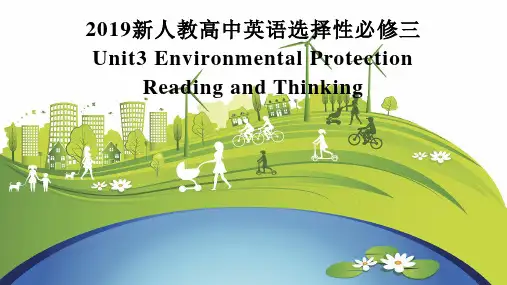
*Individuals: 1. R__e_d_u_c_e_o_u_r__“_c_a_rb__o_n_f_o_o_tp__ri_n_t_”_b_y__r_e_st_r_i_ct_i_n_g_t_h_e __a_m__o_u_n_t_o_f__ca_r_b_o_n__d_i_o_x_id_e__o_u_r_l_if_e_s_ty_l_e_s_p_r_o_d_u_c_e_.
CLIMATE CHANGE REQUIRES THE WORLD’S ATTENTION
An environmental magazine
What is the graph about? What information can you get from it?
Guess what might happen to the polar bear in the photo? How did it die? skin and bones
Discuss the front page
global warming
Where do you think this photo was taken? What is happening in the photo? What does this photo make you think of?
Prediction—— What will be talked about in the passage?
__c_o_u_l_d_n_’_t_h_u_n_t_s_e_a_l_s_a_s_b_e_f_o_r_e_. _It__h_a_d_t_o_t_r_a_v_e_l_g_r_e_a_te_r__
必修一Unit3Reading and Thinking 公开课课件

While-reading 2.Listen to the passage carefully to get the key information.
Read the body of the passage and match the main idea with
each paragraph.
Para.1
Legends in my heart
01 What’s your favorite athletes? What can you learn from him/ her
02 ?
Summary
Learn from failures Energetic
Go for your dreams
Masters
and examples.
impressive skills; mental health; in life
determined; strong-willed; patriotic; devoted; not lose heart......
professional; determined; never give up; inspiring; helpful......
athletes
2. Analyze the structure of the text.
lead paragraph
Title
Where is the text probably taken from?
A. A tour brochure
√B. A story book
C. A sports magazine D. A science report
Faced with _b_ig_c_h_al_le_n_g_es__, Lang Ping led her
【教案】公开课教学设计必修三Unit3 reading for writing
课题:必修三Unit3 Reading for Writing一、教材内容分析本课语篇的主题语境是人与社会,主题群是人与社会中的文化习俗,主题语境内容通过介绍唐人街继续聚焦中国文化。
该文介绍了旧金山中唐人街最具代表性的内容,包括该地的居民构成、语言、建筑、商品、饮食风味和人们的活动。
语篇共有6段,第一自然段概述旧金山唐人街的特点,即它在美国最大、历史最悠久,颇受游客欢迎。
主体部分的四个段落从不同角度带领读者了解旧金山的唐人街。
第二段介绍了唐人街的起源、居民的构成和当地的主要语言。
第三段继续讲述唐人街的历史,包括1906年的大火和城市的重建,并主要介绍了几个有特色的景点。
第四段介绍了唐人街的店铺类型及特色产品,包括中草药、茶叶等。
第五段介绍唐人街的饮食特点。
第六段重申唐人街存在的价值,即它是美国多元文化的重要组成部分,唐人街也是海外华人的精神家园和传播中国文化的重要窗口,外国人在唐人街能近距离体验中国文化。
该语篇是一篇典型的带有旅游宣传性质的介绍性语篇,从文章标题“Welcome to Chinatown!”到“总一分一总”的写作结构,客观而全面地描述了旧金山唐人街的历史和现状,并呼吁还没有机会去中国的人前往唐人街,亲身体验中国传统文化。
二、学情分析本课的授课对象是尤溪县第五中学高一年级学生,学生人数为26人,学生与本课相关的核心素养情况如下: 1.语言能力: 大部分学生能读懂旧金山唐人街的旅游宣传简介,基本掌握这类文章的文本结构、内容要点及语言风格,但对于内容要点相应的表达与主题结合还不太熟悉:2.学习能力: 学生已有一定的梳理文本结构,提炼关键信息的能力,但对于突出要点的同时查找细节支撑信息还不是特别熟练,在阅读写作策略及习惯上需要指导:3.文化意识: 学生对中国文化的影响及其多样性有一定的理解,但对中国文化于美国多元文化中的地位及两者的联系缺乏了解,需进一步拓宽国际视野,提升文化理解和鉴别能力;4.思维品质: 学生具备基本的语篇结构梳理能力,但根据文本进行分析、提取信息并结合写作表达关键信息的能力有所欠缺。
人教PEP版五年级英语上册《Unit3_B_Read_and_write公开课教案》
教材内容:Unit3 Part B Read and write 教材:人教PEP小学英语五年级上册P29单元主题:What would you like?课型:读写课授课教师:广东省东莞市虎门镇太平小学邹燕一、教学设计整体思路本节课以“Robin今天烹饪美食”为授课主线,教师利用这有趣的主线,把、“Homework”这几个授课环节有机地、“Post-reading”“Pre-reading”、“While-reading”融合成一个整体。
本课中各项活动的开展,都力求提供给学生以真实的情境,从而更能贴近学生生活,有真实的语言意义。
这当中有师生、生生间的互动,有利于语言的真实交际运用。
教学活动的开展采用了“任务驱动”式“合作学习”的方式,整个学习以学生能在实际生活中灵活运用为动力,学生在学中用,用中学,通过感知、交流、合作等方式,完成学习任务。
课堂上,采取教师自编歌曲、图片、多媒体等多种教学手段,给学生营造轻松、愉快的课堂气氛,为学生创设真实生动的语言场景,使课堂变得有声有色,学生学得有滋有味。
通过师生对话、课文跟读、Team work、个性化写作等各种活动,鼓励学生大胆参与、深入思考、积极发言,从而提高学生综合运用语言的能力。
二、教学目标1. 语言知识和语言技能目标:(1) 能够按照正确的意群和语音、语调朗读吴一凡和爷爷留给Robin的便条。
(2) 能够理解便条内容并完成关于吴一凡和爷爷各自喜好的表格及选图活动。
(3) 能够用本单元所学的核心单词、句型描写家人喜欢吃的食物。
2. 学习策略目标:通过头脑风暴、小组合作等方式激活思维,在阅读过程中培养学生scanning、skimming、skipping等阅读策略。
3. 情感态度目标:通过Robin的温馨提醒,使学生更加明确“Eat up your food on the plate(吃光你盘中的饭菜)”的重要性,通过提倡“光盘行动”来帮助学生树立正确的价值观,坚持绿色生活。
Welcome Unit Reading and Thinking公开课教案
2019新人教高中英语必修一Welcome Unit Reading and Thinking公开课教案Teaching aims:1.Describe the first day experiences and feelings following the time order.2.Find out the key information in the passage through reading strategies.3.Identify the structures and language features of the text.4.Retell the passage and talk about their own first day experiences using their own word bank or key sentences.Teaching key points:1.Guide students to better understand the first day experiences and feelings of Han Jing.2.Help students identify the structures and language features of the text.3.Enable students to use some key words to describe their feelings on the first day of high school.Teaching difficult points:1.Guide students to describe the first day experiences and feelings following the time order.2.Help students explore the language features and build their word bank of the text.Teaching procedures:StepⅠLead-inTalk about the teacher’s first day at school and encourage the students to describe their first day feelings.Teacher: I felt anxious on my first day at school.“Anxious”means “worried”. Did you feel annoyed? I mean if there was something that made you angry.Was there anything that made you feel awkward?“Awkward”means “not relaxed or comfortable”.What made you feel happy/excited/ anxious/annoyed/ frightened/ awkward?StepⅠPredictionLook at the pictures and the title on Page 4.Can you predict what Han Jing will talk about and then guess where the text is taken from?Suggested answer:Han Jing will talk about her first day at school.The text is taken from a social networking website.StepⅠ Skimming for the main structuresRead the passage quickly and find out which order Han Jing follows to talk about her first day.Suggested answer:Time order.7:00 a.m.→12:30 p.m.→5:32 p.m.→10:29 p.m.StepⅠScanning for detailActivity 1Read the four parts of the text,and answer the following questions.1.Why did Han Jing feel anxious before school?2.How was her first maths class?3.What happened in the chemistry class?4.What did Han Jing learn from her first day at senior high school?Suggested answers:1.Because she was not an outgoing girl and she was not sure about the future.2.The class was difficult,but the teacher was kind,friendly and helpful.3.The guy next to Han Jing tried to talk to her the whole time.4.She learnt that she would make new friends there and there was a lot to explore at senior high school.Activity 2Find the key words and phrases for each paragraph and fill in the table.(红色为学生填写部分)Time What was Han Jing s text about?7:00 a.m.senior high school,a little anxious12:30 p.m.friendly,funny story,classmates,helpful5:32 b,lesson,great,the guy next to me,the whole time10:29 p.m.worried,a lot to explore,more confident,a great dayActivity 3Can you draw a flow chart to show Han Jing’s feelings with the emoji pictures?Suggested answer:StepⅠReading for language featuresRead the text once again and find out the sentences where informal expressions and exclamations.Suggested answer:1.So this is it—senior high school at last!(Informal非正式表达)2.What a day!(Exclamation感叹句)StepⅠ DiscussionWork in pairs and discuss the question.What are Han Jing’s first impressions?(红色为学生填写部分)teachers:friendly,helpfulclass:funny,greatclassmates:friendly,helpfulhigh school:exciting,new to exploreActivity 1Learn to use the words and phrases to describe the first impressions and feelings.Activity 2Use the words above to describe your first day experiences.Suggested answer:Early in the morning,when the morning song rang,I began to get up and prepare for school.I felt a little nervous and anxious.After I had breakfast,I headed to my school.Most of the students are friendly and helpful.I was impressed by my English teacher,and she was a little excited too.In the afternoon,we had a Chinese class.I was surprised when our Chinese teacher came into the classroom since I found we were living in the same block.。
【公开课】Unit+3Reading+and+Thinking课件人教版(2019)选择性必修第二册
A 1000-person-long-table banquet in the Miao village of One Thousand Households in Leishan,Guizhou.
offer them good friendship.
Family is important to the people there.
Northwest China Xinjiang and Inner Mongolian cuisine
South China
Guangdong cuisine
boiled or roasted meat
text.
1
The
flavour
Cause preferences of
UAnmdeerrisctaannsd
ocfatuesne
and
effect
differ from those of thSeomChetiinmeesset.wo ideas are related to each other
Read para 2-7to complete the table below.
Place
Kind of Chinese food Typical dish
People or culture
America
Beijing Shandong
Chinese food changed to suit American tastes General Tso's chicken
Chinese food in Guang Dong