
(完整版)英语语言学练习题(含答案))
I . Decide whether each of the following statements is True or False:
1. Lin guistics is gen erally defi ned as the scie ntific study of lan guage.
2. Lin guistics studies particular lan guage, not lan guages in gen eral.
3. A scie ntific study of lan guage is based on what the lin guist thi nks.
4. In the study of lin guistics, hypotheses formed should be based on lan
guage facts and checked aga inst the observed facts.
5. Gen eral li nguistics is gen erally the study of lan guage as a whole.
6. Gen eral li nguistics, which relates itself to the research of other are as,
studies the basic con cepts, theories, descripti ons, models and me thods
applicable in any lin guistic study.
7. Pho netics is differe nt from pho no logy in that the latter studies the comb
in ati ons of the sounds to con vey meaning in com muni cati on.
8. Morphology studies how words can be formed to produce meaning ful
senten ces.
9. The study of the ways in which morphemes can be comb ined to fo rm
words is called morphology.
10. Syn tax is differe nt from morphology in that the former not only st udies
the morphemes, but also the comb in ati on of morphemes into words and
words into senten ces.
11. The study of meaning in lan guage is known as sema ntics.
12. Both sema ntics and pragmatics study meanin gs.
13. Pragmatics is differe nt from sema ntics in that pragmatics studies meaning not in isolati on, but in con text.
14. Social cha nges can ofte n bring about lan guage cha nges.
15. Sociolinguistics is the study of language in relation to society.
16. Modern linguistics is mostly prescriptive, but sometimes descripti
ve.
17. Moder n lin guistics is differe nt from traditi onal grammar.
18. A diachro nic study of lan guage is the descripti on of lan guage at s ome
point in time.
19. Moder n lin guistics regards the writte n lan guage as primary, not t
he writte n lan guage.
20. The disti ncti on betwee n compete nee and performa nee was propo
sed by F. de Saussure.
n . Fill in each of the following blanks with one word which begins wi
th the letter give n:
21. Chomsky defi nes “ compete nee as the ideal user ' ___________
of the rules of his lan guage.
22. Lan gue refers to the a ________ lin guistic system shared by all
the members of a speech commu nity while the parole is the con cret
e use of the conven ti ons and applicati on of the rules.
23. D ________ is one of the desig n features of huma n lan guage wh
ich refers to the phe nomenon that lan guage con sists of two levels: a lower level of mea nin gless in dividual sounds and a higher level of me anin
gful un its.
24. Lan guage is a system of a ________ vocal symbols used for hu
man com muni cati on.
25. The discipli ne that studies the rules gover ning the formati on of w
ords into permissible senten ces in lan guages is called s ______ .
26. Huma n capacity for lan guage has a g ____ basis, but the deta
ils of lan guage have to be taught and lear ned.
27. P ______ refers to the realizati on of lan gue in actual use.
28. Findings in lin guistic studies can ofte n be applied to the settleme
nt of some practical problems. The study of such applicati ons is gene rally
known as a __________ lin guistics.
29. Lan guage is p _________ in that it makes possible the con struc
tion and in terpretati on of new sig nals by its users .In other words, th ey can
produce and un dersta nd an infin itely large nu mber of sentenc es which
they have n ever heard before.
30. Lin guistics is gen erally defi ned as the s _____ study of lan guag
e.
ID . There are four choices following each statement. Mark the choice that
can best complete the stateme nt:
31. If a lin guistic study describes and an alyzes the lan guage people a
ctually use, it is said to be _______ . A. prescriptive
B. an alytic
C. descriptive
D. li nguistic
32. Which of the follow ing is not a desig n feature of huma n lan guage ?
A. Arbitrari ness
B. Displaceme nt
C. Duality
D. Meaningfuln ess
33. Moder n lin guistics regards the writte n lan guage as ____ .
A. primary
B. correct
C. sec on dary
D. stable
34. In modern linguistics, speech is regarded as more basic than writi
ng, because _______ .
A. in linguistic evolution, speech is prior to writing
B. speech plays a greater role tha n writ ing in terms of the amount of
in formati on con veyed
C. speech is always the way in which every n ative speaker acquires h is
(完整版)初中英语动词专项练习(含答案)100题
(完整版)初中英语动词专项练习(含答案)100题
一、选择题
1.They don’t live here any longer. They ________ to Chengdu last month.
A.move B.moved C.moves D.are moving
【答案】B
【解析】
【详解】
句意:他们不再住在这里了。他们上个月搬到了成都。
考查一般过去时。move“搬走”,过去式是moved,根据“last month”可知,时态是一般过去时,空缺处用move的过去式moved,故选B。
2.—Why are you in such a hurry, John?
—There ________ a basketball match between Class One and our class in ten
minutes.
A.is going to be B.is going to have C.will have D.will hold
【答案】A
【解析】
【详解】
句意:——John,你为什么这么着急?——十分钟后一班和我们班将有一场篮球赛。
考查there be句型的一般将来时。have有;hold举办;there be有,根据空前的“There”和空后的“in ten minutes”可知,应该用there be句型的一般将来时,构成:there will be/there is going to be,故选A。
3.There _________ an English speech contest.
A.is going to have B.is going to be C.are going to have D.will have
【答案】B
【解析】
【详解】
句意:将有一场英语演讲比赛。
考查一般将来时。“there be+名词”句型的一般将来时用“there will be”或“there
(完整版)《劝学》练习题(含答案)
二十三 劝学
复习指导:
1. 荀子,名____,战国末期伟大的思想家、教育家、文学家。他是先秦_____的最后一位代表人物。
2. 《劝学》是一篇______散文,是《荀子》的开篇之作。“劝”的意思是________。课文的中心论点是____________。
同步练习:
一、基础知识
1.下边加点的字的字形、注音全对的一组是( ) A..(róu)以为轮 金就砺.(lì)则利 智.(zhì)明而行无过矣
B.虽有槁暴.(bào) 须臾.(yú) 驽.(nú)马
C.善假.(jià)于物 跬.(kuǐ)步 金石可镂.(1òu)
D.跂.(qì)而望 骐骥.(jì) 爪.(zhǎo)牙
2.下边句子中没有通假字的一项是( )
A.则知明而行无过矣。 B.君子生非异也。
C.君子博学而日参省乎已。 D.虽有槁暴,不复挺者。
3.为下列各句加点词选出一个恰当的义项。
(1)假.舆马者,非利足也,而致千里( )
A.假如 B.假装 C.借助,利用 D.假的
(2)积土成山,风雨兴焉.。( )
A.在那里 B.什么 C.助词 D.代词“之”
(3)虽有槁暴.,不复挺者,輮使之然也( )
A欺凌,损害 B.晒 C.又猛又急的 D.暴躁
(4)驽马十驾.,功.在不舍。( )
A.量词;功劳,功勋 B.驾驶;工作,事情
C.马拉车一天所走的路程;成功,功效 D.量词;功能
(5)假舟揖者,非能水也,而绝.江河。( )
A.断,断绝 B.超越,超过 C.拒绝 D.横渡,横穿
4.“而”字主要有下列用法,后边句中的“而”属哪种用法,请把相应的用法的序号填在句后的括号里。
(完整版)初中英语名词性从句练习题(含答案)
1
名词性从句
01. I want to know is it is worth doing.
A. What; that B. What; whether
C. That; why D. That; what
02. visits the Great Wall will be struck by it.
A. Anyone B. Each
C. Whoever D. Everybody
03. the workers insisted on was that they more pay.
A. That; must be given B. What; should give
C. Whether; would be given D. What; be given
04. She asked .
A. what I was doing when she rang me up B. What was I doing when she rang me up
C. When she rang me up what was I doing D. When did she ring me up what I was doing
05. Writing stories and articles I enjoy most.
A. is that B. are that
C. is what D. have been what
06. He asked the tailor .
A. how long would the coat be ready B. how soon would the coat be ready
C. how long the coat would be ready D. how soon the coat would be ready
07. The policeman came up to see .
(完整版)高中英语代词练习题(含答案)
1. This bike is neither ______ nor_____
A. yours, my B. his, her's C. her, mine D. his, hers
2. Let _____ promise not to quarrel about such an unimportant matter any
more.
A. you and I B. I and you C. me and you D. you and me'
3. --Since there is _____ time, we have to take a taxi to the theatre.
--That's a good idea.
A. no B. none C. a little D. little
4. The engine in your car works far better than _______.
A. my car B. mine car
C. that in mine D. that in my car's
5.--I feel a bit hungry.
--Why don’t you have _______ bread?
A. any B. little C. some D. a
6. I want very much to buy a colour TV set, but I can't afford _______.
A. one B. it C. that D. this
英语语言学第章课后练习题答案
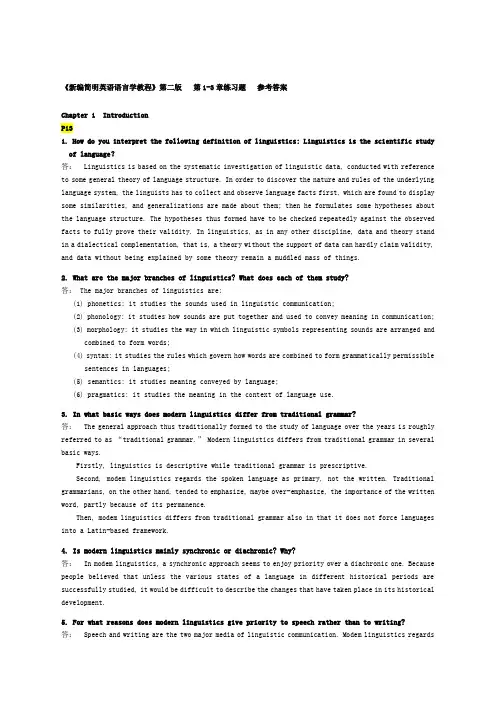
《新编简明英语语言学教程》第二版 第1-3章练习题 参考答案
Chapter 1 Introduction
P13
1. How do you interpret the following definition of linguistics: Linguistics is the scientific study
of language?
答: Linguistics is based on the systematic investigation of linguistic data, conducted with reference
to some general theory of language structure. In order to discover the nature and rules of the underlying
language system, the linguists has to collect and observe language facts first, which are found to display
some similarities, and generalizations are made about them; then he formulates some hypotheses about
the language structure. The hypotheses thus formed have to be checked repeatedly against the observed
facts to fully prove their validity. In linguistics, as in any other discipline, data and theory stand
in a dialectical complementation, that is, a theory without the support of data can hardly claim validity,
(完整版)初中英语名词性从句练习题(含答案) 2

名词性从句
01. ____ I want to know is ____ it is worth doing.
A. What; thatB. What; whether
C. That; whyD. That; what
02. ____ visits the Great Wall will be struck by it.
A. AnyoneB. Each
C. WhoeverD. Everybody
03.____ the workers insisted on was that they ____ more pay. A. That; must be givenB. What; should give
C. Whether; would be givenD. What; be given
04. She asked ____. A. what I was doing when she rang me upB. What was I doing when she rang me up
C. When she rang me up what was I doingD. When did she ring me up what I was doing
05. Writing stories and articles ____ I enjoy most.
A. is thatB. are that
C. is whatD. have been what
06. He asked the tailor ____.
A. how long would the coat be readyB. how soon would the coat be ready C. how long the coat would be readyD. how soon the coat would be ready
07. The policeman came up to see ____.
【英语】连词练习题(含答案)
【英语】连词练习题(含答案)
一、初中英语连词
1. Although she is under great stress,she always wears a smile on her face.
A. and B. or C. but D. /
【答案】D
2. Tom won't play computer games he finishes his homework.
A. if B. so that C. unless D. although
【答案】C
3. — I'm wondering she is willing to do it.
—Don't worry. I don't doubt she can do it well.
A. if; that B. that; if C. if; if D. that; that
【答案】A
【解析】 【分析】句意: 一一我想知道她是否愿意做这件事。 一一别担心。我很相信她能
做好这件事。根据 wonder可知,宾语从句的连词是 if,是否,doubt的否定形式引导的宾 语从句连词是that,其后不缺少成分且语意完整 ,故选A。
【点评】考查连词,注意宾语从句的用法。
4. —will the meeting last?
—we reach an agreement.
A. How long; Not until B. When; Not until C. How long; Until D. When; Till
【答案】C
【解析】【分析】句意:一一会议会持续多久? 一一直到我们达成协议。last是持续动词,
提问持续动词所持续的时间用 how long,故排除B和D选项,until表示动作的持续 ,故
选C。
【点评】考查连词,注意 how long和until的用法。
5. Could you tell me the singer will come to our school or not?
语言学练习题-(含答案)
-----WORD格式--可编辑--专业资料-----
--完整版学习资料分享---- 判断题
1. Interlanguage is neither the native language nor the second language.
(T)
2. Krashen assumed that there were two independent means or routes of
second language learning: acquisition and learning. (T)
3. There are two interacting factors in determining language transfer in
second language learning. (F)
4. Three important characteristics of interlanguage: systemacticity ,
permeability and fossilization. (T)
5. Intrinsic motivation:learners learn a second language for external purposes.
(F)
6. Neurolinguistics is the study of two related areas: language disorders and
the relationship between the brain and language. (T)
7. The brain is divided two sections: the higher section called the brain stem
and the lower section called the cerebrum. (F)
(完整版)初中英语动词专项练习(含答案)100题 2
(完整版)初中英语动词专项练习(含答案)100题
一、选择题
1.—Where have you been? The film ________ for half an hour.
—Oh, sorry. I’m late because of the heavy rain.
A.started B.has been on C.has started D.has begun
【答案】B
【解析】
【详解】
句意:——你去哪儿了?电影已经上映半小时了。 ——哦,对不起。因为大雨,我迟到了。
考查现在完成时。根据“for half an hour.”可知,此题需用现在完成时,排除A;而动词start与begin都是短暂性动词,不与for引导的时间状语连用。故选B。
2.—Doing _______ is good for your health. How about doing morning _______
every day?
—Sure. I will _______ more from now on.
A.exercise; exercises; exercise B.exercises; exercises; exercise
C.exercise; exercise; exercise D.exercise; exercises; exercises
【答案】A
【解析】
【分析】
【详解】
句意:——做运动对你的健康有好处。每天做早操怎么样?——当然。从现在起我要多锻炼。
考查一词多用。exercise运动,锻炼,不可数名词;exercise练习,训练活动,可数名词;exercise锻炼,动词。根据句意可知第一空应表达“做运动”,此时exercise表示“运动”为不可数名词,用“doing exercise”来表示,可排除B。第二空表达“早操”,exercise表示一套动作为可数名词,故用“morning exercises”,可排除C。最后一空用的是“will do”表示“将做某事”故用动词原形exercise。故选A。
(完整版)初中英语动词专项练习(含答案)100题 3
(完整版)初中英语动词专项练习(含答案)100题
一、选择题
1.If it rains tomorrow, we ________ at home.
A.stayed B.stay C.were staying D.will stay
【答案】D
【解析】
【详解】
句意:如果明天下雨,我们就呆在家里。
考查动词时态。if引导的条件状语从句,遵循主句用一般将来时,从句用一般现在时态,一般将来时的结构是will+动词原形,短语stay at home“呆在家”,故选D。
2.Kevin will give less homework to his students if he ________ a teacher.
A.will become B.becomes C.become D.became
【答案】B
【解析】
【详解】
句意:如果凯文成为一名教师,他将给学生们布置更少的作业。
考查动词的时态。句中“if”意为“如果”,引导条件状语从句,句中应遵循“主将从现”,故if引导的从句需要用一般现在时,主语为he,注意主谓一致,故选B。
3.You can borrow this film—surely you ________ watching it.
A.enjoy B.enjoyed C.will enjoy D.have enjoyed
【答案】C
【解析】
【详解】
句意:你可以借这部电影——当然你会喜欢看的。
考查一般将来时。分析“You can borrow this film-surely you…watching it.”可知,此处动作还未发生,用一般将来时,故选C。
4.Ms Fang ________ the piano in our classroom right now.
A.play B.plays C.are playing D.is playing
【答案】D 【解析】